← Today in Focus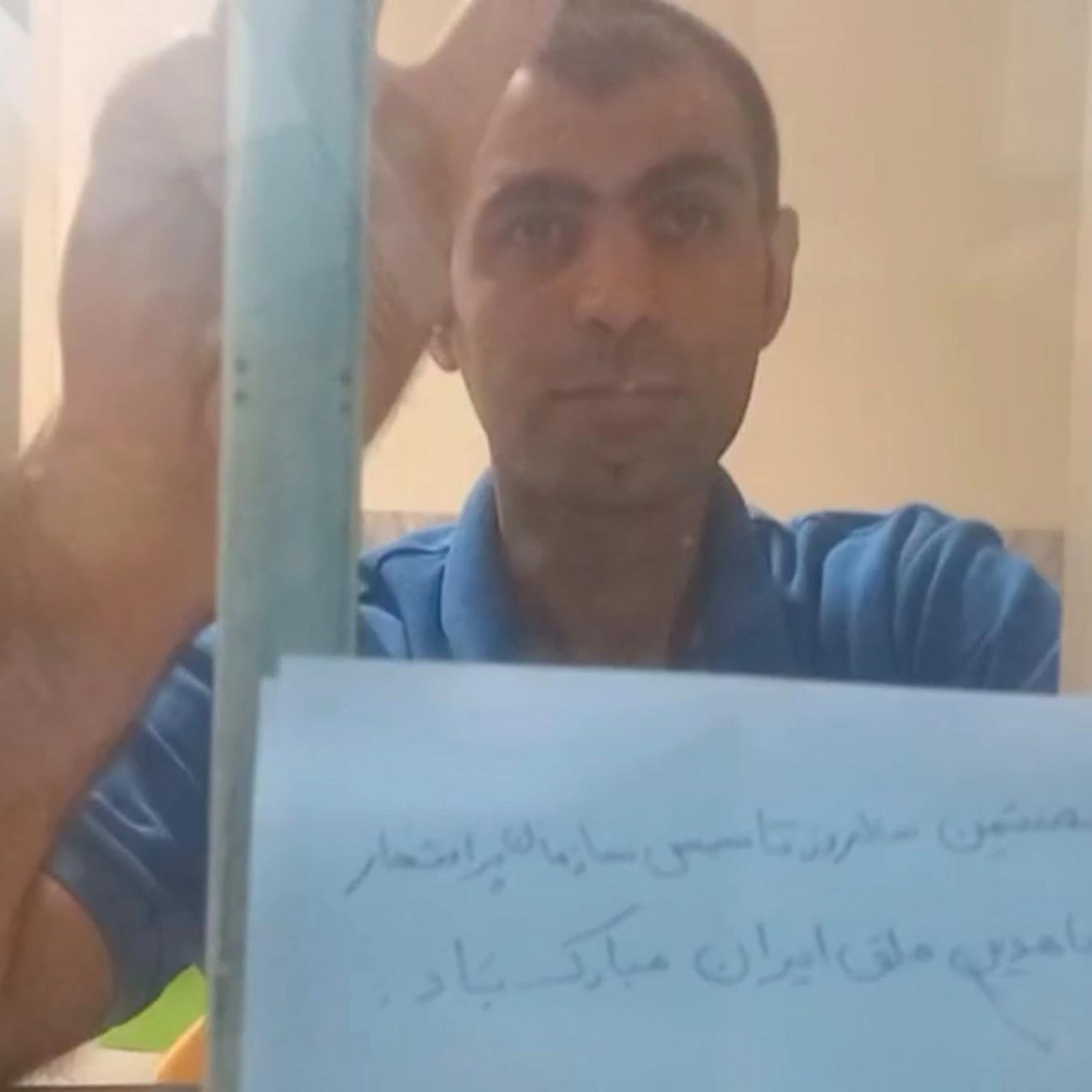
Today in Focus
Iran’s wartime executions
00:24:24
Over the last six weeks, the Iranian regime has carried out a spate of executions of political prisoners. The Guardian journalist Daniel Boffey reports
Loading summary
Transcript40 lines
- [00:00]
A
This is the Guardian. Today. Voices from Iran's death row. Just before we start, this episode does contain graphic descriptions of executions. This is the Voice of a 23 year old Kurdish political prisoner in Iran accused of spying for Israel. I am Naser Bakrzadeh, he says, and you're hearing my voice from Umer Central Prison. In a message recorded down a prison phone line, he says he was arrested three years ago. From that day onwards, as he puts it, my parents have been dying every day and the pain of separation and longing has been crushing them. Nasser's message is a desperate one because he knows time is running out. He says it might be the last time anyone hears his voice because his death sentence has just been confirmed. And the thing that seems to weigh on him most, how can he tell his fiance what's about to happen to him? Under the COVID of war, Iran's regime is executing political prisoners at an unprecedented rate. In the last six weeks, 18 political prisoners and protesters have been killed by the state. In his message, Nasser begs for help, but he also issues a warning. Today is my turn, but tomorrow it will be someone else's. As the world agonises about oil prices and stalled negotiations inside Iran, the regime is sending a message to its people. We are still in control. From the Guardian, I'm Annie Kelly. Today in focus, Iran's wartime executions. Daniel Boffi. You're the Guardian's chief reporter and you have been speaking to the families of political prisoners who have been executed in the past month. What has that been like? And what did they tell you?
- [02:58]
B
Yeah, no, it's been pretty upsetting really, because you talk to them about their brothers or sons and you hear all the gory details and then you start to worry actually for, for them because they're slightly terrified to talk to you about it. And they say, oh, the last time I, you know, one on one said the last time I spoke to someone, I had the security service come around to my mother's house, that if I spoke to the west again, that there'll be severe repercussions. You know, it's extremely high stakes. But there are those who say the safest thing for my family is for them to have a profile. We really do believe in a democratic, secular Iran. We do believe this regime can and will be taken down. And the only way that will happen is if people do talk up. And despite all the risks and the consequences that may follow.
- [03:50]
A
Yeah, I was really taken by some of the stories of the men that have been executed. I wonder if you could just Tell us a few, like, who were a few of the people that were executed in the last month.
- [04:04]
B
So there's been 18 people now, political prisoners and protesters who have been executed. Six of them were part of a group that were sentenced to death in October 2024. They were sentenced to death by the hanging judge of Iran, a man who in 2014 hanged somebody because they insisted that the story of Jonah and the whale was an allegory. These are generally young men in the late 20s and early 30s. Baba Khalip was the main character, I suppose, in my story about the prisoners who' executed. And he was 34 years old, from the northwest of Iran. He was a law graduate. He was clearly, evidently a very bright young man. He wrote a letter in which he explained that he kind of got inspired to join up with the People's Mahaj Deen organization, which is kind of an opposition armed group, rebellious group. He decided to get involved with that because he'd watched a TV channel that's associated with the group. And he got arrested first in 2018, and he got released and he got arrested again on kind of very broad char membership of this organization, collusion in seeking to damage national security. Kind of broad, vague. You couldn't really pin anything particularly on him. And then October 24, he and six others who he knew he was a keen mountaineer, and they viewed them as sort of into mountaineering and would do that together. They got sentenced to death. That doesn't mean immediately get killed. And it was a long process, but in the last month, all judicial processes, all the usual appeals, and all the rest of it to the Supreme Court, that was all expedited very, very quickly. And so he went to his death. So Babak, he produced some videos, one which was taken by somebody from outside his cell, of him in his cell. Another one he did himself talking to colleagues and friends outside the prison. He was telling them a little bit about those who had gone to the execution already, but telling them also that he intimidated. It's quite inspiring stuff. He really believed that this would end, that these executions, he said, were clearly a sign of weakness, not strength. So there's those who are in the pmoi, and then you have others who are just caught up in the January protest. There's a young man, 18 years old, 18, and there's a photograph published. And he's just such a baby face and kind of. He was accused of throwing stones, of climbing of a wall into a secure compound in Tehran, a military installation. And the idea was that he was trying to Seize guns. There's any suggestion he actually did get hold of guns or anything like that, but there was a forced confession, clearly a false confession. I mean the words were so obviously forced and yet he was hanged. The process took. He was arrested in January, murdered in. I mean I think it is murder, murdered in March. So no time to appeal, no time, no time to give defence. Amnesty International said the whole case was a nonsense, there was nothing there. But yeah, the killings have continued just in recent days. There was a 24 year old computer technician, Amirali Mijatarafari, and it was a photograph produced by the regime. It was actually a still of his court appearance, his last court appearance and it was put on the regime television. And you can see there's just confusion in his eyes about what's happening. Again, the charges around him are just so vague, you couldn't quite pinpoint what it was that he is accused of doing. But espionage is thrown around. Oh, he had links to the Zionist regime and the US government, which all seems rather unlikely. And it seems they were hanged quite quietly in a prison courtyard away from the glare of any sort of publicity.
- [08:04]
A
And I mean there have been also kind of extraordinary moments of bravery that we've seen through videos and clips of the men who were killed last month. There's a video that reportedly shows some of those men who died singing protest songs.
- [08:22]
B
Yeah, well a number of those men, I had spoken to people who knew them very well or related to them. That video was of them in the courtyard of the prison where they were ultimately going to be killed. So it's a, it's a rebel song and the words are now rise up like thunder Let your arms be shown. And it was very moving. There were no tears. It was under a blue sky in the prison yard where they would within now as B and.
- [09:13]
A
Dan. This is awful, isn't it? Just kind of drilling down into, you know, the stories behind these figures.
- [09:19]
B
Yeah, and the violence of it. They're dragged from their cells, they're peppered around in different prisons, but they all die in Gezel Hisar prison, which is a kind of a notorious place which has got 20,000 prisoners but you know, can actually only really safely accommodate a fraction of that. And they're taken there and they, without any notice, their families aren't notified, no one's notified. And it's a death at dawn. It's extraordinary that this happens. But some are sentenced to double, double hanging and that is where you're hanged to the point of which you about to die. Then they Release and then they hang you again. This is the sort of regime we're talking about.
- [10:01]
A
Were the families told that they were going to die beforehand?
- [10:06]
B
No, the ones I spoke to, the first they knew about it. Was it being announced? The executions had been announced on state television, and the bodies of those hanged are not returned to the families. I know of a couple of the fathers who have gone to Tehran to try and get the remains of their sons back and have been. No, that's not happening because they don't want. They don't want any funeral. They want to disrespect those they've killed and they don't want any fuss. Avoiding fuss, avoiding publicity is kind of. It's a. It's a big part of this regime's modus operandi.
- [10:49]
A
For some Iranians, the news of what's happening inside the country's prisons has hit particularly hard. Rezi Unesi has spent more or less his whole life with family members inside.
- [11:01]
C
Yeah. My father was political prisoner during Shah time, before the revolution. He was released when the revolution happened, and then almost three years later, he was arrested under Korean regime. He was arrested very shortly after I was born. So I didn't have him in my life for almost nine years. But then I had chance to, time to time, go to prison, to Ebwin prison with my grandmother to meet him.
- [11:34]
A
He grew up in Tehran with his parents and siblings, including his much younger brother, Ali.
- [11:39]
C
He was winner of international Olympiad competition, which probably, you know, is one of the most prestigious competition. When it's when kids finish high school, they have the chance to go through this competition. So he got the gold medal in the country, and then he won the gold medal in international competition.
- [12:03]
A
And those kids, as Reza tells me, when he grew up, he decided to leave and he went on to become a chemistry professor in Sweden. But his brother Ali and his dad, Yousef, they stayed.
- [12:15]
C
I would count them among those many, many brave people who stand against the dictatorship in Iran and they choose to live in Iran and to fight back the regime.
- [12:30]
A
Reza, can you tell me about how your father and your brother were arrested and imprisoned by the regime?
- [12:37]
C
My brother Ali Yunasi and his friend Amir Hussein Moradi, they were arrested six years and one month ago. He was 20 years old when he was arrested. They were taken to home. And then my parents were shocked to see he was beaten so badly from the street to home. He had blood everywhere. And then my parents called me. It was a big shock. I mean, even for a person like me who has been always involved in Political activities. And I have experience of my father who were in prison before. And I have always followed the situation and the news in Iran. But when it's your little brother, then it's like a big shock. They charged him with a few different accusations. These are common terms that Iranian regime uses, like spreading propaganda against the system, acting against national security. And he was charged based on those. As soon as they were arrested on the first day, they told my brother, now we're going to arrest your mom also. Or they were saying that now we're going to send some people to Sweden to kill your brother. So they were in solitary confinement for exactly 59 days. And these are small rooms that is like almost 3 square meter in size, with no window at all, lights on all the time to force them to confess to what they want. The first 59 days, we had absolutely no contact. We knew nothing where he is, what he's facing. Then after several months, the lawyers had possibility to talk with my brother and his friends. He was still in a small room, but with other prisoners. At least he wasn't in solitary confinement anymore. You have limited access to phone, so he could call my mom once or twice per week. And then he had limited time to go out from the room and walk around a little bit.
- [14:32]
A
And then your father, he was arrested some years later. Can you tell me about that?
- [14:37]
C
My father was arrested three years and four months ago. He was accused of being part of a network financially supporting family members of victims who have been killed by Iranian regime. The regime was saying that this network is connected to the opposition group Mek Mujaheddin Khalq. So my brother and his friend, they were sentenced to 16 years jail. Then it was reduced to 8 years and 6 months. And then my father is sentenced to 5 years jail.
- [15:10]
A
And what did you think it might mean for your father and your brother when the war began?
- [15:15]
C
What we knew is that this is going to be much more difficult situation for the regime. This is opportunity to do anything that they want. Basically because there is less attention to prisoners in Iran, because now suddenly everyone's attention is to the war. It is very frightening to see that the regime has again escalated the executions. The regime is using death penalties and executions to spread fear in society and also to show that yes, we are powerful, maybe we are hit badly by the US and Israel, but still we are in control. That's the message that they want to send. And then some of these prisoners who have been executed, of course, some of them were cellmate with my brother, must be terrifying.
- [16:09]
A
For him, then.
- [16:10]
C
Yeah, yeah.
- [16:13]
A
And, you know, Iran's prison system, the judiciary often doesn't work, you know, according to its own laws. And your father and brother, they haven't been given the death penalty. But there have been cases, haven't there, where prisoners have had their sentences changed, even change to the death penalty while they're already inside. And are you worried that this is something that might start happening during this period of time inside Iran?
- [16:43]
C
It's a worrying for sure. And of course, we are all worried that anything could happen. Yeah, I must say that. Yeah. Because this has happened before, during 1988 mass executions. And it has happened recently also during the last few months that there were a few cases that people were sentenced to some years of jail and then suddenly things were changed and so on. Of course, it's very concerning. We are talking about a brutal regime that can do anything to keep.
- [17:22]
A
Coming up. Why is the regime embarking on this spate of executions? Dan, we've just talked about a dozen or so executions that have happened over the last month. But we know there are thousands, hundreds of thousands of people inside Iranian prisons and that Iran also executes a lot of people every year. Could you just tell me a bit about that and put it all into context?
- [18:07]
B
Yeah. I mean, last year was a record year, a horrible record. 1600 people, more than 1,600 people were killed, which is a 68% increase on the year before, is second only to China in terms of the number of executions every year. And the people who were being executed weren't political prisoners. They were those who accused of drug offenses, murder, that sort of criminal offenses. And the reason why there weren't that many political prisoners killed is that usually there is a political price to pay. There are questions asked. Regional allies may feel a little uncomfortable. And the Iranian regime is very concerned about the fuss when they kill a political prisoner. This is one month with 18. And that can only be said to be because of the war.
- [18:54]
A
And, you know, we've just talked about it in this interview. We know that this is a brutal regime who has no compunction about killing its own people. Thousands of protesters killed on the streets in the run up to this war. Is this, you know, is this something that the regime has done before, this idea of carrying out political executions under the COVID of war or under. Under the COVID of some kind of international distraction?
- [19:19]
B
Yeah, they do look for moments when the world is looking the other way. The screams for the prisoners is not being heard. No one's really interested because the headlines are Being taken up with the big global strategic, the war. That's what people care about at the moment, oil prices, petrol prices. So, no, they look for these moments to strike. They try for it not to be publicized outside of Iran, but to let people know in Iran that it's going on, that you fall into this and this is what happens. And we don't care. You're 18 year old and you threw a few stones. Well, we don't care that this is what happens to you if you do that.
- [19:57]
A
And obviously, the prospect of any kind of ground invasion by the US or Israel is looking increasingly, you know, very, very unlikely, improbable. So really, this is the moment that the regime has to say, don't step out of line.
- [20:11]
B
Yeah, well, I mean, the human rights groups concerned with Iran say changing regime from the air was never likely. In fact, it was not going to happen. The only way it would happen is if there were ground troops, as you say. But the west has learned their lesson from Iraq. And for all that Donald Trump talks about having destroyed the Navy, destroying this and that, there doesn't seem to be an awful lot of evidence they loosened the grip of the regime on the country at all. So revolution, the proper revolution, the proper regime change, was always going to have to come from the Iranian people. And what they're doing here is ensuring themselves against that by trying to send a message, by being as just brutal as possible.
- [21:02]
C
I think the regime is very, very weak, much weaker than any other time, if you ask me. And that is what scares them also. They know that they cannot control the society. They know that people are extremely unhappy. What everyone is after is a revolution to have a free and democratic country. And all the tools that the regime has used over the last four decades, including religion, including propaganda and so on, those tools are not working anymore for the regime.
- [21:37]
A
You know, it sounds like your family have been involved in political activism and aligned with kind of opposition movements inside Iran for a long time. And, you know, you've been speaking very openly about their situation. So many other family members are understandably, really scared about speaking out, especially to foreign media. Why are you talking to me about this today?
- [22:01]
C
This is the way that the regime works, that they threaten family members a lot, that you are not allowed to talk, otherwise you will make everything difficult. But I would say that it's very opposite. I really encourage everyone to talk about their family members who are suffering in prisons. This is helpful for them, but it is good for the country and for everyone in Iran. So it's not only my brother or father. But for everyone, I think the world should hear what is happening in Iran. So I think this is very important to talk about and perhaps even more important today during the war, because now all the focus is about the war and no one really talks about human rights anymore because everything is about the oil suddenly. And that's when I get a little bit, to be honest, disappointed with European politicians that it's all about the oil. Now, if you're going to make any deal with the Iranian regime, if you're going to negotiate with Iranian regime about enriched uranium, about oil, et cetera, you must include executions in Iran also in the agenda. There must be end to all these executions.
- [23:04]
A
And it is easy to forget, isn't it, amongst this whole war, the people sitting in jail cells across Iran, including your little brother and your father. And if there was something that you would like to say to them, if they were listening to this, what would it be?
- [23:23]
C
I would say I'm very, very proud of them. Hopeful that one day there will be free Iran. So a better life for everyone in Iran, including my brother and father. And then I will have chance to meet them.
- [23:38]
A
Reza, thank you so much for talking to us today.
- [23:41]
C
Thank you. Thank you for having me.
- [23:45]
A
And that's it for today. My thanks to Reza Yanessi and Dan Boffi. And you can read all of the Guardians reporting on Iran@theguardian.com this episode was produced by Ned Carter Miles and Eli Block and presented by me, Annie Kelly. Sound design was by Ross Byrne and the executive producer was Sammy Kent. And we'll be back later on today with the latest. This is the Guardian.