← Today in Focus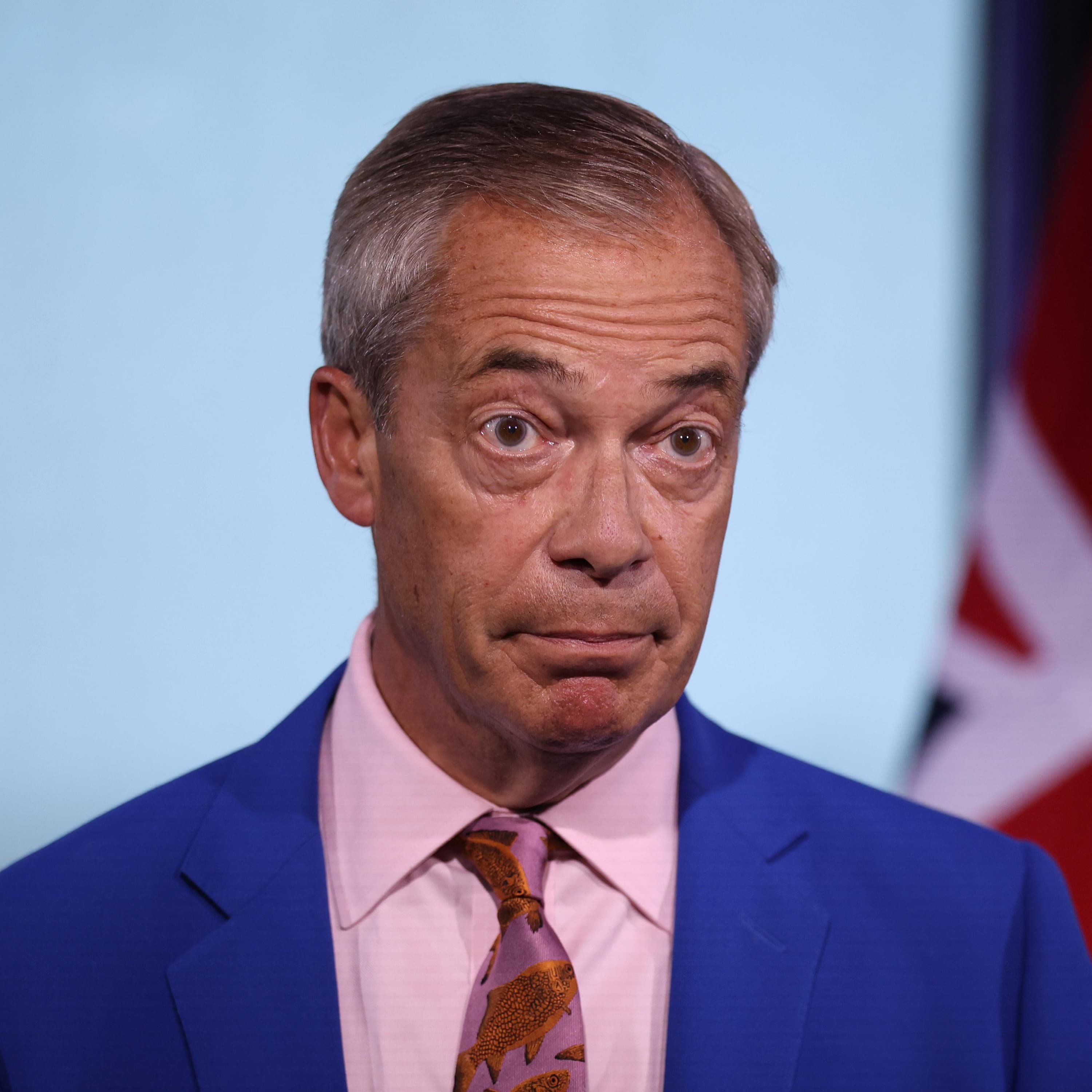
Today in Focus
Nigel Farage resigns to stand in ‘people vs establishment’ byelection – The Latest
00:12:24
Nigel Farage has announced his resignation as the MP for Clacton, triggering a byelection in which he intends to stand as a candidate. The Reform UK leader is under scrutiny over his finances, with two investigations by the parliamentary standards watchdog over undeclared gifts
Loading summary
Transcript26 lines
- [00:00]
Lucy Half
This is the Guardian.
- [00:11]
Stamps.com Advertiser
Shipping, billing, admin, payroll, marketing. You're managing all the things, so why waste time sending important documents the old fashioned way? Mail and ship when you want, how you want. With stamps.com print postage on demand 24, 7 and schedule pickups from your office or home. Save up to 90% with automated rate shopping. That's why over 1 million small businesses trust stamps.com. go to stamps.com and use code podcast to try stamps.com risk free for 60 days.
- [00:46]
Kieran Stacey
Nigel Farage is standing down essentially to say, look, I've got these, these standards inquiries into me. I think they should be put to the voters of Clacton on Sea and not really be decided by Parliament. Here we go.
- [01:00]
Max Rushton
Today I will resign as a Member of Parliament for Clacton on Sea, thereby
- [01:06]
Lucy Half
forcing a by election from the Guardians today. In focus, this is the latest. With me, Lucy Half. So, at midday we had the announcement that Nigel Farage would be holding a previously unannounced press conference at 2pm to announce the future of his public life. Kieran Stacey, our policy editor, that sent the whole of Westminster and beyond into a state of red alert. It took him about 15 minutes to get to the nub of what he wanted to announce, which is that he is standing down as an MP in Clacton on Sea to trigger a by election that he will run in. What is the political logic here?
- [01:49]
Kieran Stacey
Well, what's going on is this is a ruse that has been used by politicians before, successfully and unsuccessfully, I should say. When a politician, an mp, is particularly unhappy about the state of affairs, one thing or another, they will sometimes stand down and trigger a by election to essentially campaign on that one issue alone. The one that springs to mind is David Davis, the Tory mp, standing down and running in protest. He was in opposition at the time, but in protest the government's plans for detention. The government was planning to be able to detain terror suspects for 90 days. David Davis didn't like this, stood in a by election, won the by election and then government policy changed. Now, how much those two things are connected, you can argue about. However, it's also been unsuccessful in the past. Zach Goldsmith stood down and actually ended up losing that seat to the Liberal Democrats, Sarah Olney, and is no longer in Parliament. This is the first time that I have seen of an MP standing down, not on a matter of principle, but essentially to burnish their own agenda and their own public profile. So Nigel Farage is standing down essentially to say, look, I've got these ethics, these standards inquiries into Me, I think they should be put to the voters of Clacton on Sea and not really be decided by Parliament. Here we go.
- [03:10]
Lucy Half
So, on those two investigations, we knew that there was a Standard Commission's look into the 5 million pound gift from Christopher Harborne, the crypto billionaire, as revealed by the Guardian back in April. Farage now said in his press conference that there will be a second look in to gifts and help he received from his close ally, George Cottrell. But what implications does his stepping down as an MP in Clacton have on those procedures?
- [03:38]
Kieran Stacey
Yeah, it's a really good point. Let's just take a step back and think about the reason that Nigel Farage has done this. He is. We actually only found this out today in Nigel Farage's own statement to camera. He is now facing a second Standards Commissioner inquiry into money he has received from George Cottrell. And what essentially happened is in the year Faraj became an mp, he accepted extraordinary amounts of money and help from some very wealthy people, Christopher Harborne and George Cottrell, both of whom were involved in the crypto industry, by the way. He took this money. He took what the services that they were paying for. He then became an MP and was then supposed to declare everything he'd received that had anything to do with politics in the 12 months before becoming an MP. But what he says is these gifts were made to me in a private capacity. They were to do with my personal security and they're nothing to do with my political activities. But essentially what we now know is that there are those two investigations going on. Having a look at Parliament's rulebook on this, it seems that what will happen is during the period of that campaign, those investigations will have to be suspended because Nigel Farage won't technically be an mp. However, the Commissioner can then resume them after he, if he wins that by election and can still carry out the sanctions that the Commissioner was able to in the first place. So here we go. Here's an extraordinary scenario for you. It could be that Nigel Farage now fights a by election in Collective on Sea, wins a by election in Collective on Sea, and then a few weeks later, the Parliament's Standards Commissioner recommends that he be forced to face another one because the findings of those investigations are so extreme, we could end up in a position where Nigel Farage, by the end of the year has had to fight two by elections in his constituency.
- [05:26]
Lucy Half
Goodness me, what a thought to behold. Just as we were hoping for a little bit of calm and stability.
- [05:31]
Kieran Stacey
Oh, no, we're not, we're not hoping for that, Lucy. No, no. This is what Westminster thrives on.
- [05:36]
Lucy Half
Exactly. I mean, what was really striking was the tone of his address, wasn't it? I mean, he said himself at one point, I am angry. And that anger sort of permeated almost every sentence. We spoke to Peter Walker, your colleague in the lobby yesterday about this kind of Trumpian approach to the media that Farage has been increasingly taken on. But he talked about himself as this victim of a media establishment or an establishment more broadly. He hit out at Sky News and the Times. In particular, he hit out at any scrutiny of his personal finances, which he said, you know, it's my money, it's mine to do what I want with. I've done nothing wrong. But, but I think as journalists that is hugely debatable, isn't it? Of course those personal finances deserve scrutiny, but that seems to be a pitch to voters who like the figure of Nigel Farage and perhaps a cynical play to win in Clacton.
- [06:31]
Kieran Stacey
Yes, I think it is both potentially cynical, but I do think it is increasingly what he thinks. Nigel Farage's public appearances, I think have become increasingly self pitying and you certainly saw that on full display in his statement today. He really does think, I think, that he is the victim of some kind of stitch up and that he's being got at by the powers that be. But even his own economic spokesperson, Robert Genrick, says that these are valid questions that he has to answer. So there are people even in his own party who don't quite agree with his line on that. You're right. What it is, I guess is a pitch to voters, particularly in Clacton where he is, he won on with a big majority and where he, he remains, as far as we can tell, quite popular. Just to say I'm the outsider and all these people are out to get it is quite Trumpian and it'll be interesting to see how much that works in this country because so far British politics has not taken quite the Trumpian turn that American politics has. We still have greater confidence in our institutions, greater confidence in our media than American voters tend to. So whether these attacks on everybody and a lot of these outlets that he's attacking would normally see themselves as center right. Whether they actually work or whether they backfire with voters, I think remains to be seen.
- [07:49]
Lucy Half
Yeah, we will certainly find out. The other major thing that he raised was the issue of security, his personal security and that of his family. He spoke of the final straw being a photograph of his daughter's House published in the Times last week. And that was sort of confirmed his decision that he wanted to make, that he has now announced. He spoke of himself as the most physically and verbally attacked politician in modern times. Which I suppose, suppose when you look at that statement in light of the murder of Labour MP Jo Cox In 2016, the murder of Tory MP David Amos, that is quite a volatile thing to say. That won't go down well with much of the public.
- [08:39]
Kieran Stacey
It's an extraordinary claim. I mean, I remember the attack on Stephen Tims as well, the Labour MP who was stabbed in his constituency. MPs have been the subjects of physical attacks, much worse than having a milkshake thrown on them. And I don't want to. I don't mean to belittle Nigel Farage's experience there, but it is simply not the case that he is the most physically attacked politician in modern times. He does talk a lot about his security. You know, he does have quite a few very large men who follow him around wherever he goes. And one of the things that we found out is that George Cottrell and Christopher Harborne seem to have been helping him pay for those. Whether the public looks at statements like that and thinks, well, that doesn't quite wash, or whether they feel sympathy with him is going to be very important in terms of how this is seen in the public. I would also make one interesting comparison here. It could be that Nigel Farage's comments today play relatively well with his own voters in Clacton, that he wins that by election, that he emerges from it in a way politically stronger than he went into it. However, it could be that the rest of the country watches this and thinks that's not quite the happy, positive, optimistic politician that we have become used to seeing over the last few years. So his national poll rating could go down even as his poll rating in Clacton is shored up.
- [10:01]
Lucy Half
Yeah, yeah. Whether this is a man that looks like a Prime Minister in waiting. And I think that that anger that was driving that speech might raise questions in many voters, mind. So, Kieran, just lastly, I mean, I think we thought we had the most blockbuster by election of the year in Makerfield, but we've now got two in Clacton on sea. What is going to be at play in that constituency? Because Labour aren't expected to contest it, but will the Tories be throwing the kitchen sink at it?
- [10:32]
Kieran Stacey
I mean, it's so interesting. There are broadly, I think, three scenarios that could play out here. One is that all the other parties Say this is a completely invalid process. He's trying to basically rig an investigation process in Parliament and they simply sit it out and they say, well, if you want to fight a by election against yourself, go ahead. But we're ignoring it and we see what happens when you come back to Parliament. That's, you know, that's not a bad idea. Number two idea is the labor and the other parties do essentially what they did at the election and kind of stand back, not really campaign there, put up a paper candidate, but allow the Tories to really go after Nigel Farage and hope that their voters unite behind a Tory candidate. Number three is somehow the main parties get together and find an independent they can throw their weight behind. And I think, you know, what's being talked about a lot in Westminster is the example of Martin Bell in Tatton, who won that constituency on an anti corruption platform. And people may remember him going around in his white suit and appearing very different from other politicians.
- [11:36]
Lucy Half
Now, the purity.
- [11:37]
Kieran Stacey
The purity candidate. Exactly. Whether the Tories in Labour can actually get together and put someone up, whether that person can look independent enough to be able to withstand attacks from Nigel Farage. That they are the establishment candidate of choice, I don't know. But it is an intriguing thought that we could end up with somebody from completely outside politics who takes on Nigel Farage in a way that he's not used to being challenged.
- [11:58]
Lucy Half
Goodness me. Well, we have all that to look forward to. Kieran, thank you so much.
- [12:02]
Kieran Stacey
Thanks for having me.
- [12:04]
Lucy Half
That's it for today. My huge thanks again to Kieran Stacey, the Guardian's policy editor. You can keep up with his reporting and our live blog on this story over at the Guardian. Thanks for listening to this episode of the Latest Today In Focus will be back in your feeds as usual tomorrow morning. The latest will be back tomorrow night. This episode was presented by me, Lucy Hoff. It was produced by Leo Schick and Angus Neal. The senior producer was Ryan Ramgobin.
- [12:33]
Max Rushton
England is still in the usa and so are we. Join me, Max Rushton and a host of football experts as we overanalyze every game every day at the World cup, including England's forthcoming quarterfinal against Norway. It's Haaland versus Gay. It's Herring versus Cod. It's Vikings versus Agonizing tragic failure. The Guardians World Cup Daily. Available wherever you get your podcasts.
- [12:52]
Lucy Half
This is the Guardian.
- [13:02]
Stamps.com Advertiser
Still waiting in line again. That's time you'll never get back. Save time and money with stamps.
- [13:10]
Lucy Half
Dot com.
- [13:10]
Stamps.com Advertiser
Over 4 million businesses have skipped the line with stamps.com join them to save up to 90% off carrier rates from your computer or phone right now. Print postage for certified mail, registered mail and packages in seconds. Then schedule a pickup right from your home or office for a limited time. Go to stamps.com and use code podcast for a free welcome gift. Taxes and fees apply.