← Today in Focus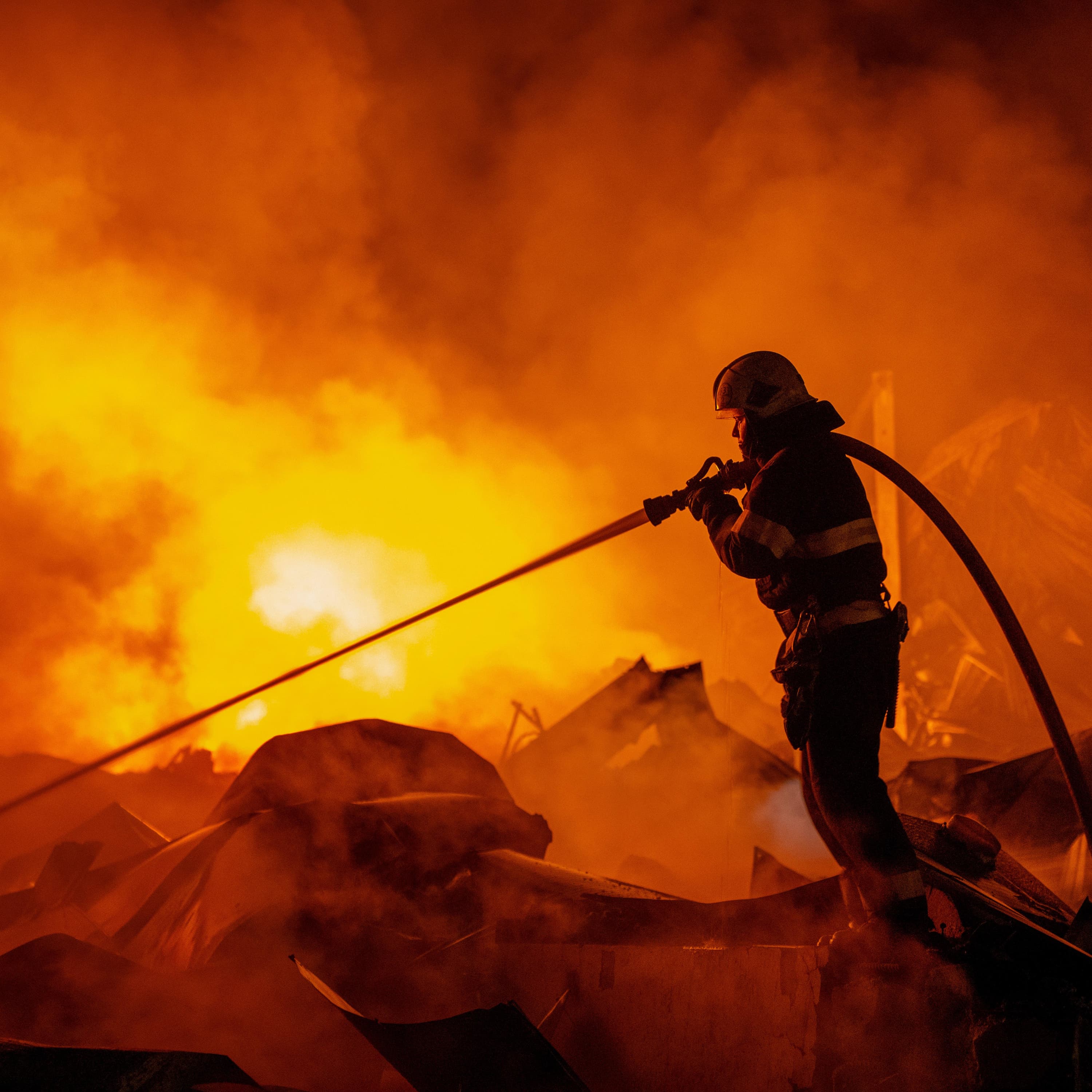
Today in Focus
Russia exploits Ukraine’s air defence shortage in deadly attack on Kyiv - The Latest
00:09:47
At least 17 people were killed and more than 40 injured in another round of deadly Russian strikes on the Ukrainian capital, Kyiv. Lucy Hough talks to the Guardian’s Russia affairs correspondent, Pjotr Sauer
Loading summary
Transcript22 lines
- [00:00]
A
This is the Guardian. Today In Focus is supported by Paramount. This isn't the end of a fight, it's the start of one. Lioness, the critically acclaimed original series from Taylor Sheridan, is now streaming only on Paramount. In the new season, hidden networks, foreign operatives and personal betrayals collide. Meanwhile, Jo walks the line between duty and family as unseen forces circle her world, leaving her to reckon with a war that now reaches into every part of her life. Don't miss the new season of Lioness, starring Zoe Saldana and Michael Kelly, with Morgan Freeman and Nicole Kidman, now streaming only on Paramount. Plus,
- [01:05]
B
Kyiv is really running low on air defenses. This money is key and Ukraine needs it. A lot of those funds don't just go into the military. They go into allowing the country to just exist. Russia knows that Ukraine is struggling with air defenses, so it wants to use this sort of opportunity to just plummet Ukraine as much as possible. But the big question is, what does Putin do? And at the end of the day, it's an authoritarian dictatorship.
- [01:30]
C
From the Guardians today in focus, this is the latest. With me, Lucy, Half. Russian strikes in Kyiv overnight have killed at least 17 people in some of the most major and deadly attacks on the Ukrainian capital. Piotr Saw, you're our Russian affairs correspondent. What do we know so far about these strikes?
- [01:55]
B
So Ukraine's air force said that Russia launched 24 ballistic missiles and over 100 drones at Kyiv. The main target appears to have been warehouse facilities belonging to a brewery and also a logistics company. And while Kyiv managed to shut down most of the drones, it didn't shoot down a single missile, which showed once again that Kyiv is really running low on air defenses.
- [02:21]
C
Yeah, this is something that President Volodymyr Zelenskyy has been talking about today. He says that ballistic missile interceptors could have saved the lives of those killed. This comes after months, as you say, of warnings from Ukraine that they are dangerously low on this equipment, which is perhaps a knock on effect from Trump backtracking on a promise to supply Ukraine with more arms. Talk to me about the pledges that Trump made and has since reversed.
- [02:52]
B
Well, Zelenskyy is signaling that he's angry that the west, too, bears responsibility for these deaths. In a later statement today, Zelensky said that air defense supplies from the west have decreased threefold compared to last year. So, you know, I think one of the main issues here is that the, that the US Needs a lot of these air defenses themselves for their war in Iran. And in particular, we're talking about the Patriot missiles which are the most reliable air defenses that Ukraine has in their capacity. And we've seen that Trump has promised to give Ukraine more patriots. He has also talked about potentially letting Ukraine produce patriots themselves. But he has since backtracked on both the promise of delivering patriots and this promise of allowing Ukraine to produce it.
- [03:43]
C
Yeah, okay, so that could have really, really major consequences as the number of Russian attacks on the capital city in particular. Earlier this year, the European Union approved a massive loan of more than 90 billion euros. They've since made a pledge of further money. But is it making a material difference to Ukraine's efforts on the battlefield?
- [04:10]
B
Yeah, it's a lot of money, and it's very important money. But it's important to also realize that a lot of those funds don't just go into the military. They go into allowing the country to just exist. You know, they go into the salaries of the. Of the workers, they go into salaries of the soldiers. You know, Ukraine has been damaged badly by this war and has a huge gap in its. In its budget. So this money is key, and, you know, Ukraine needs it, but it won't solve some of the issues it has right now, including the air defenses.
- [04:43]
C
So one of the reasons for the strikes on Kyiv overnight is tit for tat strikes early this week carried out by Ukrainian drones on a beach in the Black Sea that killed seven people. Are the number of drone attacks on Russian territory increasing as a result of that EU money?
- [05:08]
B
Yeah, I mean, I think to start with, you know, Russia might frame this as a tit for tat attack, but in reality, Russia knows that Ukraine is struggling with air defenses, so it wants to use this sort of opportunity gap that it has to just plummet Ukraine as much as possible and also to SAP some of the morale in Ukraine. Russia is not making as much progress on the battlefield, so this is another way for. For it to target Ukraine. So I wouldn't really particularly see this directly linked to the Ukrainian attacks. But you're right, Ukraine has stepped up its drone attacks on. On Russia, you know, reaching as far as Siberia. And we've seen an unprecedented campaign of Ukrainian drones targeting oil infrastructure, targeting warehouses. And these are homemade produced drones. Right. So, of course, Ukraine uses some of the money that the west gives to produce these drones. But the know how this is 100% Ukrainian. Know how.
- [06:05]
C
You mentioned earlier that Zelensky is angry. He's calling for more ballistic missile interceptors, but he's also calling on more partners to implement sanctions. Who is he speaking. Speaking to there that he feels is under Delivering?
- [06:22]
B
Well, he's not calling anyone by name, but I think it's clear he means the west, he means the European Union, the UK and America. And on one level, sanctions have failed because if you look at, at some of the missiles that are reaching Ukraine, these missiles use Western components that, that are, of course, are sanctioned and Russia shouldn't be able to get their hands on these components, but through smuggling and other ways, Russia is able to get these components into their rockets. So I think on one level, Zelensky says it's time to get tough on these third countries that allow Russia to import vital parts for their missiles. At the same time, I think it would be too easy to say that sanctions have failed. Of course, we've seen that there's been a lot of pressure on Russia's oil and gas industry. Without them, I think Russia would be making much more money from oil and gas. It's forced to sell its minerals and oil and gas on discounted prices to India and China. So it's a bit of a mixed bag, but of course, Zelensky asks for more sanctions and more pressure on Russia.
- [07:27]
C
And I mean, for Russians, they have lived now through four years of a war that has been hugely damaging to the Russian economy. They've lived through sanctions which may not have directly impacted Russia's ability to carry out its war against Ukraine, but nonetheless, popularity for war, support for the war must be on the wane, given the length of time. This was supposed to be a quick war.
- [07:56]
B
Yeah, it's supposed to be a special military operation lasting only a few weeks, of course. And we're now in year five. And, you know, both from my own reporting and speaking to Russians on the ground, but also through polls, we see that the support for war is going down and going down quite fast. Russians are feeling the impact of the war in their wallets, in their daily lives. You know, I've mentioned some of the strikes on the oil refineries. They have led to petrol shortages. For the first time sort of in modern Russian history, Russians had to queue for petrol. Most recently, we've seen Ukraine targeting warehouses belonging to wild berries. And this is the Russian Amazon. So this huge company where thousands of Russians sell their products through Ukraine has already targeted 14 warehouses, destroying billions worth of goods. So it is having an impact. We see that less and less Russians are willing to sign up for the war. So more Russians are dying than Moscow is able to recruit. But the big question is, what does Putin do? And so far, we've seen no reason to believe that he's he's willing to stop the war or, you know, negotiate with Ukraine. And at the end of the day, it's an authoritarian dictatorship where, you know, Putin can just go on for a while.
- [09:20]
C
Yeah, and obviously the US has been trying for some time to broker some sort of ceasefire between Russia and Ukraine that they said they would be able to get over the line with relative ease, but that's nowhere in sight, is it?
- [09:35]
B
Trump promised to end the war on his first day of presidency, but we see that he's completely bogged down in Iran and his people are busy trying to fix that war before even starting to think how to end the war in Ukraine.
- [09:49]
C
Yeah, looks like we've got a long road ahead. Piotr, thank you so much for your time.
- [09:53]
B
Thank you for having me.
- [09:55]
C
That's it for today. My huge thanks again to Piotr Sauer, our Russian affairs correspondent. You can keep up with all his reporting over@theguardian.com and I really recommend listening to yesterday's episode of our sister podcast Science Weekly. Madeline Findlay has visited Northumberland to learn more about the fight to save a historic English landscape. Thanks for listening to this episode of the latest Today in Focus. We'll be back in your feeds as usual tomorrow morning. The latest will be back tomorrow night. This episode was produced by Bryony Moore. The senior producer was Ryan Ramgobin. It was presented by me, Lucy Half.
- [10:34]
A
This is the Guardian.
- [10:44]
D
Today's markets move fast. Get the insights you need in 10 minutes with the Barclays Brief, a new podcast from Barclays Investment Bank. Through Sharp dialogue and scenario based analysis, our leading experts analyze key market themes each week. So whether you're managing a portfolio or leading a business, the Barclays Brief podcast can help you make smarter decisions today. Stay sharp, stay brief. Find Barclays Brief Wherever you get your
- [11:12]
E
podcasts Most people don't realize how much of their personal information is being bought and sold every day. Data brokers are making billions, pulling details about you from public records and the Internet, then packaging and selling it, usually without your consent. That's how your information lands in the hands of scammers, spammers, even stalkers. It's why you get endless robocalls and why ads seem to follow you everywhere. That's where Aura comes in. Aura actively removes your data from broker sites and keeps it off. They also instantly alert you if your information shows up in a breach or on the dark web. But Aura goes beyond data protection. With one app, you get a vpn, antivirus, password manager, spam call protection, dark web monitoring and even up to 5 million in identity theft insurance. All backed by 24, 7 US based fraud support. Other companies might sell just credit monitoring or even just a vpn. Aura gives you all of it together at the same price competitors charge for just one service. Start your free trial today at aura.com safety. Protect yourself now at aura.com safety.