← Today in Focus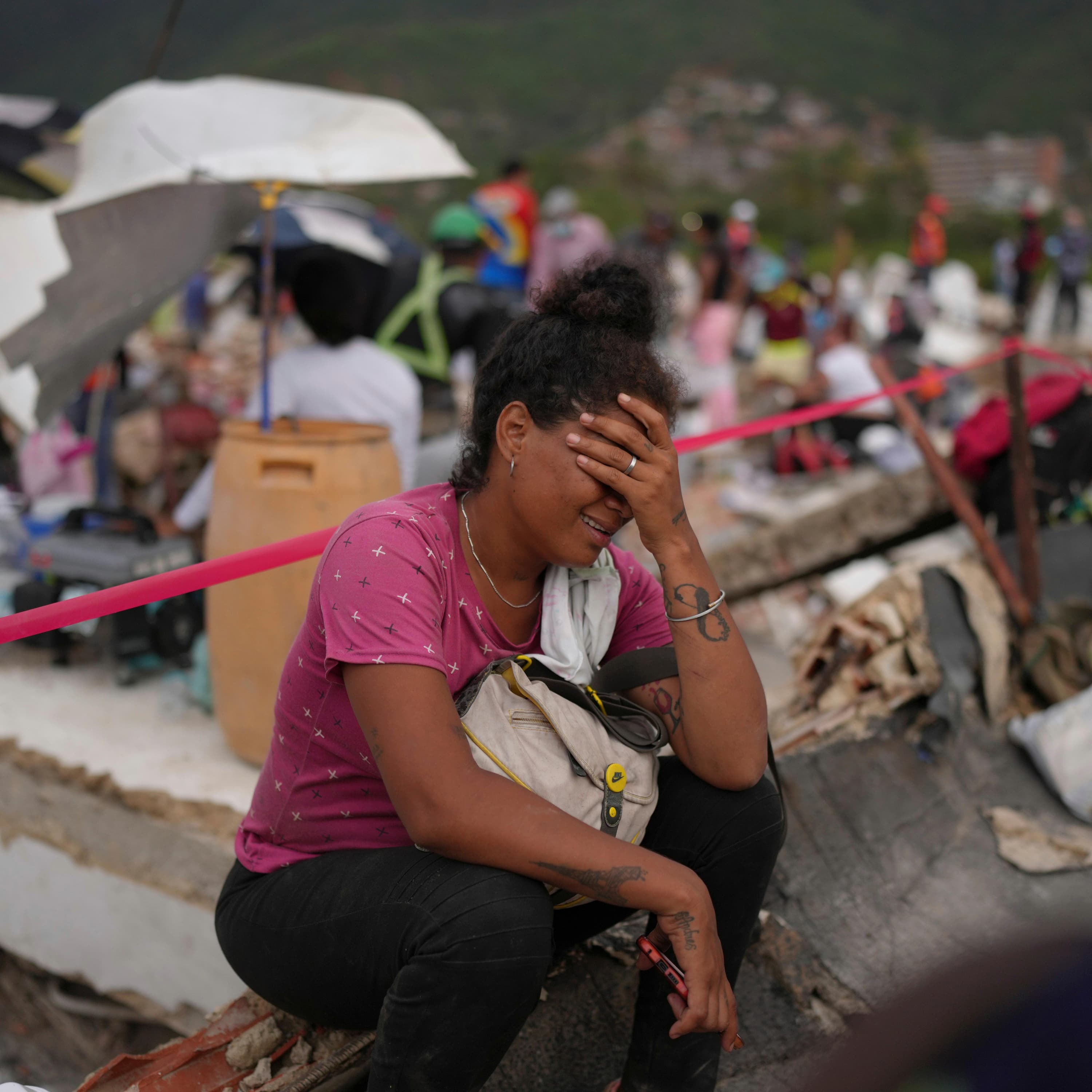
Today in Focus
Searching for earthquake survivors in Venezuela
00:24:06
Tom Phillips speaks to the ordinary Venezuelans struggling to find their friends and family after the country’s worst earthquakes in a century
Loading summary
Transcript58 lines
- [00:00]
Tom Phillips
This is the Guardian.
- [00:08]
Noshi Nikbal
Today on the ground in Venezuela after disaster.
- [00:20]
Stamps.com Advertiser
Shipping, billing, admin, payroll, marketing. You're managing all the things. So why waste time sending important documents the old fashioned way? Mail and ship when you want, how you want with stamps.com print postage on demand 24, 7 and schedule pickups from your office or home. Save up to 90% with automated rate shopping. That's why over 1 million small businesses trust stamps.com. go to stamps.com and use code podcast to try stamps.com risk free for 60 days.
- [00:53]
Tom Phillips
So the earthquakes, two of them within the space of 39 seconds, struck at just after 6pm on Wednesday 24 June, which is a bank holiday here in Venezuela. Many people were at home. Some people were watching the Brazil, Scotland World cup game. And they would have had, particularly in La Guaya where the buildings went down so fast. Absolutely no chance to respond to get out. There is a video that fishermen who were in the water took looking back at the region. And these buildings came down in seconds.
- [01:36]
Noshi Nikbal
Tom Phillips was in Caracas just a month ago as the Guardian's Latin America correspondent. He's reported from Venezuela through high stakes political drama, through economic disaster, and through one of the world's biggest displacement crises that has forced every 8 million Venezuelans out of the country. But the scenes following two enormous earthquakes, the worst in a century, have been beyond devastating.
- [02:07]
Tom Phillips
Many of those families, they are now camped outside these broken buildings. They've been sleeping rough, waiting for rescue teams to arrive, waiting for heavy machinery to arrive, waiting for someone to do something. I mean, they've been taking matters into their own hands. They've been grabbing spades and pickaxes and getting into the rubble themselves to search.
- [02:31]
Noshi Nikbal
A disaster met with political incompetence in a country still reeling from the dramatic capture of President Maduro by US forces and the installation of his wildly unpopular successor, Delsey Rodriguez.
- [02:45]
Tom Phillips
I met one family yesterday and they, they'd built a shack in a small shanty in the rubble and they'd used the rubble of the building that their daughter was in at the time of the earthquake to support their mattress that they are now sleeping on outside. And they have been there night after night after night. And they are distraught. They are also furious. I mean, the father I spoke to whose daughter was inside, I asked him what he would say to Venezuela's acting president if she were sat there on the mattress beside him. And his hands shook so violently with emotion. As he spoke. And he said, I would tell her that this damned revolution has just destroyed our country. And has destroyed our lives.
- [03:46]
Noshi Nikbal
Over 50,000 buildings have been destroyed and more than two and a half thousand people have been confirmed dead. Tens of thousands are still missing and unaccounted for. How will Venezuela recover and can it rebuild? From the Guardian, I'm Noshi Nikbal. Today in focus Venezuela after the earthquakes. Tom Phillips, you're the Guardian's Latin America correspondent and you've been in Venezuela. You've been in Caracas for the last few days and you've been talking to the people there, no doubt traumatised by what they've been through. What have they been saying? What have they been telling you?
- [04:30]
Tom Phillips
I mean, first of all, there is just the despair and the pain for families of the people who have died and particularly for the people who have not yet been able to find their loved ones in the rubble. Many, many, many, many bodies are obviously still trapped in these huge buildings that came down. And it's just almost unimaginable that anyone could be alive inside. And yet miraculously, search teams still are finding signs of life and actual survivors all these days after. I think at this stage, unfortunately, those stories are the exception and not the rule. I mean, I was at a destroyed apartment building with a grandmother whose eight year old grandson was inside and she's been camped out in a destroyed building basically ever since the earthquake, waiting for news, hoping that he's in there. He was playing at his cousin's house. So he was there with an 8 year old and a 10 year old cousin. Three young kids who have not been found. And the British and the Brazilian. The Ecuadorian search teams detected signs of life and they spent the whole day looking for these signs of life. And she was just so convinced that those were the kids. And she came up to me and she said, yeah, and it's the kids. And then I went to speak to one of the Brazilians and it wasn't. And I just didn't have the courage to tell her that, you know, there is no hope. And she's there in this, you know, sometimes smiling because she thinks they're getting closer and sometimes just breaking down. It's really, really heartbreaking.
- [06:16]
Noshi Nikbal
Just harrowing, just absolutely harrowing. Tom, your reporting from Venezuela has often revealed how resilient the people there are still days after. I mean, how much hope do people have?
- [06:27]
Tom Phillips
Well, the building I was in with the British team from the International Search and Rescue Group, a group of firefighters and medics and structural engineers who have flown in from the uk, they were using very sophisticated equipment, listening devices to try and hear the tiniest sounds from within. So they would put this device in the building. Then two of the men would put these headphones on and I put them on myself. And it sounds like you're underwater and you can hear the tiniest scratch on the pavement. And everyone is asked to be completely silent. And someone shouts out, silencio total. And everybody has to shut up. And they raise their hands in the air and these guys listen for any sign of life. And they detected the. Some, some kind of indication that something, perhaps an animal, but hopefully a human being or human beings were under that rubble. And they spent hours and hours. I was there from 9am until 10pm and they were going to work through the night, the Brits and the Ecuadorians and the Brazilians, to try and get these people out alive if they were there. So it's extraordinary and extremely dangerous. I mean, some of these guys yesterday, they were crawling into these cramped kind of crevices that they'd cut with power tools and hammers into the concrete just to try and get sort of a few centimeters or a few meters closer to the possible victim. At any moment there could be an aftershock or these structures that are so badly damaged could just come crashing down. It's incredible and very humbling to see people risking their lives like that.
- [08:03]
Noshi Nikbal
I mean, it's one thing to be there witnessing the experts doing their work, being trained to do it, having the equipment to do so. But you've also spoke to civilians who took it upon themselves to help survivors, to find survivors. Can you tell me a bit about their stories?
- [08:17]
Tom Phillips
Yeah, I mean, that's been certainly the most uplifting part of an otherwise just completely awful story for a country that has already been through so much over the past few years, years, this tsunami of volunteers who have poured into La Guaya, the worst affected area, over the past few days, from all parts of Venezuela, from the local communities too, people from those buildings, neighbors, and people from other parts of the country who have come here on the backs of cars, on buses, on motorbikes, carrying spades, carrying pickaxes, anything, you know, anything that they can get their hands on. Of course, food and water too, which are in short supply down there. And they have taken it into their own hands. They've decided to do what they feel the government is not doing. Your English is amazing.
- [09:06]
Israel Rivas
Oh, thank you.
- [09:07]
Tom Phillips
What's your name?
- [09:08]
Israel Rivas
My name is Israel.
- [09:09]
Tom Phillips
Israel. And what's your name? One man I met was a young chap called Israel Rivas, who is a mechanic and budding sort of amateur photographer from the other side of the country, 12 hours by bus, he felt the earthquake. He was at home, more than 700km away when it happened. And he was surprised and shocked, but it wasn't too bad. No buildings collapsed. And then when he turned on the television and started looking at social media and he realized the scale of the disaster, he'd actually been saving his money to buy a new lens for his camera and he decided to put all his savings into a bus ticket. And he jumped on a bus and drove all the way down to La Guayra.
- [09:52]
Israel Rivas
And I'm here to help, not, I'm not under any organization. I just got some savings, I had pay. A boss came here, started walking La Guayra and I saw them and I said, you need help, I'm here.
- [10:10]
Tom Phillips
I mean, he's an incredibly bright, smart young man who's taught himself immaculate British accented English all on his own and listening to the black eyed peasants and Maru 5. And he introduced himself and he said, you need me, I can interpret for you. And they said, we do need you. And he joined their team, put on an orange uniform and has been at the, you know, at the rock face on the front line of this, digging into these buildings, helping them translate, trying to shout out instructions to people trapped in the rubble.
- [10:42]
Israel Rivas
I couldn't eat well, I couldn't sleep well, knowing that my brothers and sisters from this country are dying. So I took the savings, came here and doing as best I can.
- [10:57]
Tom Phillips
I'm just an incredible example of this amazing outpouring of Venezuelan solidarity which stands in really sharp contrast to the very slow and incompetent reaction of the government. As many people see it here. When you turn on state run television here in Venezuela, you constantly hear the government propaganda line which is, Venezuela nuesta sola Venezuela, you are not alone. But that is exactly how people feel. They feel that they have been left to their own devices and to fend for themselves and that the government has not done enough. And once a expects that that will have very major political consequences for this already very unpopular government.
- [12:00]
Noshi Nikbal
Let's talk a bit more about that, Tom, because it's been two weeks since these devastating earthquakes hit. Can you tell me about the government rescue effort in the immediate aftermath and what it looks like now?
- [12:14]
Tom Phillips
The main criticism that you hear and the main frustration that you hear on every site that you visit, at every destroyed building is that in the hours and days following this disaster, when it was obvious to everyone in Venezuela and around the world that this was a massive, massive crisis, government Search and rescue teams were simply not anywhere to be found. People have not seen that. They have been waiting by their wrecked buildings for help. They are upset by that, but they are also really, really, really very angry.
- [12:46]
Jesus (Volunteer Engineer)
It's just people dying and they're letting it happen. Why? I don't understand it. It's frustrating. It makes me want to cry as well. We've seen some horrible things and, yeah, we're alone. It's really sad. We are alone.
- [12:59]
Tom Phillips
One of the biggest complaints is that the armed forces have not been present and people have not seen them. And that when you do see a government presence, what you see and what we have seen as we've gone down to the worst affected areas, are security forces with big guns, AK47s, assault rifles, standing by the roadside, manning roadblocks and apparently trying to control the political situation. One of the volunteers that I met outside yet another destroyed building was Jesus, a young civil engineer who studied in the UK and had come to bring food to people who'd been displaced and the families of the victims.
- [13:37]
Jesus (Volunteer Engineer)
Well, unfortunately, I mean, as you can see, the international help is really all the help that we have. As you can see, the military forces are very clean throughout. Most of them have machine guns and they need shovels.
- [13:51]
Tom Phillips
One refrain that you hear constantly as you move around these broken buildings is more spades, fewer rifles. And there is also frustration, as many see it, that the government has been standing in the way of volunteer groups getting about their work, really asking for QR codes for people to come down to La Guaira to the worst affected region.
- [14:16]
Noshi Nikbal
So people needed to access a QR code before they were able to go and volunteer and help.
- [14:23]
Jesus (Volunteer Engineer)
We're doing what we can, but we aren't ready for this. We don't know how to do it. We are doing it with our hands. And. Yeah, and the government is actually opposing the help. I don't know if you have seen that, but they are creating little systems. For example, to come here to help now, you need a QR code. Yeah. What's the QR code for? Nobody knows. You go to try to get the QR code?
- [14:45]
Tom Phillips
I mean, I saw this firsthand. I was trying to drive down there with my team and we were in a huge traffic jam. This convoy of trucks and lorries and bikes. Everyone basically tried to carry help down to the affected area. And then traffic jam just stopped. And a group of police had blocked the tunnel. They said they'd received a presidential order. We don't know why, and they were not letting anyone through. I think what had happened was that the President, Del C Rodriguez, was visiting a field hospital in La Guayra. Perhaps they didn't want more people going down. Whatever the reality of it, this massive queue of humanitarian aid wanting to get down there got angrier and angrier and angrier. They could not believe that the government was telling them they could not go to help. Given that the government was doing so
- [15:37]
Noshi Nikbal
little, why is there such a strong police presence?
- [15:41]
Tom Phillips
I think fundamentally, people feel they are there to deter any kind of rebellion or protest, to stop this sort of incandescent rage that is gripping many people down here, exploding into some kind of anti government protest or violence, so that the government's focus has been repression or deterrence and security rather than saving lives. And that really plays into one of the biggest complaints, which is that over the past few years, since 2013, since Nicolas Maduro became president of Venezuela, the country has descended into dictatorship. And many people feel that resources that should have been channeled into getting the emergency services ready for a natural disaster like this have been spent on repression and on equipping the armed forces to put down protests.
- [16:42]
Noshi Nikbal
Is it the fact that the government doesn't have the ability to coordinate or it simply doesn't have the capability, the resources at hand to have, you know, deployed the effort that was needed?
- [16:54]
Tom Phillips
I think there are a few reasons, very complex and interlinked reasons. Venezuela has, over the past 12, 13 years, been plunged into one of the worst economics crises ever outside of a war zone. Nearly 8 million people have fled the country to escape the economic collapse, to escape hunger, hyperinflation, and to start new lives in other parts of Latin America, in the US or in Europe. Just a massive, massive historic migration the likes of which Latin America has not seen. And that has come hand in hand with a very severe political chill. And that, of course, all came accompanied by crippling U.S. sanctions. And all of that has left the country just completely enfeebled. So what you had at 6 o' clock on the 24th of June this year when these two earthquakes struck was a country that has been completely brought to its knees. The country that cannot take anymore. People who really feel they deserve a break, they deserve a better future. And I think most people just cannot believe that Venezuela has suffered yet another sucker punch like this. It's just devastating.
- [18:03]
Noshi Nikbal
Tom. These earthquakes are the first national emergency faced by the Rodriguez government since President Maduro was dramatically captured by U.S. forces this morning.
- [18:12]
Tom Phillips
President Trump says the U.S. carried out large scale strikes on Venezuela overnight. He says its President Nicolas Maduro and his wife, Celia Flores, have been captured and flown out of the country.
- [18:24]
Noshi Nikbal
Attorney General Rodriguez, his deputy at the time, was installed with Trump's blessing. What does the response say about her competence and her authority?
- [18:34]
Tom Phillips
I think to many Venezuelans who you speak to in the disaster zone, it tells you that she does not have what it takes to lead this country and that the government's response has been feeble, in some cases at least criminal. We've seen video footage, for example, of members of the police digging through the rubble and apparently stealing money from destroyed buildings. And several police officers have this week been sacked for doing that.
- [19:03]
Noshi Nikbal
That's shocking.
- [19:05]
Tom Phillips
Yeah. I mean, just unbelievable at such a traumatic time. So I think many, many people think that it is, you know, another sign of what an illegitimate government this is. This is, this is not a president who has been elected. So people see this as a government with no legitimacy. What is this government relying on for its future? Well, the White House, Donald Trump.
- [19:34]
Noshi Nikbal
Coming up, what has the US Response been to Venezuela's emergency?
- [19:53]
Stamps.com Advertiser
Still waiting in line. Again, that's time you'll never get back. Save time and money with stamps dot com. Over 4 million businesses have skipped the line with stamps dot com. Join them to save up to 90% off carrier rates from your computer or phone right now. Print postage for certified mail, registered mail and packages in seconds. Then schedule a pickup right from your home or office for a limited time. Go to stamps.com and use code podcast for a free welcome gift. Taxes and fees apply.
- [20:24]
Noshi Nikbal
From globalization to innovation sustainability to market volatility, there's always more than one side to a story. Explore different perspectives on today's most important business and economic issues with the Flipside podcast from Barclays Investment Bank. Here two research analysts in a lively debate and get insights from every angle.
- [20:43]
Tom Phillips
To further inform your view, listen to
- [20:45]
Noshi Nikbal
the flip side on your favorite platform. Given Trump's obvious sponsorship of Rodriguez, what has US Aid looked like? How has the White House responded?
- [20:59]
Tom Phillips
So we have seen a significant US response. When I was down in La Guaida, the air was filled with the constant sound of the US helicopters and offspring sprays cruising along the shoreline. Field hospitals have been open. We have seen military deployed and marines and several large naval boats in the port. So there has been a significant U.S. response. And I think there really needs to be because after everything that happened on the 3rd of January, the US effectively took responsibility of Venezuela and is obviously keen to profit from Venezuela's massive oil reserves. So if it does nothing now, over, you know, to Help a country that many have described as a sort of Neo colony or a US Protectorate. It will not look good for the Trump administration. You do see US Search teams moving around, and they are part of this massive international response with search teams from Chile, El Salvador, Brazil, the uk, Other parts of Europe. That is now unfolding.
- [22:09]
Noshi Nikbal
Tom, how are people assessing what their immediate future looks like? Where are they going, and how long will it be until we know the full scale of what's happened?
- [22:22]
Tom Phillips
I think it will probably be a long time before we understand the full scale of what has happened. Just because these collapsed buildings are so complex and the machinery is not there and the devastation is just on such a great scale. I mean, it's just kilometer after kilometer of rubble and wreckage and ruins, that it will take a long time to work out how many people were inside these big buildings. And many people, of course, even the survivors are now sleeping out on the streets because their buildings were so badly damaged that they dare not go back inside. So when you're driving through the dark streets of La Guaida at night, you see tents on street corners and you see people who've moved into, effectively, refugee camps that have been set up by the UN Camps for displaced people. And their future is very uncertain. I don't think we have any clue where they will be housed or what will be done to support them. It is a hell of a job to support a country that was already in real dire straits beforehand. And the political future, I think, looks equally uncertain, because on one level, this natural disaster could help prolong the life of Delsey Rodriguez's government, because it is almost certainly going to postpone all of the talk of holding elections. But at the same time, the anger and the rage and the potential for public disorder has really risen. And I think many, many, many, many people here already despised the government for everything that has happened in Venezuela over the past 25 years plus and now I think that is likely to be intensified even further.
- [24:05]
Noshi Nikbal
I mean, surely there is an expectation of some outline of a plan in terms of rebuilding. And I wonder if you've heard anything like that. I mean, is there one? What would that look like? How does Venezuela rebuild?
- [24:18]
Tom Phillips
I don't get the sense that there was a plan for what would happen when this happened. I don't get the sense that there is particularly a well thought out plan from the Venezuelan government for what is happening now. I don't see a particular plan other than somehow stagger through this and as we've seen before with this regime, just try to survive. Just try to stay in power.
- [24:45]
Noshi Nikbal
Gosh, Tom, it's just utterly horrific. Thank you for your time and stay safe.
- [24:51]
Tom Phillips
Thank you for listening.
- [24:55]
Noshi Nikbal
That was Tom Phillips, the Guardian's Latin America correspondent. You can read all his coverage of the story, including a really incredible photo essay on the ground, all@theguardian.com and that's it for today. This episode was presented by me, Noshi Nikbal and it was produced by Casey McGlaw and Eleanor Biggs. Sound design was by Rudy Zagadlo and the executive producers with Sammy Kent and Eli Block. We'll be back later this afternoon with the latest.
- [25:31]
Tom Phillips
This is the Guardian. He's dribbling the ball with everything on the line. He's driving down the pitch. He's facing price hikes and cuts past him.
- [25:48]
Stamps.com Advertiser
Carrier contracts, tries to block him.
- [25:50]
Tom Phillips
Oh, he leaves him in the dust. He's at the edge of the box. He cuts past the non stop group chat trash talk. He clears on goal. He shoots no unlimited data for $25 a month forever. Visit your local Boost Mobile store today to get unlimited data with a price that never changes. Boost mobile after 30gb, customers may experience lower speeds. Customers will pay $25 a month as long as they remain active on the boost.
- [26:13]
Stamps.com Advertiser
$25 unlimited plan, shipping, billing, admin, payroll, marketing. You're managing all the things, so why waste time sending important documents the old fashioned way. Mail and ship when you want, how you want with stamps.com print postage on demand 24, 7 and schedule pickups for from your office or home. Save up to 90% with automated rate shopping. That's why over 1 million small businesses trust stamps.com go to stamps.com and use code podcast to try stamps.com risk free for 60 days.