← Today in Focus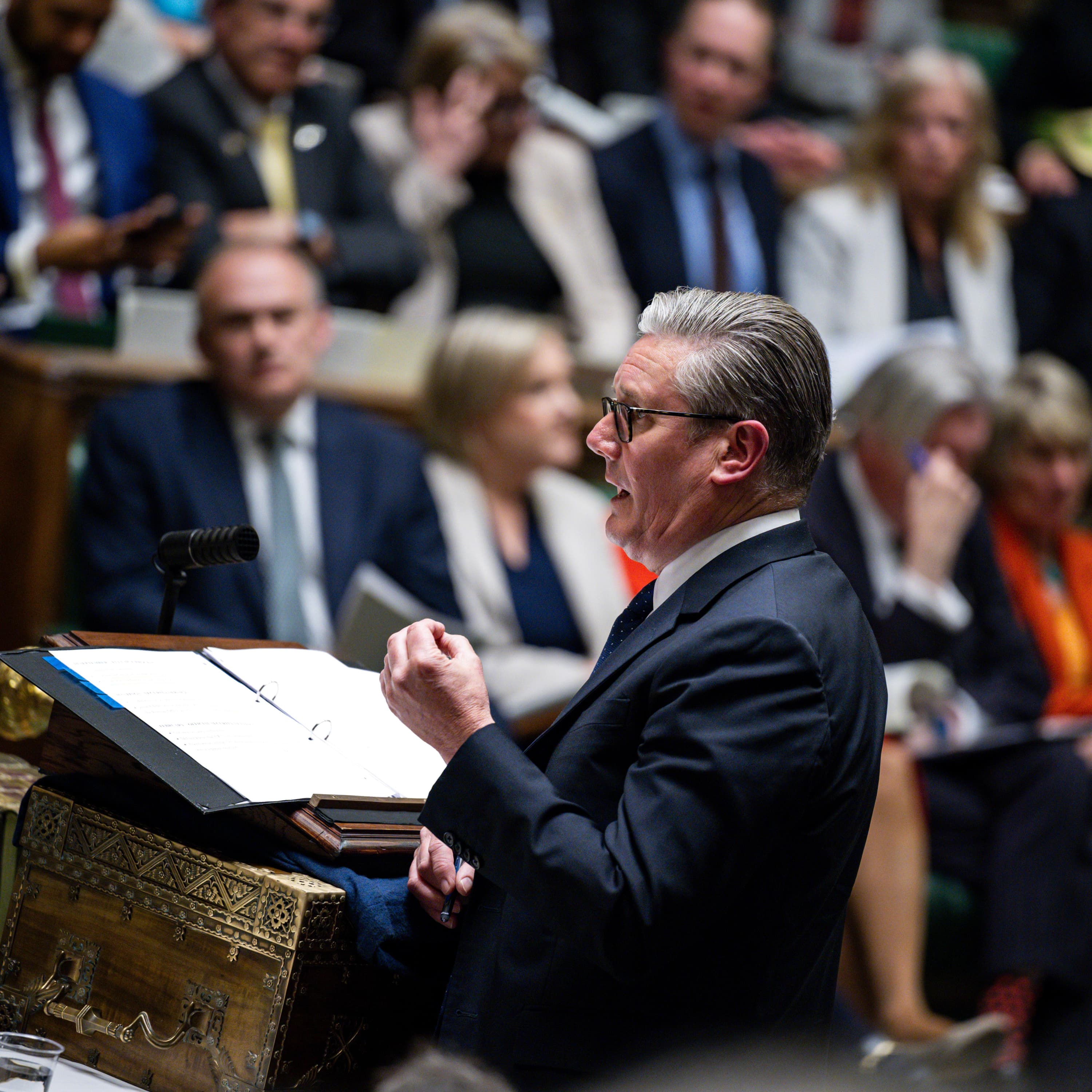
Today in Focus
Starmer addresses the Mandelson vetting saga
00:28:16
Jonathan Freedland on what Keir Starmer said – and didn’t say – to the House of Commons about the Mandelson vetting failure
Loading summary
Transcript52 lines
- [00:00]
A
This is the Guardian.
- [00:08]
B
Today. Keir Starmer and the never ending Peter Mandelson saga. It's a long established rule of British government that if a minister says something false or misleading in the debating chamber, they have to return to correct the record.
- [00:29]
A
Prime Minister Keir Starmer.
- [00:32]
B
On Monday afternoon, it was Keir Starmer's turn.
- [00:35]
C
Thank you, Mr. Speaker. With permission, I'd like to provide the House with information that I now have about the appointment of Peter Mandelson as our Ambassador to the United States.
- [00:46]
B
Standing up before during MPs storm, insisted he hadn't lied previously when he'd said that that full due process had been followed. It was the Foreign Office, he said, that had misled him by not telling him that Mandelson had failed vetting procedures.
- [01:02]
C
It's beggar's belief that throughout the whole timeline of events, officials in the Foreign Office saw fit to withhold this information from the most senior ministers in our system in government.
- [01:15]
B
If he'd known, he said repeatedly, he would not have appointed him.
- [01:20]
C
This was not a lack of asking, this wasn't an oversight. It was a decision. It was a decision taken not to share that information. On repeated occasions, the opposition were not convinced the Prime Minister appointed a national security risk to our most sensitive diplomatic post.
- [01:40]
B
Instead of taking responsibility for the decisions
- [01:43]
C
he made, the Prime Minister has thrown his staff and his officials under the bus.
- [01:50]
A
He says he had no idea. He gives every impression of a Prime Minister in office, but not in power.
- [02:00]
B
Has Starmer done enough to silence calls for him to step down? And what does all of this tell us about his judgment and his authority as the Prime Minister? From the Guardian, I'm Helen Pitt. Today in Focus, can Starmer survive the Maddelson scandal? Jonathan Freeland, welcome back to Today in Focus.
- [02:23]
A
Good to be with you, Helen.
- [02:24]
B
So you are, of course, a columnist at the Guardian and the host of our sister podcast, politics weekly America. And you are, for your sins, a longtime Peter Mandelson watcher on both sides of the Atlantic. And we're recording with you just after Keir Starmer's address to Parliament. How do you think he came across?
- [02:42]
A
He looked sober and serious. And for a while I thought he was getting through with the kind of command of the House. And they were listening, hearing him out. A turning point came actually in this moment when he said, lots of people here, members will find it incredible.
- [02:58]
C
Mr. Speaker, I know many members across the House will find these facts to be incredible
- [03:07]
A
because, of course, it opened up the door for them to indeed say they did find his account in crime incredible. And for there to be jeers. And thereafter, it opened the door for a whole series of questions that were difficult, led by quite a good performance by Leader of the opposition Kemi Badenoku. Just went in with more precision than she often has. And so I think having started well, it went less well for him because there are quite a few questions there. And at the center of it is his own admission of grave misjudgment.
- [03:38]
B
And we're going to come on to talk about the questions that he did answer and those that remain hanging. But before we go there, let's do a quick recap for those at the back, starting with what's been called the original sin of this scandal. Starmer appointing Peter Manelson to be the UK ambassador to the US back in December 2024. This is a guy, of course, who was nicknamed the Prince of Darkness, a man who Donald Trump called Sneaky Pete. Why on earth did Starmer want such a controversial figure to have such a plum job?
- [04:09]
A
In a way, it's partly the faults that drew him. I mean, it is partly that reputation for the black arts that has given Peter Mandelson what many in the public would think of as a negative reputation. But inside politics, people still believed, until really these latest revelations, that he had an almost magical power. He could understand politics and how it operated in a way that lesser mortals could not. He himself perpetuated that reputation. You know, you refer to as a longtime Peter Mandelson watcher, and it is true, the very first time I met him was weeks or months into the New Labour government of 1997. He greeted me by saying, behold the Prince of Darkness about himself. It was quite clear that he reveled in that reputation. He liked the idea that he could pull off outcomes that others thought were impossible. And with the particular circumstance, namely the return of Donald Trump to the White House, they believed only somebody extraordinary could handle this extraordinary president. To catch a rogue, a maverick, it would take someone who was himself an out of the box player. And for a while, let's remember two things. One, when the appointment was announced, greeted almost universally across the Westminster village as a moment of inspiration. Across the newspapers, media, lots of people said this is a brainwave masterstroke. But also it did seem to go well that he did get access to the Trump administration. Trump seemed to have some kind of affection. That was a pos positive nickname by Trump standards. And they did get that initial US UK trade deal. People like us me, the Guardian thought it might not be worth the paper. It's written on, but it was a deal. So at first that black arts master magician thing seemed to be working and
- [05:58]
B
yet he only managed seven months in the job, didn't he, before Starmer sacked him over his relationship with Jeffrey Epstein, which he continued after Epstein's conviction for sexual offences. And let's fast forward to last week and the Guardian's front page scoop, which said that Mandelson had failed developed vetting clearance in late January 2025, only for that advice to be overruled by the Foreign Office so that he could take up the post. Are we any clearer now why he failed that vetting? There are so many skeletons in his closet. Which ones do you think did for him in terms of the security vetting?
- [06:32]
A
Yeah, we don't know. And that's obviously this question of knowledge is central to the whole scandal. Keir Starmer is not actually saying that he knows now or that even he should have known. He's just saying I should have been given the up or down verdict. The reasoning is legitimate that that stays secret because that could be all kinds of personal circumstances that, you know, no one would deserve to be made public. The suspicion around the place is that this wasn't Epstein related. That in a way was already out there. That's the kind of thing that would have been done in this earlier, lighter touch, due diligence process that was conducted in before the appointment was announced. This was the security vetting that went afterwards. This is likelier so people say they may not know to relate to his business dealings, particularly with China and with Russia, through this company that Peter Mandelson set up in his post government life called Global Council. Very highly paid sort of strategic advice consultancy and among its clients were Chinese and Russian corporations. Kemi Badinot, leader of the opposition, asked about one of the Russian ones.
- [07:41]
C
Emma is a Russian defense company closely linked to the Kremlin and Vladimir Putin's war machine.
- [07:48]
A
There's also been talk of the fact that Peter Mandelson had a share in a big Chinese pharmaceutical company. So those things could have presented conflicts of interest for a UK ambassador sitting there in Washington getting very secret classified information across his desk about China, about Russia, about the US and UK allied posture against those countries. Was he going to be conflicted? That's the sort of thing you can imagine. Again, we don't know. That might have aroused the interest of those people doing that heavier, more intense developed or security vetting.
- [08:23]
B
But the truth is we still have not had a definitive explanation, have we, from Keir Starmer on why he failed the security vetting. So let's talk a bit more about what Starmer did clear up in Parliament on Monday. What do you think we learned about why he was left in the dark about Mandelson failing the vetting?
- [08:43]
A
In a way he fleshed out just more the center of his case. As a lawyer, he was advancing a case and that case was essentially to point the finger at what he painted as an egregious, extraordinary decision and set of decisions by officials, particularly one then newly appointed Permanent Secretary at the Foreign Office, Sir Ollie Robbins. He was saying that those decision makers had a power that until last week was bar Whitehall, including apparently by Downing street, which was to receive the advice of the vetters, the security vetting agency, and then to overrule it. So essentially, the people who did the vetting flashed a red light, said, do not appoint this guy, Ollie Robbins sits at his desk and thinks, I'm going to overrule that. Ignore that advice. One thing Starmer said today, I don't think this was known before, is that other departments can't really do that, that the decision of the security vetting agencies is, is binding for other departments. But through some quirk of Whitehall, the Foreign Office get the power to override it. Top official at the Foreign Office, Ollie Robbins, decided first to override it and give security clearance to Mandelson anyway and then not to tell anybody that he'd made that decision. And I think what buttressed Keir Starmer's case, he made a lot of it, was the fact that even later on, once Mandelson had gone and Keir Starmer set up an inquiry, a review of under the then Cabinet Secretary, the top civil servant for the whole country, Sir Chris Wormald. Wormald himself, whose whole job was to find out the whole story of the vetting, talk to the Foreign Office officials. They didn't even tell him, look, Mandelson failed his vetting and we overruled it. So I think he was trying to say, here's an outfit, the Foreign Office, that had kind of gone rogue, that was making its own decisions and not even telling, first of all, the Prime Minister, but even a kind of inquiry, a forensic probe into the whole affair, they were keeping all these cards close to their chest as if they themselves were sort of trying to cover up the traces of their own decision making.
- [10:48]
B
So Stone was clearly pointing the finger at the Foreign Office or throwing them under a bus, as Kemi Badenoch put it. But the fact remains, he appointed Peter Mandelson before this advanced security vetting was even in train. Did he say anything about why he did and whether that's something that he now regrets?
- [11:08]
A
Well, this was where he was both strong and weak. So I think he was strong. And this was in that early part in taking responsibility for what is the core crime here, the original sin, as I think he put it, the misjudgment of appointing Mandelson in the first place. I was quite impressed that Starmer had confronted that head on. He didn't give an if pology, which is the word for when people say, if someone's hurt by what I've done, then I'm sorry. He was much more full front and went out of his way to talk about and to the victims, and I
- [11:38]
C
apologise again to the victims of the pedophile, Jeffrey Epstein, who were clearly failed
- [11:44]
A
by my decision and that I thought was admirable or effective to front up and say the key thing was to appoint a man who was close to this abuser, Jeffrey Epstein, and the injury that did to the victims, he took responsibility for that. So I think that was a strong part of it. Where it got weaker was in saying that. And actually you get very legalistic and technical here, but there's a document where it could be read as saying, make sure all the vetting is done before you appoint this guy. He didn't do that. He announced it to the public in December of 2024. This is my new ambassador. And then they did the vetting afterwards. To anyone else that seems mad, his argument there fell back on. And this is where Starmer was much weaker when he sounded like an HR director, constantly saying, that's the process, that was the process, that was the normal process, and apparently it is. So I think that was another misjudgment of his. But he was much less keen to take responsibility for that one than he was for the overall original sin decision to appoint Mandelson in the first place.
- [12:58]
B
What unanswered questions remain for you after having listened to Keir Starmer in Parliament?
- [13:04]
A
I think a core one is why he didn't think, damn the process. This is an exceptional appointment of an exceptional candidate in not necessarily a good way. I mean, exceptional in the sense of this person's had to quit twice or be forced out twice. There are all these problematic associations. Let's remind ourselves it was known about his ongoing post conviction relationship relationship with Jeffrey Epstein that had been all over The Financial Times 18 months earlier. Why didn't he just say, you know, forget what the rules say, tell me what Happens from this security vetting or. Yeah, nice idea. Morgan McSweeney, my previous chief of staff that we appoint, Madison, let's just make sure we get full vetting before we even breathe a word of this. You know, I wrote a piece at the Weekend saying if only he had been more of the dull, technocratic lawyer that everyone said Keir Starmer was, then he would have asked, I'm sure of it, to top lawyer would just go, let's dot every I and cross every T here. Especially as we're dealing with someone who is so often radioactive. And I just don't think we've had good answers to that. And probably because in a way the answers would suggest, look, Morgan McSweeney thought it was a bastard stroke to appoint him. So did all you lot in the Westminster Village. And we didn't want to ask too many questions or look too deeply. That isn't a great explanation, but I think that is a part of it. The other thing I think is a really difficult question for him. It sounds a bit process ish. Is Kemi bad not asked this? If he knew last Tuesday, thanks to the Guardian's extraordinary exclusive, that this. That he'd been denied vetting, he really is, under the rules required to correct the record of previous statements and go to the House of Commons immediately, first possible opportunity. And that would have been Prime Minister's questions last Wednesday. And he stood there and didn't say, by the way, guys, I found out something that means what I told you last time was wrong. If he had done that, we wouldn't have had our big scoop. But under the rules, the ministerial code, he was required to do that and he didn't do that. And I think there is not yet a good answer to that.
- [15:08]
B
It's probably worth a reminder of just what Starmer has said in the past, whether that was in the Houses of Parliament or to journalists. He said on one occasion, security vetting carried out independently by the security services, which is an intensive exercise that gave him clearance for the role. He also said full due process was followed during this appointment, as it is with all ambassadors, which sounds pretty definitive.
- [15:30]
A
Yes. So his defense there is that that's what he honestly sincerely believed, because that's what he'd been told. And interestingly, the House has more or less accepted that, that he wasn't. Whatever misleading happened, it wasn't knowing. And I think it's important that Kemi Badenok, who has previously was saying that he was lying, that he knew he was lying, that he was misleading willfully she's dropped that line. Now, the combination of that, the fact that people have accepted it was not knowing deception and the fact that he did apologise for the main thing of appointing Madison almost gets him in the clear. The problem is the other bit of it. So he didn't knowingly mislead, but did he mislead There it's this almost sort of hair splitting theological argument about full process. And there I think the words of Ollie Robbins to the Parliamentary committee, the Foreign Affairs Committee, are really important because it seems to me that Ollie Robbins was being very Sir Humphrey, if people get the reference there to the character in yes Minister, the kind of civil servant who said the full vetting process was conducted true. And it concluded in him getting developed vetting, also true. He missed out the bit in between, which was he was denied it and I overruled it in order to give him that vetting. So technically he can say the process was followed and based on what Ollie Robbins said. But Ollie Robbins account was not complete. So I think what we're going to see over the next 24:48 hours is a battle between who really is at fault for this misleading account. And Starmer wants us to believe it was this very well regarded civil servant who was economical with the truth to that Parliamentary committee and perhaps to Downing street and Keir Starmer himself.
- [17:15]
B
We are expecting to hear from Ollie Robbins himself when he will address a par. And I guess one of the questions that he will be asked was whether he was doing his job by not telling Keir Starmer whether he failed in his duty by not filling Starmer in. Because that's an outsider. You think, well, come on, you've got to tell the Prime Minister about something like this. So should he have told him? And could he have told him?
- [17:40]
A
It seems as if. And he's marshalled in quite an effective PR campaign for his own defense. He's bringing out former officials who've stepped forward to talk about his great integrity and so on. The argument that's being made by friends of Ollie Robbins is he could not say what the developed vetting security process had found that that was against the rules. You've had Jack Straw, a former Foreign Secretary who's seen as the author of the legislation that covers all this, has said there is nothing in the rules that blocks him. And I think what it turns on is this difference between the final verdict, that red light or green light that it seems you are allowed to share, and then the actual grounds for the decision is you're not allowed to share. And so, probably my guess, Robbins could have said to Downing street, look, he's been denied this. I can't tell you why. Now you have to make a decision. Why did he not do that is a really interesting question. And it could be, you know, I heard this from a Tory back bencher today, but I'd actually thought it myself a little bit. There's something of the Henry II who will rid me of this turbulent priest story here, which, you know, people may remember that reference to Thomas Becket, where the old king said, who will rid me of this turbulent priest? And before he knew it, the turbulent priest was killed. Sometimes the head makes clear what he wants done and the officials over execute, as it were, the wishes of the boss. Did Ollie Robbins think, I know Starmer wants Mandelson, my job is to give him Mandelson and if there are obstacles in the way, it's better that he doesn't even know it. I'll make sure he gets what he wants and I will give him Denia, because he'll never know. He won't have to make the decision to overrule the advice of the security vetting agency. He might have thought he was being a very good, loyal civil servant, delivering to the PM what the PM wants. People who know these people say that is really what they live for, these top officials. Their job, as they see it, is give the PM what the PM wants. And so he may have been overzealous in that, because in the end, he's landed the PM in tremendously hot water
- [19:56]
B
and he's lost his job. I thought it was quite interesting watching Labour MPs in Parliament on Monday. Emily Thornbury, who is the chair of the Foreign Affairs Select Committee, said that getting Peter Manson the job was a priority that overrode everything else. Which speaks to what you've just said about Ollie Robbins doing everything he could to please Keir Starmer. And she said that security considerations were very much second order, I'm afraid to say.
- [20:22]
C
Doesn't this look like, for certain members of the Prime Minister's team, getting Peter Mandelson the job was a priority that overrode everything else and that security considerations were very much second order.
- [20:34]
B
What do you make of how the Labour Party is responding to this scandal? Because it's come at a terrible time for them, hasn't it? Ahead of the Scottish, Welsh and local elections?
- [20:43]
A
Yes. I mean, I half wonder if those Scottish, Welsh and local elections were not imminent, whether they would actually be gunning for Starmer more in a Funny way, the timing of this, oddly, perversely, is almost helpful for Starmer, because let's say this broke 10 days after terrible results in Scotland and Wales and English councils. You could imagine it being used as the stick with which to beat Starmer or the lever with which to prize him out of Downing Street. Instead, this is not the right time time, because they do not want to get rid of a leader just weeks before huge parts of the country of the UK go to vote. Besides, they want him there to be the lightning rod, as in to take the blame. Yeah, for the bad results. It's badly timed from their point of view and better time from his point of view. I also do think there's a worry that this actually, I think there's not a sense of how this is playing publicly. Will it? Is it process? Is it? Westminster Village is really the only thing that truly cuts through the fact of appointing Mandelson in the first place. Maybe that damage was already done. I haven't had the chance to speak to many Labour people since in the last just minutes since Starmer has sat down. But before now, what I did pick up was a sense that this was not good. It was another black mark against the Prime Minister, but without there being an appetite to terminate his Prime Ministership now, instead, there's a feeling with him, whenever you talk to people, it's not whether, it's when, but not right now.
- [22:20]
B
Coming up, will this saga ultimately be what does for Keir Starmer? Stormer, as we've discussed, is clearly intent on laying the blame for this debacle at the door of the Foreign Office. And Ollie Robbins, what do you think this tells us about Starmer's judgment and how he operates as a Prime Minister?
- [22:51]
A
It tells us a lot and not much of it is good. It tells us that he delegates, to a great extent, a lot of what would be considered not just political decisions, but very specifically prime ministerial decisions. Often you have to arbitrate as Prime Minister between conflicting arguments that are made by cabinet members, civil servants, you're the final court of appeal and decisions come to you for a final ruling. This would have been one of those decisions. But a lot of people who watch this very closely say that he just really discourages that. He doesn't like people bringing him dilemmas, he prefers people bringing him solutions. And so, again, did that play a part in people thinking, you know what, don't bring this to him, instead, let it be settled at a lower level? I think it suggests that the dependence that he had on Morgan McSweeney his former chief of staff for all matters political, was huge. I mean, because we, you know, I think it's widely accepted that Mandelson was very much his idea. McSweeney was very close to Mandolfan.
- [23:53]
B
Yeah. That's why McSweeney ultimately resigned, wasn't it?
- [23:55]
A
Yes, exactly. He carried the can initially. He saw Mandelson as a mentor with him as mentee, and he was very, very keen in particular to get Mandelson there. I think the third thing I would say about it is, and I often do wonder if this is, in the end, the place, if it has any place in sort of future history, the historians will look at this as just one more example of the warping effect of Donald Trump in power. Because I just do not believe that Peter Manderson would have got anywhere near this job if Kamala Harris had been elected in November 24th. Not Donald Trump. It was the fact that Trump was there. It meant that there was a degree of panic. Why were they rushing this appointment, not waiting for vetting? It's because Donald Trump was going to take office on 20th January, 2025. They needed someone there. As it happened, they had a perfectly good diplomat there, Karen Pierce, the sort of career official diplomat who apparently the Trump people quite liked.
- [24:51]
B
Yeah. And she would already passed her security vetting many moons ago.
- [24:55]
A
Oh, no problem on that score with her. And so they were fine. But instead, there was a kind of headless chicken quality to this of, oh, my God, we are gonna have to go crazy to get on the right side of this guy. And this is the effect. He makes people kind of lose their judgment. Judgment and lose their minds. I mean, I remember when Theresa May, wasn't she the first leader, world leader, to go to Washington to see Donald Trump days after he was elected and immediately invited him for a state visit, you know, in this kind of panic. And you saw Starmer doing the same, pulling out the envelope. The king wants me to invite you again. He wrong foots people. Donald Trump, he gets people off their game and panicked and alarmed. And I think the whole Mandelson story, in a way, is an example of how much the Trump presidency has sort of wobbled and shaken the Starmer premiership and may in the end be responsible for the decision which ultimately costs this prime minister his job.
- [25:49]
B
Well, that was going to be my final question. Do you think that this could be the scandal that ultimately does for Keir Starmer?
- [25:56]
A
Well, you know, there were some uncomfortable comparisons made today for Keir Starmer with Boris Johnson, where people were quoting back to Keir Starmer what he, Starmer, had himself said to Boris Johnson after the Partygate affair. You know, if you mislead the Commons, that's terminal. You can't blame officials for your own misjudgments and so on, and they're throwing back those lines. But let's remember what drove out Boris Johnson. In the end. It wasn't technically the Partygate affair. It was some other row about a memorably named minister called Pincher who had been making unwanted advances to somebody. And Boris Johnson's account of it didn't appear to fully stack up. But the reason why that episode was terminal for Johnson was because of everything that had gone before. My sense is it may well not be this, it may well be something down the road, but the reason why that will be a tipping point will be because of what's gone before. In other words, there's a whole lot of straw being piled up on the camel's back right now because of this Mandelson affairs. More today because of the missing answers, the remaining questions. But the last straw itself may be something else that we can't yet see. But it will be fateful for him because of everything that's gone before.
- [27:15]
B
Well, when that last straw is finally placed on the pile, perhaps you'll come back and talk to us again. Jonathan, thank you so much.
- [27:21]
A
My pleasure, Helen.
- [27:27]
B
That was Jonathan Friedland. You can read his columns@theguardian.com before we go, did you know that Today In Focus is now on social media? I know it's very 2012, so if you've always wondered what the presenters look like or you want to watch clips from the show, you can find us on YouTube todayinfocuspodcast and Instagram. Todayinfocuspod. That is all for today. This episode was produced by Ned Carter Miles and Natalie Katana and presented by me, Helen Pitt. Sound design was by Rudy Zagadlo and the executive producer was Elizabeth Cassin. We'll be back in your feeds this afternoon with the latest.
- [28:06]
A
This is the Guardian.