← Today in Focus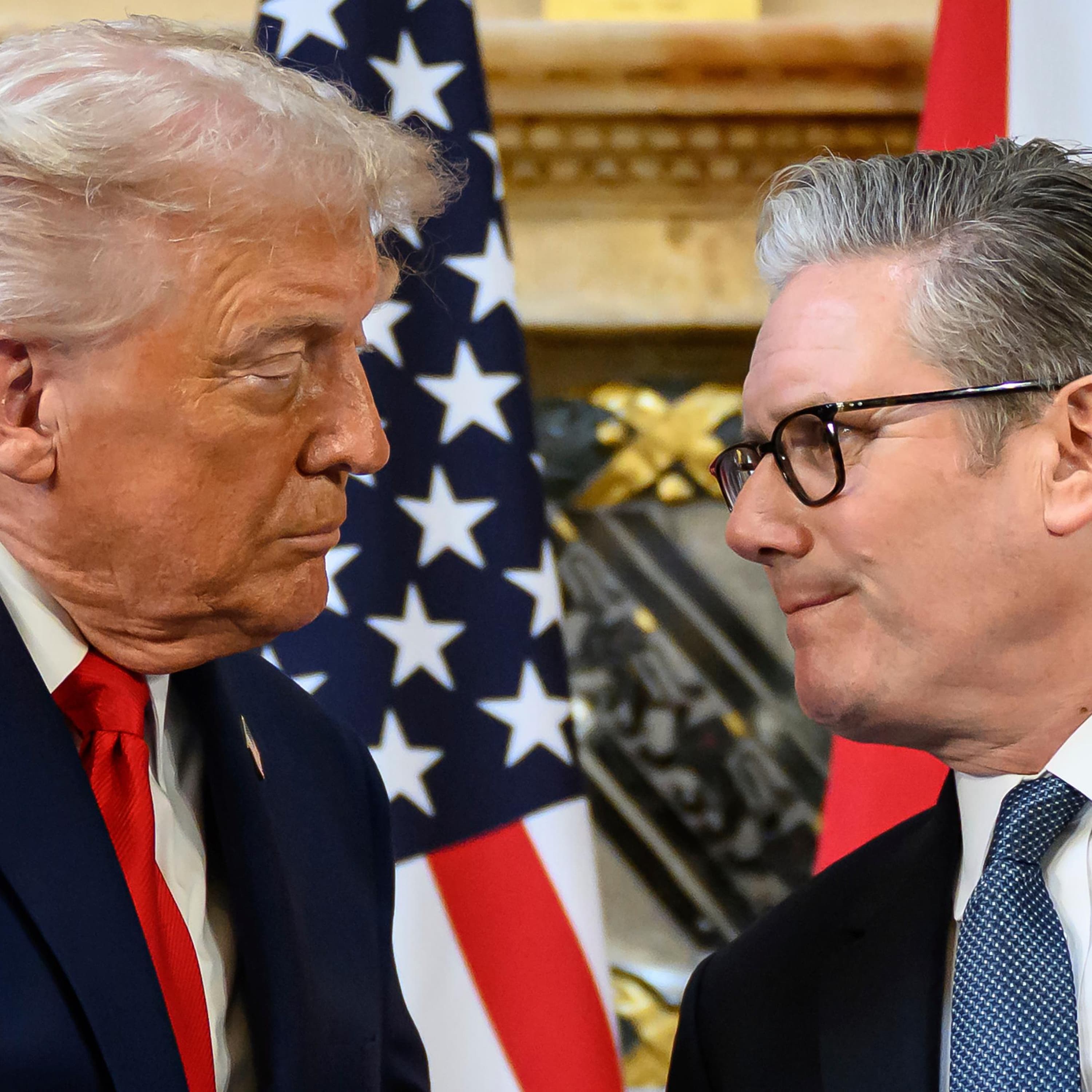
Today in Focus
Starmer, Trump and the shaky ‘special relationship’
00:26:06
Rafael Behr on why Donald Trump’s war on Iran presents a strategic dilemma for Keir Starmer
Loading summary
Transcript79 lines
- [00:00]
Raphael Bair
This is the Guardian.
- [00:07]
Helen Pitt
Today. Starmer Iran and the Shaky Special Relationship.
- [00:18]
Ayo Akimwaleere
This is Ayo Akimwaleere from the Athletic FC podcast. Buying a car should be exciting, not exhausting. And if you're looking for a gleaming SUV to replace your old banger or you're taking the plunge and going electric, the good news is you can buy your car completely online on Autotrader.
- [00:35]
Raphael Bair
Really?
- [00:35]
Ayo Akimwaleere
Just go to autotrader.com and get picky. Search through dealer listings for the make, model, color and the features that matter to you. Then just drop in your info and you'll see all the cars that fit your budget. Really, once you've found the car of your dreams, you can have it delivered to your driveway or you can pick it up at the dealership. Really? So buy your next car entirely online on autotrader. Head to autotrader.com or search the Autotrader app.
- [01:08]
Donald Trump
By the way, I'm not happy with the UK either.
- [01:13]
Helen Pitt
The so called special relationship between the US and the UK has taken a bit of a battering this week.
- [01:19]
Donald Trump
This is not Winston Churchill that we're dealing with. I will say the UK has been very, very uncooper.
- [01:28]
Helen Pitt
Donald Trump was especially unhappy that Keir Starmer initially refused to let the Americans use British bases, including one on the Chagos Islands, which are quite handy if you want to attack Iran with that
- [01:42]
Donald Trump
stupid island that they have that they gave away and took a 100 year lease having to do with perhaps indigenous people claiming the island. They never even saw the island before. What's that all about?
- [01:59]
Helen Pitt
Even though Starmer has since changed course, Trump remains in a hoof. But at Prime Minister's questions on Wednesday, Starmer insisted that the special relationship was just fine.
- [02:10]
Keir Starmer
British jets are shooting down drones and missiles to protect American lives in the Middle east on our joint bases. That is the special relationship in action. Sharing intelligence every day to keep our people safe. That is the special relationship in action.
- [02:27]
Helen Pitt
Still, Kemi Badenok said he was putting himself before his country.
- [02:32]
Ayo Akimwaleere
They might not like to hear it, but they are going to hear it, Mr. Speaker, whether they like it or not. Is it not the truth that he is prioritizing his job security over our national security?
- [02:49]
Helen Pitt
Starmer's response to the war has shifted over the past few days, but is there anything he can say to silence his critics? From the Guardian, I'm Helen Pitt. Why Starmer's position on Iran is pleasing no one. Rafael Bair, you're a Guardian columnist and you, like the rest of us, have been following the fallout of the attacks on Iran on Saturday. And how did Starmer initially react to the news?
- [03:25]
Raphael Bair
Well, the Prime Minister's position at the very beginning was, I think, characteristically judicious, to the point of cagey.
- [03:33]
Keir Starmer
The United Kingdom played no role in these strikes, but we have long been clear the regime in Iran is utterly abhorrent.
- [03:45]
Raphael Bair
Essentially, the view was, we're not going to say anything that's going to condemn American action. The US is still an ally. We're not going to be hostile to what the Americans are doing.
- [03:56]
Keir Starmer
I condemn Iran's attacks today on partners
- [04:00]
Raphael Bair
across the region, but with a clear undercurrent of wariness as to whether or not this is a good idea. And in practical terms, not allowing RAF bases in the region and indeed in the uk, because there's a refueling option, obviously, if you're flying across the Atlantic to use the uk, not allowing those assets to be part of the offensive operation, and that it's entirely precedented. Sometimes the UK will say, look, you know, this is a US Operation. This has nothing to do with us. But more generally, when the Americans go in somewhere, it is almost automatic that the British Prime Minister says, look, if you need to use RAF equipment as part of that, uncomfortably or not, we'll let you do it. And so it was, I would say, fairly remarkable that he quickly said, no, look, that's not happening this time.
- [04:52]
Helen Pitt
Yeah. On the basis that it was illegal. And, you know, this is Starmer, the human rights lawyer again, who has sometimes been a bit missing in action when it comes to condemning questionable decisions made by the Trump administration. For example, I think when Trump effectively ordered the kidnapping of Maduro, Starmer was pretty reticent in terms of criticizing that operation, wasn't he?
- [05:16]
Raphael Bair
Yeah. And there's a number of different things going on here. I think you're right that the undergirding of the UK position is about what is legal in international law. And then overlaid on top of that is also a very clear political understanding that this was going to be spectacularly unpopular with a lot of people in Britain, particularly with Labour MPs, particularly with Labour voters. So I think Starmer's motivation is statecraft and law. I think it probably helped him hold that position that also the politics of this were more on the side of. Let's not just go all in with. I mean, bear in mind also in terms of how his position has shifted towards the current White House regime. Recently, a similar change happened when Trump was really going off the deep end in terms of his ambitions to take hold of Greenland. And again, to begin with, there was a very moderate. The Prime Minister's stance was essentially, he hinted that if there was any difference, it would be expressed in private behind closed doors, and he wasn't going to come out and condemn the US President. And then he did. Over the course of a couple of days, when, you know, when Trump's position was just so bellicose and Europeans were absolutely freaking out, Starmer did nudge the dial more towards criticism. And then in this case, again, we've seen, I think, more significantly now, within, certainly within 48 hours of that initial stammer position, a shift to say, well, for defensive purposes, given what the scale of the Iranian retaliation has been and the indiscriminate nature of it. Scorched earth is the term that Starmer used. Obviously, RAF bases and equipment can be used defensively.
- [07:03]
Keir Starmer
The United States has requested permission to use British bases for that specific and limited defensive purpose. We have taken the decision to accept this request.
- [07:23]
Helen Pitt
Why do you think he made this U turn? Do you think that it was a pragmatic response to a fast moving situation, or is it just yet another flaky Starmer? You know, he just, he changes his direction like the wind.
- [07:37]
Raphael Bair
I would be wary of calling it a U turn, actually, just because there is actually a conceptual difference between saying, use our bases to go and fire missiles on Tehran as part of a project to remove the Iranian regime or assassinate senior figures in that regime, and saying when the Iranian response to that is throwing missiles at any country that is aligned with the US can perceive to be an ally of the us, including RAF bases in Cyprus, UK allies elsewhere, that the UK military actually has an obligation to do something about that. I mean, the bases on Cyprus, that's sovereign UK territory. If a drone attacks it, I don't think anyone would realistically expect the UK position to be, that's fine, that's not our problem automatically has become a problem, so to say, in light of what has now happened, the UK military will be operational in a defensive stance, but still not part of the offensive operations. I think those are consistent positions. The problem is the politics of it. It looks very much like Storm has started off saying, this is not our war. Yeah, we're watching from the sidelines. And now it's saying, well, kind of is becoming our war, so we'll tiptoe towards more involvement.
- [09:09]
Helen Pitt
And how much of Starmer's decision making do you think is influenced by his desire to always attempt to keep Trump on side?
- [09:19]
Raphael Bair
Hugely, this is the most significant foreign policy parameter that he has at the moment. And frustrating though it is to those of us who think the Trump administration is appalling, Trump himself is a despot and a maniac and very dangerous, and a lot of what he wants is hostile to what I see as UK interests personally. It is also the case that for decades, UK foreign policy has rested on an assumption that the relationship with Washington is the most important one. And as a result, particularly in the sphere of defense security, all the. The systems, the chains of command, everything, are thoroughly enmeshed. If you get under the bonnet of what a defence and security apparatus actually looks like in terms of whether you need software upgrades to run your fighter planes, whether you need satellite data to have a good intelligence operation, really important stuff that keeps Britain safe. There are keys and codes and switches that the Pentagon has that can turn off Britain's safety in ways that the Prime Minister is extremely aware of, but doesn't say Al. So he really doesn't have a lot of choice to come out and have what is called, in conventional parlance, the love actually moment. A friend who bullies us is no longer a friend. And since bullies only respond to strength,
- [10:40]
Keir Starmer
from now onward, I will be prepared
- [10:42]
Raphael Bair
to be much stronger. That would be a nice, romantic thing to do that would gratify a lot of people on the liberal left. In hard, realpolitik terms, it's a really dangerous thing to do. And as one Cabinet minister said to me, you have to understand how massively exposed Britain would be if the US decided one day, you're not our friend anymore. How, you know, especially in the context of Brexit, how isolated, how. How actually dangerous to Britain that would be in a global context?
- [11:12]
Helen Pitt
And do you think we are seeing a rupture in that relationship now in terms of how Trump reacted on Saturday to Starmer's initial refusal to allow the U.S. to use our bases, and then him saying, okay, you can, but only for defensive purposes.
- [11:27]
Raphael Bair
There are so many interlocking parts of this that all are difficult to disentangle because Trump's personality is so volatile. And you never know when he says something. Is that a caprice of the moment? Is that a position that will actually manifest as action in policy? Will it manifest in action in trade policy? So the language has been quite stark, given that it was surprising how well Trump and Starmer seemed to get on to begin with. Now sudden Trump said, what, you know, storm is no Churchill. You know, it's terrible. It's very sad what's happened to the uk it's covered in windmills. He calls them wind turbines.
- [12:06]
Donald Trump
They got windmills all over the place that are ruining the country, ruining the landscapes, ruin the beautiful fields.
- [12:12]
Raphael Bair
There's Sharia lawyer, and he just went off on one about a load of culture war talking points.
- [12:18]
Donald Trump
You have a terrible mayor of London.
- [12:19]
Keir Starmer
Terrible.
- [12:20]
Donald Trump
He's an incompetent guy. But you have Sharia courts.
- [12:24]
Raphael Bair
What that means in terms of an actual policy change in the US it's really hard to say. But certainly if you are the Prime Minister, you need to be worried that it turns into the unraveling of trade agreements on technology, that it turns into a spiteful imposition of tariffs on cars or you don't know, but that's the danger. The uncertainty is pretty alarming.
- [12:51]
Helen Pitt
Yeah. And I just wonder what you make of how other European countries have approached the Iran issue. I think in particular here of Spain.
- [13:00]
Raphael Bair
Well, again, there's an object lesson in how things could go wrong. I mean, Pedro Sanchez, the Spanish Prime Minister, was the most forthright, I think, among European leaders in saying, this is wrong, this should happen, it's illegal, it's going to be a disaster.
- [13:18]
Helen Pitt
But.
- [13:19]
Raphael Bair
And he has felt the force of, of Trump's anger even more than Starmer.
- [13:25]
Donald Trump
And now Spain actually said that we can't use their bases, and that's all right.
- [13:30]
Helen Pitt
We don't want to.
- [13:31]
Donald Trump
We could use their base if we want. We could just fly in and use it. Nobody's going to tell us not to use it.
- [13:37]
Raphael Bair
He said we're going to cut off all trade with Spain.
- [13:40]
Donald Trump
So we're going to cut off all trade with Spain. We don't want anything to do with.
- [13:43]
Raphael Bair
That's obviously not something the UK wants to experience. It is, again, worth really underlying here the difference between being in the European Union and not being in the European Union, because ultimately, although Donald Trump might really hate Spain and want to punish Spain, in terms of trade, there is a common external tariff to the eu. Spain is part of the single market. He can be culturally abusive to Spain, but in reality, the relationship is between the US and the European Union, and in trade, it's between the White House and the European Commission, with a bit of European politics behind. That's very different to the relationship between the US and the UK and, and as I say, the UK is just more exposed in that level. We are this sole trader out in the Atlantic. And the downside potential to really getting on the wrong side of Donald Trump if he decides to lash out economically is greater, I think.
- [14:44]
Helen Pitt
Coming up, why Nigel Farage and Kemi Badenoch may come to regret calling for Britain to fully join the war. Chicago 2011. A cop is murdered. Police and prosecutors swear they have the trigger man. He swears he didn't do it. How far will each side go to prove they're right?
- [15:19]
Raphael Bair
Like, it's just one bombshell after another. You know, you're like, what? What?
- [15:24]
Helen Pitt
The story of a PlayStation, a brain eating amoeba and the relentless pursuit of justice. Off duty coming soon. Listen, wherever you get your podcasts.
- [15:37]
Raphael Bair
Raf.
- [15:37]
Helen Pitt
This has come at a very bad time for Starmer. Domestically. Labour, of course, came third behind the Greens and reform at the Gorton and Denton by election last week. And There was a YouGov poll on Tuesday which put the Greens above Labour, second to Reform. Were there to be a general election tomorrow. So essentially, Starmer's popularity is in the toilet. How do you think this will impact
- [15:58]
Raphael Bair
him politically in terms of the broader political prospects for the Prime Minister, as you say, in the context of losing a by election to the Greens, Absolutely terrible poll ratings is. Does any of this now really shift the dial when you've gone to a place in polling that pretty much by historical precedent, no one ever comes back from? Now, I've put this to Labour ministers. I put it to people who are the last remaining friends of Keir Starmer, and they will say, we live in massively unprecedented times. Who knows? You can't just write anyone off. All sorts of unexpected things happen, but the reality is at a certain depth at the bottom of the ocean, the pressure of water above you just crushes the life out of you and you can't float back up again. Keir Starmer is in that place.
- [16:51]
Helen Pitt
Yeah. And how are the leaders of the other parties confronting the Iran issue?
- [16:57]
Raphael Bair
This is fascinating, I think. I mean, the easy one is on the Liberal on the left side. So Ed Davey and the Greens are able, because of who their supporters are and because of what their positions have always been, to say, this is a mistake, it'll go wrong. Look at all the precedents we have seen before.
- [17:13]
Keir Starmer
What happens when an American president launches
- [17:17]
Raphael Bair
an illegal war with no idea how
- [17:19]
Keir Starmer
or when it is going to end and we fear for what comes next.
- [17:25]
Raphael Bair
Zach Polanski for the Greens has been more forthright. He's called for Keir Starmer to condemn the war. I understand why he says that. I don't think it's a very realistic thing to expect a UK Prime Minister to do, to condemn a US president in the middle of a war. War in bold terms. But Zach Polanski isn't the Prime Minister. And so he can say that. And I think a lot of people will wish that was something that Keir Starmer would and could do.
- [17:48]
Ayo Akimwaleere
Dragging the UK into another illegal war does not make us any more safe. And polling shows over and over again that the majority of people in this country do not want our UK bases to be used by US military. And the only reason why this is happening is Keir Starmer is incapable of standing up to Donald Trump.
- [18:08]
Raphael Bair
All these things are true, but they're also kind of platitudes because there were negotiations and the Americans ignored what was happening and then just assassinated the Supreme Leader of Iran. So to have an anti war position that essentially comes down to, well, we wouldn't start from here and we wish the world were different and we wish we weren't entirely dependent on the US has a kind of moral resonance to it. It's not actually a policy prescription that the Prime Minister can use. On the right hand side, that's even more interesting because there, both Kemi Badenoch and Nigel Farage were all in straight away, absolutely gung ho behind it. Yes, the UK should jump on board with this.
- [18:53]
Keir Starmer
Look, there are times to say no to the Americans. Absolutely. You know, we should have said no a couple of times in the last 25 years. And of course, because Saddam Hussein didn't pose any direct threat to this country, they had to invent a threat. I would argue in the case of Iran, since the 7th of October, this country has fundamentally changed as a result of terrorism funded by Iran. And frankly, if this, if this operation stops Iran getting a nuclear weapon, it would have been worth it. And I believe that very, very strongly.
- [19:29]
Raphael Bair
Cami Badenoch made quite a peculiar statement.
- [19:33]
Ayo Akimwaleere
Across the uk, there are groups whose political loyalties when it comes to conflicts in the Middle east, do not align with British national interest. These are people who Labour see as their voters because without them they cannot stay in power.
- [19:48]
Raphael Bair
She said that the only reason Starmer's wibbling about these. I'm paraphrasing here, the only reason's wibbling about international law is actually because he's pandering to certain people who, you know, when it comes to Middle east policy, their instincts don't align with British interests.
- [20:04]
Helen Pitt
And what's that, a dog whistle?
- [20:06]
Raphael Bair
Well, yes, there's just a whistle. He's saying there are Muslims who and labor mps have them in their constituencies. And therefore the idea that the UK would be in a position in an international arena where it's effectively fighting on the same side as Israel would be absolutely toxic to those people, to Labour MPs. Keir Starmer's afraid, therefore he's not doing it. And somewhere in that there is a political observation of a fact. You know, it is true that a lot of Muslim voters will be very upset about the idea of another gung ho intervention in the Middle east, particularly on the side of Israel, and that a lot of Labour MPs will be very uncomfortable if the UK seems to be associated with that. But also there are an awful lot of British voters of all demographics and ages and inclinations who won't support this.
- [20:56]
Helen Pitt
Yeah.
- [20:57]
Raphael Bair
And the Farage Badenoch position is actually incredibly niche. And although they have the Conservative and right leaning press on their side, you can't help feeling that some of this is captured by a Twitter X American coded radical right wing information ecosystem. And that the Badenoch Farage position is extraordinarily loyal to Donald Trump in a way that is basically disloyal to the UK's interests. You can say that maybe it is in Britain's interest to not annoy Trump at all and therefore to be more supportive. In this case, that's an argument. But to essentially say we think that UK foreign policy should submit itself in the mercenary way to whatever Donald Trump says and wants, which does seem to effectively be the Farage Baden opposition. I don't think that's a popular position in the uk, and I don't think it's necessarily even a very patriotic position. I think Farage and Badenoch could look quite quickly, very stupid for having said the UK should have been absolutely shoulder to shoulder with the US on this.
- [22:13]
Helen Pitt
Yeah. I mean, there was a poll from YouGov that showed 49% of Britain, so almost half, oppose the US strikes on Iran, compared with just 28% who back them. So as you say, there's far from universal support for doing whatever the, the Americans want.
- [22:29]
Raphael Bair
And also, who the hell knows, there was a majority support for the Iraq war in 2003 and a lot of people who just marginally, but a lot of people who. You won't find a majority of people who were alive then who will say that they supported him. Because people's memories get recoded when they realize what disaster it was. But it was not at all clear cut for a lot of people how much of a disaster it would be. And history has then sort of refashioned that in the public memory is obviously a disaster that everyone was against. My concern, actually, about how a really protracted, messy unraveling could feed into politics is more on two fronts, two different fronts. One is the economic one. I think if you have a prolonged energy price spike, that then becomes inflation and queues at petrol pumps, all that sort of stuff. We don't know for sure that's going to happen, but that's clearly a risk.
- [23:24]
Helen Pitt
Yeah, definitely.
- [23:25]
Raphael Bair
The impact in domestic politics, people don't care really what caused the inflation, they just hate the government that presided over the inflation. So that's one. And the other one is remembering quite how direct the feedback loop was between the Syrian civil war, massive outflux of refugees into Europe and how that then stirred a radical right wing reaction in Europe against refugees. The situation is all the more fissile politically and that the atmosphere is that much nastier now that the danger of there being a lot of Iranian refugees who are desperate for somewhere to go to, they're not going to go to America, they're going to end up in Europe. And what that does to politics and our politics, that for me is a greater concern than the idea that we're having another argument like the one we had around Iraq in 2003.
- [24:17]
Helen Pitt
What are the risks that the UK gets drawn further into this? We're talking at a time when UK Navy warships are on their way pretty slowly, it seems, to the Middle east that the bases in Cyprus are being used for the us
- [24:32]
Raphael Bair
I can only guess and speculate here. Like everyone else, I think the position will remain that defensive operations in order to protect UK assets and UK personnel and civilians in the Gulf will stay. But actually, you can push the definition of defensive quite far into. Because if Iranian missiles are raining down on Gulf cities that contain a lot of UK expats, then do you fly RAF operations to shoot those down? And at what point does trying to strike at the bases that are launching missiles in Iran cease to be a defensive operation and look like an offensive one? You're firing missiles into another sovereign country. So I think the potential for mission creep, not necessarily because Starmer suddenly decides that he wants to listen to Kemi Badenok and Nigel Farage and get closer to Donald Trump, but just because there are UK interests in the Middle east and if there's a massive conflagration that starts to sweep across the region, the requirement to defend and protect those UK interests becomes a blurred line between what's defensive and what's an offensive operation. So, yeah, I think mission creep almost inevitably by virtue of the fact that the UK is a US ally, is an ally of Israel in defense and security operations, and has interests in the region. It seems that's a very high risk.
- [25:56]
Helen Pitt
Raf, thank you very much.
- [25:58]
Raphael Bair
It's a pleasure. Thank you.
- [26:02]
Helen Pitt
That was Raphael Bair. You can read his really interesting column on all of this@theguardian.com and just before we go, I just wanted to recommend our sister podcast, Politics Weekly uk. On this week's episode, the Guardian's defence editor, Dan Saba, is talking to Kieran Stacey about what the Iran war means from a security perspective. You can find that wherever you get your podcast. This episode was produced by Alex Atak, Eli Block and Sundar Zabdi and was presented by me, Helen Pitt. Sound design was by Brian McNamara, and the executive producer was Elizabeth Kassin. We'll be back later today with the latest.
- [26:48]
Raphael Bair
This is the Guardian.