← Today in Focus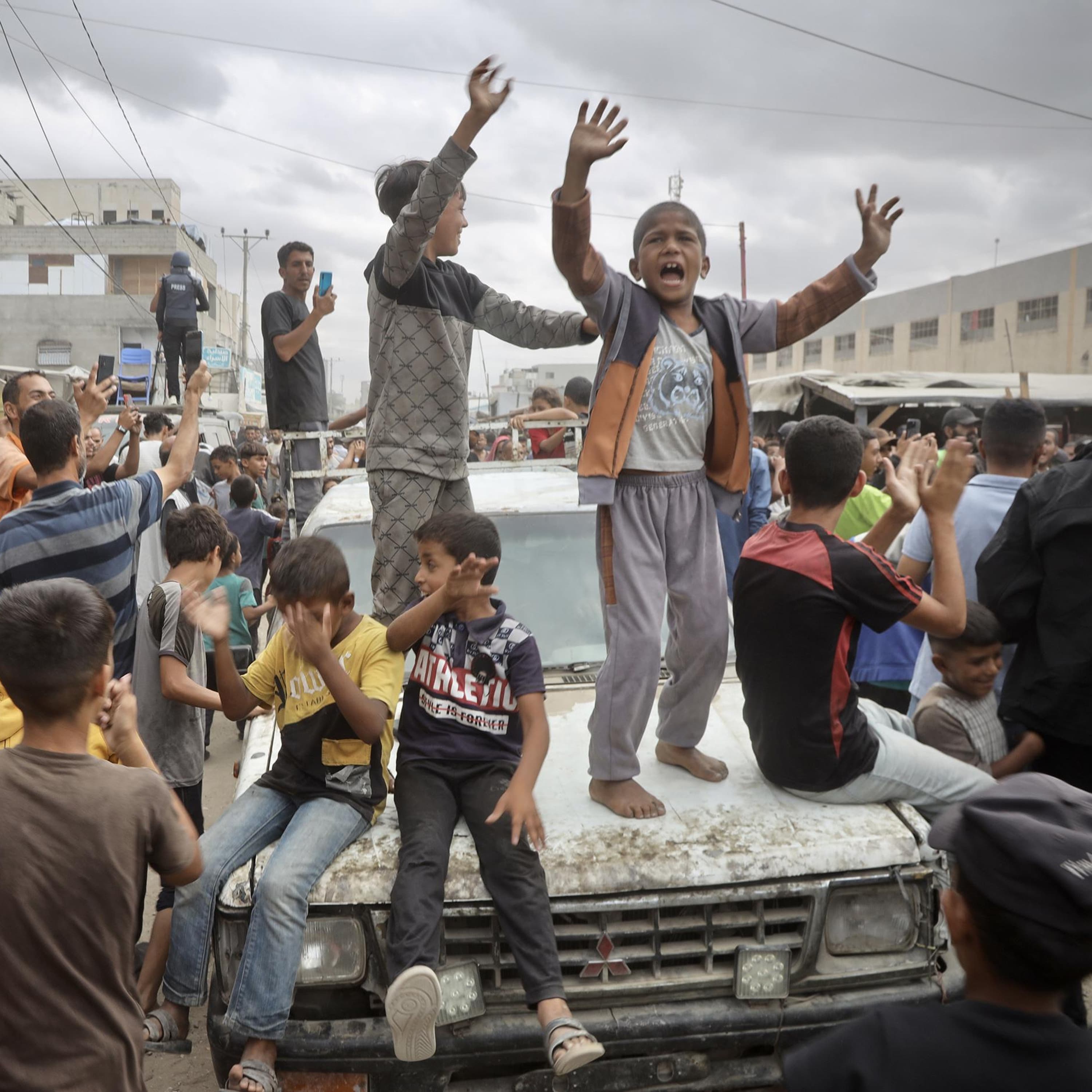
Today in Focus
‘Thank God we witnessed this’: Palestinians on the ceasefire deal - Today in Focus Extra
Loading summary
Transcript26 lines
- [00:00]
A
This is the Guardian. This afternoon, the view from Gaza on the day of the ceasefire agreement.
- [00:22]
B
Hi, I'm Darina, co founder of Quo. You might know us as openphone. My dad is a business owner and growing up, he always kept his ringtone super loud so he'd never miss a customer call. That stuck with me when we started kuo. Our mission was to help businesses not just stay in touch, but make every customer feel valued, no matter when they might call. Quo gives your team business phone numbers to call and text on your phone or computer. Your calls, messages and contacts live in one workspace so your team can stay fully aligned and reply faster. And with our AI agent answering 24. Seven, you'll really never miss a customer. Over 90,000 businesses use quo. Get 20% off@quo.com tech. That's quo.com tech and we can port your existing numbers over for free. Quo. No missed calls, no missed customers.
- [01:32]
A
In the early hours of this morning, while it was still dark outside, Palestinians in Gaza crowded around their phones and television sets as the news broke. Hamas and Israel had finally agreed to the initial phase of a ceasefire plan for Gaza. Donald Trump broke the news on his Truth Social platform, heralding in what he called the first steps towards a strong, durable and everlasting peace. Previous ceasefires have collapsed, but this agreement could be the best hope yet for an end to Israel's two year war on Gaza. It has already killed at least 6,67,000 people and left 170,000 more injured, overwhelmingly civilians. Almost the entire strip has also been reduced to rubble. In the first step that's been agreed. The remaining 20 Israeli hostages believed to still be alive will be released perhaps as early as Monday, and the remains of 28 others will be returned to their families. As many as 1,700 Palestinians held in Israeli prisons are due to be freed in the coming days or weeks, and the Israeli military is preparing to partially pull back their troops. A lot of the details in Trump's 21 point peace plan are still unclear, like how or if Hamas might put down their weapons, whether they'll agree that they will have no further political role in Gaza, and whether Israel will ever completely withdraw from the Strip. But despite all of this, the news was met with jubilation and relief in Israel, where relatives anxiously await the release of their loved ones taken hostage. And in Gaza, where it means that tonight, for the first time in a long time, Palestinians can go to sleep without the fear of airstrikes. From the Guardian, I'm Annie Kelly. Today in Focus, extra hope and Uncertainty in Gaza on the day of the ceasefire agreement. So, Anselm Tantish, you're an English literature graduate in Gaza. Can you just describe to me, like, the moment you first heard this news, how did you feel when you heard that a ceasefire had been announced?
- [03:51]
C
Honestly, my feelings are mixed between deep sadness and a bit of joy. Like, hearing about the ceasefire was something that we waited for with all our hearts patiently. We, we were waiting for, for hearing that, like, thank God, Thank God we are still alive and still healed here, that we witnessed this moment. Effy.
- [04:16]
A
And were you expecting this? Was, was everyone very hopeful that this news would come? Or did this come as a surprise to many people there?
- [04:23]
C
Actually, because we have been through this so many times now, we had to wear broken yet this time it was like somehow we were certain that everything is going to be okay because the efforts that the countries around have felt that it's going to be done this time. I feel very hopeful about what is happening and still. But at the same time, things still feel uncertain and hard to trust. For now, we can only let things move forward and see what comes next. Like, I believe this could be the end of a dark time. We have been for two years and I believe it's the beginning of something new and something better for Gaza and Gazans and for all people around in the world.
- [05:13]
A
And tell me a bit about what you think that the next two or three days will hopefully look like for Gaza. Have you seen any signs of the ceasefire? Have you seen the military attack stop? Or is it really too soon to kind of feel that effect yet?
- [05:26]
C
Actually, I'm still hearing the sounds of drones and the sounds of planes. It doesn't stop yet. What I'm looking forward to see is just getting back to Gaza. This is exactly what I'm imagining, just leaving this area and just go to Gaza.
- [05:45]
A
You want to go home to Gaza City?
- [05:47]
C
Yeah, home.
- [05:58]
A
Mai Alawada, you're a communications officer for medical aid for Palestinians. Could you tell me how you felt when you first heard the news of the ceasefire?
- [06:06]
D
Well, it was really a mix of feelings. Well, because we have, we have went through this many times, but. But now it's really happening. And I can't believe, I can't believe that this is really ending and we will be given a chance to take a breath and to understand everything we have been going through and to really, I mean, to mourn those people whom we've lost, to process, to process the idea that everything now is ended.
- [06:40]
A
And can you just describe to me where you are right now, like, where is it that you're staying and what is it that you can see around you?
- [06:49]
D
Well, I'm now in the middle area of Gaza Strip, well, technically in southern Gaza, in and from where I'm staying now, dozens, I can see right now from my window dozens of tents who have been doubled and tripled over the past month where the Israeli army ordered people in northern Gaza to leave their homes. And I really wish that those people in this week would go back to their homes and the aid of shelters would be provided to them. I hope that their way to northern Gaza, back to northern Gaza is a safe route in which they would go this time for good. I feel overwhelmed, actually. I feel until this very moment I am in denial because really, really, I really wish for all those people whom we, as humanitarians have been feeling helpless. I hope that this time we would be able to promise them that we will scale up our support, our humanitarian aid that they will pretty much need now, specifically after the war has ended. They need shelters, they need very basic needs, food, clean water, medications. Because, you know, the ceasefire doesn't end Gaza's health and humanitarian catastrophe. And we will. Palestinians, until until now, we continue to face starvation and disease and forced displacement and any delay in much needed aid being delivered and, you know, at scale and will cost more lives.
- [08:26]
A
And you're obviously expressing a lot of caution, understandably as well, from all the humanitarian work you've been doing. Is that caution shared by your family and friends or. Or is this kind of a general sense of uncertainty?
- [08:39]
D
Absolutely. But we have faith, we Palestinians, we don't. We are fed up with words, without actions. So without true action, of unobstructed aid, of true stop of killing, of not forcing people to leave their homes and the areas they are staying in, all of this would be meaningless. So I can't hide it. I can't hide it. I am optimistic. But I really, really call on everyone in power to make this actual and real.
- [09:19]
A
Anselm, can you tell me a bit about what life has been like for you and your family over the last two years?
- [09:25]
C
Words are not enough, actually, to describe all of what I have been through. Like we lived through fear, loss, hunger and endless nights not knowing if we, like, if we would survive or going to die. Like, I was displaced from my home so many times. Can you imagine that you had to leave everything behind, your stuff, your luggage, your box, your whole life at your home and just run away? And that pain stays with me and will never, ever in my life. Yani, Will will left my heart and
- [10:04]
A
the details of the plan are complex. It's all quite vague. This next phase is obviously going to see the release of the Israeli hostages and the Palestinians held in Israeli prisons. Do you feel hopeful that the rest of the plans, like the planned withdrawal of Israeli troops and all of those other details that have already been outlined in the plan, Are you hopeful that this will come to pass, that you'll actually see this happen?
- [10:27]
C
Yeah, for being honest, Wallah I hope that everything is going to be all right and everything is going to be done 100%. What is left to do? If they didn't stuck to the plan, I guess we are going to die. That's exactly what's going to happen because nothing is left in Gaza. Expected people, Gazans like they are destroying buildings. They destroyed our dreams, they destroyed our house, homes. Nothing is left behind especially people, humans, bodies, blood. That's it. I hope that everything will attune hurts me sometimes, but yet it's powerful. Like it is what keeps me alive and it is what reminds me that the better days are yet to come. And even after everything, we're still, we're still there to help. And as long as we have hope, I guess we have the strength to keep forward.
- [11:31]
A
And you know, Anselm, you're only 23. You're really young woman. Does this moment like, do you think it will eventually allow you to start thinking about your own future, about your life ahead, or is it just too soon for that?
- [11:43]
C
I'm studying to be a teacher and that's actually what I'm looking forward to be a teacher, to teach kids English and to show how powerful our message to the world. And that's exactly what kids need in Gaza currently. Education, education, education. You know, a few years of being disconnected, education is something horrible actually. And that's exactly what made me take the step and study education.
- [12:13]
A
Lansome, I really, you know, I really, really hope that this peace holds, that it's an enduring peace, you know, and I really hope that all of your dreams of the future do as well. So thank you so much.
- [12:24]
C
Thank you. Thank you so much for having me. It's my pleasure. Walla.
- [12:29]
A
That was my Elawada and Ansam Tantesh in Gaza. My thanks to them. You can keep up with this story as it develops@theguardian.com this episode was hosted by me, Annie Kelly. I'll be joining the team as a presenter from now on. It was produced by Eleanor Biggs, Alex Atak and Eli Block. The executive producer was Sammy Kent. We'll be back tomorrow. This is the Guardian.
- [13:14]
E
Quen no esperas Buenos precios para lo que usas todos los dias. Descarga TikTok. Ahora si puedes r. TikTok Slash e free. Tedeja bajar el presio astacero. Descarga TikTok Busca free y compartelink para consegir productos gratis MPSA notienestiempo paracerias largas and TikTok I short dramas infinitos paraver cuando quieras rapidos faciles de seguir y addictivos. Descarga TikTok Aurora ympiesa average.