← Today in Focus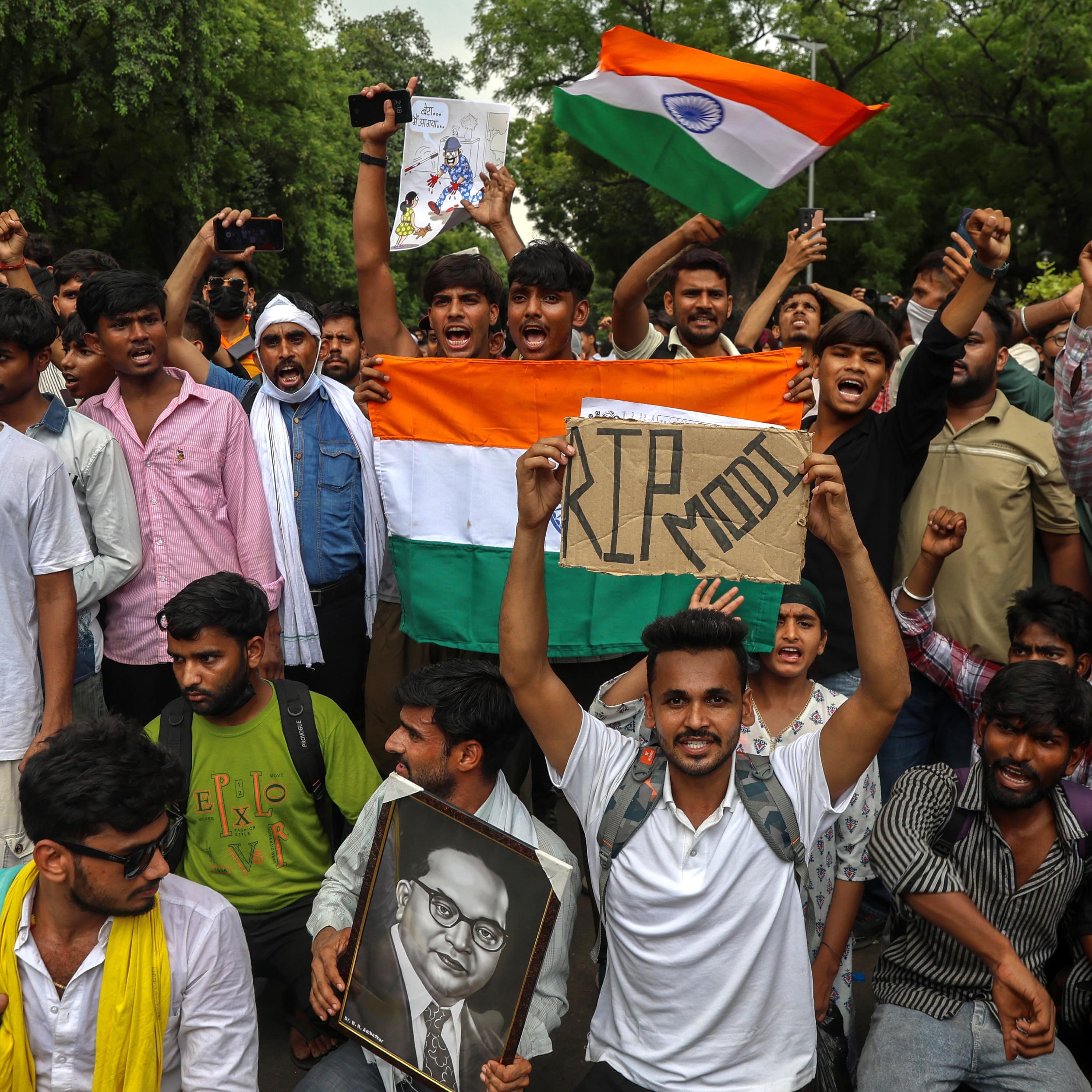
Today in Focus
The ‘cockroaches’ marching on India’s government
00:25:44
South Asia correspondent Hannah Ellis-Petersen on the Cockroach movement – and the students driving India’s biggest protests in years
Loading summary
Transcript84 lines
- [00:00]
Hannah Ellis Peterson
This is the Guardian.
- [00:10]
Helen Pitt
Today, the cockroach is marching on India's government.
- [00:21]
Podcast Advertiser/Host
From globalization to innovation sustainability to market volatility, there's always more than one side to a story. Explore different perspectives on today's most important business and economic issues with the Flipside podcast from Barclays Investment Bank. Hear two research analysts in a lively debate and get insights from every angle. To further inform your view, listen to the Flipside on your favorite platform.
- [00:50]
Helen Pitt
The Guardian. South Asia correspondent Hannah Ellis Peterson was at home in Delhi on Sunday when her phone started blowing up.
- [00:58]
Hannah Ellis Peterson
I'd actually been receiving WhatsApps all night by lots of young people I know just saying come down. It's amazing here.
- [01:06]
Helen Pitt
Here was the heart of India's capital where protesters were gathering in a park in New Delhi's government district.
- [01:12]
Hannah Ellis Peterson
And so I set out around 7am and I headed down into central Delhi. Already the roads were closed by the time you got to the center of the city. Your phone Internet stopped working. As I drove around the city, you could just see people pouring in from everywhere. From the metro stations. People were using auto rickshaws to get around the police barriers. You know, it just got bigger and bigger and bigger.
- [01:45]
Helen Pitt
Protesting in India can be a risky business. But this time the demonstrators were too furious to care. Demanding changes to India's flawed and often corrupt education system.
- [01:56]
Hannah Ellis Peterson
The main thing that these protests were demanding was the resignation of the education minister.
- [02:01]
Protester/Activist
We want him to resign and take accountability and so that a better person can take the position.
- [02:06]
Hannah Ellis Peterson
And then also more broadly a kind of reform of an education system they feel is failing them.
- [02:12]
Protester/Activist
The absolutely crazy corruption that's so blatant. So I think it's all those issues and more that's just coming together.
- [02:19]
Helen Pitt
The members of this movement refer to themselves as cockroaches and they turned out in their droves.
- [02:25]
Hannah Ellis Peterson
I've never seen this many young people in particular out on the streets. I'd say 50,000 and 100,000 is the estimate that people are now going with.
- [02:33]
Protester/Activist
All the Gen Z of India is here. I am a working person. I have taken a day off and I have coming because today is the time I have to smoke. We have to smoke that. Please government have some accountability.
- [02:45]
Hannah Ellis Peterson
And in a country that has really seen a kind of crackdown on dissent. I haven't seen this kind of level of protest in the seven years I've been in India.
- [02:59]
Helen Pitt
As the protests spread across India and even to the uk the Indian Prime Minister Narendra Modi is coming under increasing pressure.
- [03:07]
Hannah Ellis Peterson
I mean, there's 600 million plus young people in India. So when they actually came out as a collective, there was a sense that actually we do have some power and we do have a voice. We can change the future of India.
- [03:20]
Protester/Activist
Yes, we are the future of India. Government is already scared of us.
- [03:29]
Hannah Ellis Peterson
While the Modi government remains extremely powerful. Ignoring 600 million plus young people is something that could genuinely become a real problem for them if this continues.
- [03:41]
Helen Pitt
From the Guardian, I'm Helen Pitt. Today in focus. From a leaked exam paper to a mass movement. Meet the cockroaches. Hannah Ellis Peterson, welcome back to Today in Focus. Always a pleasure to have you on the show. How are you?
- [04:00]
Hannah Ellis Peterson
I'm very good, thank you. Lovely to be here.
- [04:03]
Helen Pitt
So we've seen this recent movement of young people in India taking to the streets, and they've called themselves the Cockroaches, which I think is a very intriguing name. Talk us through the origin of the Cockroaches.
- [04:15]
Hannah Ellis Peterson
It was really just started as a satirical joke, but based on something that really was very serious, which is the chief justice of India, one of the most senior, most powerful figures in the a Supreme Court hearing, made a comment about young people and how they didn't have any jobs and they were just, you know, activists and cockroaches and parasites on society. The chief justice later denied making these comments and said they'd been taken out of context. But nonetheless, the line still really caught fire online. You know, young people who have had a lot of frustrations were really angry about this. And Abhijit Dibke, an Indian student who is studying in the US just put out a line on social media saying, what if all the cockroaches came together together? And the response was huge. So many people replied to him. And so he decided to make a website, make a satirical party. He called it the Cockroach Junta Party, which is a play on the ruling Bhatia Janta Party. And it had a very funny, very dark manifesto which kind of touched on a lot of things that really were true, which is about young people being ignored, about a suppression of the media erosion of democracy. But it was just kind of a joke website.
- [05:24]
Helen Pitt
And the party has a tagline, right? A political party for the people. The system forgot to count. Why has that touched a nerve among young Indians?
- [05:32]
Hannah Ellis Peterson
Because it's true, you know, on both sides of the political divide, there is a sense that young people's issues are just going ignored. They're not seen as important voters. And so it was interesting. So, you know, he built this satirical website. They put on an Instagram page, you know, within two weeks it had 22 million followers. Abhijit Dibke realized there was something more here that actually he had tapped into
- [05:55]
Protester/Activist
something that is when I realized maybe the youth here is trying to send a message. They told me that they are really dissatisfied with all the existing political parties and it's because nobody listens to them, nobody even talks about them.
- [06:07]
Hannah Ellis Peterson
And so he looked at what were the issues that really young people felt really strongly about. And the thing he seemed to land upon was this issue of education and specifically this issue of exam leaks. This is an interesting issue because it is a very specifically Indian issue. It's often difficult to explain to people, exam leaks, what does that even mean? But in India, it's critical. There are these specific exams that get people into higher education to study things such as medicine, to go into the civil service, to go into other high profile jobs. And these exams are so competitive and families will put their whole life savings, put themselves into debt to pay for their children to go to schools that help them pass these exams. And the competition is crazy. It's more than 2 million students each year applying for 130,000 places to study medicine. And the pressure on the students is huge to perform because their families have made such huge sacrifices for them to get there. And so what happens is when these exams then get leaked, which they have done on multiple occasions, where, you know, basically people make money by selling them so they're sold to the highest bidder. So that completely destroys the level playing field. And it also means when the leaks get exposed, these students have to retake these extremely grueling exams all over again.
- [07:23]
Protester/Activist
A couple of years ago, I was preparing for these entrance exams too. And I've seen the amount of work students put in, study for 12 to 14 hours a day for years together to build their entire future around one entrance exam.
- [07:32]
Hannah Ellis Peterson
And lots of students just simply can't do it. And some of them have taken their own lives or just had complete breakdowns in the process.
- [07:39]
Podcast Advertiser/Host
As a proud cockroach myself, I demand the resignation of the Education Minister of India, Mr. Dharmendra Pradhan. It is because of your incompetency and corrupted ministry which have led to the death of 17 cockroaches in India.
- [07:52]
Hannah Ellis Peterson
And you have also played and viewed
- [07:55]
Helen Pitt
from London, it seems quite surprising actually that what might seem to be a niche issue, this one medical exam that got leaked, even as you said, it has happened in, you know, in many years in the past, that this is the thing that has got people out on the streets in numbers that have not been seen for many, many years. Is it really just about the medical exams or is that a kind of proxy for a wider dissatisfact?
- [08:21]
Hannah Ellis Peterson
Absolutely. It has become a much bigger issue than that. Certainly, you know, there weren't 100,000 people protesting because of the exams. The leaking of the exam is this idea of kind of the way in which this government seems to be kind of very careless about the future of young people. I would also say that one of the crucial figures that has got involved in this protest is this activist and educationist and very world famous engineer in fact, called Sonam Wangchuk, who is from a north Indian state in the Himalayas called Ladakh. And he kind of dedicated his life to education in Ladakh. You know, he could have gone around the world with his incredible inventions, but he stayed and he dedicated himself to a school that he's built there. Last year he was jailed for his activism. He was tarnished as a, as a terrorist. Has happened to a lot of people who've stood up against the Modi government. And after he was released this year, he has pledged his support to the Gokraj Junta party. And at the end of June he basically said, I'm going to go on hunger strike. CJP or Ladakh until the education minister resigns. And hunger strike has a lot of history in India. It's very associated with Gandhi, you know, the independence movement. So this is, this is a real kind of big symbol of commitment by Son and Wangchuk. And over the course of weeks it gained a lot of momentum, a lot of attention.
- [09:42]
Helen Pitt
While you scroll past this video, a
- [09:44]
Protester/Activist
man named Sonam Wangchuk is putting his
- [09:47]
Helen Pitt
own body on the line, demanding accountability for millions of students like you.
- [09:51]
Protester/Activist
Man has been sitting on a hunger strike for weeks together along with a lot of other young students who are disappointed. And somehow this is still not enough for the government to respond and take accountability.
- [09:58]
Hannah Ellis Peterson
And the government didn't make any comment. This man was essentially slowly starving to death. And there was no response from the government until on Saturday morning, very early in the morning, the Delhi police sent in officers and forcibly removed him from the site and dragged him to a hospital. And the video of him being forcibly removed went absolutely, absolutely viral, went across Indian social media. And for students who felt like this is a man who'd put his life on the line for them, when a call was made for students then to come out on Monday and march to Parliament, they felt, well, you know, we owe this to him all your life.
- [10:32]
Protester/Activist
I'M assuming there was a point where you were suppressed by someone or something and you wish that you spoke up, but you could never. This is. And this can be a point in your life where you are no longer being suppressed.
- [10:44]
Hannah Ellis Peterson
And so a lot of the students that I. Not just students, young people, actually, even older people who came out on Monday had also been driven there because they said, you know, this is not what a democracy does and this is not how we should treat someone like Sonam Wangchuk.
- [10:58]
Protester/Activist
And he's not a person that you can tarnish easily. You know, he has a pretty immaculate reputation. So the fact that he's come here, he's been fasting, people can. He's a figure that people can actually get around.
- [11:07]
Hannah Ellis Peterson
So how do you feel about what they've done to Sonom Wangchuk, how they've treated him?
- [11:11]
Protester/Activist
Sonam Wangchuk, he's an Indian scientist, a brilliant brain. But a brilliant brain is coming on street, having a Hun strike. It's. It's a shame on India. He just speaking for the student, he's speaking for us. So we are here working for the
- [11:25]
Hannah Ellis Peterson
Sodam Banjuk and a lot of people were repeating the core demand that they wanted the Education Minister to resign.
- [11:31]
Protester/Activist
He's the Education Minister of India and he's not educated at all. Yeah, this is. This is the contrary of the India. So, yeah, go. Prathan goes.
- [11:40]
Helen Pitt
And is it a big deal in modern India to take to the streets? I mean, India always prides itself on being the world's biggest democracy, but is it a dangerous thing to put your head above the parapet and go onto the streets and have your voice heard?
- [11:54]
Hannah Ellis Peterson
It can be, yeah, absolutely. I mean, the most prominent protesters of the last 10 years, most of them are in jail. They've had police raids against them, they've had police cases filed against them. There is an enormous amount of fear. And that was the thing that was very interesting because on Monday, there didn't seem to be the fear. People actually were raising all different kinds of slogans about the government.
- [12:16]
Protester/Activist
We have been seeing that anyone who tries to question this government, they tried their best to silence them. There's fear in the minds of people that they think a lot before, you know, speaking up. It just shows that they are not fearful anymore. They want justice.
- [12:34]
Hannah Ellis Peterson
But what then happened was towards the afternoon it shifted, there started to be police retaliation against the protesters. There was tear gas. They started to lattice charge and use these police batons against them. They pushed back barriers against them.
- [12:50]
Protester/Activist
They have dragged the students on the Roads. They had beaten them on their heads. Blood was spilled everywhere.
- [12:58]
Hannah Ellis Peterson
And what had been a real protest of kind of joy and solidarity became scenes of kind of chaos and violence.
- [13:06]
Protester/Activist
They brutally attacked everyone. It just shows how barbaric and how demonic the entire thing is. They're beating everyone they were seeing.
- [13:14]
Hannah Ellis Peterson
And there was a lot of anger and a lot of sadness and a lot of frustration that that is how the government felt like they should be dealing with this many young people who were simply out there just to say we have a voice too.
- [13:26]
Helen Pitt
And how were you received as a foreign journalist? Were they frightened of speaking to you? Were they happy that you were there?
- [13:33]
Hannah Ellis Peterson
Oh, they were thrilled I was there. Indian media, particularly mainstream TV media, did not cover this protest. They were not there at all. No, not really. They call them godi media in India, which means lap dog.
- [13:49]
Protester/Activist
Indian journalists are just a puppet for the Modi government. They are just dancing on the.
- [13:55]
Hannah Ellis Peterson
Everyone has something to say. People were happy to give their names. They were happy to talk. They were happy to give their expressions, experiences.
- [14:01]
Protester/Activist
Media does. They obviously have control of all the national media channels. They've made sure that those guys ignore this entire protest. Let's see. I don't see any of them around. But unfortunately, you're in an age of dictatorship. You're also in the age of social media. There's tons of people here getting the message out and that's what's been able to mobilize. So maybe the 20 years too late for dictatorship.
- [14:19]
Hannah Ellis Peterson
Let's see.
- [14:29]
Helen Pitt
And so you were there on Monday and people said that they were going to come back on Tuesday. What did you find when you returned?
- [14:38]
Hannah Ellis Peterson
So I wasn't actually sure there would be many people on Tuesday, you know, given the level of police brutality, what people had endured. And I was actually really wrong. It's astonishing. There are thousands and thousands of people here. There are people with banners. You can't even get to the stage where the kind of main protesters have been camped out. It's an absolute huge wall of people. I can barely see it. And there were even louder singing, even louder chanting. And there was this real kind of sense that this had become not just a single protest, but a long movement. I spoke to a spokesperson for the cockroach junta party, Ratna Singh, and asked her whether or not they had experienced, expected such huge turnout.
- [15:22]
Protester/Activist
You know, the youth of this country is just done with how this current education system is. It is not just about neet exams anymore. Yeah. It is about colleges. It is about, you know, the fee structure. So I think everyone was so, you know, just angry about the fact that nothing is changing in this country.
- [15:41]
Hannah Ellis Peterson
So since then, I've gone down to the protest on Wednesday and then again on Thursday, and there are 30 thousands of people there. Every time I go, it's got bigger. It's really become the place to be for young people in Delhi. People are there serving food. There's been Sikh kitchens giving food every day. There's been a Muslim chef who's been down there every day. There are people from all different communities who have turned out. It's so hot and so grueling there, but when you go down, it feels like a festival and there's just a sense of joy that's really there. And a lot of these posters are, you know, they're really poking fun at the government, but they're really funny. There's loads of memes. I was just walking around talking to people and two guys rush up to me and they hold their phone and it's a photoshopped photo of Modi riding a pig. And they say to me in Hindi, have you seen this man? This man is missing in action. And it's just, I've never had this kind of satire, this idea of poking fun at the government in this kind of way, but in this funny way and in this very fearless way. There is this sense that people have a courage now to speak about the government in the way they never had before and they're using Internet culture to do it.
- [16:46]
Helen Pitt
And has the government responded in any way?
- [16:49]
Hannah Ellis Peterson
So up till late this week, there had been an almost complete refusal by the government to get into a dialogue with these protesters, have any kind of conversation with them. There was a complete intransigence to engaging with their demands. But then on Thursday, in quite a, I would say, telling shift, Modi put out a tweet on social media which said that they would take action against the exams. They would implement fast track courts to punish those who were involved in the exam leaks, which is very significant because in his 12 years in power, Modi has almost never acknowledged any kind of movement on the streets and any kind of pressure on his government. But for the protesters, this was just him trying to pay lip service. He didn't acknowledge the key demand of their protest movement, which is the resignation of his education minister. And lots of people are saying to me, well, why doesn't he just sack him? It's such an easy demand to, you know, appease a mass movement and then you can clear them off the streets. But for Modi, it's much trickier. You know, he operates almost as this court of loyal advisors. And the education minister, Damendra Pradhan, is one of his most loyal ministers. And what he has done, the way in which he's politicized the education system, the privatization of exams, these are things he was actually asked to do. And so Modi is in a very difficult position here because he cannot fire a loyal supporter of his for doing exactly what he's asked him to do without undermining support of other members of his cabinet and possibly creating fractures within this very powerful institution of government that he has assembled and this very powerful, very loyal team of advisors he has around him.
- [18:31]
Helen Pitt
Coming up, can the cockroaches truly challenge Modi's grip on power?
- [18:46]
Podcast Advertiser/Host
Decisions made in Washington can affect your portfolio every day. But what policy changes should investors be watching? Washington Wise is an original podcast from Charles Schwab that unpacks the stories making news in Washington right now and how they may affect your finances and portfolio. Listen@schwab.com WashingtonWise Most people don't realize how
- [19:09]
Podcast Advertiser
much of their personal information is being bought and sold every day. Data brokers are making billions, pulling details about you from public records and the Internet, then packaging and selling it, usually without your consent. That's how your information lands in the hands of scammers, spammers, even stalkers. It's why you get endless robocalls and why ads seem to follow you everywhere. That's where Aura comes in. Aura actively removes your data from broker sites and keeps it off. They also instantly alert you if your information shows up in a breach or on the dark web. But Aura goes beyond data protection. With one app, you get a vpn, antivirus, password manager, spam call protection, dark web monitoring, and even up to $5 million in identity theft insurance, all backed by 24. 7 US based fraud support. Other companies might sell just credit monitoring or even just a vpn. Aura gives you all it together at the same price competitors charge for just one service. Start your free trial today@aura.com safety. Protect yourself. Now@aura.com safety,
- [20:24]
Helen Pitt
Let's talk a bit about India's Prime Minister, Narendra Modi. Because he's, he's a pretty polarizing figure, isn't he? And his critics would say that he's weakened federal institutions. He's been silencing dissent, limiting press freedom, as you've already said, and also India's Muslim minority feel rightly, you may say, threatened under his rule. But at the same time, he does remain an enormous Popularity or that that's how it looks from over here. Anyway, he's been prime minister for 12 years. How dangerous a moment is this for him?
- [20:53]
Hannah Ellis Peterson
So you're very right, his government is very, very popular. The form of Hindu nationalist politics that he and the BJP subscribe to have gained enormous amounts of voters and support in a country which is 80% Hindu. But what is also true is that there is a lot of discontent in the country. And while he successfully managed to undermine almost all opposition movements, that doesn't mean that something can't actually emerge and that there are so many young people in this country. And what's been interesting is this is a movement that's managed to mobilize outside of a lot of the politics that this government subscribes to. But I think what is also true is that when I was out at the protests, the people out there are the children of BJP supporters and they are, some of them are BJP supporters. You know, these, a lot of them are affluent and middle class urban people who are the BJP's core vote bank.
- [21:42]
Protester/Activist
I'm a privileged kid, I have studied in private school. I don't need this, I never give any exam. This is only, you know, a reason for a middle class family to, you know, stand for themselves.
- [21:53]
Hannah Ellis Peterson
And so there is a sense of anger and frustration amongst people who do actually traditionally vote for the bjp. And that's the thing, I think that is different to past challenges to his government. And that's why I think this is a movement that they can't afford to ignore. There is a huge amount of young frustration, there is an enormous amount of youth unemployment. 40% of graduates under 25 don't have a job. And that's a lot of young people with nothing to do and a lot of time their hands to protest on the streets. So whilst the politics of the BJP remains the most dominant politics in India, there is no disputing that and there isn't really an opposition movement. The opposition is so weak. Now the reality is the BJP are extremely powerful and they remain even more powerful after 12 years in power. But they also are there because they have votes. And as soon as that starts to unravel and as soon as a kind of movement starts to gain momentum, that does present a challenge to them.
- [22:47]
Helen Pitt
And who is the opposition in India right now and how are they reacting to these protests?
- [22:52]
Hannah Ellis Peterson
So the opposition in India, the main opposition party remains the Congress party, but it is enormously weakened. It's run by the Gandhi family. Raul Gandhi is the kind of main figurehead but these parties are in power in very few states, they have very few seats in parliament, proved consistently unable to beat the BJP in elections and capture the political narrative. And so they've garnered huge amounts of criticism because there is a sense that they aren't actually challenging the bjp, as lots of people who are critics of the government believe that they should be. Also, the BJP has proved very good at undermining them. You know, they have filed police cases, court cases, tax cases against opposition politicians, which have really undermined the political movement and political parties in opposition to the bjp. But what has been interesting is the opposition parties, particularly Congress, have really seized upon this cockroach junta party movement and given it their full backing. You know, they've raised it in parliament this week. Raul Gandhi was detained by police this week outside of Modi's house, protesting, arguing for him to take accountability for the exam leaks. So there is a sense that, you know, the opposition are really seizing upon this.
- [24:01]
Helen Pitt
Where do you think the cockroach movement are going to go next? What do you think they're going to do in the next weeks and months?
- [24:08]
Hannah Ellis Peterson
So right now, there is huge momentum behind this movement. I mean, some people are talking about possibly a million people coming to the protest site over the weekend, possibly from all across the country. So it feels like this is something that is going to get bigger and bigger. But there is also fear here that the way in which this government rules is that they will only give the protesters so much space. And there is a fear that a ruthless crackdown in some capacity is also coming, and that the only way in which they can really regain the kind of power that's so important to how they govern is to respond with force. And I think it's also interesting, there's talk of kind of how to bring this into a political movement. That's a conversation that's now being had. You know, the point here is that the Modi government has almost decimated the political opposition. And so what people are saying is the cockroach party has actually created space for a new kind of political opposition, for one that could actually, actually represent the voice of young people. You know, they're actually not saying we want to tear down the whole system here. That's very important. They're actually saying, we want to be part of the system, but we want the system to represent us. We want the courts to represent us. We want politics to represent us. We want to be part of parliament. And so it feels like there are people, even if the cockroach Dunter party doesn't become a party in itself, that there are people will emerge from this movement that are actually keen to enter India's political realm and possibly forge a new pathway for what opposition could look like.
- [25:29]
Helen Pitt
There have been youth protests across the region, protests in Sri Lanka, Bangladesh, Nepal. And in Nepal, the prime minister resigned after protests turned violent. And in Bangladesh in particular, they led to the toppling of its long serving prime minister. Do you get a sense, I know, that you keep tabs on countries in the region. Do you get a sense that protest is kind of becoming the new normal for disenfranchised young people in South Asia?
- [25:53]
Hannah Ellis Peterson
I think there's certainly a sense of frustration in all of these countries. I mean, I would say that all of these cases are quite different, but there is a sense, I think, of the same issues of, you know, poor education, lack of jobs, lack of voice, lack of political representation. The things you heard people saying on the streets of Bangladesh and Nepal when I covered them are the same things I'm hearing in India. But actually, the greatest aspiration of many young Indians is to go abroad. They want to study in international universities, they want an international job because they feel like the opportunities, the best opportunities still exist outside of the country. And that's really frustrating because most of them can't afford to do that. That's absolutely impossible. There's also, you know, they're increasingly not being welcomed in these countries. So there is this sense that they have to invest in the place that they're in, that this is the only choice they have now. They have to stay here. The education system, the job system, it needs to serve them better. You know, so many more Indians than ever in history are being educated. They've got higher education. You've got this huge pool of incredibly educated young Indians and there's nowhere for them to go. And so there is just this frustration. And as long as, you know, this keeps happening, I do feel like these will keep bubbling up and simmering. And I don't think that these issues can go untapped for a lot longer.
- [27:17]
Helen Pitt
That was Hannah Ellis Peterson. You can read all of her coverage of the cockroach protests@theguardian.com that is all for today. This episode was produced by Saskia Collette and Alex Atak and presented by me, Helen Pitt. Sound design was by Brian McNamara and the executive producer was Eli Block. We'll be back in your feeds this afternoon with the latest.
- [27:46]
Hannah Ellis Peterson
This is the Guardian.
- [27:57]
Podcast Advertiser/Host
Decisions made in Washington can affect your portfolio every day. But what policy changes should investors be watching? Washington Wise is an original podcast from Charles Schwab that unpacks the stories making news in Washington right now and how they may affect your finances and portfolio. Listen@schwab.com WashingtonWyse Christmas in July is back.
- [28:19]
Hannah Ellis Peterson
Fresh pine, warm spice all July long. Save up to 20 on holiday fragrances, plus a free blanket with orders over $100. No winter required.
- [28:29]
Podcast Advertiser
Visit pura.com Most people don't realize how much of their personal information is being bought and sold every day. Data brokers are making billions, pulling details about you from public records and the Internet, then packaging and selling it, usually without your consent. That's how your information lands in the hands of scammers, spammers, even stalkers. It's why you get endless robocalls and why ads seem to follow you everywhere. That's where Aura comes in. Aura actively removes your data from broker sites and keeps it off. They also instantly alert you if your information shows up in a breach or on the dark Web. But Aura goes beyond data protection. With one app, you get a vpn, antivirus, password manager, spam call protection, dark web monitoring and even up to 5 million in identity theft insurance, all backed by 24. 7 US based fraud support. Other companies might sell just credit monitoring or even just a vpn. Aura gives you all of it together at the same price competitors charge for just one service. Start your free trial today@aura.com safety protect yourself now@aura.com safety.