← Today in Focus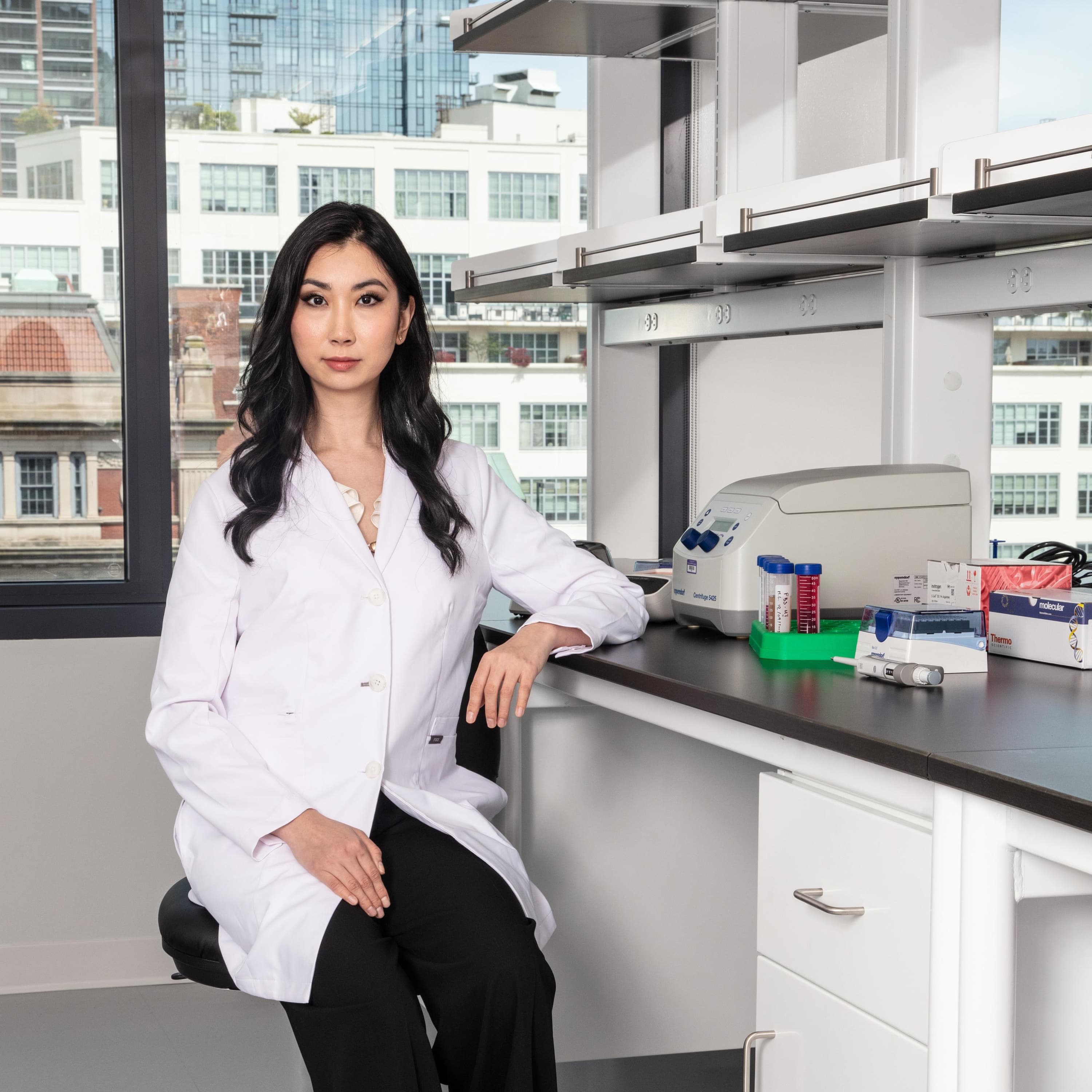
Today in Focus
The dawn of the designer baby
00:32:10
Jenny Kleeman investigates ‘Biotech Barbie’ Cathy Tie, the controversial entrepreneur hoping to revolutionise human reproduction by letting parents edit their embryos
Loading summary
Transcript80 lines
- [00:00]
Jenny Kleeman
This is the Guardian.
- [00:09]
Helen Pidd
Today. The biotech Barbie and her mission to produce better, healthier babies.
- [00:22]
Disruption Play Announcer
Should I stay married, have a kid, buy that house? What if you could know with certainty what you should do before you do it? Disruption is a new play about six friends, one dinner, and a technology that knows them better than they know themselves. A provocative new play about love, ambition and the cost of certainty. Off Broadway at the Pershing Square Signature Center, July 22 through September 13. Tickets@disruptionplay.com.
- [01:07]
Jenny Kleeman
On a Friday night in April, I was in Manhattan, in New York City in Carnegie hall at a very exclusive event. Invite only.
- [01:19]
Helen Pidd
Jenny Kleeman, a features writer for the Guardian, was in the Big Apple for a birthday party. And the birthday girl, Kathy Tighe, was providing the entertainment herself. In fact, she'd even hired out the venue for the occasion.
- [01:36]
Jenny Kleeman
She was wearing this pink shimmering gown with a cape on it. It was a Jenny Packham gown. I looked it up. It costs about £4,000. Playing this Steinway grand piano on stage at Carnegie hall backed by an orchestra. She was playing the Sassonce piece. She was playing it very beautifully, but slightly mechanically and very seriously. And then she stood up and bowed. Then everyone in the orchestra and all of us sang Happy Birthday. It was a bit awkward and a bit weird and we all went upstairs to have a champagne reception on one of the upper floors. And when I was at this champagne reception, I started talking to people. And almost everybody I spoke to had never met Kathy or had only just met Kathy.
- [02:33]
Helen Pidd
Jenny doesn't usually go to strangers birthday parties halfway across the world. But she's wanted to interview Kathy Tighe for a really long time. Because Kathy isn't just any 30 year old. She is the self described biotech Barbie, a serial entrepreneur who wants to edit human embryos to make healthier babies.
- [02:56]
Kathy Tighe
What we're deciding is whether our species will use the most precise biological tool ever developed to prevent suffering, or whether we will let fear dressed up as caution make that decision for us.
- [03:15]
Helen Pidd
But gene editing could also create designer babies, taller babies, cleverer babies, babies with lighter skin. The technology has the power to alter the trajectory of human evolution forever. And when things go wrong, the consequences could scarcely be more serious.
- [03:34]
Jenny Kleeman
Germline editing has very serious safety concerns
- [03:37]
Helen Pidd
that could have irreversible consequences.
- [03:40]
Jenny Kleeman
We simply lack the tools. We're living in this world of hyper optimization. We're all supposed to be hacking ourselves, and now we're hacking our babies too. I think the dial has shifted on what we are prepared to do to optimize our offspring or what some people are prepared to do.
- [03:58]
Helen Pidd
From the Guardian, I'm Helen Pitt. Baby hacking and the biological arms race. Ginny, welcome back to Today in Focus. Great to see you.
- [04:11]
Jenny Kleeman
Very lovely to be back here.
- [04:13]
Helen Pidd
So you're back in London after what sounds like an incredibly glamorous trip to New York to celebrate Kathy Tighe's 30th birthday. And I don't remember playing a grand piano in concert to celebrate my 30th. I think I was in some dodgy pub in Hackney for mine. What's her backstory? How has she got to this position? What qualifications has she got? And how can she already afford to hire out the Carnegie hall for her 30th birthday?
- [04:36]
Jenny Kleeman
She comes from a Chinese family. She wouldn't tell me exactly where she was born. She said it was just outside of Beijing. Her family moved to Canada when she was very young, four or five. And from what I can tell, she was a really, really good student. She's clearly brilliant at the piano. Very, very academic. Was winning vast amounts of money in science fairs as a teenager. She had her first scientific paper published when she was 16. She likes to say that a lot. And in previous reporting about her, it always says, oh, she her first scientific paper published before she was 16. But I actually looked up what paper this was and it's in a journal for school children. So while she did have a scientific paper published, there's a bit of spin there. And that's something you need to bear in mind all the time with Kathy Tighe. There's always a bit of spin. She got in trouble once for missing a biology class cause she was preparing for one of these fairs where she'd win lots of money. And her teacher was angry with her for missing the class. And she asked her teacher, well, what scientific papers have you published? I've had a paper published. She went to university when she was very young and she dropped out at age 18 because she won a fellowship offered by the very famous billionaire Peter Thiel. It's a Thiel Fellowship. At the time it was $100,000 fellowship. Now it's a quarter of a million dollars. He gives these fellowships to people aged under 22 who agree to drop out of university and build something. And it comes from this. I guess it's an idea that smart people are wasting their time at university. They could do better if they went into the real world. And she says from speaking to her, that was clearly the formative experience for her and it's given her this Very, she says useful irreverence, this sense of not wanting to go along with the orthodoxy, challenging things. She was on Forbes list of 30 most interesting individuals under 30 when she was 22. She set up lots of companies. And so yes, she is, as she calls herself, a serial entrepreneur and proud of it.
- [06:41]
Helen Pidd
Okay, so she is clearly a very bright spark, she's very ambitious. But nothing demonstrates the level of her ambition, I think than the last 18 months, does it?
- [06:51]
Jenny Kleeman
Well, I have to say that since the beginning of 2025, it's been quite a ride for Kathy Tighe.
- [06:58]
Kathy Tighe
So how did I end up here? Why am I in this wonderful suite but in New York City with no home, traveling from city to city? What am I doing here? How did I end up here? Record snatch, freeze frame. How did I end up in this situation?
- [07:12]
Jenny Kleeman
She started it by announcing her first ever biotech startup, which was a company that sought to genetically engineer exotic pets for wealthy pet owners. And then she moved to Beijing, or at least she tried to move to Beijing because she fell in love with He Jiankui, who is probably one of the most notorious scientists in the world. So a Chinese scientist helped create the world's first genetically edited babies. He is going to jail. His name is He Jiankui of China. He is going to be in prison for three years for carrying out what the Chinese government says were illegal medical practices. And following his release from prison, she was communicating with him. She met him, fell in love with him, tried to move to Beijing to be with him. But when she was on her layover in Manila, she was informed that the Chinese authorities would not be allowing into Beijing. So she spent a while in limbo trying to work out what was going on. Eventually she moved back to Toronto, which is where she's originally from. She's from Canada. Her marriage to He Jiankui dissolves. They were separated.
- [08:22]
Helen Pidd
Later on we're gonna talk more about this short lived husband and why his work was so controversial. But spoiler alert, it involves some real life human twins. But can you first tell us about Cathy's latest company, Origin Genomics?
- [08:36]
Jenny Kleeman
Kathy Tighe wants to use germline gene editing to stop serious diseases, genetically inherited diseases. And what germline gene editing is, is it's basically editing the genes of eggs or very, very early stage embryos. And you use a gene editing tool called CRISPR to go in and change genes. And she says that if you change the genes of the very earliest forms of human life, then those changes will be replicated in all the Cells as divide and reproduce and you can essentially prevent really serious diseases like sickle cell anemia, like Huntington's diseases, diseases that cause a lot of suffering.
- [09:17]
Helen Pidd
Just how new is this technology really? Because all the listeners might remember Dolly the sheep, Dolly the cloned sheep. I think she came into the world in the lab in 1996. And there is already embryo screening, isn't there, for exactly the sort of diseases, these hereditary diseases that you've just listed?
- [09:35]
Jenny Kleeman
Yeah, I mean, this is a very specific technology. This is not cloning, this is not screening. So what happens with screening is you see if the genes are there. What happens with cloning is that you replicate the genes that are there. Gene editing involves changing, deleting or modifying the genes that are there. And that's been around for about 15 years. This technology has been possible, from what I understand, that it's not actually difficult to do. The problem is the tools have made mistakes in the past and they've caused, it's called mosaicism. They've caused unintended changes, consequences, genetic changes that aren't quite what's intended. But apparently the newest generation of these tools can be quite precise. So it's quite a new field, relatively speaking. And it hasn't. Well, we know that it's only been used to our knowledge once before, and that was in human beings, and that was with He Jiankui. Because at the moment the rules are you're not allowed to use gene editing on an embryo, a human embryo older than 14 days of gestation, or one that has a chance of one day being implanted and being born as a human being.
- [10:43]
Helen Pidd
Okay. So in labs around the world, there are plenty of molecular biologists out there who are experimenting on these very, very young embryos, but nobody's been allowed to actually take it to its, I was going to say natural conclusion. Maybe it's not a natural conclusion of a baby. Apart from, as you've already told us, Cathy's short lived husband.
- [11:06]
Jenny Kleeman
Yes, experiments are going on all the time. They're also going on quite a lot with animals all over the world. These experiments are happening, although actually they're not so much happening in universities in America. There is a moratorium on doing this research in universities. And this is Kathy's argument, because universities can't get funding to do this research. It's only private companies that can do it. So she's saying that she's flying the flag for science by having a private company that is doing this research that has the potential to transform the lives of people who are the carriers of these very serious genetic diseases.
- [11:42]
Helen Pidd
I mean, clearly the potential is enormous. And has that been recognized by venture capital companies? Is there a lot of money being poured into this kind of research?
- [11:50]
Jenny Kleeman
Well, some of the most wealthy people in the world are pouring their money into this kind of research. Sam Altman, the CEO of OpenAI, who own ChatGPT, and his husband, they have invested in a company called Preventive, which is another gene editing startup that seeks to prevent the same sorts of diseases that Kathy is seeking to prevent. The CEO of Coinbase is also an investor in Preventive, and he's spoken quite openly, this guy called Brian Armstrong, about what might be possible in the future. He calls it a Gattaca stack. Gattaca is this famous movie from the 90s with Ethan Hawke in it about a kind of dystopian future where people are genetically engineered. He says in the future, people will have babies using embryo selection, gene editing, artificial wombs, various other technologies that we'll be using to make our families right.
- [12:41]
Helen Pidd
Okay, so Cathy's far from the only person trying to make this a reality. So is her biggest challenge then, convincing the regulators that this is ethical and that it isn't going to lead to horrendous consequences that you don't have to be a genetic expert to be able to imagine?
- [12:59]
Jenny Kleeman
Yes. Cathy is on a mission to make gene editing acceptable. And I think that's part of the reason why she invited me to her birthday party, is she knows that she needs to at least be seen to be being open and transparent, open with the public, engaging with ethicists, and in public debates and in a constant dialogue with regulators. And that's her biggest challenge at the moment, is to get these norms changed and to get research board approval for the work that she's doing.
- [13:41]
Helen Pidd
So you went to meet Kath. It sounds like it wasn't hard to persuade her to open up to you if she's on a PR mission, to try to persuade people that this isn't as dangerous as it sounds.
- [13:51]
Jenny Kleeman
I think it was quite difficult to get her to say anything at all, because I think what she wanted was the publicity. But she didn't want to answer difficult questions, and there were a lot of difficult questions that I wanted to put to her.
- [14:01]
Helen Pidd
She invited the wrong journalist then, didn't she?
- [14:03]
Jenny Kleeman
I think so. I think so. And she looked genuinely uncomfortable during a lot of our conversation, particularly when I asked her about her marriage to her Jean Kui. But there were other questions that she should have been more comfortable answering. When you go and Interview people. You expect them to be able to answer basic questions. How many people work for you? Who funds you? And she kept saying, well, I'm not at liberty to discuss that at the moment. Our funders are extremely motivated. I've got pioneers working for me, but I'm unfortunately unable to name any of them at the moment. Which doesn't really strike me as being very transparent. I mean, it wasn't the kind of response you'd expect from someone who's saying, hey, I'm an open book.
- [14:45]
Helen Pidd
Yeah, and you piqued my interest when you said that one of her earlier ventures was genetically modifying animals. Tell me about that.
- [14:54]
Jenny Kleeman
She had a company called the Los Angeles Project, which sought to biohack pets. So making Glow in the Dark bunnies.
- [15:03]
Helen Pidd
What? Why would you wanna Glow in the Dark bunnies? So you didn't lose them in the dark.
- [15:06]
Jenny Kleeman
Well, I guess if you're a Los Angeles pet owner who has everything, why not have a glow in the dark phosphorescent bunny. Phosphorescent bunny rabbits. She said she was interested in using genetic engineering to turn horses into unicorns. Get them to grow a nice big horn. Also, other things, slightly more practical, hypoallergenic cats.
- [15:29]
Kathy Tighe
Okay.
- [15:30]
Jenny Kleeman
It sounded like a fun project. I don't know how far she got with it, because when I asked her, she wouldn't tell me. She clearly thought it was a lot of fun. She said it was a useful way of understanding genetic engineering, which is what she'd always wanted to do. And then I thought, oh, yeah, obviously you would try this out on animals first, because there aren't the restrictions on animals that there are on human beings. And when I asked her this, when I put that to her, she said, I'm not familiar with what the animal consent process is. And I said, surely there is no animal consent process. Cause animals can't consent to being experimented on. And then she said, yes, I'd rather we didn't talk about this. I don't remember exactly what was going on with that company.
- [16:12]
Helen Pidd
Yeah. And after that project, what did she do next?
- [16:15]
Jenny Kleeman
She went to China. That's where she met up with He Jiankui, who she had interviewed before. There's a very strange video on Kathy's YouTube channel of her interviewing him.
- [16:24]
Helen Pidd
That's great.
- [16:25]
Kathy Tighe
Thank you. Yeah. Just, you know, informally, as a. As an individual, outside of science, what do you like to do in your free time? What are your hobbies, and what are you passionate about?
- [16:37]
Jenny Kleeman
Well, I love playing golf. I also enjoy watching. She got together with Him. I think he told her he was in love with her and it was a bit of a surprise for her, but then she fell in love with him. They got married. She told me they weren't legally married, but there was certainly, there was certainly a wedding. There were wedding photographs all over both of their social media. They had matching wedding bands custom made that were DNA double helixes.
- [17:04]
Helen Pidd
Of course.
- [17:05]
Jenny Kleeman
Of course. She was living in Los Angeles at the time. She went back to the US to pack up all of her stuff. Everything was in storage. Everything was going to be shipped over to Beijing. But then the Chinese government got in the way and she was visibly squirming when I was asking her about him. She looked so uncomfortable. She was going red in the face. I asked her if the only reason why their marriage didn't survive was because they couldn't be together for logistical reasons, and she said yes. So I think if she could have moved to China, she would have. She was really in admiration of him. She saw him as a heretic. You know, someone who is a teal fellow who has been incubated in a culture of, you know, healthy disrespect for authority, is great for science, is great for the world. Someone like him who would break the rules and create the world's first gene edited babies, it sounds very appealing, but when you know the details of what he actually did, and I think most people don't know and don't ask many questions, he's actually a very, very dubious figure.
- [18:07]
Helen Pidd
Okay, and can you actually just break down for us exactly what he did?
- [18:11]
Jenny Kleeman
This all came to light in 2018 when he gave a presentation about his experiment, and he called it an experiment which was the creation of twin girls, Lulu and Nana, who will be, I think around nine years old now. So Lulu and Nana's father was HIV positive. And what he Jiankui did was he tried to introduce what is a naturally occurring genetic mutation that gives people natural immunity to hiv. This protein is responsible for lots of other stuff as well, not just immunity to hiv. We don't know what the consequences of that would be. So he tried to do this in these two embryos and he failed. According to his own data, he failed. So he caused unknown changes in both of the embryos. And he knew this, and yet he still allowed both embryos to be implanted into Lulu and Nana's mother. And for Lulu and Nana to be born, what most people understand is he gave these twins immunity to hiv, but he didn't. And also, this was not a disease like Huntington's they weren't carriers of a genetic abnormality that needed to be created. He was giving them, or trying to give them a protection against a disease that they might contract because they were living, sharing a household with someone who was HIV positive. So this is not a necessary life saving procedure by any stretch of the imagination.
- [19:45]
Helen Pidd
You can see why he was nicknamed China's Dr. Frankenstein, can't you?
- [19:48]
Jenny Kleeman
Yeah, I mean, he was, you know, really experimenting with human life, suturing together different bits of genetic code and hoping for the best. Even when he knew that what he had tried to do had failed, he still wanted to see the outcome. And nobody knows what's happened to them. There's a lot of secrecy about it. He hasn't published any information. The Chinese government doesn't want people to know. So the fate of Lulu and Nana is a complete mystery.
- [20:25]
Helen Pidd
In terms of what Kathy is wanting to do with her new venture, how does it differ from what her ex husband, estranged husband, was doing?
- [20:35]
Jenny Kleeman
Kathy is seeking to target monogenic conditions, so conditions where there is one gene that you can target and change and for those changes to be made very early on so that the growing embryo does not have this condition and the baby doesn't have it. And that's different from what He Jiankui was doing. But there are other ways of achieving the same ends. We can do embryo selection where we screen embryos created in IVF to see which embryos are the carriers of a genetic condition and implant only the ones that aren't the carriers of a condition. Or we can do gene therapy, where you deliver a therapy after a person's born. The difference between gene therapy and germline gene correction, which is what Kathy wants to do. When you do gene editing of sperm or of embryos, the changes you make are present in all the cells of the body, including the reproductive cells. So it means that that person and all that person's descendants will have the changes that you make. Gene therapies are very expensive. You have to have a procedure where the medicine is delivered to you. And sometimes that can be painful and sometimes it can take a long time, but not always. I wrote a book, one of the chapters looked at the most expensive medicine in the world, which is a gene therapy for spinal muscular atrophy, or it was at the time that I wrote it. And spinal muscular atrophy used to be the most common genetic cause of disease for children under two. So it's quite a common disease. And I know that SMA, the gene therapy for SMA, which is called Zolgensma it costs $2 million a dose, but it is delivered within a few hours. We were having this conversation and Cathy was saying that gene therapy is really bad. It's really expensive, and you have to have chemotherapy. She was talking about this gene therapy for sickle cell, and I said, well, not all gene therapies are like this. For example, zolgensma, it only takes a few hours to deliver. And she said to me, I'm familiar with that treatment. And the idea of somebody who is specializing in this area not knowing about sma, which is an incredibly common disease, and not knowing about Zolgensma, which made headlines around the world, is quite astonishing. So she is either very poorly informed or she's not telling the truth when she says that it's in her interest to spin this idea that all existing treatments are really flawed and that the only real answer to stopping children from suffering is, is to edit the genes of embryos.
- [23:05]
Helen Pidd
Has Cathy got a sense of how much her treatment is going to cost?
- [23:08]
Jenny Kleeman
She has no idea how much it will cost. I heard her on a podcast saying that it would cost about $20,000, which is the same price as IVF in the U.S. i put this to her and she basically told me she just made that up on the spot in that podcast. Nonetheless, I know that in America, people are prepared to spend a lot of money on reproductive technology. One of the things that I have found as somebody who's reported a lot on reproductive technology over the past few years, is the normalization of pre implantation genetic testing for things like height, for things like not just gender, but things like intelligence. In America, it's perfectly allowed for you to have your embryos screened and tested so that you implant the ones that are most likely to be healthy and tall or have a particular eye color. That is legal, that is normal, but it's also very expensive. It's seen as a sort of enhanced form of ivf. It's increasingly an option for wealthy Americans.
- [24:09]
Helen Pidd
I'm listening to this as somebody who has undergone ivf, which is essentially what any couples who are wanting to do this would have to go through. And when you have a round of ivf, every single egg, every embryo, is so precious. I didn't have any kind of pre genetic screening. I didn't need to. But the thought of having to discard these precious embryos, I think would have been very painful. So is that, I mean, is that one of the advantages that Cathy is selling?
- [24:36]
Jenny Kleeman
Absolutely. I mean, Cathy's big thing is that pre implantation genetic Testing involves throwing out the embryos that do carry the genes that you are seeking not to have in the next generation. And some people don't produce enough embryos. And for some people, every embryo will be affected. You know, each one of those embryos is incredibly precious, and this gives every embryo a chance. It's an extremely emotive, very powerful and legitimate argument for this. When I went to this Harvard debate where she was speaking at, there were people in the audience who are carriers of diseases where all of their offspring will have this condition. So it's a choice between being a parent or not being a parent. This technology, families should have the choice.
- [25:26]
Kathy Tighe
It's about the choice of having the option to correct the genome of their children. And if that's something they want to get rid of in their family, they should have the option to do something. No one's coercing them, but taking that option away when the technology could be ready for them, I think that is a form of coercion on its own, and it's pretty unethical.
- [25:44]
Jenny Kleeman
Kathy is insistent that she is at the moment only looking to stop severe monogenic diseases. So that means things that are dictated by one gene and things like intelligence and height are polygenic. There's many different genes that come into play there. So she says the technology is too difficult for that. The thing that really fascinates me, though, is if she says she's only looking to stop severe monogenic diseases. She thinks the word severe should be defined by parents, not doctors. Because she says, why should doctors and ethicists get to decide what is serious enough to use this technology? And you can imagine, not now, but in a time in the future. Let's say that you allow gene editing to be used to correct hunting disease or sickle cell anaemia that you could have down the line, people saying, well, I don't want my kids to have osteoporosis, I want them to have stronger bones. Or I don't want my kids to have heart disease, I don't want them to have high cholesterol. And you know that that could be classed as severe. And what about a world in which, you know, the genetic lottery of not being an intelligent person in an increasingly high stakes competitive world, that could be seen as a really unfair defect. If severity of a condition is defined by the parents, you know, you could take that almost anywhere.
- [27:08]
Helen Pidd
Yeah. And how does Cathy defend herself and her method against these criticisms, the ethics, this argument that it's a slippery slope?
- [27:17]
Jenny Kleeman
She says it's not her problem. She says it's up to regulators and governments to decide where to stop, where to put the guardrails. Her job is to show that the science is safe and efficacious, and that's what she's trying to do. But the rest of it, it's up. It's up to democratically elected governments to decide where to draw the line, not her.
- [27:40]
Helen Pidd
Coming up, Is it only a matter of time before these genetically edited babies enroll at a nursery near you?
- [28:02]
Disruption Play Announcer
Should I stay married? Have a kid? Buy that house? What if you could know with certainty what you should do before you do it? Disruption is a new play about six friends, one dinner and a technology that knows them better than they know themselves. A provocative new play about love, ambition and the cost of certainty. Off Broadway at the Pershing Square Signature Center, July 22 through September 13.
- [28:33]
Jenny Kleeman
Tickets@disruptionplay.com Parle Tu Francais hablas parli italiano?
- [28:39]
Advertisement Voice
If you've used Babbel, you would Babbel's conversation based technique teaches you useful words and phrases to get you speaking quickly, quickly about the things you actually talk about in the real world. With lessons handcrafted by over 200 language experts and voiced by real native speakers, Babbel is like having a private tutor in your pocket. Start speaking with Babbel today. Get up to 55% off your Babbel subscription right now at babbel.com acast spelled B-A B-B-E-L.com acast rules and restrictions may apply.
- [29:19]
Helen Pidd
And how far do you think that this enhancement technology could go?
- [29:24]
Jenny Kleeman
It's limited only by our understanding of genetics. And I think maybe 20, 30 years ago we thought, oh, we'll find a gene for this, a gene for that, and we'll be able to, you know, work out what the gene for curly hair is or, you know, and we'd just be able to tweak this and tweak that and change it. And we're learning now that there is a big interplay between different kinds of genes and there is epigenetics, where you have a gene but it's not expressed in the same way. Things are slightly more complicated. But ultimately, if we understand which genes are responsible for which traits, down the line, anything might be possible. It's limited only by our understanding of how the genetic code that we have in our cells ends up being expressed in our bodies.
- [30:10]
Helen Pidd
And you said that she kept on saying that this technology is inevitable. Is it?
- [30:16]
Jenny Kleeman
Do you think it's as inevitable as we allow it to be? She said she used the word inevitable 12 times during our conversation in her office. I feel like there is a tide that is turning in the U.S. having seen the tone and the mood of this debate with this ethicist, having walked around New York and seen the advertising for pre implantation genetic testing, where the slogan for this company is have your best baby. This idea that, you know, being not just a healthy baby, not just a healthy. Your best baby. I've looked at a lot of technologies where the argument for it is, we're helping children. Do you want little children to suffer? And there are very few people who will say, yes, of course not. Yes, we're happy for little children to suffer. In order to maintain this arbitrary ethical boundary, you do need to be flexible when you're looking at these things. But the thing about Cathy is her association with He Shen Kuei does tarnish this somewhat because Hen Kuei has tweeted at length about how inevitable it will be to do genetic engineering for intelligence, for enhancement, as opposed to just medicine. And if she is doing this, if her objective is really just to help the sickest, most vulnerable individuals on this planet, why did she have this close association with this man? And why isn't she prepared to completely disown everything that he did? And so I do feel like we are moving closer to a world where gene editing of embryos is going to happen. But it concerns me greatly that this American model of the way to make this happen is through genetic engineering startups rather than through proper scientific research. And I understand why there isn't this scientific research is because there's a moratorium on that research. But it would be really worrying if a consequence of that moratorium is. You've got Sam Altman and Kathy Tighe driving it.
- [32:19]
Helen Pidd
Yeah, I was going to say Sam Altman. This discussion really reminds me of the discussion around AI right now. It's inevitable.
- [32:27]
Jenny Kleeman
It's exactly the same thing. It's exactly the same discourse of this is definitely gonna happen. So we might as well have good people driving it, or we might as well have me driving it because I know what I'm doing.
- [32:37]
Helen Pidd
I know, do I? Is she a good person?
- [32:40]
Jenny Kleeman
Well, it's exactly the same thing with AI and China. Like, you know, we can't have any regulation on AI because otherwise China is gonna beat us. We can't have any regulation on genetic engineering of embryos, otherwise China is gonna get there first. And there is a sense that China is moving forward. Even though it was the Chinese authorities that put He Jiankui in prison after he broke. There is that argument. But there's a point in which we have to step back and say, just because we think other people might be doing it, is this a reason for us to race to the bottom of doing it? And we should be able to have a mature conversation about this without saying we've got to hurry up and do this first. Otherwise, you know, we're going to be left behind and this is inevitable. It's going to happen anyway, so we must make sure we're at the front of it.
- [33:28]
Helen Pidd
Fascinating and terrifying in equal measure. Jenny, thank you very much.
- [33:32]
Jenny Kleeman
Thank you so much.
- [33:36]
Helen Pidd
That was Jenny Kleeman. You can read her interview with kathy@theguardian.com and that is all for today. This episode was Produced by Casey McLaw and Tom Glasser and presented by me, Helen Pidd. Sound design was by Ross Burns and the executive producer was Eli Block. We'll be back in your feeds this afternoon with the latest.
- [33:57]
Jenny Kleeman
This is the Guardian.
- [34:07]
Disruption Play Announcer
Should I stay married? Have a kid? Buy that house? What if you could know with certainty what you should do before you do it? Disruption is a new play about six friends, one dinner and a technology that knows them better than they know themselves. A provocative new play about love, ambition and the cost of certainty. Off Broadway at the Pershing Square Signature Center, July 22 through September 13. Tickets@disruptionplay.com High Interest Debt is one of
- [34:41]
Advertisement Voice
the toughest opponents you'll face unless you power up with a Sofi personal loan. A Sofi personal loan could repackage your bad debt into one no fixed rate monthly payment. It's even got super speed since you could get the funds as soon as the same day you sign. Visit sofi.compower to learn more. That's S-O-F I.com P-O-W-E-R loans originated by SoFi Bank NA member FDIC terms and conditions apply.
- [35:08]
Disruption Play Announcer
NMLS 696891 summer smells like citrus in the sun. Turn your home into a daily getaway with Pura's new summer collection. Find your flow and fragrance and explore the scents@pura.