Loading summary
Transcript86 lines
- [00:00]
Narrator/Host
This is the Guardian.
- [00:10]
Nosheen Iqbal
Today, the Gen Z protests that are toppling governments around the world.
- [00:23]
Dr. Nyana Prakash
Performance comes down to controlling what you can.
- [00:26]
Nosheen Iqbal
For Jessica Pegula, it starts with the air around her.
- [00:28]
Dr. Nyana Prakash
A blueair user for over five years, she trusts blue signature air purifiers engineered to perform and designed to impress. Shop blueair.com and use code signature30.
- [00:44]
Nosheen Iqbal
If you go online now and search Nepal Christmas tree, one of the first images you'll see is of a young man with slicked back hair in a red sweater. I think it's Ralph Lauren. It looks like cashmere. Anyway, he's standing next to a pretty ostentatious tower of gifts. Boxes from Louis Vuitton and Cartier all piled up and decorated to look like a festive blingy Christmas tree. This photo of the son of a Nepali politician seems to have been the final straw.
- [01:18]
Yujain Rajbanderi
The Nepal kit trend was going on TikTok in Nepal, the children of the politicians were having, you know, lavish life but low class and middle class people were struggling even for a meal. And that made, you know, feel so angry and frustrated.
- [01:37]
Nosheen Iqbal
Protests led by students, including children, erupted in Nepal.
- [01:42]
Narrator/Host
We are the movement.
- [01:43]
Dr. Nyana Prakash
We are the movement.
- [01:48]
Nosheen Iqbal
In September, they took down its government and they haven't stopped. There. An ocean away, a generation of young people inspired by Nepal took to the streets of Madagascar.
- [02:03]
Shelley Andromiaja
It gave us this line of hope that we can speak up and fight against corrupt leaders and against the system that just benefit to the wealthy people.
- [02:18]
Nosheen Iqbal
5,000 miles north, protesters were out in Morocco too.
- [02:22]
Narrator/Host
The country is not a good place to live anymore and population is really, really upset.
- [02:40]
Nosheen Iqbal
All around the world, young people are rising up. From Nepal to Madagascar, Morocco to Peru, Indonesia, Bangladesh, Philippines, Philippines. Gen zers have had enough. What do they want? Well, everything. And when will they get it? Well, from the Guardian, I'm Nosheen Iqbal. Today in focus, how TikTok and a pirate flag inspired a generation to take to the streets. Doctor Nyana Prakash, you specialise in politics, technology and the Global south at Chatham House. Even closely following this wave of protests which has spread across the world, can you pinpoint exactly where it started?
- [03:24]
Dr. Nyana Prakash
Well, this year some of the major protests in Nepal began on 8th September and there have been other protests in subsequent weeks. But of course over the last year we've seen protests in Indonesia, we've seen protests in Kenya, we've seen protests in Bangladesh, so very close to Nepal. But this year the Nepal protests have really earned and used the moniker Gen Z. Protests and other protests that have come subsequently in Madagascar and Peru and Morocco have chosen to use this term as well.
- [03:52]
Nosheen Iqbal
And how did the movement in Nepal start? What happened?
- [03:55]
Dr. Nyana Prakash
So in Nepal, the government banned 25 social media apps because they failed to comply with the government's policy to register themselves by a certain date. And tech companies would have to pull content that wasn't very complimentary or was inflammatory towards the Nepalese government, but they didn't give tech companies a very long time to register themselves. And then when tech companies kind of declined to do so, or just forgot about it because they only had a week, they were then banned. This is a really wide range of apps. Some we might expect, like obviously Facebook, Instagram, some we might be quite surprised by, like LinkedIn or Pinterest. Right? Yeah. So very wide range of apps. And as a result of this, members of youth led groups who labeled themselves Gen Z protesters using two available apps that were still not banned, which were Discord, which is a kind of messaging platform traditionally used in gaming, but loads of other people use it as well. And TikTok took to the streets to protest. But I want to emphasize this was only the trigger point. The wider protest and what they're protesting about isn't really about social media. It's actually about corruption, unemployment in the country, inequality, and what is perceived to be a two tiered society in Nepal.
- [05:08]
Nosheen Iqbal
And so is there any truth in my understanding, which is that there was a trend that was sort of flying in Nepal which was showing the lives of the young, rich Nepo babies of Nepal, which kind of sparked a backlash. I mean, can you tell us a bit more about that?
- [05:22]
Dr. Nyana Prakash
Absolutely. So there are lots of young people who are related to government officials and who themselves occupy, you know, a very elite, very affluent lifestyle. And even in response to kind of seeing these posts which have obviously been building up over time, a lot of people started commenting Nepobaby in reference to the fact that these are rich people who haven't necessarily built their own career, but are famous because their parents are famous.
- [05:47]
Nosheen Iqbal
Like a classic Nepo baby.
- [05:48]
Dr. Nyana Prakash
A classic Nepo baby, which has also become quite a big term in South Asia as a pejorative. And there are specifically a few posts, one posted by a member of government's son who posed in front of a Christmas tree made of luxury goods from Cartier and Louis Vuitton. The perception is that corruption is rampant. And you know, there is this real kind of vitriol and anger towards the fact that some people have no jobs and some people have Christmas trees made of Cartier.
- [06:23]
Yujain Rajbanderi
The country was angry and frustrated by the work of the recent governments.
- [06:32]
Nosheen Iqbal
This is Yujain Rajbanderi, a 23 year old civil engineering student in Nepal.
- [06:37]
Yujain Rajbanderi
It was burning like a fuel. It would explode anytime, any moment. It was just searching for kind of triggering point. So when social media was banned, all these things accumulated. So there were no any official organizer of this protest. It was not organized by any individual or any political parties. This is a protest of one generation of the youth. It made everyone feel like this is my protest, I have to be involved in this.
- [07:18]
Dr. Nyana Prakash
In the early stages of the protest we saw tens of thousands turned up the streets. There are young people in school uniform carrying flags, protesting for a change of government, an end to this government's corruption. We are going to stand together, every
- [07:33]
Narrator/Host
single one of them.
- [07:33]
Dr. Nyana Prakash
Are you with me?
- [07:37]
Yujain Rajbanderi
We made clear that the protest was to be peaceful and it was, you know, traumatizing. As the event went the other way, I was in the crowd, we were in the front line of the protest and the police were firing bullets towards the crowd. Me along with other protesters made a human chain and we tried to evacuate. School children were below 18. They were also involved in protest. So we thought their safety is must. So some of friends made human chains and we tried to evacuate as much as we could.
- [08:26]
Nosheen Iqbal
Protesters attempted to storm Nepal's parliament and the police began shooting.
- [08:35]
Yujain Rajbanderi
Some of friends are injured and some of friends have sacrificed their life in this protest. Around 19 children or youths were killed in few hours, like two, three hours. You know, I could be one of those but the bullet did not hit me. That's the difference. So that was how brutal the government was, how they tried to suppress the movement.
- [09:10]
Nosheen Iqbal
Nayana these protests were really intense. Government buildings were set on fire. The wife of one former prime minister actually suffered severe burns after her home was set on fire as well. How did it spiral so far out of control?
- [09:25]
Dr. Nyana Prakash
So the protest groups are very clear to say that this isn't the act of the group themselves, the original kind of Gen Z group, but other people taking advantage perhaps of the situation, bad actors. And we see this a lot actually, not just in Nepal, but in all the other protests that have happened since. Which is that because you know, they're kind of leaderless groups. They're not specifically tied to a person or to even a specific political organization. It can be very difficult to determine who's actually behind these protests. And when violence does happen, as it has happened in all these situations, who is responsible for it? Is it the government? Is it the police or the military intervention? That's happened in a lot of these countries. Or is it protesters themselves? And of course it does serve the government very well to say that it is the protesters who are causing this kind of damage.
- [10:11]
Nosheen Iqbal
The Prime Minister of Nepal has resigned as deadly protests continue across the country.
- [10:18]
Dr. Nyana Prakash
After the former prime minister of Nepal stepped down, the Gen Z protest group took to discord to elect a new caretaker prime minister for the next six months until Nepal has democratic elections. So a really interesting use of democracy in action for a younger generation.
- [10:35]
Nosheen Iqbal
After several rounds of negotiations between the army chief and a delegation of young
- [10:39]
Yujain Rajbanderi
protesters and the president, the country's former chief justice Susheela Karki, who's known for
- [10:44]
Nosheen Iqbal
her anti corruption stance, has been chosen
- [10:47]
Yujain Rajbanderi
to now lead the country in this difficult moment. Nepal's Gen Z is banking on her to usher in change. As the prime minister resigned, we thought now something better will happen because he was not, he did not deserve that post. And the JNJ moment in Nepal have been, you know, example for the other jengis around the world that the change is possible by youth.
- [11:16]
Dr. Nyana Prakash
They've shown to the government that the youth vote is really significant and that young people can be mobilized very, very quickly and with quite limited tools.
- [11:24]
Nosheen Iqbal
Even when you close down social media,
- [11:25]
Dr. Nyana Prakash
even when you close down 25 apps, people will use whatever is available to them, I think to protest. So it's been a really significant month for Nepal. But of course the story isn't really over yet. Even if the media spotlight has now moved on to other protests around the
- [11:39]
Nosheen Iqbal
world, The Gen Z protests have quickly spread, going from Nepal to Madagascar, Peru, Morocco, the Philippines, the list goes on. What do these countries even have in common?
- [11:58]
Dr. Nyana Prakash
Well, they're all in the global south. And these are also all countries where the median age is quite young. So the median age in many of these countries, so in Kenya and nepal, is about 19. And if we compare this with the kind of aging populations that we see in the west, we may understand a little bit more about why issues like youth unemployment are so significant to these countries. Because it does impact a really, really vast range of people. Like in Peru, you know, the country's been in a bit of a political crisis since 2016. There is an official unemployment rate of like 70%, which is incredibly high. And the former president had an approval rating of something like 2%. So it's a very, very unpopular government. But also in a lot of these cases, people are protesting against the fact that these political regimes haven't changed in a. Possibly in their lifetimes, possibly in their entire Lifetime. They've seen the same figures take office again and again and again, decade after decade, year after year. And they don't believe in the democratic system anymore because it seems like nothing changes in the last few months. I think as a result of seeing protests in other countries, protesters have just decided enough is enough.
- [13:11]
Narrator/Host
I didn't pay attention to it at first, but then when I heard that they kicked out the Prime Minister and Nepal, then I started giving some attention to it.
- [13:21]
Nosheen Iqbal
This is Yassin, a protester from Morocco. He can't reveal his full name for his own safety.
- [13:27]
Narrator/Host
I found it, like, very brave from the Gen Z or the whole population that they acted like, I would say violently, but it was a necessary course in order to have a new government. And it's something that I wish we had here in Morocco to kick out the government at the moment.
- [13:48]
Dr. Nyana Prakash
I think a lot of these protests are tied to the fact that Gen Z has grown up in a time of austerity, in a time of limited funding. And in Morocco, some of these protests have been triggered by immediate events, like, for example, Morocco's hosting the Africa cup of nations in December and the World cup in, I think, 2030.
- [14:08]
Nosheen Iqbal
Big decade for Morocco.
- [14:10]
Dr. Nyana Prakash
Big decade for Morocco. Absolutely. And the perception in Morocco is that the government is sinking a lot of money into infrastructure for these events, but not putting money into things like hospitals.
- [14:20]
Narrator/Host
The Gen Z movement started when six pregnant women died in the Agadez hospital. Like, it like, blew and people, like, started, like, trying to protest. In the beginning, they were a bit rough. There was a lot of oppression by the authorities, by the police.
- [14:45]
Nosheen Iqbal
Just as in Nepal, the police response was severe. Three protesters were shot and killed as they tried to break into a police station near Agadir. Very lengthy prison sentences have been handed out to those accused of violence during the protest. For Yassin, this has stalled the movement in Morocco.
- [15:07]
Narrator/Host
People are even scared to speak out about what's happening because the government is always trying to imprison those who speak up. And if the process will keep going peacefully like this, from my point of view, nothing will change.
- [15:33]
Nosheen Iqbal
Liana, in terms of the spread, I'm thinking about my own use of social media and some of the most interesting and insightful coverage I've seen of this story. And these protests has actually come from TikTok and not to, you know, reduce these movements to social media, but, you know, in a similar way that the Arab Spring was very closely connected to Twitter. Can you explain the role that TikTok is having and actually how key Is it to the understanding of what we have today?
- [16:01]
Dr. Nyana Prakash
I think we've seen over the last decade or so that TikTok and other social media platforms that are video first are really significant to protest movements. We saw that over the Black Lives Matter movement. We've also seen it over Palestine protests across the world and indeed kind of knowledge about these issues, which maybe previously people in the west didn't necessarily have a lot of information about. So TikTok is, is significant, obviously, because it is global. Smartphones have become cheaper worldwide and many people, you know, have smartphones that are produced in their own country. You don't have to have an iPhone. Right. And because it is also a platform that is video first, as I said. So it doesn't require high levels of literacy. So you can see a TikTok in Arabic or in a different language and not have to understand the caption of what's going on, but you can see the visual. There isn't a shared cultural history, a shared language across these countries that they're speaking literally quite different languages and they're speaking from quite different histories. When the Arab Spring protest happened over a decade ago, they were united by the fact that they were countries with similar histories that spoke Arabic. And when protesters were speaking to each other using Twitter, they were able to use this shared language. And now protesters are speaking to each other in very different ways without any of those kind of similarities.
- [17:22]
Nosheen Iqbal
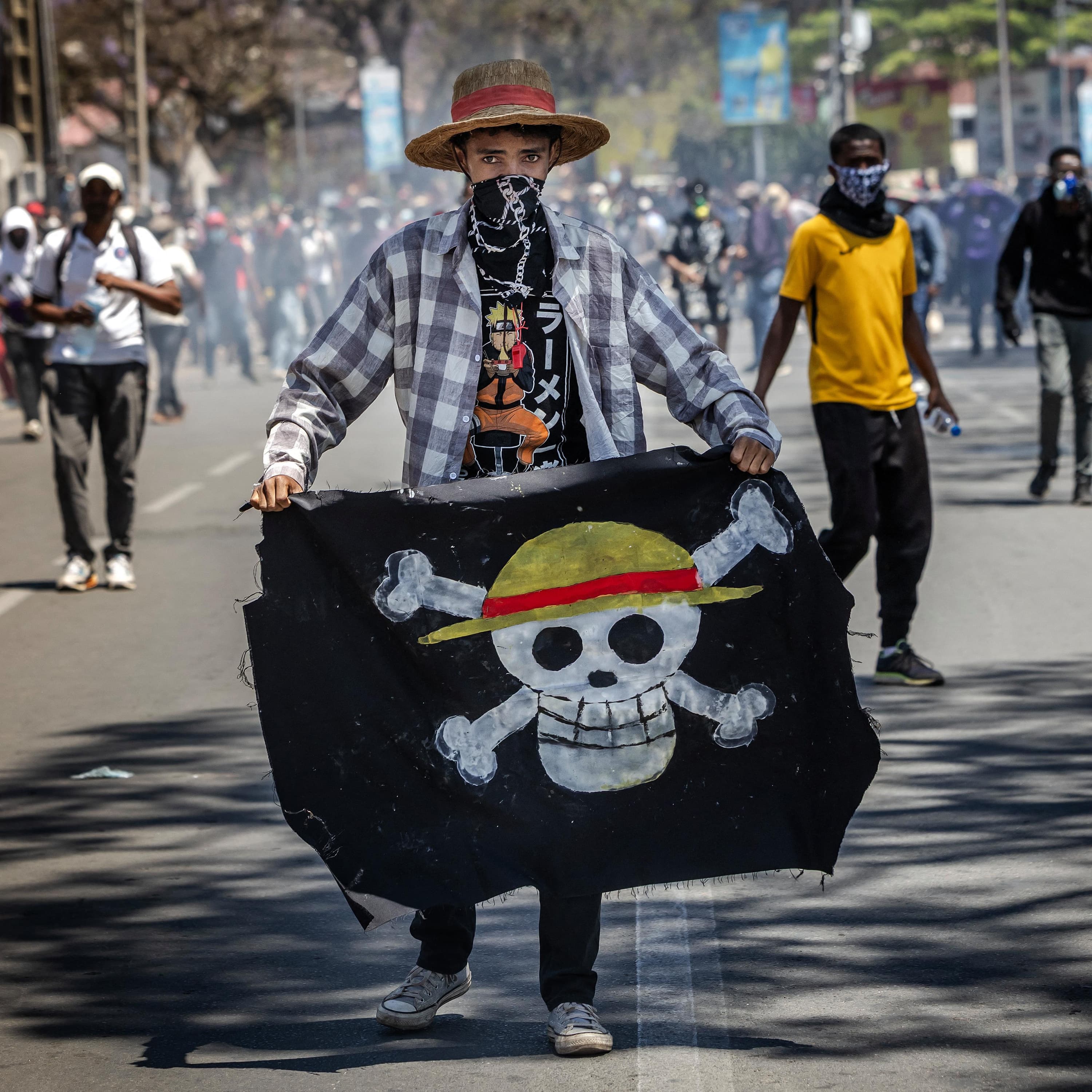
There may be no shared language, but there is this shared symbol, and it's of a skull and crossbones wearing a straw hat from the anime show called One Piece, which kind of gather is about an anti corruption sort of defiant message. Can you tell us more about that?
- [17:38]
Dr. Nyana Prakash
One Piece is an anime show that's very, very popular. It's in Japanese, but it's been translated to loads of languages now. And we've seen that flag all over protests. We've seen it in Nepal, we saw it in Indonesia. We're now seeing it in Madagascar, we're seeing in Peru, we're seeing it in Kenya, we've seen it in Morocco. It's a very typical kind of pirate flag, but it's sort of become in some ways a beacon. And now every subsequent use of that flag is a response perhaps to previous iterations of it. And in carrying it, supporters showed that they are in solidarity with other protesters around the world and that they are conscious of the symbol that they are holding and that what they're protesting about may be, you know, centered in Nepal or Madagascar or Morocco, but really it's speaking to a wider trend across the world, even with people they've never seen and will never meet.
- [18:35]
Shelley Andromiaja
I think everything began with what happened in Nepal. When the protests in Nepal began, people in Madagascar knew that it was high time for Madagascar to have the same.
- [18:47]
Nosheen Iqbal
This is Shelley Andromiaja, a 26 year old activist from Madagascar.
- [18:52]
Shelley Andromiaja
Young people felt really desperate about the future. Two out of three Malagasy live with less than $2 a day. Every day people wake up with no electricity and no running water. There was no potential jobs. So I think it is the culmination of years of corruption, bad governance and
- [19:19]
Nosheen Iqbal
neglect from the governments across Madagascar. People took to the streets demanding the resignation of the president accused of widespread corruption.
- [19:33]
Shelley Andromiaja
The process started on September 25 in Atana rivu and quickly spread out in all the big cities in Madagascar. It was one of the most exciting experience of my whole life because it was the very first time in years that we could express ourselves freely, that we could go on the street and say what frustrated us. At the same time, we were so afraid and scared of getting injured, of getting arrested. And also just like the violence from the security forces, There was 20 deaths, there was hundreds of people that get injured. But it never stopped us from fighting and we knew that we had to honor all the people that died for this cause.
- [20:44]
Nosheen Iqbal
Madagascar's president has reportedly fled the country after a powerful military unit backed protesters demanding his resignation. However, Andre Adswell has addressed the nation
- [20:54]
Dr. Nyana Prakash
from an unknown location saying that although
- [20:57]
Nosheen Iqbal
he is sheltering in a safe space, he was forced to flee to protect his life.
- [21:06]
Shelley Andromiaja
It was an incredible moment and we could feel the happiness of the world people once they heard the news.
- [21:31]
Nosheen Iqbal
After the president fled the country, the leader of an elite military unit took power with a stated plan to lead an interim government for the next two years. Many in the Gen Z movement are feeling cautious.
- [21:43]
Shelley Andromiaja
Yeah, of course it brought a lot of uncertainties and also worries because having a military as president is rarely good news, especially in Africa. But we want to stay optimist and we know for sure that we will monitor every decision that he will take from now. And we really hope that he will take in consideration the voices of young people and they will make sure that our protest didn't go to waste.
- [22:29]
Nosheen Iqbal
Coming up, can the protests in Nepal, Madagascar and elsewhere inspire Gen Z protests in the West?
- [22:42]
Dr. Nyana Prakash
This is a Monday.com ad, the same Monday.com designed for every team. The same Monday.com with built in AI scaling your work from day one. The same Monday.comwith an easy and intuitive setup. Go to Monday.com and try it for free.
- [22:57]
Advertisement Voice
We optimize everything about our health routines except the air we breathe. And when your air is off, your body feels it first. The blueair Blue Signature air purifiers quietly remove tiny airborne pollutants and odors, supporting deeper sleep, better recovery and clearer focus. Visit blueair.com and use code signature30.
- [23:21]
Nosheen Iqbal
The sense of this organic youth movement on the one hand, you know, fantastic for these young people when they've got the results they want, but on the other, it's automatically decentralized and without leaders. And so I wonder in Nepal, in Madagascar and Peru where they have managed to get rid of their leaders. What do you think are the challenges when it comes to thinking about what comes next?
- [23:43]
Dr. Nyana Prakash
Well, I think the leaderless option, the idea of not having clear leaders, not having clear people in charge of the movement was a wise one, both legally so that people couldn't be arrested, and also in terms of the idea that, well, it's like a many headed hydra. Just because you take away a few leaders, it doesn't mean that the movement stops. Of course, when it comes to actually creating solutions and finding a blueprint of what's going to happen next, that becomes very difficult because who of these people actually wants to take power or has the capability to take power? And that's when these groups can be susceptible to people stepping in and saying I can be the leader for this period of time, but the people who are stepping in to take charge are not themselves Gen Z or young people. These are establishment figures who are perhaps taking advantage or have the potential to take advantage of a situation. They don't necessarily have the same interests as the protesters. And this is where leaderless movements can become really difficult and can become co opted by establishment politics. And I think the question is for young people is what's actually going to change if these politicians come into power? What I thought we might see and what we haven't yet seen is natural leaders emerging out of these protests. But of course people don't want to be the face of the movement because then they'll be the ones being arrested or targeted.
- [25:06]
Nosheen Iqbal
Well, where does it all go from here? I mean, do you think these protests will keep spreading and that if you were the leader of a country with a significantly high youth population that you should and could be worried?
- [25:18]
Dr. Nyana Prakash
Yes.
- [25:19]
Nosheen Iqbal
Right, okay, so not the UK then?
- [25:22]
Dr. Nyana Prakash
Well, I think the question for me that's interesting is what is stopping these protests from coming to countries like the UK or the US and is it just that we don't have as many young people. I think there are other factors at play here. Right. But yes, I'd be worried, but I also would see it perhaps as an opportunity to think about the fact that these young people are going to be voting, they're going to be citizens of your country for a very long time. Some of them may go into politics, some of them may be galvanized to go into politics themselves after this. What do young people want and what have young people not had so far? If you're 20 years old and you've not experienced a life where education is free or a life where education is cheap or affordable, or you've not been able to get a job or your parents haven't been been able to get a job, what kind of opportunities, I mean, that is a challenge for governments. What kind of opportunities does that have for politicians who should be, I think, looking to these young people to get a sense of how they should shape the policy landscape for decades to come.
- [26:23]
Nosheen Iqbal
And Liana, finally, what do you think that these youth protests tell us about where the world is at the moment?
- [26:30]
Dr. Nyana Prakash
I think it suggests that we are in an era of dissent in so many different ways because even though geopolitically it seems strange to compare all these different protests, I think, to the protests we've had in the last few years, whether it's whether it's protests about Palestine, whether it's anti immigration and fascist marches, whether it's protests about Black Lives Matter, all these protests that have really dominated our screens and our attention cycles over the last decade. And I think it shows how much young people are unhappy with their government.
- [27:07]
Nosheen Iqbal
I mean, many, many of us are, I'd say not just young people, of
- [27:10]
Dr. Nyana Prakash
course, but a lot of these protests originate in, in places where young people congregate, whether it's schools, campuses, et cetera. I think it also shows the challenge for democratic governments in trying to if they seek control over the next few decades or over the next few years, how much control is perhaps an illusion when you have this kind of population of unhappy people living in your country? And I think as well as being an era of dissent, perhaps it's an era of hearing more, I think, from countries that we perhaps haven't paid enough attention to in the last couple of decades. I don't know when the last time people in the west sat up and listened to like a story about what was happening in Madagascar in Peru, but I think now these stories have come to the sort of main stage. Will it just be a kind of flash in the pan, or will we continue to pay attention to the political movements that happen in the global south in this way, especially in smaller states? And will these countries be allowed to set their own agenda, their own political agenda in the future?
- [28:13]
Nosheen Iqbal
We'll have to wait and see if those leaders take it as an opportunity or not. Nyana, thank you so much for your time.
- [28:18]
Dr. Nyana Prakash
Thank you very much.
- [28:22]
Nosheen Iqbal
That was Dr. Nyana Prakash from Chatham House. My thanks to her. Thank you also to Yujain, Yassine and Shelley for sharing their stories with us. And also to Renee Boscol Leon. And that's it for today. This episode was presented by me, Noshi Nikbal. It was produced by Eli Block and Sinead Campbell. Sound design is by Joel Cox. The executive producer was Sammy Kent. We'll see you again tomorrow.
- [28:55]
Narrator/Host
This is the Guardian.
- [29:05]
Advertisement Voice
Big news. Boost Mobile is now sending experts nationwide to deliver and set up customers new phones at home or work. Wait, we're going on tour? Not a tour. We're delivering and setting up customers phones so it's easier to upgrade. Let's get in the tour bus and hit the road. No, not a tour bus. It's a regular car we use to deliver and set up customers phones at home or work. Are you a groupie on this tour? We deliver and set up phones. It's not a tour. Oh, you're definitely a groupie. Introducing store to door switch and get a new device with expert setup and delivery wherever you're at. Delivery available for select devices purchased@boostmobile.com dreaming of getting the all new iPhone 17 Pro designed to be the most powerful iPhone ever. Then stay in bed and let a Boost Mobile expert deliver and set it up for you. Oh actually they will have to get up and open the door. Oh right. Delivery available for select devices purchased@boostmobile.com terms apply.