← Today in Focus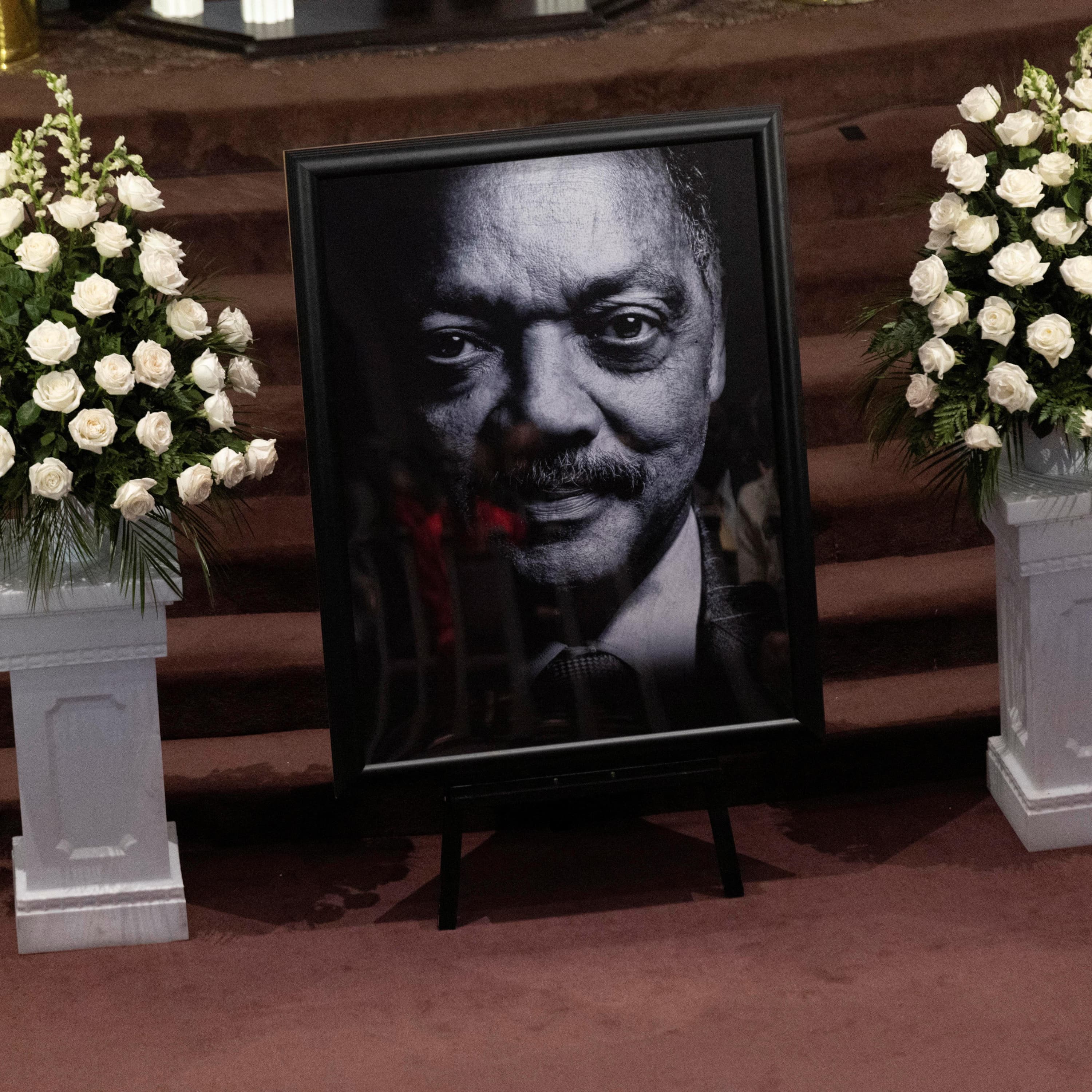
Today in Focus
The Jesse Jackson I knew
00:33:47
As Chicago prepares to bid farewell to Jackson, Today in Focus hears about the groundbreaking civil rights activist from those who knew him
Loading summary
Transcript119 lines
- [00:00]
Annie Kelly
This is the Guardian. Today. Remembering Jesse Jackson.
- [00:14]
Quo Business Phone System Advertiser
Missed calls, slow replies, messages scattered everywhere. If you're running a business that's not just annoying, it's revenue slipping away. That's where quo comes in. Spelled Quo, Quo is the 1 rated business phone system on G2.1 shared business number for calls and texts. Stop missing customers. Start capturing every opportunity. Try quo free and get 20% off your first six months at quo.comtech that's quashuo.com tech quo no missed calls, no missed customers.
- [00:55]
Jesse Jackson
We come before thee just now with heaviness of heart broken spirit wounded by the passing of our beloved brother, the Reverend Jesse Jackson.
- [01:10]
Annie Kelly
All this week, the life of the Reverend Jesse Jackson, who has died at the age of 84, has been celebrated and commemorated. He was many different things. Civil rights leader and put a voter
- [01:24]
Jesse Jackson
registration card in that other hand, symbolizing power and responsibility.
- [01:29]
Annie Kelly
Hostage negotiator.
- [01:30]
Jesse Jackson
Whenever hostages are released, it's always an expression of some hope.
- [01:35]
Annie Kelly
Presidential candidates.
- [01:37]
Jesse Jackson
My decision to seek the nomination of the Democratic Party for the presidency of the United States of America.
- [01:45]
Annie Kelly
But there are things that everyone who met him remembers.
- [01:48]
Gerald Austin
He was this 6 foot 3, 225 pound guy who basically commanded an audience.
- [01:54]
Del Marie Cobb
I just remember him appearing larger than life in terms of presence.
- [01:59]
Hugh Muir
Big in frame and he was big in stature.
- [02:02]
Gerald Austin
He was tireless. We put him to bed at 1:30 in the morning and he got up at 6:30.
- [02:06]
Del Marie Cobb
If you happened to be on the other side of the room, he was going to make his way to the other side of the room, shake your hand and introduce himself.
- [02:14]
Hugh Muir
He had this laser focus on whoever it was that he was talking to and he always made you feel as if what you were saying was really important.
- [02:23]
Annie Kelly
His charisma, drive and vision saw him become the first black candidate who was a serious contender for the American presidency. Paving the way for Barack Obama years later, helped in no small part by his talent of connecting with people wherever he went.
- [02:40]
Jesse Jackson
Brothers and sisters, what time is it?
- [02:44]
Hugh Muir
He would say something and just to make sure that the audience were completely connected to him, he would make them say it back to him. It was almost a complete mastery of his situation. And of course the audience loved that.
- [02:59]
Jesse Jackson
2000 black elected and appointed officials and legislatures and government. What time is it?
- [03:07]
Hugh Muir
And I think that's one of the gifts that he had and everyone of that generation there was a really important message that they were trying to impart, but also it was just fantastic theatre.
- [03:21]
Jesse Jackson
Unregistered black voters. What time is it for black Democrats, Black Republicans, Black Panthers, Black Newsoms, Black Independents.
- [03:33]
Annie Kelly
From the Guardian, I'm Annie Kelly. Today in focus, Jesse Jackson, the civil rights trailblazer who changed politics forever. Hugh Muir, you're the executive editor for Opinion here at the Guardian. Welcome to Jamfocus. You met Jesse Jackson on a number of occasions when he came to the uk. But first, take us back to the beginning of his life. What was his early childhood like?
- [04:04]
Hugh Muir
Jesse Jackson had in some ways a kind of typical early childhood of people who've become prominent because it was, you know, it was far from affluent. He grew up in Greenville in South Carolina, and that was a fairly poor area, but he was in the poor bit of it.
- [04:18]
Jesse Jackson
I too, know suffering. My great grandfather was the sheriff of Greenville county, who raped my great grandmother. And of that relationship, my grandmother who was stolen from the plantation by my grandfather. And then my father came out of that relationship. I know suffering. I was born to a teenage mother who was born to a teenage mother.
- [04:41]
Hugh Muir
And he took the name Jackson from someone that his mother later had a relationship with because Jackson was not his natural father. And he was often taunted one for being black, but also for his own family situation. And I think that he obviously would have had to stand up for himself. And in some ways that sort of made him a stronger person, having to deal with that. He was always very bright, and it was his education and his love of education that actually drew him into the civil rights movement in quite a small way, quite early, because he went to his local library to get a particular book. The libraries at that point was segregated, and they didn't have that book. But the white part of the library did have that book. And so he was denied entry to the white bit of the library. And so I suppose, echoing the Jesse we would know later on in life, he organized a sit.
- [05:41]
Jesse Jackson
In July 17, 1960, I went to jail in Greenville, South Carolina, trying to use a library. We marched to the library, and of course, they had a knack for shutting the lights off.
- [05:52]
Hugh Muir
That meant the library was closed.
- [05:54]
Del Marie Cobb
She says the protest wasn't planned, but developed naturally when a young Jesse Jackson needed to do some research for a homework assignment.
- [06:02]
Annie Kelly
How old would he have been then? Kind of in his early 20s or late teens.
- [06:06]
Hugh Muir
At that point, I think he would have been in his late teens. But even then, the organizer, I think he took seven people into the library.
- [06:14]
Jesse Jackson
So we went back, and when we went back, they arrested us.
- [06:19]
Del Marie Cobb
This picture shows the young people now called the Greenville Eight.
- [06:23]
Hugh Muir
He was arrested, but he clearly learned some things about how you organize things and how you raise a voice.
- [06:38]
Annie Kelly
Five years later, in 1965, Martin Luther King organized a march from Selma to Birmingham, Alabama. Around 6, 600 people took part and the young Jesse Jackson was there.
- [06:51]
Jesse Jackson
So the march from Selma to Montgomery has begun. Dr. Martin Luther King here heading a possession of between 7 and 10,000 people on the first stage of their march towards Montgomery and the state capital.
- [07:03]
Gerald Austin
We hope that this will be a
- [07:05]
Jesse Jackson
peaceful, non violent demonstration of our determination to register and vote and to end police brutality and all of the other things that we've suffered here.
- [07:16]
Hugh Muir
Martin Luther King had organized a march in protest at denial of voting rights. And so Jesse Jackson took them people down to that, caught King's eye and quickly was taken under King's wing and became a protege in the Southern Christian Leadership Conference, which was King's main vehicle for activism. And of course, what Jackson learned from that was that fusion of religion and political activism that would later become a real hallmark of what he did.
- [07:47]
Annie Kelly
And that, as you said, kind of fusion of religion, oratory politics, civil rights, that came to kind of define his work. Was he always considered to be a great speaker?
- [07:59]
Hugh Muir
I think yes. He did show that he'd learned at the master's knee, if you like, from Martin Luther King very early on and very quickly established himself as one of the main leaders. He was first given a local role in a thing called Operation Breadbasket.
- [08:17]
Jesse Jackson
White supermarkets like this are boycotted by Operation Breadbasket if they don't stock enough black goods and hire enough black employees.
- [08:25]
Hugh Muir
He became the head of the Chicago branch of that. So that started giving him a profile. And of course it would have meant that he had to make a lot of speeches.
- [08:33]
Jesse Jackson
The economic power is not there on the leverage. And I think that the black community is driving for economic independence, for political independence, for military independence, for social, for religious and psychological independence, which means that we will control our community as do other ethnic groups. I think it might.
- [08:50]
Hugh Muir
You have to understand that in a way, the genius of Martin Luther King later taken on by Jesse Jackson was taking the religion out of the purely theological and fusing that with politics as we know it on, on planet earth, if you like.
- [09:07]
Annie Kelly
So he was the Reverend Jesse Jackson.
- [09:09]
Hugh Muir
He was the Reverend Jesse Jackson. And that's really key when you look at his approach to his activism. Certainly when you listen to his speeches, that's absolutely a Pentecostal Baptist preaching fused with politics, with the politics of anti racism, of anti sexism.
- [09:29]
Jesse Jackson
I believe that we will go from guttermost to uttermost. I believe that we will go from slave ship to championship. I believe that we will go from outhouse, the State House, the courthouse, the White House. I believe we will rise all the way to the top. I believe that my mind is a. Martin Luther King Jr. Was killed tonight in Memphis, Tennessee. Shot in the face as he stood alone on the balcony of his hotel room.
- [10:15]
Quo Business Phone System Advertiser
He died in a hospital an hour later.
- [10:18]
Annie Kelly
In 1968, Martin Luther King was assassinated. It was a defining moment for Jesse Jackson.
- [10:26]
Jesse Jackson
When you saw your friend and mentor
- [10:29]
Hugh Muir
in that condition, what was going through your head?
- [10:33]
Jesse Jackson
I was traumatized.
- [10:34]
Hugh Muir
It was full of pain and anger
- [10:38]
Jesse Jackson
and sorrow and desperation and many emotions
- [10:41]
Hugh Muir
at the same time.
- [10:43]
Annie Kelly
But it also brought to the surface underlying tensions around his relationship to King.
- [10:48]
Hugh Muir
Jesse Jackson was never everyone's favorite person, not least because there were people there who thought that he was probably too close to Martin Luther King and that maybe he had a patronage that they would have liked to have. And so he always faced criticism and questioning of things that he had said, even about, you know, what he did and where he was on the night that Martin Luther King was shot. Well, he was there. He was at the Lorraine Motel. But there were always arguments and debates about his actual proximity to it. He also said that immediately after King had been shot that he cradled him in his arms. And there were others who dispute that and basically accused him of trying to aggrandize himself while making himself seem much closer to those events than he actually was.
- [11:37]
Jesse Jackson
And then I heard Jesse Jackson say. He told me, jesse, take our people onto the mountain.
- [11:45]
Annie Kelly
Her.
- [11:46]
Jesse Jackson
And that didn't bother me, even though I know Jesse got nowhere near him. And then Jesse said, I held his head in my hand while he died, and that didn't get to me. And then Jesse said, look at my shirt. And I looked around, showed up, and Jesse Jackson's shirt was drenched in blood. And I realized the only way Jesse could have gotten that blood or stooped out on that floor with an array motel and raked that blood off that floor and put that blood on him. And I went crazy. I really tried to kill Jesse.
- [12:23]
Hugh Muir
The other thing that became controversial was that whilst many of the lieutenants of Martin Luther King stayed around Memphis almost in a kind of period of mourning, Jackson didn't. He went back to Chicago. I think it was. He began doing a series of national interviews. And I think he almost saw it as, you know, we have to seize the narrative and we have to get on the front foot about what we do next. Others just saw it as well. Basically, you think there's a vacancy and you're trying to fill it. But of course, that didn't make him very popular with a lot of people outside the movement, because, as I say, some people saw him as being almost too effective and quite dangerous, but also inside the movement as well, because there would be some. Some level of competitive rivalry.
- [13:10]
Annie Kelly
After Martin Luther King's death in 1971, Jesse Jackson founded PUSH, a campaign group that would allow him to grow his reputation as a civil rights leader. And he continued to be an unstoppable force, inspirational to some, but considered dangerous by others.
- [13:27]
Hugh Muir
I think at the time, it's quite easy if you're a formidable, very high profile public figure to be put in a particular box. And so when you're a religious leader, okay, that's fine. And when you're a religious leader who, who gets involved in activism, well, okay, that's fine as well. But if you're a religious leader who then goes beyond that and you're appealing not just to church people, not just to black people, but to people of a certain class if you're able to emphasize the intersectionality in what you're doing, which is what he did. He basically said, you know, I think that you matter too. He had his, you know, his great catchphrase, I am somebody. And he tried to relate it to everyone. He said that, you know, if you're a woman, you're somebody. If you're gay, you're somebody. And that sounds kind of routine now, but at the time it wasn't. And it particularly wasn't for a black church leader to say that.
- [14:24]
Annie Kelly
There's that really famous clip of him on Sesame street, isn't there?
- [14:27]
Hugh Muir
Yeah, he did. He did two things he did in the same year, I think it was 1972, he did wattstacks, the music festival
- [14:34]
Jesse Jackson
to celebrate our homecoming and our own sense of somebodyness, where there was a
- [14:40]
Hugh Muir
huge rendition of the I am somebody poem and of call and response.
- [14:46]
Jesse Jackson
I am, I am somebody. I am somebody. I may be poor but I am somebody I may build welfare.
- [15:04]
Hugh Muir
And he also then did a, a poignant version of it on Sesame street where he sat there with his big afro and it's very moving. The camera panned across and you saw a group of children who were of different ages and races. And he got them all saying, I am somebody as well.
- [15:21]
Jesse Jackson
Ready on the stop. Okay, here we go. I am, I am somebody, Somebody I am, I am somebody. I may be poor, I may be poor But I am somebody, Somebody I may be young but I am but I am somebody, Somebody but his work
- [15:45]
Annie Kelly
wasn't limited to politics and preaching. In the 80s and 90s, he helped release dozens of American hostages and prisoners abroad through his own brand of unofficial diplomacy.
- [15:57]
Stamps.com Advertiser
Lieutenant Robert Goodman, freed only yesterday after
- [16:00]
Del Marie Cobb
one month in Syrian captivity, looked healthy and happy as his entire family looked on. Goodman expressed thanks to both Jackson and
- [16:08]
Annie Kelly
the administration he negotiated with Syria in 1983, Cuba in 1984, Iraq in 1990 and Yugoslavia in 1999. He often operated without US government approval and used personal and direct dialogue with world leaders such as Fidel Castro and Saddam Hussein. But he was also criticised for it.
- [16:32]
Hugh Muir
Well, he could do that, and it was win, win, because he got huge profile when he went on those rescue missions. He was all over the news as almost being the only person who could do this. And so it was win, win for him. And sometimes it was successful as well. But he couldn't have done that had he sat inside the establishment. It was just the fact that he was knowledgeable of it but not part of it that allowed him to be able to do that.
- [16:56]
Jesse Jackson
It was especially meaningful to us that once we got our telegram back from President Assad, we then called Senator Charles Percy, Chairman of our Foreign Relations Committee, which we thought was the appropriate thing to do. He then got us in contact with the State Department.
- [17:14]
Annie Kelly
And then, of course, he had his two presidential runs, 1984 and then 88. How significant a moment was it when he announced that he was going to run for president in 1984?
- [17:25]
Hugh Muir
Well, I think it was almost the culmination of the profile that he'd built, and I think people were pleased, but a bit incredulous. No black American had sought the presidency for a very long time. I think he had a passion, very formidable organizational skills, which he will have learned from his earlier life back in Chicago. And so that run actually was going quite well. It didn't succeed. Ultimately, he said some things, in particular his advocacy of a Palestinian that cost him quite a lot of votes, particularly in New York. But it was not seen as a failure. And I think it was seen as a marker, maybe for him, maybe for someone else, but I think the feeling was that a taboo had been broken.
- [18:09]
Jesse Jackson
America's not like a blanket, one piece of unbroken cloth, the same color, the same texture, the same size. America's more like a quilt. Many patches, many pieces, many colors, many sizes, all woven and held together by a common thread. The white, the Hispanic, the black, the Arab, the Jew, the woman, the Native American, the small farmer, the business person, the environmentalist, the peace activist, the young the old the lesbian, the gay and the disabled make up the American quilt.
- [18:47]
Annie Kelly
In 1988, Jesse Jackson ran for the Democratic presidential nomination.
- [18:52]
Jesse Jackson
Once more, the President should be a leader. Jesse Jackson is a leader. He provided leadership to end the Chicago firemen strike, leadership to negotiate a settlement
- [19:08]
Quo Business Phone System Advertiser
to the nurses strike in Buffalo and
- [19:10]
Jesse Jackson
a teacher's strike in South Jesse Jackson also successfully negotiated the return of Lieutenant Goodman from Syria. Leadership for President Jesse Jackson.
- [19:26]
Annie Kelly
He took everything he'd learned from 1984 and found a team that would help him run a more organized and focused campaign.
- [19:35]
Del Marie Cobb
My name is Del Marie Cobb, and I'm a political consultant here in Chicago. And I was Jesse Jackson's national traveling press secretary in 1988 when he ran for president.
- [19:47]
Gerald Austin
Jerry Austin. I'm longtime, now retired political consultant in the United States, and I was Jesse Jackson's 1988 campaign manager. Jesse Jackson ran for president in 1984, and it wasn't really a run. It was really more of a protest candidacy. So in 1988, we went to Willie Brown, who was the speaker of the House, and asked him to chair his campaign. And Willie Brown responded that he would only do that if Jesse Jackson found a real campaign manager and ran a real campaign. So Jackson said to Brown, find somebody. And one thing led to another, and I got a phone call from somebody who knew Willie Brown and knew me and asked me if I would like to be Jesse Jackson's 1988 campaign manager. So I signed on and he said, you got a plan for this campaign? I said, actually, I do. And he said, well, what is it? I said, well, the first endorsement we need is from the press corps that the press corps has to look at you as a viable candidate, which they never did in 1984. How do we do that? Number one, we need to get a plane.
- [20:59]
Jesse Jackson
The challenge for Jackson was to find a way to compete in 20 states at once with no money. By March, the campaign was already hundreds of thousands of dollars in debt. For a strategy, Jackson turned to his campaign manager, Gerald Austin.
- [21:17]
Gerald Austin
We decided that the best way to deal with Super Tuesday is we never would have a million dollars for media. But if we were able to get a large enough plane to take the the media with us and go to four or five or sometimes even six different media markets in a day. The first time I actually went with him to an event, and it was what they call a Jefferson Humphrey dinner. And when Jesse got to speak, all of a sudden, from out of the kitchen came the cooks, came the waiters and waitresses, all the People working to hear him speak. And I thought to myself, I've never seen this before. No other candidates went to an Indian reservation or went to a poor church in Mississippi, or went to a coal mining area, or went to a rural area in Appalachia. And what he brought to those people was recognition they existed, which is important to begin with and to get them involved in that. Voting was something that they should do and they could benefit from it by electing people that they liked.
- [22:22]
Jesse Jackson
I was facing foreclosure, had gotten the foreclosure notice and in the spring of 85 and got a hold of Jesse, and we got a telegram to our local banker. He offered to come sit down at a mediation table and try to work this thing out between myself and my bankers. And we wound up going through some reorganization, given some things back, but we still got every acre and we're going to farm and we're going to continue to farm.
- [22:54]
Gerald Austin
We targeted congressional districts that had a large black population. And at that time, the rules were if you won that district, you got all of the delegates. So that was the initial goal. And we showed that we were winning. And that's how the press corps came to start to cover us. And from there, you know, we were, you know, considered a viable candidate.
- [23:19]
Jesse Jackson
In the south, almost 20% of eligible voters are black. Jackson's strategy depended on a large black voter turnout. In March of 1988, at the United House of Prayer in Charlotte, North Carolina, we saw something we had not seen a month before in the chilly towns of Iowa. Instead of polite interest, interest in the Jackson campaign, we saw enthusiasm.
- [23:44]
Annie Kelly
Unlike the other high profile Democratic candidates, the Reverend Jesse Jackson had to find alternative ways to fund his campaign.
- [23:52]
Gerald Austin
Whenever he spoke, whether it was to 2,000 people in a upscale church in New York or whether it was to 200 poor people in Meridian, Mississippi, we passed the hat. And so in New York, he'd ask, who'd give me $1,000? Five people raised their hand and then he'd say, 500, 100. Well, we could raise for 2,000 people. We could raise 20 or $30,000 at that event in New York. Now you go to Meridian, Mississippi, with 200 very, very poor people. And he would ask for who would give me $1,000? And nobody raised their hand. Who would give me 500, 150? No one raised their hand. Lastly, he said, who would give me something? Everybody raised their hand and we passed a hat, mostly dollar bills, sometimes a $5 bill. And I asked him, why do you do that? He said, because the people in this church in Mississippi, by giving me a dollar, have basically bought into my campaign. And they will gladly, proudly tell their neighbors and friends that they're part of the campaign.
- [25:01]
Del Marie Cobb
We were joking all the time about the fact that he would pass out the Kentucky Fried Chicken buckets to raise money. And, you know, by him being the black candidate, he had to do other ways of raising money. I mean, he wasn't able to raise money like Dukakis and George Bush. What's even more interesting if you think about who was in the race, you had Joe Biden, you had Al Gore. All of them dropped out of the race and he was still standing. They were establishment. They had establishment ways of raising money and getting to people. He had anti establishment ways of getting money and getting to people and getting his word out. And so the church was one of his ways of getting money. So on Sundays and other days on our schedule, we had churches and we went to churches and the churches were packed and he made his speeches and then he made his ask, and then they passed the Kentucky Fried Chicken buckets and then we collected them at the end. And that's what kept the campaign going.
- [26:05]
Jesse Jackson
Brother Jesse, now he's running for the presidency. But don't come here trying to take this away from me, because I am the president here.
- [26:24]
Annie Kelly
You must have seen a lot of iconic speeches on the campaign trail. Did you help him write any of them?
- [26:30]
Del Marie Cobb
No, they were all his. But, you know, after a while, you know the speeches, and I pretty much knew them by heart after hearing them, and I knew that there were times when, based on what, the calendar or based on where we were, that there might be things he wanted to say that he didn't say. And this was the other thing I found absolutely amazing is that I could sneak a note to him and he would look at the note and incorporate what it was I was telling him and never miss a beat.
- [27:06]
Annie Kelly
In the end, Jesse Jackson's 1988 campaign finished when he lost out on the Democratic nomination to Michael Duchar. But he still managed to make one of his most iconic speeches at the Democratic National Convention that July.
- [27:21]
Jesse Jackson
We must never surrender. America will get better and better. Keep hope alive. Keep hope alive. Keep hope alive on tomorrow night and beyond. Keep hope alive. I love you very much.
- [27:41]
Annie Kelly
Coming up, how Jesse Jackson opened the door to the Obama presidency.
- [27:59]
Farnoosh Tarabi
Hi, this is Farnoosh Tarabi from Sew Money with Farnoosh Tarabi. And today I want to talk to you about Boost Mobile, Quick money, stop paying a carrier tax if your phone Bill feels trapped in a pricey plan. This is your sign to unlock savings. Boost Mobile helps you reset your spending with the $25 Unlimited Forever plan. You can bring your own phone, pay $25 and get unlimited wireless forever. And that simple switch can unlock up to $600 in savings a year. That's money you could put towards paying down debt, investing or something that actually brings you joy. Those savings are based on average annual single line payment of AT&T Verizon and T Mobile customers, compared to 12 months on the Boost Mobile Unlimited plan as of January 2026. For full offer details, visit boostmobile.com shipping
- [28:50]
Stamps.com Advertiser
billing admin payroll Marketing. You're managing all the things, so why waste time sending important documents the old fashioned way? Mail and ship when you want, how you want with stamps.com print postage on demand 24, 7 and schedule pickups from your office or home. Save up to 90% with automated rate shopping. That's why over 1 million small businesses trust stamps.com go to stamps.com and use code podcast to try stamps.com risk free for 60 days.
- [29:25]
Annie Kelly
Do you think that he ever believed that he could become president? Or do you think that that campaign that you worked on with him, that wasn't really the point, it was about something else.
- [29:36]
Del Marie Cobb
I believe he believed he could become president. Maybe in 1984 he didn't believe it, but in 1988 I think he did believe it. And coming in second was significant. And so what he did was even if he couldn't become president, he understood what power that gave him. And so that's what I talk about is being in the room with his delegates in Atlanta because they wanted him to take the fight to the floor to become vice president. And he said, no, we're not going to do that. What we're going to do is we're going to ask for rules to be changed, we're going to ask for the platform to be changed, and we're going to ask for the committee to be expanded to include ordinary people, not just the party elite. And so that's what he did. And one of the rules he got changed was during our campaign, it was winner take all. And he decided, you know, it shouldn't be winner take all, it should be proportionality so that the nominee gets a proportion of the vote. And so that change in 1988 is what allowed Barack Obama to become the president 20 years later in 2008.
- [30:58]
Jesse Jackson
It's the answer that led those who have been told for so long by so many to be cynical and fearful and doubtful about what we can achieve. To put their hands on the arc of history and, and bend it once more toward the hope of a better day. It's been a long time coming, but tonight, because of what we did on this day, in this election, at this defining moment, change has come to America.
- [31:35]
Annie Kelly
One of the most kind of arresting images of Jesse Jackson is him crying at a Barack Obama's inauguration. It's said that Obama could never have made the presidency without Jesse Jackson. Do you believe in that?
- [31:49]
Hugh Muir
Oh, absolutely, because I think that you have to establish the concept first. I think that those two runs made it look as if in the modern era it was possible for a black man to get to the White House. And so in a way, when Obama came along, the idea wasn't a strange one. And of course Obama and Jesse Jackson had a kind of complicated relationship. There was an occasion in which Jesse Jackson was heard what he thought was off mic, talking about Obama and complaining that Obama too often talked down to black people.
- [32:31]
Jesse Jackson
When Fox News decided to air the
- [32:33]
Gerald Austin
tape, Jackson rushed to clarify his position
- [32:35]
Jesse Jackson
on the likely nominee. My support for Rock and his policies are long standing.
- [32:43]
Hugh Muir
I think there was probably was a class issue there as well because I think Jackson probably thought that Obama was trying too much to appeal to a certain demographic, whereas Jesse's demographic was very much a kind of grassroots demographic. But then when Obama was elected, there he was, you know, weeping like a baby and clearly elated at what had happened. I'm not sure that given their politics that he would have fully approved of everything that Obama did. But I think that, I think he said it himself that Obama ran the last lap of a 60 year race.
- [33:21]
Annie Kelly
And what would you say is his political legacy? Like what is it that we can look back on in his life and take lessons from in terms of moving forward?
- [33:30]
Hugh Muir
I think it's extraordinary that one man with his oratory, with his ear for a catchphrase, with his eye for an issue could lift up so many people and make so many people feel more confident in themselves and more robust about their rights. I think what was his real impact? I think it was psychological because I think that he just made people feel differently. I think that was the impact on me. As I say, I think that that, that idea of I am somebody, when you've got everyone saying that, you know, I'm not sure what you. That you are. I'm not sure that you are. That you have equality, that you deserve equality. Well, to have someone say, well yeah, you really do. And so you claim it and you seize it. That was really important.
- [34:22]
Jesse Jackson
But I am somebody. I am black, beautiful, proud. I must be respected. I must be protected. I am somebody I know.
- [34:54]
Annie Kelly
And that's it for today. My thanks to Hugh Muir, Del Marie Cobb and Gerry Austin. You can read our obituary to Jesse jackson@theguardian.com this episode was produced by Ivor Manley, Yassin, Al Mudden, Elna Biggs, Ruth Abrahams and Thomas Glatter and presented by me, Annie Kelly. Sound design was by Brian McNamara and the executive producer was Maz Eddihaj. We'll be back later on this afternoon with the latest. This is the Guardian.
- [35:54]
Farnoosh Tarabi
Hi, this is Farnoosh Tarabi from Sew Money with Farnoosh Tarabi. And today I want to talk to you about Boost Mobile Quick Money Tip Stop paying a carrier tax if your phone bill feels trapped in a pricey plan, this is your sign to unlock savings. Boost Mobile helps you reset your spending. With the $25 Unlimited Forever plan, you can bring your own phone, pay $25, and get unlimited wireless forever. And that simple switch can unlock up to $600 in savings a year. That's money you could put towards paying down debt, investing or something that actually brings you joy. Those savings are based on average annual single line payment of AT&T Verizon and T Mobile customers, compared to 12 months on the Boost Mobile Unlimited plan as of January 2026. For full offer details, visit boostmobile.com a
- [36:44]
Quo Business Phone System Advertiser
password manager should be the first security purchase you make for your team. Why? Because compromised passwords are the number one way bad actors attack companies, and small businesses are their favorite targets. But unlike a lot of security challenges, passwords actually have a pretty simple solution. 1Password lets you manage all your business's credentials so you can feel confident that your data stays secure as your company grows. Find out more@1Password.com special offer and start securing every login, shipping, billing, admin, payroll, marketing.
- [37:18]
Stamps.com Advertiser
You're managing all the things, so why waste time sending important documents the old fashioned way. Mail and ship when you want how you want with stamps.com print postage on demand 24, 7 and schedule pickups from your office or home. Save up to to 90% with automated rate shopping. That's why over 1 million small businesses trust stamps.com go to stamps.com and use code podcast to try stamps.com risk free for 60 days.