← Today in Focus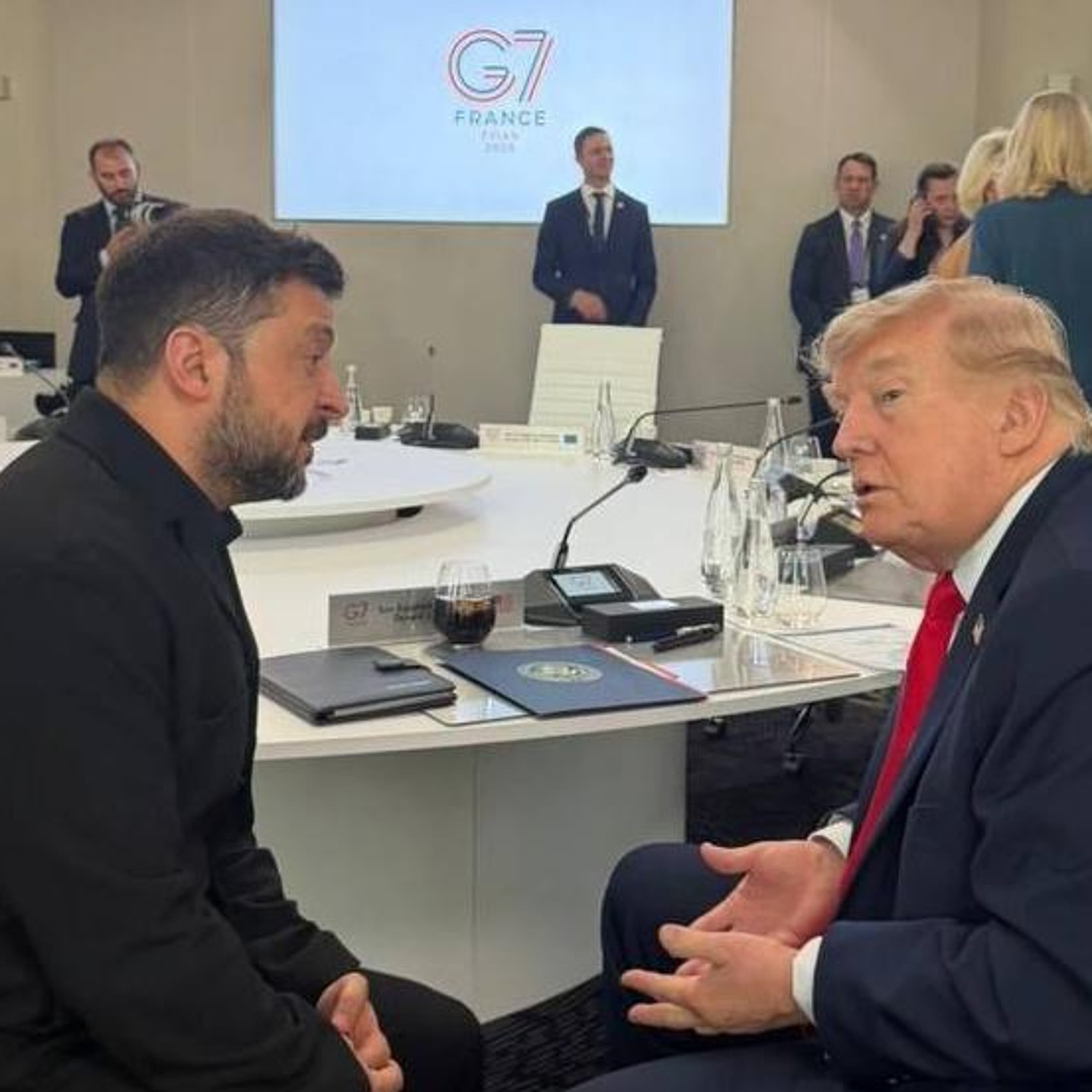
Today in Focus
Zelenskyy’s clever play to win over Trump at G7– The Latest
00:11:52
Donald Trump has urged Russia to ‘make a deal’ with Ukraine as the leaders of G7 countries meet and try to put the conflict back at the top of the agenda. Nosheen Iqbal speaks to the Guardian’s Europe correspondent, Jon Henley
Loading summary
Transcript21 lines
- [00:00]
Podcast Narrator
This is the Guardian, Today in Focus is supported by Paramount, the Agency. All episodes streaming June 21st on Paramount. In the world of espionage, truth is a moving target, and every decision carries a dangerous consequence. This new mission explores what it means to live as a double agent. Twice the lies, twice the risk. The lines between ally and enemy blur like never before. And survival depends on trusting no one. Starring Michael Fassbender, Jeffrey Wright, Jodie Turner Smith and Richard Gere. Don't miss the Agency. All episode streaming June 21st on Paramount.
- [01:11]
John Henley
This is a defense crisis for Europe. It's an economic crisis for Europe. This is existential. Look, Russia should make a deal. Russia's lost tremendous amounts of people and so has Ukraine. The crucial thing in that is that he is expecting concessions from Putin as well. That's a step in the right direction and that would be welcomed by European leaders.
- [01:33]
Noshi Nikbal
From the Guardians Today In Focus, this is the latest with me, Noshi Nikbal. John Henley, thank you for joining us. You're the Guardians Europe correspondent. It is day one of the G7 summit, where world leaders are gathering in the French Alps and all eyes today are on Donald Trump. Who else? Now, there's a lot of attention being paid in trying to get Trump to focus on the Russia. Ukraine war could be something of a mixed blessing. But what are European leaders hoping for?
- [02:04]
John Henley
I mean, they're essentially hoping to keep Donald Trump on board and to get him to agree to at least an agreed set of parameters for ongoing talks over Ukraine. I mean, Trump arrived at this G7 summit with, with quite a head of kind of diplomatic and political momentum because of the deal on Iran, albeit it's very vague, nobody really knows yet what's in it. It could all come to nothing. It doesn't look very convincing. But he arrived with that in his pocket, as it were. And what European leaders are absolutely terrified of is that he will take the momentum from that deal and try and move it forward into a deal between Moscow and Kyiv that dramatically favors Russia rather than Ukraine. So European leaders are just absolutely desperate to keep him on board, keep him focused, try and get a kind of coherent, unified strategic approach to Ukraine out of him. That's what they're looking for, because that
- [03:17]
Noshi Nikbal
sort of favorability to Moscow, it is a real worry, isn't it? I mean, Trump confirmed this morning that he'd had a very good meeting with Zelenskyy. He's due to have another one today. He did also say Russia should make a deal. It's a very simple statement. But, John, how significant is it because he's not exactly been consistent in his condemnation of Putin or in his support for Zelenskyy in these last few years.
- [03:41]
John Henley
No, exactly. I mean, I think he has a very transactional relationship now with Zelensk. I think that's the key thing. Zelenskyy is playing it really quite cleverly, I think. I mean, he's massaging Trump's ego as hard as he can, really. Trump said he had these good talks. Zelensky in turn, has said only Trump can do it or maybe only Trump can solve this problem. And it's clear that Zelenskyy also wants desperately license a light permission essentially to manufacture Patriot missiles in Ukraine. So he's keen to get that out of Trump. Trump is, you know, we've moved on clearly from that extraordinary blow up that we all remember in the White House When J.D. vance and Trump essentially insulted Zelensky in front of everybody.
- [04:42]
Noshi Nikbal
It's humiliating.
- [04:43]
John Henley
Well, yeah, we've now moved onto a, you know, a much more transactional kind of relationship. And as regards put, Trump has long trumpeted his kind of special relationship with Putin and boasted that he's capable of solving the situation and stopping the war essentially with a single phone call, which clearly isn't true. But he did acknowledge today at the G7 summit that there is an awful lot of animosity, at least between Zelensky and Putin, which is progress from Trump. And as you say, he said pushing Moscow to get a deal done. And I think the crucial thing in that is that it kind of acknowledges that he is expecting concessions from Putin as well in order to make a deal. He's clearly demanding that Putin make some concessions. That's a step in the right direction and that would be welcomed by European leaders.
- [05:46]
Noshi Nikbal
Well, let's talk about the concessions on the Ukrainian side, because after that explosive White House meeting, Ukraine and the US did sign a deal on critical minerals, which means that the US Will share profits in any future mineral or energy resources that Ukraine has, which obviously can't really come into full play until the war is over. So I wonder, John, how much is that partnership worth to Trump and how much do you think it's incentivizing him to get this peace deal going?
- [06:15]
John Henley
Well, it clearly will be motivating him for the simple reason that, as you say, this US Ukraine Reconstruction Investment Fund, as it's called, it gives basically 50% of all future licensing revenue from the extraction of, yes, of critical minerals, of lithium, titanium gas, energy gas, et cetera in Ukraine. The whole package of that is estimated to be worth something like $14 trillion. So there's potentially a lot of money in there for Donald Trump. But the crucial thing is that 50% of those reserves, more than 50% of those reserves are underneath territory that is currently occupied Russia. And so, you know, Trump can't, as it were, cash in or American companies can't cash in on this agreement until the war, the war is over. So that clearly will be a motivate. I mean, we know, we've seen in the past how much, you know, commercial interest, the extent to which commercial interests, you know, motivate Trump and his family and the whole kind of Trump money making machine. So, yeah, that will be certainly, you know, be at the forefront of his mind as well.
- [07:32]
Noshi Nikbal
I wonder what you make of some of the statements coming out of the summit today. And I'm thinking about Ursula von der Leyen, the Europe Commission president, who said Ukraine is holding the front line, even partially regaining territory. And she goes on to say that, you know, the country has developed the capability to strike strategic targets deep inside. Russia has become world leading in terms of producing cutting edge military equipment. And on the other hand, Russia is feeling the strain and the pressure. John, how fair do you think this is, an assessment of the war as it's going?
- [08:04]
John Henley
Yeah, I mean, I think it's. As regards Ursula von der Leyen's comments, they're kind of a mix, I think of sort of, you know, strategic optimism, but also a good dose of reality. You know, I mean, it's absolutely true and that the, you know, the leaders at the summit today essentially agreed that Russia is not, not winning this war. I mean, it might not be losing and Ukraine might not be winning either, but Russia certainly isn't winning. And so in that case, that's a very fair assessment.
- [08:42]
Noshi Nikbal
He does suggest that Ukraine has the edge here, though. I mean, you say neither side are really winning and there's something of an impasse.
- [08:46]
John Henley
But, well, you know, I mean, I would just think it's unrealistic to say that Russia has lost. So, yes, Ukraine is succeeding in striking deep into Russian territory, but the front line is still really bitterly contested and a very, very tough place indeed to be. And as we saw yesterday, Russia is still very much capable of launching really big full scale drone and missile attacks on Ukrainian targets. As the summit was effectively getting underway yesterday, UNESCO listed World Heritage sites were being struck in Kyiv. So the Russian war machine certainly isn' isn't paralyzed yet. And although the Russian economy is definitely suffering, it hasn't collapsed either. I mean, Russia is now functioning as a full scale militarized war economy. And it can continue functioning despite the sanctions and everything. It can continue functioning like that, theoretically, at least for some time. So I think the situation is quite, quite finely balanced. Nobody's actually losing, but nobody's actually winning either.
- [10:09]
Noshi Nikbal
And then so when it comes to the summit itself, I mean, I don't want to do the G7 dirty. It's full of very important people. But how much traditionally, historically does it actually get done? How much faith do you have that there will be some influence that's wielded over the next few days that will have some impact in this war?
- [10:27]
John Henley
I mean, they are obviously talking shops and very little concretely comes out of them directly, but I think they are useful. It is clearly useful for world leaders to sit down relatively informally and talking about this full scale Russian invasion of Ukraine in terms of what matters for the European Union. I mean, this is existential, really. This conflict is absolutely critical for the European Union. If by virtue of some kind of forced deal that Trump pushes through and that Zelensky is obliged to give in to, if by virtue of a deal like that, Russia succeeds in gaining more Ukrainian territory, more Ukrainian territory than it has at the moment, then Europe's borders are fragile and they look vulnerable. So this is a defense crisis for Europe. It's an economic crisis. For energy costs have gone through the roof, inflation is, et cetera. It's really something that the European leaders feel they have to resolve. And to do that, they're very well aware that they have to get Trump on board. So sitting around the table with him, you know, the least you can say is that it can't do any harm.
- [11:49]
Noshi Nikbal
We'll have to wait and see. John, thank you so much for your time. That's it for today. Thanks again to Europe correspondent John Henley. Thanks for listening to this episode of the latest Today in Focus will be back with you tomorrow morning and their latest will be back in your feeds tomorrow night. This episode was produced by Annie Levespa. The senior producer was Ryan Ramgobin and the lead producer was Zoe Hitch. The presenter was me, Noshi Nikval.
- [12:18]
Max Rushton
Hello, I'm Max Rushton. The World cup is back and Football Weekly is going daily. If you want award winning soccer coverage from a podcast that's been overanalyzing the game for more than 20 years and still hasn't run out of opinions or just repeats the same ones over and over again, this is where you'll find it. We'll be producing 33 daily episodes across the tournament breaking down all the action, the results and of course, the drama. Can the US make it out of the group stage and into the spotlight on the biggest stage World Cup Daily? Listen Wherever you get your podcasts or watch full episodes on YouTube, this is the Guardian.
- [12:56]
Barclays Investment Bank Analyst
From globalization to innovation sustainability to market volatility, there's always more than one side to a story. Explore different perspectives on today's most important business and economic issues with the Flipside podcast from Barclays Investment Bank. Hear two research analysts in a lively debate and get insights from every angle to further inform your view. Listen to the Flipside on your favorite platform.
- [13:21]
SoFi Advertiser
High interest debt is one of the toughest opponents you'll face unless you power up with a Sofi personal loan. A Sofi personal loan could repackage your bad debt into one low fixed rate monthly payment. It's even got superspeed since you could get the funds as soon as the same day you sign. Visit sofi.compower to learn more. That's s o f I.com power loans originated by SoFi Bank NA member FDIC terms and conditions apply. NMLS 696891 A History of the United
- [13:52]
99% Invisible Narrator
States in 100 Objects is a brand new podcast from 99% Invisible and BBC Studios. Each week we're looking at a different object from across American history with a unique story to tell about who we've been, what we've built, and what we've allowed ourselves to forget. Some of these objects are well known, many are not, but all of them carry the story of how we got to this moment. Find A History of the United States in a Hundred Hundred objects on the 99% invisible feed. Wherever you get your podcasts.