← Today in Focus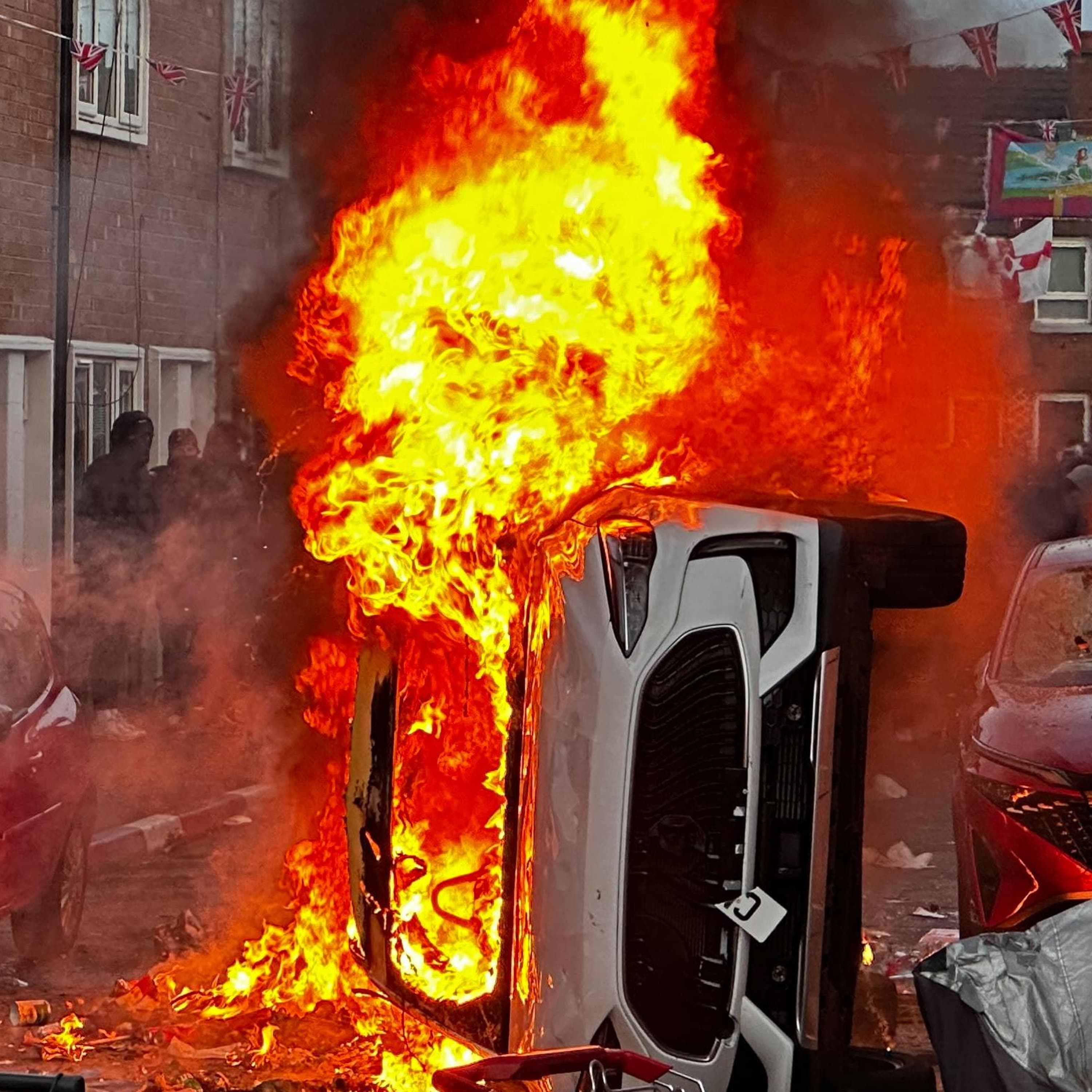
Today in Focus
The view from Belfast after a night of violent protests - The Latest
00:12:34
Violence erupted in Northern Ireland last night in response to a stabbing attack in Belfast that was captured in a graphic video. Nosheen Iqbal speaks to Ireland correspondent Rory Carroll
Loading summary
Transcript28 lines
- [00:00]
Narrator/Announcer
This is the Guardian. Today in Focus is supported by Paramount, the Agency. All episodes streaming June 21st on Paramount. In the world of espionage, truth is a moving target and every decision carries a dangerous consequence. This new mission explores what it means to live as a double agent. Twice the lies, twice the risk. The lines between ally and enemy blur like never before. And survival depends on trusting no one. Starring Michael Fassbender, Jeffrey Wright, Jodie Turner Smith and Richard Gere. Don't miss the Agency. All episode streaming June 21st on Paramount. Plus.
- [01:12]
Rory Carroll
It was basically, you know, racist attacks, a form of ethnic cleansing whereby, you know, foreigners are being targeted on the basis of the color of their skin. Hundreds of boys and men, dark clothing, wearing masks. And yet there's also strange, almost elements of a festive atmosphere there which made it even more sinister. The Troubles, the history of Northern Ireland echoes through what we're seeing. Some of the very same streets where mobs burned out Catholic families back in 1969.
- [01:40]
Noshi Nikbal
From the Guardians Today in Focus, this is the latest. I'm Noshi Nikbal. Rory Carroll, you're the Guardians island correspondent and you've been reporting from Northern Ireland where we saw violence erupt on the streets of Belfast last night in response to this horrific knife attack on Monday evening. The suspect, a 30 year old Sudanese man, Hadi Alodid, has been arrested and charged with attempted murder. The victim, Stephen Ogilvie, has lost his left eye and remains in hospital. I will say at the top that we're not going to be discussing the attack itself. There are reporting restrictions in place to prevent prejudice in criminal proceedings. Needless to say, a graphic video has been shared online and people took to the streets in rage. Rory, you were out in the city last night. Can you tell me what you saw?
- [02:33]
Rory Carroll
A lot of anger. People felt that they were completely justified to burn buses, cars, to storm the homes of foreigners whom they knew had nothing to do with this dreadful stabbing attack. And yet they felt that this was justice, community justice, because they feel that things have got the, you know, you hear the sentiment out of control repeatedly. And so there was obviously sense of menace, very sinister when you see hundreds of boys and men, dark clothing, wearing masks and very dramatic circumstance. Police helicopters overhead, houses on fire and accurate smell everywhere, sirens going off. And yet there's also strange, almost elements of a festive atmosphere there which made it even more sinister. You had families coming out with young children coming out to watch what was happening and what was happening. It was basically, you know, racist attacks, a form of ethnic cleansing whereby, you know, foreigners are being targeted on the basis of the color of their skin. And so this was unfolded across multiple locations in Belfast and also in other parts outside the city.
- [03:45]
Noshi Nikbal
Well, Rory, you've reported on waves of violence against immigrants in Ireland and Northern Ireland in recent years, from the sustained attack on Deliveroo drivers in 2023, the riots that were triggered by the Southport attack in 24, and what we saw in Ballymena last year against the Roma community. Would you say it's typically the same minority of people behind the unrest?
- [04:07]
Rory Carroll
Yes, in the sense that it's often, usually the worst trouble is in loyalist Protestant working class areas of Belfast. You mentioned Ballymena. You know, and of course in Northern Ireland, so much as sectarian, nationalist Catholic areas tend to be less, not so much flashpoints when it comes to anti immigrant sentiments.
- [04:28]
Noshi Nikbal
Why is that?
- [04:29]
Rory Carroll
If you go to nationalist Catholic areas, you hear the same kind of racist sentiments that you hear in loyalist ones. There seems to be little difference there. But one big difference is that I think the IRA or the remnants of it are able to stifle on the republican side these explicit eruptions of kind of racial tinged ethnic cleansing. Whereas on the loyalist side, there are ex lawyers, paramedics, who do also try to stifle this, feel that this is wrong, but they don't have the same level of control. And also going a bit more deeply, I think the sense of grievance on the loyalist side, the sense that immigrants are taking over, they're taking over the housing. And certainly it is true that there are more immigrants, newly arrived immigrants and asylum seekers are more likely to be placed in loyalist areas than nationalist areas. So, I mean, there is a certain kind of logic as to why we're seeing this again and again happening in loyalist areas.
- [05:27]
Noshi Nikbal
And you mentioned the families, the women with their kids. Is that unusual, do you think? That was quite distinctive last night in a way that you haven't seen before?
- [05:35]
Rory Carroll
Sadly, no. And I often find that one of the most upsetting things at these events, when you see kind of rubberneckers coming out to. But not just to watch what's happening. And, you know, that's kind of universal. People are just curious. I mean, a riot, among other things, is also a spectacle. And so it's natural that people are wanting to come out and see it. But when you see the vibe is quite supportive, you know, and they're holding up young children so they can see better as a house is burning or a sofa's being thrown out of a window and you know, see there, catch a, get the Duke of that, you know, with glee. And, you know, and so that's. Unfortunately, I saw that also in Ballymena and here two years ago when riots erupted in Belfast in the wake of the Southport tragedy.
- [06:20]
Noshi Nikbal
Rory, you spoke to members of Belfast Sudanese community, but what happened last night seems to be affecting anyone essentially, who isn't white people's, as you say, houses have been set on fire, businesses attacked. What are those people saying to you?
- [06:34]
Rory Carroll
There's a mixture. Some are just very frightened, upset. You know, they're worried, is it going to happen again? Might there be fresh eruptions today? And at the same time, there's also very. I was going to impress a very kind of phlegmatic, kind of stoic response yesterday from some of the Sudanese business owners who have had their businesses attacked before were kind of bracing themselves for fresh attacks last night. And, you know, some said, well, you know, where is safe? They've come from Sudan, a Southern Sudan where, you know, they fled war. And so, you know, they kind of just roll with it in a way. But, you know, I think once they're home at hunkering down with their children, you know, it must be just a very difficult situation.
- [07:15]
Noshi Nikbal
And is there anything about the context of Northern Ireland and the way that people mobilized last night different to the protests we saw in pockets of the uk?
- [07:25]
Rory Carroll
Well, on one level, the scenes here in Northern Ireland are very similar to what unfolds, has unfolded in England. But, of course, the Troubles, the history of Northern Ireland echoes through what we're seeing this week, since some of the very same streets where houses were burned out last night, where mobs burned out Catholic families back in 1969, at the dawn of the Troubles. And so, you know, there's kind of a precedent for. For ethnic cleansing and the purging of the other. Also the iconography of the Troubles, you know, masked men, dark clothing, out in the streets like that. We saw that so many the times in different contexts during the Troubles. So in a sense, there's like these young guys now are almost like cosplaying, you know, these memories of archival footage that they've seen of the Troubles.
- [08:15]
Noshi Nikbal
And meanwhile, Stephen Ogilvy's family have called for calm. They've issued this statement stressing the deeply valuable contribution that migrants make. And yet, given the current political climate, it is unsurprising that the focus of debate is again on immigration and that this shocking act of violence is being used by some to justify hostility against all minorities. Rory, how do you assess what's actually behind the anger, resentment and violence that was just triggered last night.
- [08:43]
Rory Carroll
Well, people here, and this is Catholics and Protestants and surveys show this, that they often, many think that immigrants and especially asylum seekers are not contributing to Northern Ireland society, that they're a drain on the economics because they're given, you know, the sentiment of the narrative is that they are given preferential treatment for housing, that they are given handouts by the state. And so people are resentful of that. And plus that they are imposing, you know, their alien culture. And this is sort of a rhetoric that is also being reflected by politicians, in some cases more explicitly than others. And so for a lot of people here, they feel that, you know, they didn't want this. Nobody asked them, nobody consulted them. Do you want to live in a multicultural, multi ethnic society? Northern Ireland used to be mono ethnic, as completely white up until, you know, within almost two generations. And so, you know, people feel, well, we're responding to this.
- [09:42]
Noshi Nikbal
And how much of that feeling is based on any sort of reality of facts when it comes to housing, when it comes to jobs, when it actually comes to the economic conditions?
- [09:50]
Rory Carroll
Well, at a micro level, clearly the numbers show that immigrants contribute economically to the society, that they contribute more in terms of driving the economy. But at a micro level, if you're in a loyalist housing estate, you don't necessarily see, you know, the role, the economic impact of immigrants. What you do see is that the house down the road that your aunt or your cousin hoped to get doesn't get it because it's a family from Romania or Bulgaria or Sudan. And, you know, so then. And the social media is telling you, your social media feeds are telling you that these people are, you know, glomming off the States and that they're also, they're not like you and I. They've got these strange, you know, violent ways. And so, you know, this narrative of invasion influx is very prevalent and people feel, well, that their own eyes are telling them that it's true.
- [10:45]
Noshi Nikbal
And that language is really strong online, isn't it? And I'm thinking about, you know, Elon Musk and Tommy Robinson furiously posting, claiming that only by protesting repeatedly and loudly will there be any change. You know. Meanwhile, John Boucher, chief constable of Northern Ireland's police, has urged people not to be fooled or duped into a trap by people online inciting awful behavior. But how much of what you're seeing on social media is a real worry to what's happening offline?
- [11:14]
Rory Carroll
Oh, well, it's extremely worrying because it's creating its own kind of parallel world and reality and then people are acting out on that in the real world. We saw that last night, may well see it again today. You know, it legitimizes, I mean, the worst behavior and the worst sentiments.
- [11:33]
Noshi Nikbal
And meanwhile, you know, the Prime Minister issued a statement this morning, and he said, there is no justification for the violence and disorder that we saw threatening our communities, nor for those who encouraged it online or elsewhere. It is clear that people were targeted last night because of their background, and I will not tolerate it. And in similar way to what he said after the Southport attacks, those responsible will feel the full force of the law. Rory, how effective do you think that will be in calming things down?
- [12:02]
Rory Carroll
Well, the police, to their credit, were very effective after the Ballymena riots of last year. There were dozens of arrests after that. And that actually had an impact on the community there. People. I was back in Ballymena after the riots, and people were saying, my God, so many teenagers getting criminal records because of that. And so I think that's one reason why our job now as journalists become even harder covering these things, because last night people were so rioters and their sympathizers were very hostile to anybody, any perceived outsiders taking pictures, you know, you take out your camera, you know, at your peril, because they're much more conscious now of the potential policing and being identified. The policing is. Is it a deterrence? To some extent. But clearly on the base of what we saw last night, it's not enough.
- [12:53]
Noshi Nikbal
Rory, thank you so much for your time.
- [12:55]
Rory Carroll
Thank you, Anashin.
- [12:57]
Noshi Nikbal
That's it for today. My thanks to Rory Carroll, the Guardians island correspondent. You can keep up with all of Rory's reporting and live coverage of this story over@the guardian.com thanks for listening to this episode of the latest Today in Focus will be back in your feeds as usual tomorrow morning, and the latest will be back tomorrow night. This episode was produced by Bryony Moore and Annie Levespa. It was presented by me, Noshi Nikbal, and the senior producer was Ryan Ramgobin.
- [13:27]
Narrator/Announcer
This is the Guardian.
- [13:38]
Rory Carroll
From globalization to innovation sustainability to market volatility, there's always more than one side to a story. Explore different perspectives on today's most important business and economic issues with the Flipside podcast from Barclays Investment Bank. Hear two research analysts in a lively debate, and get insights from every angle to further inform your view. Listen to the Flipside on your favorite platform.
- [14:03]
Narrator/Announcer
Former politics reporter Jane Coston is now hosting Crooked Media's daily news podcast. What a day. Five days a week with stories constantly flooding your for you page, it's hard to separate what matters from all the noise. That's why every weekday, Jane and the Whataday team scour the biggest headlines and bring you the stories that matter most to your life, all in just 20 minutes. Listen to what a Day. Wherever you get your podcast or subscribe to what a Day on YouTube for the video version.