← Today in Focus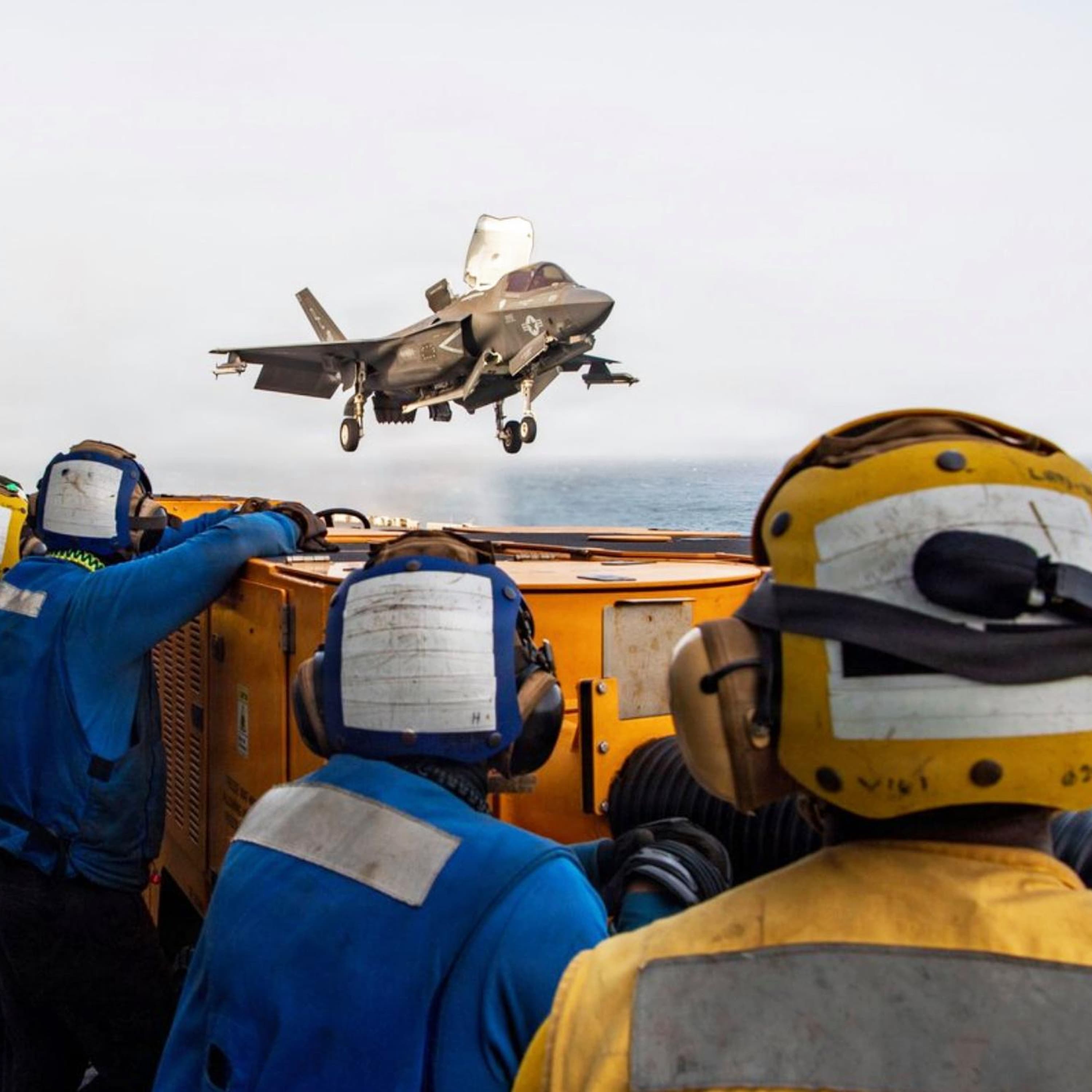
Today in Focus
US troops killed: has Trump lost control of Iran war? – The Latest
00:10:54
The US has carried out fresh strikes on Iran after three American soldiers were killed in action. The Pentagon has admitted that nearly 100 US service members have also been wounded as Tehran responded to 10 consecutive nights of attacks. Lucy Hough speaks to our senior international correspondent, Julian Borger
Loading summary
Transcript22 lines
- [00:00]
Lucy Hoff
This is the Guardian.
- [00:11]
Barclays Investment Bank Narrator
From globalization to innovation sustainability to market volatility, there's always more than one side to a story. Explore different perspectives on today's most important business and economic issues with the Flipside podcast from Barclays Investment Bank. Hear two research analysts in a lively debate and get insights from every angle. To further inform your view, listen to the flip side on your favorite platform.
- [00:42]
Julian Borger
Iran still has the capability to hurt the U.S. they were lucky. The casualties could have been far worse. We hit him very hard again tonight and we did that in honor of the great patriots. He couldn't accept American casualties. The real problem for him is to get to somewhere some agreement that he can claim is a diplomatic triumph from the Guardians today.
- [01:05]
Lucy Hoff
In focus, this is the latest. With me, Lucy Hoff. We're now in the tenth consecutive day of renewed strikes between the US And Iran as tensions re escalate in the region. Julian Borger, you're our senior international correspondent. I think most significant for Trump is the deaths of military personnel over the weekend in the Middle east, in addition to the nearly 100 that have been injured in the region in the last two weeks. What are the implications for Trump on that, do you think?
- [01:42]
Julian Borger
Well, they're very serious because this is already a very unpopular war in the US Public opinion mostly for economic reasons up to now price of petrol. But if you add into that American servicemen and women are beginning to get killed and injured, then that is a whole other level. And that's something, if there's one consistent thing about Trump over the years, is he's been very reluctant, reluctant to put American soldiers in harm's way. He has no problem with bombing other people and likes to see war in that way, just bombing the enemy and keeping American soldiers away from it. So this is something he is trying to avoid and yet it has happened now. And so the stakes for him are growing and the jeopardy for him, especially politically with the elections coming up, that is getting worse.
- [02:38]
Lucy Hoff
Yeah, because we have these very crucial November midterms coming up, don't we? As you say, this is a war that is enormously unpopular and increasingly so in the United States, not just because of the impact on consumers, the petrol pump and elsewhere, but when you start to then have US Military personnel coming home in coffins, the visuals of that are likely to increase that unpopularity. The stakes are enormous for him. He has responded for now by saying that that Iran will pay many times over and has carried out a series of US Strikes. Do you think those will continue?
- [03:18]
Julian Borger
Well, there are two things, really. One is the sort of the revenge and that, you know, he couldn't accept American casualties and then said, okay, well, that's call it off. That's not in his DNA, and that doesn't work politically. The longer question is, will he keep on, on up these attacks in the hope that it will shake something loose in the Iranian negotiating position and he can get what he wants on the negotiating table? Up to now, that really hasn't worked, and there's no sign that it's going to begin to work. But he's apart from that, really out of ideas. And of course, he has the military at his shoulder, who always have a plan of how things can be done and more things to bomb. And so, for the time being, as there isn't a diplomatic solution, that's all he has. And so without any real strategy, that is going to carry on until something else comes up, something shakes loose in the. In the negotiations.
- [04:18]
Lucy Hoff
Yeah. Which is still ongoing, and we'll talk about those in more detail. But in terms of the options available to him, I mean, as ever, it is impossible to work out what's going on in Trump's head. But will he be looking to achieve another kind of fragile truce? And I think crucial to that is the fact that Israel have said that they have no interest in getting involved in this latest round of fighting. So that leaves him quite isolated on that front, doesn't it?
- [04:49]
Julian Borger
I think it's more a problem for him if Israel gets involved. It's a problem in terms of perceptions, political perceptions at home, which was originally that it was Israel that had led the US into this war.
- [05:02]
Lucy Hoff
So.
- [05:04]
Julian Borger
And it makes very little military difference, Israeli involvement. So that probably is not a huge factor. But the real problem for him is to get to somewhere, some agreement that he can claim is a diplomatic triumph, as he tried to do with the June Memorandum of understanding.
- [05:22]
Lucy Hoff
Yeah. A very fragile truce that was much trumpeted at the time, but has fallen apart very quickly in terms of what Iran are up to. They are carrying out their own strikes in the Strait of Hormuz, but also in the wider Middle east region, Right?
- [05:38]
Julian Borger
Yes. They aimed their missiles and drones at U.S. bases and concentrations of U.S. forces in the region. So Jordan in particular, there's a Jordanian air base out in the eastern desert called Muafak Salti, which they've managed to hit, and this is where the three US Casualties were and many of the injuries, but also in Qatar, Bahrain, Kuwait. But what it shows is that despite all the claims we've heard from the Trump administration over the weeks and months that Iran still has the capability to hurt the US and to pinpoint and to hit these bases. So it shows that they still have missiles and drones and that they are relatively accurate. The US has stressed that most of these 100 casualties were mild concussion. Most are back on duty. But that shows they were lucky that a missile drone hit in a concentration of US forces and the casualties could have been far worse.
- [06:50]
Lucy Hoff
Yeah, quite a lot of spin going on in the last few days. Another significant development is that the Iran backed Houthis have also threatened to blockade the Red Sea. Presumably inspired by what Iran has been doing in the Strait of Hormuz and the huge ripple effect that's had to had on the global economy. And how empowering that that's been for Iran. How significant would you say that intervention or that threat is potentially?
- [07:19]
Julian Borger
Very, very significant. Houthis up to now have been sort of the bog, the dog that didn't bark. Because they are, they are a major proxy force, partner force of the Iran, who have this ability to close the other main waterway out of the Middle east, which is the Bab El Manda Strait. If they are able to do that, in a way, they just have to hit a few ships to put off shipping companies from using that strait. Then the two big choke points in terms of global trade, in terms of oil and gas coming out of the Middle east, those will have been closed. And then you can see oil prices potentially going back where they were at the height of the war, $120. So that is their capability. Now, whether they will follow through on their threat and whether they are able to hit ships and put off the shipping companies and the insurance companies, well, we'll see over the next few days. But if they do have that capability,
- [08:30]
Lucy Hoff
that could be hugely damaging to an already very damaged global economy. So you mentioned talks are still ongoing. The Memorandum of Understanding still stands. It seems, despite what's going on in the Middle east, talks are continuing. But are they progressing? Because it feels like yet again we've taken a bit of a step backwards, I suppose.
- [08:55]
Julian Borger
We don't know if they're progressing until something comes of it. I mean, new ideas seem to be being explored. The problem with the Memorandum of Understanding is, well, it was negotiated by two real estate developers who were sort of freelancing for the U.S. steve Witkoff and Jared Kushner. And it was full of holes. I mean, no diplomat would have gone away and thought that they had an agreement. For example, it was largely about the Strait of Hormuz. There was no attached map of where ships and what route ships could take through the Strait of Hormuz. So it was left very up in the air. The question of who has control was very much left in the air and so was full of ambiguities. And so its collapse was really inevitable because both sides came away thinking different things about it with their own interpretations. So what we understand is that the center of talks right now, the behind the scenes negotiations involve Iran and Oman, who are on both sides of the Strait, to come to an agreement on how the flow of ships can be jointly regulated. And if that can be done, then potentially there is the prospect of going back to the negotiating table and redoing that memorandum understanding in a way that
- [10:18]
Lucy Hoff
works this time doesn't sound like easy work. Julian, thank you so much for your time.
- [10:24]
Julian Borger
Thanks, thanks for having me.
- [10:27]
Lucy Hoff
That's it for today. My huge thanks again to Julian Borger, the Guardian's senior international correspondent. You can keep up with all his reporting over@wuardian.com as well as live coverage of the crisis in the Middle Middle East. And I really recommend heading over to our sister podcast Stateside with Kyan Carter. Carter Sherman is speaking to the classicist Mary Beard about Christopher Nolan's adaptation of the Odyssey and why it's left her a bit disappointed. Thanks for listening to this episode of the latest Today in Focus will be back in your feeds as usual tomorrow morning. The latest will be back tomorrow night. This episode was presented by me, Lucy Hoff. It was produced by Angus Neal. The senior producer was Ryan Ramgobin. The executive producer was Zoe Hitch. This is the Guardian.
- [11:27]
Pura Advertisement Narrator
Summer smells like salt in the air and warm sand. Restore your sense of place with Pura's new summer fragrance collection. Discover Transform Transportive clean scents@pura.com close your eyes. Summer smells like sunshine, fresh citrus and salty air. What if your living room could feel just like that with Pura's new summer collection? It can restore your sense of well being with fragrances designed to move with your day. From bright, energizing mornings to soft, relaxing evenings. Make the invisible unforgettable this season. Visit pura.com to find your new favorite summer scent.
- [12:06]
Aura Advertisement Narrator
Most people don't realize how much of their personal information is being bought and sold every day. Data brokers are making billions, pulling details about you from public records and the Internet, then packaging and selling it, usually without your consent. That's how your information lands in the hands of scammers, spammers, even stalkers. It's why you get endless robocalls and why ads seem to follow you everywhere. That's where Aura comes in. Aura actively removes your data from broker sites and keeps it off. They also instantly alert you if your information shows up in a breach or on the dark Web. But Aura goes beyond data protection. With one app, you get a vpn, antivirus, password manager, spam call protection, dark Web monitoring, and even up to $5 million in identity theft insurance. All backed by 24. 7 US based fraud support. Other companies might sell just credit monitoring or even just a vpn. Aura gives you of it together at the same price competitors charge for just one service. Start your free trial today@aura.com safety protect yourself now@aura.com safety.