← Today in Focus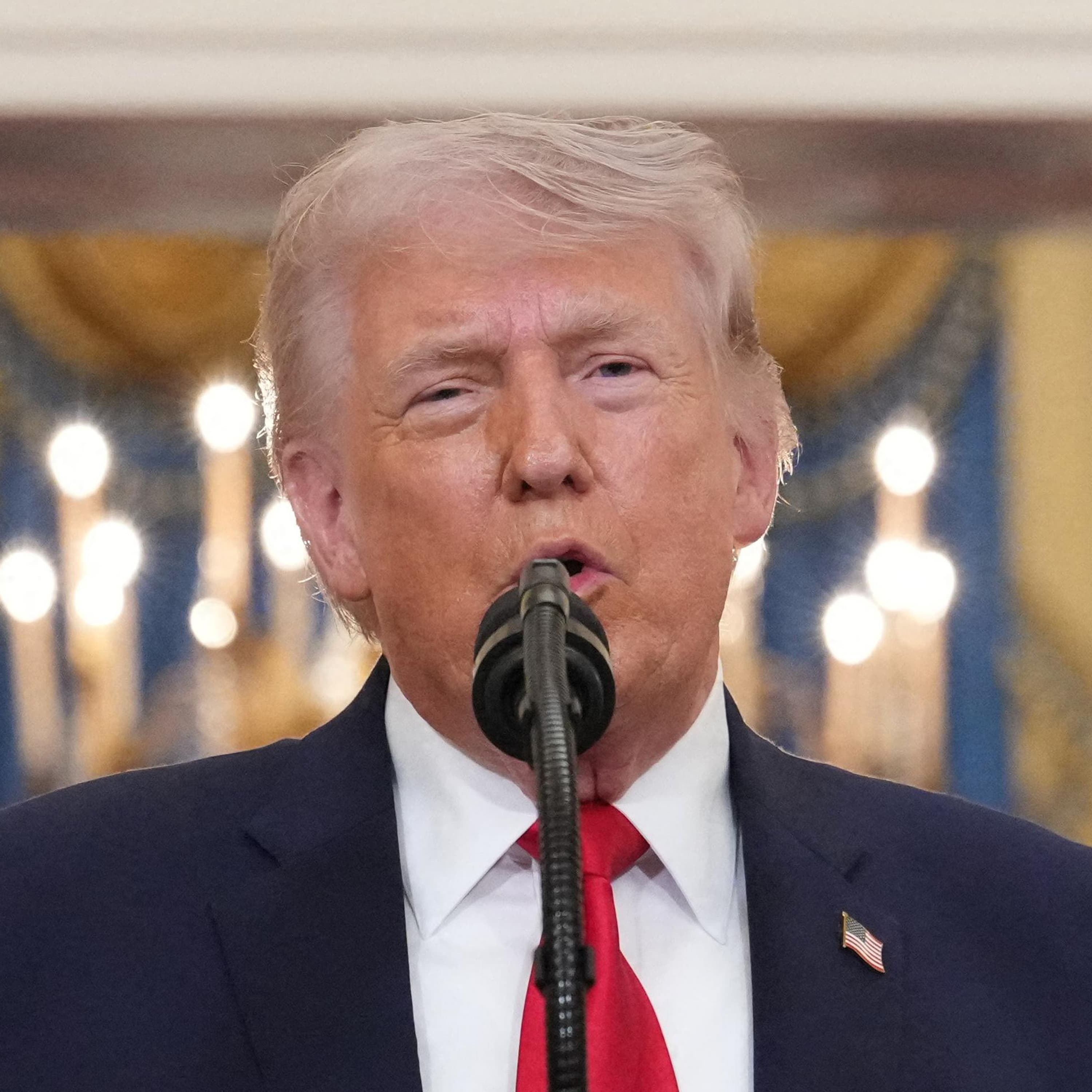
Today in Focus
War without a plan?: What Trump’s latest speech revealed – The Latest
00:12:59
Donald Trump’s primetime address on Wednesday evening provided little clarity on the US’s strategy in its war against Iran. Lucy Hough speaks to the Guardian’s global affairs correspondent, Andrew Roth
Loading summary
Transcript22 lines
- [00:00]
Lucy Hoffman
This is the Guardian.
- [00:11]
Barclays Investment Bank Announcer
From globalization to innovation sustainability to market volatility, there's always more than one side to a story. Explore different perspectives on today's most important business and economic issues with the Flipside podcast from Barclays Investment Bank. Hear two research analysts in a lively debate and get insights from every angle. To further inform your view, listen to the flip side on your favorite platform.
- [00:42]
Andrew Roth
This 20 minute speech was incredibly bellicose, but I think that it came off to many as a damn squib. We're going to hit them extremely hard over the next two to three weeks. We're going to bring them back to the Stone Ages where they belong. You know, they're really looking for a way out of this to say mission accomplished. And yet they have this massive problem, which is that they still have a closed strait of form moves and an energy shock that's about to hit the world that is going to make a lot of people doubt whether this was worth it at all.
- [01:11]
Lucy Hoffman
More mixed messages from President Trump, who used a White House primetime address to the nation to promise the US Would hit Iran hard, whilst also saying it would all be over soon. So what to make of it all from the Guardians today. In Focus this is the latest with me, Lucy Hoffman. I'm joined by Andrew Roth, the Guardian's global affairs correspondent based in Washington, D.C. thanks so much for dialing in from Washington. It's really great to have you on the show for the first time. So when it was announced that Donald Trump would be giving this sort of big primetime address in the White House about the Iran war, there were perhaps some who would have expected there to be a kind of major announcement on future strategy, an end to the war or perhaps something concrete. But instead we had more of this sort of convoluted, confused, confusing messaging. You know, like we're going to escalate, we're achieving our aims, but it's all going to be over really soon. Don't worry about it. We're going to bring Iran back to the Stone Ages is one quote that has stuck in my mind this morning. How would you summarize the tone of this 20 minute speech?
- [02:21]
Andrew Roth
Yesterday, 20 minute speech was incredibly bellicose, but I think that it came off to many as a damn squib. The expectation was for some kind of major announcement and that would be either an escalation for some kind of, let's say, ground invasion of Iran, maybe to secure highly enriched uranium, or to reopen the Straits of Hormuz, or on the other hand, to announce the drawdown to say mission accomplished. Like that George bush moment in 2002
- [02:50]
Lucy Hoffman
that went so well for him.
- [02:51]
Andrew Roth
Exactly. And so I think that that's also something that current presidents tried to avoid. But the idea is that Donald Trump would get in front of the nation and say. And ultimately, I think that a lot of people were left thinking that nothing had really changed after they watched that speech last night.
- [03:08]
Lucy Hoffman
Yeah. And it's his central message was that the war is necessary, it will continue, that the US And Israel are achieving their aims. But. But also it will be over soon. Obviously trying to reassure a jittery American public and international community. He. He also claimed that the Strait of Hormuz will open naturally once the war is over, which I think is some questionable. One of the central justifications for the war in the first instance, nearly five weeks ago, was about dismantling Iran's nuclear capability. The claim at the time was that Iran was weeks away from having a nuclear weapon. Again, very confusing messages from Trump on this yesterday because he said he now doesn't care about Iran's uranium stockpiles because they're deep underground and can be monitored. And so, presumably for analysts and people skeptical of this war, that sort of public admission that perhaps this was done illegally, we could say, or at least on very, very dubious grounds.
- [04:08]
Andrew Roth
Right. It seems like the administration is trying to throw everything at the wall and see what sticks. Exactly. And they're often looking for an explanation that justifies whatever it is they want to do at the moment. So with this administration right now, the explanation that Iran was just weeks away from a bomb, which has already been questioned by a lot of observers in public, members of the Democratic Party, but also backers of Donald Trump. There's now this big question that nothing has actually been done with this uranium. It remains available somewhere in Iran to the regime there. And ultimately, the question has not been settled by the US Military because of the difficulty of doing this with just an aerial campaign without being there on the ground. So to come on primetime last night and to say that to the American public that ultimately it's good enough, you know, we've almost gotten to our aims, is just the latest sort of promise that was made as part of this campaign that doesn't really seem to be fulfilled. You know, they're really looking for a way out of this to say mission accomplished. And yet they have this massive problem, which is that they still have a closed Strait of Hormuz and an energy shock that's about to hit the world that is going to make a Lot of people doubt whether this was worth it at all.
- [05:22]
Lucy Hoffman
Yeah. And if this address was in some way designed to calm the markets, which is what the President has been very much focused, focused on in the weeks since the conflict started, that was clearly unsuccessful. The cost of gas surged past an average of $4 a gallon for the first time since 2022. So levels of the start of the Ukraine war again, Donald Trump made this appeal for other nations to join the efforts to reopen the Strait of Hormuz. He said the sort of ludicrous quote, grab it and cherish it. No one, as we have discussed on the program this week, has, has answered those calls for help. Again, it just looks like more economic uncertainty. And that is going to start cutting through to the, to the public, as it, as it already is in the U.S. right, right.
- [06:11]
Andrew Roth
Even before Donald Trump came on television, we saw two other leaders from Australia and from the uk, Keir Starmer, go to their publics to basically say, this is about to get very bad and you are about to face a lot of economic hardship. You're going to see petrol become more expensive, you're going to see prices go up for ordinary things. But, you know, in this Almost World War II or other difficult time kind of vein where, you know, we're Brits, we're Australians, we can pull together and deal with this. And I think that that was sort of speaking to the difficulty of the moment that's coming up. So, you know, ahead of Donald Trump coming on television, there's a sense in each country that there's about to be a kind of crisis as a result of this specific decision to go to war with Iran. Marcus did not seem to be calmed down by the announcements that Donald Trump made last night because it does not look like the administration has a firm plan. Once again, they repeated two to three weeks of heavy bombing, and then we're going to be out of this. We've been hearing that for a long time, and ultimately it could have been a true social post. These are things that Donald Trump has said over the recent weeks, and going on television doesn't really seem to be merited.
- [07:22]
Lucy Hoffman
Yeah. And I'm just wondering about the political reaction to the speech, because, as you say, it was widely anticipated that there would be some kind of concrete announcement about what the next few weeks might hold. Senator Chris Murphy, a Democrat, says no one in America, after listening to that speech, knows whether we are escalating or de. Escalating. So, you know, is that representative of the broader political response in Washington?
- [07:49]
Andrew Roth
Do you think, yes, it is. I think that there was a lot more expectation for that speech, even from allies, the president, obviously, people who were behind him, like the Secretary of Defense, Pete Hegseth, the radio host, Mark Levin, who's very conservative, will say things like, that was the best speech of all speeches we've ever seen. But I think for a lot of more, you know, dispassionate observers of Donald Trump and those who are really wondering what's going to happen next, there was not much to seize on in that speech. And it really leaves them thinking, is there a plan to get out of this conflict? And it doesn't seem like there is.
- [08:26]
Lucy Hoffman
And quite how harmful that could be as Donald Trump approaches the November midterms, having promised on the campaign trail to end the endless wars. I mean, you know, what is the sense that you're getting kind of watching, say, Trump friendly media or speaking to people who traditionally support him?
- [08:46]
Andrew Roth
I think that the anger against him over the war is going to be compounded by the anger over the economy. So I would say that the elite supporters are people who are real, die hard fans of his, particularly from kind of, you know, MAGA point of view, will be very angry about the actual war itself, about the invasion of Iran. This is not supposed to be an America first foreign policy. So those are the people who, you know, would be backing him amongst the Republican elite, amongst the MAGA elite. And so a lot of those backers would maybe be moving away from him, moving away from people like J.D. vance who were supposed to be opposed to this kind of aggressive, interventionist foreign policy that's going to be compounded by ordinary, ordinary people who are going to be hit at the pump with, once again, petrol prices, with grocery prices, prices for everything are going to go up. And I think that that's the biggest concern for the administration right now is how to deal with the coming price shocks that could hit and could continue through a midterm election that could be devastating for Republicans and devastating for Donald Trump.
- [09:49]
Lucy Hoffman
Yeah. And it's also not a decision that the US can unilaterally take to exit the war and for the Strait of Hormuz to naturally open itself. As he said yester, we've had a deployment of thousands of US Troops into the regions and Iran has responded by saying that they will carry out more crushing attacks. So what are some of the possible off ramps that are being taken into serious consideration in the White House? As far as we can tell, Lul,
- [10:20]
Andrew Roth
I mean, the main idea in the White House right now is to find some kind of leverage to force Iran to open the Strait of Hormuz, because that is ultimately the escalation dominance that Iran has. Ultimately, Iran can decide at the moment whether or not to close the strait and has a bunch of options to do that. So the U.S. you know, some of these ideas for a ground invasion are basically to take something so dear to Iran that the regime there would be forced to negotiate something like Harg island, which is the bay, you know, the most important oil depot for the government there. But once again, this is an existential fight for the Iranian government. And the question remains, if you're willing to kill their leaders, why would they negotiate over something like their oil industry, even negotiate over these threats from the administration to attack energy infrastructure, you know, major power plants and plunge the country back into the stone Age, as Donald Trump says. So once again, the question is whether that leverage will really work. Short of that, the other off ramp for the administration is simply to walk away, to say that the Strait of Hormuz is not our problem. This is not where we get our oil. This is where they get their oil. They being our allies in Europe, other economies across the globe. Once again, though, markets are connected throughout the world. This conflict is causing prices to rise in the United States. And I think the expectation that you can just walk away is going to prove to be short sighted. So there are not perfect ways for the administration to, to find an off ramp, which is kind of a trap that they found themselves in at this point.
- [11:55]
Lucy Hoffman
Yeah, it certainly is. Well, Andrew, thank you so much for your time.
- [11:59]
Andrew Roth
Thank you.
- [12:01]
Lucy Hoffman
Thanks again to Andrew Roth, the Guardian's global affairs correspondent. You can keep up with his reporting over@theguardian.com as well as rolling coverage of the Iran war. And I do recommend that you listen to our sister podcast, Politics Weekly America, where Jonathan Friedland is talking to author Sasha Abramski about his new book, American How Trump, Musk and Doge Butchered the US Government. Today in Focus. We'll be back with you as usual tomorrow morning. The latest will be taking a short Easter break and we'll be back with you on Tuesday nights wishing you a wonderful Easter and a good weekend. This episode was presented by me, Lucy Half. It was produced by Bryony Moore, with senior producer was Ryan Ramgobin and the lead producer was Zoe Hitch. Chicago, 2011. A cop is murdered. Police and prosecutors swear they have the trigger man. He swears he didn't do it. How far will each side go to prove their right? Like it's just one bombshell after another. You know, you're like, what? What? The story of a PlayStation, a brain eating amoeba and the relentless pursuit of justice. Off duty out now. Listen Wherever you get your podcasts, this is the Guardian.
- [13:33]
Barclays Investment Bank Announcer
From globalization to innovation, sustainability to market volatility, there's always more than one side to a story. Explore different perspectives on today's most important business and economic issues with the Flipside podcast from Barclays Investment Bank. Hear two research analysts in a lively debate and get insights from every angle to further inform your view. Listen to the Flipside on your favorite platform.
- [13:58]
Paige from Giggly Squad
Hey, it's Paige from Giggly Squad. And you know those moments when you just want to slow down and actually treat yourself? That's exactly where Haagen Dazs comes in. Haagen Dazs just launched a brand new flavor Coffee Almond Toffee Ice Cream. It's rich, smooth, creamy, indulgent and honestly too good to rush through. Take your sweet time. That's Daz. Find Haagen Dazs new Coffee Almond Toffee Ice Cream at retailers nationwide.