← Today in Focus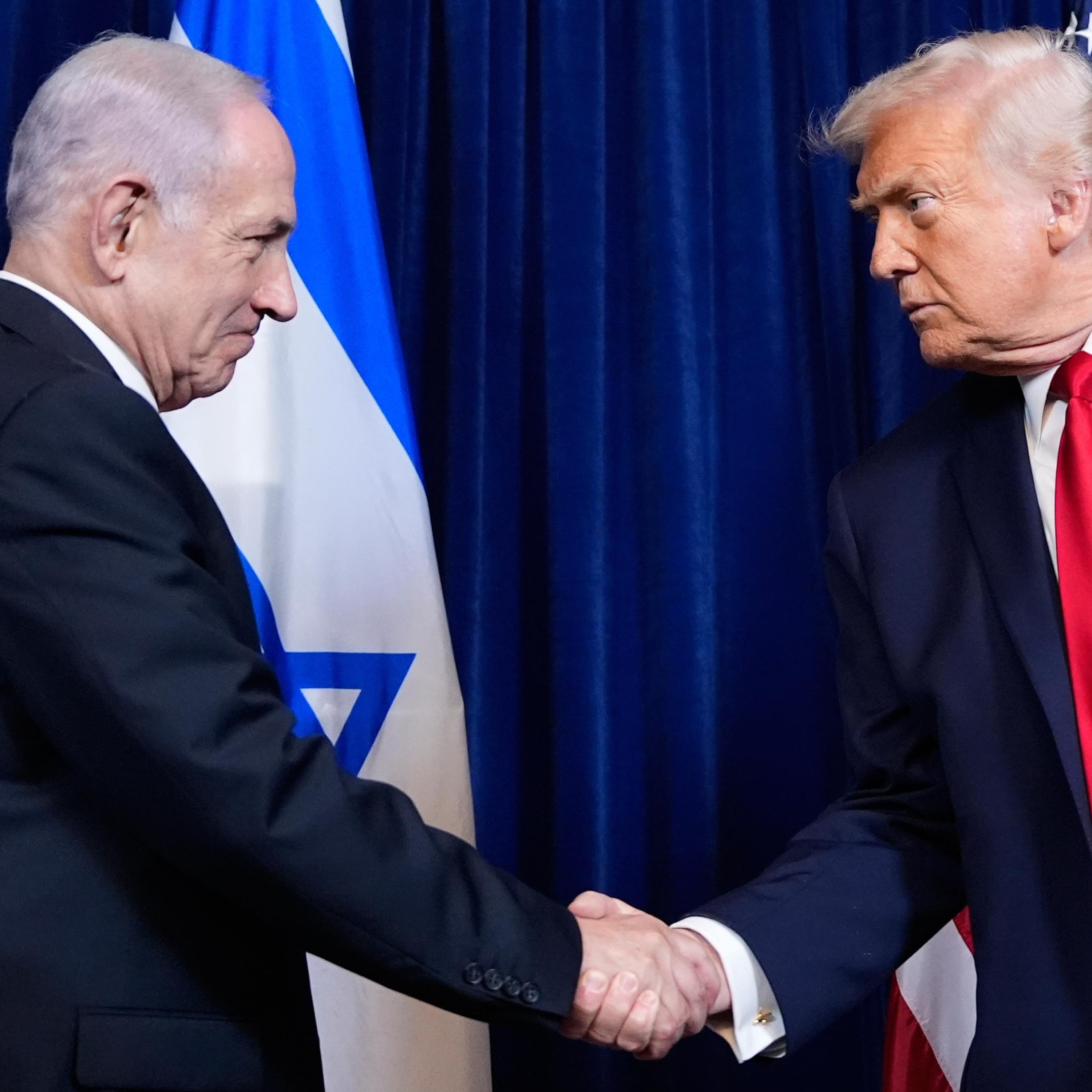
Today in Focus
What do Netanyahu and Trump really want in Iran?
00:25:34
Who’s calling the shots in the US-Israeli war on Iran? Chief Middle East correspondent Emma Graham-Harrison and international security correspondent Jason Burke report
Loading summary
Transcript55 lines
- [00:00]
A
This is the Guardian. Today. Trump or Netanyahu, who is really calling the shots over Iran?
- [00:20]
B
The United States military began major combat operations in Iran.
- [00:27]
A
When Donald Trump announced early on Saturday morning that the US had launched military strikes on Iran, he made it sound like an American idea.
- [00:35]
B
This regime will soon learn that no one should challenge the strength and might of the United States armed forces.
- [00:42]
A
But on Monday, Trump's secretary of state offered a different story. The US Actually got involved because Israel was about to attack Iran, said Marco Ribio.
- [00:52]
B
And so the president made the very wise decision. We knew that there was going to be an Israeli action. We knew that that would precipitate an attack against American forces. And we knew that if we didn't preemptively go after them before they launched those attacks, we would suffer higher casualties.
- [01:07]
A
Meanwhile, Benjamin Netanyahu insisted that he didn't drag Trump into war.
- [01:12]
B
Donald Trump is the strongest leader in the world. He does what he thinks is right for America. Iran is committed to your destruction. And whether people understand it or not, the leader to understand it, Donald Trump understands it. You don't have to drag him into anything. He does what he thinks is right.
- [01:32]
A
And then on Tuesday in the White House, Trump contradicted his own secretary of state and said it was in fact, Iran that was poised to make the first move.
- [01:41]
B
I think they were going to attack first, and I didn't want that to happen. So if anything, I might have forced Israel's hand.
- [01:53]
A
From the Guardian, I'm Helen Pitt. Today in Focus, Whose war is this and how does it end? Emma Graham Harrison. You're the Guardian's chief Middle east correspondent based in Jerusalem, and we're talking on Tuesday afternoon. Things are moving, obviously, very quickly, but what's the mood like there today?
- [02:17]
C
I've spent a lot of the last three days going around Israel and this war, to an outsider perhaps might seem quite a surprising amount of public and political support for this war, despite the very heavy cost that it's inflicting on Israel. I went yesterday to the site of a bomb shelter in synagogue that was directly hit by an Iranian missile, where nine people were killed, including four children. I went to a site in Tel Aviv where one person was killed. And what many, many people said to me, not all, but many of them said, we're glad that this is happening. It should have been done before, including people who had been directly affected. A guy who had to be pulled from the wreckage of his apartment last June, a guy whose apartment had been hit this time he said, oh, this is going to be an Israeli story, I tell my children the tyrant was hit. By that, he means Iran's supreme leader Khamenei was assassinated and my apartment was hit.
- [03:12]
A
Wow.
- [03:13]
C
So, yeah, there really is a pretty broad political and popular support.
- [03:18]
A
I think Israel's military said that in the early hours of Tuesday it was intercepting a new wave of missiles. Are there just a constant stream of missiles in the air that are being repelled by the Iron Dome at the moment?
- [03:31]
C
So Israel's air defense system is not just the Iron Dome. It has this multi layered system. The Iron Dome actually mostly gets rockets. They have other layers, the arrow, David's sling that get missiles. Missiles coming from Iran are the most destructive. The thing that I think people here are most frightened of, Iran said, you know, we will defend ourselves if we have to by attacking targets across the region. And that's what we've seen. So it may be that the Iranian military, because we're seeing attacks from, you know, Riyadh to the UAE to Cyprus, that perhaps there's slightly less coming to Israel or perhaps there's slightly better interception.
- [04:07]
A
And how is Israel dealing with Iran's proxies in the region? I'm thinking particularly Hezbollah in Lebanon, who, as I understand it, have been firing rockets into Israel in recent days.
- [04:18]
C
We saw overnight that Israel has announced it's sending ground troops back into southern Lebanon. So, you know, Hezbollah seems to have been drawn back into the conflict. Most people in Lebanon do not want to be drawn into another war. They don't want to have to leave their homes again. And at one point, Lebanon said it would stop the Lebanese armed forces, would stop Hezbol, but obviously they didn't have the capacity to do that.
- [04:42]
A
Yeah. And we're talking to you on day four of this war. What operations are Israel carrying out against Iran now at this point in the conflict?
- [04:52]
C
So Israel is still targeting Iran very intensely. From what we understand from their public statements, they're trying to take out missile launcher sites. So instead of the very expensive and sometimes failing process of taking out these missiles as they come towards Israel, they're trying to destroy the sites from which they're launched, missile production sites. And they're apparently also still going after the assassination of senior figures.
- [05:17]
A
Oh, right. So they're not done yet.
- [05:19]
C
Very much not. I mean, that's what we're hearing. It's perhaps one of the few things that does seem to be a consistent message that we're getting both from the American leadership and the Israeli leadership, is that people should be prepared for a weeks Long conflict. That very much seems to be the message. You know, there's really no precedence, at least that I can think of, of regime change, operation imposed from the air that has gone the way the people trying to effect it thought it would go. So, you know, it's one thing to kill a leader, it's another to have control over who replaces them.
- [05:57]
A
So you think that they thought it would be as simple as taking out the top guy and a few, some of his aides and then the people would rise up and lo and behold, a new regime.
- [06:07]
C
I mean, honestly, I wish I could say that I thought that was what they imagined because that would imply they had a clear plan, like everything that's coming out of America and everything that Trump is saying implies that they really didn't have a plan. For those of us who are old enough to remember 2003, the US led invasion of Iraq, it's really terrifyingly, tragically reminiscent of what we were hearing from America there. I mean, perhaps one of the most indicative things was Trump saying in one interview, oh yeah, we've identified two or three people that we thought could take over from Harmony, sort of wanting to do a Venezuelan style model and then saying in his next interview that, oh yeah, but he killed those people. Yeah, I mean, if it wasn't, if there weren't so many lives at stake, it would, it would be comic.
- [07:00]
A
Emma isn't the only Guardian journalist in Jerusalem right now. Our international security correspondent is also there, Jason Burke. Welcome back to Today in Focus. I can actually hear air raid sirens in the background. So it's very clear to me that you are indeed in Jerusalem. And I guess there's one big question a lot of people are asking, which is how the hell did Iran allow this to happen and should they have been more prepared for this?
- [07:27]
B
That is a really important question and we just don't have an answer. It seems completely bewildering that Ali Khamenei, who knew that he was being targeted, that would be right in the front line of any major offensive, would be prepared to expose himself to that kind of risk, not be in a bunker, particularly after the collapse of talks on the Thursday just before the war began. Again, he would meet with all his senior people, military and intelligence, in one place at one time. I mean, it just breaks absolutely every rule. And the only thing I can think of is that it's a very closed regime. It's a very closed senior ranks of these officers in a sense. And in those situations you get the kind of group think you get this sort of almost delusional view of the outside world. Maybe they thought the Israelis would never do it, maybe they thought that they would only do it at night. And the strike was actually timed, we know now, for the morning, partly because they had this window of opportunity, but also because it would surprise the Iranians.
- [08:50]
A
And can you tell us a bit more about how Israel and the US knew so precisely where Khomeini and his key lieutenants were going to be on Saturday morning?
- [09:00]
B
Some of the suggestions are that the. I heard that a lot of the communications were being intercepted and that by triangulating those intercepts with other sources of information, visual surveillance of the movements of drivers, for example, caterers, people who take out the trash, that kind of thing, that you could work out that meetings were going on and quite whom, who was taking part in those meetings? There's a suggestion the CIA particularly had a human source at a very high level. We know that the Iranian regime is penetrated very heavily by the Mossad, the Israelis, and perhaps the CIA as well. Is it penetrated at that level? That would be pretty extraordinary, but perhaps not impossible. So in terms of where the absolute pinpoint comes from, when I asked this of serving and veteran former intelligence officials involved in targeting, they say, listen, it's a jigsaw. You get all your bits of information together. You now use AI often to combine them, to reconcile them, to draw in as much as you can. And then that may produce something, or it may really just be one key source that provides that absolute confirmation. And then you pass it up to the chain, to the decision makers and go for it or not, as they decide.
- [10:36]
A
How does Mossad operate in Iran?
- [10:39]
B
I mean, for the last 20 years, 30 years, it's been very clear to the Israelis that Iran is a great threat to them. It's perceived as an existential threat, particularly the nuclear program. And they have focused enormous resources on intelligence gathering in Iran. Now, a really key change was about 10 or 15 years ago when they decided they would start recruiting Iranians rather than trying to put in their own people. And not only were they going to recruit Iranians, but they were going to provide them with very high level training, good resources, good equipment. That's certainly what's been going on more recently. And that obviously has a devastating effect on morale of the enemy within Iran. The other thing we saw was just really detailed knowledge. So there have been all sorts of assassinations over the years in Iran that Mossad have carried out of nuclear scientists and others. And what has been striking is the detailed knowledge that clearly facilitated those attacks. So the killing of Ismail Haniyeh in 2024, who's a senior Hamas leader who was in Tehran visiting, and he was killed by a bomb that was placed in a government guest house in his favorite bedroom.
- [12:17]
A
Emma, the messaging coming out of the White House is extremely inconsistent, to say the least, and it seems to be shifting hour by hour. So you had Trump at the start, very much owning this mission. And then you had Marco Rubio, the US Secretary of State, on Monday suggesting this was actually an Israeli operation and that the US Only joined because they just anticipated that the Israeli action would cause retaliatory attacks on their forces in the region. I just wonder who you think has led on this operation. Is it the US or is it Israel?
- [12:50]
C
I mean, those comments by Rubio were truly, truly bizarre because, you know, for a government that's very interested in sort of macho posturing and looking strong, he was essentially saying, we gave Israel more of a say in whether or not America went to war than the American government and the American people. Because, you know, I think one of the things that's. That's really been focused on by domestic critics is that not only did Donald Trump not go to Congress to get authorization, he also didn't go to the American people to explain what he was doing, why he was doing, what the plan of the war was. And I think quite possibly a lot of what you're seeing coming now, this inconsistent messaging, comes back to the fact that there really doesn't seem to have been a clear plan. Yeah.
- [13:36]
A
And I wonder, how has all this gone down in Israel, What Ribio has said, and this suggestion that it's the Israelis have led and kind of the
- [13:44]
C
Americans have followed, I think it's problematic to say that the Israelis have led and Trump has followed because it sort of really, I think, underestimates Trump's autonomy and his own responsibility in this. What I do think that people perhaps credit Netanyahu with is. Is a sort of diplomatic, or whether you want to call it a personal relationship effort, which managed to convince Trump that Netanyahu's plans, projects were in Trump's own interests. So I think rather than presenting it as, oh, you know, Israel or Netanyahu persuaded Trump to do what they want, I don't think that would happen. I don't think you can really do that with Trump. I think what Netanyahu appears to have done is much more subtle and sophisticated. And although the. I would say that the results so far are looking catastrophic in many ways, beyond the immediate Tragedy of many civilians killed diplomatically. It's very impressive. He basically appears to have persuaded Trump over a period of several months, at least from the beginning of the year, that what he, Netanyahu, wanted to happen would also be very good for Trump.
- [15:07]
A
Right, and why do you think Trump wants this?
- [15:12]
C
I mean, look, Trump is a confusing, contradictory, difficult to understand person, and I just do not follow him closely enough. But I think you can look at many immediate things. You know, if you look at sort of autocratic leaders, particularly people who, you know, men who go for a kind of particular vision of how power is deployed, the use of military force, the idea that sort of might is right, that strength is what matters, that whoever has the best military technology is the person who's going to. Yeah, is the person who's going to be most secure. And that's an idea that seems to appeal to Trump. That's very much Netanyahu's approach, too. And you see, there's this long history of targeted assassinations that are incredibly technically impressive as both military and sort of espionage feats. Locating your enemy, someone like Khamenei, and then killing him in a relatively pinpoint operation on his compound. But Israel has been taking out leaders for decades. It's killed generations of leaders of Hamas. You know, they killed the head of Hezbollah. And yet it's still threatened by Hezbollah. Still threatened. You know, Hamas is reconstituting.
- [16:22]
A
Yeah, indeed. And you've already sort of touched on this, but perhaps you could expand a bit on what you think Netanyahu actually wants to get out of this war.
- [16:31]
C
Well, Netanyahu presided over October 7.
- [16:36]
A
It happened on his watch. Yes.
- [16:38]
C
Everybody else pretty much who was in a senior position, whether political or military, on that day has stepped down. Most of them, I believe, have, one way or another apologized for their role. And Netanyahu has remained defiant. And I think it's reasonable to think he's looking around, what security achievement could wipe out the memory of that failure? You take down Khamenei, take down the regime that has been a sponsor of Hamas, a sponsor of Hezbollah. Khamenei himself called for the destruction of Israel sponsored armed groups, militias, hostile states who actively work towards that end. A very dangerous, violent enemy. That potentially could be a major security achievement. Israel has to have elections by October this year, so this is very immediate. And Netanyahu is on trial for corruption. He's trying to get a preemptive pardon. Trump has got involved in that, too. He's asked the President of Israel to give Netanyahu a Preemptive pardon. The president's already said he'd give Netanyahu a pardon, but only if Netanyahu agreed to step down from public life. And at the moment, Netanyahu wants to have both. He wants the pardon and he wants to hold on to cause.
- [17:53]
A
Of course he does. Yes.
- [17:55]
C
And you know, it's very convenient for him. You start this war, you see this surge of political unity. The entire opposition across the spectrum of Jewish Israeli politicians at least has united behind him. The lone voice of dissent that I'vesin has been a Palestinian citizen of Israel. The population is pretty supportive of the war, as I said. So suddenly from being in a fractious situation where you're trying to hold together a feuding coalition, you're a wartime president leading a country in a, at least as it's begun, a pretty impressive tactical achievement of, of assassinating Khamenei.
- [18:39]
A
And do you think that as this war goes on, Trump and Netanyahu are going to agree on how it should progress and I guess how it should also come to an end?
- [18:49]
C
Well, I mean, for that I would say your answer is probably only going to become clear when we see how the war plays out. I mean, as we said, this tactical achievement of assassinating Khamenei that Netanyahu and Trump both been very keen to claim success for sure. If in six months we see in Iran something like what happened in Iraq, which is the country fragmenting it falling into some kind of chaos, perhaps even towards civil war, or if we see the security apparatus somehow reconsolidating itself, I think six months down the line, if things aren't looking as Netanyahu and Trump would like them to, as they hope they will, I imagine that would weigh on their relationship.
- [19:40]
A
Yeah. And it's worth remembering that Israel is a country that's been in a state of near constant war for over two years now. And for much of that time you've been reporting on Israel's war on Gaza. I just wonder what impact has the past few days had on both Gaza and also the West Bank.
- [19:58]
C
So, you know, that's a very good question and it's a really critical one because the situation in Gaza is still devastating. The so called ceasefire under which we've continued to see hundreds of people killed, aid is still in very short supply, hospitals aren't able to rebuild the situation there. You know, leading humanitarian Jan Eglin, the president of NRC said it's still catastrophic, but and really world attention has been completely distracted. When Israel launched the war, they closed all crossings into Gaza. That caused panic pretty much immediately. You know, people are still living with the horrific memories of the famine that they endured last. Last summer. And again in the west bank, we've seen the world's attention is distracted. Violent settlers, who have the backing of much of the state, have gone on a rampage. We saw two people were killed yesterday. And the state has sort of shut down the west movement in the West Bank. They've basically restricted people to their local area. So there's massive restrictions on daily life and a step up of violence.
- [21:09]
A
Coming up, will Trump and Netanyahu come to regret killing the Ayatollah? Foreign. So, Jason, this was a joint operation, but it was also notably the first time that the Israelis have assassinated a head of state. And I wonder in the past, have they not done that because they just didn't have the military, the intelligence capabilities to do so, or was it because they just didn't see it as being in their best interest to do something so dangerous and, you know, which has such severe ramifications.
- [21:52]
B
I think it's more the latter, to be honest. They've had opportunities to kill senior leaders before. We know that historically, they haven't taken them. This crosses a significant boundary. Certainly, it takes state assassinations into a really extraordinary place. I mean, when did we last have anybody kill a ruler of a country, a sovereign nation? Certainly in this way, I mean, it takes us into a very different space. And previously, I think there was a significant reluctance to cross that line on the basis of not so much in terms of law, but in terms of diplomatic fallout, in terms of image. And simply, I mean, it is a kind of massive event that can have very unforeseeable consequences.
- [22:47]
A
And in terms of achieving their objectives, do you think that this was a wise move for Israel?
- [22:53]
B
I rely on what I hear from people who've been involved in this kind of operation. So I spoke to several in the last two or three days, including two who admit that they've been involved, in the words of one, in killing a lot of people. In fact, that person said to me, an American CIA said to me, to, quote, I've got no ethical problem with killing people. I've killed a lot. I do have a problem with the hit on Khomeini. Interesting, because I don't think it's the right thing to do. I think it's a tactical victory, but not a strategic one. The problem, this is what they said, the problem with taking out a leader is you just get another one. You don't resolve the problem. You just create another one.
- [23:43]
A
So if the goal is regime change, this will not necessarily achieve that.
- [23:47]
B
That we don't know. I mean, is it going to suddenly the Iranian masses rise up, storm ministries, lynch, irgc, commanders in the streets, take over the criminal justice system and spring open the prisons? I think not. No, that appears to be the ambition and possibly the expectation even that that might happen in the coming days in parts of the US and parts of the Israeli security establishment and among decision making officials. And I mean, I don't think that's going to happen. So, yeah, it will change the regime, it will change the situation dramatically and has done clearly. Does it solve the various problems? It doesn't look like it right now.
- [24:44]
A
Jason, thank you very much.
- [24:45]
B
Thank you.
- [24:48]
A
That was Jason Burke, the Guardian's international security correspondent. Thanks to him and also to Emma Graham Harrison, our chief Middle east correspondent. You can follow all of their reporting on this fast moving story@theguardian.com and that is all for today. This episode was produced by Ruth Abrahams and Hannah Aden and presented by me, Helen Pitt. Sound design was by Brian McNamara and the executive executive producer was Sammy Kent. We'll be back in your feeds later this afternoon with the latest. This is the Guardian.