← Today in Focus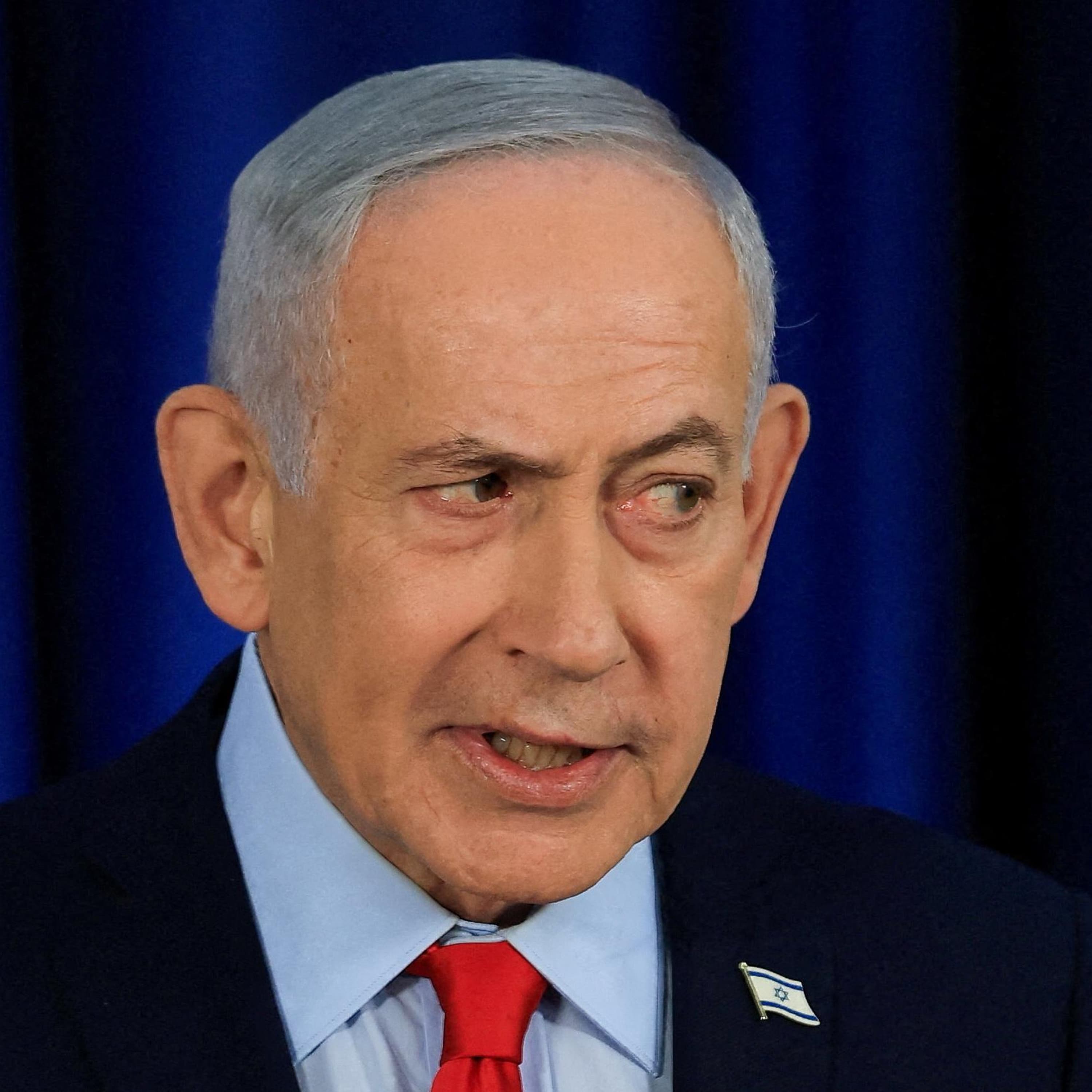
Today in Focus
What is Netanyahu’s endgame in Iran war? – The Latest
00:13:33
Could Israeli public support for the war in Iran give Benjamin Netanyahu a boost before this year’s elections? Lucy Hough speaks to Guardian’s chief Middle East correspondent, Emma Graham-Harrison
Loading summary
Transcript37 lines
- [00:00]
Lucy Hoff
This is the Guardian.
- [00:10]
Darina
Hi, I'm Darina, co founder of Quo. If you run a business, you know the team that responds first wins the customer. You've probably opened your phone to a bunch of missed calls and no voicemails. Those are missed opportunities and exactly why we built Quo. Cuo is the business phone system that helps your team handle every call and text right away. Join over 90,000 businesses that win more customers with Quo. Try Quo for free@quo.com tech that's quo.com tech.
- [00:46]
Emma Graham Harrison
Over the last two and a half years, polling has repeatedly showed that the Israelis has been very skeptical of Netanyahu's handling of the war in Gaza. What's interesting with the Iran war is that we see overwhelming support for his handling of the war, for his decision to go to war. That doesn't seem to have translated into political support for returning him to office. So basically, Israelis are happy he decided to go to war, but they still don't want him to carry on being prime minister.
- [01:11]
Lucy Hoff
Four weeks into the Iran war, there is still overwhelming support in Israel for the military action. But for Prime Minister Benjamin Netanyahu, it's a different story. His career, legacy and personal freedom may all be on the line from the Guardians today. In Focus this is the latest. With me, Lucy Half. I'm joined by Emma Graham Harrison, the Guardian's chief Middle east correspondent based in Jerusalem. So we want to look at the view from within Israel. Obviously, the war and Netanyahu's fortunes are closely interlinked. But let's start with the public support or otherwise for Israel and the US's war in Iran. How popular is the military action at the moment?
- [02:01]
Emma Graham Harrison
So there's been a couple of polls now, both from the beginning of the war and a couple of weeks in, showing that support for the war among Jewish Israelis is absolutely overwhelming. It started at over 90% and it stayed at over 90%, which makes Israel a real outlier internationally. It's probably the only country in the world by this war has overwhelming popular support.
- [02:22]
Lucy Hoff
And despite the fact that there are air raids, 15 people have been killed, there is this sense of a threat, that support remains that resolute.
- [02:34]
Emma Graham Harrison
Absolutely. I mean, normal life's been very much disrupted, particularly for parents. Kids aren't going to school because of fears they could be a hit on a school could have catastrophic results. So they're all homeschooling. Lots of places are closed, yet the days are constantly interrupted by air raid sirens. So you have to go and take shelter in the nearest shelter. Most people don't have them in their homes. I think we should say that's if you're lucky enough to have a shelter. You know, there's large areas of Israel, particularly areas where there's a big population of Palestinian citizens of Israel, where people really have very little access to shelters. But despite all that, there is, yeah, there's overwhelming support for this war. And I think the reason for that is there's a sense among those who support it that this is a kind of immediate pain and suffering and risk that people are going through in order to secure some kind of long term security for themselves, for their loved ones, for their families, for their country.
- [03:31]
Lucy Hoff
So the messaging of the Israeli government that Iran was posing an imminent security threat seems to have been believed as been taken plausible by much of the Israeli public. I'm interested in the conversations you've been having with people who are opposed or perhaps more skeptical of that messaging from the government.
- [03:53]
Emma Graham Harrison
The extraordinary thing is there is almost no opposition to this war inside Israel, at least inside, you know, mainstream Jewish Israeli politics. Really, people have, you know, we've got an election coming up in a couple of months, and politicians have really set aside their campaigning, their disputes on other issues to support this war overwhelmingly. Where I have heard criticism is when I've been speaking mostly off record to members of the security and intelligence establishment who've said, you know, first of all, that there wasn't really ever a plan for regime change in Iran. That that was pretty much wishful thinking. More than one person said to me that ultimately the real measure of whether this war has been a success without regime change will be Whether or not 440 kg of enriched uranium remain under Iranian control. If they don't, that probably be an escalated risk of a nuclear bomb. And then even if they still support the war, they say they're very concerned about what it could potentially do to the relationship with America, which is really like the foundational diplomatic and security alliance for Israel.
- [05:03]
Lucy Hoff
And Netanyahu has an as ever unreliable ally in Trump who has been kind of careering all over the shop in terms of looking for a deal, but also threatening more military strikes in the coming days. There is so, as you say, very, very strong support for the war within Israel. But the situation is very different for Netanyahu's own personal popularity. Right. And there are these very crucial elections coming later in the year, in the autumn. He's trying to force through a budget to avoid bringing that election forward. He's widely expected to lose election. So how can we view the action in Iran as part of saving his own political skin, as he has done so successfully over so many years now.
- [05:53]
Emma Graham Harrison
So the election that's coming up is going to be the first time that Israelis have a chance to vote on, pass judgment on their leadership since the October 7th attacks, which was the bloodiest day for Israeli civilians in the country's history. And there's long been a sense that Netanyahu has really tried to avoid personal responsibility for that. We've seen almost everyone else who is in positions of political or military power on that day take some kind of responsibility, step down. He's managed to stay in power over the last two and a half years. Polling has repeatedly showed that Israelis has been very skeptical of Netanyahu's handling of the war in Gaza, that people have often considered he's making decisions for personal political reasons rather than focused on national security. And really the opinion polls have hovered below the level that he'd need to return to power. What's interesting with the Iran war is that we see overwhelming support for his handling of the war, for his decision to go to war, confidence, strong levels of confidence that he made this decision for security reasons, not for personal political reasons. Many skeptics in perhaps one could say, the analytical commentary community or outside Israel have said that he was wanted to launch this war because he saw sort of, in the words of one cabinet minister quoted by Haaretz, he saw the road back to office went through Tehran. But despite support for the war and his handling of it, that doesn't, the polls so far show, seem to have translated into political support for returning him to office. So basically, Israelis are happy he decided to go to war, but they still don't want him to carry on being prime minister.
- [07:37]
Lucy Hoff
So you mentioned Netanyahu's own personal motivations, Emma. I mean, not least the fact that he is on trial for corruption charges for which he could plausibly face jail time. That plays into all of this, doesn't it?
- [07:53]
Emma Graham Harrison
Absolutely. I mean, you have this extraordinary scene you have had for two years where he sort of one minute is making cabinet decisions, the next minute he's testifying, testifying in court. And he's obviously very keen to avoid taking the stand without the protections that being prime minister offers him.
- [08:09]
Lucy Hoff
So clearly, prior to this U. S. Israeli war on Iran, there was immense pressure on Netanyahu. There is an ICC arrest warrant issued for him. The situation in Gaza remains dire, to put it mildly, with severe age restrictions still imposed. How helpful is it for. For Netanyahu to have the world's Attention now distracted elsewhere.
- [08:37]
Emma Graham Harrison
So, yeah, I mean, for Gaza, where experts, including the un, international legal scholars, genocide scholars, have said what's happening is a genocide, this war is just another level of catastrophe really, on top of everything else they've lived through. Because all the attention that was going into trying to turn Trump's plan for Gaza into some kind of, you know, enduring peace, has been completely distracted. It's been, you know, put elsewhere. Literally. The people who were meant to be heading those negotiations, his son in law Jared Kushner and Steve Witkoff are now sort of focused on Iran. You know, meanwhile, killing continues in Gaza. Several hundred people have been killed since the so called ceasefire was brought into place. As you said, there's shortages of all kinds of aid. And it's worth remembering that the Palestinian population of Gaza is, is in an already overcrowded place, has been forced into just 40% of the territory.
- [09:35]
Lucy Hoff
Yeah, it's this yellow line which the last time you appeared on the program you described as a kill line. And it is extremely stark when you see the reduced size of that territory compared to Gaza pre October 7th. And Emma, of course, it's not just Gaza. It is rapidly increasing settler violence activity in the west bank too, which has drawn huge condemnation recently.
- [10:00]
Emma Graham Harrison
Actually, it's not just settler violence. It's been a surge of violence by Israeli security forces and settlers in the West Bank. They've killed at least ten Palestinians since this war began, including a family of four who were shot in the head and the face, two parents and their five and seven year old children. And the situation has got so bad, particularly with the settlers who are a focus inside Israel, that we saw an extraordinary call from the former Prime Minister of Israel, Ehud Elmart, made in the Guardian, demanding ICC intervention, so calling for the International Criminal Court to intervene to save Palestinians and us Israelis. That was his words from Jewish terrorism. This is organized state sponsored campaign of ethnic cleansing which has really ramped up with the world distracted by the war in Iran.
- [10:49]
Lucy Hoff
I mean, Emma, that is barbaric and tragic to hear about what's been happening in the west bank. But I mean, we should look at southern Lebanon where similar tactics seem to be being used or these, this strategy seems to be being expanded. We've got these strikes on southern Lebanon where Hezbollah are very powerful. There's been hundreds of civilian casualties there. The Israeli government is now talking about this area of southern Lebanon as potentially being a security zone. To quote, which is language that is, is very reminiscent of the type of language that's used about the Gaza Strip and about the West Bank.
- [11:28]
Emma Graham Harrison
Yeah. And I think it's very disturbing the idea that Israel believes it has the right to take an area that is someone's home, force them out as a pretext for their security. It's illegal under international law. And I mean, there's certainly a sense from the Israeli government and military establishment that even if some kind of deal is, is reached with Tehran, that they want to continue prosecuting this war in Lebanon. Again, there's this sense that this is being done. The argument is we have to do this to protect ourselves. But you know, Israeli troops have been in and out of Lebanon since the 80s and you know, nobody in northern Israel has security. And I just think it's really striking that if you look at the two borders on which Israel does have some form of security, their borders where you had negotiated ends to conflicts with Egypt, which at one time was considered as exist existential a threat to Israel, as Iran is today. It didn't have a nuclear program, but it was right on Israel's border and Jordan. And those negotiated solutions which have held, they've provided a way for Israelis and others to get in and out of the country while airspace is closed. They're just hardly discussed inside Israel. There's almost a sense they're taken for granted. They certainly don't seem to be seen as models that could be followed to seek long term stability. Instead, there's just this focus on endless wars.
- [12:47]
Lucy Hoff
Yeah, there certainly is, Emma, and it's a terrible situation. Thank you for your reporting and see you on the show soon.
- [12:55]
Emma Graham Harrison
Thank you.
- [12:57]
Lucy Hoff
That's it for today. My huge thanks again to Emma Graham Harrison, the Guardian's chief Middle east correspondent. You can keep up with her reporting over@theguardian.com where you can also keep on top of our live coverage of the war. I do really recommend that you listen to our new series from Guardian Investigates Off Duty, a seven part series with reporter Melissa Segura. In 2011, a Chicago police officer was murdered. Police identified four suspects. Three confessed, but the fourth refused to break. He embarked on a 12 year battle to prove his innocence against a system that refused to admit it might be wrong. Subscribe to the Guardian Investigates feed or listen wherever you get your podcasts. Thanks for listening to this episode of the Latest, the new evening edition of Today in Focus. Today in Focus will be back in your feeds as usual on Monday morning. The latest will be back on Monday night. Have a lovely weekend. This episode was presented by me, Lucy Hoff. It was produced by Sam Grewitt, the senior producer was Ryan Ramgobin. The lead producer was Zoe Hitch. This is the Guardian.
- [14:11]
Boost Mobile Representative 1
Big news. Boost Mobile is now sending experts nationwide to deliver and set up customers new phones at home or work.
- [14:16]
Boost Mobile Representative 2
Wait, we're going on tour?
- [14:17]
Boost Mobile Representative 1
Not a tour. We're delivering and setting up customers phones so it's easier to upgrade.
- [14:21]
Boost Mobile Representative 2
Let's get in the tour bus and hit the road.
- [14:23]
Boost Mobile Representative 1
No, not a tour bus. It's a regular car we use to deliver and set up customers phones at home or work.
- [14:27]
Boost Mobile Representative 2
Are you a groupie on this tour?
- [14:29]
Boost Mobile Representative 1
We deliver and set up phones. It's not a tour.
- [14:31]
Boost Mobile Representative 2
Oh you're definitely a groupie.
- [14:33]
Boost Mobile Representative 1
Introducing Store to door Switch and get a new device with expert setup and delivery wherever you're at.
- [14:38]
Boost Mobile Representative 2
Delivery available for select devices purchased@boostmobile.com dreaming of getting the all new iPhone 17 Pro designed to be the most powerful iPhone ever?
- [14:45]
Boost Mobile Representative 1
Then stay in bed and let a Boost Mobile expert deliver and set it up for you.
- [14:49]
Boost Mobile Representative 2
Oh actually they will have to get up and open the door.
- [14:51]
Boost Mobile Representative 3
Oh right.
- [14:52]
Boost Mobile Representative 2
Delivery available for select devices purchased@boostmobile.com terms apply.
- [14:56]
Boost Mobile Representative 3
You're locked into a lot of things you can't change. Weather, traffic. Hey, stay in your lane. Your wireless carrier's latest price hike. But you can unlock a better way. Unlock the savings at Boost Mobile and save up to $600 a year. Switch to the $25 a month unlimited wireless plan. No contracts, no price hikes and you keep your phone. Stop being locked into their games. Unlock the savings@boostmobile.com unlock based on average annual single line of payment of AT&T Verizon and T Mobile customers compared to 12 months on the Boost Mobile Unlimited Wireless plan as of January 2026. For full offer details, visit boostmobile.com.