← Today in Focus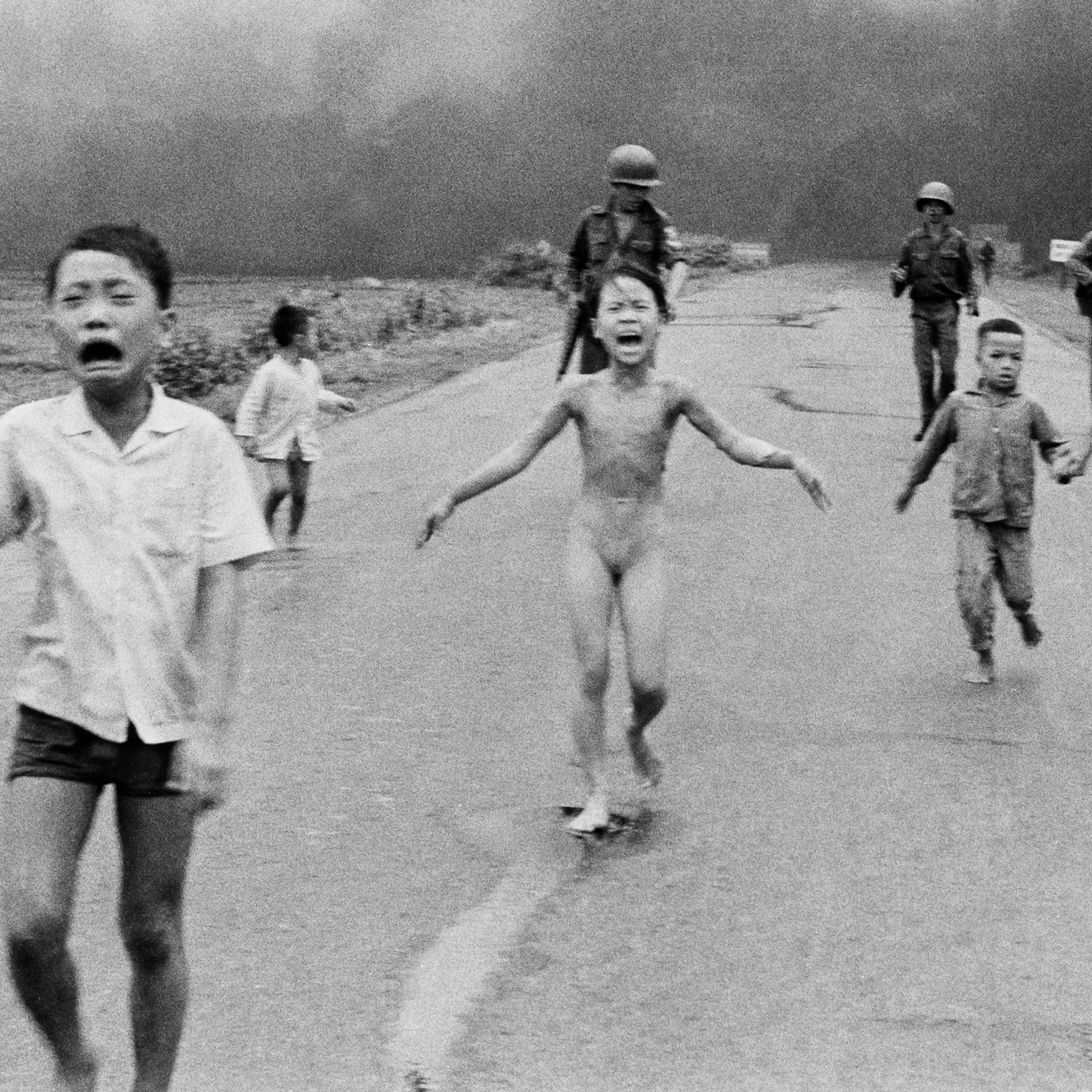
Today in Focus
Who really took one of history’s most famous pictures?
00:31:49
The photo of a Vietnamese girl running away from a napalm strike is one of the most famous in history. But who actually took it? With conflict photographers Gary Knight and David Burnett, and film-maker Bao Nguyen
Loading summary
Transcript81 lines
- [00:00]
A
This is the Guardian. Today. The mystery behind two really took one of history's most famous photographs.
- [00:24]
B
Shipping, billing, admin, payroll, marketing. You're managing all the things, so why waste time sending important documents the old fashioned way? Mail and ship when you want, how you want with stamps.com print postage on demand 24, 7 and schedule pickups from your office or home. Save up to 90% with automated rate shopping. That's why over 1 million small businesses trust stamps.com. go to stamps.com and use code podcast to try stamps.com risk free for 60 days.
- [01:07]
C
It's a terrifying photograph of a group of children running down a road in Vietnam, away from a temple that is consumed by black smoke from a napalm attack.
- [01:22]
A
Gary Knight has been a conflict photographer for over three decades. He's worked all over the world, Bosnia, Iraq, Afghanistan, covering war and the scars it leaves behind. He understands the power of an image to tell a story. But we were here to talk to him about one photo taken more than 50 years ago that could be the most powerful war photograph of all time.
- [01:49]
C
And at the center of the photograph is a nine year old girl. And on the left is her brother and on the right, cousin.
- [01:56]
A
The little girl in the middle of the photograph is running down the road towards the camera and she's screaming in pain and in terror. She's also naked. Her clothes have been burnt off by the napalm that's just been dropped on the village behind her, which is now engulfed in thick black clouds of smoke.
- [02:16]
C
It's a photograph that really represents the suffering of innocent civilians. A nine year old child. You know nothing is more innocent in war than that, right?
- [02:27]
A
This photo became an iconic image of war almost as soon as it was published in June 1972. Within a day it was on the front page of the New York Times and in nearly every Western newspaper and magazine shortly afterwards.
- [02:43]
D
In many ways, it became one of the lasting images of the war to the world, right? And it becomes ingrained in our community of like what happened there.
- [02:54]
A
This is filmmaker Bao Nguyen. He grew up the son of Vietnamese refugees in the U.S. my parents lived
- [03:01]
D
in Guangxi, which is near the 17th parallel, which saw some of the most intense fighting. My, my father was a soldier and my mom was around the same age that Kim Fook was in the photograph.
- [03:14]
A
The photo didn't just go on to become one, if not the most famous war photograph of all time. It also made the career of the man credited with taking it.
- [03:24]
E
Ladies and gentlemen, Nick Ut.
- [03:26]
A
Nick Utz, the photographer behind the famous photograph. Nick Oet was a young staff photographer at the Associated Press.
- [03:33]
B
Do you still remember that day?
- [03:34]
A
Vividly.
- [03:35]
E
Oh, I remember that picture.
- [03:37]
A
The picture won him two of the most prestigious prizes in photojournalism, the World Press Photo Award and the Pulitzer Prize. And the fame and the accolades that followed secured his legacy in the history of war reporting.
- [03:51]
C
We took a photograph.
- [03:52]
E
I saw it today, just a little while ago. It was presented to me in such an incredible, important photograph. It showed the world the indescribable horrors of the war.
- [04:04]
D
There were very few Vietnamese American photojournalists that were well known, and Nick was obviously on the top of that list, having won a Pulitzer Prize and a World Press Photo Award. And so that photo meant a lot to me and my community. And that achievement meant a lot.
- [04:25]
A
And then, more than five decades after the Napalm Girl photo was published, an email pinged into Gary's inbox. It was from a man called Carl Robinson, who'd worked as a photo editor at the Associated Press's Saigon bureau throughout the Vietnamese War.
- [04:43]
C
And in that email, he told me that he had deliberately, at the instruction of his boss, changed the name, the accreditation of the photograph from a stringer's name to a staff photographer's name to Nicot's name.
- [05:05]
A
When Gary says stringer, he's talking about a freelancer, a photographer making a living selling photographs to news agencies. And the idea that one of the most famous anti war images of all time could have been deliberately credited to the wrong photographer was enough for Gary Bao and a team of investigative reporters to start digging around.
- [05:28]
C
So that's where this journey started, really.
- [05:37]
A
At a time when local journalists and photographers in war zones across the world are being killed in greater numbers than ever before. The story of who really took the Napalm Gull photo is about who controls the narrative of world events, who gets remembered or forgotten. From the Guardian, I'm Annie Kelly. Today in Focus, who really took the most famous war photo of all time and why it matters 50 years later, By 8 June 1972, the war in Vietnam had been raging for years.
- [06:18]
E
Even as late as 1970, when I ended up going, it was still the biggest story in the world on an ongoing basis.
- [06:27]
A
David Burnett was one of a generation of young photographers drawn to the front lines to make their name covering the conflict.
- [06:34]
E
And there's no doubt that photography played a huge role in how things were seen back home and around the world. In particular that day in Trang Bang, when the Vietnamese Air Force plane dropped the Napalm. And from which that day comes the famous napalm girl photo.
- [07:01]
A
That day, David was on assignment for the New York Times and was heading away from Saigon towards the front line when he heard something is happening in a little village called Trangbang.
- [07:11]
F
As the Skyraiders moved in, we could see that their bombs were falling very close indeed to the South Vietnamese positions.
- [07:18]
E
And when we got there, like many of the journalists who had just hopped in cars and gone looking for what was happening that day in the war, we saw a bunch of our colleagues there kind of lined up on a concertina wire across the road just to keep people from getting too close to the fighting. And we were a few hundred yards outside this little village.
- [07:41]
F
In the distance, we could see South Vietnamese troops frantically scrambling across the highway for safety. As we watched, they gestured to a group of civilians to join them.
- [07:49]
E
And we could hear the firing that was going on. You could hear that there was fighting going on. And these two Vietnamese Air Force Skyraider planes came in.
- [08:01]
F
They dropped four canisters of napalm on
- [08:04]
E
those civilians, dropped their napalm. And the people who had gathered what they thought was the safe place in the village, many of whom were injured, they came running out of where they had taken refuge through a cemetery, which was right on the edge of the village. And then they came back towards the road where we were. We were, I don't know, maybe three or 400 yards outside the village, maybe a little, little farther. I was standing right where Nick Utt was and another reporter, an American guy named Alex Shimkin. And both Alex and Nick realized immediately what had happened. And they began running down the road. And I just. That look on his face, I still see it. My memory is that the two of them were the only real press people who were running down the road towards where the refugees were running out of the village.
- [09:10]
F
Almost the first person we saw was a little girl, aged about nine, running up the road. She hadn't got any clothes on. She'd presumably torn them off when they caught fire. There's not a great deal everybody else.
- [09:21]
E
It was another couple of minutes before we all kind of went past that row of concertina wire and started mingling down the road looking for pictures and recording what was going on. I just can't imagine anyone else could have made that picture other than Nick.
- [09:45]
A
Nick Utt always said that after he took the photo of the little girl, whose name was Kim Fook, he put his camera down and took her to the hospital. After that, he said he went to the Associated Press office in Saigon, where his film of what happened that day would be processed. David was there too.
- [10:02]
E
I had come back because working for the New York Times, I wanted to get my films processed, choose a couple of pictures, make prints, and then radio photo them directly to the New York Times.
- [10:15]
A
Also in the office were the Associated Press photo editors, Carl Robinson and his boss, Horst Vaas.
- [10:22]
E
Well, there's no doubt that Horst Vaas was. Wherever he went, he was the chief. He was not a wallflower who just kind of went along. He decided how things were going to be and that was it. And we're looking at this print when it was over and they had sent the picture out and Horace said to Nikot, you do good work today, Nikot.
- [10:50]
A
But this is just David's version of events. When, decades later, Carl Robinson got in touch with Gary Knight. He had very different memories of what happened in the AP offices that day.
- [11:02]
C
What he'd said happened is that the film came in from a stringer along with Nick's film and I think the film of other photographers that it was processed in the dark room. Horst Farce came into the dark room, into the photo room from his lunch and looks at the photographs that had been laid out on the table. Carl and others in the bureau had selected a photograph of Kim Fook that was shot from the side that didn't show full frontal nudity, which was against the policy of ap. Horst said, no, this, this photograph, the photograph we all know the photograph we're talking about is the photograph we'll put on the wire. And then it was given back to Carl, who sat at his typewriter and typed on some paper which was sticky and would be stuck to the bottom of the print, the caption and certain information, the date, the location, etc. And Carl said, that horse came up to him, stood over his shoulder. As Carl was looking in his logbook for the name of the stringer to type it onto the caption, Horst said to him, no, put Nekut's name on it. And Carl, without missing a beat, did put Neerkut's name on it. Photograph was then given to the courier, who took it over on a scooter to Radio Saigon where it was transmitted to ap.
- [12:31]
A
What are some of your thinking behind why he might have instructed Karl to change the photo? Credit, as Karl has alleged, Horst knew
- [12:45]
C
the value of this photograph and he communicated that to Hal Buhl, his boss in New York. And he wrote to Hal Buhl and said, I'm sending you a photograph that will become an icon of all time, trust me, and urged him to publish it despite the fact that it showed full frontal nudity. So Horst knew very well what he was dealing with with this photograph. And I think he wanted to make sure that that went to an AP staffer. And it wasn't just any AP staffer. Nick's brother had been killed on Assignment 4, Horst, earlier in the war, very, very brutally. And Nick had been hired to ensure that the family continued to have an income and were secure. And Horst felt a great deal of loyalty to the family and to Nick. And I think he underst. This would be something that wasn't only great for ap, but it would be great for Link.
- [13:43]
A
We'll never know how Horst Fass would have responded to Carl Robinson's allegations or what was going through his mind. He died in 2012 without ever publicly speaking about what happened that day in June 1972. But if what Carl says was true and that Nick Utt didn't take the photo, then who did? Carl told Gary that for decades he didn't know anything about the stringer whose credit he says he removed from the Napalm Girl photo. Then, quite by chance, at a reunion of Vietnamese journalists in 2010, Carl's wife sought him out to tell him that someone had just given her a name, Nguyen Thanh Ney. And after Gary learnt this, he teamed up with a Vietnamese journalist, Le Van, who tracked down Wintan Ney to a small, remote village.
- [14:36]
C
He just confirmed that that was his photograph and that he was there. And he was shocked, actually, that anybody had bothered to come and find him. He thought he would die with his story never told. And that moment was also very moving for his daughter, Janie, because she and her brother had heard Nay's story, you know, for decades. They'd grown up with it. They knew their father took the photograph, but they'd heard him talk about it for over 50 years and they were just trying to encourage him to stop talking about it and to get over it and to move on. And it was as clear to them when we came to see him how important this still was to him.
- [15:20]
A
Win Thane is in his 80s now. It turned out that after the war, he'd moved to California, where he'd raised his family and worked processing film for Hollywood movies. He told Gary that he sold the Napalm Girl photograph to the Associated Press for $20 and a print. And the fact that he was never credited had haunted him for decades.
- [15:42]
C
He explained, you know, that he'd seen somebody else for 50 years, receive all the plaudits, receive medals, receive every prize available in journalism. Meet the Queen of England, the Pope, travel around the world being hailed and recognized as the author of this incredible photograph. And that's really difficult to watch and very painful.
- [16:23]
A
And once you'd found him, it's kind of like that's where the hard work began, isn't it? Because you'd found him, he'd claimed he also took the photo. It backed up what Carl had said. What then did you need to do to try and stand up those claims and to try and get the hard evidence? And we're talking about a photo that was obviously taken 50 years ago before all of the kind of modern technology that we would now be instantly able to access to give us that proof.
- [16:51]
C
Sure. It was really important for us to, you know, treat everybody in this story with respect and with dignity. That includes and especially Nikud, and it includes ap. So, you know, we set about interviewing people, people who were there. A number of people who were there declined to be interviewed, but a number of people did. And so we said about interviewing eyewitnesses, but, you know, memory is tricky. My memory is tricky about things that happened last year. When you're asking people to recall in detail things that happened 50 odd years ago, it's hard.
- [17:31]
A
Gary says he tried every avenue to stand up Wintan Ney's claims. Eventually they went to an independent forensics investigations team called Index. Gary asked them to analyze all of the evidence they'd found, plus all the available archive photographs and footage from that and Trangbang.
- [17:50]
C
They were able to piece together the scene using, you know, satellite photograph that was taken by the Americans in 1972. Of course, we have all the journalists photographs, the photographer's photographs and all of the film. So they were able to reconstruct the scene. And using the still photographs and the film made by other journalists, we were able to, or they were able to situate all of the key people who were there that day. And we can see where they were
- [18:20]
A
at various moments in Gary and Bao's documentary. They spend a lot of time showing the work that index did, creating 3D renderings and digital reconstructions of the children running down the road towards the journalists in Trangbang.
- [18:36]
C
And what that shows is that Nick Ert was a significant way away from where he needed to be to have taken the photograph. And it shows who was close enough to have taken the photograph. And of the people who were close enough to have taken the photograph, the only one who claims to have taken the photograph and the only one who is identified by other eyewitnesses as taking the photograph is his name.
- [19:16]
A
It was enough for Index to conclude that in their view, it was almost impossible for Nick Utt to have taken the napalm girl photo. And it was enough for Gary to make his own conclusion at the end of his investigation that it was Wintan ney and not Nick Utt who was the man behind the lens that day. What about Nick utt and the AP?
- [19:41]
C
So we approached Nick, I think it's 16 times through WhatsApp and Instagram and Facebook messenger and also through mutual friends. But he declined to talk to us and has only responded through his lawyer to my knowledge, since the film came out and ap, we went to AP during the process of the investigation. We asked them to collaborate with us. I thought, well, there's a chance that they might be open and willing to examine this with us. But that proved not to be the case and we had to proceed without them, which is regrettable.
- [20:29]
A
Coming up, Gary and Bao's film comes out and the backlash begins.
- [20:42]
G
There's a saying that in business, how you enter a room really matters. Did you enter like someone who just spent six hours on the plane wedged into a middle seat in economy next to the restrooms, or did you sleep like a baby in your reclining window seat with extra legroom? That's why amex Global Business Travel remembers how you like to travel. It'll also automatically rebook your flight if it's canceled because being there is everything. Amexgbt Great ideas Travel.
- [21:16]
H
If you've used Babbel, you would. Babbel's conversation based technique teaches you useful words and phrases to get you speaking quickly about the things you actually talk about about in the real world. With lessons handcrafted by over 200 language experts and voiced by real native speakers, Babbel is like having a private tutor in your pocket. Start speaking with Babbel today. Get up to 55% off your Babbel subscription right now at babbel.com acast spelled B-A B B E L.com acast rules and restrictions may apply.
- [22:00]
D
I love that.
- [22:01]
A
Gary, this is so exciting to see you here at Sundance. How does it feel?
- [22:06]
C
Well, it's a mixture of sort of excitement, anxiety, to be honest.
- [22:11]
A
You know, Gary and Bell's film of the investigation, the Stringer, premiered at the Sundance Film Festival in January last year.
- [22:18]
D
I hope that, you know, audiences understand. I hope the audience understand that listening is so important.
- [22:25]
A
Also in the audience was Nguyen Than who received a standing ovation. And despite the fact the film wasn't even out yet and barely anyone had seen, had already become hugely controversial.
- [22:38]
C
Here's where it gets really freaking weird. Essentially, they're saying that Nick Utt wasn't
- [22:44]
F
the photographer who took the photograph. We want to be accurate, very emotional
- [22:49]
A
and dramatic, and it really, as a journalist, it gets you thinking about who owns the story and how do these things happen. Both Gary and Bao said they had been bracing themselves for a backlash. But the force of the vitriol they faced by some in the photojournalism world was a shock as friends and colleagues of Nickert came out to publicly defend him and denounce Gary's investigation. Because although Gary wasn't claiming his findings were conclusive, they did have consequences. In line with our judging procedures and with our values. We cannot, with the amount of doubt that exists, continue to say that the photo is attributed to Nick Ut. World Press photo, who'd given Nick Ut their Highest accolade in 1973, suspended the attribution of the photograph to him. After this was announced, over 400 photographers, including some of photojournalism's biggest names, like Don McCullen, wrote to World Press photo to protest and demand Nick Ut's name be reinstated. Kim Fook, the girl in the photograph, has criticised the film's findings as well, calling it an outrageous and false attack on Nick Utt. The publicity surrounding the film prompted the Associated Press, Nick Goethe's employer of nearly five decades, to launch their own internal investigation. And if I'm honest, the report they released at the end, it's a slightly confusing read. It said that after reviewing all of the evidence, that it could not definitively prove that Nick Utt did take the Napalm Girl photo as credited, but that it was still possible and that none of the material it had available proved that anyone else apart from Nick Utt did.
- [24:46]
C
I think what is interesting in the AP report is that they established that the camera Nick has said for 50 years that he used to take the photograph could not have taken that photograph, that the negative of the Napalm Girl photograph was made by a Pentax. A subsequent forensic report establishes that Nick wasn't carrying a Pentax. So I think there's a lot in the AP report that actually we found very helpful. Also, if AP were certain who took that photograph, they would have said so, and they didn't. They presented a lot of evidence that proved that Nick's story is not sound. And they said that we are open to changing the accreditation. And I think that's. They would have not said that if they were certain who did take the photograph and that it was Nick Ut.
- [25:43]
A
Just last week, Nick Ut filed a defamation lawsuit in France against Gary Knight and Netflix, seeking €100,000 in damages, which Nick Goetz says he will donate to charity through his lawyer. He rejected our request for an interview, but he did say in a statement that the film has, quote, caused great pain to me and my family. These accusations strike at the very core of who I am. My entire career has been built on telling the truth, often at great personal risk. The legal papers themselves don't offer evidence that Nick Utt took the Napalm Girl photo, but they state that the film portrays Nick Utt as a shameless liar who over the years has skillfully cultivated a narrative that he knew to be false and a stolen attribution, and that it is, quote, seriously damaging his honour, professional integrity and reputation as a world renowned photojournalist. Gary says all of his work investigating the origins of the Napalm Girl photo was based on his belief that if a fellow photographer had been erased from history, his name scrubbed from an image he took by people who wielded power when he had none, then history should be corrected. And whatever the real truth of the origins of this photo, the power imbalance that Gary says played out between local stringers in the war in Vietnam more than 50 years ago does still exist today, where Western media organisations and the largely Western journalists they employ are still the ones dictating the images and the words that become the official version of history. And there is another uncomfortable truth about Gary's film, that by trying to set the record straight, he's also casting doubt on the credibility of another local Vietnamese journalist, Nick Utt, who was also there that day in the AP office, but who seemed to have no control over whose credit was put on that photo. David Burnett has been one of the most vocal critics of Gary's film and defender of Nick Utt and his legacy.
- [28:15]
E
You know, Nick has kind of gone through a tough time because it's a very tough thing when somebody tries to out you publicly on a case like this. And amongst those of us who are in that world, whether you're a writer or a photographer, you know you want to be credited for what you've done, and that's as it ought to be. I think the believability of the photograph is not really in question, but there is a question of can you believe the people who create them? And I think for that reason that there is a lot of interest and that there is a lot of defense amongst those of us who really think this is kind of an unfair attack on somebody's reputation and whether or not there will ever be a real resolution of this argument. And I feel bad that he's been kind of dragged through this in an unfortunate way, but at the same time, I feel nothing but sympathy and respect for Mr. Nay. I just really don't think he was in a place to take that photograph, that's all.
- [29:28]
A
David said he did watch the film when it was released on Netflix a couple of weeks before our interview, and he saw all the evidence that Gary and his team had to back up their assertions, but it just didn't convince him to reconsider his memories of that day.
- [29:43]
E
Yeah, I mean, I. I saw what the index people did. I just. I don't. I just don't buy it. I just. And as I remember it, and you can say maybe eyewitnesses aren't the greatest source of truth. Although in. In my memory, I just don't see how anyone could have shot that picture that wasn't down the road very quickly.
- [30:33]
A
It's just one photo taken 50 years ago. But to Gary, it's more than that. For him, this is his attempt to try and redress that power imbalance and put the spotlight back onto those risking their lives to tell the world what's happening in their own countries and to their own communities.
- [30:52]
C
I was watching an interview a couple of days ago with a Palestinian journalist from Gaza. And in the interview he said, you know, I wish. We wish that Western journalists had been allowed into Gaza not because they would have done a better job, but solely because their work would never have been challenged in the way that ours has. Right. The future of journalism is in the hands of people who are reporting on countries where they live. We would not know what had happened and what had taken place in Gaza if it wasn't for Gazan journalists. And over 200 media workers have been killed in Gaza since October 7th. And that's more than the total number of journalists who were killed in the US Civil War, the First World War, the Second World War, the Korean War, and the Vietnam War, more than all of those wars combined. And those who didn't lose their lives have been actively undermined, and their work has been challenged. The veracity of their work has been challenged. And one of the reasons I believe that foreign journalists weren't allowed in there is so that could happen, so that that work could be undermined. And the truth that they were telling could be challenged. I think it is an existentialist issue for those of us who live outside of territories like Gaza, countries like Myanmar and Congo that we support and acknowledge the work of local journalists because if not for them we wouldn't have any idea what is going on in these places. We need to treat them the way that we treat ourselves in this profession and we don't. We treat them like second class individuals.
- [32:59]
A
That was Gary Knight, Bao Nguyen and David Burnett. My thanks to them. You can watch Gary and Bao's film the Stringer on Netflix. This episode was produced and sound designed by Alex Atak and presented by me, Annie Kelly. The executive producer was Homa Khalili. Special thanks too to Bim Adewumni. We'll be back in your feeds this afternoon with the latest. This is the Guardian.
- [33:40]
G
A password manager should be the first security purchase you make for your team. Why? Because compromised passwords are the number one way bad actors attack companies, and small businesses are their favorite targets. But unlike a lot of security challenges, passwords actually have a pretty simple solution. 1Password lets you manage all your business's credentials so you can feel confident that your data stays secure as your company grows. Find out more@1Password.com specialoffer and start securing every login.
- [34:11]
I
Guys, it's no use putting it off. The best time for an underwear refresh is now. Tommy John Underwear is designed for a perfect fit that stays put all day. There's zero chafe thanks to four times more stretch than competing brands and their innovative horizontal Quick Draw Fly is a game changer with over 30 million pairs sold, there are thousands of men out there more comfortable than you. Don't settle for less. Go to tommyjohn.com today for 25% off your first order with code comfort. That's tommyjohn.comfort Tommy John comfort Perfected Shipping,
- [34:45]
B
Billing, admin, Payroll, marketing. You're managing all the things, so why waste time sending important documents the old fashioned way? Mail and ship when you want, how you want with stamps.com print postage on demand 247 and schedule pickups from your office or home. Save up to 90% with automated rate shopping. That's why over 1 million small businesses trust stamps.com go to stamps.com and use code podcast to try stamps.com risk free for 60 days.