← Today in Focus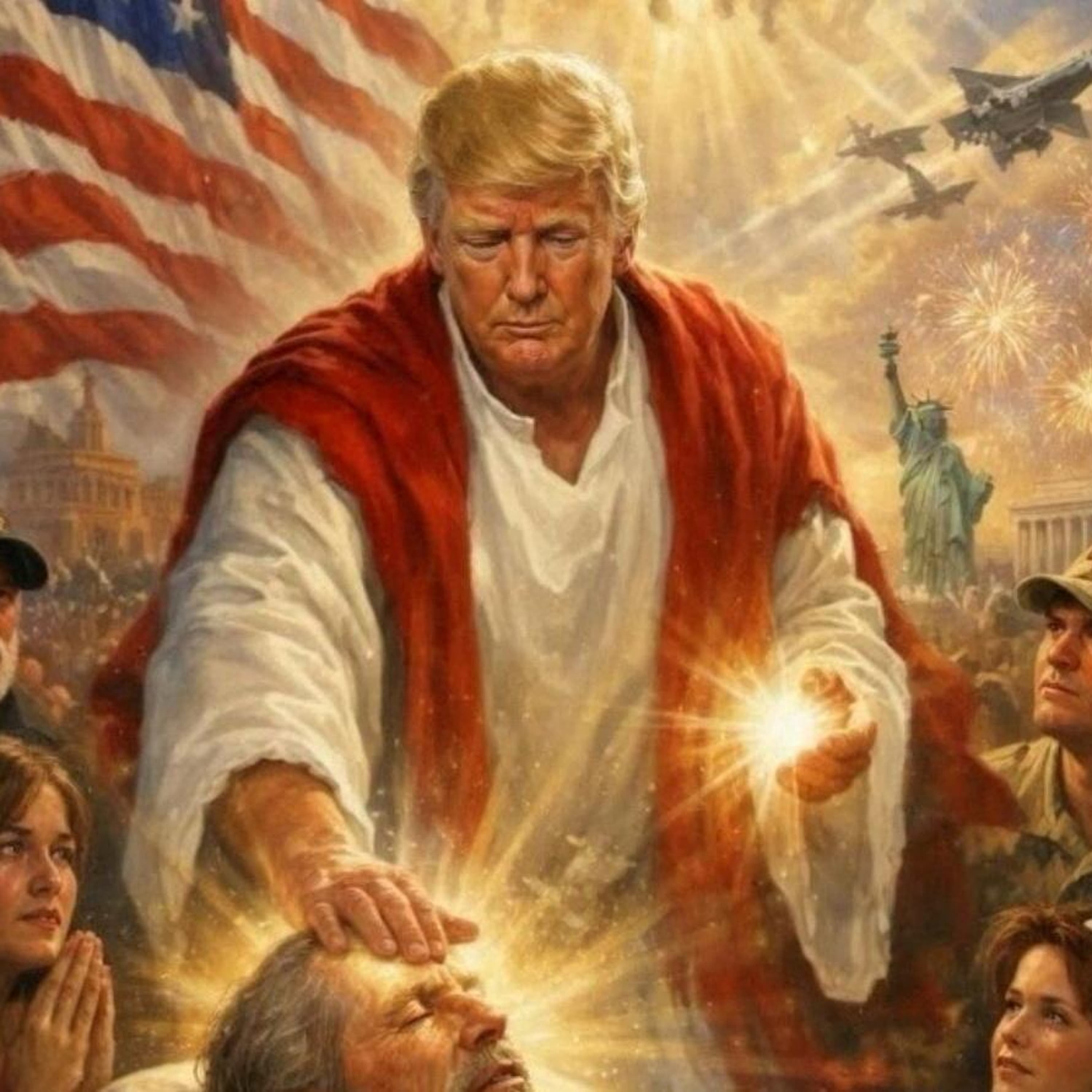
Today in Focus
Will Trump regret taking on the Pope?
00:30:37
The president’s posting of an AI-generated image of himself as Jesus horrified many Christians. Sarah Posner tells Annie Kelly why evangelical voters still flock to him
Loading summary
Transcript87 lines
- [00:00]
A
This is the Guardian. Today, Trump takes on the other most powerful American on the planet. Donald Trump's late night social media meltdowns are now the stuff of legend. But even by his standards, last Sunday was epic. Throughout the night until 4am The President was busy on his Truth Social account. And squeezed in between posts on his new ballroom and Joe Biden was a bizarre attack on Pope Leo, God's representative on Earth, to 1.4 billion Catholics. Clearly angry over the Pope's criticism of his war in Iran, he called him weak on crime and terrible on foreign policy. Then just 46 minutes later, the President posted a quite frankly bonkers, AI generated picture of himself as Jesus basking in a holy glow.
- [01:15]
B
Trump is laying hands on a sick person in a bed. He's surrounded both by somebody who looks like a nurse, someone who looks like a praying figure, someone who is clearly a soldier or a military figure. And in the background, there's an American flag, fighter planes, the Statue of Liberty, the Lincoln Memorial. It's crazy in only the way an AI image can be.
- [01:46]
A
The backlash from the most dedicated Trump. Don't. Diehards from both his Catholic and his evangelical supporters was swift and damning.
- [01:57]
C
This is blasphemy. You've got angels that are soldiers or something. You've got Donald Trump clearly portraying himself as God. This is exactly what the Bible calls blasphemy.
- [02:09]
A
Yeah, I'm ashamed. I'm ashamed that, that he would actually do that. The man I voted for and trust. Trump deleted the image, but his beef with the Pope has continued all week. We don't like a pope that's going to say that it's okay to have a nuclear weapon. We don't want a pope that says crime is okay in our cities.
- [02:29]
C
I don't like it.
- [02:30]
D
I'm not a big fan of Pope Leo.
- [02:32]
A
With the Holy Father clapping back and refusing to be intimidated, I have no
- [02:37]
D
fear, neither of the Trump administration nor speaking out loudly about the message of the gospel. Woe to those who manipulate religion in the very name of God for their own military, economic or political gain.
- [02:58]
A
Can a president battling crises on multiple fronts afford to gamble so wildly on the support of the very people who raised him up to the pinnacle of power. From the Guardian, I'm Annie Kelly. Today in Focus late night, the Pope and that picture, the week that shook Trump's Christian credentials. Sarah Posner, you're a contributing writer to Talking Points Memo, and you're also host of your own podcast, Reign of Error, and you've been covering the conservative Christian right in the US throughout the Trump administration. Thanks to. Thank you for joining us.
- [03:38]
B
Thank you.
- [03:39]
A
It's been quite a week for maga's Christian supporters, hasn't it? Many people already know that evangelical Christians are a real power base for him. I think 80% of white evangelicals voted for Trump, but conservative Catholics are also a really important part of his power base. So this attack on the Pope on Sunday is really surprising, especially when you consider that Pope Leo is the first American Pope. So can we start by talking about Pope Leo and how popular he is
- [04:13]
B
in the U.S. i think he's proven to be very popular. Pope Leo has been out front and very clear in his pronouncements about Trump's immigration crackdown, which I'll note is very unpopular in the United States, and the war, which is also unpopular in the United States. So I think that for Americans, even if they're not Catholics, they have been warmed, shall we say, by having the first American pope be so forceful in his condemnations of both the immigration crackdown and the war.
- [04:52]
A
And Pope Francis wasn't very popular, was he? He was considered to be too liberal for a lot of conservative Catholics.
- [04:58]
B
Well, I think the same is true of Leo.
- [04:59]
A
Right.
- [05:00]
B
But, yes, Francis was very unpopular with the Catholic far right, and Leo is possibly even more so, I think, for two reasons. He's been so direct in his criticism of the immigration crackdown and the war, which are central to Trump's second term. And also because he is the first American Pope.
- [05:21]
A
Right. Yeah. So it feels like a betrayal. And within that context, tell us about this spat between Trump and the pope, the two most powerful American men in the world. How did this come about, and how has the pope responded?
- [05:34]
B
During the peace talks in Pakistan between Vice President J.D. vance and the Iranians, Leo spoke at St. Peter's Basilica, denouncing what he called the delusion of omnipotence that he said was fueling the war.
- [05:55]
D
Del proprio limite non nucide e non min hacha la morte basta con lido la trio.
- [06:02]
B
And it was the day after that that Trump posted his just wild denunciation of the pope, accusing him of being weak on crime and terrible on foreign policy. And in the wake of that, Leo has said, I am not afraid of Donald Trump.
- [06:22]
D
People are doing, and I will continue to speak out loudly against war, looking to promote peace, promoting dialogue and multilateral relationships among the states, to look for just solutions to problems. Too many people are suffering in the world.
- [06:37]
A
Yeah. And it does seem like there is this growing schism between the Catholic Church and the MAGA movement since the start of Donald Trump's second term. Just the night before Donald Trump published those posts, you had two American Catholic cardinals appearing on the 60 Minute News show speaking out against Trump.
- [06:56]
B
This past January, Cardinal Tobin called Immigration and Customs Enforcement, or ice, a lawless organization. Cardinal, those are strong words to call ICE a lawless organization.
- [07:08]
A
Why did you do that? I didn't say that they were people without law. But when people act in this way,
- [07:15]
B
when they have to hide their identities
- [07:17]
A
to terrify people, when they can actually violate other guarantees of our Constitution and Bill of Rights, well, I think somebody's gotta call that out. And I'm not the only one.
- [07:30]
B
I do think that the brutality of his immigration crackdown combined with how the crackdown really also violated people's religious rights, not allowing people to attend services, or that the ICE crackdowns themselves made people too afraid to attend Mass. I think that has really caused the Catholic clergy in the United States to speak out in ways we hadn't seen in Trump's first term.
- [08:01]
A
Right. So, of course, so many of the people targeted by ICE come from the Latino community and so are probably highly likely to be Catholic. And how problematic is it, do you think, for. For many Catholics who are Trump supporters, that Trump has been attacking the Pope so publicly?
- [08:22]
B
Even the Trump ally, Bishop Robert Barron, who serves on the White House Religious Liberty Commission, so obviously had a good relationship with Trump to get appointed to. That said, it was unacceptable for Trump to criticize the Pope in this way. So I think it has ranged from absolute shock and disgust to dismay.
- [08:44]
A
But you have got the most prominent Catholic politician in the country, J.D. vance, who is coming out in support of Trump. So there are also elements that are basically telling the Pope to stay in his lane and stay out of politics.
- [08:57]
B
Yes. And J.D. vance, by the way, also told Pope Leo to stay in his lane and stay out of matters of morality, which was very.
- [09:05]
A
It's very much in his lane, you would think.
- [09:07]
B
Exactly. That is his lane. But Vance, I think it's important to understand that Vance converted to Catholicism just seven or so years ago and is much more representative of what I've been calling the maga far right Catholics who have been much more energized since Pope Francis papacy. They saw Pope Francis as being too liberal. They obviously see Pope Leo as too liberal. And so Vance is speaking to that movement within American Catholicism and not to most Catholics.
- [09:44]
A
So interesting. And also I found it, you know, I think many people found it very telling that Trump doubled down on his pope bashing. It's been continuing throughout the week. But he very, very quickly deleted that AI image that appeared to represent himself as some kind of sort of Jesus figure. Quite unprecedented for him. He doesn't delete many of his posts. He clearly realized he'd gone too far.
- [10:06]
B
Yes.
- [10:07]
A
Could you just explain how offensive that image was not just to Catholics, but to many conservative Christians? And why we've seen a backlash from even his most loyal evangelical supporters.
- [10:21]
B
For human being to compare themselves to and visually depict themselves as, as Jesus Christ as their Lord and Savior was absolutely blasphemous and offensive to them. And there were many evangelical leaders who spoke out against it publicly, said publicly that they had privately urged Trump or Trump staff to get him to delete the post, which he did. I think they're also feeling like they're able to press him to correct course if they feel like he's gone off course.
- [11:06]
A
Yeah. And could you just talk us through his relationship with his evangelical base? You talked a bit about this quite complicated relationship he has with his Catholic supporters or the schisms within that. But could he have kind of got where he is today without the the support of his evangelical MAGA fans?
- [11:24]
B
No. Trump never would have become the Republican nominee in 2016 and would never have become president in 2016 or in 2024 without his White evangelical supporters. For many decades, the Christian right evangelicals, and together with some Catholic and mainline Protestant allies, have been a central block for electing Republican presidents. And without them, Republican presidential candidates are unable to put together a coalition that will win them the presidency. And he attracted them because they saw him as a generationally strong leader who would defend them against what they claim is persecution of Christians in the United States. That's why they wanted to overturn abortion rights, they want to overturn same sex marriage, and they want to create a state which favors what they would consider to be the rights of conservative Christians to practice their faith.
- [12:29]
A
So it's quite a kind of, maybe transactional is the wrong word, but it's quite a kind of interdependent relationship then, isn't it?
- [12:36]
B
Yes. And I want to say that it's not transactional just because of the level of belief that the base has in him as a figure who is going to save American Christianity and save the nation as a Christian nation, even if he's not.
- [12:56]
A
He doesn't lead a particularly Christian life himself.
- [12:58]
B
Correct.
- [12:58]
A
That's the deal they've made.
- [13:00]
B
Well, it's not a deal. They claim that sometimes God chooses an unlikely figure to lead a nation at a critical juncture in its history. And so they created this narrative that the Christian nation of America was under threat by secularism and he was going to save it. And, you know, I know it's hard to understand, but many, most American evangelicals believe that Christians in America are persecuted. And so that's why they react to attacks on WOKE and DEI positively, because they see those things or those things have been portrayed to them as being anti Christian.
- [13:44]
A
Within that context, it seems kind of wild that he could have thought that it was okay to post that image, basically depicting himself as the Messiah. But he didn't make this image. It had already been circulating for weeks online. For people who don't know, Trump's got this spiritual advisor, Paula Whitecane. Just a week before this image was posted by Trump, she was comparing him directly to Jesus, like, you have paid the price.
- [14:11]
C
It almost cost you your life. You were betrayed and arrested and falsely accused.
- [14:19]
B
It's a familiar pattern that our Lord
- [14:22]
C
and Savior showed us, but it didn't end there for him and it didn't
- [14:27]
A
end there for you.
- [14:29]
C
God always had a plan.
- [14:31]
A
So just how influential has this imagery been that Trump is somehow divinely ordained or doing God's work? How influential is that become to his presidency and his policies?
- [14:47]
B
It's essential to it because they believe that he is this God ordained God anointed figure who is going to save Christian America. They have given him their basically unmitigated support.
- [15:03]
A
And, you know, as we've been talking about religion always being this huge part of the MAGA narrative, but there seems to have been since the start of the Iran war, an even bigger uptick. What's been happening over the last couple of weeks?
- [15:20]
B
Well, I think it's important to understand the backdrop to the war in Iran, that for several decades now, evangelicals who consider themselves to be Christian Zionists, which is most evangelicals, have been pressing for the United States to go to war with Iran. So they believe on a geopolitical level that it's the United States responsibility to defend Israel from Iran's potential aggression or from a potential nuclear weapon, and also to defend the United States from a potential nuclear weapon. But on a theological level, which they express almost simultaneously with their geopolitical ambitions, they believe that it's biblically required for, for America to defend, quote, unquote, defend Israel by going to war with Iran, and that a war with Iran could trigger a sequence of events that they say are prophesied in the Bible that will trigger a global War that will culminate in the second coming of Jesus at the battle of Armageddon.
- [16:30]
A
But this is not a fringe belief.
- [16:31]
B
This is, it is not a fringe belief at all. In evangelicalism. It is a very mainstream belief.
- [16:38]
A
How is the war in Iran playing out with his Catholic bases? Is it a very different response?
- [16:44]
B
Catholics do not have the same theology about Israel or about the role of Iran in the End Times scenario. To the extent that Catholics do or don't support the war in Iran, it has more, more to do with just straight up geopolitical considerations.
- [17:10]
A
Let's turn to the Pentagon and Pete Hegseth, because in the same time frame we've already seen him begin to use this also extraordinarily violent but very religious speech, which is almost kind of crusader type language through this self styled Secretary
- [17:29]
C
of War fell under my feet for you equipped me with strength for the battle. You made those who rise against me sink under me. You made my enemies turn their backs to me. And those who hated me, I destroyed. They cried for help, but there was none to save. They cried to the Lord, but he did not answer them. I beat them fine as dust.
- [17:50]
A
I just wonder if you could just talk us through what has been happening with Pete Hegseth and how we've seen him using the Pentagon as a way of pushing this very radical version of Christianity.
- [18:03]
B
So Hegseth belongs to a denomination called the Communion of Reformed Evangelical Churches, which is extremely far right. The denomination teaches that religion is central to every facet of life. So Hegseth believes that biblical law should govern what he's doing. That goes a long way to explaining his dismissal of international law on war and human rights and civilian rights. You know, he wrote in his book that the Geneva Conventions and similar are. I can't remember the exact phrase he used, but he basically dismisses them out of hand. So he has been hosting Christian prayer meetings every month at the Pentagon, where he has invited his own pastors to speak and sermonize. And his view that you show no mercy to your enemies. He believes he's carrying out God's will. And so his justification for doing this is that God has willed it, which is in line with the tattoo that he has just vault.
- [19:13]
A
Much of the outrage fueled by his
- [19:15]
B
tattoo saying Deus vulture, Latin for God wills it. And a common battle cry during the Crusades, the religious wars led by Catholics to convert Muslims a millennium ago. So he has this crusader mentality. But I think it's even worse than that because this religious sect that he belongs to tells him that whatever he decides to do is actually God's will because he's prayed for God's guidance. And then when he does it, it's God's will. And his own pastor told the audience at one of these prayer gatherings at the Pentagon that when a tomahawk missile falls, that's just, you know, it's all in God's hands.
- [19:59]
A
So this kind of idea of Trump's word is God's word, like, you know, these actions are divine by God. This is all part of the same evangelical rhetoric that's grown up around the MAGA movement and around Christian nationalism. Can you just explain how Hegseth's kind of sect relates to the evangelical movement?
- [20:21]
B
Hegseth's sect is different in terms of how we talk about how they see the Iran war, because he doesn't share the same End times theology that they have. He sees it more as a much more imperialistic in the way that he thinks that the US should go out there and just conquer countries the way they went into Venezuela or the way they want to go into Greenland and the way that they're trying to go into Iran. And, you know, the end result might be the same, but I think the theological thinking of how they get there. He's different from these other evangelicals, but no less dangerous, maybe even more so because of his position and that kind
- [21:07]
A
of blurring of state and church. That's not a problem either in this context for them.
- [21:12]
B
Right. I mean, both of them believe that we are or should be a Christian nation and that the government should express itself as a Christian state, and that the government, the federal government, state governments, local governments, should all be Christianized is something that they very much share in common.
- [21:31]
A
And how powerful are these new radical elements that Hegseth's part of? How powerful are they becoming?
- [21:38]
B
Well, I think they have become more powerful because of his position. Right. I mean, we've never had a Secretary of Defense who has been so openly theocratic, not just hosting these prayer gatherings, but also using this overtly religious language just in press conferences, telling people that they should be praying in Jesus name, on bended knee for this war.
- [22:06]
C
May Almighty God continue to bless our troops in this fight. And again, to the American people, please pray for them every day on bended knee with your family, in your schools, in your churches, in the name of Jesus Christ.
- [22:25]
B
We haven't seen that before. So just the fact of him having become Secretary of Defense and remaining Secretary of Defense, surviving many scandals to get confirmed and surviving scandals and failures through his tenure shows how powerful they are because the Republican Party, first of all, confirmed him to be Secretary of Defense, knowing these things about him, and secondly, that they have done nothing to rein him in and nothing to require Trump to get congressional approval for this war.
- [23:04]
A
And aside from Hagseth, who is pushing this very radical version of Christianity within Trump's inner circle, I think most of
- [23:13]
B
the other evangelicals around Trump are of the variety that I described before, more like Paula White. They believe in signs and wonders and miracles and that they are modern day apostles and prophets who receive direct revelations from God. They believe that Christians should have a biblical mandate to take dominion over the earth. It's just that it manifests itself in different ways. And so if you have an evangelical like Paula White talking to Trump, the language would be much more supernatural, talking about angels and demons and signs and wonders, and Hegseths would be much more militaristic and imperialistic.
- [24:00]
A
Wow. I mean, quite the combination. Especially for someone who's quite okay with posting AI images of himself as Christ.
- [24:08]
B
Exactly. So you can see these theological differences between the Christian nationalists who are around Trump, and the differences, in a lot of ways don't really matter in the sense that they're all converging to create this extremely dangerous situation.
- [24:32]
A
Coming up, what would it take for Trump's Christian supporters to abandon him? How dangerous could it be if this very radical version of Christianity that you just laid out becomes increasingly influential over US Foreign or domestic policy and actions?
- [25:05]
B
Well, I mean, I think on the foreign front, I think what we're seeing in Iran and the fact that that could get worse is extremely frightening at home. I think they've already done a lot. The overturning of abortion rights, the chipping away at the separation of church and state at the Supreme Court. And I think what we're seeing in Trump's second term is that Cabinet secretaries like Hegseth and others are much more forceful with imposing their religion on the agencies that they are running. And so Hegseth is not the only Cabinet secretary who has these monthly prayer meetings. Other Cabinet secretaries are doing it. And we're seeing increasing reports that government employees, people who are not political appointees by Trump, but just career government employees, are saying that they feel like a certain religion is being imposed on them, which is obviously contrary to our Constitution, but not something that the current Supreme Court has done much to inhibit.
- [26:13]
A
Also, you know, if you've got elements who believe that the second coming of the Messiah will only happen in some kind of global military apocalypse, I mean, that's it's pretty scary, isn't it, for all of us. And is there a risk for Trump that this increasingly radical, violent thinking will just become too much for voters or will just become too much for even his kind of loyal evangelical followers?
- [26:47]
B
Well, let's be clear. Trump's popularity overall in the United States is sinking, right? So many polls have him at only, you know, 35, 36% approval rating, which typically is catastrophic for a president. I think the way that the evangelicals are going to see it is that they want to hold on to power, right? They've worked very hard to be this central block inside the Republican Party and have power in the courts and in Washington, and they don't want to lose that. Trump won in 2024 because he was able to put together a coalition of these MAGA evangelicals, MAGA Catholics and other MAGA supporters, and in addition, independent voters or low information voters who thought that maybe he was a successful businessman who might be able to fix the economy. Right now that he's tanking the economy, he's losing a lot of those voters. So I think the more rational minded or politically minded evangelical leadership has got to that losing the ability to create a coalition with them to win elections is gonna be damaging to them. Because if they can't ride on that kind of coalition, then where are they?
- [28:05]
A
But saying this, it will probably take more than an AI image of him as Jesus to rock that too much.
- [28:12]
B
They have forgiven him many, many times. And the fact that he took it down, although I've seen some of them saying things like, he took it down, fine, but I think he needs to also apologize, which we all know is not forthcoming. But they have given him a break on multiple occasions in his first term and his second term. But I think that they're not stupid in terms of understanding the politics here. And they have created the Frankenstein of their base, their base that believes that Trump is anointed by God to save Christian America. And so to be able to unwind that, I think will take time. And they also don't want to admit that they were wrong or that he was wrong. So it's, I think for them to abandon him or to erode their support for him will take some time, but this single thing won't be the thing that does the trick. Ultimately, I think it's going to come down to not whether they're offended by a social media post, but whether they see their ability to have a viable coalition erode away.
- [29:22]
A
Fascinating. And also pretty scary stuff. Thank you, Sarah. So much for joining us today.
- [29:27]
B
Thanks for having me.
- [29:32]
A
And that's it for today. My thanks to Sarah Posner for joining us. And you can read all of our reporting on Trump and the ongoing feud with the pope@theguardian.com this episode was produced by Guy Zafnum, Eli Block and Joe Pinner and presented by me, Annie Kelly. The sound designer was Ross Burns, and the executive producer was Homa Khalili. Just before we go, listeners may remember our producer, Nathalie Kattena, reported from a peace camp for Palestinian and Israeli teenagers back in October. And now the organization behind it, the Parent Circle Families Forum, has been nominated for the 2026 Nobel Peace Prize. Congratulations to them. And if you want to hear the episode, search for the Palestinian and Israeli kids trying to be friends in your feed. And we'll be back later on with the latest. This is the Guardian.