← Today in Focus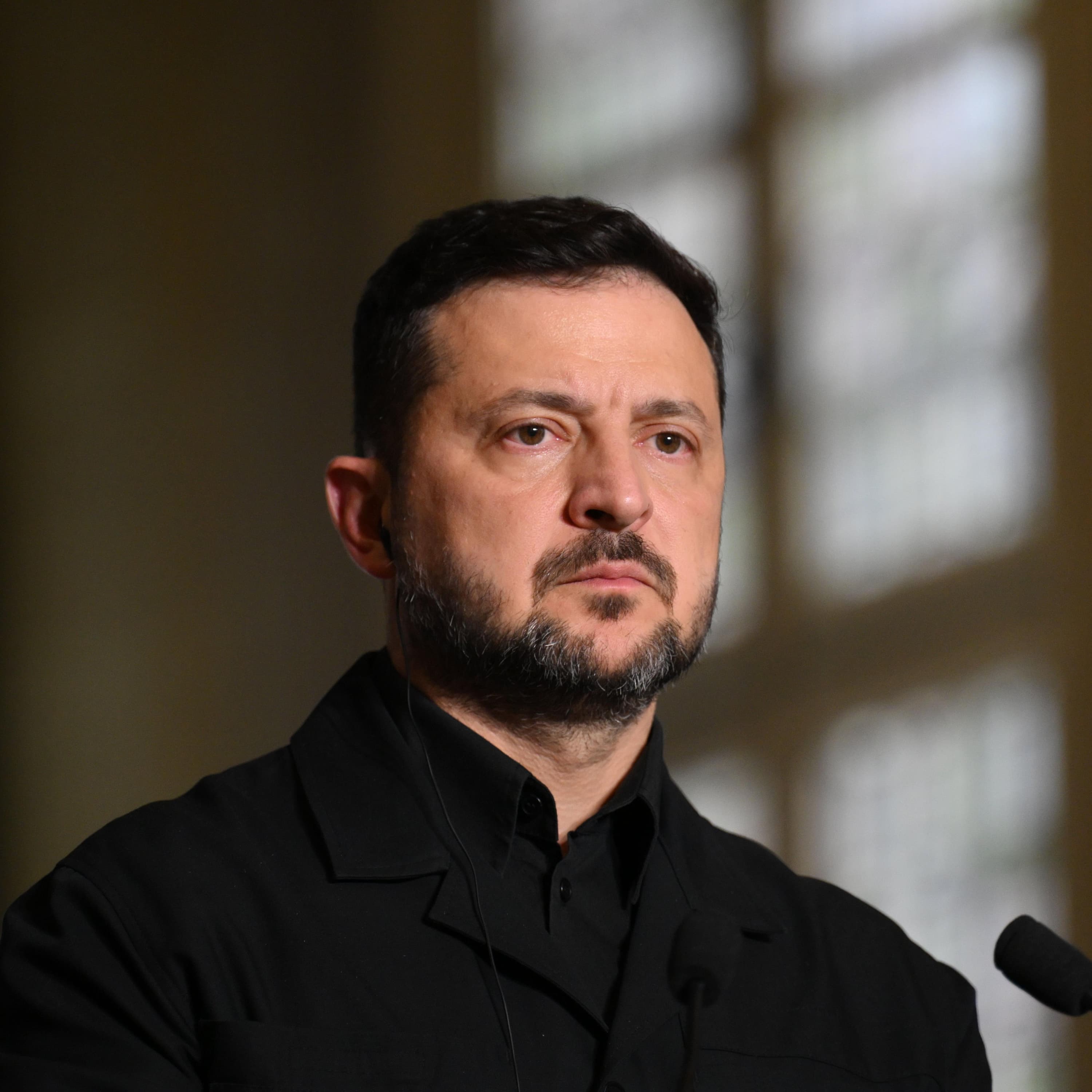
Today in Focus
Zelenskyy ousts Ukraine army chief after protests - The Latest
00:10:24
Volodymyr Zelenskyy has fired his commander-in-chief, Oleksandr Syrskyi, in Ukraine’s biggest military shake-up in two years. Lucy Hough speaks to the Guardian’s senior international correspondent Luke Harding
Loading summary
Transcript21 lines
- [00:00]
Lucy Hoff
This is the Guardian.
- [00:11]
Podcast Narrator
From globalization to innovation sustainability to market volatility, there's always more than one side to a story. Explore different perspectives on today's most important business and economic issues with the Flipside podcast from Barclays Investment Bank. Hear two research analysts in a lively debate and get insights from every angle. To further inform your view, listen to the flip side on your favorite platform.
- [00:42]
Luke Harding
Really? Within hours of the decision, there were people gathering outside Zelenskyy's presidential office shouting Syrsky out. The critique of Zelenskyy is that he can be centralizing. He makes impulsive and chaotic personnel decisions. What I think is remarkable is that, is that Zelenskyy, after five days of protests, has essentially bowed to their demands
- [01:05]
Lucy Hoff
and he's got rid of Syrskiy from the Guardians today. In focus, this is the latest. With me, Lucy Hoff. Yesterday, the Ukrainian president, Volodymyr Zelensky fired his commander in chief, Army Oleksandr Cersky in what seems to be the biggest military shakeup in years of this conflict in Ukraine. Luke Harding, you're our senior international correspondent. What's going on? Why has Zelensky made this decision?
- [01:35]
Luke Harding
I think this decision to fire the commander in chief, Colonel General Alexander Syrsky, is really a victory for reformists, for modernizers, for society, civil society in Ukraine, which had demanded that Syrsky was removed. And I think it's a really interesting step. I mean, it shows above all that Ukraine is a democracy where there is a president in the shape of Zelenskyy who makes mistakes, but who also is acutely aware of popular opinion in the middle of a war and tries to fix them.
- [02:08]
Lucy Hoff
And so who is Syrsky and why was he such a controversial figure?
- [02:13]
Luke Harding
I mean, Syrsky is a controversial figure for a number of reasons. I think primarily because he's seen as very much an old school general. He's Soviet trained, 60 years old. On the one hand, he's played a huge role in this war. He was the person who organized the defence of Kyiv in the spring of 2022, when Russian tanks were rolling imperiously towards the capital from Belarus and the Ukrainian armed forces kind of held them off and drove them back. And he's also the person who launched a surprise counteroffensive into Russia, into the western Kursk region of Russia in the summer of 2024, where Ukrainian soldiers were actually steaming on fighting vehicles through Russian villages. It was another astonishing moment. So he is someone with a record. But the problem, I think is that he's regarded by many people as inflexible, centralizing a micromanager. And also the gravest accusation is that he has used kind of Russian style meat assaults, as they're known, where he's thrown Ukrainian troops into battle and the losses have been very high.
- [03:27]
Lucy Hoff
Okay, so Cersky has now gone. But this follows a week of protests after the dismissal of the former former defense minister. You were at some of those protests. What were people telling you about their concerns about that decision?
- [03:42]
Luke Harding
Yeah, I mean, that's right, Lucy. Last week Zelenskyy unexpectedly fired Mykhailo Fedorov, 35 year old, young, digitally savvy, popular defense minister, and sided with Syrsky that the two had fallen out catastrophically over how to prosecute the war and the role of drones and so on. And really within hours of the decision, there were people gathering outside Zelenskyy's presidential office, waving cardboard banners and shouting, syrsky out, Syrsky out. And I went to those protests, I reported from the square and the mood was electric. And what was really interesting was the sense that these people, mostly young people, some older, but essentially it was the kind of young post Soviet generation understood profoundly that they were the power, that actually it wasn't the government, it wasn't Zelenskyy and his team, it was the people on the ultimately held all the cards. And what I think is remarkable is that Zelenskyy, after five days of protests, not just in Kyiv, but across the capital, has essentially bowed to their demands and he's got rid of Syrsky.
- [04:50]
Lucy Hoff
So how do these two things interlink? Because Fedorov is now reportedly, according to Zelenskyy, being brought back into the government in a senior position. So is that trying to placate some of that public anger? And do we know what he'll be doing in terms of the war?
- [05:09]
Luke Harding
That's the big mystery, is what happens to Fedorov now because his old job, defence minister, has been taken by someone else. Zelenskyy's appointed a new acting defense minister. Now the protesters want Fedorov back. Zelenskyy said he's offered him a role, we think deputy prime minister in charge of technical innovation. But so far Fedorov appears to be resisting. So I think it would be wrong to characterize this as a conflict between Fedorov and Zelenskyy. Fedorov is very much a Zelenskyy loyalist and clearly Zelenskyy is keen to playing a senior role. But negotiations are continuing and meanwhile Zelenskyy is signaling a really massive shakeup of the army leadership. There's a new chief of the General Staff. And the other thing to say is that the reaction from ordinary Ukrainians has been overwhelmingly positive, not least because the man who succeeds Syrsky, someone called Mykhailo Drapaty, is very well liked, both within the army and by the general public. And there's one incident which really made him a kind of star here, which is back in 2014, Lucy, you remember Russia staged this covert takeover of the eastern Donbas region and tried to grab the city of Mariupol. And what Drupaty did was drive an armored vehicle, literally drive an armored vehicle through a barricade by pro Russian protesters spinning tires across the street with the Ukrainian flag flying and flying proudly from the top of the vehicle. And the whole vehicle rocked. It nearly flipped. And this is sort of symbolic. This is a kind of symbolic act of defiance against Russia. Drupatty really hates Russia. And it's a very interesting moment.
- [06:54]
Lucy Hoff
It's a very interesting moment. So it sounds like, as you say, this huge military shakeup. So what does that tell us about Zelensky's position at home, domestically? I mean, we've seen him a lot on the global stage recently. He was recently at a NATO summit in Ankara, in Turkey. But does that tell us that he's facing some heat from Ukrainians?
- [07:17]
Luke Harding
The picture regarding Zelenskyy is complicated. I mean, his international profile is still very high. I mean, I watched him last week when Keir Starmer, remember him, British Prime Minister, made a kind of valedictory trip out to Kiev, and they gave a press conference in the presidential pal, sat in the shade having a cup of tea, talking one on one. I mean, the Zelenskyy, the statesman, Winston Churchill with an iPhone, as he's been dubbed, that is very much still the case. The problem is here in Ukraine, the view is slightly different. And the critique of Zelenskyy is that he can be centralizing some of the people around him, give bad advice. He makes impulsive and chaotic personnel decisions, such as the firing of Fedorov and. But all of that is tempered by the fact that he is present in a time of war. And I think most Ukrainians support him. I mean, the kids on the square chanting Syrsky out, would then sing the Ukrainian national anthem and then chant Syrskiy out again. So they are patriots. They want Zelenskyy to succeed, but at the same time, they want to keep him honest and on the right track.
- [08:23]
Lucy Hoff
So it sounds like Zelenskyy has been under pressure, particularly from young Ukrainians, about keeping modernizers like Fedorov in place who understand this new era of warfare involving drones and AI and that he is bowing somewhat to that pressure. Ukraine has also recently benefited from a huge 90 billion euro loan from the European Union that has proved, you know, helpful to Ukraine in giving it some success on the battlefield. Luke, you are literally about to travel to the front line in Ukraine in the next few minutes. What are you expecting to see there? And how would you assess Ukraine's recent successes or otherwise on the battlefield?
- [09:08]
Luke Harding
I mean, it was interesting. I mean, Syrsky, ex commander in Chief, posted a kind of message this morning basically defending his record and saying very clearly, among other things, that Ukraine is on the offensive. Ukraine is on the offensive. He says Ukraine has won back more than 700km of territory from Russia this year. Now, we can debate that the Russians are still going forward in these major cities in the east at huge costs, but there's definitely something here has changed. The mood is brighter. It's more up to optimistic. And that's because over the last few months, Ukraine has really been pulverizing Russia with targets on oil refineries, military warehouses, ports, roads. It's destroyed nearly 200 oil tankers and ships in the Sea of Azov and the Black Sea in a very clinical and systematic way. And in this drone war, because the war now is a drone war, you get the feeling that Ukraine has the upper hand.
- [10:08]
Lucy Hoff
Well, that sounds fascinating. And Luke, good luck on the front lines. Stay safe. And thank you as ever for your reporting.
- [10:14]
Luke Harding
Thank you.
- [10:15]
Lucy Hoff
That's it for today. My huge thanks again to Luke Harding, our senior international correspondent. You can keep up with his reporting from the frontline in Ukraine over@theguardian.com Thanks for listening to this episode of the latest Today in Focus will be back in your feeds as usual tomorrow morning. The latest will be back tomorrow night. This episode was presented by me, Lucy Hoff. It was produced by Angus Neil and Belinda Gurung. The senior producer was Ryan Ramgobin. The executive producer was Zoe Hitch. This is the Guardian.
- [10:57]
Boost Mobile Advertiser
He's dribbling the ball with everything on the line. He's driving down the pitch. He's facing price hikes. It cuts past him. Carrier contracts, tries to block him. Oh, he leaves him in the dust. He's at the edge of the box. He cuts past the non stop group chat trash talk. He clears on goal. He shoots no unlimited data for $25 a month.
- [11:15]
Luke Harding
Forever.
- [11:16]
Boost Mobile Advertiser
Visit your local Boost mobile store today to get unlimited data with a price that never changes. Boost mobile after 30gb, customers may experience lower speeds. Customers will pay $25 a month as long as they remain active on the boost. $25 unlimited plan.