← Tomorrow, Today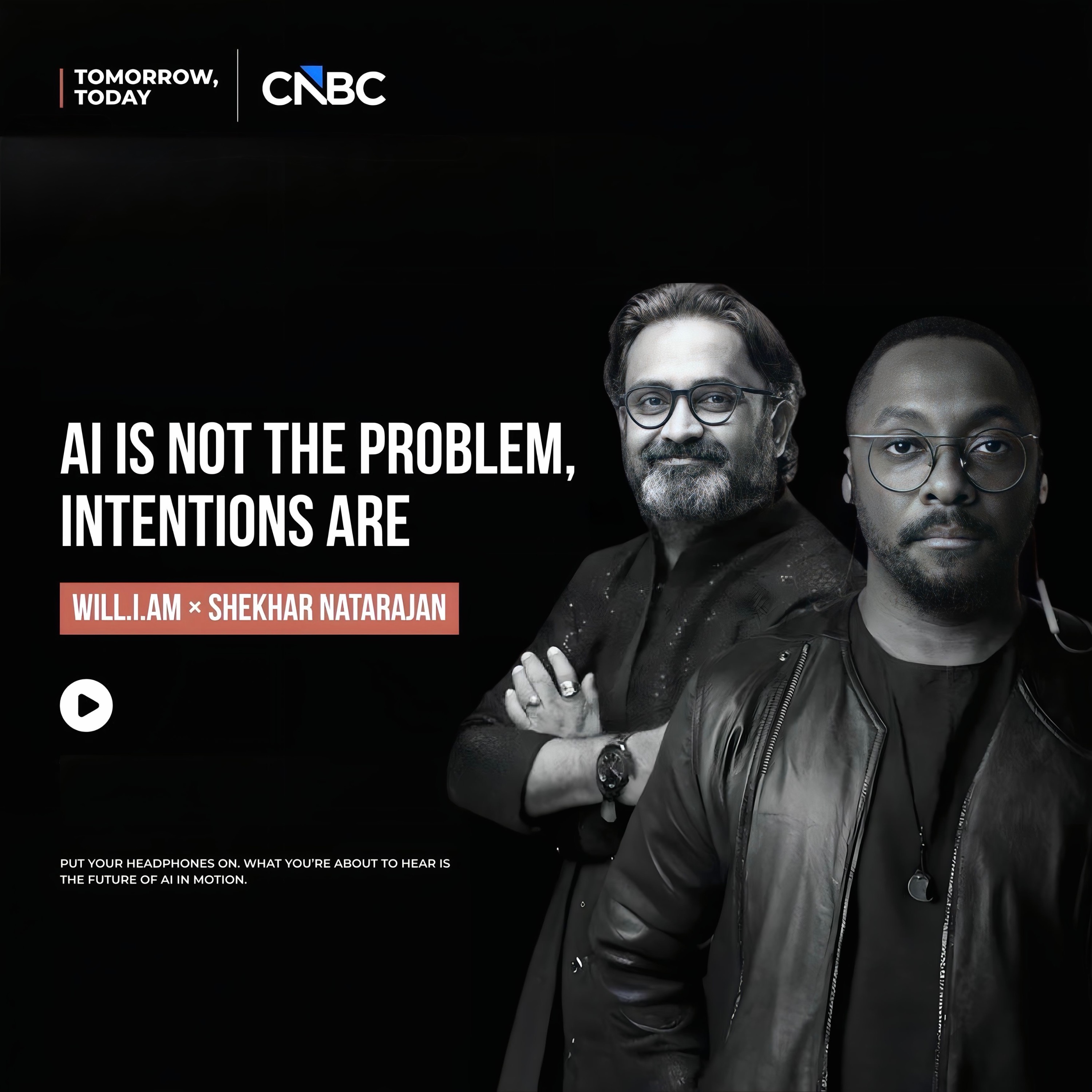
Tomorrow, Today
AI Needs Intention, Not Fear | will.i.am on Leadership, Creativity & the Future of Artificial Intelligence
00:40:25
Loading summary
Transcript132 lines
- [00:00]
Will
When you have the right intentions, when you have a moral compass, when there's ethics at the core of the products you build, It's not the tech, it's the greed. Is that the fate of AI?
- [00:45]
Interviewer
It's an honor to be here. We are at the CES show shooting for Tomorrow Today and cnbc. Thank you, Will.
- [00:51]
Will
Thank you. So I'm just like a enthusiast, a tinker, a thinker, ideator, manifestor. You know, I love making stuff.
- [01:02]
Interviewer
I know that like, you know, you had a very humble beginning. Like you used to take like a, like a bus, like a yellow bus from like East Brentwood, like, you know.
- [01:10]
Will
East LA to Brentwood.
- [01:11]
Interviewer
Brentwood, yeah. And so East LA to Brentwood. And so. And I come from slums in India and I actually like used to watch like, you know, like the rich kids from my house. And I'm sure, like you are watching like, you know, as you were passing by. So what came to your mind when you were watching outside and what you did not want to be when you were watching that?
- [01:32]
Will
So when you're in a poor neighborhood, you don't know you're poor because everyone's poor. You only know you're poor when you see how someone else is living. And because I went to Brentwood and I saw how people were living, I'm like, why are you living like this? And I'm living like that. Like, what are we doing wrong? But it wasn't till I met a Persian family, Ms. Sharif, and I asked, you know, how do you live like this? Because she was a single parent, had two beautiful daughters, and she was like, will I work really hard? I come from Iran after the Civil War and I worked really hard. And, you know, I came, came to the country, studied, became a teacher and someone that's come from a war torn country came to our country, figured out how to make their way to where they could take care of their family. And the most luxurious. That blew my mind. And from there I wanted to apply that same type of focus. It's just focus, that work ethic of focus on who you surround yourself with. Like, if you want to build an awesome company, you got to hire the right people. You want to have a freaking awesome team that wins the super bowl, you got to have the right players. You want to go from a nightmare and dream and then manifest that dream to change your reality. You gotta pick the right friends. There's no way you're gonna get out of your circumstance if you're hanging out with folks that don't resemble the Life you want to live. It's like your company. You are the company you keep. And you could end up either working for a company and helping somebody else with their dream, or you could be very selective on the company you keep and you manifest your dream.
- [03:44]
Interviewer
Absolutely. So you're saying that poverty is your origin story, not like, your identity.
- [03:52]
Will
First off, when I was poor, it was beautiful. I have no, like, that was the most beautiful experience. And I love my neighborhood. That's why I go back to my neighborhood. I have my foundation there. We serve about 500 schools with my robotics program serving over 14,000 students. Like, I'm committed to my neighborhood. Yes, I was able to get out, but I want to go back. And that's part of the dream that I have with the Trinity, is to manufacture the trinity in the neighborhood while teaching the community robotics and agentic systems. You know, not everything should be like, I want to be the richest. I want to have more than that. I don't want to change. I'm on a mission to, like, you know, because when I was in the hood, people came and gave us food. Somebody had a big heart. And what's been, you know, provided programs like the food drive. I was one of the recipients. The kids in the line getting free cheese, free milk, free warm lunches. And so now that I made it.
- [05:06]
Interviewer
Out, you want to shut the door on them.
- [05:10]
Will
Yeah. I brought free WI Fi to my neighborhood during COVID I have a robotics program in my neighborhood and college prep. I've sent hundreds of kids to school with my. My IM scholarship. And now I want to, like, take it to the next level. Let's. Let's build a vehicle. Like, I know that's audacious, but, well.
- [05:35]
Interviewer
You got to have intent.
- [05:36]
Will
I remember back in the day when you would say, wow, this is made in China. Back in the day, this is made in Pakistan. That's a nice jacket. Pakistan in the house. That's nice.
- [05:48]
Interviewer
But I'm from India.
- [05:49]
Will
Hey, we can all get. So China's is. Is inspirational. What Shenzhen was able to accomplish in 30 years, what it is now, like, that's fantastic. Why can't that happen at Boyle Heights? Like, Singapore is. My mom is older than Singapore. The UAE, my uncle's older than the UAE. And so when you have countries that are 70 years less, under 70 years old, and they're booming, why can't that happen at Compton? Why can't that happen at 5th Warren? Why can't that happen to the South Bronx? Why can't every inner city overcome its issues? And the intentions, you know, intentions are all we need. Google knows about that because they said attention is all we need. Transformer with the attention is all you need paper, the Transformer paper, it transformed how we learn, transform how we exchange knowledge with the large language model. What up, Aydin? He's one of the authors for the Transformer paper. Founder of Cohere so intentions is all we need and we will transcend. Attention is all we need. We transform. Intentions is all we need. We transcend. When you have the right intentions, when you have a moral compass, when there's ethics at the core of the products you build. Yeah.
- [07:23]
Interviewer
So let's talk about a little bit about AI. There's a lot of fear about AI. People are worried about it. Like moms talking about basically, like, you know, children and like, you know, workers talking about losing their jobs. But you seem to be the guy who's actually embracing AI like, as though there is no tomorrow. What, what are you, why are you so different and what are you seeing that is so different than all the others?
- [07:44]
Will
I'm optimistic at my core, and I don't think there's anything going to be worse than being in the slum or being in the project. Right. Hey, when you were in the slums and I was in the projects, AI didn't create that. Will it ever get any worse than what you experience?
- [08:03]
Interviewer
Absolutely not. There's nothing to lose.
- [08:05]
Participant C
Right.
- [08:06]
Will
So from what we experienced and what we overcome, there will be nothing that bad. And look what we were able to do. Your optimism got you to where you are. My optimism got me to where? So if I see AI, I'm like, no, that's a solution for us. Because when we, the lives we live, we didn't have AI. Had we had AI, people would, wouldn't live like that because they could solve their problems themselves.
- [08:34]
Interviewer
Absolutely.
- [08:35]
Will
It's a, it's a liberator if you think about it, you know, and that's why I seen what robotics did to my neighborhood. I seen what, you know, science, technology, engineering, mathematics, skill sets did to my kids, how it motivated them, how it brought them like this. Like, I see myself contributing. You know, they have the tools to identify the problem, to critical think, to solve problems. And AI can, can be that. So when people are afraid of AI, they're afraid of the business model. I don't know if they're really, truly afraid about AI.
- [09:21]
Interviewer
Got it?
- [09:21]
Will
It's the business model as to why they're like, hey, what's going on? What's going to happen because their gut and their intuition tells them that this technology coupled with that business model that's totally transformed. It's not the tech, it's the greed.
- [09:39]
Interviewer
Got it. So how do you prevent greed and, like, teach intelligence, virtue? Well, first off, can you do that in the first place? Can people do that?
- [09:53]
Will
Yeah. Think about how complex it is to walk down the street in India. How many cars are there and bikes and cows. And the cows are safe.
- [10:08]
Participant D
Yes.
- [10:09]
Interviewer
And, you know, like, I gave this example, I gave this example, and I got to tell you this. So in India, it's very. You got to be a 360 driver, right? Like, because people's sense of direction and people's sense of like, lane is like, almost lost. So, like, usually people say, like, I'm taking a left turn, or they'll indicate left that, but they'll turn right and they'll show a right and then they'll turn left and they will have both hands up and then they'll start going straight. So I had a very weird experience. My driver knows how to drive, and every other driver knows, like, what the driver is trying to tell him. Like, the intent is shared, but when the cow is sitting in the center of the road, no one knows how to, like, communicate with the cow. Right. So a lot of, like, building of the technology and all of this seems to be like that intent sharing problem. Like, I know what I'm trying to build, but the intent is not clearly translated and communicated from a literacy perspective. So how do you solve the problem of embracing this?
- [11:05]
Will
No, the reason why I wanted to use that as a metaphor is because cars are dangerous, but folks that are operating the vehicle have a license. Folks that put the vehicle on the road have a license. And in a very complex, you know, environment like India, where you have cars, bikes and cows, even the cow is safe. People have licenses. Folks that deployed vehicles out there took a test. Here we are in 20, 26. People that are deploying AI never took a test. They don't have a license to deploy systems that are going to interface with humans to make sure they have the right intent. So when you. One of the first things when you're taking a driver's test is your intentions. Do you understand that this means stop? Do you understand, like, just basic stuff? We haven't even scratched the surface on basic intent. And so not stifling the innovation. Not. No, that's not what we're asking. Hey, do you mean, well, are you deploying this? Do you have. What are your intentions for society? Are you Is this for your shareholders, for you to be rich? That could potentially compromise society as a whole. We saw that happen to social media.
- [12:34]
Interviewer
Yeah, yeah.
- [12:36]
Will
Is that the fate of AI? And that's what people are feeling? They're not feeling the tech, they're not fearing it from just the tech on its own.
- [12:45]
Interviewer
And how do you go about like teaching virtue to AI? Like, because see, like in my life, like I couldn't have been where I am without my father and mother doing all the good things that they did. And whatever they did came as a boomerang in my life, right? Like, people came out of nowhere to try to help me and show me the direction where I need to go. I call them angels. Right? And angels are nothing more than basically telling you, like, don't veer off a certain destination, stay on it and let me open the door for you.
- [13:16]
Participant E
Right?
- [13:17]
Interviewer
So how do you bring that human goodness in technology? Because all these companies. Because I'm an optimization wonk. Like, you know, I spent like 25 years of my career building system for Walmart, Co, PepsiCo and all those guys. And all I focused was how to save a penny more than last year.
- [13:36]
Participant E
Right?
- [13:36]
Interviewer
So if the, if the intent is all optimization, where is the line for dignity? How do you understand? Where is the crossover? How do you balance it? Okay, am I making sense to you?
- [13:50]
Will
Yeah, big time.
- [13:51]
Participant E
Yeah.
- [13:51]
Will
So I have a course that I'm teaching at ASU as a matter of fact.
- [13:56]
Interviewer
What did you not do?
- [14:00]
Will
That's a good question. I don't sleep enough. So I have a course called the Agentic Self. My first class begins next Wednesday.
- [14:15]
Participant F
And.
- [14:16]
Will
The course starts with self. Because a lot of times when you in technology, you lose yourself in it. No one ever asked, who am I? The whole premise of the Internet sometimes was to like be anonymous where yourself is not important, you want to be something else. And that's cool, that's good to show up, you know, incognito. But when the same system that you're showing up to incognito is smart enough to learn you and knows you more than you know yourself, is when you need to start asking, who am I? Because the machine knows you more than you know you. This whole time you've been going on the Internet incognito and your cookies machine has learned and the true you that you've been ignoring has now been absorbed and soaked up and now companies can micro target you, predict you, and you can't even predict yourself. So in 2020, now asking and being your full self and owning Your data is the most important, you know, step that we need to take in this new agentic realm. So we dive into, like, you know, the pains that social media has caused the students. Learn the greatest hack, you know, Brittany Kaiser, the whistleblower. She's coming and speaking to our students. Aiden from Cohere, speaking to our students. Reid Hoffman is coming to speak to our students. Prim from Stability AI. We have a awesome cast of folks that are going to mentor and speak to our students as we teach them the basics of agentic systems, building agents, but then at the same time reminding them the ethics. So they, so they, so they combine their point of view and their point of interest, stitching beliefs into the agents they build, stitching concerns into the agents they build so that when they reflect on the agent that is theirs on a GPU that sits at their home, right? So it doesn't have to go into some unknown cloud where who's scouring all your information. It sits at home. Like your refrigerator. Your refrigerator stores the food you're gonna eat. You don't. You wouldn't buy a house where you're storing your food next door or somewhere else. You wouldn't buy a house where you have to go take number two or number one down the street.
- [16:50]
Interviewer
So you give away the data to a neighbor, but you gave.
- [16:53]
Will
You give away all your stuff to somebody else?
- [16:55]
Interviewer
Absolutely.
- [16:56]
Will
Like, there's not even a, a data center in the house yet in 2020. Right now there isn't a your own cloud yet. As far as everyone knowing that, that's like, default, like a refrigerator is, or air conditioning is, or plumbing or kitchen and stove.
- [17:17]
Interviewer
Are we, are we too far past that? Like.
- [17:20]
Will
Nope, it's right now we're starting off, bro. It's a new jump. Jump.
- [17:26]
Interviewer
Will, tell me about the toy that you're holding in the hand.
- [17:28]
Will
Oh, first off, it's not a toy. It's a agentic AI collectible. I wanted to build a system that was, you know, for the agent itself. So reimagining the OS instead of AI being a layer on os, collaborated very deeply with Qualcomm, where we've reimagined the operating system from the agent and built the product from the agent up.
- [17:57]
Interviewer
Got it. What does it solve for you?
- [17:59]
Will
Oh, so let's think about my digital life, right? There's a lot of noise on email, a lot of, like, incoming calendar requests, whole lot of text messages, DMs, and the MoFo. Because it's the operating system. I put the MOFO on my Threads that are important on my emails that are important. And it will help navigate my digital life using N8N workflows and NCP protocols. But in this case, because it's the operating system, we don't need to always depend on APIs that are available for the mofo to connect to because it would use the device the way a human does. It would swipe, click, type, you know, engage, browse, connect, you know, work with apps and allow apps to be used in, like, a concert way. But right now, an app is, like, works one at a time, calendar doesn't talk to phone, phone doesn't talk to email in concert.
- [19:06]
Interviewer
So you're trying to create a connected system.
- [19:07]
Will
It's a connected system down at the core. So it's a modular omnifunctional operator. So it's an operating system. Yes, at its core, but more an operator. It doesn't need you to swipe through it for it to be functional or tap through it for it to be functional.
- [19:23]
Interviewer
Does it also solve the loneliness problem?
- [19:26]
Will
Oh, the loneliness. Because it's conversational at its core. You know, you, you converse with the mofo about your digital life. You could talk about because it's, you know, has the power of browsing. It can reason with what's going on in the world and talk about it in a very natural, lifelike human way. What the expression, emotion. And because, you know, it also has, like, the ability to express itself with facial expressions. You know, we, we, we say a lot with just how we blink and sad face or not emoji, like breaking out of emoji and really having a dynamic facial expression while you're speaking to the mofo. So we have this agentic rig that we've, that we've created for the mofo to be able to express itself.
- [20:14]
Interviewer
It's fantastic. It's fantastic. So what other toys do you have here?
- [20:18]
Will
Well, first off, it's not a toy. It's a toy section on the box. Then it's a toy. I am not a toy. Parental advisory. So it doesn't swear? I swear. You have to check it out for yourself. So here at ces, I also have a car that I've, that I have on display at Fontainebleau. It's a trinity, fully electric, zero to 60 in under two seconds. YASA engines on the back wheels, 400 horsepower on each wheel, giving you 800 horsepower in the vehicle. The same type of agentic system is inside the Trinity as well. So the Trinity is called the Trinity because it merges man, machine and Agent. So that's there at the Nvidia booth here with Qualcomm, our agentic radio station is there in the zinger. That system has, you know, been approved with Qualcomm SOC software on chip. And so we're going to scale FYI Radio, which is our agentic radio stations, where we have agentic host that. That go between segments and music. And so they have that here. Qualcomm have this here with Qualcomm. The mofo have my LG speaker bags, the boom bags at LG's booth, and then my Trinity over at Nvidia's booth.
- [21:43]
Interviewer
So you're like an out and out AI guy, bro.
- [21:46]
Will
It's 20, 26.
- [21:48]
Interviewer
So I saw an interview where, like, someone was asking you a question about creativity, and, like, you know, you ask them, what is creativity? And then they never, like, answered that question. So I want to ask you that question. So what is creativity for you?
- [22:01]
Will
Creativity?
- [22:02]
Participant F
Yeah.
- [22:03]
Will
Oh, man. Creativity is making sense of noise. Creativity is a rinse. I felt something, I rinse it out. It's being free with your rinse, allowing your rinse to bring you joy however it comes out. Creativity is not perfect. And sometimes creativity is perfect. But the moment that you try to make your creative output perfect is when you have writer's block, your creativity block. Whatever you make, someone will love it. And then the more you get good at it, your creativity is, you know, builds buildings and, you know, bridges, no pun intended. On what type of bridge? It could be a bridge that spans across the globe, you know, from one point to another point. Or a bridge could be like a song because it helps somebody get over something. You know, creativity is like.
- [23:11]
Participant C
It's.
- [23:13]
Will
It's. Spiritual.
- [23:21]
Interviewer
You feel it inside.
- [23:22]
Will
It's the human, the true human language. Math is math. Language is language. But then creativity, the expressiveness, it rhymes the same as poetry. It manifests in calculus. The same as math is when you connect, you know, but it's. But it's freedom.
- [23:47]
Interviewer
Are creatives worried about creativity, like, migrating into AI and like, people giving up the agency to AI? Is it like, there's a big, like. Like, problem? Like, you know, people are actually talking about it. They're worried. Actors are worried. Artists are worried. Like, there was a recent song which was created by AI, which became number one on Spotify.
- [24:08]
Will
Yeah, it's awesome, right?
- [24:09]
Interviewer
So, like. So is creativity, like, not what we thought it is? Like, you know, can.
- [24:14]
Participant F
Can you.
- [24:15]
Interviewer
Can machines replicate it?
- [24:17]
Will
Okay, okay, so say, for example, you built totem poles your whole life. You Wanted to build objects that go up and. But you've never seen a tree, for example, in your life. You've never seen a tree. But wherever you live, you've been building objects that go up and then finally you come across a tree and you see it. Are you inspired or are you threatened? Fact is, there's somebody that's like, what are you talking about, Will? I am. I'm saying nature is awesome. Nature creates. Does it daunt you? Does it like hold you back to see how beautiful nature is? It hasn't.
- [25:08]
Interviewer
Right?
- [25:09]
Will
Humans still created even though nature creates everything. So wait, so now you're going to get all freaking sensitive and emotional and freaking cry cuz AI can create out of here, bro. I'm sorry. There's nothing more powerful than nature.
- [25:29]
Participant G
Yes.
- [25:31]
Will
And we've already out created to the point we ignored how fucking awesome nature is. Nature is so dope that we're like, oh man, this gravity shit, what are we gonna do? We made helicopters, we freaking created magnets thing that. No, we didn't let that stop our human nature. And so now humans created AI, and now AI is created. Now people can be like, nah, bro, that ain't it. And whoever's filling that were not true creatives to begin with got it.
- [26:02]
Interviewer
Because true creatives are not afraid.
- [26:05]
Will
A true creative is not afraid because that's what they need to do. It's a part of their self.
- [26:10]
Interviewer
Create again.
- [26:11]
Will
Yeah. And so no disrespect to anyone that that is concerned. They have every right to be concerned. But I would say use your concern, that energy, that energy force of your concern and create a new type of theater. For example, there's a guy by the name of Charlie Chaplin. He was a traditional theatrical artist. And then film came. Did he shy away from film or did he go head at it and help birth Hollywood? Here's a guy that could have been like, this film stuff is not taking our stages away. Our theaters are, you know, amphitheaters and, and basilicas and doom. He was like, there's a new stage that happens in a Nickelodeon that happens on screen. And he went to Hollywood on LEA and created United Artists. He embraced it and dreamt. And so is AI Great. They could do film. That's cool. But it's doing what we did yesterday. Now I would, I would be worried. If it's like, yo, did you see that new thing AI did? What it, it just made something that never existed. This new thing, then yeah, yeah, that's when you should worry. But if it's just Doing what we did yesterday.
- [27:34]
Interviewer
Yeah.
- [27:34]
Will
That's what we did.
- [27:35]
Interviewer
Yeah.
- [27:36]
Will
Now what are we going to do that's new?
- [27:40]
Interviewer
That's the creator's mind.
- [27:41]
Will
That's the creator's mind, yeah.
- [27:43]
Interviewer
What if you lived for 300 years? If someone gave you a pill and said, like, you can live up to 300 years, would you take that pill?
- [27:49]
Will
How do you know I'm not 300 years old?
- [27:52]
Interviewer
I don't even know you look like you are.
- [27:54]
Will
Oh, you said I look old?
- [27:58]
Participant G
No.
- [27:59]
Will
Hey, black don't crack. How you know, how, you know.
- [28:04]
Interviewer
But, you know, you seem to have accomplished so much in like a short period of time. Like, you know, with someone like, you know, with 300 years would have actually achieved. But would you take that pill? And what is the societal impact to all of those things?
- [28:16]
Will
I would take that pill if I knew exactly what I would do with that time. If I don't know what I'm going to do at that time, then that pill is prison. Because maybe going on to the next, maybe you're summoned to do something in a different realm. And maybe the pill is a spiritual imprisonment. Unless you know what you're going to do with that time. And what can you create in 300 years that's worth you taking that pill? Time is awesome. It's valuable. But. Or if someone's taking pills and they don't know what to do with that time, then time could be misused. Society could be a lot worse because we're not maximizing the time that we have now. Look at how inhumane we are to one another when we only live 100 years. Look at how inhumane we were to one another when we lived 40, 50 years now. You know what I mean? So I think we need to start asking how, how productive, how, you know, solution orientated, how collaborative, how empathetic, how loving, how helping we are to one another. I know that sounds like Kumbaya, but love, you know, where's the love? There's love. Hey, I know somebody that sings that song. So, bro, thank you so much.
- [29:57]
Interviewer
I don't think it will impact humanity. AI will help you. So I, I see AI as a tool like Internet or computer, not as a. As impacting for humanity.
- [30:09]
Participant D
I think what people want out of it is dumb because as an artist, the point is to do it yourself and make those choices and put yourself into the work. So it being used in, like, cancer research, like unfolding proteins, that's super cool. But that's not where the money's going. That's not what people are hyped about. So I think people are interested in it because they want work done for free and that's the wrong reason to be interested.
- [30:39]
Participant C
If you can give me an AI that can give me a companion replacing my wife, I will buy that.
- [30:47]
Participant H
It's going to improve quality of life for everybody. At the end of the day, innovations will be faster, use cases for things that we haven't thought about around how life can become even simpler or easier, more than simpler. I think it's just going to be a reality very soon if it's not already getting there.
- [31:11]
Participant G
AI is going to have good sides and bad sides. It's going to help take a lot of thinking workloads off of people. It'll help answer a lot of questions, but it'll also take away a lot of jobs from people. That's just a progression of normal life. I'm just concerned that if that some of the, the more capitalist instincts within, across the globe will use it to replace human labor.
- [31:39]
Participant E
I noticed that the people are getting like scared for the future. You know, maybe we are thinking about in the future we lost some jobs or maybe the machine or the AI will be the replace us. And then that, that's make scary, you know, in the, in the future. As a Latin American people, we are scary about it because most of most of us we are working in operations stuff, you know. And I think it's the first things that AI will be the replacement.
- [32:24]
Participant F
I think it's deeply integrated in all aspects of how we live, especially like I work in the marketing and I also know some friends in Laurel, which is in the humanities of our life. And I think AI is going to be able to do these kind of jobs better than a lot of human beings. So I'm not saying it's gonna replace us, but I see a lot of opportunities in this aspect. I feel it's ignoring a lot of people and it's going to take jobs away from people that I'm very concerned about.
- [33:12]
Participant I
From someone who is in tech, it has a lot of pros, but also considerably dangerous cons. So I recently visited my native land and I was able to see billboards of OpenAI in a rural area. That really shows how AI is taking over the world. And I hear school kids doing homeworks with AI. So in my sense it's definitely good. It's faster, it makes things life, it makes life much easier. But is there. So we have a lot of discussions. Is there going to be a lot of thinking? Will people have patience? There's a lot of questions that I don't have answers to and it definitely scares me to some extent.
- [33:54]
Will
I mean it's been helping out too. Like it's very creative. It made a lot of good movies.
- [33:58]
Participant D
On the creativity side, right?
- [34:00]
Participant F
Yeah, it's very like artistic, you know.
- [34:02]
Will
It's pretty clever too. It's very clever.
- [34:06]
Participant F
It's very amazing.
- [34:09]
Will
What I can do, huh?
- [34:11]
Participant F
I mean I did it like I tried it here and there in the library.
- [34:15]
Interviewer
Like.
- [34:15]
Participant F
Yeah, try to like look it up.
- [34:18]
Will
Yeah, it's very creative and it's really.
- [34:19]
Participant D
Quick neutral to concerned. I mean I've seen Chat GPT make some really terrible art. So I'm not like, oh man, it's going to change the world. But you know, I think I could definitely see a model that ends up, you know, coming into contacts or conflict people. I think that's real.
- [34:35]
Participant G
Well, I mean they're like everything, there's pluses and minuses. If AI just is allowed to go without any kind of oversight or, or regulation, it's probably going to be problematic. Exactly how you're looking at part of the AI thing is the, the data centers and the processing and the impact that it's having on people's, you know, avail access to electricity and the cost of that electricity replacing people's jobs in the arts, which is something that I'm involved in, replacing people and what they're doing by generating these things. There are also some incredibly creative things that are done with AI. So like anything, you know, the pendulum's got to be more in the middle, not to one side, not to the other.
- [35:24]
Participant D
I think that diminishing returns to capital spend, meaning you need to put a bunch of data centers in the ground, means the people like kill the world. AI is going to be very, very expensive to produce. Unlike chips themselves, which I think you get diminishing returns to building bigger foundries, like building bigger data centers is more heat and more power. But yeah, at a certain point you already see AIs that, you know, in a lab environment are down to kill their owners or blackmail them or you know, at the end of the day do stuff to, to ensure their own survival. And I think at a certain point we'll, we'll butt heads with that.
- [35:54]
Participant F
I like the idea of discovering new drugs that might help people medical research. And yet I think some things might get out of control very easily. And I don't understand. I don't think government, I think government is reluctant to put any restraints on it. And that worries me.
- [36:16]
Participant G
So I'm not necessarily negative, just inherently negative towards AI or inherently I think that it's still within the control of human beings to decide how to use it for the betterment of man, of mankind or toward the detriment of mankind.
- [36:32]
Participant E
AI make the society working more efficiently, especially in programming coding stuff. I think AI plays a very big part of roles but at the same time I think AI is also taking some people's jobs and you. Yeah, making some people jobless. I think it's like it's the kind of problem that people and the government should think of. Yeah, it's a problem but I think overall it makes the society more productive, more efficient. But right now we are trying to use for positive things including my baby. When we have some question about his growing, about his new skill, about him, we search or we're trying to use the AI to help us. How can we manage those next levels for him or how can we manage the new challenge about him? And the AI has helped us a lot.
- [37:34]
Participant H
If you look at it both from the pros and cons perspective there are abundance when you say concert jobs are going to be really, really scarce, they're going to be layoffs. But on the other hand if you see that a lot of diseases and a lot of infections or other diseases they are getting kind of reasonably solved or at least in say they're getting better with respect to adapting to newer medicines, we are getting newer medicines and all of that. So it's there are pros and cons but I think over time society will technically adapt to how to use AI and in the long run I'm very optimistic that it's going to be pretty good.
- [38:13]
Interviewer
Yeah, there will be concerns the regulation.
- [38:15]
Participant E
Will catch up with that basically.
- [38:16]
Interviewer
So it's always going to be technology.
- [38:18]
Participant E
Is going to keep up the pace no matter what.
- [38:20]
Participant C
Whether you like it or not, AI is very good. It took away my decision making. I can ask AI but how to make that AI as intelligent as you and me does work. It all depends on the need.
- [38:41]
Participant E
It doesn't affect me so far myself as individual but you know, in general, you know, in the public might be, you know, take over humans job and intelligence, you know, all these things might be affected. Regular, you know, regular basic things. Otherwise if it is a normal factory machinery, stuff like that, AI might be works better but individually I don't like it. I don't like it because you know, it has impact on our job, you know. Yeah. So that's only the bad parts.
- [39:22]
Participant C
To answer your question there are probably going to be another five years. Going to be millions of AI out there. That's why NVDA still keep going. But I hate to say it, United States is behind.
- [39:38]
Interviewer
In the long run, it is going.
- [39:39]
Participant E
To be helpful for all of us. Just like it was Internet back then.
- [39:44]
Participant F
I use it in my work. It's been helping me become more efficient. And I don't personally think it's to me, I remember time before the Internet and I remember that switch. And to me, this is like a modern day version of that happening. And so I think it's going to take some time for us to catch up and figure out how to use it ethically and in a way that helps more than hurts. But I think, like the Internet, we figured it out and we'll figure this out too.