Loading summary
Transcript610 lines
- [00:00]
Shawad
What the hell am I going to do if I lived for 250 years?
- [00:10]
Kevin Brown
Orwell was an optimist because he never understood the power of machine learning.
- [00:19]
Jason Silva
I would describe myself definitely as a protopian or a techno optimist.
- [00:28]
Natalie
So I'm really interested in how technologies shape our behaviors, our relationships, the way that we conceive of ourselves, what's possible.
- [01:00]
Shawad
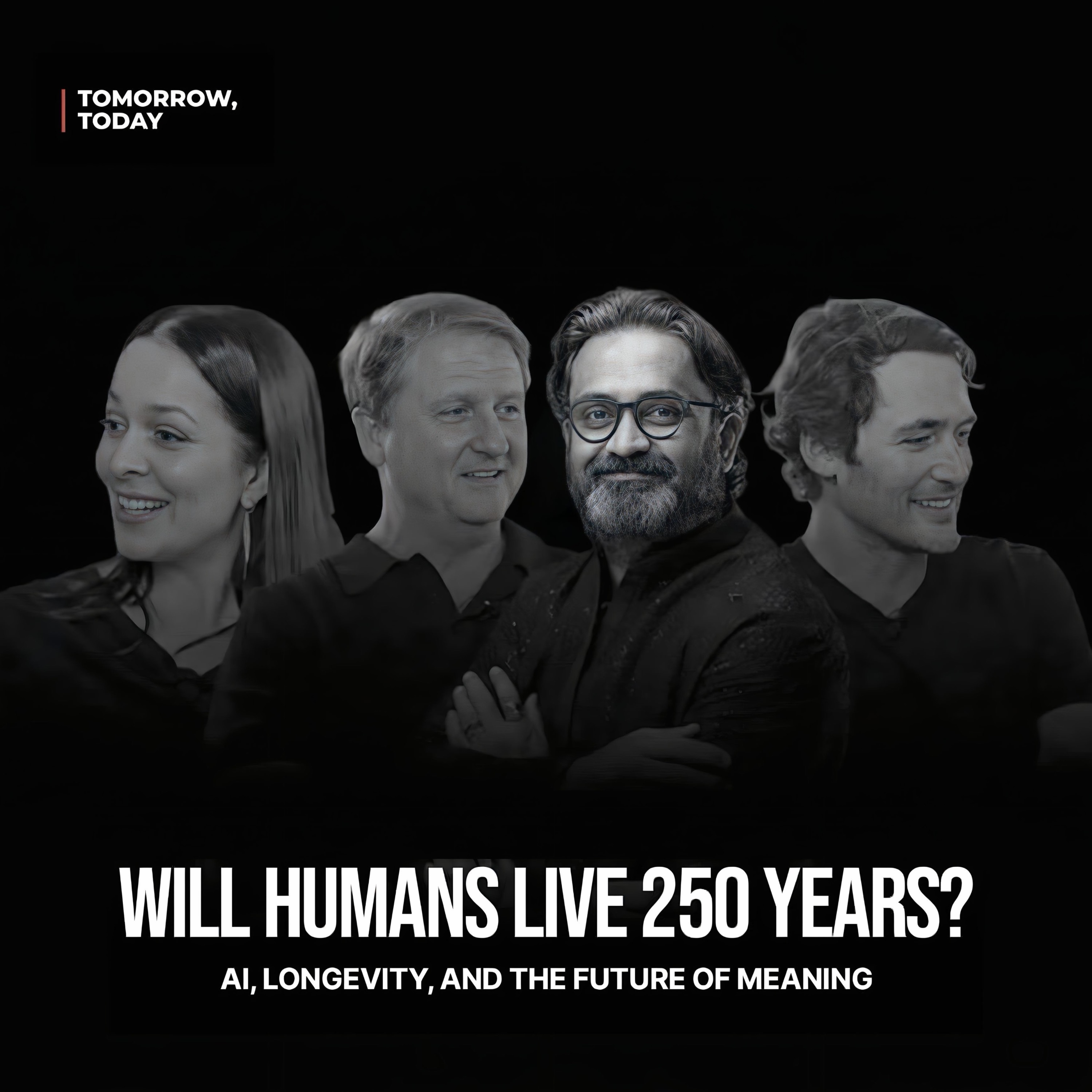
She touched it every morning before sunrise. A small gold ring. The only evidence anyone had ever chosen her. Then one fine day, she took it off for me. A boy with no shoes, no future anyone could see. No proof he was even worth the price. My mother didn't pawn a ring that day. She pawned the only story she had that mattered to her. And she bedded on a story that didn't exist yet. That was my story. I grew up in a single room in South India, in the slums. Dirt floors and walls that couldn't keep out the rain or the doubt. But my mother never looked at those walls. She never looked past them. That's not hope. Because hope waits. She chose a direction and walked towards it. That's called orientation. Fire didn't ask our ancestors if they were ready for it. Neither did electricity or Internet or the splitting of the atom. The future never asks us the permission. Right now, someone is designing the world your grandchildren are going to inherit. What would you give up to live long enough to meet your great great grandchildren? What would you give up to never forget your mother's face? What if the future offered you everything that you ever wanted and it costed you everything that you had? My mother couldn't read, she couldn't plan, she couldn't prepare. But she knew what every futurist had forgotten. The future belongs to those who face it. Not the ready, but the ones who are oriented towards it. This show won't describe the future for you. It will drop you right into it and ask you questions that are thought provoking. Who will you be when you get there? What will you hold on to? What will you let go? What will you pawn? And for whom? My mother is gone now, but every morning I think about a woman touching a gold ring in the dark. Choosing a direction. Choosing to believe. She couldn't have imagined the machines that think or lives stretched beyond two centuries. But she gave me something no algorithm would ever replicate. The courage to face what I cannot predict. This is tomorrow. Today. The future is already here. Walking towards you. Turn and face it together. Thank you Four Seasons Hotel and we're deeply thankful for making this space ours for today. Thank you so much. In July 2024, researchers at Imperial College and Duke University gave elderly mice a single injection. It blocked one protein. The mice lived 25% longer. Not just alive, but it was healthier, stronger, fewer cancers. Google just paid $571 million to license the technology. Human trials are already underway. In May 2025, Max Planck Institute combined two existing drugs. The mice lived 35% longer. Harvard's David Sinclair predicts an age reversal pill by 2030. 500 bucks a month. Take it for four weeks and get biologically younger. Can you believe that? The longest verified human lifespan is 122 years, but Sinclair believes it could double. So I'm not looking at 35 years anymore. I may be looking at 250 years. 250 years means seven different carriers. It means you're going to see great, great, great grandchildren, and they'll be probably older than you. Till death do us apart suddenly means two centuries of marriage. Would you take the pill if death gives meaning. What happens when death becomes optional? My mother lived 70 years. She pawned her wedding ring for my education. What would she say if I lived three times her lifetime? Would that honor her sacrifice or somehow diminish that? I came to this country with $34 in my pocket. I built technology for Fortune 500 companies. I filed hundreds of patterns. But I've never faced a question like this in my lifetime. What the hell am I going to do if I lived for 250 years and that science isn't coming? It's already here. In this episode, we explore exactly that. Not whether we can live longer, but. But whether we should and what it means for love, for purpose, for meaning itself. Because when the clock we've been always racing against just stopped ticking. Welcome to the inaugural show of Tomorrow Today. I'm super excited to have great guests. In fact, the purpose of this show is to evaluate the technology that is already emergent amongst us and what does it mean to the society in general for my amazing guest. Like, I'd love for you guys to introduce yourself. Jason, Natalie, and Kevin, that order. Why don't you introduce yourself, Jason? Like, you are a phenomenal prominent figure and a celebrity, and I'm so glad to have you. But, like, I would love for my guests to hear in your own words, like, who you are.
- [08:04]
Jason Silva
Yeah, sure. Well, thank you. Thank you for having me. Hello, everybody. My name is Jason Silva, and I'm a filmmaker, a digital. Digital creator, and very often a keynote speaker as well. My background is mostly as a television presenter. I would say that My most high profile program was Brain Games, which was a TV show I hosted for National Geographic Channel. Did that for five seasons. And that looked at it was like, you know, ABCs of neuroscience was a kid, a show that kids and parents could watch together. And then I also hosted another show called Origins, which was about transformative technologies that changed humanity. I would describe myself definitely as a protopian or a techno optimist, which means I like to dream about the ways that we can use our technologies to extend our capacities. I'm passionate about human flourishing, which also includes mental health. And so I feel like paleolithic brains, medieval laws, and godlike technologies is a bit of a problem. So I'm always thinking about ways in which we can sort of up level our psyches and souls and psychologies so that we can better deploy these increasingly godlike tools. But ultimately, I'm a dreamer and a romantic.
- [09:26]
Shawad
Fantastic, Fantastic. Natalie, you're the rising star in the world of AI and social psychology and I'm really, really excited to have you. So love for you to actually educate our guests on your background. What do you do and why are you here first place?
- [09:47]
Natalie
Well, this is lovely opportunity, so thanks. Nice to be here with you guys. So my background is in psychology, behavioral science and persuasive tech. And so I'm really interested in how technologies shape our behaviors, our relationships, the way that we conceive of ourselves, what's possible. But I'm also an artist and a musician since very young, and I'm absolutely passionate about finding ways in which to tap into that which we most profoundly love and what gives us meaning and to make our decisions from a much more rooted place, embedded in the idea of what is it that gives life vitality, not just our lives, but also the wider living world. So to your humanist, I'd say I'm possibly more on the animist side. And I think we have this precious moment in time where many of the crises that we face share roots. And we get the opportunities now to have these kinds of conversations, to robustly challenge one another and our assumptions, to find pathways forward that can, like you suggest, reduce human and life suffering and create a world which is much more regenerative, dignified, and that creates a space for people to live meaningfully. And that's going to be a pluralistic vision. Yeah.
- [11:04]
Shawad
Amen. Excited to have you. Excited to have you. And finally, my friend here, Kevin Brown, like, you know, a serial entrepreneur. Kevin, like, why don't you introduce yourself?
- [11:14]
Kevin Brown
Sure. Well, amazing to be here and to meet everyone. So Shaker, you and I have known each other for 10 years and I've been looking at some of these topics from the technologist point of view. So I've been building and running companies in Silicon Valley for the last 25 years and, you know, really pretty, you know, blowing away by the impact of, you know, technology. I got to work on the early Internet and saw that big change. I grew up analog, so we went from analog to the Internet and now we're onto something new. And it's very interesting to be in the middle of it. So I started working on AI. We were doing pre AI things way back at Ink to me in 1999, dealing with basically, how do you look at the whole Internet and use the meaning of web pages to categorize and start to take meaning out of the massive data. I started working on computer vision in 2013. So it's been, you know, I've always loved to be on kind of the early edge of that technology. And you know, and now seeing what's happened the last few years, it's really just, it's this accelerating curve. And so it's both, I say, a concerning and a scary time to be around. But I'm also really driven by curiosity and I'm really curious to see, you know, what we can, you know, what we can do, what, what's going to happen and how can we really extract the best out of it. And that's something that is pretty exciting. Personally, my favorite things are I'm a musician, so I play the drums, I'm a chef, I love to cook family. So for me it's really that intersection of science and art that's quite interesting. And especially when it brings people together, those are the things I'm really excited about.
- [12:51]
Shawad
Great. So it's no coincidence that I have a futurist, I have a social psychologist, and I have a technologist, and I am a dummy here. No. So we're gonna have a lot of fun talking about the role of technology and basically how humanity can consume it. So, and this is a very important topic for me because I come from slums in India and somehow, through my mother's blessing, my father's like, virtues that he had, I got the escape velocity and I was able to get out and I was able to basically figure out like angels in my life, like Kevin and others, and they showed me the direction of what technology can do to a person. And basically what I want to get out of this show is to educate people on the choices that we have. The agency that we have. And where is really technology headed in the first place? Because there's so much noise, there's so much, like, hype, like there's AI everywhere, there's infrastructure, like investment talk everywhere. And like, you know, people are just going frenzy about it. And there is a lot of evolving emergent technology that has meaningful impact in our lives and sometimes scary implications that we haven't contemplated. So I would love this conversation to be about that, so we could educate people on how to embrace technology and what is the best use of technology and what are we getting into? Okay.
- [15:11]
Natalie
150 years. Can you believe it?
- [15:16]
Jason Silva
150 years married, and I'd do it all over again.
- [15:24]
Natalie
Remember when till death do us part heart actually meant something.
- [15:28]
Jason Silva
Now we're just beautifully stuck forever. Come on, let's get the champagne ready before our guests arrive.
- [15:55]
Shawad
The first question I have for you guys and Jason, like, you know, Jason and then Natalie and then Kevin. What did you feel when you watched that movie?
- [16:06]
Jason Silva
Well, I loved the futuristic world where it begins. This sort of environment felt like this kind of futuristic house that also felt kind of like an Apple Store, you know, I could just feel the futuristic ambiance. And they were about to celebrate. It felt like an early evening feeling. They looked vibrant and youthful, and right away they're like, happy. 150. And so for sure, my solar plexus got relaxed. I was like, oh, my God, that sounds amazing. Like, to be 150 and be young and there's no death and decrepitude and illness and terror. I have a lot of anxiety related to mortality. I have since I was a teenager and I've been dreaming, dreaming about, like, an intervention that can come in time, potentially to save my parents. But my relationship with the transcendent as an artist still hasn't fully resolved my fear of mortality. I mean. I mean, I think human beings are suspended in paradox, but I don't know what comes after. I'm pretty agnostic. But what I do know is there's a lot of books that I want to read, and certainly a single human lifespan is not enough. I want to have many lives within my single life. I want to live in many countries for two decades each. You know, I want to learn Japanese, and then I want to move to Europe, and then I want to hang out in safaris in South Africa. But, like, for decades at a time. And so from the beginning, I immediately felt soothed by their youthful longevity. And of course, then as the story progresses, then it becomes really interesting and thought Provoking because it raises questions about, well, what happens when we're ageless and we have these radically extended lifespans. Then we have to have a negotiation about monogamy or the idea that we change and evolve. Like maybe we have many lifetimes, so then maybe we have many marriages that each last 150 years. And so I thought that was like a very interesting and compelling thing. I certainly, as somebody of many interests, imagine that if we have radical longevity, we're going to become definitely intellectually promiscuous. We're going to have promiscuity in our careers and interests and whatnot. But I also think we might become polyamorous in a new kind of way. So I don't, you know, I don't agree with the actions taken by the male protagonist where he was like, I'd rather die than date somebody else. I mean, for all I know, they could still stay friends with the ex and just go, you know.
- [18:33]
Kevin Brown
So that's what I was like, what the hell?
- [18:35]
Jason Silva
You choose death? You know, do you know something? I don't? But yeah, and I also, the idea that the state would say that if you opt not to switch partners, punishment is death, that seemed like, I don't see why that would be the case. Like, why does it have to be so harsh? You know, if we have radical abundance, then you should have like radical freedom of choice, you know, so that's the only part that didn't sit well with me.
- [19:04]
Kevin Brown
Initial impressions,
- [19:07]
Shawad
Natalie.
- [19:08]
Natalie
So interesting. Building on that, I think one of the other things that struck me was how isolated the place was. Mostly because I think if we're thinking about an interconnected future where technology, having had its foundations in connection, so the Internet connected people, social media, normally connected people, why would it be that people would be living in really hyper, individualized, secluded lives? There are many reasons why that might be the case. Anyway, so that was the first thing that really struck me was this really enclosed space and then the idea that if you are living a life as the couple situation, which is entwined, they've been managing it for 150 years. If you look at the sociobiology of it, typically couples who share a physical environment also share gut biome. They share psychological traits. Memory is not stored within a single individual, it's stored socially. So you would have a shared cultural, social history together. The chances are that if you have a partnership which grows and develops, and you mentioned several lifestyles or life times which can allow you to experience different places of life, styles of life, intellectual endeavors, etc. If you have been with someone for 150 years, one might imagine that you would grow together with certain level of promiscuity feeding into the relationship. And relationship experts will often talk about this desire for novelty on the one hand and familiarity on the other. And you often end up partnering with someone, especially in longer term relationships where that balance dynamic, but it continues as an appetite throughout life. So I think there's certain things that it raised for me, this question of, okay, if you're with someone for 150 years, where are the points of convergence? What does it look like to have a dynamic, fruitful, curious life? Or are you at the other end of the spectrum where actually what you do want is routine and similarity and you have something which is predictable and nourishing in that way? The state intervention thing was very like draconian and pretty grim. But then also this sort of raises questions about how we make meaning. And she says, till death do us part. There was a movie, I can't remember the name of it, I was trying to search for it this morning, where everyone stays young and the thing that changes is the time that you're allocated based on the value that you provide society. So there's a scene where I can't remember who the actors were, where these two actors come together and they look like they're 30, but one is the mother and one is a son and he's successful and has made all this money. So has all of this time. The mother is ticking time, is it calling time? And the mother's about to die because her bar is basically going down and he tries to reach her in time and she dies. So it's things like that. Like there's always been value based on something that is life. And whether it's a body that dies or time that runs out, I don't know. I think there are certain ways in which we can't cheat time. We'll see. Just some initial thoughts.
- [22:06]
Jason Silva
Quickly. I would just say that I appreciate this insight about wanting novelty while wanting the familiar at the same time. I always think of Joseph Campbell's idea of the womb with a view.
- [22:24]
Natalie
Oh, that's such a grim idea.
- [22:31]
Jason Silva
I think he was talking about it in the idea of being safely held in a protected psychological environment where things are predictable and familiar. So you're safe, but you're simultaneously have an open horizon if you can't get through it.
- [22:46]
Natalie
Like if you're just in a. Okay, clearly hit something in my spirit.
- [22:51]
Kevin Brown
Well, okay.
- [22:52]
Jason Silva
Allen Ginsberg, the beat poet from the 60s, he used to be a big advocate for. For, like, psychedelic expansion of consciousness. And he used to describe his favorite headspace. Again, talk about, like, the ideal psychological state as buoyant, floating attention, like a rubber duck in the bathtub of the universe. Maybe you like that one better.
- [23:10]
Natalie
That's better.
- [23:11]
Jason Silva
Okay, so you're like a rubber duck. You're just bopping along, feeling groovy. You're in the bath, it's warm, it's nice. But it's the bathtub of the universe. You're, like, beholding galaxies, you know, So I just. I've always wanted both of those things because I love expansion, but I also love to feel safe. It's a big one for me, you know, so that made me think of that.
- [23:34]
Shawad
And, Kevin, what was you. What did you feel?
- [23:38]
Kevin Brown
Yeah, like, so for me, there was a, you know, a feeling of helplessness, of, you know, this, you know, perfection, you know, this biological ascendance of health and youth and. And so forth, and then, you know, grinding into this machine that is unyielding and just doesn't care. And, you know, and it was interesting to see them deal with that. And, you know, I think it taps into a little bit of what we're feeling these days of, you know, there's a lot of hidden algorithms, hidden machinery that are, you know, are driving us or changing our world or manipulating us and getting more complex to the point where it's hard to even understand. And our early experiments on this with social media, for example, have been mixed. And so seeing the sort of. This kind of endgame, kind of version of it really kind of brought back to me today a little bit of existential helplessness that people are, I think, going to feel as things are changing more and more, more quickly, feel a little bit less grounded. Is the rubber ducky going over the waterfall? There's definitely some of that. That was my emotional imprint. But that sense of the state knows best. But the question of any algorithm is, what is it optimizing for?
- [25:05]
Shawad
Absolutely. So my question to all the three of you is. So there's a lot of sublimality in the movie that we had put in, and there was a lot of intentionality in terms of how we constructed the movie. Okay, if you look at the guy and the girl, they're dressed well, and basically, so they had freedom of choice in the way they had decorated things. And, like, you know, there's pictures of them like. Like, you know, in the hallway about all the memorable moments they had in life, and they're happy and all that Stuff. And the guy who shows up from the State is dressed in dark, in black, right? So like algorithms turning dark. Right. And so. And then when you look at the girl, when she moves on, she's in yellow, she's moved on. And the guy has a painless death. Utopian. So my question to all of you is, is the dystopia much more scarier than the utopia that you're seeing or the vice versa?
- [26:22]
Natalie
Can we just have some definitions in terms of what? When you're talking about utopia and dystopia?
- [26:26]
Shawad
Yeah, so the algorithms, like, you know, if you look at the perfect, like the guy is wearing a white suit. That's purity. Utopian. The perfect world. Everyone is cloned the same way. All of the guys who are wandering around in the black jacket, the guy who shows up, the State guys, they're all same. They're unified in one system. They're all thinking alike. And the death is also perfect, painless. That's a utopian world where everything is perfect. That is what, like, the promise of AI is. But we are living in a dystopian world. So what is more scarier?
- [27:12]
Natalie
So to me, there's something, what you said about perfection, the algorithm deciding for you. There is something about a frictionless, predetermined, optimized existence which reduces potentially suffering in the moment. You're talking about painless death. Yeah, I haven't died yet. I have experienced pain. I think everyone on Earth who has experienced even a moment of life will have experienced some kind of suffering pain. And while we don't wish our worst experience on other people, nor would we necessarily want to relive them, that's where we gain insight into compassion, into ourselves, our own limitations. Our capacity to love, I think, is connected with our capacity to feel, you know, the pain of ourselves and others and how we're cared for. And I think things like heartbreak and death and loss, they season a person. And so I think a utopia that removes all of that friction and potential for deepening and seasoning. I'm not talking about unnecessary suffering. I'm not talking about things like torture, rape, imprisonment, those things that we can make different choices about. I'm not talking about that. But something that removes all of that, I think removes our capacity to grow into what our species can be experience
- [28:32]
Jason Silva
that, you know, I'd rather watch a disturbing and redemptive film that takes me to all those places, but still live in a world where we solved cancer and my mom doesn't have to grow old and die. And maybe I'M trying to have my cake and eat it too. But why not? The whole thing's a mystery. We're suspended in paradox. I don't know where we came from. I don't know where we're going, so why not? My soul wants to reconcile my desire for the multidimensional human life, but at the same time not compromise on the finality of that kind of loss. And I'll grant that maybe I'm spiritually immature, you know, but maybe I just retain a childlike insistence on our genius and our poetry. Like, I love this idea of the truth beyond the literal grid of, you know, like the idea that somehow fiction can be more truthful than reality. You know, you can tell me that objectively and empirically a film is 120 minutes of like pre recorded and scripted illusion. But the subjective experience of watching that film can be as real or more real than something that happens in the Euclidean meat space. And altered states of consciousness also hint at time dilation and the kind of presence that seems to go beyond ordinary perception. And so, yeah, I just agree with everything you're saying about the full range of human experience and still want to insist on alleviating the kind of suffering that puts you on a deathbed versus, like symbolic, transformative psychological suffering, which I think we could just emulate.
- [30:22]
Natalie
So no death?
- [30:23]
Shawad
No death.
- [30:24]
Natalie
I mean, but does that also then mean no birth?
- [30:28]
Jason Silva
Not necessarily. I mean, you're talking about like overpopulation related issues. Well, you know, you turn people like Peter Diamandis and Ray Kurzweil will talk about how overpopulation is a myth and most of the world is empty space and you could fit the entire global population in the state of Texas and there'd still be plenty of empty space. The issue is distribution of resources. But if you're imagining God like technologies at exponentially increasing capacities, the idea that we wouldn't be able to deliver resources I think is contextual and technology is a resource liberating mechanism. And so again, I can find a reason to stick with my narrative.
- [31:08]
Shawad
That's what makes us human. We all have a perspective. Kevin, what about you?
- [31:12]
Kevin Brown
Well, so if you look at the spectrum of where we are to this kind of sanitized utopia, there's quite a bit of distance. And so I would fall on let's roll the dice and let's crowd out cancer. Let's sort of, let's take maybe a little bit of risk of less seasoning because we, you know, we've all been through some seasoning that has made Us better and some seasoning that is, you know, damaged us and you know, and we don't even know what that human experience will be in 50 years or 100 years. What's the human machine interface? What's the human to machine to human? Like, you know, do we directly transmit our emotions? Like we don't know what that's going to mean. And so there's a kind of the great fomo, you know, I kind of want to see what, what happens now. Being trapped in it where you couldn't exit and the government would never let you, or you're trapped in consciousness in an AI sort of computer and you can never get out. Those are pretty bad sci fi sort of themes. But between where we are and this kind of sanitized utopia, I'm certainly curious and I'm somewhat hopeful that there's upside. You know, I'm an entrepreneur. Like I kind of, I operate on optimism and realism. But you know, so, so for me there's at least this first part that you know, let's knock out cancer. Let's, you know, let's see if we can feed people better, like, you know, help everyone optimize their health, you know, like, you know, and, but I think there's real work to be done, you know, with these kind of discussions of what to do to our character. Like, you know, the human, you know, hardware has evolved over 100,000 years and you know, all hundred thousand years of it have been infused with hardship. So there is something, you know, I think really profound to what you're saying is how do you have those experiences? So at 40 I almost died. I had a very bad bike accident. It was real close. And you know, just, you know, two years ago my wife had a massive brain tumor like and you know, massive surgery and then was able to like we got the best healthcare and is able to recover and is back. She's like 95%, she's doing amazing. And like so you know, those experiences, you know, you know, they could have, you know, made you, you know, kind of cynical or whatever. I kind of chose the, the glass half full. And for me those were carpe diem moments of like, hey, I really value because like, you know, 40 was too young.
- [33:49]
Natalie
Yeah, you can just lose everything.
- [33:52]
Kevin Brown
But that's how long you used to live, you know, not too many generations ago. So we kind of take it for granted. Hey, you know, you don't live to 40 or 50, live to 80, you know, what about 120, like so I don't know, you know, we may get to a point where we wish we weren't there, but I'm too curious to not take a look.
- [34:10]
Jason Silva
I mean, the Greenland show, he says,
- [34:12]
Natalie
in the big Greenland.
- [34:15]
Jason Silva
Yeah, the Greenland shark, like they found in the ocean. It's like almost 400 years old and it's like navigating around.
- [34:21]
Kevin Brown
You're like, that's that guy around during
- [34:23]
Jason Silva
the Gilded Age of the Dutch. Yeah, yeah. I mean, look again. The question of not dying in immortality is one thing, but like the lifespan of the Earth, the lifespan of the universe, these are dealing in proportions so much beyond us. Like, how about like giving us a
- [34:37]
Kevin Brown
couple hundred more years just to like
- [34:39]
Jason Silva
feel it through, you know, inside and just read more books, live in more places, you know, like, so would you
- [34:46]
Shawad
let AI pick like someone that you want to live with? And if AI tells you that stop loving that person and start loving someone else, would you do that?
- [34:55]
Jason Silva
I just, I don't think that AI would have a reason to force that upon us, given the fact that I just suspect. My inclination is that what these technologies do is expand our possibility spaces. You know, Kevin Kelly famously says, like, you know, technology is a double edged sword, but as long as it creates more choices, in the end that's like a good thing. And that seems like constraining choices. And so I like to think that it's, it's a great thought experiment, but I just, I don't know, I don't think that that's the way it would go.
- [35:30]
Kevin Brown
So the cautionary note is that, you know, maybe AI is going to tell us things, but, you know, more likely it's humans using AI to tell us things and manipulate them maybe for their agenda. And so that's a little bit of the rich set of themes of the dystopian versions that I think we need to be nervous about. And how does that play out? And so we have to get a little bit better at electing people that can be entrusted with the ever increasing power of that technology.
- [36:06]
Jason Silva
The fact that we can be so brilliant and so awful at the same time, that like, one human can be like, man, this person reminds me that humanity can achieve anything. And then someone else can just be like, wow, like, we haven't evolved at all, like, what a brute this person is. And the fact that our species produces individuals that can be both of those things continues to be the thing that haunts me the most.
- [36:32]
Natalie
I think there's also a systemic question. You're talking about people using technologies in service to certain ideas, values, motivations and Thinking about longevity, one of the things that you one reads about if you read science fiction or history books is that whenever there's been, there's two things, the longevity of a system that produces ecological nooks, if you like, for certain people with certain character traits to thrive. So the masks and the kind of the Caligulas of this world, let's say. And then the flip side, which is individuals who do not seem to become wiser or more compassionate with time, who become more entrenched. You mentioned these wounds that cannot be healed. And I think a lot of the leaders that we see who are in it to acquire power and to dominate others have wounds that have not been touched and haven't been able to find resolution of some kind or healing. So if you have a system where people are living longer, those who acquire the power to extend their lives are the ones with the greatest resources. Typically they're the ones in a current system that will be able to extract, dominate and then essentially prolong their own lives. You're completely shifting of these evolutionary dynamics that mean that even the most cruel of dictators will die. What does that mean? Does that mean more revolutions? Does that mean more bloodshed? Does that mean like if we, if we can't find on a self sustaining Earth that is much longer lived than we are, if we cannot find a way to sustain the resources available to us and acknowledge that we are all interrelated, how the are we going to use AI as in service to anything other than the destruction of our species? I'm sorry, but like we need to change the systems and the assumptions and we have not gotten there yet. At the same time, I am a fervent lover of humanity and of life. And I think that at the darkest point in human history, when you look backwards often it's in these most dark moments before dawn, where things are lost, that something shifts. And I would love to believe, like the deathbed, whatever, that there is a way in which we don't. Oh no, you mentioned with the film that we don't have to get to that point in order to have this phase transition into something else. I would love to believe that that's true. And I think it is true. The future is not yet written. Much as the tech overlords would like us to leave it. It is. And so the question is, how can we learn from all of the wealth of knowledge that we have through cultures throughout the world to be able to create conditions for different systems to emerge so that AI and any other kind of technology can help us reduce suffering like that. I think we're all fairly aligned. Maybe we have different visions as to how that works.
- [39:18]
Kevin Brown
But so this gets back to the algorithm. What do you optimize on? And so we're building this machine. It's a statistical machine, it's a calculating machine. But what is it going to to calculate and what's it going to do? And I think that this is an area and shaker, you've spoken really inspiringly on this topic of how do we build some of this in now kind of before it's too late. And so that's why I think this is an urgent moment to bring the cross functional expertise of the world together on this couch, but on all of them into how do we look at this from the different angles to understand what that impact is going to, to be on us and the psyche. You know, it's an experiment we've never run. Absolutely.
- [40:04]
Jason Silva
You know, it's interesting. I can't help but want to bring up the subject matter of awe. You know, my entire YouTube series is called Shots of Awe. I've been making videos about the subject of awe for 12 years. And it's the reason is that I have found sort of that confrontation or that direct encounter with, with that which exceeds our mental maps. You know, the Greater Good Science center in Berkeley, the work of Decker Kelter, describes awe as an experience of such perceptual vastness or such perceptual expansion that our assumptions, the mental models of the world that we use to orient ourselves are forced into a state of humbling accommodation. They just completely dissolve. Right. And the mental health crisis right now, one of the sort of transformative interventions. There's the return of psychedelics and the idea that these psychotechnologies, because they are technologies, can put us into places beyond our maps where we can encounter the mysterium tremendum, like the full sort of naked encounter with the mystery of being. And how that ends up having these incredibly pro social effects. Like what happens is this humbling accommodation before the mystery. Like makes us more compassionate, makes us have more well being, you know, makes us want to extend our hands to others. There's just something that happens. Now granted it has to do with set and setting and context in which people partake in these psychotechnologies. You can also have ego inflation. A lot of these Silicon Valley tech bros have taken psychedelics and haven't become necessarily more compassionate and more empathetic. But I just feel like artists, psychedelics, consciousness, more works of beauty that these are Things that could move mountains potentially. I've always felt that a great work of art can change the world. A great film can change the world. I mean, my heroes are people like Chris Nolan. You know, he makes a film like Oppenheimer. Like, how does that change potentially the conversation we have about nuclear weapons? But everybody's affected differently. But like, for me, like when I encounter transcendent art, when I encounter experiences of awe, I sometimes feel it becomes at least self evident in my experience. I'm like, oh, this is the path. This is how everybody changes. This is how we scale a shift in consciousness. You know,
- [42:14]
Shawad
let me provoke a little bit more. Like, not that I'm trying to be a provocateur, but so in all of this we are assuming that we don't lose agency in all of this, right? But I see us losing agency every day. Let me give you an example, okay? And we go after many examples like that. As I said, I grew up in India and I used to walk 45 minutes to my school. Me and my brother, we used to hold our hands to walk to the school. There was a lot of pain. But we absolutely loved the fact that we were going to a temple. For me, education is like going to a temple. And we loved the struggle. 45 minutes going in, 45 minutes coming back. And someone took pity on me when I was in 10th grade. These guys are living in slums. Maybe they deserve a cycle bicycle. But they gave me bicycle. Okay? So the same distance, point A to point b, took me 15 minutes and relieved a little bit of my pain. I got a little efficient in my life. It got me from point A to point B. And I thought, boy, this is good, this is fantastic. And then I basically, this is Uber, before Uber, by the way. Everyone like talks about Uber. Like technology is only replicated what we've been already doing most of the time. That's what I feel. So I used to take this something called shared autorickshaw.
- [44:06]
Natalie
Okay?
- [44:06]
Shawad
You just get into autorickshaw with 10 unknown people, pay like someone 5 rupees, and then you can go from point A to point B. So if I get lazy someday using my bike, I now had an option to take an autorickshaw. So that was my recommendation engine in my head. Cycle or autorickshaw. Then I came to United States. I didn't have a car for three years, by the way. I used to like go around with my friends. Then I got into a car, took me from point A to point B. All I had to use was accelerator, brake, and just Put my hands and my fingers on the steering wheel. Efficient way to go from point A to point B. Now we are getting into the age of autonomous cars. You don't lose your brain at all. Imagine my son gets into an autonomous car. Never has driven a regular car. What the F is he gonna do? And that's happening everywhere. By the way. We have taken our cognitive and said, here's the best movie recommend. I'll keep watching. Here's the memes. I'll keep watching. So this is happening more and more and more. I have an example. I just want to read this example to you guys. So this is Allegheny county in Pittsburgh. By the way, Allegheny, we talked about the state and whether the state can influence a decision. By the way, okay, Allegheny county, they have created an algorithm that scores family when the child abuse and neglect is reported, predicts the likelihood of child removal. The family can't see their scores. The Department of Justice is investigating bias and they have an app called hello Baby. Okay, that hello baby app. It gives you two options to opt in or opt out. One, when you have delivered the baby and you have too much paperwork going on and a postcard that shows up in your mail that you may forget. And if you are ever recorded, you are always in the list to be taken away. The child to be taken away. That's the reality, my friends. So it is. The movie is not far fetched. And this is also happening in corporate today. Think about Microsoft and Google. They have a network study and you may be spending time with like your friends and your co workers for a lot of time. And they then decide and say that person should not work with this person. Their performance is better if they went to a different team altogether. They get reallocated. Reallocation is happening in corporate settings. Reallocation is happening in child born in a childbirth because of abuse or whatever it is. And there is also an app in China, by the way, where they're actually taking the Alipay's credit score and saying you're no longer eligible to travel or date or I have marriage. And there's a social credit system in one of the states in China where you have to disclose everything and they will decide whether you need to get married or not. That seems rather horrible.
- [47:47]
Kevin Brown
Horrible.
- [47:49]
Shawad
And we are taking all of the data and creating all of the these algorithms and biasing the systems and it is going to be recursive and it is going to make bad decisions. That is my worry.
- [48:03]
Kevin Brown
So you know, on the darker side of this. So I've always said that Orwell was an optimist because he never understood the power of machine learning. It's powerful in both directions. And so this is back to the state. Right. And that heartless, chilling version in the film is something really to be afraid of. Yeah.
- [48:29]
Jason Silva
I mean, I think there's no doubt that humans in control of AI, in places where you have a political system or a governmental system, where it's not really about human rights or fundamental freedoms and whatnot, is terrifying because it just makes those kinds of governments more powerful and more able to control us. That's about as scary as can be.
- [48:57]
Shawad
And we are in a democratic country, by the way, and we have Allegheny County, Pittsburgh, by the way.
- [49:04]
Jason Silva
It's ugly as hell. But I think that's, that's where it's up to culture, artists, rebels, tricksters, I mean, to create the conversation that keeps this thing from happening. I mean, look, that scenario you're saying, I know that it's playing out in many places in the world, and of course that terrifies me. I grew up in Venezuela and I saw what happens when a government goes tyrannical. And you know, right now I'm living in the Netherlands, which is one of the freest places in the world. Ironically, everybody there goes on their bicycle and has a lot of agency on their bike. So there's some return to a very analog village life there in a high trust society where there's not that kind of surveillance. But yeah, no, look, what you're saying terrifies me. And there's no real rebuttal against it. It's legit. We just have to, I guess, speak out. Right.
- [50:09]
Natalie
But I think also there's so thinking about democracies and what democracy actually is and the different versions of democracy that exist, and it being kind of not even just a spectrum, but a constellation of different expressions of systems where people have more or less agency to vote in people to represent their values, ideals, etc. There are places in the world, like for instance, Taiwan, where Audrey Tang used digital tools to democratize a system in which people felt like they were alienated from the decisions being made by their government. And so to create a system, it was almost the anti Twitter back in the day before it became X, where rather than upvote antagonistic content that would split people from one another in different groups, it upvoted those points around which there was greater consensus. And so you can actually, depending on the intention and therefore the architecture that you create around it, create greater social cohesion and a better cultural condition within which people can thrive using digital technologies. And I think one of the things that we're seeing across different parts of the world, I don't know how much you've been kind of tapping into this, but these quote unquote Gen Z rebellions happening when social media platforms have been shut down, but they go to discord, or for instance, people not using iPhones and Google phones, whatever, they go to mesh networks. This is something I've read about quite a bit in Spain. Not necessarily smartphones, but they're resilient. And there are other ways to organize in such a way as people can have a greater sense of collective agency. And when we think about agency, agency for whom and within what kind of context, if you're thinking about like in that film and you mentioned Amsterdam, there is something about having this sensation of being held within a relational field of goodwill in a community that broadly is aligned with certain values. So democratic societies that want to be able collectively to cycle their kids to school without having to wear helmets because people are being careful. It's like I think we'll end up accelerating these pockets where in some countries there'll be a greater alignment, super alignment, between the technologies being used not to support veil and create credit systems and keep people apart from one another, but to enhance the quality of life so that the gains that are made through technology can actually embed themselves in a functioning economically, agriculturally, societally like healthy and wealthy environment. So if you get access to cancer cures or to personalized education or whatever it is, your society is robust enough because it's been supported to support itself that it can benefit from those sorts of advances. So like I think we're going to see pockets where countries go for the individualistic gung ho technology, surveillance data, selling it to the highest bidder and then there'll be everything in between and those societies go, hell no, we're not, that's not what we want. Finland, Denmark, using copyright on people's faces and biometrics so they cannot be sold to AI companies. It's a very swift, fairly simple innovation in the law or application of law anyway. So like we're going to see different places doing it very, very differently.
- [53:08]
Jason Silva
You see, you are an example of somebody that makes me think everything's going to be okay.
- [53:13]
Kevin Brown
I think some people.
- [53:15]
Jason Silva
Well no, but I'm saying the way you think other people think like you, you get brought to be the policy head of this. Oh God, no, but you're a public person. You're out there thinking these thoughts are articulated them so Eloquently I mean, I'm just saying, like, everything you just said was just like, spot on and brilliant and was in diametrical, you know, parallel to the scenarios that he was painting. So I was just like. I was listening to you. I was like, yes, more like her.
- [53:45]
Natalie
It was, to your point, about creating cultural conditions and what you were saying also about in service to whom and for what, like, yeah, but then who gets to decide?
- [53:52]
Shawad
Who gets to decide?
- [53:55]
Kevin Brown
And you have to build a system that brings it. Ultimately, the idea of democracy is that how do you reflect the will and the good outcomes for people? And technology is in a position to really do that instead of a representative one, where it's sort of a. It's a first approximation of the general beliefs of what someone wants. But if we at all times knew what everyone wanted and what would be good for them and made decisions in a way that was good for many, many people, you know, the world could get better. You know, decisions, the decisions could reflect that. But, you know, it used to be we lived in a monolithic culture. We had three television channels. You could, like either Elvis or the Beatles. So those are your choices, you know, and it was very, you know, sort of homogeneous. Now we're in a hyper, you know, sort of heterogeneous, you know, sort of, you know, branched out state.
- [54:41]
Natalie
Because I think at least back in. Back in the day, you'd have, you know, when I was at school, we would have like, you know, you have the hippies and you'd have the prog rockers and you'd have the emo kids, and you could see, like there was
- [54:51]
Shawad
a four or five buffet.
- [54:53]
Natalie
Yeah. And you could migrate between them if you liked, whatever. And now there's. I think there's a difference between heterogeneity and fragmentation.
- [54:59]
Kevin Brown
Yeah.
- [55:00]
Natalie
And hypersonizing. Yeah. And then also look at the generated AI, all the voices of anything generated by large language models. It's the same as. There's no distinctiveness, no taste, no differentiation, no macro trend to go, oh, that's the macro trend. Trend. I'm going to do a counter thing over here. It's a bit like blur. It's like you mix all the colors on the palette and you end up with this kind of mushy brown gray.
- [55:20]
Kevin Brown
Yeah, well, fragmentation, I think, is the word. And right now you have people that are using that to turn them against each other because it serves their purposes. And so can we have a heterogeneity and sort of diversity, which you then roll that up into sort of better outcomes. It's going to require people with voice and with power to do that. So I'll second the motion. So the idea is, how do we sort of insert. And from the technology point of view, this is something that we've been talking quite a bit about is are there places that we can start to insert this kind of virtue, this kind of good into the processes in a very explicit way?
- [56:06]
Natalie
Can you tell us a little bit? I know you're hosting, but you're at the heart of the storm here. What are some of the ways in which you are doing this that you talk about angelic intelligence and these virtues? Can we hear a bit about that?
- [56:19]
Shawad
So the fundamental problem that I see in the world is that we are taking garbage data and recycling all the garbage data to create more garbage output. Right? And there is this like, you know, sort of the paradox of like aggregation. Like, you know, we assume the mundane that we see of the human is the real human. It's not the real human. The variances and the extraordinary movements is actually what makes a human human. And we're not able to capture those. I'll give you an example. Like, you know, my. Like in our house, I remember this very distinctly. We had like one bowl of rice. Rice, okay. And my next door neighbor came and asked for rice. Guess what my mother did? She took the bowl of rice and gave it to her. That from an economist perspective is irrational behavior. That according to optimization, is wrong behavior. That according to anyone out there is irrational and stupid outright. Because there is a family of eight. Why are you not feeding the family of eight and worried about the next door family? But what she tried to do in all of this is display great work, virtue, care, compassion. And we are not able to capture these kinds of story to really train our models. We are training that like, you know, someone who was abusive or someone who had a bad credit history is not qualified to date someone. That's what Alipay trying to do with Blythe, you know, app, which is a dating app, trying to do. So we have a fundamental problem with data, the way we think about it. And all decisions that are out there are not really binary. 01 we as humans operate in a shade of gray. So where is that goodness captured in the models today? I don't see that. And if you let machines make more decisions on our behalf and give the agency to the machines to make those decisions, you're gonna end up with a lot of like crappy sh T. Yeah. And that is my biggest worry. And that's what we are trying to address. So my question to you guys, based on the movie that you just saw, would you let an algorithm decide who the partner is? Would you do that?
- [58:56]
Kevin Brown
No, thanks.
- [58:59]
Shawad
What about you?
- [58:59]
Kevin Brown
Hell no.
- [59:01]
Shawad
What about you?
- [59:05]
Jason Silva
No, I think that, I think, I think it would be. Well, I think first of all, chemistry, connection, attraction, these things have an intuitive dimension, strictly non rational dimension. And I think that the non rational, I think is part of what makes us human. Right brain, left brain. Like there's room for empiricism and rationality, but there is a need for the Dionysian, for vitality, for the non rational. Sometimes things that we want to satiate that are inherently non rational. And I still think the non rational can be languaged. Maybe not with ordinary language, but certainly with poetic language. When I have conversations, for example with ChatGPT, I usually press the button where I can speak and I'll just go and riff for minutes at a time which then immediately transcribes and then we'll reflect back. And what I find is that it can totally meet me in places that can make sense of my non rational discourse. And sometimes I've been able to squeeze it for advice that is insightful. Like a very good student, I'm fully aware that I'm the one planting the seed with the input, with the prompt and I'm speaking that prompt is coming out with certain speech patterns, certain poetic references. I'm well aware of what I'm doing to get the answer that I want from my student in the way that I present the inquiry.
- [60:44]
Shawad
But would you let an algorithm pick your partner?
- [60:49]
Jason Silva
Well, I think that I would
- [60:53]
Shawad
be
- [60:53]
Jason Silva
persuaded to take a closer look at someone after I was like, help me make sense of this. And then if my students surprised me and connected the dots based on my input in a way that I didn't expect, I would go on a date with their suggested person. But ultimately I would follow my intuition. But I would be open for the recommendation if that's the question, I would.
- [61:16]
Shawad
But most of the data suggestions, most of the data suggests that love fades away over a period of time.
- [61:25]
Natalie
Hang on, what research suggests that?
- [61:27]
Shawad
I'm just saying, like that's what people say all the time.
- [61:31]
Natalie
So can I just stop you there a moment? So I remember all the way back in Psychology 101, we were looking at cross cultural studies on love as they reflect in different cultures. Cultures. And I remember one of the studies we looked at was in religions that have. And my mum was from Iran. And this doesn't always Happen. But suggested or arranged marriages. In India this still happens sometimes. In Iran it still happens.
- [61:57]
Shawad
Mine is one.
- [61:58]
Natalie
Right. So. And I'm like, well doesn't that's for another conversation? It's not relevant to this necessarily. But in those cultures, if the people involved, the arranged marriage are respectful and non abusive, which is a big if, then typically the reports of love over time actually increase because it's not predicated on erotic chemistry based love, which in most partnerships subsides over a period of time. Depending on the research that read it can be short or longer. In Western societies which prioritize individual choice, erotic love matchmaking outside of a potentially religious context, citations of love can reduce over time. Divorce rates are up to 50%, what have you. But when we talk about love, we don't have many words to talk about it. You're not talking about agape or Eros or you just, you know, what does it actually mean? And so you mentioned earlier about this potential for different models of relationship, whether it's polyamory or monogamish or whatever it might be, or like a life partner and then lust or love partner, whatever you want to call it. So I think we've got to be quite careful about how we describe love.
- [63:02]
Shawad
Yes.
- [63:03]
Natalie
Because it's not one monolithic thing by any stretch of the imagination.
- [63:06]
Kevin Brown
Well, in the movie, you know, it seemed to have been growing.
- [63:09]
Shawad
Yeah, yeah.
- [63:10]
Jason Silva
They were doing good, they were doing great.
- [63:12]
Kevin Brown
And you know, and we've been married, you know. You know, you know, going 28 years and you know, and you know, it's great. And now there's phase changes. You dip, you know, you change what it means. But in terms of human connection, I think, you know, and back to the hardware. Right. And how we've evolved, there is something of, you know, where you depend on interpersonal relationships and there's that shared kind of. Yeah. There's a, there's a safety and a. And there's no one else who understands you better. And in a world that's of more fragmentation, like I think that's important.
- [63:47]
Shawad
But would that not come through more relationship and being with that person versus being recommended something.
- [63:54]
Kevin Brown
Well, so, you know, I would bring us back to the, the science and art. Right. So I'm an old search guy. So can you use some little bit of technology to cut through all the pages on the Internet and get your top 10? Maybe. But like as suggested, I think there's a lot that's not captured in that algorithm and a lot that we don't even know how to Say, but you know it when you feel it, which
- [64:21]
Shawad
is where the responsible use of building the technology is super important for. Oh, for sure, for the flourishing of the humanity. Right. And so the question is not whether, like we should or not, but how are we training these damn systems in the first place?
- [64:39]
Natalie
But even more than that, like if you look at, if you talk to people who are again, not thinking monolithically in this as a generalization, but Gen Z populations who are having, those who are of a kind of active age, having a lot less sex, having a lot less interaction with alcohol, and a lot of people are saying, well, you know, psychedelics are the way we should be sober. But as a function that allows people to tell truths to one another in a low, lower stakes environment if they're not massively drunk and to have that kind of. Exactly. Disinhibition. There is something about the ways in which, if we rely too much on our technologies, whether it's social media or dating apps, whatever, to remove that element of risk. Like, I remember when I used to fancy whoever it was in class, you slip notes to each other and the fear of rejection was a like, oh my God, are they going to go on a date with me? Or one time I went for a date with someone and they waited for me for an hour and a half. My train was delayed and I'm going to go up and I'm going to turn up and they're not going to be there. Like these sorts of things. If we reduce that potential for eroticism, for anticipation, for rejection, that kind of, not that we want to be rejected is horrible. But there's something about that longing, that yearning. And if you remove all of that, then you're killing Eros.
- [65:49]
Jason Silva
Yeah, we don't want to lose embodiment. We don't want to lose deep embodiment, rich environments and high consequences, which is what?
- [65:57]
Natalie
And excitement.
- [65:58]
Jason Silva
And it puts you in the present moment and in a flow state. And what you were speaking to before about like love fading over time, I think you were maybe speaking directly to maybe to the idea of like habituation or like people kind of starting to take each other for granted simply through repetition, you know, And I thought about this a lot because I am a creature of novelty and at the same time I'm a romantic. I love the idea of loving somebody over time. And I've always felt like, what's the hack here? You know, like one of the things that can make you, for example, revivify the high of connecting with somebody, like boosting, dopamine so there's some habituation. You know, maybe you don't have to switch partners, just switch the context. Let's take a trip somewhere. Like, let's just go to Japan together and get lost and see how that radical novelty pushes us together and forces us to see each other in new ways. Let's ritualize couples MDMA therapy four times
- [66:51]
Natalie
a year, you know?
- [66:53]
Kevin Brown
Yeah.
- [66:53]
Jason Silva
Let's incorporate, like, cannabis and gypsy jazz on walks in nature. I'm telling you, this is like a dating exercise.
- [67:02]
Kevin Brown
Yes.
- [67:02]
Jason Silva
Like, I just think that, like, I have cultivated a series of my own sort of psychological interventions and ecstatic practices to go back to beginner's mind. Continuously put myself in states of heightened openness, heightened salience, heightened qualitative intensity. Like, these are practices that. That are part of my lifestyle. I'm very good friends with Jamie Wheal and Steven Kotler, who ran the Flow genome projects. And it's just, you know, I think these psycho technologies and interventions are just as important as, like, whether we use these digital technologies of optimization to maximally create spaces of connection.
- [67:44]
Shawad
Got it.
- [67:44]
Jason Silva
Both long term and short term.
- [67:47]
Natalie
It's also about knowing he's an anomaly.
- [67:49]
Shawad
He's an anomaly. But that anomaly is not captured everywhere.
- [67:54]
Natalie
But why does it have to be captured? Why do we have to. Can't we just create conditions for people to experience? Not everything has to be quantified.
- [68:00]
Kevin Brown
He's looking for training data.
- [68:01]
Shawad
Yeah, I'm looking for training data.
- [68:03]
Natalie
No, that pertains to mystery.
- [68:06]
Shawad
No, but this is exactly the point
- [68:08]
Jason Silva
of all of us. We're training data.
- [68:09]
Shawad
Exactly. In our own version. Right. But I think, like, the beauty of this conversation is, like, we are all so different and we have so many different opinions. Opinion about what makes it right. And so that's the anomaly. That's the human. Right. And so we try to basically assume that all humans are alike, which we're not. Right. And we are training these morals with all that, like, philosophies. And so longevity is a very beautiful topic. Very beautiful topic. And I'm like. I'm like, super confused myself. Super confused myself. Like, whenever I want to live long or I want to die early. Okay. To be honest, my mom just. My mom just passed away four weeks ago. Okay. And she. She was instrumental, like, in shaping me into the person I am today. When we had nothing. She believed in me and she saw something beyond anyone else saw. That's what moms too, right? And she passed away at the age of 70. And let's say, like, I live up to 250 years. Would I be diminishing her sacrifice or would I be celebrating her sacrifice? I don't know. I don't know. I don't know. And so my question to all of you is, what would you do if you lived up to 200 years?
- [69:44]
Natalie
And what kind of body?
- [69:45]
Shawad
Yeah, well, make up your own body.
- [69:50]
Kevin Brown
The first question is health span. Yes. Yeah. You know, the second mystery is what happens to the human mind after, you know, 150 years. Like, we haven't run that experiment, you know, but let's assume that it's not. It doesn't go into a psychotic, you know, kind of, you know, crueler, you know, sort of, you know, some of my favorite books touch on those kind of, you know, cruel endings. But let's, let's say that we can remain, you know, curious and optimistic and so forth. Like, you know, for me, there's, you know, you know, as the world has changed and I'm discovering things and learning things, you know, what keeps me feeling young is staying curious and learning. And so, you know, what would I choose to do? I would choose to just keep learning same. And, you know, and, and, you know, there'll be new things to, you know, I love astrophysics, so I follow, I geek out, I read all this stuff and we're learning new things from the, the James Webb and like, you know, looking at the, you know, the galaxies at the edge. And so, like, for me, like, there's a constant, like, you know, that's part of the human experiment that I think is. Is. Is really, you know, sort of reverent is like, you know, this, this wanting to understand and learn and, and then bring that back into, you know, hey, you know, can we learn these things that make the world a better place? So, like, you know, to me, I would try to take that optimistic kind of youthful energy and keep it going. I wouldn't want to be kind of old and boring. Even at 200.
- [71:15]
Shawad
Are you financially prepared for it? Let's say, like, no one is. Like, let's say five years. And there's signs which are telling you right now, David Sinclair, right, from Harvard University, he's saying you can take a pill in 10 years from now and you can live up to 250 years, four pills. Are you financially prepared for that?
- [71:39]
Kevin Brown
Well, so, you know, this is back to the health span and the energy, because we're probably not going to retire at 60.
- [71:45]
Natalie
Yeah, that's for sure.
- [71:47]
Kevin Brown
And honestly, I don't think that's a bad thing. I mean, I'VE looked at this a lot and you know, there's a lot of people that retire. They go from 100 to zero and then three years later, you know, they're dead. Yeah, right. And, you know, there's many factors to this social isolation, all that. But you know, for me it's, it's the, the mental, the curiosity, the not learning thing and not giving back. And so for me, with retirement, I think about it and it's, it's a dial. Like, I don't want to stop doing things. I don't want to stop giving back or contributing or paying it forward. In fact, I find that incredibly energizing and exothermic. Like, you know, to work with young people to help them out to like, you know, learn new things. You like. So for me, that, you know, like, you know, I don't think that you have to stop being economically, you know, kind of contributing and, you know, it'll, it'll, it'll throw the whole system into disarray. But, you know, here we are, you know, but we, you know, we won't be retiring at one third of the way in unless, you know, AI and robots are doing it all and we're in a post know, scarcity world or something. But like, to me, I think, you know, you know, that's why the health span and, you know, keeping it going, you're not going to be able to be, I don't think, you know, sort of useless for 100 years.
- [72:56]
Jason Silva
Yeah, well, I think that.
- [72:58]
Shawad
What about you, Natalie?
- [72:59]
Natalie
Please, go on, go on, finish your thought.
- [73:01]
Jason Silva
Well, I was going to say, I mean, post scarcity, I would think is a prerequisite for a world with radically extended lifespan. So you follow, these transformations are happening in biotech and health span and whatnot. I also think it'll happen in the productivity allowed by AI and universal high income, whatever it may be. So then maybe people can just orient their lives around joyful curiosity. You know, that gets me very excited. You mentioned the Hubble Space Telescope. There's this great article by Ross Anderson that sort of contemplates the insights of the images of the deep field and so on.
- [73:34]
Kevin Brown
The deep field blew me away totally.
- [73:36]
Jason Silva
You know what he says? It allowed us to mainline space and time through the optic nerve. You know, this idea that we're like fitting the universe through our brain, the kind of genius, the kind of mind that conceived of an instrument that allows us to fit the universe through the optic brain, like just sitting in, in that vastness, both intellectually thrilling vastness, like Psychologically expansive vastness. And I think to myself, I'm like, like more of that. And then it just hits against entropy and limitation and lifespan. You know, like, I'm just like getting excited. I feel like Jodie Foster in the movie Contact, you know, when she goes through the wormhole, she's finally seeing the celestial event and she's like, they should
- [74:16]
Kevin Brown
have sent a poet.
- [74:17]
Jason Silva
They should have sent a poet. Carl Sagan is one of my heroes. He called himself a wonder junkie. So, like, I really resonate with your enthusiasm, your joyful curiosity. And I think that's the engine that wants to just like, remove all constraints on joyful curiosity. So get rid of diseases, get rid of lifespan limitations, get rid of unnecessary suffering, and just allow us to have joyful exploration forever. Having invented the gods, we can turn into them. This is what Alan Harrington said.
- [74:46]
Kevin Brown
Well, and so as a thought experiment, if you remove many of the traditional frictions.
- [74:53]
Jason Silva
Yeah.
- [74:54]
Kevin Brown
That we use, you know, in some cases to grow and to advance. Right. Is there a way to substitute them? Maybe I set a new goal for myself of I'm going to discover this and I haven't discovered it yet. And now I'm feeling despair because I'm not there yet and I'm not dying of cancer, but like. But I'm still going through that same learning and seasoning motion. Perhaps. I don't know. You know, it could be that, you know, we find new ways to keep growing. You know, that's my hopeful side. Maybe not.
- [75:23]
Natalie
I mean, I think there's. So there's an interesting idea about. You're mentioning about retiring at 60 and what happens that you fall off the cliff edge potentially. And I think there's something about the ways in which you've structured many of our societies where purpose and a feeling of usefulness, not necessarily utility, because I think these are separate things, but the sense of being useful to and belonging with a good group of people often is connected with work and what we do. From a flip side to that, and it's again, this idea of purpose got me thinking about Carl Jung and this idea of self individuation, that when we hit what the moment is for those of us who are lucky to live up to 80, 90, half point of our lives, like around 40, that's when you tend to find people come into a greater sense of questioning around service. And you mentioned service and purpose. And purpose. Yeah. That you've kind of conformed to the acculturated norms of what it means to potentially have a marriage or have Kids or whatever it might be. And then you come to the point of okay, how can I be of service in this world? What does it mean to actually live when death is now perhaps as close as my birth was to this midpoint in my life? And so I wonder if you extend the lifespan and there's still the horizon of mortality, do we still have that Sense at age 40, for instance, or thereabouts, of wanting to become in greater service to something and then do we just have a longer time frame in which to actually pursue those things? Like for me, thinking about. I like this idea of these models of self determination where you have the idea of being able to really deepen your mastery and your belonging in the world and your autonomy, mastery. I would love to dedicate 50 years of my life to my painting, 50 years of my life to my music. And at the moment it's like, I've got a month here. I'll do a week. I've got a month. You know, I'm living five lives already and I don't want to have kids because I don't have the drive or the desire for it. I'd rather be a steward for other people's, you know, lives and kids. But even that's tangential. Like wanting to be someone who looks after animals or who gets to learn about, you know, ethnobotany. Like, there's so many things I want to deepen my mastery that are in service to life. But to your point about aperture and openness and your joyful curiosity. But I also wonder if that's something where already you've come to the point where you mentioned you're kind of this, this. It's almost like an existential grapple with the fear of death and loss of your loved ones, perhaps more than even for yourself. Like, where do we also. Okay, so for your own life and for the life of those you love. Like, how do we begin to grapple with these things and with the people who are most wounded, who potentially could derail the joy seeking for the rest. Rest of us, when we're not all just plugged into this hedonistic, give me the hits now. But there's more. Eudaimonic meaning filled what's life well lived? And then how do you create? Like, so, for instance, thinking about criminal justice systems or leaders who are trying to just everybody over because there is not another way that is known to them yet. And then who gets to decide? Because it's also, I'm making a judgment that our way is.
- [78:16]
Shawad
See, I'm not a psychologist or a social psychologist, but like, and I never would understand it, but my question is, if you had more time, would you procrastinate more?
- [78:29]
Natalie
No, do more. Do more. You've got more time to do more.
- [78:33]
Shawad
What do you want to do more? More?
- [78:34]
Jason Silva
Yeah, yeah, I'm with you. I would not procrastinate at all.
- [78:37]
Natalie
No.
- [78:38]
Shawad
But what is the general human tendency though? Like, like the intellectuals. Let's talk about common people. Like, would they if they had more time?
- [78:49]
Natalie
But I don't think the issue for most people is more time. I think the issue is how do I feed my kids, how do I put a roof over my head, how do I make sure that my mum's taken care of and has the meds that she needs or is able to go to hospital to save her life? That's the issue. I don't think the issue is time. The issue is scarcity of medical, educational, social resources.
- [79:10]
Kevin Brown
So.
- [79:11]
Shawad
But most of the world lives still under the poverty line.
- [79:13]
Natalie
Yeah. Because there's a large portion of the minority of the world.
- [79:17]
Kevin Brown
Back to the spectrum. You are here.
- [79:19]
Shawad
Yes, we are here.
- [79:21]
Kevin Brown
Can we maybe get here and then sort of. Then have a little bit more of the higher order self actualization worries?
- [79:28]
Shawad
Yes.
- [79:28]
Kevin Brown
Right. Like, I think there's room to do
- [79:30]
Natalie
a lot of good and especially those who have the luxury and fluke of being born in a context where we, we have the privilege to make our actions louder.
- [79:41]
Shawad
Like Jason.
- [79:43]
Jason Silva
Yes.
- [79:44]
Shawad
How about you? What about you?
- [79:47]
Jason Silva
I just echo with what they've said.
- [79:49]
Shawad
You want to keep learning.
- [79:52]
Jason Silva
You know, it's like I sometimes mourn for parallel timelines that I haven't been able to act upon. And I'm incredibly privileged. I've already lived many lives. I think about my life when I lived in la, my life now living in Amsterdam, and the life that I haven't had yet where I'm just like, I just want to spend like three years walking pilgrimages in Japan, you know, I just read this book about this guy who's walking Japan. It's called Things Become Other Things. It's marvelous. You read five pages and you're like, I want to go do this for a couple of years, you know, and I don't want to like be counting the clock and thinking what age I am and do I have kids yet? And you know, I'm not married and what does this mean? And oh, my dad. I want to spend more time with my dad, you know, like, I feel constrained now. Maybe, you know, it could be that I, this is just my wiring and this is just her wiring. But I don't know, like, I think that like, if given the opportunity and the inspiration and if people weren't fighting to survive and weren't in the survivalist mindset, I imagine, you know, in, in the future a kind of university campus upbringing for people where it's like the movie Dead Poets Society and people are just like going to classes on whatever subject they want because you study whatever you want, you sit in bean bags, you learn, you get excited. Like, you know, I sort of see that. I just, I listen to how things feel and that's how I decide like what I want and like what I feel is I want to be in a state where, where I'm learning and growing and the horizon just keeps expanding and I don't feel the existential constraint of time, entropy, loss and all these things. I just, you know, talk about frictions, you know, I see them as like, as like a fist in the stomach,
- [81:35]
Shawad
you know, let's imagine that you did everything you could do in 200 years and you can live up to 250. What would you do the next 50 years? You did everything you like, went all over the world. You did like you went to Mars, came back.
- [81:56]
Natalie
It's not what it's cracked up to be.
- [81:58]
Kevin Brown
That's not on my list.
- [81:59]
Natalie
Not mine either. Send mosque to mosque, you know, let them succeed and they can just.
- [82:04]
Shawad
I'm sure he will go leave this
- [82:06]
Kevin Brown
to the rest of us.
- [82:06]
Shawad
With the 1 trillion pay package, I'm sure he is going to go.
- [82:09]
Kevin Brown
So, so today the decision is made. You know, today people, they lose energy, they're deteriorating. And some people will feel like, hey, this is my time. And that's the natural envelope that our biology has delivered. And it's a miracle that we can live 80 years, right? It's crazy, but that's the status quo. Is there a point where you've just exhausted everything that there is to be learned and there's nothing more to to be field and you can't, you know, feel joy anymore or learn? Well, yeah, maybe that's, you know, you know, back to my opt in, opt out, you know, like I wouldn't want to be trapped forever, you know, where you could never choose and then, you know, you lived in that hell of, you know, gray, bland despair. So, you know, maybe that's a different sort of equation that we need to think about in that, you know, in that world. But today, you know, you know, before you want to, for a lot of people, you lose the physical energy, the mental energy, the acuity that all of the things that would have allowed you to keep learning. And for me, you know, at my age, like, you know, I'm leaning into, I'm in two bands right now.
- [83:22]
Shawad
Right.
- [83:22]
Kevin Brown
You know, for you, I'm playing with my daughter and she's an incredible musician and then the singer in other bands, you know, 24. And like, you know, I'm showing them our music and they actually have great music station, but they're showing us, you know, the new music I haven't heard. And so like, I, I, I'm not feeling any kind of asymptotic approach to, to boring yet.
- [83:43]
Jason Silva
Make it optional, right?
- [83:44]
Shawad
Like the people opt in, opt out
- [83:46]
Jason Silva
to radical life extension. But even, not even more talent, but just like make it optional. Like people be. I believe in assisted suicide, if that's your jam, you know, like, I think people should be able to choose. And, and, and you know, these technologies might at first have this idea that they're only available for the rich, but that's when they don't work very well, you know, like the cell phone and sort of eventually information technology is the price point goes to almost zero. Jeremy Rifkin wrote this in the Zero Marginal Cost Society. So I think eventually everybody will have access to this. And so I just think like, hey man, if you are of enthusiastic disposition, let's keep it going. And those, that they want to be more Amish, like, and you know, that's it.
- [84:28]
Shawad
They can still leave it to free will.
- [84:30]
Jason Silva
Oh, for sure.
- [84:31]
Shawad
Yeah.
- [84:32]
Jason Silva
Force anybody to stick around if they don't want to offer them like guided psychedelic trips to like, reconnect them with the joy of living.
- [84:39]
Shawad
Oh my God.
- [84:39]
Jason Silva
Before they take their lives.
- [84:41]
Kevin Brown
But see, it's a new business venture.
- [84:43]
Shawad
I know.
- [84:48]
Jason Silva
Before you commit suicide. Suicide. Let me reconnect you with the wonders of the universe.
- [84:55]
Shawad
So let's assume that you're 25 years old. Let's assume for a second. Okay. And then you enter the room with someone who's like 225 years old. Would you like that interaction? And what would be your interaction in the first place?
- [85:16]
Natalie
I would love that. You kidding?
- [85:18]
Shawad
All the stories,
- [85:21]
Natalie
one of the best trips, sex positions, food, countries. Tell me everything you've learned. Are you kidding?
- [85:29]
Shawad
Amazing.
- [85:30]
Kevin Brown
And the inverse is I tell young CEOs, I say, look, you always have to learn from your own mistakes, but it's way cheaper to learn from other people, right? So like, think of all of those that used wisdom and, and particularly if at 225, they still had a youthful vitality. Some of the reason that young people don't want to be around old people is it's you know, kind of a wet blanket or like, you know, it's like a non joyous kind of thing. But you know, I had some, some very energetic, you know, 90 plus year old relatives that, you know, that I loved being with till the end when I was 20. And, and it's interesting because at 20, like, you know, we're, we're not really burdened with that, you know, that midlife crisis that, that, you know, you kind of think you'll live forever and, and it's not that bad. Yeah, like I kind of, you know, being 20 something is, is not that bad.
- [86:17]
Natalie
But the 20s are pretty. Like, I don't know about your 20s,
- [86:20]
Kevin Brown
but mine were all, they're up and down. You know, there's, you know, but maybe those are the friction points that you're learning from. But like, yeah, you don't realize how good you had it like with, you know, the fittest body and the, you know, sort of all of the, the freedom and like. But you know, do I think that not feeling the end makes you not appreciate the current. I'd offer your 20 something self as a counterpoint. Yeah.
- [86:43]
Jason Silva
Ray Kurzweil was asked about this. They said, don't you think death is what gives meaning to life? And he said, no, I think life is what gives meaning to life, do with life, which is to create art and knowledge and whatnot. It's not a complex answer, but I was like, yeah, that makes sense to me. I don't need death for life to be meaningful. I think the things that life encompasses, you know, are what are deeply meaningful. And it's precisely why death seems like this existential tragedy, like beyond measure like that. The kind of heart, the kind of mind that made, you know, Beethoven's music, you know, the kind of heart, the kind of mind that writes poetry just like what, like that, what they felt for them to be eliminated. I just, I don't, I can't understand that contrast. I'm not equipped to make it make sense for me at the moment. And I think that any attempt to romanticize it is a psychological way of acquiescing to something that would otherwise drive a psychotic. You know, Ernest Becker, in his book the Denial of Death, Great psychoanalysis, an analytic book from the 70s, said that the awareness of mortality drives human beings mad and that there's three solutions, psychological solutions that we use to deal with death awareness. Because we're the only animal that's like aware of its death long term. The religious solution, the romantic solution and the creative solution. So the religious one is like, well death isn't real. We go back to God and everything's good. The romantic solution is we'll put them on a pedestal. And so now I'm like merging with my God by putting them on a pedestal. But your gods eventually reveal their clay feet, so that also collapses. And then the creative solution in some way, another sublimation. Well, I'm finding transcendence in my self expression. And so death falls away temporarily. And I always found that to be a very persuasive thing because without, without those things, just like staring it in the face is a tough thing I think.
- [88:50]
Natalie
But do you not think impermanence is fundamental to life?
- [88:53]
Jason Silva
Maybe still terrifying.
- [88:56]
Natalie
I know it is still very hard.
- [89:00]
Shawad
Yeah.
- [89:00]
Jason Silva
I don't understand it. And what I mean by not understanding it is that I don't emotionally understand. My inner child doesn't understand it. It's incompatible with how love feels to me.
- [89:17]
Shawad
So let's say I lied to you. Yeah, let's say I lied to you.
- [89:23]
Kevin Brown
Okay.
- [89:24]
Shawad
Okay. And let's say that 25 year old that you're looking at is actually you. And also the 225 just became you. So all your cells, all your memories, everything is gone. Would it still be you in that question?
- [89:45]
Natalie
So then it's subject to.
- [89:48]
Shawad
So you're looking at your mirror, that's the 25 and the 225. The 225 just became the 25. The 25 is completely changed. Every cell has changed.
- [89:58]
Natalie
But life doesn't happen that way. It's not just about this kind of building block of it's subjective experience that we carry. The relationships that we have, we're into being one can't exist as a separate self. Like I can't exist without. Like life happens in a related way. And I think in much the same way like the 25 year old self was doing her fucking best. She was doing a great job. But it's different to who I am now. And hopefully I'm different to who I'll be when I'm. If I get to be 90, whatever. There's something about that kind of hopefully self compassion for one's younger iteration or being. But then all of the people that you have been and become, it's almost like the river is never the same river twice. The water is different, but it's still the same river. Same thing with the land or with the boat, if you change a plank, sort of philosophical idea and the memory's gone, the memories shift. But memory is creative. Not unless you've had a traumatic experience in which the memory freezes. Memory is also a creative act. So I think we have this. My sense is we have this desire to grasp our identity or self as a fixed thing. And I don't think that's necessarily true. I think it's. It's kind of like maybe like an orchestra which can play different songs and maybe have a certain set of instruments, but the song is always evolving. And if you're lucky, you remember the song that you played when you're 25 with fondness. But it changes. It's not a static, calcified thing. And I think this touches on something that all of us have already touched on, which is this joy and this openness and the vitality. It's that capacity to kind of be in that song or be in that river knowing that it's not the same and it's not going to be the same. And it's different how it was and still live with it and flow through it. Something like this.
- [91:44]
Shawad
Yeah.
- [91:44]
Jason Silva
It's like the paradox of, like, feeling a continuity even as you watch everything change. But that felt sense of continuity because, you know, you could argue that the past has been like. Is dead. You look at an old photo, like, what is that? Who is that? You know, I'm in that.
- [92:04]
Kevin Brown
I'm that.
- [92:04]
Jason Silva
Well, not really. Like every cell has turned over. Like this gets back into just like this sort of felt mystery of what it is to be us, you know? But what I do know is I wake up every morning in gratitude and I like the feeling of an open horizon. Alfred Hitchcock was once asked, what is happiness? And he was like an open horizon. Nothing to worry about, nothing.
- [92:34]
Kevin Brown
Just like.
- [92:34]
Shawad
Yeah.
- [92:34]
Jason Silva
That open horizon. It's just like possibility, you know?
- [92:38]
Natalie
Or just chocolate.
- [92:39]
Kevin Brown
Yeah.
- [92:39]
Jason Silva
Or just chocolate.
- [92:43]
Natalie
Sorry.
- [92:43]
Jason Silva
No, no.
- [92:44]
Shawad
So let's say like, you. These are all hypothetical questions, but, like, these could be all true, by the way. I'm just like. I'm thinking about the future. So let's say, like, you know, all of your memories that you had for 250 years is compressed into 80. And some are forgotten. Your first love is forgotten. The first baby is forgotten. What happens?
- [93:10]
Natalie
Life unfolds.
- [93:12]
Kevin Brown
Well, I'll point out that I've forgotten a lot of things. Yeah. And I've still made it through.
- [93:17]
Shawad
Right.
- [93:19]
Natalie
I'm still smiling.
- [93:22]
Kevin Brown
And some of them are probably adaptive that I did forget Them, but, but that's kind of the, that's the way it works today. But if you had like this tabula rasa kind of there's still you, there's a genetic makeup of what your machine is that would live in some ways a similar life perhaps. And the egocentric, wanting your machine to still imprint the world. And so even if I had to forget everything and learn anew, would you still wish that? I think so. I think so. Because there's that biological. Even if you don't remember it. But the twist on it would be, can I get one page of wisdom from my old self? Can I get one handwritten page
- [94:08]
Natalie
a night though?
- [94:09]
Shawad
How about you, Jason?
- [94:13]
Jason Silva
To be able to get young again but forget everything. It's an interesting question. If it was going to feel like an erasure of total identity, then that's the same as dying, isn't it? So close. Yeah, I am.
- [94:42]
Shawad
But would you. I don't know.
- [94:43]
Jason Silva
I don't know. I don't know because I don't know how much of who I was is erased or you know, like subjectivity and consciousness is still kind of a mysterious thing. You know, like sometimes I remember being really little and remember vividly and remember that it was exactly me now. But then, you know, and other times I think like you said, memory is creative. Like maybe that's just me projecting my current self into the past. That maybe that was.
- [95:14]
Natalie
Maybe it's both.
- [95:14]
Jason Silva
Yeah, yeah. So I don't know how to answer that question.
- [95:18]
Kevin Brown
Well, this kind of amnesia scenario is interesting because there's what you actively remember and you could recount, but then there's the chips that have been burned in that allow you to still move as a 25 year old in the world. That's right. And so there's a fair amount of me. That is the unspoken, you know, kind of model of how you can operate as a 25 year old sentiently, even if you didn't remember anything.
- [95:44]
Natalie
Yeah.
- [95:45]
Kevin Brown
So like, you know, so there's the hardware layer. There's this, you know, this, this, you know, trained, you know, sort of, you know, processing of the world and then there's the active memory of it. So if I have to lose the top third or the top half or whatever that is, obviously that is a lot of who I am. Yeah. But it's maybe not 100%.
- [96:04]
Shawad
So what if there was trauma, there's depression, there's other things. Would you want to retain those memories?
- [96:11]
Kevin Brown
Well, yeah. Then the question is, can you choose? Which
- [96:16]
Shawad
do you want to Heal better if you're, like, living up to 250.
- [96:19]
Kevin Brown
And can you have all the wisdom and forget the.
- [96:21]
Shawad
Forget all the bad.
- [96:22]
Kevin Brown
Well, I'll give you this one. So, you know, at 40, I had a terrible bike accident. So I had 26 broken bones, punctured lung, concussion.
- [96:32]
Shawad
Wow.
- [96:32]
Kevin Brown
They took me to the hospital, survived
- [96:34]
Shawad
and still playing bad.
- [96:35]
Kevin Brown
No, no. And one more. They took me to the hospital and they accidentally gave me a 10x overdose of morphine with one lung working. So, like, this was kind of this, you know, carpe diem reset for me. But the point here of this story is that I don't remember any of it.
- [96:53]
Natalie
What was it like when you came
- [96:55]
Kevin Brown
out, when you came to, like, rough. But I felt like I'd been run over by a couple more trucks, but my mind has flushed those. It's done a selective version of what you're talking about, and maybe it's for the better. And even that whole period of recovery, months of recovery, it's still kind of hazy. Yeah.
- [97:21]
Shawad
Is trauma not, like, somewhat like, burnt in your memory?
- [97:25]
Kevin Brown
Well, so here's the question. So. And part of, you know, I kind of chose to take this as, hey, I'm lucky. Like, I could have been dead. And, you know, and I'm not. And so now what do I. What do I do with, you know, with this year? So, like, you know, there's some of that. That you choose to be grateful. But I think there is an adaptive thing in the human mind that was operating there of, like, you know, all of that pain, that maybe that's not adaptive to keep it all, but. But I kept the. If you could take the emotional pain out of it, but still keep the lesson of gratitude. So, like, you know, I feel like I kind of came out, you know, more than whole from that. And, you know, that was a lot of friction. So. But I don't have the explicit memory of all the pain.
- [98:12]
Jason Silva
But maybe that speaks to this innate intelligence of the body mind of not retaining all of that, you know, because you said something interesting before about some emotional trauma is actually like a stuck memory, you know, like this guy David Linson calls it temporal dislocation. So the trauma gets stuck, and you're actually bringing that to the doorstep of every moment. So you're kind of like living as if that past thing was happening to you now, and. And it's affecting your biochemistry and so on and so forth. And one of the things that happens in Psychedelic Experience when they do trauma work is that it puts you in a state of Consciousness in which not only can you visit the trauma, but dissolve the stuckness of it. You know, they say the body keeps the score, that book about trauma. And so that's an interesting thing. It's like to be in a state of color consciousness where you feel somatically safe enough to like, go back to it, visit it, look at it, acknowledge it, and also realize it's in the past, it's not here now, and it doesn't have to be. And yeah, so I just think that's, that's how we can potentially deal with that if our body doesn't do it with its own innate intelligence.
- [99:30]
Shawad
In your case, you know, so let's say like, you know, you cheated on someone or like you were like mean to someone or you were really bad to someone and now you're living up to 250 years. Do you want to live with that resentment till that age or.
- [99:46]
Kevin Brown
Well, maybe that'll be a, you know, an incentive to behave better since you have to live with it longer. Totally. Right? Yeah.
- [99:54]
Shawad
But like, just imagine, right, you had only like, let's say like, you're 55 and you did something at the age 50 and like, you know, God forbid, let's say, like, you know, your use, like end of life was 70 now extended to 250. You just had that period of resentment for 15. Now it turned into 200 and 200 odd years.
- [100:18]
Kevin Brown
Well, maybe that's the new justice. But like, these are the stakes.
- [100:23]
Shawad
These are the stakes.
- [100:25]
Natalie
And also don't forget that, like, culture adapts as well. Like, so thinking about psychological support through psychedelics, or, you know, it might have been your local community that discuss these things or 12 step programs that you would have to have a cultural context that adapted to longevity in such a way that you find a way to restore some kind of homeostatic balance or that, you know, you carry these, you carry these things with you and then that's a way for you to remember not to do these things in the future. So if you said a sharp word or cruel to someone when you're like 20 or 21, I can remember specific conversations I've had that I wish I had been more thoughtful before I spoke. And if you're lucky, you remember them. And if you're lucky, you don't create that pattern again, you don't cause further harm. So I think there's also this. Maybe it creates conditions for people to be more compassionate, but it requires being attentive to that and a willingness to want to look inside and to name One's shadows and fears and to desire to help other people, to accompany other people as they explore theirs. But wisdom is not just individual either. It's collective. It's this cultural embedding of support.
- [101:34]
Shawad
So you're saying that live to 250 years, but don't screw up and you have to repent longer.
- [101:43]
Kevin Brown
There's a human equation,
- [101:46]
Shawad
ways of dealing with it.
- [101:47]
Natalie
Dealing with it.
- [101:48]
Jason Silva
Yeah, yeah, yeah.
- [101:51]
Shawad
Good, good.
- [101:52]
Natalie
So, all right. I still live to 250.
- [101:55]
Shawad
Let's all live up to 250. So let's get into some controversial topics. Okay.
- [102:03]
Natalie
Now, just now.
- [102:04]
Shawad
Yeah. Would you want. Would you have the sexual desire at like, age 150?
- [102:11]
Kevin Brown
Well, that, that, that comes down to, you know, that's one of the. The questions about youthful vitality and like, what's the health span and so forth. Right, of course. So, like, I think, you know, as a human, if you think of what did I have in my 20s or my 40s or my, like, you know, and, you know, generally there's a desire to carry that forward. So I think that that's a part of being human that, you know, that, you know, that I like and that many people like. And so, like, I'd say the answer is, you know, to keep as much of being human and keep it in, like, you know, in full. Full color, full, you know, sort of life that. That seems like the optimal.
- [102:49]
Shawad
I don't know.
- [102:50]
Natalie
Yeah, what you said.
- [102:53]
Shawad
Yes.
- [102:55]
Jason Silva
If, if we are maintaining our homeostasis and we're thriving biologically, I don't see a reason why we would lose any of those faculties.
- [103:05]
Natalie
And also, I've read studies that as people get older, if they do still have sexual appetite, which most folks in these studies have, inhibitions go down. So there's less judgment about body. There's less, you know, in your 20s and your 30s and possibly into your 40s. Now with social media, we're so judgmental about how we look. How am I going to be judged? And as you get older and our bodies get older, it's like it. Pleasure is primary, and that is also a liberation. So I wonder also with that if you get to enjoy more of that kind of less inhibited joy and pleasure and exploratory, focused appetite.
- [103:36]
Kevin Brown
That's one of the parts of me of getting older I like is I'm all out of Fs.
- [103:40]
Jason Silva
Right.
- [103:41]
Kevin Brown
Like, there's much that I don't care about anymore that used to bother me or weigh me down or I thought I was supposed to worry about. And so to me, that is the optimistic case of, like, do you shed baggage?
- [103:58]
Natalie
Yes.
- [103:58]
Kevin Brown
Like, you know, instead of picking up baggage, do you shed some? I don't know that, but that. That would become part of the philosophy of how do I, you know, how do I be a mentally healthy 100-year-old or 150 year old?
- [104:09]
Natalie
I mean, imagine the sex forces, like, really disinhibited, respectful, consensual. Like, you know, it would just. It would transform the way that maybe younger people learn about sex, too.
- [104:18]
Kevin Brown
I like her utopia a little bit better.
- [104:22]
Natalie
Just say, I mean, you. You could be monogamous, whatever, but, like, you know. Yeah.
- [104:26]
Shawad
So, like, so the question is, like, I like, is monogamy even a thing when you're living 250 years?
- [104:33]
Kevin Brown
Well, I think, you know, there'll certainly be challenges to it. Like, you know, in the movie, you know, that there was a, you know, some statistical sort of approach they used that said that, you know, hey, it breaks down and for society's good, you know, either you, you know, you get with the program or you're dead. Like, you know, I think, you know, we'll have to rethink a lot of things if we live to 250 and, you know, but like, you know, you know, having the agency to decide for yourself is part of what I think would make that a lot better. And then society would have to kind of catch up with how it thinks about it.
- [105:05]
Natalie
Yeah. And what kind of monogamy are we talking about? Partnership. We're talking about sexual monogamy. There's all kinds of different types of. Even if you think about people who've been together a long time, like historical figures like Frido and what's his job like designing relationships that work based on the benefits you bring to each other, the style of relating that works for you, and then that being able to evolve over time.
- [105:26]
Kevin Brown
Yeah.
- [105:26]
Jason Silva
They lived next to each other. They didn't even live together.
- [105:28]
Kevin Brown
Great.
- [105:28]
Jason Silva
So cool. They had a little bridge connecting their houses or something.
- [105:32]
Natalie
And she had lovers, he had lovers. It's turbulent, but it's like,
- [105:37]
Kevin Brown
I think
- [105:38]
Jason Silva
there'll be a new bohemianism in the future when we have, like, radical life extension. I think there's going to be all these kinds of quirky ways that we're going to, like, relate and explore each other.
- [105:49]
Shawad
Tell me more. I would love to listen.
- [105:54]
Natalie
So go on, man.
- [105:55]
Jason Silva
Go on. I sort of. Maybe I'm projecting my own romanticism, but I just think that there will be. Be this kind of like, new renaissance of, like, bohemianism and disinhibition and sexuality and consciousness exploration and wild technologies. If you ever read the Hedonistic Imperative by David Pearce, he writes about like using biotechnology to transform subjectivity and create gradients of pleasure we can barely imagine. He's a brilliant writer. I used to read it in college. And so they call him the genomic Bodhisattva. And yes, super cool. It's like kind of like psychedelic transhumanism. So I've always wanted to like bring those things together. You know, it's like, how do you have a psychedelic transhumanism?
- [106:51]
Kevin Brown
It's like genomic bodhisattva back to fomo, Right. Like, yeah. What's it gonna be?
- [106:55]
Jason Silva
Yeah, yeah.
- [106:57]
Kevin Brown
I don't know, like, and again, you know, you know, I don't really want to be first in line for brain chips.
- [107:03]
Natalie
Yeah.
- [107:04]
Kevin Brown
But like, you know, in a hundred years, like, you know, it's nanobots or like, you know, like we take a pill and it changes your cell structures. Like, I don't know. But like, we may be different. Like maybe you unlock 10 more levels of pleasure.
- [107:17]
Jason Silva
That's right.
- [107:17]
Kevin Brown
Like, give that a shot. I don't know, you know, maybe it's bad.
- [107:24]
Natalie
Yeah, I'm not gonna carry on.
- [107:27]
Kevin Brown
Yeah, yeah. But like this is with all of the magical kind of capability of technology. These are like, this is where science fiction is. To me, it's my favorite genre of writing because it's really, it's kind of the MRD for the future. It's a bit of the blueprint. And in fact, if you look at like Star Trek, we were talking about that earlier. Star Trek actually drove a lot of inventions, like the tricorder as your iPhone. Right?
- [107:57]
Jason Silva
Yeah, for sure.
- [107:59]
Kevin Brown
And so there's this. There's a lot of times where media is the distorted mirror and it reflects back and we get worse and worse
- [108:05]
Jason Silva
and sometimes the opposite.
- [108:07]
Kevin Brown
But sci fi is certainly for innovation is the one where it reflects back and then reality follows the fiction.
- [108:14]
Jason Silva
Well, think of how magical that technology is that we can like use the technology of writing to create something that when you open it, it's true.
- [108:24]
Shawad
Right.
- [108:24]
Jason Silva
Because the minute you're reading a great piece of science fiction, you know, when you're reading it, it's true. I mean, it's viscerally true. Like you're there. So it's like maybe it's a psychotechnology that's like whispering something from the future, pulling the pro present forward to meet it. Like we never know the creativity of the person who wrote it maybe that was being whispered retroactively from the future. Maybe it's some beckoning, you know, some
- [108:51]
Kevin Brown
txs kind of thing, crazy time loop.
- [108:53]
Jason Silva
Like, I don't know, I mean I think already there are technologies that border on like metaphysical or like that are miraculous. And I think writing is one of them. Like when deployed in the right way.
- [109:03]
Natalie
I always wanted the holodeck from Star Trek. You know, when you go in you can choose your risk and everything and it's like VR but much better than VR. It's like VR without the nausea and the isolation.
- [109:14]
Shawad
So let's switch it up a little bit. Like, you know, I know that you guys are all like the optimists I feel like in the room here. So talk to me a little bit about the relational crisis that may come upon you guys. Think about the other extreme that the society should prepare for. Like what type of relational crisis can come if you start living up to 250 years? Whether it's like talking to your great, great, great, great, great grandchildren and don't even know where they came from.
- [109:48]
Jason Silva
Sounds cool.
- [109:49]
Shawad
I don't know if it's cool or not, but like, or like, you know, people start dying around you and you're the only one alive.
- [109:55]
Natalie
But then why would you choose longevity?
- [109:57]
Shawad
I don't know. Like I'm just, just asking what, what
- [109:59]
Natalie
are all these vampire movies? It's like this 3,000 year feud between my family and your family and I had this lover and she died. Or like Philip, Philip Pullman's books. I love the Dark.
- [110:12]
Shawad
Like let me tell you, there's the
- [110:14]
Natalie
witch and she has like a human lover and then he gets older and he's going to die and then she carries on Seraphina Pekal and like, but that the cohort of witches live on and they carry the wisdom of all these other populations that, that have passed away. Who gets to be that central population? What are their values? Are their stewards or are they the people that are just going to extract endlessly from the other? It's back to the same old dynamics.
- [110:34]
Shawad
So I'll tell you why this question came to me for two reasons, okay. And nothing in my life like just happens by this thing. Is this like all serendipity? Like you know, I have conversations and I'm translating that conversation. So I, I, one of my mentor is a guy called Jim Kant and I was telling him like, you know, because I haven't caught up with him for the last, he's a phenomenal speaker. He's probably like you know, keynote at about like 3, 3000 odd, like stages, very well known in the industry, like, you know, phenomenal guy. And I was telling him, sorry, Jim, I couldn't meet you. You. I've been going through a lot of personal trauma in a sense. My father in law passed away and then my mother passed away. And then right before I left, my father grew up with his uncle and like they're siblings. Like, so my dad's cousin's husband passed away way. And so there's a lot of like, people passing away, right? And I start explaining to him, like, you know, like, this is so like, like painful. Like, you know, you just see all the people that you like, loved and like, you know, you want them to be part of your life and they're just all passing away. He said, like, you know, there comes a time in everyone's life, few times in your life, like when you're like probably 30, 40s, like your parents pass away and all of the people around him pass away. Then when you get to 70, 75, like all of your friends pass away. And so he was relating the story of how lonely he is at his age right now. So this is not an uncommon thing, by the way. At what point in time would you start regretting being. Being alive?
- [112:31]
Jason Silva
It's a legitimate question. But I think the point of these breakthroughs in longevity happening is that a lot of people would opt in. So it's not like not everybody's gonna
- [112:41]
Shawad
do that, but I think a lot of people would.
- [112:43]
Jason Silva
I think a lot of people would. And knowing that those that don't chose not to would make me grieve them less because it wouldn't be the tragedy of life that took them away. Like, oh, that's what they chose.
- [112:55]
Shawad
Well, we are all assuming the fact that the economic reality of the people is in sync with their longevity experiences. Like, I come from slums in India, okay, I went back to the slums. I go back to that all the time whenever I visit. Just to go back and see, like, to be grateful from where I came and how long I've come. There are still many people who can't afford a proper burial, a funeral. Like, like I like the, the school that I went, the Montessori school I went still exists one without even enclosing, like, it's just open to the entire environment. And so when you get to November, December, it's super cold and kids fall sick. And so we had to go build all the enclosures there. So we are all assuming that
- [113:49]
Natalie
a
- [113:49]
Shawad
small population A small spectra population is going to basically dictate how the world lives. But there's a large majority of people who are not even. They can't even afford education. They can't afford like, you know, minimum wages. They can't afford like health care. I'll give you another example. Like my next door neighbor, she had two heart attacks. She's my age, two years elder to me. And so they told her like, you know, she has to take, take this hypertension injection which will help her like calm down her hypertension problems. I never heard of an injection in, in India for 1 1/2 lakh, which is $2,000. Seems like outrageous money by the way. So I said, hey, like, and she was worried, like, you know, like, why should I take it? Like it's so expensive. Like I don't even, like, I don't want to live like the fundamental cares. So I'm like standing in the queue and I force her to take the injection, by the way. I said like, you know, like, you're not dying on me because everyone else is dying on me because we grew up, like the way we grew up. I'll tell you the way we grew up. So we, I used to wear black shoes and she used to wear white shoes. And we were like, we used to flip flop the shoes because we couldn't afford the shoes. Okay, so that close we are. And I was standing in front of the queue and there was a guy sitting in front of me and he was asked to pay 60 lakhs, which is $100,000. And the fear they were putting in that guy is like, we can make that person live if you paid 60 lakh rupees. And I look at that person and I know for a fact that he cannot afford 60 lakhs. They're gonna go sell a farmland or their house or their jewelry or they're going to take a loan and they're going to live in debts forever. So this notion, this fantasies, you know, the fantasy of longevity and we want to live long is all predicated on the fact that we can economically survive. I know there is talk about universal blah, blah, blah play. None of these assholes are actually doing anything about it, to be honest. I get on the show, like I see the show. There was a beautiful show, like a podcast, televised, like worldwide, by the way. Everyone watched it. Two billionaires sitting against each other, talking to each other. One guy, an Indian billionaire, and the other guy is Elon Musk. And they're talking about humanity. One guy has $500 billion and is negotiating over trillion dollar pay package. The other guy has a billion dollars. Together they have 501 billion dollars. Multiply that by 88 rupees, that is 40 trillion Indian rupees. Put that in a bank and give it to a billion people. Many people will survive. And they were talking about humanity, but their goal is to make money. Right. So we have created this society where we celebrate money and we haven't created the society where humanity can thrive and longevity can have an aspiration and we are not preparing that society in the first place. So where is the preparation in all of this? That's my question to you guys. Tell me about like how do we prepare those society for. To live longer and happier.
- [117:23]
Natalie
Tax the wealthy. By which I mean corporations. Corporations that have stolen the data of thousands, tens of thousands, hundred thousands of people's work. Whether it's, you know, I'm an author, you're an author. People who's had, who've had their, basically everyone's. The collective output of humanity that is available online. Tax the corporations that have used that to train their health and their AI models and then put that wealth into the support of people so they can have access to medicine and health care and education and safe clean water and pesticide free process free food that is not going to cause diabetes and the rest of it. Like the solutions are there. Yeah, in historic, you know, I'm not one for like the accumulation of vast amounts of wealth in the hands of very few and these sort of dynasties that then perpetuate these sorts of kind of inherited billionaire trust fund kids, whatever. But at the same time, if you look back historically, people who had lots of money would typically ensure their legacy by investing back in the cultures in which they were embedded. Is Musk doing that?
- [118:36]
Shawad
He's not doing it.
- [118:37]
Natalie
No. So like you've got these billionaires.
- [118:39]
Shawad
He's actually negotiating a trillion dollar pay package. How do you get a trillion dollar pay package? By being more profitable. How do you become more profitable? By becoming more efficient. What does it mean? Less humans in the job.
- [118:54]
Jason Silva
Yeah, but maybe he's not a great example.
- [118:56]
Shawad
No, no. Like that's the examples we all aspire to. Like.
- [118:59]
Natalie
No, we do not all aspire to. Let me tell you, there's a lot of it.
- [119:03]
Jason Silva
I think social media maybe is warping
- [119:05]
Shawad
its bottom success by the way.
- [119:08]
Kevin Brown
So I'll give you a little bit alternate story which was Bill Gates. Bill Gates was a T. Rex just ferociously tearing through other companies. Like you know, very amoral, like you know like for a long, long time. But then, you know, you know, he married Melinda like a bit flipped and
- [119:28]
Shawad
he was always married to Melinda. What do you mean he was always married to her? Well, but cheating on her too.
- [119:34]
Natalie
Well, oh my God.
- [119:35]
Shawad
Really
- [119:38]
Jason Silva
change, right? He became more of service.
- [119:41]
Kevin Brown
Well, yeah. So like that aside, the richest man in the world at the time, you know, human. Yes. But, you know, but he, he actually made an incredible turn and has saved millions of lives. Yeah, millions of lives. Yeah. Like fighting malaria, like a disease. Like hey Elon, maybe go hang out with, with Bill. Like you know, like there's, there's a little bit of that of hope there. And even with someone who was a, like a ferocious, like you know, not really caring. He didn't even donate much early on, just didn't care. Just money, power, like you know, windows like, you know, but like something flow, flip for the good in him and had a tremendous impact. And like, and in fact the amount that, you know that there could be a, you know, an idea where like, you know, if you have these like accumulations of wealth, if you had a culture and a, you know, a reward system amongst all that, that, that affected it and they, that people skewed more that way. Maybe, maybe someone should write poetry about that.
- [120:48]
Shawad
But we're going down the opposite direction.
- [120:50]
Natalie
Written about this, he's like a young thug, 30 something year old Dutch historian who's written this book called Moral Ambition where he talks about maybe two, three generations ago where the emphasis was if you ask people what does living well mean, it was a pursuit of a meaningful life. And now you ask people what does living well mean? And certainly in the west it's having enough money to live. And so it's about money. But money becomes a thing when it's. When not having enough money is a barrier to living sufficiently well. But you don't have to worry. So it's that back, that scarcity thing that you're talking about. But there is a redemptive possibility. We all have the seeds of beauty and compassion within us for sure.
- [121:27]
Shawad
And I think that's conscious.
- [121:29]
Jason Silva
It's consciousness. It's always about consciousness. Compassion, kindness, the better angels of our nature, the good, the true and the beautiful. And.
- [121:38]
Shawad
But are we not going as a society, are we not going back in the opposite direction? Like we want like fewer taxes from the corporates. They're all celebrating it, are we not?
- [121:48]
Natalie
I mean, who wants fewer tax? I want.
- [121:50]
Shawad
Well, like all the corporations aren't, you know, they're all celebrating like taxes being less Today.
- [121:54]
Kevin Brown
Well, and so, you know, there's always a back and forth, you know, and the answer isn't 0 and it isn't 100. What's the right rate? And then there's a lot of embedded assumptions and winners and losers and democracies and, you know, underhanding such a complicated problem. It's a complicated problem, but it gets less complicated. If they accumulate those billions and then pull the Bill Gates maneuver, that helps. But there's definitely the society is going to create the wealth and it's going to have to find a balance between not letting people starve to death in the slums and in fact, there could be enough of a productivity gain that you can still have really rich people. But the rising tide, it's not trickle down, it's rising tide.
- [122:39]
Jason Silva
Well, this is Steven Pinker's idea, right? I mean, that website, Human Progress, that talks about all the ways in which the world has improved across the board for even the people supposedly on the bottom. Is there truth to that data? So hasn't that played out? Things aren't far from perfect, but you can track the ways. Things are better now than they used to be.
- [123:03]
Kevin Brown
There are things that are better and even things that every poor person has access to. The richest person in the world couldn't have had in 1950.
- [123:10]
Jason Silva
That's right.
- [123:10]
Kevin Brown
Think of your iPhone or like whatever. And so like there are examples of where there is, you know, demonetization of these aspects. So back to the Live Forever pill. There's probably a very high fixed cost to develop it, but it's probably a pretty low cost to manufacture it. And so, you know, could you kind of. Could you crank out 10 billion pills with all the like you probably could. It's not necessarily when you're in the first starts of a technology, it's very expensive, right? It's mainframe, but then it gets down to sort of ipod. And so that to me is like, that's the hopeful part of like some of these breakthroughs, they might start being very sort of exquisite. But I would hope that the effort goes in to make them available. Let's cure cancer for everyone for sure. In the slums too, everywhere. And look, if any of us are lucky enough to be that next billionaire, maybe take half, there's a decreasing marginal utility to dollars.
- [124:11]
Shawad
Who dictates all of that? Who's going to dictate all of that?
- [124:15]
Kevin Brown
Government dictates some of it. Society can create an environment, but when
- [124:21]
Natalie
there's regulatory capture by corporates, then it's. Government doesn't have.
- [124:25]
Shawad
How do you do that?
- [124:26]
Natalie
The power to be able to.
- [124:27]
Kevin Brown
We've seen a lot of examples.
- [124:28]
Shawad
We as a society has not. We haven't done that in the last. I don't know, like, I've been on this earth for the last 45 years. I've not seen this happen.
- [124:38]
Natalie
When you end up with monopolies and regulatory capture and you then essentially you're talking about a system which is so enclosed that it. You don't have checks and balances. And then can you change the system from within? Or do alternatives need to be generated in order to provide alternatives so that when the system comes to grinding hole, there's something else or other things that can then support. I mean, I'm not a historian, but
- [125:06]
Shawad
like, so longevity is a phenomenal topic, but like the societal impact and like all the things that need to be done is super important. I'll give you a cow story.
- [125:21]
Natalie
A cow story.
- [125:22]
Shawad
A cow story. So I like, I was one of those morons who used to think that like drone delivery is going to happen tomorrow. I was so convinced in 2015. Okay. And then like, you know, I see started thinking about autonomous cars and all kinds of stuff and like, I have like tons of patterns on this. Like drones flying out of like a truck and then coming back to the truck and sitting on the truck and taking the packages and all kinds of shit like that. Okay. So the. And then I was like super fascinated about all of this. And then I go to India obviously, and like, I see the way people drive. Okay. In India, in order that you drive, you have to be a 360 person.
- [126:18]
Natalie
Yeah, it's wild.
- [126:20]
Shawad
The guy will put like the left hand sign, but he will go on the right hand, he will put the right hand sign and he will go on the left hand. Like just like the Indian guys nod their head yes and no, by the way. Right? And they may put both the hands and then they may be keeping on, they may be driving straight. And so my driver, I can't drive in India, by the way. I always need a driver. Okay? So my driver knows how to navigate the drive like the roads. And then he encounters a cow sitting in the center of the road and everyone is like trying to honk.
- [127:00]
Natalie
She's just sitting there.
- [127:01]
Kevin Brown
She's just sitting there.
- [127:02]
Shawad
Okay? So the cow could not understand the intent of the driver. Neither the driver could understand the intent of the cow. And technology, the way we think about technology and pushing the technology into the society is this problem
- [127:27]
Natalie
in what sense?
- [127:28]
Shawad
That we are not completely you know, there are a lot of people who don't even understand how to use it, how to consume it. They're like cows.
- [127:39]
Jason Silva
So you think we need like a literacy that accompanies.
- [127:41]
Shawad
Absolutely.
- [127:42]
Jason Silva
Technology so that people know how to
- [127:44]
Shawad
use the tools they need to know how. We need to create the conditions. We cannot have the cows on the road when you're trying to like develop autonomous cars, can we?
- [127:53]
Jason Silva
Fair enough. Education, literacy, I mean these are things that need to scale alongside regulation, policies,
- [128:00]
Shawad
all these things are super critical for sure. And we are like at an inflection point in the technology. We are running so fast with technology. We are so fascinated by technology and what it can do. We are not asking the question, are we really preparing the society for incoming change?
- [128:17]
Kevin Brown
I think we know the answer.
- [128:19]
Shawad
What is the answer?
- [128:20]
Kevin Brown
No, we're not.
- [128:21]
Shawad
And so like, so how do we.
- [128:23]
Kevin Brown
It's a new experiment and we're going to screw it up.
- [128:26]
Shawad
And what is the cost of the screw up?
- [128:28]
Natalie
Variable stratospheric.
- [128:30]
Kevin Brown
Yeah.
- [128:31]
Jason Silva
Or humanity adapts somehow. The market. Adaptation.
- [128:39]
Natalie
New kinds of things have to be some adaptation. But again, it's about the range of subject. How much do you want to and how much. I think the thing that really strikes me is that we have such extraordinary potential for imagination, for strategy, for looking back through history, spotting patterns if we have the skills. You mentioned about the idea of, you know, the potential to become gods if we have the tools. Certainly not with the yellow lemons, but with other like neurosymbolic AI or world models or whatever it might be to be able to create tools that extend our capacity to understand and engage with the external world and to adapt it to our needs while hopefully supporting its life. If we have all of that capacity, I refuse to believe that the best we can come up with is these gen AI models that are sloppy, extracting all these resources while people are getting access to dwindling water supply. We have so much more potential than this. And I think it's such a lie, this kind of, this sense that this is the best we can do. It's not. We are capable of so much beauty.
- [129:39]
Jason Silva
Absolutely.
- [129:39]
Natalie
And so many people. Every person I speak to when I give keynotes at all of these sorts of events, whether it's an open business event or for an insurance company, the people that come up after like, yes, there is potential. Because if you're buying into this idea that this is the best we can do, really in these beautiful brief lives that we have and we are so
- [129:57]
Shawad
reckless about all this technology and with the way we are developing.
- [130:00]
Natalie
But not all people are reckless. There's the Distributed AR Research Institute. There's the Mozilla Foundation. There's Tristan's. Tristan Harris's center for Humane Technology. The work of Tim Neat, gebru. The work of Karen Howe. The work of people like Tom Chatfield, gary Marcus Corry. Dr. There are so many people doing extraordinary work who have been basically saying, let's be an analytical, discerning and sober in our conversation about the risks, how to mitigate them, what societies we want to build into, and how we can draw upon a pluralism of voices and histories and cultures and philosophies and cosmologies to create alternative futures that actually support the kinds of visions that we would want to inhabit or live into if we're going to live for 250 years or have offspring. So this all exists. The voices are there. It's just not. Not evenly distributed. And they're not getting as much media attention as others.
- [130:54]
Shawad
Well, there's power they do have.
- [130:57]
Natalie
They increasingly are having the power.
- [130:59]
Shawad
Let's take an example. Like, you know, I want to contradict that point.
- [131:01]
Natalie
Okay.
- [131:02]
Shawad
Okay.
- [131:03]
Natalie
So
- [131:05]
Shawad
there was an extraordinary race to actually push out, like, nano banana.
- [131:10]
Natalie
Oh, yeah, yeah.
- [131:12]
Shawad
Okay, like. And people said, oh, great. Like, you know, let's push the software out. You know what happened? I was in India at that time when it happened. Okay. I was there. So people actually took the picture of one broken egg, and basically they said, 10 of my eggs are broken. There was so much fraud in the delivery system because people were not responsible. Pushing the technology out, the technology is so beautiful. I'm not, like, disputing whether it's beautiful or not. I'm not disputing that the reckless nature of how it was done created so much fraud. People were writing medical transcription saying, like, I'm so sorry, I'm sick, I cannot come to the office today. Like, in, like, you know, insurance, like, jobs.
- [132:10]
Natalie
They can't afford to eat. You're gonna get that kind of behavior when society doesn't support you.
- [132:14]
Shawad
So now, like, what is the role of this big tech company? Like, you know, the Karen House and others, they are all, like, what I would call, like, basically, like, influencers or like, opinion leaders, so to say. Right? But whistleblowers, or the whistleblowers, but the power lies with the companies which are actually pushing this technology, and they're being reckless more and more. There feels like a race. I am like. I'm like, you know, Gemini three chat GPT five, maybe six. And then that fellow is gonna say four and this fellow is gonna say seven. They're gonna keep like perpetuating this donkey work and creating a very dysfunctional dystopian society.
- [132:56]
Natalie
You know, corporate adoption of AI technologies this year in the Financial Times, it has shown to have dropped. And I think the reason for that is all this overblown hype about what these technologies can do. And they can do a lot, let's not mistake that are not meeting the bloated or hyperbolic expectations that were set a year, two years ago. So you're going to see market kind of response to the results that are being found or not in the case, as the case may be. And also things like the use of these technologies in schools, in education. We already touched on this conversation. But you're going to get some kind of kickback based on the actual value or lack thereof of these tools, the actual ROI or whatever. And so, and yeah, so it's self
- [133:42]
Jason Silva
correcting, it's self correcting systems of being self correcting.
- [133:44]
Kevin Brown
This is the classic in tech. It's the hype cycle, trough of disillusionment, plateau of productivity. Like it always happens that way.
- [133:52]
Jason Silva
And then a new literacy is born, set of practices and so on and so forth.
- [133:56]
Kevin Brown
And so there's disruptions, right? Like and this has happened with the Internet, happened with the printing press, whatever. Like, you know, they happen over different periods of time. These are being. So they feel sharp in all of that.
- [134:05]
Shawad
You had the agency. Not with AI.
- [134:08]
Natalie
Why not with AI?
- [134:09]
Shawad
We don't, like we are giving up the control.
- [134:11]
Natalie
But there's a whole class of people who are choosing not to use AI. Just like Steve Jobs. Kids didn't have screens where people are retreating to philosophy, to the humanities, to books, to slow reading, to somatic learning and having the capacity. You mentioned Montessori schools. Why is it that some of the wealthiest technologically patented people in their families are sending their kids to lo fi Montessori schools?
- [134:35]
Jason Silva
I went to Montessori school also.
- [134:37]
Natalie
Right.
- [134:37]
Kevin Brown
And that's why.
- [134:39]
Shawad
That's why.
- [134:39]
Natalie
But like, so we are seeing counter trends already. There was, there was a study that was done by the BSI and the UK UK earlier this year. 16 to 21 year olds, 47% of them when polled said they wish they'd been raised in an era without the Internet. Think of that. No Deliveroo, no Spotify, no porn, no YouTube, no Netflix. They would forego all of that age 16 to 21 to be able to live more fully at that young, young age. Like clearly something is not quite addressing our needs even at a young age, before we develop the wisdom to be able to understand some of the benefits of not being online the whole time.
- [135:16]
Jason Silva
You've heard that line that says, it is the best of times, it is the worst of times.
- [135:21]
Kevin Brown
Yeah.
- [135:23]
Jason Silva
Different levels of analysis, perspectives. Like, there's this like, simultaneity where it's like, yeah, it's intense. Yeah, it is. It is the worst of times. But having said everything, you know, and not looking away from the pain of the world, I still find a lot to marvel over and think that there's great potential and like the eloquence and spirit of people like you. And there's lots of people like you, lots of people like us, just as many as potentially those that we find disempowering or uninspired. Never doubt that a small, passionate, committed group of people could change the world. And it's the only thing that ever has. Margaret Mead, like, be the change you want to be in the world. Like, like, I just. We have to come back to that. Otherwise like, we shoot ourselves, you know?
- [136:19]
Shawad
Absolutely. The notion of this discussion was not to be anti technology or any of that.
- [136:27]
Jason Silva
Yeah.
- [136:27]
Shawad
It is to be like more responsible with it and like, how do we prepare the society for it? Right. Like here, here's another thought experiment we did. Okay, so we just like India, random, like we went and talked to 5,000 people. We talked, like, we asked them, what do you know, like, what is artificial intelligence? They didn't know. They didn't know. They did not know.
- [136:53]
Natalie
Unevenly distributed.
- [136:55]
Shawad
So it's so and so. It's a country with 1.4 billion people and it's like technologically very savvy. So there's a lot of like coaching and teaching and educating and rebalancing the society, thinking about the like. Let's take another example. Larry Nasser, the guy who was like caught like raping kids, gymnastic kids, like, you know, he was sentenced to like a thousand years in prison. He was only going to live another 20 years. Now let's say like, he lives for another 250 years.
- [137:29]
Natalie
Castration is always an option. Just saying.
- [137:33]
Shawad
So here are all. So we have to think about criminal justice. We have to think about, like, what does it mean from financial perspective? The psychology of things. How do we think about relationships? Everything, everything needs to be rethought.
- [137:49]
Jason Silva
But how exciting?
- [137:50]
Shawad
How exciting is the time? But like, who's thinking all of that?
- [137:54]
Natalie
Well, us, clearly.
- [137:58]
Shawad
But we need more of this. We need more of these discussions. We need More of this education. We need more of this. Like we need to become the voices that we want the society to look
- [138:09]
Kevin Brown
like and come join us.
- [138:10]
Jason Silva
Yeah. I mean, that's why we're doing this. That's why we're bringing this conversation out in the world.
- [138:14]
Shawad
But I think these are very limited these days. Right. You know, they're not as much.
- [138:18]
Natalie
I don't, I don't agree. I see this in so many different places. I think there's also, I think that there's another question that's one step beyond that, which is when we have access to, for instance, these long form podcasts where people are coming together, there's always different sorts of small groups where people are having these sorts of conversations. What's the next step? You can't just be locked in, talk. There are a lot of these ideas floating around, they're not necessarily new. What I think needs to happen next is then some form of citizen assembly or some form of ways of bringing people together so their voices can be heard, so we can have these discussions in greater depth. And then that can inform regulation, it can inform the way that we structure our educational systems and change our political systems. That's the next step conversation that there is in abundance. I find it everywhere. Every single place I talk or place that I'm invited to go, listen to someone else talk like it's there, it's right under the surface. I agree with this. So many people talking about it, the question is, what next? What do we do? How do we take thoughtful, considered action?
- [139:18]
Shawad
What do you think is the next step? Like what should happen?
- [139:21]
Natalie
Citizens assemblies. Get people together and start to think about what these sorts of solutions might look like in practice. Lobby your Parliament. In the UK, there was this ridiculous idea about digital IDs which would have caused all sorts of problems around surveillance technologies which were already massively skyrocketing. The uk, millions of people took part in getting active against it and they had to discuss it in Parliament and the only person who was in favour was the Prime Minister. Every other, almost every other MP that stood up representing their constituents said, this is an insane idea. What about when the hack happens, which they always do when there's a concentrated center of data and so like that, there are ways in which you can go against it. So get political, identify the problems, come together, discuss it, find points of convergence and get political and act, because nothing else will really move the needle in the way that we need it to quickly enough.
- [140:16]
Shawad
So you're offered longevity for 300 years. Would you take It. Yes or no?
- [140:25]
Kevin Brown
Yes.
- [140:26]
Natalie
No.
- [140:27]
Jason Silva
Yes.
- [140:28]
Kevin Brown
Join.
- [140:29]
Natalie
Depends on if my loved ones are there with me.
- [140:32]
Kevin Brown
They are.
- [140:33]
Shawad
So your spouse chooses not to take it. Okay. You choose to take it. You're still married. You do still stay married.
- [140:44]
Kevin Brown
Absolutely.
- [140:46]
Shawad
To another person.
- [140:47]
Kevin Brown
Oh, well, you stay married and live.
- [140:50]
Shawad
No, no. Your spouse decided not to take the pill. You decided to take the pill. So you're alive. She's dead.
- [140:56]
Natalie
Oh my God.
- [140:57]
Kevin Brown
Oh.
- [140:57]
Jason Silva
Like.
- [140:58]
Kevin Brown
Oh. Did you remarry? Yeah, I think so.
- [141:01]
Shawad
You would marry someone else?
- [141:03]
Kevin Brown
Yeah. It's the same discussion. If a spouse dies today, I think.
- [141:07]
Shawad
Okay.
- [141:07]
Natalie
Don't want to get married. Full stop.
- [141:12]
Kevin Brown
Yeah.
- [141:13]
Shawad
Stay open. Yeah, got it. Interesting. So AI says you're 65% compatible with your spouse and someone offers a 95% compatible solution. Would you take the compatible solution or would you keep your wife?
- [141:30]
Kevin Brown
Keep.
- [141:32]
Natalie
Yeah, same. But that would be my wife. It's my partner. I mean, it might be a wife. Who knows?
- [141:38]
Jason Silva
Well, depends on how my marriage is feeling. It's feeling wonderful. And with all the non rational elements as well. Then I would stay. If it's feeling like, you know what, we're growing apart. I'm gonna try this new thing and you should try a new thing too.
- [141:52]
Natalie
I'll revise my opinion. I agree with him. That's not the way.
- [141:56]
Shawad
But okay. So you can. You have two kids and you have one pill to give the longevity pill. Who would you give it to?
- [142:08]
Kevin Brown
I give it to the both of them and let them decide. It's agency.
- [142:12]
Natalie
I'd give it to the dog.
- [142:17]
Shawad
How about you?
- [142:18]
Jason Silva
I have one pill is the question.
- [142:20]
Shawad
You have one pill and you have two kids.
- [142:23]
Jason Silva
Oh, wow. Impossible question.
- [142:27]
Shawad
You gotta decide.
- [142:28]
Natalie
She's the dog. Damn.
- [142:30]
Jason Silva
I mean, yeah, give it to the dog, I guess.
- [142:34]
Kevin Brown
Yeah.
- [142:35]
Shawad
You're gonna give it to the dog too.
- [142:37]
Jason Silva
You asked me to pick between my two kids. I don't know if I can do that. Yeah,
- [142:43]
Shawad
okay. These are probably something we'll run into. I'm sure someone is gonna run into this dilemma. Okay. You're 200 years old and you can erase hundred years of your memory, including your trauma and pain. But you can retain joy and love. Would you keep it? You can erase trauma and pain, but you can keep love and joy.
- [143:09]
Kevin Brown
The question is, can I keep wisdom? So if yes, yes. No.
- [143:13]
Shawad
Love and joy versus trauma and pain. As simple as that.
- [143:17]
Kevin Brown
Wisdom.
- [143:17]
Shawad
So you forget all the bad and you keep only keep the good. Would you take that?
- [143:22]
Kevin Brown
Not if I lose the wisdom that makes me who I am. Me.
- [143:26]
Shawad
So you would not take it no, me neither.
- [143:33]
Jason Silva
There's a couple things.
- [143:35]
Shawad
Psychedelic guy.
- [143:38]
Kevin Brown
Fair, fair.
- [143:39]
Shawad
That makes us human, by the way. So you can upload your consciousness to a computer and you. And you can live forever. Forever. So you're no longer biological. Would you do it?
- [143:52]
Kevin Brown
Only If I have 100% reliable kill switch.
- [143:57]
Natalie
No,
- [143:59]
Jason Silva
if I could simulate embodiment.
- [144:02]
Natalie
Oh, I'm just getting it.
- [144:04]
Shawad
This guy's a consultant.
- [144:06]
Jason Silva
Indistinguishable from this, you know, full authorial control, but not constrained by entropy. Yeah, full on, like. Yes.
- [144:15]
Shawad
Okay.
- [144:17]
Natalie
Sweet. Quite lonely here in the middle of the bench. Yeah, I get it.
- [144:21]
Kevin Brown
Very efficient, though.
- [144:23]
Shawad
Yeah, yeah, yeah. So the next one, your most unfavorite politician gets longevity and you have the power to revoke it. Would you do it? The most hated politician. I don't want to name names, like, because we all have different opinions.
- [144:49]
Kevin Brown
Strongly consider.
- [144:50]
Shawad
So you would revoke it on their behalf?
- [144:53]
Kevin Brown
I'd strongly consider. Well, and it's really. It's a humanity thing. Right? You know, think of, you know, Hitler. Or like, think of an example, like the flag. Full end of the spectrum. And you're gonna save millions of other lives. I think those are. If that decision was in your lap, you'd have to weigh it.
- [145:13]
Shawad
Okay. How about you?
- [145:15]
Natalie
Yeah. With all the context and the agent. Because you're not condemning them beyond their natural lifespan. So I would also consider the harm caused by keeping them alive longer than they might otherwise actually live.
- [145:28]
Kevin Brown
Maybe we could have.
- [145:29]
Jason Silva
Yeah, sorry, no, go on. Maybe we could have legislation that says that you can only govern within original biological lifespan.
- [145:39]
Natalie
That.
- [145:39]
Jason Silva
I like the sound of the radical life extension stuff. Makes it so that you're not eligible to have control over large numbers of people.
- [145:47]
Kevin Brown
Term limit.
- [145:48]
Natalie
Yeah, yeah, term limit.
- [145:52]
Shawad
Okay. So you are the scientist who discovered longevity. You can release it, everyone gets it, all the consequences are discussed. Or you destroy it and let the humanity stay at 80%. Like, 80 years forever. What. Like, what is your choice? Whether are you going to give it to everyone and let them all live, or are you going to say, like, screw it, let everyone live up to atm, but, like, live a full life.
- [146:23]
Kevin Brown
I share it. I share it.
- [146:26]
Shawad
You share it. Give a longer life.
- [146:30]
Natalie
Can I ask a question? Thinking about all the people who are living in servitude, does that mean extended servitude for them?
- [146:37]
Kevin Brown
I hope not.
- [146:38]
Shawad
Yes.
- [146:39]
Natalie
The proportion of people living in servitude outweigh the number of people who have privilege in not having to live the. In conservatives, until that was addressed, I would say no. I would Withhold, I wouldn't destroy.
- [146:49]
Kevin Brown
What do you think they would want?
- [146:52]
Natalie
Well, If I was 6 years old and struggling down a cobalt mine and my brother was dying because of poison and they could keep me on meds to keep me living for another 50, 60 years down those mines, I'd want to get out. If I was a woman in sex slavery, I'd want to get out. Like, no, I don't want to go to any point in history where I was either darker skinned or female or a child, where my rights are stripped. And there are so many people living in exactly those conditions today, some in my ancestral country. And I would not choose that for anyone else. These are sufferings which you need not have in the world. So until that was resolved, I would withhold it.
- [147:28]
Shawad
Does it not apply to even like poor people?
- [147:32]
Natalie
But poor doesn't necessarily mean suffering.
- [147:35]
Shawad
Like they are suffering for sure, they don't have food to eat.
- [147:37]
Natalie
If you're talking about poor as in. Yeah, I mean, if you're caught. Yeah, I think any system which has baked in inequality, where you're keeping people, you're withholding a dignified life from people.
- [147:49]
Kevin Brown
But the question is, can they choose to take it or not?
- [147:52]
Natalie
Can they choose to take it or not? But they don't have a choice.
- [147:55]
Shawad
No, you can give it to all, or even you don't, like, you are the scientist, you can just give it to all.
- [147:59]
Kevin Brown
I think. Yeah, for me, I give it to everyone. And they can, you know, they can put it in their drawer and decide.
- [148:06]
Natalie
Yeah, but if you're giving people, if you're taking people's passports from them, making them work long hours and they're essentially in servitude, they're not. You're not going to give them access to the pill.
- [148:15]
Kevin Brown
Well, so that's a different question.
- [148:18]
Natalie
But this is all implied by that question.
- [148:20]
Kevin Brown
Well, I would withhold until those are, I think your counter examples are powerful.
- [148:24]
Natalie
Yeah.
- [148:25]
Shawad
How about you, my friend, you would give a devil.
- [148:28]
Jason Silva
Let's drop it into the bucket, you know, let's unleash it and see what happens.
- [148:34]
Shawad
It sounds like a Google guy. That's all right.
- [148:37]
Natalie
Well, you wanted a plurality of opinion.
- [148:39]
Shawad
I know, I love it.
- [148:41]
Jason Silva
I love that.
- [148:42]
Shawad
I love this, by the way. So the final question now, I want you all to be honest. We've discussed a lot whether it's like, you know, what happens to relation, financial, all of this relationship, like, you know, like poverty, this and that, responsibilities of technology. Would you still want to live longer for 300 years? The answer the final answer?
- [149:09]
Kevin Brown
Yes.
- [149:09]
Shawad
Yes.
- [149:10]
Natalie
I'm not sure.
- [149:11]
Shawad
Oh, come on. She's not sure. You don't, you don't, you don't inspire her.
- [149:16]
Natalie
I'm scared for the future.
- [149:18]
Jason Silva
I'm scared 100% yes.
- [149:20]
Shawad
You would be 100% yes. And I'm a no.
- [149:26]
Natalie
Why are you a no?
- [149:28]
Shawad
I don't know. I don't know if it's worth it. Because I believe living in the moment is more important than living 300 years.
- [149:36]
Jason Silva
There's 300 years of moments those are not mutually exclusive. I don't think they are.
- [149:41]
Shawad
Like, for me, like, you know, if I, if I lived a beautiful life, my mom lived a full life. And some people, even if I gave them like 700 years, she wouldn't have. They wouldn't have lived what my mom lived. So for me, that is living the life, not living 350 years or 250 years. So I wouldn't do it. That's just me. Okay, final reflections. Jason, you go first.
- [150:11]
Jason Silva
Well, final reflections is gratitude for a stimulating, mind expanding conversation. It's always nice to go deeply into this subject matter which is exhilarating and existential and challenging and beautiful and. Yeah, just really grateful for you guys.
- [150:29]
Natalie
Yeah. I think it's really important to have spaces in which you can unpack some of these more poignant, challenging, hopefully life affirming questions. And my hope is that more of these conversations will make their way into more spaces. So thank you for making that possible. Thank you, Shawad.
- [150:47]
Kevin Brown
Well, thank you to you all. This was one of those where what's the point of life is make new friends, learn new things. I felt this was really amazing. Time spent.
- [150:57]
Natalie
Yeah, same.
- [150:59]
Shawad
I'm incredibly thankful to the three of you. I know that like, you came all the way from different parts of the country, like, you are here, local and I'm gonna come to your house so that you could cook me food.
- [151:10]
Natalie
Such a hard one.
- [151:11]
Shawad
But I'm super inspired by the conversation and the wisdom that we had. And thanks for all the vulnerabilities because we went like, into topics that were very uncomfortable, somewhat provocative at times. And I sincerely thank you for the time that you guys spent. I know you could have spent it anywhere else, but thanks for making it my time and the viewers time. We are grateful for that and we're going to have a lot more of these interesting conversations about how society needs to evolve as technology evolves around us. Thank you so much.
- [151:45]
Natalie
And thanks to the Four Seasons Hotel.
- [151:47]
Shawad
And I will rule the other one.
- [151:50]
Jason Silva
Thank you.
- [151:52]
Shawad
And we Are sincerely thankful to the Four Seasons Hotel for letting us host this show here in San Francisco. It's an amazing hotel, as you all could see. And we are deeply appreciative of their time and space. Thank you so much. If AI were to develop a pill
- [152:11]
Kevin Brown
that could increase your lifespan, I think
- [152:13]
Shawad
it would be so expensive that it
- [152:16]
Jason Silva
would further stratify the haves and the have nots.
- [152:20]
Kevin Brown
It's a scary thought.
- [152:21]
Shawad
That'd be sick. I'd do it in a heartbeat.
- [152:23]
Jason Silva
I think generally being alive is preferable to being dead.
- [152:25]
Kevin Brown
And so if you get to extend that, why not?
- [152:28]
Shawad
No. Oh, wow. It's amazing. I don't. I don't think about it, but wow.
- [152:34]
Kevin Brown
Do it naturally.
- [152:35]
Jason Silva
I think I would.
- [152:35]
Kevin Brown
Yeah, you would.
- [152:36]
Jason Silva
I think I would just for the
- [152:37]
Kevin Brown
possibilities that that could open.
- [152:39]
Jason Silva
No, I'm not.
- [152:41]
Shawad
Experiment, Experiment object. You know, I'm human religiously. You know, God gave me certain 10 years to live. People should live whatever God decided to live, not by the medicine or not by something else. I believe in God, so I. And I believe that he created us and all things and so he created science. And if science makes it so you can live longer, then I don't know, maybe. No, I would be happy just living my life and let the next generation take over. Personally, me, yeah, I could see myself doing that. I don't think everyone should do that because unless everybody you know and love
- [153:22]
Kevin Brown
around you is going to take the
- [153:23]
Shawad
pill because you could be very lonely for 200 years. It was. If everybody you knew and loved withered and died.
- [153:31]
Kevin Brown
If you say I have a young wife, of course I will likely live 300 more years. Right. You know, a good companion. So. So the main thing for me, my needs is really companion. Not money, but companion. Sharing it with people that you really
- [153:48]
Shawad
care about, I think would be.
- [153:51]
Kevin Brown
Would make it more worthwhile.
- [153:53]
Shawad
I would like to know if my family will be here as well with a pill. What kind of planning for my 300 years about it, in which condition I will live in 300. Because if I will be poor or without good health or without good environment, I'm not sure if I could start good news if leave 300.
- [154:21]
Natalie
I've seen people die with dementia.
- [154:23]
Kevin Brown
I've seen people younger than me.
- [154:25]
Natalie
My brother died at 44 of cancer.
- [154:28]
Kevin Brown
No, to live longer than not live long.
- [154:32]
Shawad
Well, not interested Personally, me, I could handle that. It's kind of stress. But probably not everybody. I just don't know if 300 is at least in my mind. I'm just not ready for that.
- [154:45]
Kevin Brown
Yet you live for 300 years. Okay, living I, you know, that's more life to live.
- [154:52]
Shawad
Like, hey, maybe I changed my mind down the line, but I can always
- [154:56]
Kevin Brown
choose that later as well. I'm worried that it's going to get really old after 250 years.
- [155:01]
Shawad
But I think, yeah, if that exists,
- [155:04]
Kevin Brown
then I would probably take the pill.
- [155:06]
Shawad
I wouldn't take it for just the sake of it. If the quality of life improves, definitely I'll take it. I'm happy with my life currently. I'm living my life to the fullest with the person I love the most.
- [155:16]
Natalie
So I'm happy just being who I am. I don't want to extend it.
- [155:20]
Jason Silva
Yes, I would, I would take the pill. You know, it's 300 extra years plus
- [155:25]
Kevin Brown
the years I'm already alive right now.
- [155:27]
Jason Silva
So it's like, it's, it's close to eternity. No, humanity is short. I think I was like, we kind
- [155:35]
Kevin Brown
of like go off the map very quick.
- [155:39]
Shawad
I'm happy living a good 78 years and probably moving on. No, I, I, nah, I don't, I don't want to take it. I just want to enjoy life right now. Because the quality of life is important than the quantity of life. Correct. How you age, that is very important. We all have a finite amount of time.
- [156:01]
Jason Silva
The experience should be here.
- [156:02]
Shawad
We should contribute and enjoy and try
- [156:06]
Kevin Brown
and make a positive impact as much as we can. But when the time is up, the time is up. I think we should be focused on
- [156:13]
Jason Silva
improving the quality of life and maybe,
- [156:16]
Kevin Brown
well, I think if you improve the
- [156:17]
Shawad
quality of life, lifespans will naturally extend.
- [156:22]
Jason Silva
I'm just concerned about what type of
- [156:24]
Shawad
how that
- [156:27]
Jason Silva
new ability would be manipulated in our society.
- [156:34]
Shawad
I'm 45. If someone handed me a pill tomorrow that guaranteed me that I would live to 300, would I take it? Honestly, I don't know. Part of me is electrified. Endless learning, watching humanity reach for the stars. But then I thought about it and I realized something very profound. The question was never would I live 300 years? The question is, am I living this life right now in a way that's worth extending? That's the most important question. Because if I'm going to be going through the motions, putting things off for someday, half present today, what's the point of living up to 250 years more than what I'm going to live today? My mother lived 70 years. She came from a single room in South India, pawned her wedding ring and so I could get an education. She lived 70 years, and she lived more fully than most people would live in 700 years. So here's what I'm taking from this we don't need to live 300 years to live differently. We don't need a pill. We just need to ask, if you had 250 extra years, what would you do differently this afternoon? What conversation would you stop avoiding? What dreams would you stop postponing? What person would you finally forgive? Because whether you get to live 80 years or 800 years, the only moment you will ever actually have is the one that you're living in right now. So what are you doing with all of the time that you have? Live the life to the fullest because you don't need to live up to 250 years.