Loading summary
Transcript72 lines
- [00:00]
A
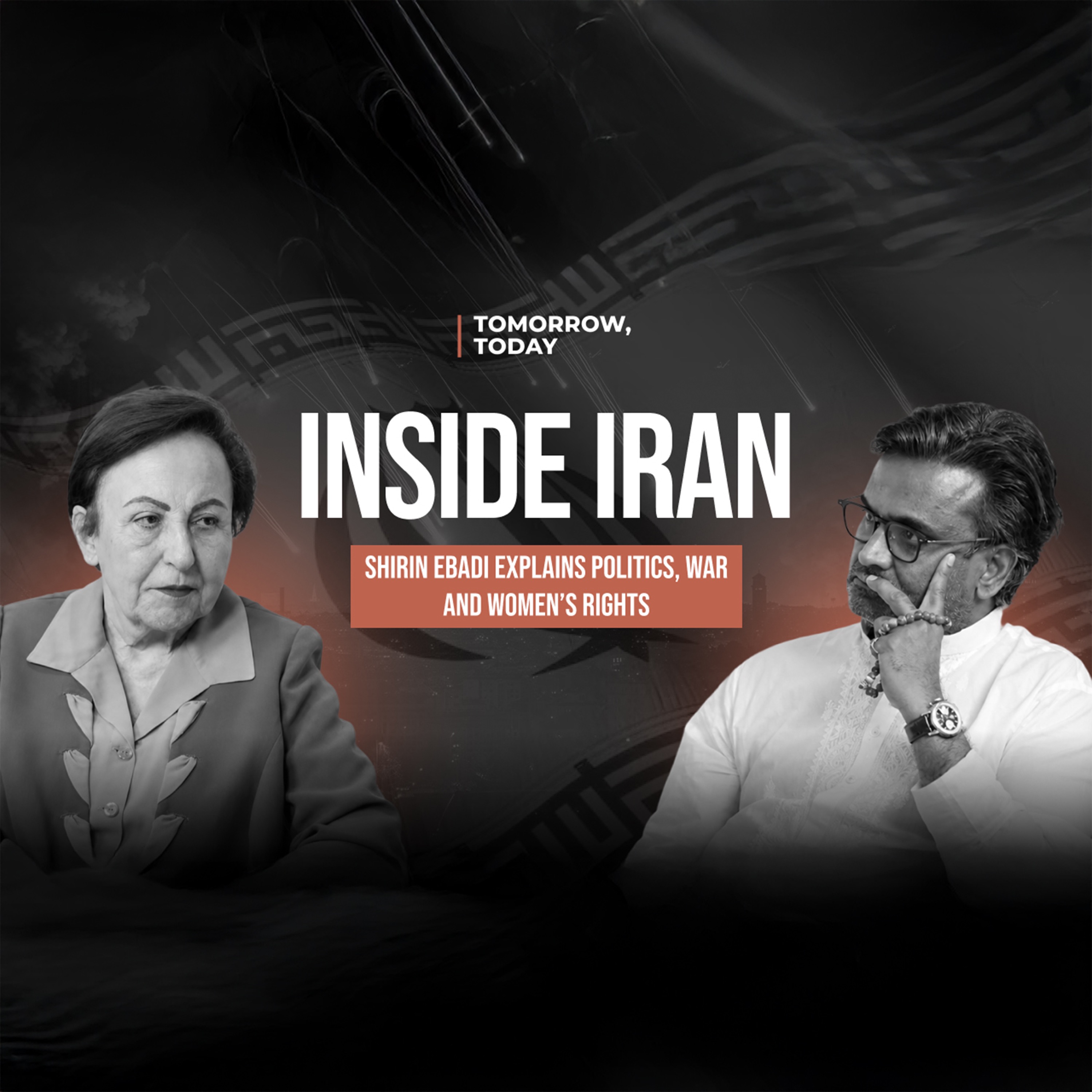
It's the honor of my life to actually have Dr. Shireen Ibadi. We're going to dig deeper into what makes Iran, Iran, your journey and what is happening today. And I'm excited to have you, and it's a true honor to have you here.
- [00:21]
B
I think as a society now, we've learned a good lesson. As Dr. Ebodi was just saying, that you, when these two go together, a true disaster comes.
- [00:35]
A
It would have been an incredible feeling for you to become the first female judge of Iran, something that the country never represented, like the first female judge.
- [00:50]
C
So I very much hope that if we do, when we have a transitional period, there will be very little bloodshed.
- [01:03]
A
I don't want them to think that Iran is bad. I want them to know that the Iranian rulers are bad.
- [01:27]
C
Women cannot be judges. I became a clerk in the very court that I used to preside over. This war did not actually begin in 2026. It actually started in 1979 with the revolution in IR.
- [02:00]
A
It would have been an incredible feeling for you to become the first female judge of Iran, Nobel Laureate, and an amazing, courageous person who's actually fought for Iran and the future of Iran for all your life.
- [02:21]
C
They confiscated all my properties. They seized my assets. They arrested my husband and my sister. And they did that in a bid to silence me. I refused to be silenced.
- [02:37]
A
I don't want them to think that Iran is bad. I want them to know that the Iranian rulers are bad.
- [02:45]
C
I was also imprisoned. I made a mistake. A woman's life is considered to be worth half that of a man.
- [03:08]
A
Well, welcome to the other episode of Like Tomorrow Today with Shekhar Natarajan. It's my. It's my. The honor of my life to actually have Dr. Shireen Ebadi. You are an inspirational person for the world, not just for me. The first judge for Iran, like, female judge of Iran, Nobel laureate, and an amazing, courageous person who's actually fought for Iran and the future of Iran for all your life. It's an incredible honor to have you, ma'. Am. It's a true blessing. And I'm really, really excited about this episode. I'm also excited to have Reema here along with you. And also, like Mariam, who's going to be helping interpret their conversation, we're going to dig deeper into what makes Iran, Iran, your journey, your aspirations for Iran, and, like, you know, what is happening today. So we want to unpack all of this. We're going to keep it very conversational. And I'm excited to have you and It's a. It's a true honor to have you here.
- [05:12]
C
Iran, unfortunately, is in the throes of a war that has inflicted a great deal of damage on the country. Unlike any war, many civilians are killed. So I hope that this war will end very soon. This is a war that is between three countries, the Islamic Republic, the United States and Israel. And there is something I need to point out, that this war did not actually begin in 2026. It actually started in 1979 with the Revolution in Iran, with the Islamic Revolution, as a result of which an Islamic Republic was established. Since its inception, the Islamic Republic adopted a foreign policy. And this official foreign policy was that Israel must be annihilated and the forces of the United States must be evicted from the region. And it used all its resources to achieve that objective. This foreign policy, although it was very wrong, it was endured by the United States and Israel until the Islamic Republic decided to embark on enriching uranium up to 60% and banning the IAEA inspectors from visiting the nuclear sites. And that is why currently we see this war and Iran is being damaged and civilians are being killed.
- [07:12]
A
It's a sorry state for Iran as a country. But I want to unwind to you as a person. Right, you had a desire to be the judge. Your father was a professor of law in Those days, in 1970s, when no one thought about becoming a judge, you pursued that ambition. And you are probably one of the pioneers in the country, like, who became a judge during those days. And you were also part of the revolution itself that actually hoped for a better Society in 76, 77, 78. So can you explain us your early days, your journey, like, your desire to actually, like, seek law enforcement and basically the profession that you went after and why did you choose that?
- [08:10]
C
I was born in a Muslim family, yet a progressive one. And my family, they were practicing Muslims, yet as I said, they were very open minded, they were very progressive. As a result, I was sent to a Zoroastrian school. And my father's reasoning was that this is a good school, it's near our home. There is no reason why you should go to an Islamic one because their religion is just as good as our religion is. That is how I was raised. And as a result, later on in life, I developed very good and close relations with religious minorities in Iran. And I represented many of them in court, whereas there were many lawyers who were too scared to do that, who refused to do that at home. Thanks to my father, I developed an interest in law because he was a Law professor. So I went to law school. And since even as a child, justice was very important for me, I decided upon completion of law school, to become a judge. And I loved my job, and I progressed and was good at my job until the 1979 Islamic Revolution when they said, based on Islamic law, women cannot be judges. So myself and other fellow female judges, we had to. We were demoted, and I became a clerk in the very court that I used to preside over. As a result, I decided, I'm not going to do that. I decided to retire and focus my work on defending victims of human rights violation. I started my law firm, and after the 2003 Nobel Peace Prize was awarded to me, I decided to invest the money from the Nobel Peace Prize. I used part of it to set up an ngo, Defenders of Human Rights center, that was the name of my ngo. And I also established my LOU firm. And I invested the money from the Nobel Peace Prize, and I used the interest from the investment from an Iranian bank where I invested it to defend political prisoners pro bono and also to run my NGO. And gradually, I persuaded some 30 other lawyers to join my NGO, and they all worked pro bono to defend victims of human rights violation. I was also imprisoned because I had filed a complaint that against the head of the police force. Until 2009, I carried on with my work once I was released from prison. But in 2009, the security forces raided my office. They closed down my law firm and my ngo. Many of my colleagues were arrested. But I happened to be in Spain at the time, attending a conference where I was giving a speech. And that is why I decided it would be better for me to stay out of Iran. I'd be of greater benefit to my people because of the censorship in the country. And that way I could make sure that the voices of the Iranian people were heard through me. So I gave many speeches, I granted interviews, I wrote books. And while I was out of Iran, the regime, they confiscated all my properties, they seized my assets, they closed my bank account. And because they couldn't get me, they arrested my husband and my sister. And they did that in a bid to silence me. But I refused to be silenced. And I have decided to continue with my work until democracy returns to Iran. And I have no right to become tired, to retire, and to lose hope, because the people need me. And I have to carry on until democracy is established in the country.
- [13:24]
A
Wow, Fantastic. Like, it's, like, so inspiring. It's like. Like, it just moves you when you hear this. And truly, truly blessed you Know to, to know you. So before the Islamic Revolution, you participated in the revolution like you know, where the monarchy was there and basically like, you know, you felt like you needed a better tomorrow. What was the promise? What was like Iran at that time before the revolution? And what were you like, expecting that the revolution would bring?
- [14:09]
C
Rahmangala Rohan Y. Piribhut the leader of the revolution at the time was this old cleric. His name was Khomeini. Before coming to Iran from exile, he'd made some very good, very sensible comments and we were all impressed by that. He used to say, when we have a revolution, there will be freedom. Even communists, women, they will all be free. And his slogan for the revolution was freedom and independence. And he said, an Islamic Republic will make sure that these two are realized. I never thought at the time that a high ranking cleric and a leader would resort to lies. But soon the penny dropped. I realized that all these were nothing but lies. Two months into the victory of the Islamic Revolution, they announced on Iranian radio and television that all female who worked in government institutions had to cover their hair. They had to wear at least a headscarf. That was very unexpected for all of us. So since 8th of March 1979 when this announcement was made, I separated my path from that of the Islamic Republic. Since then, the Islamic Republic adopted one after another, discriminatory laws against women. To highlight these laws, I wrote 11 books about every one of these legislations. But then I decided it's not sufficient for me just to write books and give speeches. I have to acknowledge that by having participated in the coming of the Islamic revolution, I made a mistake. So I acknowledged my mistake. I said I am sorry that I was one of the million strong people who staged a revolution against the monarchy. And I had the courage to acknowledge that mistake. And I think it's very important if people have the courage to do so, to show remorse, to say that they've made a mistake. And I can say that today hardly anyone in Iran supports the regime, but sadly, many don't have the courage to say that they made a mistake by taking part in this revolution. So I very much hope that by acknowledging that mistake, we can all go towards the path that we are all seeking, which is freedom and independence.
- [17:28]
A
So the, the revolution was against the monarchy and then the Islamic. So it was supposed to be Republic of Iran and then it became Islamic Republic of Iran. Right. So which one is better, the monarchy or the republic? The Islamic Republic.
- [18:00]
C
The Iranian people have seen the result of an Islamic Republic and what has happened to the country. So they are calling for a democratic and secular government. They want religion and state to be separated from one another so that religious sentiments are not exploited in any way. Now, such a democratic and secular government could be within the framework of a monarchy or it could be within the framework of a republic. As for monarchies, there are examples of successful monarchies like Norway or Denmark where people are free, yet they have monarchy. Or there are many good examples of republics such as France and Germany. And people in these countries are very satisfied with life in general. And the exact opposite could also happen. There are republics that undermine the rights of the people. And such republics have even become hereditary. For instance, if you remember Hafez Assad in Syria and who handed over the republic to his son Bashar Al Assad. Or the same applies to Azerbaijan, the Aliyevsky one after the other. Or even in our neighborhood we had Saddam Hussein and that was supposed to be a republic. So many such examples of corrupt leadership, be it monarchy or republic, have also existed, as have good ones. So it is not the type of government that takes over that's important, but the conduct of, of such a government. And it is with such a belief that I am continuing my work and I'm hoping for such a government now. The people of Iran, throughout their protests in the past 40 years or so, have always called for the return of the former Crown Prince Reza Pahlavi, who left Iran when his father was deposed and he was only 18 years old. But since then, although he's lived outside the country, he's devoted his life to Iran. And I remember that when we had an eight year war with Iraq, that was 1982, 1988, a former crown Prince who'd had pilot training even offered to, to go to Iran and fight Iraq in fighter jets. But of course the regime would not accept that. So that is why the Iranian people are fond of him. They call his name and they demand that he returns to Iran. And he has recently pitched his policy and he has made it very clear that when or if he returns to Iran, it will be to lead a transitional period in order to ensure that justice is administered in Iran. For 48 years, the Iranian people have been repressed by the regime. They have been executed, they've been killed and justice has been totally ignored. And that is why Ereza has decided to come and lead this transitional period. And to that end, I have been appointed to lead a transitional justice committee to draft regulations for such a future government. And Reza Pahlavi has called for a referendum under the auspices of the United Nations. And it's then up to the people to decide whether they want a republic or a monarchy. And Reza Pahlavi has made it very clear that should the people opt for a republic rather than monarchy, he will not interfere. Because his intention is not to have power, but to have to pave the way for a transition to a democratic and secular state. And that is why I accepted this position. And we work, we have set up a good team, and I hope that this transition period is realized, and I hope there'll be very little bloodshed until then. And then once we do have such a referendum, the people will be free to determine their own faith, whatever they choose it to be. It is only then that if I'm still alive, I will allow myself to retire, stay at home, rest, and read books.
- [23:44]
A
In Iran. Yes. So it would have been an incredible feeling for you to become the first female judge of Iran, and it would have been devastating for you to become the clerk in the same office. So tell me, like, what was going on in your mind at that time? Like. Like that whole, you know, the excitement of being there and being able to help people like women like yourself, courageous women who needed help or anyone who needed help, and you representing something that the country never represented, like the first female judge, and then being stripped away from all of that and say, like, hey, like, you know, you become the clerk in the same court, that's humiliating. I wouldn't. Like, I don't know how to take that, you know, So I don't know, like, how you were able to cope with that. Like, what I would call humiliation. So to say. She understands English, she only wants to learn. She only wants to let the world know that, like, the language is so beautiful. I love, like, what she's doing.
- [25:21]
C
I remember once when I was a judge and there was a court case. During my court case, one of the court clerks approached me and handed me a letter. Before even opening that letter, I knew what the content of it was going to be, because I'd already heard people talking about how women were going to be dismissed, female judges were going to be dismissed. My first thought was the young Iranian girls studying with such hopes at law school in Iran, hoping to become judges one day. So I felt really sorry for them, more than feeling sorry for myself. And I have to mention that I am a mother to two daughters, one of whom has decided to follow the same path as myself, and she studied law. And both my daughters, as a matter of fact, were born after I was demoted from my position as A judge. But the fact that I have two daughters has motivated me even more to defend women and to fight tirelessly against the discriminatory laws against women in the country. I will elaborate on these laws later on in this interview because I was always worried that when my daughters grow up, they might turn around and say to me, mother, as a judge, as a lawyer, what did you do to help us? Why have they imposed such discriminatory laws on us women in the country? So the fact that I had two daughters motivated me even more to fight against these laws. And I have to point out that these laws did not stem from Islam, but they actually stem from the thinking of some superstitious old cleric who was a dictator, and that was his interpretation of the religion. We could be Muslims, but we don't have to be fanatics like they were. As I was brought up in my father's house and later on with my husband, we were never fanatics. I remember when, the day I was marrying my husband, I said to him, look, I'm a progressive, yet practicing Muslim. And my husband said, well, you know, I'm an atheist. I don't believe in God. So we came to compromise. We said, look, we are always going to have differences of view on many subjects, but never on the subject of religion, because we realize that we have to have respect for one another's religious or lack of religious beliefs. Look, there are Muslim countries that are progressive, and I've been to some of these countries like Malaysia or Indonesia. And then there are Muslim countries like Iran, where they sever the limbs of a thief, they stone people to death, they flog them for drinking alcohol. Even in Saudi Arabia, I've heard it recently, they're allowing alcohol to be served in many cities, with the exception, of course, Riyadh and Mecca, but not in Iran. In Iran, if someone is caught drinking alcohol, he or she is subjected to at least 80 lashes. And that is why I have highlighted these discriminatory laws in my books, because it is imperative that these laws have to be changed.
- [29:41]
A
Tell me more about the laws.
- [29:47]
C
The Islamic Republic adopted such discriminatory laws, some of which I'm going to highlight. One is laws based on gender discrimination, according to which, for instance, a woman's life is considered to be worth half that of a man. For instance, if my brother and I happen to have been in a car accident, the court awards my brother twice as much in compensation from the driver than to myself, because I'm considered to be half worth that of my brother. In other instances, a testimony of two Women in a court of law is tantamount to the testimony of one man. Then there is a law of inheritance. When the girls under the Islamic Republic inherit half as much as their brothers do, and a wife only inherits one eighth of her deceased husband's wealth, whereas the same does not apply to the husband, of course, he inherits everything. In other example, a man is allowed to have legally four or five wives and he can divorce any of them without giving any justification at any time he chooses to do so. Whereas it's almost impossible for a woman to be granted a divorce. Child marriage legally at the beginning of the Islamic Revolution was nine years old. A nine year old girl was considered to be of a legal age to get married. But thanks to myself and fellow feminists, we put up a fight. We fought tirelessly against this law and we managed to raise it to 13, which is still very low, but it's better than 9. And I have to point out that before the Islamic Revolution, the legal age for girls to get married was. And I also have to point out that laws were much, much better and much fairer before the 1979 Islamic Revolution. In fact, women in Iran won the right to vote and enter parliament long before women in Switzerland did. So the Islamic Revolution deprived us women of all and adopted series of discriminatory laws. And as a result, Iranian women have been at the forefront of every protest that has been staged in the country for the past four decades because they are the ones who have been subjected to much greater discrimination. Our culture has always been very different to religion. Over 50% of students at universities in Iran are girls. Then there is also religious discrimination based on the constitution of the Islamic Republic. Shiite Islam is the official religion. And there are several other religions which have also been recognized by the constitution, which comprise of other Islamic sects such as the Sunnis, the Jewish religion, Zoroastrians and Christians. But there are some religious minorities that are banned from participating in variety of fields in the country and they've even been barred from access to education. And one of the biggest religious minorities in Iran is the Bahai sect, which is a very old religion in Iran, like Zoroastrian religion and it is 200 years old. And there are some 350,000 Baha' is that live in Iran and they've been deprived of all their rights. They're not allowed to work in government offices and they're not allowed to even have jobs in bakeries or work as a hairdresser because the Muslim regime says that they are filthy. They have Dirty hands. They cannot serve Muslims. They're not allowed to go to university, so they've been deprived of all their rights. There are also other religious minorities, not as big as the Bahai sects, but they're also being discriminated against and being repressed, such as Yaresan and Yazidis. And we have some of them in Iran, unless they resort to lying and pretending that they have converted to Islam. And many refuse to do that, especially the Baha'. Is. They refuse to say they've become Muslims because they are Baha' Is and they're proud of it. And as a result, we have many Baha' Is who are currently behind bars. And I have been representing some of them. And they have been imprisoned because the government has falsely accused them of espionage. And even there is even discrimination between those of a Shiite faith and other Muslim sects such as the Sunnis. When it comes to officially recognized religions such as Christianity, there is even greater discrimination. Although they are recognized by the Constitution, they're still being discriminated against. For instance, when it comes to inheritance, if a Christian father happens to have three sons passes away, naturally the three sons should get equal share of the inheritance. However, if one of these sons happens to have converted to Islam, the whole inheritance goes to him and not to the other two. And there are also some posts in Iran that only a Shiite Muslim is allowed to have. For instance, a judge has to be Shiite, president has to be Shiite, the head of the judiciary has to be Shiite. So Sunnis and other Islamic religions cannot have such occupations. In a nutshell, the Iranian people are tired of these discriminations and they want this to be changed. This is not our culture. This is not the Iranian culture. As I said, I went to a Zoroastrian school, but now Zoroastrians are considered to be of lower rank than Muslims. And anyone who converts from their from Islam to another religion is meted out a very heavy punishment, including the death penalty. This is wrong.
- [38:14]
A
So I have Rima here who is a Baha', I, right? And she lost her uncle after the revolution, you know, so. And I know having lived in Hyderabad, like I grew up with a lot of friends with Farsi friends, right? Like, you know, so most of the restaurants that like, are very popular in Hyderabad and secondary all happen to be Iranian restaurants. There's Irani chai, Lukmi biryani. Like, these are like the most popular things that you find, like the, the influence of the Nizam culture, right? So I have always known the Iranian people to Be far richer in culture, right? Like, you know, for all the people who are listening, like, I don't want them to think that Iran is bad. I want, like, them to know that the Iranian rulers are bad, right? So for that, like, you know, like, if I step back and think about, like, like, what makes Iran Iran, you know, it is like the women of courage, like, you know, who can come out and like, protest, right? Like Tahira, like in 1840, right, who actually was the person who actually, like, you know, called for emancipation of women or it is like people like yourself. So for all those people like it, like, you know, I feel like, very sad. Like, you know, this is. These are the rules that they have to live by. So how do you feel about that dreamer? Like, you know, like, you. You've been the recipient of that, like, and I also, like, you also brought up like, you know, the question of Riza Palwi. His daughter was also exiled and she died, right? Like, she died in, like, you know, in. In la, in unknown circumstances. So I. There is so much pain and grief. But, like, the country is like, so rich in culture, poetry, like, the. The essence of the culture itself. Like, you know, what they stand for. So diverse, and yet, like, you know, like a handful of people can come and screw it all up for us. That makes me, like, wonder, like, where we are in a society, you know, like, are we living in like 19, 1600s or 1500s or what? I don't even know how to, like, you know, even think about all these things. Things, because my friends, like, you know, like, I know my friend, like, you know, his name is Zubin Wakel, Zoroastrian Farsi guy. He's one of the most famous fashion designers in Hyderabad. He went to school with me. Like, we were like, like benchmates. And I've been surrounded by a lot of farsis. So, like, it's. It's incredible to know, like, in a lot of good Indian businessmen are also farsis, by the way. So it's just ironic. Like, you know, the country is one way and like, and I don't like. So what do you have to tell to those people? Like, what is Iran really about? And I would like to hear all of you as well chime in on this.
- [41:43]
C
You are totally right. The culture of the Iranian people is totally different to what the government is practicing in Iran. As a result, there have been such social tensions in the country. Their laws are not compatible with our rich culture. And I believe you were mentioned, what you mentioned was the sister of Reza Pahlavi who died. Because Reza Pahlavi, the former Crown Prince who currently resides in the United States, has three daughters. Three daughters, and they're all alive. But he lost his sister and his brother, unfortunately, when the deposed Shah of Iran ended up in exile, that had tragic impact on his children, especially his youngest daughter and his youngest son, both of whom committed suicide. So the only children he still has, and they're still alive, is a current former Crown prince, Reza Pahlavi, who is about 65 years old and his slightly younger sister. And the reason the Iranian people are calling on him to return to the country is because his lifestyle is a lot more compatible with the culture of Iran than the lifestyle propagated by the Iranian regime, by the Islamic Republic regime. When they see the former Crown Prince dancing with his daughter, when they see him wearing a tie, they much prefer that to some turban wearing mullah who always looks angry. So that was not our culture. And in a nutshell, I have to stress that in 1979, all of us, we committed mass suicide by this revolution. And I again express how remorseful I am and how sorry I am that I took part in that revolution. It was nothing but mass suicide.
- [44:24]
B
I think it's one of the learning processes that take place, place in history, because let's not forget that back in the 19th century, Iran had an amazing encounter with principles that actually came to change the world. And principles of equality between men and women, the importance of education, the importance of religion not being mixed with politics. I think as a society now, we've learned a good lesson. As Dr. Ebodi was just saying, that when these two go together, a true disaster comes. Let's not forget that that same society participated in that referendum, and it was a majority vote for this very system. And I think with the years seeing what different groups were suffering, the Iranian society became incredibly sensitive to the suffering of others. And they realized that we can't be indifferent to what happens to the Kurds, we can't be indifferent to what happens to women, to the Baha', Is, to political prisoners. So now collectively, the society has come to this, to this, to the fact that, no, there's something, something went wrong in all of this. And definitely that's why it's a society that asks for a system that is secular, for example, such a big learning.
- [45:53]
A
So what is the life of a
- [45:54]
B
Baha' I in Iran?
- [45:58]
A
If everything is banned, you cannot access anything. How do they live? What do they eat? What happens to them?
- [46:05]
B
Well, as Dr. Ebadi was saying, that the Baha' Is are deprived of their rights, of their civil rights. Yes.
- [46:15]
C
So.
- [46:16]
A
And it's not a small number, it's 300,000.
- [46:18]
B
300, yeah. It's a big community. It kept itself united. And as she said that they did not recount, they did not say, oh, we don't believe. I think that kind of firmness that we talked about before, women also had that kind of firmness. They believed in something. They really were committed to that belief and that's why they led a movement. So the same thing the Baha' I communities is showing to the world. Deprived of their education, of their, you know, to go to university and to pursue higher education, they're deprived of working for government institutions from universities, schools, and
- [47:00]
A
can they have access to regular jobs?
- [47:03]
B
Yeah. All of the Baha' Is have private, like they have their own private work or jobs. They work, I don't know, like they have their own shops or businesses. But I think the Iranian regime tried to keep them separate. As Dr. Ebadi was saying, and before I was mentioning to you that Mahabhar, one of the things that she says is that when she was in prison, many prisoners thought of her as someone filthy, you know, and she said that they would even keep their plates and their clothes separate. They would hang their clothes in the prison, and she said that they would hang their clothes separate from her and Fariba and the other Bahai who was imprisoned with her because they really believed that these people are filthy. It's the government, it's the regime that actually made the Iranian society feel like this. But now it's completely different, that those people are the ones that are defending the rights of the Baha', Is, you see. So it's beautiful. Now the whole, I think society has become more united and they realize really that if a part of our society is suffering, we can't prosper, we can't be.
- [48:16]
A
Well, yeah, so when you got like your Nobel Prize, like you did not talk about law, you talk about Rumi, you talked about Hafiz, you talk about Saad, like, why did you do that?
- [48:36]
C
At the Nobel Peace Prize ceremony, they'd given me very limited time to speak, so I couldn't mention all of this to the international community. I had very limited time. That is why I chose to highlight Iranian culture, speak of Cyrus the Great, speak of Rumi. I wanted the world to hear about 3,000 year old Iranian civilization. And I wanted the world not to judge us based on the theocracy that is now over 47 years old. Iranian women are not these hijab clad women, female protesters, pro government female protesters that you see in various video footages that are being propagated by the regime. Again, I stress, do not judge us based on the over four decades of rule by this regime. Judge us based on the very rich Iranian culture.
- [49:53]
A
So, Nobel Prize, they stole that from you. They went and like took it from your bank box and then they got your husband on television under duress, like, tell me that image.
- [50:14]
C
As I noted earlier, they confiscated all my assets, even the house that I'd inherited from my father. They seized that. But my husband, whose properties and whose bank account was not seized, used to have a bank safety deposit box. And I'd kept my gold Nobel medal and some memorabilia in that safety deposit box in the bank. But they put pressure on him that they wanted that box opened. But thanks to efforts by the Nobel Institute and international protests, they allowed me to keep my Nobel medal, although they took everything else. And as a result, shortly afterwards, after all the harassment that he was subjected to, my husband developed some mental problems which later ended up in him suffering from dementia. Now, as for why my husband went on television and made the so called confession berating me is because when he was imprisoned, they put a lot of pressure on him. And I remember when he was released from prison, the first thing he did was to phone me. And he burst into tears during that phone call. And he said, look, the regime set a honey trap for me and they got this female sex worker to join me in a room, they gave us alcohol. And suddenly one of the adjoining doors in this apartment was opened and this security agent, who happened to have been one of my past interrogators, by the way, appeared with a camera crew and took a film of my husband and this sex worker. So it shows that it was all premeditated. Then they handcuffed my husband, they flogged him for having consumed alcohol, and then they put him on trial in what they called a court. But it was a sham trial, naturally. And they said to him, look, you've committed adultery. And you know, according to Islam, the punishment for adultery could be stoning to death. And by the way, he'd been kept in solitary confinement all the time. Then they started playing good cop, bad cop. And a good cop turned round to my husband and said, there is a solution. We will let you go. You'll be free. Because it's your wife who is a problem, because we want him to shut her mouth and he refuses to do that. She's constantly going around the world and speaking against us and that's the only way we can release you and give you your freedom. If you go on TV and agree to speak against your wife. My husband, under pressure, reluctantly agreed to do so. So they gave him a handwritten confession from which he started reading. And they broadcast this so called confession by my husband at 8:30 in the evening, which is when they broadcast the most popular news program. And the announcer said, before the so called confession of my husband was broadcast, he introduced the program by saying, you all know Shireen Ebadi as your idol, as your hero, but she has many other faces, listen to what her husband has to say. And then they got my husband to read from this written note that they had in which they'd written that, yes, my wife is very aggressive. She has harassed me constantly. She's not really a human rights activist, she only pretends to be one. She's a traitor. She's under the control of foreign forces. And to make sure that this program was, they broadcast it again the following evening to make sure that all Iranians had seen it. And I knew that the intelligence ministry in Iran recruits sex workers. I'd heard that from two other clients who had suffered the same fate as my husband. So it wasn't anything new. And when my husband tearfully told me about what had happened, I said to him, don't worry, I understand. And I have always viewed my husband as a victim of a conspiracy, never as an adulterer. When he was released, they didn't let him be free. Once a week, they would summon him, they would interrogate him, and they would say to him, your wife is still talking against us. She's refusing to be silent. And he kept begging them and saying, look, I have no influence over my wife. So eventually my husband phoned me and said, look, I think it would be best for us to separate from one another. And I agreed. So I gave him permission to apply for divorce so that we'd be separated. So it was an amicable separation. And shortly afterwards, as I said, my husband developed mental problems. He started suffering from dementia. I remember I consulted many psychiatrists and I said, could this be caused by the concussion that he had received when he was subjected to torture in prison? Or was it just Alzheimer because of his old age? Well, we never know. But thankfully, since my husband's bank accounts have not been seized by the government, he still has money for round the clock nursing care. And his two sisters are also in Iran keeping an eye on him. But he's suffering from Alzheimer. This case proves how the Iranian regime has Been exploiting religion and the hypocrisy of it all. On the one hand, they recruit sex workers, on the other, they say adultery is punishment by stoning to death. And unfortunately, it is what it is. But I never view myself as a victim, despite having lost everything. What is important is that I'm alive, I am active, and until the day I die, I am going to fight against this government and their atrocities. And I will never be sorry for having lost all my belongings. That is not important.
- [58:26]
A
So what does exile feel like for you? You've been asked to leave your own country.
- [58:38]
C
Physically, yes, I live in exile. But mentally and emotionally I still live in Iran. I have never actually felt that I am out of Iran. Hence my devotion to Iran, to improving the life of the people in Iran. And my work is focused on that. But I am grateful to my host country for having given me a passport and the fact that I can live here. I am grateful for that. But I always see myself as an Iranian. My homeland will always be Iran. My spirit, my soul, my heart is in Iran and will always be there.
- [59:25]
A
So you are a practicing Muslim and like there's nowhere in Quran which says you got to submit and surrender. Like, where did all of this come from?
- [59:43]
C
Yes, the Quran does mention surrender, but Islam, like all other faiths, has different interpretations. It depends on how it is interpreted. It is, look at Christianity for instance. In Europe you have churches that accept same sex marriages, whereas you have some that do not accept it. And the same applies to Islam and its interpretation in various Islamic countries. When in the Quran it's mentioned that you have to surrender, it is not about surrendering to the will of oppressors, but it is surrendering to God and the divine fate. When for instance, somebody in an accident breaks a leg, that person doesn't have to just say, I will not do anything about it. This is what God had wanted for me and remain inactive. He can join parallel, he become paralympian, he will carry on despite the deformity. And that is how I see the word surrender in the Quran. And that is what I how I live. I've accepted my circumstances, I've accepted that I live in exile and that is where I have to work and live. But my wish always is and will always remain returning to my homeland, Iran.
- [61:37]
A
So you, you say that Iran will be independent one day. It's not like a hope, you say it will. It's a strong statement. What gives you that conviction?
- [61:56]
C
It's the people of Iran that have given me this belief, this Confidence that we will achieve independence. It is the people who will determine their own fate. Shortly after the revolution, the people realized that they had been deceived and they started staging protest after protest. And every protest was subjected to repression by the government, massive crackdowns. Yet people continued their protests, even at times underground opposition and protests. So this continued protest by the people is what has given me strength and the belief that this regime will be toppled and the situation will change. And I understand that if we have a transitional period, there will be some bloodshed that is inevitable. But so far it has been the government that has been mainly responsible for the bloodshed due to its constant crackdowns. The Iranian people are peace loving people. And every time they have staged protests, they have been unarmed, they have been doing so peacefully. So I very much hope that if we do, when we have a transitional period, there will be very little bloodshed because of the fact that our people are peace loving.
- [63:46]
A
So when you, there is so much pain, humility and like suffering that was inflicted on you, they stripped you out of your dignity, your, you know, your title, your, all of those things. And let's say, like you know, the government were to get toppled and you are going back, would you forgive all those people? Would you reconcile?
- [64:21]
C
I myself for my part, would forgive those who worked for this government. I've even forgiven them now. I think bearing a grudge would only harm myself. So in this draft legislation that we are working on for this transitional period, we have said that decisions should be made by the people. But I have envisaged a few points in this draft legislation which include ending the death penalty. There will no longer be death penalty in the country, nor will there be any physical torture. And working for the government is not a crime per se, and only those who have been stained in the blood of the people would be punished. Trials nevertheless have to be fair and based on human rights standards. There should be open trials. They should all have access to, to lawyers. And their lawyers should be given sufficient time to consult their case files. And those who are guilty, if they come forward of their own volition and show remorse, their punishment will be mitigated. But, and if a plaintiff forgives some guilty party, sure they will be released. If not, yes, they will get mitigated punishment, because I don't believe retaliation is the answer. I think we have to come to a compromise and we have to come to reconciliation rather than being vindictive. And we have to ensure that the laws and justice has been administrate, administered based on the law.
- [66:42]
A
So I'll ask you some simple one line questions for which you need like one line, like one answer, one word answer, two word answers. Maybe. What is the one word describes Iran that no headline has ever captured?
- [66:59]
C
The word Iran in the Persian language is actually a name of a woman. So Iran to me is a woman who is beautiful and who is very progressive.
- [67:16]
A
Very beautiful. What is that one dish that makes you homesick?
- [67:30]
C
First of all, there are many dishes, excellent Persian restaurants and I love food. Times tik. What I miss is tadik. Now tadik is the crunchy rice that the bottom of the rice. Only Iranians understand what tadik is. Y. I am I. I could invite you one day to a place where you can get decent study.
- [68:22]
A
Sure, I will come for sure. So rumi, hafiz or saadi? If you had to pick only one, who would you pick?
- [68:33]
C
Rumi.
- [68:36]
A
Rumi. So if there is one word, there is like in Persian that has no translation, what is that one word? I'm sure iran.
- [68:53]
C
Look, I'm not a linguist, so it's not an easy question for me to answer.
- [68:59]
A
That's good. That's good enough. So what is the best piece of advice that you got from another human rights defender?
- [69:10]
C
Look, when I started working as an activist, there weren't many activists around. So there were few people who could actually give me advice. So I had to experience myself. I made errors and learned from my mistakes. So that is how I. That was the advice myself that I followed.
- [69:38]
A
Very good. Beautiful. So I know that they persecuted you, the regime, but they are probably persecuting you because they are afraid of you. When did you know that they were afraid of you?
- [69:55]
C
Months. I remember I was lawyer in a case that involved a husband and wife who'd been arrested by Intelligence Ministry officials. And I was representing them. And as I was the lawyer, I was looking at case files. And in the case file I noticed that the interrogator had mentioned that the next person on his list who was going to be killed was Shireen Abadi. And he'd been asked to coordinate that my assassination with the Intelligence Ministry. And it appears that the agent had asked the Intelligence Ministry permission for assassinating me. And the Intelligence Minister, the then Intelligence Minister said, approved of that, but said, it is Ramadan at the moment, wait till Ramadan and the fasting month of Ramadan is over. But before that happened, there was some internal differences among these government officials and there were fallouts among them. And so as a result, that very minister who had approved my assassination was removed from that position. But instead, he was promoted. He was promoted to become a Friday prayer leader and a representative of the Supreme Leader. So to all intents and purposes, he led a prayer that was attended by the people every Friday. So the people were following a murderer during the Friday prayers.
- [72:08]
A
So my mother used to say, even a bad guy does something good. Is there one thing that Islamic Republic got right?
- [72:44]
C
It's a very difficult question, because to answer that, I need to have lived among the Islamic Republic officials, and I never have. So I haven't been able to see if there was even one good thing that they'd done.
- [73:00]
A
Got it. Ms. Shireen Ibadi. It's an absolute honor to actually talk to you. And the world needs more of you. And I think the world created you for Iran. And your determination and your dedication to Iran is unlike matched. So it's a true honor. And I'm really blessed to even have spent this time with with you. You are like God's blessing. Truly, you are.
- [73:32]
C
Thank you.
- [73:33]
A
Thank you. That doesn't need translation.
- [73:38]
C
She understood you. Yeah. I generally understand when people speak English to me, but because I want to be precise in my answers, I want to make sure that I have understood every question correctly. Hence the need for interpretation of the question.
- [74:08]
A
And you speak very beautiful Persian. I understood every word of it. Thank you. So, can I ask you something? It's Indian tradition to seek blessings. Is it okay if I take your blessing?
- [74:31]
C
Sorry?
- [74:32]
A
It's Indian tradition to take blessings.
- [74:34]
C
How do you take blessings?
- [74:36]
A
Just take blessings.
- [74:54]
C
I prefer to embrace you.
- [74:59]
A
But still, I will take him your blessings.
- [75:10]
C
Sa.