← Tomorrow, Today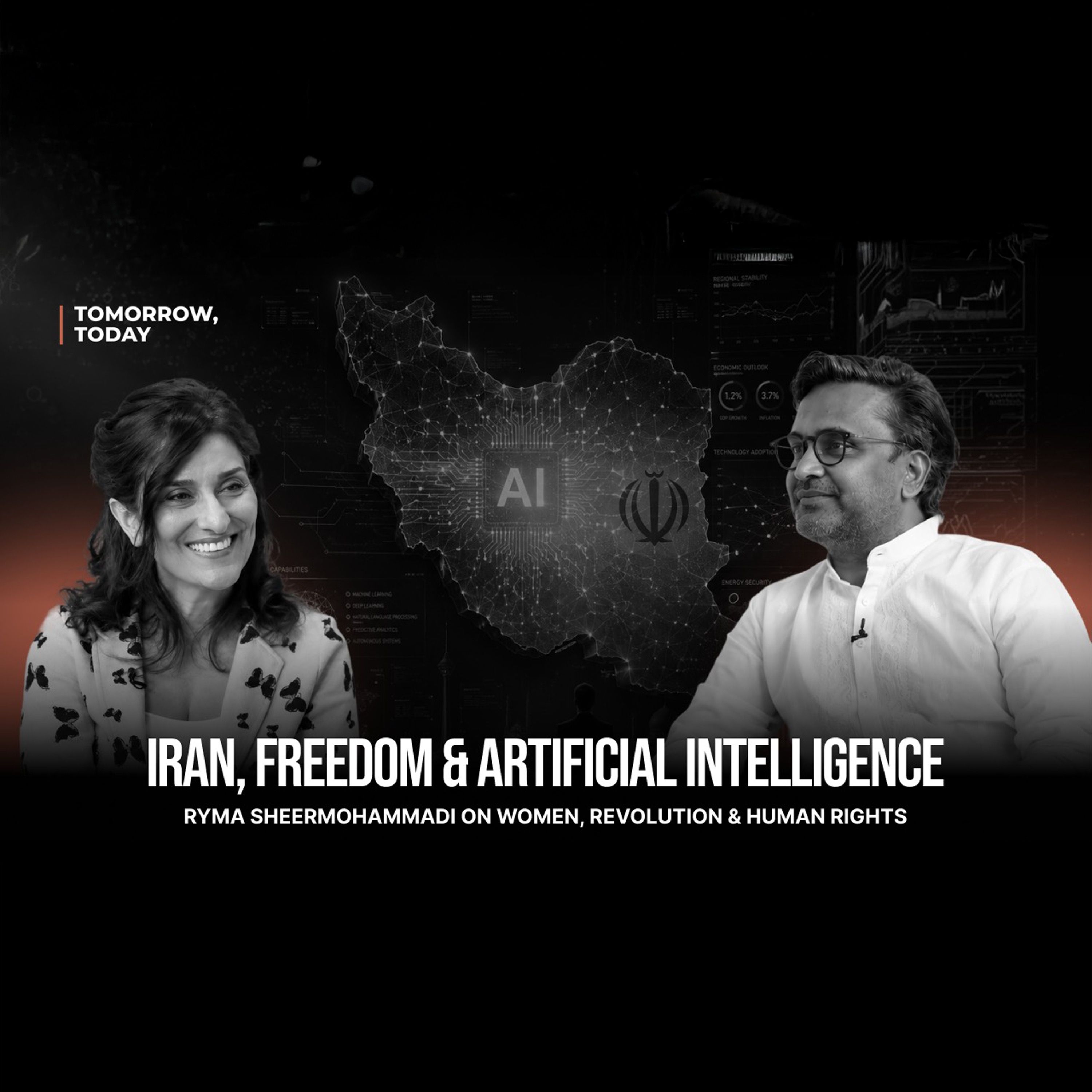
Tomorrow, Today
Iran Beyond Headlines: Women’s Freedom, Human Rights, AI & The Future of Humanity | Ryma Sheermohammadi
01:57:22
What is the real Iran beyond the headlines? In one of the most emotional and thought-provoking episodes of the Tomorrow Today Show, Shekhar Natarajan sits down with Iranian human rights advocate and global activist Ryma Sheermohammadi for a powerful conversation on freedom, women’s rights, identity, culture, technology, and the future of humanity. From the Iranian Revolution to modern-day protests, Ryma shares deeply personal stories about growing up between Iran and Saudi Arabia, witnessing political oppression, fighting for human dignity, and becoming a voice for justice across the world. This episode explores: • The truth about Iran beyond media narratives • Women’s freedom before and after the Revolution • Human rights, censorship, and resistance movements • The persecution of minorities and activists • Iranian culture, poetry, hospitality, food, and identity • Exile, displacement, and emotional resilience • AI, governance, and the future of society • Why empathy, education,...
Loading summary
Transcript310 lines
- [00:00]
A
I find artificial intelligence as one of these deadly weapons. Deadly weapons, if not trained well, is going to be more destructive than the Islamic Republic of Iran.
- [00:17]
B
You can kill me, but you will never stop the emancipation of women.
- [00:29]
A
The role of technology in the future, like how it can actually shape, shape governance, shape prosperity of nations.
- [00:39]
B
I remember a sentence that moved me back then. It says, the youth, youth can move the world.
- [00:50]
A
How different is UK from Iran? Right. How different is US from Iran? Because we are so worried about everything around us.
- [01:13]
B
You can kill me, but you will never stop the emancipation of women.
- [01:22]
A
What is the real like Iran without the Islamic Republic?
- [01:27]
B
Iran is a language of poetry, of culture, of humor, of beautiful food, as you just said. Yes. Beautiful instruments, music. So it's, as you said, it's really a country full of beauty.
- [01:44]
A
And what happened to Iran?
- [01:46]
B
The revolution in Iran, which was not supposed to be an Islamic revolution. Women never thought that the first thing would be actually that you should be wearing a veil to go out in the street. Absolutely. Language is. We see it right now. We are witnessing the power of discourse.
- [02:09]
A
How different is UK from Iran? Right. How different is US from Iran?
- [02:13]
B
Obviously, artificial intelligence does its own thing.
- [02:20]
A
What is the first thing you would
- [02:21]
B
do when you speak? You exercise true freedom.
- [02:39]
A
Welcome to another episode of Tomorrow Today with Shekhar Natarajan. I'm incredibly honored to have absolutely a phenomenal brain and a mind. Reema Shir Mohammadi. She's, she's a human rights, like, you know, she sits on United Council, Human Rights Council. She's a translator, she's an interpreter. But more than all of that, she's a great human being who's actually been active in the pursuit, you know, in the pursuit of freedom for the Iranians. And, like, I so welcome you, Rima. Like, this is like an incredible honor. I've been wanting to talk to you for almost like three and a half months now. Three and a half months. Like, I know, like the day I saw your profile, I reached out to your contact and I've been trying to, like, chase you down for three and a half months. Such a strong woman. Such a strong woman. I've been surrounded by my. My grandmother who was very strong. My mother was very strong. My wife and I draw, like, you know, great energy from all of them. And people need, like, voices like yourself in the world. So it's an incredible honor to host you and I would love to get to know you. We would love to get to know, like, what's happening in Iran right now. The role of technology in the Future, like, how it can actually shape governance, shape prosperity of nations. What. What is your thought on that? And, like, you know, we'll keep it very conversational.
- [04:05]
B
Sure. Thank you so much. I'm very, very happy to have this conversation with you.
- [04:10]
A
Absolutely. Great. So let's go back to the origins. Like, you know, so you were actually born in Saudi Arabia, in Taif, close to Makkah.
- [04:21]
B
Yes.
- [04:21]
A
Right. Your. Your parents are from Baha', I. Right. Like, you know, they follow the Baha' I religion and, you know, they are Iranian by descent. And then you grew up in Saudi Arabia, moved to, you know, Barcelona at the age 15. So tell me, like, when someone asks you, what's your country, what is it?
- [04:47]
B
Oh, it's the world, really. It's the world. I was absolutely. I was able to live such different cultures. You see Saudi Arabia back in the 70s and how things were and how society itself, full of really love and wanting to progress and to change, and yet because of political reasons, they would look with suspicious eyes towards the Iranians there, and vice versa. Also, the Iranians who would come from Iran, they would always have this kind of sarcastic behavior and attitude towards the Saudis. And I was in the middle of all of that. I was very lucky to be in a. In a family that believed in unity of mankind. It's one of the main principles of the Baha' I faith. And so I was always told that, look how much beauty each culture gives us. And of course, Spain was exactly, you know, a different cultural. It was a cultural shock when we got there for me, because I was really immersed in the Saudi culture and going back and forth to Iran, of course, to visit the family. So really, where is my country? I think it's really the world. And the more one travels, the more one realizes that there is so much to fall in love with in each culture in the world. So we're all part of that.
- [06:15]
A
But what does your heart carry? Like, you know, who are you as a person? Like, you know, there's something like, you know, you always have an identity of who you are. Right. Like, you know, irrespective of where you belong.
- [06:25]
B
I think I'm Iranian. I always say that. I say I am Iranian. Born in Saudi and living in Spain. Yeah, I think I've answered yes, I live in Spain. Of course. I love the Spanish culture, and I owe it. I owe so much to that culture.
- [06:46]
A
So growing up, like, as a kid, like, you know, in Saudi Arabia and watching, like, what is going on in Iran, and I think the revolution happened, like, you know, at the age, like, you know, six or seven. Six or seven. So what was it like? You know, what were your parents telling you? Like, what was going on in their mind? What were they hoping for? And what happened to Iran?
- [07:07]
B
We were actually in Iran at the time when Khomeini came back. And I remember we were just visiting family, like any immigrant family that goes back home for the kids to kind of bond with the. With the relatives and the family members. And I remember the upheaval in the street. And my mom would say, don't worry, you know, this will calm down. And it's just a few protests here and there. And I remember very vividly my aunt saying that we have to book your tickets because she used to work for the Iranian airline. And she said, I think the airport will close, so we have to book your ticket so you can go back to Saudi. So I remember that moment as a child, seeing so much confusion around me, and also realizing as I would see my parents saying goodbye, that with the way they were reacting, that most probably there won't be any coming back to Iran for now. So it was a very, very dramatic moment.
- [08:11]
A
But what were people trying to achieve through the revolution?
- [08:14]
B
They were actually very, very unhappy with the monarchy that actually had given the Iranian society within its. The context of modernizing the country, which was.
- [08:26]
A
Can you walk us through the history of Iran? Like, yeah, because it's fascinating.
- [08:30]
B
Right.
- [08:30]
A
You know, I just wanted to understand more about the culture. Like, you know, the. What were the struggles? Like. Like, what was the structure like, in place? Why were people revolting? What were they hoping for? Like, because people don't understand. They only see the news. They don't understand, like, the evolution.
- [08:49]
B
Yeah, well, you know, we had the white revolution, which was the revolution of the famous Reza Shah. His idea was to bring modernism to Iran. And so he was the one who said that women should not come out in the street veiled. And you see the contrast now. Yes. So he said, no, this is a modern country. If a woman doesn't want to be seen and she wants to cover herself, she can stay at home. So that was a big clash for a society that was extremely traditional, very religious. And so that kind of clashed with the religious class right from the beginning. And of course, to make sure that power is there later on. At the time of the last shah or king in Iran, the secret service was really, really oppressing any kind of criticism towards the monarchy. And so many groups suffered the consequences of that. There was absolutely no way for the Iranians to have A political party, for example, or even to voice their criticism towards what's happening with the monarchy. And they would see that although there was a middle class that was quite prosperous, but any criticism towards, you know, poverty in many areas of the country or the way the king was ruling would mean that you would be taken to jail immediately. And so we had a lot of executions at that time, a lot of imprisonment.
- [10:33]
A
This is all pre revolution.
- [10:35]
B
This is all pre revolution. Of course, it's nothing in comparison to what came out after the revolution. But so he would look with certain, he would look for groups and communities within the country with ideas that would socially revolutionize the country. Like for example, in that case, the Baha' Is of Iran with ideas that talked about equality between men and women, the importance of education. They actually started the first schools for women in Iran.
- [11:08]
A
The Bahinians.
- [11:09]
B
Yeah. And the top hospital was actually the first. I was reading yesterday a very good article about one of the first hospitals that were, that had women doctors actually was also from the Baha' I community. And so he would look at them,
- [11:25]
A
this huge, beautiful temple. Baha' I temple in India.
- [11:30]
B
Yes, it's beautiful.
- [11:31]
A
Lots that like, you know, like long time ago, I think it was like 90, 97 maybe, or no, 2000. Me and my mom.
- [11:38]
B
Oh, oh, what a lovely visit.
- [11:40]
A
It's a lovely visit.
- [11:41]
B
It's very nice.
- [11:42]
A
So I remember like, you know, I actually like, you know, like finishing up my engineering. Like, you know, there was a program, they were trying to retain all the, the students in India, like, who went to second year university, not the first year university. Okay. To go to the first year university and they don't have to brain drain. And so, so there was a huge, so they, they created a program called young scientists or whatever it is. And so, and my mom, like, you know, she never had education in her life and for her, like, you know, me going to iit, like was her dream. So I said like, okay, like I could not go to iit, but I'll go to this program. You can follow me.
- [12:18]
B
How wonderful. Wow.
- [12:20]
A
And so, so I took her to, to Kanpur and then like on the way back we actually stopped in Delhi and we visited that temple. A beautiful, gorgeous temple.
- [12:30]
B
It's like the Lotus temple. Yes. Yeah, yeah, I, I, I, I see the photo and I just see the atmosphere there. It's really so neat. Everyone says that.
- [12:40]
A
So peaceful. It's so beautiful. Exquisite.
- [12:43]
B
Yeah. Oh, I'm very happy. Actually. Everyone who's been there says, talks about how peaceful. So he drew on that but at the same time he was really scared that this competition or rivality, you know, or the fear of losing power, which was something that the religious leaders, they actually created that fear in him. So he would also. He was also behind the destruction of the Baha' I National center in, in Tehran. So I'm saying that. So at the same time there were contradictions there. Exactly. Full of contradictions.
- [13:20]
A
And then to open the society, but like, you know, don't give them like too much. Yeah, like, you know, take the Baha' I hell, but like, you know, like, don't let them.
- [13:29]
B
Yeah, be careful because maybe they seek power. Although he knew also that the Baha'. Is, one of the principles of the Baha' I faith is that there's no intervention in any political parties or, you know, so there's nothing involved with power is in the agenda of the Baha', I, so to say, or the principles of the Baha' I faith. But so society was like part of society was content, but the great majority were not content. And so you had this mixture of the left wing, you know, in Iran at that time, who were always in prison or would come out of prison and they would again get themselves in trouble and be back in prison. And also the religious sector of the country, they actually were the ones who led the revolution in Iran, which was not supposed to be an Islamic revolution, it was just a revolution, like a republic.
- [14:26]
A
To become a republic.
- [14:26]
B
To become a republic, exactly. But then when Khomeini came back, the idea was that this will be a governed by everyone who actually helped the revolution to succeed. And so it was the opposite.
- [14:44]
A
So who helped Khomeini?
- [14:46]
B
Well, the US was very interested in seeing things happening.
- [14:52]
A
Why were there like, why was us like, you know, for taking out the Shah and like replacing it with.
- [14:57]
B
Because the Shah, in many of his discourses, he would say, we are the powerful country, number one powerful country in this region, and we want, we are independent. We have, you know, basically his discourse and his policy was always about Iran is great and we are going to be, we are the superpower here in this region and we decide everything that is best for us as a country. So I think that independence was not looked at with good eyes from the US and from France, because we can't forget that Khomeini obviously was taken by the French government. He lived there when he was sent on, when he was expelled from Iran. So he was in France and the help, with the aid of the French government and the U.S. the revolution took place. And I think at that time when there was this mass executions of the west, of the left in Iran, none of these countries said anything about it. And the power was taken completely by the religious leaders in Iran, by Khomeini and everyone who was following him, basically. So that's why the left movement in Iran was really oppressed, severely oppressed.
- [16:30]
A
So there were women, there was left, there was religious leaders.
- [16:33]
B
And then what happened to women and
- [16:35]
A
what happened to the religious leaders?
- [16:36]
B
Yeah, so the women never thought that, you know, the first thing would be actually that you should be wearing a veil, a veil to go out in the street, or that they will pass all these laws that will limit them in every sense of the word.
- [16:48]
A
But would they not like have already anticipated that? Because the Sharia law says that like we should not. And the religious leaders are part of this.
- [16:55]
B
And so I think there was absolutely no way that this could happen because they came from a system or a society in which personal freedom was there. At the time of the monarchy, personal freedom was there. Women would decide everything they want. In fact, I always say that they
- [17:13]
A
presume that that is going to continue and then.
- [17:14]
B
Yeah, because just it's a change of
- [17:16]
A
power to like a structure.
- [17:18]
B
Exactly. The generation of my mom and even my grandmother, they were educated, they would go to university and they would go with other men free, and they could decide where they want to travel to. They wouldn't need any consent from a male in the household. So it was absolutely out of question that that will happen. We had women judges, we had women working in any sector or any area of profession that you can think of. So it was really out of question that they would be limited in such a way. In fact, the only 8th of March, the International Day of Women that was celebrated so to say in Iran, was the first one after the revolution in which women came out to protest against these laws. So it's amazing, that was the first protest after the revolution. And so after that the Islamic Republic of Iran was established. So that Islamic part of it was not. What was everyone thinking about when they went out on the streets?
- [18:22]
A
So they went from one ditch to another.
- [18:24]
B
Yes, yes. And from there on it went down in every sense of the word. I mean, socially, politically, economically, everything was absolutely controlled.
- [18:39]
A
What is very fascinating about what you're saying is, see, I had the privilege of two things, okay? I had the privilege of living in Hyderabad, which is south central of India, ruled by the Nizams, right? And growing up as a kid, right, the influence of, so Hyderabad, and second, Rabad, Sikandarabad is Like, and like, you know, obviously the colonization made it like, second rabad.
- [19:12]
B
Yes, yes. Everything changed.
- [19:14]
A
Everything changes. Like, you know, Mumbai become Bombay. Like, you know, all those things. Right. So because they could not pronounce, like, those names, so, like, it became like second Rabad. Like, you know, it's like Sikandarabad. Sikandar.
- [19:27]
B
Yeah.
- [19:28]
A
So, so basically, like, there was a strong Persian influence.
- [19:35]
B
Yeah.
- [19:35]
A
And an Iranian influence. So in fact, like, you know, if you go talk to anyone in India, you know, obviously, like, you know, butter chicken.
- [19:45]
B
Yeah.
- [19:46]
A
Is a. Is a famous dish made by Indians here. Like, it never originated in India. It just like, became popular here by someone here. But biryani is the next, like, you know, most favorite dish of every Indian. In fact, like, I remember on December 25 and January 30, like January 1 or December 31, the most like, ordered dish in India is a biryani. Like, you know, like, you could, you could, you could get the stats now with like, you know, with all of the crowdsource provide companies, and that was the single most biggest order dish in the world, like, in India. Okay. And that actually goes back to the roots of Iran.
- [20:28]
B
Yes.
- [20:28]
A
Like, you know, we. We still have Iranian chai. Like, Nilofer Cafe is like one of the, like, you know, the most famous cafes in Paradise.
- [20:37]
B
Yes.
- [20:38]
A
Is also run by Rani. Like, there's so many beautiful restaurants. Lukmi is what we used to eat when I was a kid. You know, I carry this all the time because, like, growing up, like, my. My best friends are all Muslims.
- [20:52]
B
Yeah.
- [20:53]
A
And, like, you know, like, everyone that I know of, like, had some kind of heritage. And so I saw that side of like, you know, the, the richness of the culture. Right.
- [21:03]
B
Yeah.
- [21:03]
A
Obviously, like, you know, I was impacted by Nizam. Like, my family was dislocated by Nizam, you know, from. From the business and the wealth and other things. So. But, like, leaving that aside, then I go to United States and some of the best minds, like, intellectually, kids who have a very strong math background come from Tehran University.
- [21:27]
B
Yes.
- [21:28]
A
Like, it's such a beautiful country. Such a beautiful country. Right. Like, and, oh, by, like, by whatever it happened, like, you know, it just, just went down, like, you know, like, you know, like a house of cards. So I want, I want you to explain what is the real, like, Iran without the Islamic, like, you know, republic, what would it look like? Yeah, I just want you to imagine that and tell us, like, the heritage of it, the beauty of the country, the resources of the country, like, what makes it so unique. The people, like, you know, amazing people like you, like, you are the most strongest women that I've seen. Including, like, you know, someone we're going to talk to. Shireeni Bhaadi. Right. Where does that courage come from? Like, how do you guys get produced there?
- [22:11]
B
It's a country. It's a diverse country where people at times struggle with the diversity of its own people. We can't forget the ethnic diversity in the country, the religious background of people. We have Jewish, Iranians, Christians, Muslims, Baha', is, we have Kurds, we have Arabs, we have Turks, we have Azaris. Sorry. So this diversity is there. And I think the language of the streets of Iran is a language of poetry, of culture, of humor, of beautiful food, as you just said. Yes. Beautiful instruments, music. So as you said, it's really a country full of beauty. And I also mean with diversity. Beauty, not only beauty when it comes to poetry and cuisine. And, you know, what we know externally as something beautiful, but deep inside, it comes and it emerges from diverse cultures mingling with each other and saying, it's okay, you're not like me. But we have so much to share with each other. And it's a creative and a spiritual thing that takes place, a process that takes place there. And the result of it is what you and me see. We see it in the beautiful poetry of Hafiz and Sa'di. We see it in the language of people in the street. That is a language of hospitality and generosity. Even if they don't have any money or anything material to offer you, they will never turn you back. And we see it in the way. In the languages that are there, the mother tongue of so many of these ethnic groups that although they have been controlled not to use it in order to make them all look like each other, all speak. Speak Farsi. They managed to keep it with such solid, you know, solidarity among them, among them. So I think.
- [24:10]
A
So how about different cultures, like, coexisting in a country which has such strong laws? Like, you know, I'm sure, like. Like when I. When I think about the Baha' I culture. Right. Like, you know, the head of Baha' I went to Israel and died.
- [24:22]
B
Yes.
- [24:22]
A
Right. So, like, there's always a suspicion that, like, you know, he's an Israeli spy.
- [24:27]
B
Yeah, yeah. And amazingly enough, yeah, those who claim that they have no knowledge of history or they decide not to look at history because at the time that Bahaullah, the founder of the Baha' I faith, was. He was sent. He was sent on exile to, at that time, it was Palestine and it was under the rule of the Ottoman Empire and the Israeli state was not even established. It was, that came after that. And the reason the Baha' I world center is in Israel is because Bahaullah and together with his family were sent there. They were forced to leave Iran and they were sent country to another country. And finally back then it was in Palestine. And they decided that we will send them to the worst prison cell, which was the fortress of Akka. So they will die there basically. And it will disappear, this religious movement, it will disappear. They were thinking back then. And so now the Iranian government accuses the Baha', Is, but now we see that they accuse everyone. You know. Now if you connect to Internet in Iran, a friend of mine, he managed to get through to me on WhatsApp today and I was really worried about him. He's a very, very well known activist in Iran. He was imprisoned four times and he told me, rima, it's even. They just told us that it's an accusation if you connect to Internet. So if you go beyond the national Internet, like because in Iran there's a national Internet and if you try to connect with the international Internet, it's considered a crime. Yeah, it's a crime. And surely you are spying for Israel or for the US and so imagine it's like in the same country where that was okay just a month ago. Yeah. Now it's like spying for Israel. So thank God the Iranians are aware of these games. But back then in the 80s, when my mom's cousin was executed because he was a Baha', I, many Iranians were thinking, well, maybe these people are really spies. You know, there was not this mentality of no, but these people are like us. How can they be spies? You can't even come close to the area where these public government institutions are there, let alone get inside of it and get some documents and send it to Israel, you know, so he was executed and before that he was asked to renounce his religion. They told him, if you sign a paper and say that you're not member of this religion, we will let you go. And so he said no, like many people back then and even now, and he was executed. And so the reason why I'm sharing all of this, these are all diverse elements that makes a society very rich. The way of memory is very important because we were talking about that before. It carries our present life, it nurtures it. And all of these things has nurtured the society that you see now. And you're able to Appreciate its diversity and beauty.
- [27:52]
A
So, you know, obviously, like, that, like, is a troubling time of transition, and I'm so sorry for your loss. You know, losing. When, like, you know, stuff comes very close to home, it becomes much more sobering for a lot of people. Otherwise, like, you know, we just, like, say, great. Like, you know, we just, like, fall into the frenzy of, like, what we hear and see. So I'm really sorry for what happened, and I'm sure, like, you are not the person who's alone in this room or, like, in the world.
- [28:24]
B
Yeah.
- [28:25]
A
And there's so many sacrifices of so many women, so many, like, men there who have wanted to be free. Free and, like, wanted to have an expression of thought, now feel like, like, you know, completely isolated from the world.
- [28:39]
B
Yeah.
- [28:40]
A
And. But the courage they exhibit every day gives everyone the hope.
- [28:46]
B
Yeah.
- [28:46]
A
You know, so. So now. So, Rima, like, you moved to Barcelona.
- [28:53]
B
Yeah.
- [28:54]
A
Like, at the age 15.
- [28:55]
B
Yeah.
- [28:56]
A
Okay. So when you. When you went from. When you saw what had happened to your own personal family, your uncle, the close relatives that you had, and the revolution that was going on, what came as a surprise? And then, like, you. You are now in, like, Saudi, you know, it's. It's a much beautiful, much more better culture. Beautiful culture. And then you're experiencing Barcelona, which is completely open. Right. Like, different altogether. So what was this transition of freedom in your mind? Like, what did it feel like? You know, did you feel anything? Like, when you went from all these different places to, like, to Barcelona?
- [29:37]
B
I think everything kind of started to earn a new. Get a new meaning for me, because partly the idea of being in a society where you're free to express yourself, you're even encouraged to speak out and to say what you think.
- [29:54]
A
But did you do that automatically when you went there, or did it take time for you to adjust?
- [29:59]
B
It took time. Of course, there was language limitation. But also, I remember in Saudi, many times I would kind of ask questions at my classroom. And back then the education system was different. So there was always like, why are you asking these questions? You know, what are you trying to get at? Or so it was like this subtle way of saying, why are you doing? Why? It wasn't even like, you can't ask questions. It was like, why are you asking? And that kind of had such a way on me as a child, because partly it was curiosity and partly because I would hear at home things that were like, okay, you are limited when you go out in the street, but remember, you have to be educated as a woman. Because this is what we believe in, and there's no way out of it. Education is very important. But then I would see a different reality at school. I would see that kids my age, 10, 11, they would be married. They would actually. They would have someone asking them for marriage, and they would drop from school. Brilliant girls that were with me studying. And so I saw this contrast. And for me, getting to, you know, country like Spain, where everyone was so free to be whatever really they wanted.
- [31:20]
A
Who made the choice for you?
- [31:22]
B
I think it was. It was definitely was partly when my mom passed away was a year after we arrived to Spain. And there is this saying in Persian that I really like. It says that when parents go away, like when they die, the kids are the next to be seen by the world. And I find it very interesting because she was always very active. Her idea originally when she got married to my father, is that we have to go to a country where we feel useful. We can't stay in Iran because it's too comfortable to stay there. She was telling my dad back in the 60s. And so in a way, she kind of forced him to go to the Arab countries. And she immediately thought of giving classes to teach women how to sew and how to be able to earn their living. And every summer she would go to Pakistan and to India to continue collaborating with other organizations. So she was very involved in all of that. But she died very. She passed away very young. She was 46. And I think. Thank you. And I think her life was really an inspiration that, okay, I have to do something here, you know? And I think my dad also encouraged that a lot. He would always say, you have to learn to speak in public. You have to be able to speak and know that you will make mistakes and that it's okay to make mistakes and you will be criticized and you shouldn't be offended. You should see it as a learning process. So I learned that. And I also, you know, you mingle with a society, you try to find your way around it with the loss that you have at that age. And also, I think the activities of the Baha' I community, which was and still is very focused towards the youth and empowering the youth. I remember a sentence that moved me back then. It says, the youth can move the world. And so that was very empowering for me at that age. Yes.
- [33:36]
A
And then you moved. You relocated all by yourself.
- [33:40]
B
It was with the family. Yeah, it was with the family. And, yeah, I stayed there. One of my sisters left to Canada, and the other one stayed with us. Until she moved here to the uk. And basically I went through education, and from there on I went to the UK to study. And then at that time, the Eastern countries opened up, and I was fascinated to go and experience the change in a country. I was really. And my dad kept telling me, you have to finish your studies and then you decide what you want to do. I said, no, but this will change. So I have to go to Prague. I have to see what's happening. So I moved there for a year and a half, and I was absolutely.
- [34:23]
A
To the Czech Republic.
- [34:24]
B
To the Czech Republic? Yes. Back then it was Czechoslovakia.
- [34:27]
A
Czechoslovakia.
- [34:28]
B
And I was able to see how these two countries, they separated, but so peacefully. It's the heritage of a wonderful leader like Vaclav Havel. He managed these amazing leaders that some countries had. They really, really set an example. Those two countries, they suffer. Can you think of that in the context of the world we are living in right now? They separated. I didn't even see a Czech insulting a Slovak about this, you know, or telling them, oh, you're separatist, you're this and that. They separated. Isn't that amazing? History is really. Is fascinating. And then I was 19. I was absolutely blown away. Yeah. I said, this is. This is incredible. These young people my age, they know so much about music, about literature, about arts, and I'm trying to figure out my way around, and they are like. They're having these conversations. So it was a very good thing. So good for the youth to move. Yeah. To go and see other countries.
- [35:31]
A
And so that made you, like. So then you became a linguist.
- [35:36]
B
Yes, I decided. Yes. That I will go into that. My dad encouraged me a lot. They said, oh, you know, all these languages, you have to go into translation.
- [35:43]
A
So what all languages do you know?
- [35:45]
B
So I speak Arabic, of course, because it was the first language I learned. And then I speak Farsi because my dad was very strict about teaching. Yes. History and poetry. That we have to know how to read it and to recite it and all of that. And of course, Spanish and English. Yeah, got it. Yes.
- [36:01]
A
So tell me, like, the transition you made from being a linguist to becoming a translator and a voice for people, that's a very, like, profound change.
- [36:14]
B
Yes.
- [36:14]
A
I don't know, like, many people do that.
- [36:16]
B
Yeah. It kind of emerges, you know, all of these experiences of. And how did that happen, changing countries? I actually. I did translation studies and I decided to specialize in interpretation because I thought it will allow me to move from one subject to another and be exposed to different Stories and different contexts. And it just seems to be more challenging than translating papers and books. And so I started working for different organizations. It was back in 2004 where I met for the first time Dr. Ebodi. She had been Nobel Peace Prize laureate, 2003, a year. A year before meeting. And that was really nice. And at that time, I was in contact with some activists inside Iran, already working with them on different projects and trying to.
- [37:18]
A
But how did you go into that? What triggered the movement?
- [37:23]
B
I met some through work. Again, I met some. You see, I always say that to many of my friends. I say you have two options when you think about work. You can think about work as something that obviously it brings income for you. It's very important. And you can think of it as something that starts and ends. But if you look at it with a humanistic eye. I don't know if this is the right word, but if you look at it, when it comes to human resources and the people that you meet, what moves them? Who are they? What's their story? You connect in a different way, and then you see what else you can contribute with. So you do your work. You do it to the best of your ability, of course, but then a whole world is behind each one of us. So I was able to meet very outstanding people through work. I would translate. I met Abbas Kiarostami, who became a very good friend of mine. And he became a friend because I saw him not only as a client or someone I was translating for, I saw him as a human being. And through these connections, it's what. It helped me to kind of connect with Iran. And it was the same story with Dr. Ebadi. I didn't see her as someone who was famous. I saw the human aspect of her. And I would always tell her, if there's anything that you think I can do, I am here. And work is work. But there is a whole aspect of all of us that yearns for service, for service, to serve others. And so through that, all these network opened up for me in Iran and also in some of the Gulf countries, but more in Iran. And so I would always.
- [39:19]
A
But how would people access you from Iran?
- [39:22]
B
Well, back then it was okay. We would contact through phone and phone calls and we would email each other. And so there was actually no restriction or no. No problems, like nothing to do with the current situation that we are going through now. And yes, please. I wouldn't. Yeah, thank you.
- [39:44]
A
This is not as good as the Irani tea, but Masala tea.
- [39:48]
B
No, it's Lovely. It looks very good. It looks very good. Masala tea is the best. It's actually very nice and warm. It's, like, very nurturing.
- [39:59]
A
That's what I do.
- [40:00]
B
So, yes. So that opened up a new area for me where activism, activism, activism took over. And the stories of people, what moved people, what is it that they produce and they're proud of. Work, again is work. You can be proud, of course, which is wonderful, of some of your work that you do. But some people, they just work for work, you know, and some people are proud of the work that they do, which helps to improve other people's lives. And so I was interested in that, in that part of it, and I think I never realized that that will open many doors for me to connect with the Iranian culture, with the Iranian society, with the grassroots, really. There's stories and the traumas that exist in. In our.
- [40:56]
A
And so people were allowed to share all of those stories.
- [40:59]
B
Yes, because they would kind of talk to me. They would say, and I would tell them, oh, it would be nice if we could work this together. Next time when you come to Spain or next time when we travel together. This aspect of your work is really interesting. So it was like a bit of consultancy, a bit of. But the most important thing for me was that both I and them, we knew that we are just moved by these stories, and we want the world to know about these stories. And that's what really matters at the end of the day, because that is what makes them.
- [41:41]
A
And these were not censored or anything?
- [41:43]
B
No, it was not censored. Obviously. It was not like, really that open, like, oh, you know, come over to Iran and we do this program project together, or we can. It was all social. It was nothing political. It was nothing against the government or, you know, was nothing out of.
- [42:00]
A
But what were people talking about, like, when they were, like, working with, for
- [42:03]
B
example, social things like women movement campaigns? What can this group of women in Zahedan, for example, in Baluchistan, which is a very, very poor area in the country, what they could do. Who can go and teach these women something to do to earn a living? How can we connect with the Iranians, of the Arab Iranians who live in the south of Iran? You know, the language. Can you help us translate these documents? So we tell the women in that area, for example, about health issues, how to take care of themselves, how to take care of the kids. We don't have funds. Can you do this? Yeah. Pro bono? Yes, why not? So you kind of collaborate, but in These collaborations, you understand, and you gain so much knowledge and so much feeling about what's going on in the grassroots. So I would go in this sessions of the Human Rights Council or other organizations I worked for as an interpreter, and I would listen to even some of the talks. And I would think, this is so far away from the reality that I am. That I see. Yes. And I just see it because I am there. I don't expect to do, to get anything out of it. I'm just there as a tool. I'm there as someone who could, maybe, could help.
- [43:35]
A
So how does it feel like to be an activist from outside versus being from within?
- [43:41]
B
Well, you know. You know how it is when it comes to the power of those who think, okay, this is us here, we live here. You are the privileged one who live outside, you know, and so by that it means you have nothing to say if you can help us and you
- [43:58]
A
have nothing to lose.
- [43:59]
B
And you have. Yeah, well, you have. Exactly. You have nothing to lose. But when it comes to. For those who kind of maybe seek power in any way, not power only. Thank you. Not only power. Power in getting somewhere with what you want to do, but power in getting your name out there, becoming famous. Maybe it's not worth it to get involved in all of these things, because at the end of the day, of course, those who are inside are the protagonists. For me, it was always very natural, and it still is very natural.
- [44:32]
A
Does your heart not crave to be the activist from within?
- [44:35]
B
Oh, I would love to. What prevents you from going back? I went 20 years ago to Iran and I decided I would never go back. I went only for 10 days to visit relatives and to see them and to visit some friends. Back then, Abbas Kiarostami was alive. We had beautiful two encounters. Dr. Abadi was there. I met other friends too, activists who were living there. But it was really, really, it was very difficult. I could feel that I was being controlled all the time and really going to Iran and having the feeling that, will I be able to leave? Would they make up a story as I go to the airport and say, oh, you stay here, your passport is with us.
- [45:24]
A
Oh, that could happen too.
- [45:25]
B
That could happen because it happened to many people. It's still happening. Just lately, a friend went to Iran to visit her parents, Roya Sabet. She went to visit both her parents who were dying and she lived in UAE. She was detained. She is serving 10 years sentence now.
- [45:50]
A
Why?
- [45:51]
B
Because she's a Baha'. I. And they told her, why did you come back? What do you want here? She's like, my parents are dying. I want to see them before they die. Why did you come now? And they just make up. Make up stories. 10 years in a prison. Yeah. Her family is in UAE. She had nothing to do with Iran. She was having just a normal family life in uae. And her parents, because they were dying. She wanted to do what any human being would do, which is pay a last visit.
- [46:25]
A
And she got detained.
- [46:26]
B
She got detained. And she actually sent a heartbreaking file from prison.
- [46:32]
A
Yeah. I wanted to talk to you about that. Mawanshak Sabad. So tell me, like, her. Like, what she did. Like, you know, I was reading about her while I was, like, trying to research on you.
- [46:41]
B
Yeah.
- [46:42]
A
Like that she would actually write poems.
- [46:46]
B
Oh, Mahrash Sawbet. Yes.
- [46:48]
A
And. And basically she would. She would, like, you know, have that, like, sent out.
- [46:54]
B
Yes. Jacket. Yeah, in the.
- [46:56]
A
In the jacket. And basically, like, you know, you. You got all of those and then started translating them into poems. So tell me, like, you know, what was. It's when you read that kind of thing, right. Like, you know, that people don't have the privilege and the freedom to do something as simple as expressing themselves and the thoughts, and they have to smuggle their thoughts out of the prison.
- [47:18]
B
Yeah.
- [47:18]
A
It's like. It's like. And talking to, like, you know, people in prison cells, like, I don't know, like, how you do that all day long.
- [47:24]
B
Yeah. It's amazing. You know, the name of the. The other lady is also Sabat. Yeah. As I was hearing you, I said. I said, oh, yes, it's. I'm not surprised that, you know, you brought up Mahvash. Now name. She's an awesome.
- [47:40]
A
Both of them are in prison, actually.
- [47:41]
B
Strong women, amazing women. That surname is very special. Mahvaj Sobet. She's absolutely amazing. Her own story is like a memory, is the history, almost the history of what a Baha' I goes through in that country.
- [47:57]
A
Can you tell, like, everyone what, like, it's a fascinating story.
- [48:00]
B
Well, the amazing. She says she shares a story, which I really think those who listen to this podcast would absolutely love. You know, as a child, she said that her parents had the choice to go and live in a city. And her father, like my mom, he decided that they would go to a rural area, to a small town to be. To live there with the people. And she said that I was a child, and I realized one day my dad said, this is not possible, that we live in a place where, after dark, no one dares to go outside because there's no electricity, there's no light in the street. And so she said, my dad started asking all his friends to help out with this project of buying, of buying, you know, something that will allow this little village have light at night so the kids can come out and it feels safe for them. So he got money from all his friends and they bought this generator. And she said it was really thanks to what he did that that village had light and people were able to come out in the street and have something. And she said after the revolution, the clergyman from a near village, he said that, you know, you have to go after that family and expel them from this village. They are dangerous. And people believed him. You see people when there is no knowledge to look, when there's no. There's no this, when you don't have this conscious of looking at people's action and just you follow the words of someone. They listened to him. And she said, we were basically attacked in the street. And my father told my mom we should take the kids and leave immediately. So she said, one day my dad brought light to that village and another day we were expelled from that village. And she came to Tehran. She lost her job because after the revolution they said all the Baha' Is in public institutions should be expelled from their work because they're Baha'. Is. So she lost the work that. The job that she loved, which was as a school teacher. And then years later, when they realized in the Baha' I community, because it's the biggest minority in the country, they realized that they have to do something for their young people because they are not allowed to go to public and private schools, to the universities to study. And education is very important for the Baha' I community. They got together all these professors who lost their jobs, they got together and they created like a Baha' I inspired institution that was a university that offered four careers for the Baha' I youth. So you see how creative you become under pressure, under pressure. And she was one of the people who taught in that Higher education for Higher Institute of Higher Education, I think it's the name of. And so Baha' I Institute for Higher Education is the name of the university. So she was detained together with the other members of a group of a council that was in charge of taking care of the Baha' I community's needs. For example, if someone dies, they go and help the family to arrange their paperwork or any kind of difficulties that the Baha' Is might have. They were there just to help them. And so they were sentenced to 20 years of prison. So Mahabhaj goes to prison. And this is the fascinating part about. Also about her life, that she was in solitary confinement for 10 years. Yeah, for the first, I think, two years, she was in solitary confinement, and then she went on to the General. But during those two years, there were two other people with her in prison. And I had the chance to speak to one of them when the book was published, the translation of her book, and she was saying that she was amazing. Every morning she would wake up, she would comb her beautiful hair, and she would basically, it would seem like she would receive a visit from someone, and she would tell her, we have to keep up our spirit. We have to think about the beauty that we saw in this world. We have to set time for prayers. So Mahavash was always looking for a way to go beyond the material aspect that you. That you are living under. Yeah. And you. You always look for something higher than that. And you only have this connection in times like that, when you think about spiritual connections. At T. So she started. She was a poet, so she would start writing. First she said, we didn't have any pen, and then we had one pen we had to share between the three of us. And she started writing her verses of her poems on the newspapers and serviettes and tissues. And then she managed to. When one of the inmates came out, they kind of put it in there in the coat of this woman. It was taken out, and it was actually her husband who managed to get these poems sent to France. And it was really amazing that one of the very top writers that we have, Bahia Nachciovoni, she translated her poems into English. She made an amazing work, really, that is one of the best translations of any poetry book that I've seen. And then we decided that we will work on a project to translate that into Spanish so that the world knows that there are people who write from prison cells, but their voice is heard everywhere. Everywhere. You know, none of these top politicians in Iran who had the control of everything, no one knows what they say. No one cares about what they say.
- [54:45]
A
Here's the lady who was in a prison, like, writing poems, and everyone heard. Yeah, amazing. Fascinating.
- [54:50]
B
Yeah. And it's all. I think it's all the power of faith and creativity.
- [54:54]
A
What I heard is like, they released her.
- [54:57]
B
Yes.
- [54:57]
A
And then she went back to prison again.
- [54:59]
B
Yes, they released her. And actually, many journalists interviewed her and asked and said to her, well, you know, Mrs. Sabet, you're now out. You have a chance to live outside.
- [55:08]
A
Would you like she did.
- [55:10]
B
And she said, no, I didn't spend 10 years of my life in prison in Iran so that I come and live outside. I did it because I want to be of service to the Iranian society. I want to come out and serve other people here. Why would I want to be in prison and endure 10 years? And she would always say that I lived with women. So she shared her time, some time of her prison, with the daughter of Rafsan Johni, one of the founders of the revolution. And she was also with women who were sentenced to death who could hardly read and write, and they were forced to sign a paper accepting the sentence that they had. So she lived really with the top of the society and also the people who were under terrible, you know, conditions, social conditions. And her poems talk about more about them, you know, and how we have to serve this part of our society. We have to find a way for this group of people to be educated, to be able to learn and to. To come out of the situation where they are at.
- [56:26]
A
So, yeah, so you are a linguist and, like, so interesting that, like, you know, that is your profession. Because my eldest brother, yeah, he has bipolar depression and a brilliant guy. And so basically when he started his career, he was really good in language, Amazingly good in language. In fact, like, you know, my dad's very closest friend, like, you know, who was a doctor, and he was a very famous doctor in Germany. He promised, like, my brother or my father that, like, you know, you take my brother to Germany. And basically, like, in that time, like, there was something called Max Mueller Bavan, which is. Which is a German. Like, you know, you learn German there. And so this was like, prior to, like, you know, east and West Germany getting split up and all that. So this guy started learning languages, like, you know, 87, 86, 87. He's super proficient. And he used to always tell me something like. And he's a. Like, you know, he has dual PhD, like, one in psychology for clinical and then one for cognition. And amazing guy, like, super light sound. Brilliant guy, like, Einstein is nothing in front of him in front of my brother. Seriously, like, you know, he's like. He's like. He's lights out genius. So he used to always tell me, like, words are like weapons. Yeah, right. And like, that always stuck with me. So he always used to say, like, you know, you can use that weapon very carefully. Right? And the way you use it, you know, it could weaponize the society or it could, like, be the. The beautiful, like, you know, panacea that everyone is looking for.
- [58:11]
B
Yeah.
- [58:11]
A
Right. So you are living that world like, you know, through the world of translation, through a world of interpretation, through activism, through basically like bringing the voices out from prison from all sources. Right. What does it feel like actually to do that?
- [58:25]
B
Yeah, it truly is a weapon. It really is. It. It carries such an important way. It makes you travel back and forth. It has all these qualities of what it means to be really influential, to be powerful. If you're able to use it properly, if you're able to, it makes you transcend. Transcend anything, any condition. It inspires people, it moves people. Absolutely. Language is. We see it right now. We are witnessing the power of discourse, you know, when we see it in the social media, the impact of this hate discourse and discourse that seeks to separate people, to make them look with eyes of suspicious to the other one. Oh, what is he up to? Or what they want. And even instill that feel in other fear in other people. But we also have many examples of exactly the opposite. Yeah, that it unites that it makes you think, oh, if someone under these hardships was able to do this, then, then I can also do it and I can also transcend. So it empowers, it gives hope. So can. It can basically equip you with whatever you need to change, even your thoughts about anything. When you're able to use it and when you're able to actually allow yourself to immerse in it, you have everything, really, you have everything. Your sensitivity to how you interpret the reality get stronger also when you're connected to language. But if you disconnect from language, you are an easy target for those who connect with language to move you around to do whatever they want with you. So I think, yes, and that's why I think we have to work with our kids, we have to work with our youth and tell them, what do you mean by this thing that you just said? What are you trying to say? Can you describe this better? Can you think of a different way of showing your disagreement? How would you say it? How would you show your anger to the other person just by language? How would you express that? And I think we are not educated to do that. No, we're not, unfortunately. But we're learning the importance of it. Like people like your own brother, as you said, they are the ones who can make us aware because they say something like this and then you bring it to this interview, we talk about it, hopefully other people will hear about it and it will make them reflect.
- [61:26]
A
So, you know, that brings us to a very Interesting topic, Rima. So obviously, artificial intelligence, like, you know, and we'll come back to this, you know, in a few minutes. But, like, I wanted to touch and pull up this topic because it's very, very critical. Like, you just brought up, right? Like, there is so much hate speech.
- [61:49]
B
Yeah.
- [61:49]
A
There is so much negativity. Like, you know, I was like, you know, yesterday we had, like, Lord Ravel from UK Parliament. Right. And I've been visiting UK Parliament quite a bit, like, you know, and talking about what I'm trying to build, which is called angelic intelligence. Like malak intelligence.
- [62:06]
B
Yes.
- [62:06]
A
Right. So for me, whether you call it deva, you call it, like, angel, you call it malak, they are like superhumans. They have transcended over humans. They have the purest form of virtues. Right. And I've been seeking to understand, like, how do I train the models to mimic this virtue behavior. Right. Because if I simply take the world's garbage wasteland and train the models, we're gonna get, like, something very, very, like, you know, stupid on the other side.
- [62:41]
B
Yeah.
- [62:41]
A
You know, it would. It would think, like, putting glue on a pizza is a good thing to do.
- [62:47]
B
Yes.
- [62:47]
A
It was like, someone actually wrote about it in, like, you know, 12 years ago, and he thinks that's the right thing to do. So I think. So I've been trying to look for. And that's why, like, you know, I was so interested in talking to you as well, because, you know, what you bring is the corpus of data that I am using to train these models. Are these very poems. Are these very, like, you know, religious scriptures? Are these, like, very ways of life? Like Bahai means way of life.
- [63:13]
B
Yeah, absolutely.
- [63:15]
A
And so people don't even know, like, what Bahai stands for. Right. Like, they just use that word, you know, like, who's a Zoroastrian, who's a Hindu, who's a Muslim. Right. You know, we all. We all have these, like, beautiful scriptures that, like, you know, you know, people with, like, higher wisdom passed on to us. I don't call them God. I call them like, people with higher wisdom. You know, they have evolved souls and consciences. Right?
- [63:40]
B
Absolutely.
- [63:40]
A
So they pass it on to us. We put it on the side, but we believe on the garbage. Right. And we propagate more garbage.
- [63:48]
B
Yeah.
- [63:48]
A
And so. So much so that Lord Ravel was, like, you know, was very concerned about the hate index in UK going up.
- [63:56]
B
Wow.
- [63:58]
A
And, you know, we were talking about atomization of the society, meaning no longer a community. You're a person to yourself. And within yourself, you're so conflicted as an atom that you, like, worry about your own shadow. Yeah, yeah, right. Like, you know, I am worried about Islamophobia. I am worried about minorities. I'm worried about, like, how. How different is UK from Iran.
- [64:21]
B
Yeah, you're right.
- [64:23]
A
Right. How different is us from Iran because we are so worried about everything around us. Well, those societies cannot express themselves because they have, like, a totalitarian government. But, you know, in the same way, we have created algorithms, which has created disinformation. That actually makes us even worse than a governance system, which is totalitarian.
- [64:44]
B
Yes.
- [64:46]
A
In this case, the totalitarian systems are more like technology companies, because Amazon decides what you buy, Google decides what you see, Netflix tells you what movies you can watch, Uber tells you how to take a ride. So where is your free will?
- [65:02]
B
Yeah, where is your free will? Yes. And then you get a country like the Iranian government that takes away all digital things.
- [65:10]
A
What are these things?
- [65:10]
B
Digital? Yes. And they say, you know what? Stay. Stay as you are and make sure I control the street. And I shut you off from the world. Yeah, it's really. It's. You're right.
- [65:22]
A
So we actually. We somehow unconsciously create our own consequences, and we have to live with it. Now, let's go to the question that, like, I had the invisible persecution right. About, like, what happens in societies, in some of the societies that we have. And tell me, like. Like, you know, your contrast, like, you know, like, of Iran versus what you see in the rest of the world, the invisible persecution that happens, whether it's algorithmic in nature, whether it is, like, you know, harm inflicted to people. How, like, what do you. How do you make sense of it? Like, what is going on? Yeah, like, what is going on to the society in general? Like, why are we, like, so close to war? Many wars, Many, many different wars, and everyone is, like, so freaked out.
- [66:10]
B
Yeah, yeah, exactly. Because of the way we look at each other. Because there's such. There's such resource and material everything, human resources, everything is put into creating this state of social hysteria, you know, that, you know, oh, you know, I have people telling me, oh, what if a war? What if there's a war? And it's like, well, you're worried if there's a war here, but there are wars in so many parts of the world. Yes, you should be worried about all parts of the world. You shouldn't be worried because you think there will be war here.
- [66:47]
A
How do you define a war?
- [66:48]
B
Exactly? And I was actually getting that. And it's funny. That we are thinking about bombs, and of course it's devastating. But there's also a war that takes place place in our lives, in every single one of us. The way we talk about each other, the way we expect relatives to be close, and yet we are so aggressive. The way we talk to each other, we talk about each other in each other's absence. These are all violence and these are all words. The way I look at you, the way I interpret everything, the way I judge the other person, the way I look at putting down the others, hoping that I will go up. These are all manifestations of violence, of hate, of fear of losing what I have.
- [67:37]
A
So are we in a proxy war with each other?
- [67:39]
B
Yes, I think in some sense of the word, and we are in that. But also we also have something very unique taking place right now in the world, that there are many people learning how to work together, how to build communities, how to bring what I have with what you have. How can we improve the conditions of this studio, of this place where we are sitting now? How what I do definitely affects what you can do. The energy, the way I behave, all of these things. We have so much science backed up, research that tells us that. And some people take it seriously because they see benefit in it, which is wonderful. And some people just basically use it because they want to do it, they want to use it. They're not looking for anything specifically as material benefit out of it. But I think going back to the subject of the hate discourse and the persecution that is taking place there, it's part of this destruction, destructive force that I think is making us go to a point where we have to. We are saying, oh, wait a minute, let's talk about this. We can't just follow because as we follow, it will get to a point where we are going to fall from this cliff and there will be nothing after that. So as we go on, there are also many people who are starting to reflect on it and speak about it like you do right now, for example, many, many people and many young people are also involved in these kind of activities. So although that is happening, there's also another thing emerging which is absolutely unique and amazing because we are learning also that peace is not only the absence of war. So if I live in Spain and there are no bombs, it doesn't necessarily mean that it's a peaceful country. How do they talk about the sufferings of other people? We have to refine that. For example, you know, just recently there was a big political thing about banning burga. Yes, and all the media was like, oh, what do you think? Rehabilitation? What do you think? Should it be banned? Because, of course, you believe in women's freedom. And you talked a lot about the Iranian women movement and all of that. What do you think about that? I said, no. The laws of the European Union itself, they say that you cannot ban any cultural or religious symbolism without creating space of dialogue. You have to talk about those who will be affected by this law. You can't just come and ban it, you see. So why I put this example, because I think even in those cases where you think, no, obviously for women's rights, you have to ban something called burga. No, it's not. So it's like free will. Yes. Other people will feel violent, you know, they will feel your violence when it comes to that. So you have to sit, you have to dialogue, you have to create the space for it. We can't just. So you see, even. Even those processes where it's. It's obvious, it's black and white, you realize it's not so obvious. It's not so obvious. And it can actually promote a violent process if we don't take care of it properly. So the persecution takes place in many different ways. It takes place in this, you know, in this example, this way. But in Iran in a different way. Obviously, artificial intelligence does its.
- [71:30]
A
Its own thing.
- [71:32]
B
We're looking for the angelical one very eagerly. Yeah.
- [71:38]
A
So let's go back to 1840. Right. Tahira. Ah, yes, Tahira, you know, so. So tell me about Tahira and her courage and how it has inspired you, the poems and, like, what she's done and like, you know, how influential she is to the society because not a lot of people know about her.
- [71:58]
B
Yes.
- [71:58]
A
And I've been, like, through, like, thanks to you and thanks to, like, you know, Shireen. All of that research has led me to all these interesting characters. Boy, like, you know, like, she's a symbol of, like, courage. Like, a lot of people talk about a lot of, like, queens and princesses. She's, like, not heard of, like, and. But she's like the symbol of courage.
- [72:19]
B
Yes.
- [72:19]
A
So talk to us about that.
- [72:21]
B
Yes. Tahere was an amazing poet of the mid 19th century. She was a theologian. She was actually. She was sought by men who wanted to ask really difficult religious questions. They would go to meet her, of course, always separated by curtain because you're not allowed to see a woman, like, be in her presence. But she was there answering their questions. And Shosri was very famous in Iran, for being one of these voices back then. Imagine 19th century for someone who was outstanding. She became. She became the first woman to believe in the Babi religion, the religion of the Bab that was actually before the Baha' I religion, Baha' I faith. And the Bab was the founder of the Babi dispensation or religion. And he actually said that humanity that the world is waiting for, all the religions in the world have always said that he who God will make manifest will appear, and that is the person of Baqa'llah. So he came just to tell everyone that the time is now and that he will be coming. So she becomes a Babi and she was the first woman, and she goes to one of these big meetings where obviously everyone was a man in the city of Badasht. And she appears in that assembly of men unveiled. And basically with that appearance, with that presence, she was saying that we have come to a new stage in mankind's history where women also take space and they are like men. There shouldn't be any difference between them. And so obviously she was arrested. And the King of Iran, at that time, he was fascinated by her. And he actually proposed to her. He said, you know, I would marry you if you leave this religion, and you will be one of my wives. She, of course, rejects that proposition. And she was sentenced to death. And at the moment of killing her, as they were putting her white scarf around her neck, she tells the person who was there to carry out the order of the king that you can kill me, but you will never stop the emancipation of women. And that sentence became the sentence that inspires millions of people around the world. How this woman, she could have everything. And what did she choose? What did she decide? Why did she decide that? You know, it's all these questions that make you realize that, oh, so the decisions that we make making our lives, they transcend our. Our being. They can either be like, oh, well, you know, she took the. She got married to the king and she had the best of her life. And. And that's it, you know, but what did this woman decide? And how did she translate the religion she believed in? How did she take it into action? How did she translate it, really? Because at the end of the day, we translate in our action our thoughts, our beliefs. If we think of someone badly, it comes out in our action, in the energy that we show them, but if we look at that person's soul, it also shows. And so she translated the principles of that religion in a way that really, mankind, the history of Mankind. There was a before and after the presence and the life of Tahereh. And her name means the Pure One. The Pure One, yes. Tahereh. It was a title given to her actually, by Bahaullah. So she's. She's very, very special and very inspirational for all the women movement also in Iran. Everyone in Iran knows about tohere. Everyone. And she is.
- [77:01]
A
So she celebrated or she like, how is she? Like.
- [77:04]
B
Yes. Yeah. Many, many, like millions of Iranians talk about her, especially when they talk about women movement, about freedom, about doing revolutionary acts. And even when the movement of the women of the Revolution street, because there's a street in Iran, it's called Revolution Street. And Bidam overhead is a young woman, she's actually a Bahai. She went up and took her white scarf off her head and she put it on a stick and she stood in an area where everyone could see her. And in a way, she was telling the world, she was telling the Iranians there that, I am doing this in a public space. I am here. And with that presence and with that act, she started an amazing movement in the country. Very courageous, really. So these examples of people who set the time for before and after, I think it's fascinating.
- [78:11]
A
So the Iranian ambassador and Queen Letitia.
- [78:17]
B
Oh. Oh, such a. Yes, My goodness. Yes, yes.
- [78:24]
A
Tell me more about that.
- [78:25]
B
Oh, that was amazing. You know, back in 2022, with the women life freedom movement, in the middle of all of this happening, you know, the protest and the detention and so many people were killed in those protests, and they left many women blind in the streets. They would do that on purpose because they know that these women or these men, they would go to a hospital. It's not like you go home and if you go to the hospital, you'll be detained because then they will know that you came from the protest. So in the middle of all of this happening and the media coverage and all of that, there was a reception offered by the royal family in Spain. In Spain. And all the ambassadors were invited to that reception. And in the middle of all of that, the ambassador of Iran refused to shake hands. He doesn't shake hands with the queen of Spain. And you think. And what. You know, in what.
- [79:30]
A
But is he justified, though? Like, you know, like, it's like Spain not playing like a silent hand in all of this.
- [79:36]
B
You see, I think. Yeah, exactly. We go back to what we talked about before. We are just. We are approaching the cliff to fall down. We are thinking, did we say the right stories and narratives to each other? Did the principles that we just say it bluntly like this, but we don't know the implications of it. Do we really mean it? Okay, we say we have to respect everyone's culture, which sounds fantastic. Yes. We have to respect everyone's culture. What does that mean? What implication does that have? What are the consequences? Does that mean that if a culture violates the dignity of another human being under the name of my tradition, it's my culture. What do you know about my culture? You should respect my culture. Is it acceptable? Is it justified? What should be the norm then? What norm should we follow to ensure that we are respecting each other's dignity? That's the norm to respect. What culture in the Iranian. Not even the Iranian culture. The culture that the Islamic Republic of Iran promotes is that, no, a man goes to the reception offered by another woman, in that case the royal family, he shakes hands with. I was saying it to the media at that time because everyone asked me about that. Rima, what do you think about this? I said, no. The ambassador of Iran was saying, you do not exist to the Queen of Spain. Yes. This was his message. What do you want to know? What else do you want to know? And they were like, yeah, it's unacceptable. I said, I don't know if it's acceptable or not acceptable by you, but the interpretation of his act while all the cameras were on him is that, yes, you are a human being. Yes, you're a man. Human being. Human being. Oh, you are a flower or a tree or whatever decoration there. I don't shake. I don't shake hands with a table. So I don't shake hands with you. Yes, that's what this was, what he was saying, what else do you want to know? And they were like, oh, this is very. I said, no. Why do you say. It's very strange. If you teach your kids that you have to respect all cultures, then your kids will say, no. The ambassador of Iran has a different culture. We have to respect him. Do you think it's dignified how he acted? Do you think he was showing respect to another human being? It doesn't matter. Queen or whatever. It doesn't matter. A human being. And they say, no, no, no. It's very disrespectful when they say, we can't serve alcohol. We respect them. And I said to them, you have to decide what should be the norm. The norm should be. Gender is only one aspect of a human being. It's the external aspect of a human being. We are souls. Souls don't have gender. When you look at someone, I could always look at that person and say, oh, he's a man, he's a man, or he's a woman. But if I look at their soul, I am not so busy about what they're wearing. Women, man, tall, short, I don't think about that. It's a soul human being. And so, yes, this is the kind of narrative that the west has put there on the table. And now I think it's an opportunity for us again to redefine it. What is responsible?
- [83:06]
A
Yeah. So which is, which is. Which is where I would like to bring you now with like artificial intelligence, my favorite topic.
- [83:12]
B
Yes, let's go.
- [83:14]
A
So in the world of artificial intelligence, right, the way the models are constructed right now, it has no cultural sensitivity. Yeah, right. Like, you know, so all of the models are western models, right. The. And it gives, it gives no weightage or any weightage to the diversity of cultures, the scriptures, the density of data. Like, you know, what does it mean? Like, courage in its highest form. Where does it reside? Like, who decides that? How do you decide it? Like, culturally it is very different for you than for me.
- [83:47]
B
Right.
- [83:48]
A
So we've created this universal morality code and we have like, propagated that into the entire world. Like what anthropic and. Or like what, like chatgpt things is compassion.
- [83:58]
B
Yes.
- [83:58]
A
Is what like, compassion means to the rest of the world. Like, who told you that? Yeah, so there was a very famous ad that like Coca Cola had that actually like has. Was stuck in my. I used to work for Coke. And this used to be the thing they used to always talk about, like, the sensitivity of culture and like, you know, think global, act local. Right. So. So the ad goes something like this. It's a paper ad.
- [84:23]
B
Yeah.
- [84:24]
A
Okay. And the guy is like super tired. Yeah, this is the ad. Yeah, the guy is super tired. He's almost about to fall. The first picture, the second picture is he gets a, you know, a can of Coke. He drinks. Okay. And third picture, he wakes up with all the energy and he walks. Okay, this is left to right. They published that in Middle East.
- [84:49]
B
Yeah.
- [84:49]
A
What does it mean? So the guy was standing, drank coke and fell down dead. So, so not having that sensitivity of what a culture means, like, you like, you know, you. It wouldn't like. And it was like a phenomenal failure, that ad.
- [85:09]
B
Yes, yes. Right. So.
- [85:12]
A
So something as simple as that, like, you know, knowing the, the world from the lens you live in and understanding it and understanding and defining it. Right. Is one of the biggest challenges of the current artificial intelligence system. It is not culturally aware, neither it is virtue aware. It doesn't understand, like, what is a rant versus what is really compassion mean.
- [85:34]
B
Yeah.
- [85:34]
A
And sometimes what people say is compassion, they're meaning something else completely. They're talking about like empathy means. Right. They may be talking about justice, but it looks like, you know, something else. They call it something else because, see, our expression of semantics, language is like how we grew up.
- [85:53]
B
Yeah. What do you think it is?
- [85:55]
A
Right. Yeah. So for me to like, for you to like, you know, this is like, this is why this conversation was so beautiful with you. Because you're a translator.
- [86:02]
B
Yeah.
- [86:03]
A
Like you could read my mind, you could translate and you could like, get my emotions. You could, could translate it to the other person and they understand what I said. Some of those words that I just said, like you wanted to hide because you did not want the other guy to know.
- [86:13]
B
Yeah, right.
- [86:16]
A
But this is the roll up of like, how you like, you know, distill and give so that all of that nuances the models don't have. And so I get deeply worried when universal code gets like, pushed. Universal morality gets pushed, universal virtues get pushed. There's no sensitivity. Oh, by the way, like, you know, because it's a reinforcement model, it will continue to engage you on the things that you showed barely some interest, which may be like, you're very curious about looking at a picture where someone is beating something and then it thinks that you like the pictures, all pictures of you beating someone or someone beating someone, and continues to show you over and over and over. And, and, and that's how models work. So I find artificial intelligence as one of these deadly weapons. Yeah, deadly weapons, if not trained well, is going to be more destructive than the Islamic Republic of Iran at the worldwide level. And I'm not talking about country going like, bad. Like, you know, the society as a whole could go completely like, in the wrong direction. Like there will be a silent or like, you know, what do you, what do you call, like, you know, a very dark like, persecution going on that we are not even aware of. It's opaque to us, silently happening in our society. And then one fine day we emerge and say, like, you know, oh, shit, like, you know, what happened? So I want you to, I want to get your take on all of this. Like, you know, you've been very close talking about artificial intelligence quite a bit. So tell me more, like what, what concerns you? What are you excited about?
- [88:08]
B
I think, yeah, I think we have to decide what is a tool what is really a mean and what is a final like destination? Where are we trying to head to? I think one of the challenges that we have is that we were in a process of learning how to work together, how to cooperate, how to consult, how to make decisions, how to accept the decision of the majority, how the majority should respect the rights of minority. We are in that process and then we have this revolution taking place in history and we are very lucky to live through it and very lucky also to have people who are thinking about what's going on and putting all these questions on the table and saying, how do you feel about this? Are we going in the right direction? What is happening? And I think as a tool we know all the benefits of it and where it will get. I mean, especially when it comes to the management of, of data and the possibility of the interpretations of things, the, you know, millions of possibilities that it offers you to make you think and bear in mind all the different aspects of something that goes be we can five people can become five million thanks to AI. But I think if we lose connection with each other, if we don't have the impulse to seek each other and to work with each other and to work in our communities to build what it needs to build, then absolutely we will be living with other human beings, with other models, we will be living in a different place. And we would feel alien when it comes to other human beings because we don't know how to interact with, we don't know how to speak to each other, we don't know how to show disagreement, we don't know how to go and navigate through all these processes in our personal lives. And also when it comes to governance, of course. So I think we are learning how to put these two together and make them meet at somewhere and to strengthen each other. Because the idea would be that whatever it is that we have would strengthen
- [90:41]
A
the system as a whole.
- [90:42]
B
Yeah, the system as a whole. And the outcome of that system is that it improves the quality of your life, of my life, of our community's life. Otherwise what sense, what meaning does it have? And so I think it's the challenge of our time. One thing should not replace the other. In countries like my country, if they do it reverse, like if they, if everything is controlled by the state and all this creativity that we were talking about, it comes out of anywhere because this is the power of creativity that it comes out, then there are tools that can help that, that can strengthen that, that can move us forward in a very accelerated way. So in Iran the state controls everything. And they realize they can't control human souls. We saw it. They tried to put the person in 2. 2 times 3 meters square meters place. And look what she did, you know? So imagine with a tool like AI we can't even imagine how it will redefine our societies. But I think that we will always have to keep certain things that have worked worked out for us, like community development, like how we work together and how we come together as mankind.
- [92:18]
A
The basic human virtues. Respect.
- [92:21]
B
Yes. And how we come together as mankind, how we are united. You see, this is again, this is one of the. One of the natural aspects of our times. Humanity has reached a stage in its development. It's in the maturity of, you know, it has come. It's coming out of the age of adolescence. This is actually one of the sayings of Bahaullah. And it is reaching its stage of maturity. And the stage of maturity is what you use all the tools, but you use it with sense. You. You think about it. You just don't do it. Like, what did we do when we were adolescents? Oh, impulse. You know, I'm gonna do this. No, but how are you gonna do it? No, it doesn't matter. I'm just gonna do it. You know, it's the impulse of just, let's get it done. But a mature person says, no. Let me think about the consequences of this. Would it help me now? Oh, wonderful. I have AI. I can do that. I can redistribute everything human beings can do. A lot of. They can dedicate their times to building up a civilization with a tool like AI they can stop working. I mean, everyone is panicking in Spain because of job loss. And I'm saying, no, we have to think about it also differently. What it means, what kind of challenges it puts on the table for you and me to solve. But also it means that we will work less, but in exchange, we will do other beneficial things in that time. It's not that we spend all our life working and we are not doing anything for the development of the place we are living in because we don't have time. We can't educate our kids because we don't have time. From school to babysitters, from babysitters to bed. So it's. I think it's a revolution. Yeah, it's. It's a new civilization that we're building as mankind. And I'm very optimistic, actually, about AI. Yes, I am. I'm just. I'm, you know, I realize what a dangerous tool it is. Yes. The same governments that say, oh, Internet out. I realize that there are few individuals who say, oh, this is in our hands. We use it. We have the data, we use it. We will let you all know later. I realize that. But I also know the power of individuals, I believe. Like Mawash. Like Mawash, yes. And you know, so many unknown people, you know, so many of these people who went out in the streets in Iran. I think the world now is seeing Iranian missiles, Right. And President Trump comes out and says, oh, we have to destroy the, you know, the drones and the missiles in Iran. And I'm thinking, yes. And hundreds of thousands of Iranians went out in the street not even throwing one stone. Who is the enemy for them? The missiles and the drones and the bullets of the regime. Yes. That it is threatening powerful countries like the US and Israel, uae, with all the financial and all the money and the wealth there. Yes. And then you think about hundreds of thousands of Iranians in the streets. What is it that moves people out in the street? Faith. Faith that I'm going to go out. Many of these young people, they said, we have nothing to lose if we die. We are dying to improve life for the next generation. And if we don't die, then we will live and see the change. And I think this is the era of faith. Others they are discussing, they are translating with drones and bombs, and others are translating their faith into action. They've taken out all the legitimacy of the Iranian government. Millions of people without weapons. Isn't that amazing? I find it fascinating. They didn't care about the missiles and the drones. They were out in the street. How many examples we have of that in history? We have many, many. We just have to turn to it and get inspired and see, these people were no famous people. They were just normal citizens with courage and faith. Like Tahereh, like Mahabash Sobet. Many other people, of course, like your mom. Like my mom. Many wonderful mothers who didn't think how I can improve only my life. I don't care about the others. No. My kids have to study. They have to be outstanding to help other people. We have to instill service in their thinking. How I can do something to help other people, not only me, myself and I only.
- [97:39]
A
So you believe in the power of technology. You're not. You're worried about it. But basically you. You also know that the human spirit can overcome it.
- [97:48]
B
Absolutely. Absolutely. I believe that because I think we are the ones who
- [97:57]
A
are going to shape it in the future.
- [97:58]
B
Yeah, Yeah, I believe that maybe it's now we think about it as a threat because we see the risks and we have to be sensible. We have to know also about the risks that it has. But I am sure that we will get to a stage where we are able to look at it as a tool
- [98:24]
A
and a capability.
- [98:25]
B
Yeah. And hopefully we won't lose completely our youth. So that they live in isolated communities where it's them and the data, it's them and themselves that they know that, you know, we are here, there are other human beings that we can work together. We have to work together and then there is that, that can help us.
- [98:53]
A
So do you, do you think that, like, we're closer to, like a free Iran?
- [98:58]
B
Yes, absolutely. Because when you sleep, you think about the next day and all the things that you have to do. But say if you wake up at four in the morning, you know that there will be a seven in the morning. You can also think, oh, it's four in the morning and it's only four in the morning. But no, you don't think that, you think, oh, it's four, I just wake up very early at seven, I will do it. And I think we are at those very dark hours of the night that we wake up, but we know there will be seven o' clock in the morning. But of course, you wake up and you see it's all dark. And if you tell someone, oh, it's not dark, it's daylight, they tell you, you're crazy. They say, no, it's four in the morning, it's four, it's dark, go back to bed. But you go back to bed and you know there will be a seven in the morning and the light will come out daytime. So I'm sure we are, we are moving towards a free Iran because look at the examples that we have. This will not stay like this. But of course, we are now looking and we say, it's four, it's dark. Yes, it's dark. Very dark.
- [100:19]
A
Now, how, how far do you think free run?
- [100:22]
B
I don't think it will be very short term free. I mean, we, yeah, it will take some time. But I, I want to take you back to 2022, you know, when the protests were, they ended, of course, because there was mass killing by the government and detentions and all of that, that many of the people in the media, many journalists used to say, oh, the protest over. Is there any place in Iran where there would be protest? I said, no. How do you want people to come out in the street? They were butchered. They can't Come out on the street. Oh, it's a pity. Let's see, when is the next one? Then I said, I used to tell them, no, the revolution takes place now. Now we will see how determined these people are. And you know what happened? It's amazing. All these women would come out in the street. Even though there was by law the Iranian police officers, they would detain them, they would find them. They would have like more than 5,000 legal cases were filed against universities students in Iran, and they would still come out in the street not wearing anything. And you think their determination got to a point where the Iranian government said, okay, we can't detain thousands of people every day and it's already made a lot of noise in the world, so we have to back up. This backing up is a clear sign of their victory, of the Iranian women's determination, firmness in what they wanted. It got to an extent where now the Iranian government, as usual, they want to take ownership of the narrative. They say, no, look how free the country is that women can actually walk around without a veil. But everyone knows the truth. The truth is that they won. They won. And that gave courage for these protests to take place in January. Yes, people again came out in the street. They saw how women were strong and determined. So I think that is also part of what, what will go on.
- [102:47]
A
So I'll do a few rapid fire questions for you.
- [102:49]
B
Sure.
- [102:50]
A
So, AI translation or a human translator? Which one carries the truth?
- [102:57]
B
Human translator, I think carries the truth. But AI does a lot also to help in that process. But really, as you said, compassion, you know, you need to break with a text, with a poem, you need to break, allow yourself to break so that you rebuild the whole thing from a different place when you translate. So, yes, I think if you make me choose, I would say human.
- [103:22]
A
Human translator, for sure. Regime surveillance camera on a Tehran street. Or a poem written on toilet paper and smuggled out of. Smuggled out on a coat lining. Which one is more powerful?
- [103:35]
B
Oh, absolutely. The poem. Absolutely. Look what it's done in the. Yes, look, look at the evidences, you know, look what the poem has done. Yeah, yeah, yes, yes.
- [103:46]
A
The woman who removes her hijab and walks with Iran right now, is that resistance or is it like simply living? Is she living her life?
- [103:54]
B
No, no, it's absolutely resistance. She knows what she's doing. It's back again to what we said about decisions. We decide we want to be part of the narrative and play victim or we want to make a change. Tahereh inspired change. Yeah.
- [104:12]
A
Barcelona or Tehran. Like, what's in your heart?
- [104:16]
B
Oh, Tehran, yes.
- [104:19]
A
Words or actions which travels faster?
- [104:21]
B
Actions. Always.
- [104:23]
A
Got it. Okay, now we're gonna get, like, a little. It's gonna get a little harder for you.
- [104:27]
B
Okay.
- [104:28]
A
AI can translate every Iranian prisoner's words instantly into a language that no human translator probably is needed in the future. Okay. Is that the gift to the resistance or is the threat.
- [104:44]
B
It's a gift. I have a positive outlook.
- [104:47]
A
But, like, would it translate with the same level of compassion and emotion?
- [104:51]
B
No. You know, I tell you something that might interest you, and I know you wanted the short answer, but as you can see, I am unable to give short answers. But I tell you something that I find beautiful. You know, Abdul Baha, the son of Baha'? U'llah, in one of his talks, he says, how would you know if a salty water is water from the sea or it's the tears of a mother who lost her son? How would you tell?
- [105:23]
A
No way.
- [105:26]
B
I think that answers your question. Yes. So a human, again, you break with some of these problems poems, with some of these texts. As a human being, you realize, wow, this person has trans. This person was able to see so much beauty in such a dungeon, in such a horrible place. So the way of responsibility is a lot. I wonder if AI feels responsible. It doesn't. Right.
- [105:53]
A
It does not.
- [105:54]
B
Right.
- [105:56]
A
A free Iran in 10 years or justice for every crime committed in the last 47 years. Which one would you want?
- [106:03]
B
Absolutely. A free Iran. I want free Iran for my people.
- [106:06]
A
And then you want reconciliation and move on?
- [106:08]
B
I want reconciliation. But again, it's a decision that I think people should make for me. As a personal decision, I always go for reconciliation. I think, yes, I want to have a peaceful mind, to continue work. I don't want to be worried about how I can put into accountability others. But of course, society needs another parameters, another principles. Yes.
- [106:37]
A
So if the regime falls tomorrow and you. You get an opportunity to travel back.
- [106:42]
B
Yes.
- [106:42]
A
What is the first thing you would do?
- [106:44]
B
Oh, I would go to a bakery in Iran, in Tehran and have lukmi. And yes, absolutely. I would buy these. Delicious. Really? You know, I say it. It sounds trivial, but I say it because we live with a sense of nostalgia from our childhood. Because I remember going to the bakery and buying this bread, and then my mom saying, oh, we have to go back and I'm going to miss my dad. And so you see how feelings and memories, they all come together in moments like this. So I say, bakery doesn't mean that I can't get the best bread, of course, in Spain or here, but bakery with all those feelings. Yeah. Inside of it, all these talks and my mom talking to my grandmother and saying, oh, you know, the kids and what will happen with the kids and all of that. We all have that. Yes. So, yes. I'm sure you know what I mean.
- [107:43]
A
Yes, absolutely. Resistance without hope. Is it possible or does hope come first?
- [107:51]
B
I think more than hope. Faith. Faith comes first, then comes hope, then comes hope and resistance.
- [108:01]
A
And then comes resistance.
- [108:02]
B
Yes. Because you have faith that. Faith first in your beliefs, that this is the best thing that can happen for me and for everyone around me. This is something that will do us well. And then. Okay, I will take that one step forward and I will resist and I will learn from this process. And I'm not talking about superheroes, of course we learn. Sometimes we can't resist, sometimes we fail. We learn. We say, oh, that was not a good decision. I'll think about it differently next time. And we learn as human beings how to show resistance and how committed we are to our faith. Yeah.
- [108:51]
A
So Bahai, the political women prisoner, the journalist. If you could free only one group, which one would you?
- [108:58]
B
Oh yeah, that's such a difficult question with really free all of them. I really can.
- [109:08]
A
Okay, let me put it another way. If. If given a choice, yeah, they would like. They would like release the prisoner and the journalist. But you would have to go in the prison, would you?
- [109:21]
B
Uh huh. You know, I would. I'm thankful to Mahavash Sabet because she has taught me that maybe I will be able to live that condition in a different way. And I think those who went to prison have so much to offer to the Iranian society. So that would make sense. I wouldn't do it because I love sacrificing myself and all of that. I would do it because I've seen so much happening in prison.
- [109:57]
A
That it doesn't worry you?
- [109:59]
B
That it doesn't worry me. I know that if I go back to Iran, I will definitely go to prison because of all the work that I've been involved in, that the government finds it very threatening and against the Republic Islamic of Iran, because they see everything anyway against them. But I think for many of. Going back to your question, for many of the Baha' I prisoners, if they were given the chance, I. I'm sure they would want the political prisoners to go out before themselves again because they have seen the experience of going to prison as an ability to change from within the prison, to change society. That's such a Powerful thing. I give you one example. The Iranian government has decided to segregate the Baha' is from the rest of society. They made a whole propaganda against the Baha', is, saying that the Baha' is want to overthrow the government. The Baha' is are dangerous because they promote corruption, because they're women. They don't believe in covering themselves. All sorts of lies and things. You know, calumnies and lies, rumors and things to make Iranian society suspicious of the Baha'. Is. And then they had massive detentions, like right now as we speak. But the Baha' is said, oh, this is such an opportunity to go to prison with other people. What do you do in prison so many years? You talk to other people. You talk to them. You tell them, this is what I believe in. I also love this country. I also want to serve, you know, eight Baha' I women in Isfahan. They were sentenced to eight years of prison. Prison. Five to eight years of prison. Because they were giving reading and writing classes to Afghan kids who are deprived of education in Iran. And the government obliged the families to denounce the Baha' I women. And they said we would go to prison. They went to prison because they know if they're outside, they will serve other people in prison. They will talk to other prisoners, and the prisoners will learn that these are not weird people. They're like us. They want to do something to help the society. If we believe in what they believe in, okay, we are Baha'. Is. If we don't want to believe, we don't believe. But we can live together in peace.
- [112:36]
A
Such a sacrifice.
- [112:37]
B
Yeah, it's powerful.
- [112:39]
A
Powerful. AI gives the regime perfect surveillance. Each face is identified in real time. Every message read before it is sent. Does the resistance survive that resistance still?
- [112:51]
B
Absolutely. Because you still have human soul is very creative. Yeah. You know, the. The. The. The people who were killed in January 8th and 9th, they killed more than 50,000 people. The majority young, 16, 17, 18 years old. And you know what the families have done, you know, 40 years after the death of someone close in your family? The Iranians have this tradition of getting together. And of course, you wear black if you're religious. You bring someone who recites the Quran. If you're not religious. Anyway, it's like a sad moment of mourning. Yes. And, you know, feeling really sad and sharing your grief with other people. And you know what they did? The women would sing and dance on the gravestones of their loved ones. And they would ask the male in the family to also dance. Dance. I mean, who thinks in this world that at the funeral of your loved one, you would dance. They dance to show the government that we have nothing to do with you. We sing, we dance. Both crimes, of course, for women in Iran to do that in public. We are in public. We do whatever we want. And we are not. We won't give you the joy of seeing us sad and crying because we celebrate the life of someone who sacrificed himself for us. Human soul. Creative. Yeah.
- [114:25]
A
A free Iran with elections, a free press, and women's choice over the hijab. But Baha' I still cannot attend the university. Is that freedom?
- [114:34]
B
No, it's not freedom. Yeah, because Baha' Is are part of that society. They're agents for change. They want to work with other people. All their hope and wish is to be able to. To do something also to feel useful, to serve other people. Yes. And education is a pillar. Is absolutely. Imagine in those universities having their classes in the house of people and graduating from there. And now they're doing their Masters and PhD in top universities around the world. It's quite incredible. Again, from the dark things, the most glorious things come out.
- [115:20]
A
So let's say the government called you tomorrow and said, like, you know, we're gonna drop all cases against you. Like, you know, you can come here, live here, work here, be with your family, but you gotta, like, give up, like, public speaking. Would you do that?
- [115:35]
B
You're giving me difficult choices. No, no, this is not a difficult. This is an easy one. No, of course not. No public speak. Because when you speak, you exercise true freedom. True freedom for the good and the bad. Of course, yes. But when you speak, you are the voice of those who think that they are not being heard.
- [116:00]
A
The women who stayed silent to protect her family. And the women who spoke and lost everything, who made the right choice.
- [116:09]
B
I think the woman who lost everything. She spoke and lost everything. You see, again, if you make a decision that will affect the life of many people, you have to think about many people. If you think that you are doing something to save only your family, at the end of the day, we know it for facts, that everything around will end up affecting my family. Even if I think that my family is doing really well.
- [116:38]
A
It's such a phenomenal conversation with you.
- [116:41]
B
Thank you so much. Thank you.
- [116:43]
A
I know that we're going to continue again in the afternoon. Shirin here.
- [116:47]
B
Yes, thank you.
- [116:49]
A
I love the conversation. Like, it was so inspiring, amazing, and this is probably one of my best podcasts.
- [116:56]
B
Thank you so much. Thank you for the time for these wonderful questions. You made me think you made me challenged, emotional. Thank you. Thank you. I really enjoyed it. Absolutely. Thank you. Thank you.