← Tomorrow, Today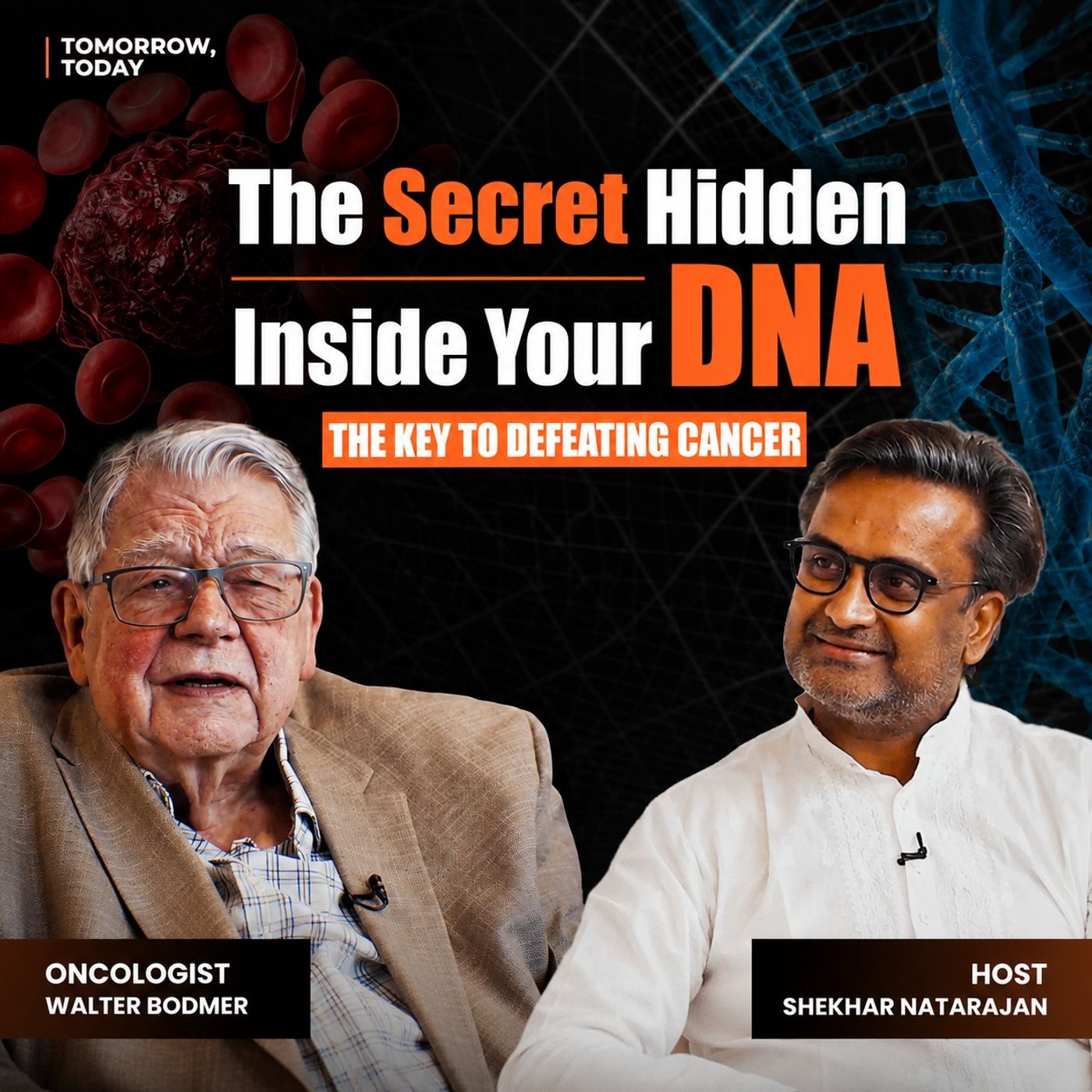
Tomorrow, Today
Sir Walter Bodmer: Genetics, Cancer & the Future of Humanity | Tomorrow Today
01:55:08
What does it take to survive history and go on to change the future of science? In this remarkable episode of Tomorrow, Today, host Shekhar Natarajan sits down with Sir Walter Bodmer, one of the world's most influential geneticists and pioneers in cancer research. Born in Germany to a Jewish family, Sir Walter escaped Nazi persecution as a young child before building a career that would redefine modern genetics. His groundbreaking work on the Human Genome Project, cancer biology, and immunogenetics has transformed our understanding of human health and disease. This conversation goes beyond scientific achievements. It explores resilience, identity, curiosity, the evolution of cancer research, artificial intelligence in medicine, the future of healthcare, and the unanswered scientific questions that continue to inspire one of the greatest minds in modern biology. A powerful discussion about history, humanity, and the relentless pursuit of knowledge.
Loading summary
Transcript260 lines
- [00:00]
A
Without the genome project, we could do nothing in the way that we're now studying any medical problem, any health problem.
- [00:12]
B
He's probably the world's most renowned, you know, oncologist, genetic scientist.
- [00:23]
A
So it's fundamentally a genetic disease at the cellular level.
- [00:32]
B
I don't have any knowledge whatsoever about cancer. I'm deeply curious about it.
- [00:43]
A
The most credible claim is that we won't live fore.
- [01:12]
B
So it's an incredible honor for me to have my next guest on the show, Sir Walter Bodmer. He's a phenomenal, phenomenal scientist. He's probably the world's most renowned, you know, oncologist, genetic scientist and, and, and basically is also the guy who's gifted to the scientist community the way to talk to humans, which is Bodmer report. Like, you know, and so I'm incredibly honored to have him. It's like it's my lifetime dream to like talk to you. Like I've been chasing you down through many different channels. Finally I get to sit down with you here in London. And sir, I don't have any knowledge whatsoever about cancer. I'm deeply curious about it. I'm curious about technology. I'm curious about like where genetic engineering and science is going in general. And I would love for you to unpack it for our audience through this conversation. But before we get rolling on that, like, I know that like, you know, you were conferred Sir Walter Bodmer. So tell us a little bit about that.
- [02:26]
A
I'm not sure what I can say except that I was honored and pleased and surprised. I was relatively young. It's now almost exactly 40 years ago since I was made a sergeant and I assume it was for my contributions to science in general. That's about all I can say. I mean, it's a great honor.
- [02:46]
B
And was it for a specific topic that you were contributing towards?
- [02:50]
A
Not as far as I'm aware. You have to find out who promoted me and what they said I could get it for. It's hard to decide. I've been involved in promoting people and helping. I mean, it's a question of what you feel their contribution has been in a useful way. It can be in sport, it can be in the arts and humanities, or it can be in sciences in my case. Good, good. Awesome.
- [03:16]
B
Like you're such a humble man. So tell me about your origin story. Like, you know, you came from Germany at the age.
- [03:25]
A
My father was Jewish and I was born in 1936. And already of course by that time, Hitler's anti Semitism was very, very widespread. So although my father at that time was already a successful physician in Frankfurt with a largely Jewish practice, he realized in the end he would have to leave. He didn't think he would need to. And so we left Germany because of Hitler, in the middle of 1938, when I was two and a half. So I don't really remember anything about Germany, but it was a difficult time, a difficult time for him. He had to retake medical exams so he could practice and so on. And when you think back of those times, you're made to realize something that unfortunately, some people still suffer from that many people who live in the Western society haven't experienced really what a situation like that that then came with the Second World War, how it can influence your lives.
- [04:38]
B
So you were age two at that time?
- [04:40]
A
Two and a half, yeah, two and a half. The half makes a difference when you're only two.
- [04:49]
B
Why do you say that?
- [04:50]
A
Well, the thing that I find strange is that I remember nothing from when I was in Germany, and yet I remember things that must have happened fairly soon after we came to England. I had two older brothers, and they were, of course, much more conscious of what had been happening in Germany. And my first reaction was refusing to learn how to speak English. I'd only just learned how to speak at all. That was in German. And then having learned some German, I refused some English. I refused to learn German again. But then I learned German at school, and it's still reasonably okay. My parents spoke to me in Germany. So
- [05:38]
B
what is the memories you had of, like, you coming here to UK Like?
- [05:46]
A
Well, I.
- [05:47]
B
Was it vague?
- [05:49]
A
It wasn't a memory of what I had in Germany. It was an experience of what I was having as a very young child and then during the Second World War in England, and I have to say, a strong antipathy against Germany for many years. When I was younger, it was a very difficult time. My father was, in a way, lucky because being a doctor, they needed doctors. And a lot of the British doctors, obviously, were going into the services so that he was able to practice his medicine and in the end did quite well. But he was a general practitioner, family doctor. He would have liked to have been academic, clinical scientist, we would say. But he had a life that he appreciated and enjoyed. And of course, my mother and my two brothers were all together as a family, and he had to go to Manchester because they said they had enough of immigrants in London. So we chose Manchester because through my wife, through my mother, they had friends in Manchester.
- [06:59]
B
Very good. So at your heart, like, are You a German? Are you a UK citizen?
- [07:07]
A
Or are you committed? I mean, are you a Jew or. I'm not a practicing Jew. I've never been a practicing religious person. I respect those who are, but I'm not. My whole upbringing was in the uk. I spent nine years at one time in the United States at Stanford University, which is well known, was a wonderful time. Married wife, first wife. She was British through and through. And so we thought in the end we might want to come back to England for the sake of our children and the environment there. Which is not to say that we weren't happy in the United States, but there's a certain amount of feeling you belong somewhere that maybe takes you away from where you are, even if you're enjoying it.
- [08:01]
B
So growing up like, you know, what are the things you distinctly remember about your father and mother? The values and the culture and other things?
- [08:13]
A
I learned a lot, in a way, from my father that I perhaps only realized later. He was undoubtedly highly intelligent. He'd already published a number of papers. He would have liked to have been clinician scientists. He never really could. He was 44 by the time he came back and settled. It was not really possible to change your directions then. And he'd been told, and I have letters about this, by his mentor, who's a leading surgeon in Frankfurt, and supported him strongly. He said, you'll never get a proper job in the university because you're Jewish. And this was in the 1920s. So he had certainly, in the end, a Stalin fluence. Because initially, as I'm sure you're going to ask me, I said, in months I'd have no idea what else I would do. And my mother was an important influence. She was a student of one of. Essentially the founder of modern dance in Germany, Rudolf Van Laban, one of his early students, and that was an important influence, too. I even once took a holiday course in which she taught. And I was involved with the organization of the labran. The institute and that. And I think that was also an influence, giving a direction of interest in the artistic time. Very good, sir.
- [09:42]
B
Bodmut, like, you know, you went to Cambridge for mathematics.
- [09:48]
A
Yes, I went to a school in Manchester that's very well known, Manchester Gamma School. That was interesting when you think about it. My father, who only just come to get to work properly, must have asked, well, what's the best school for my three sons to go to in Manchester? He was told it was the Manchester Gamma School. So that's where my two older brothers and I went at a Time when it was not necessarily all that easy to get into a school like that. And I went into what was called a modern side, not scientific. And I was told I was quite good at doing somons. And we had a friend who was a teacher, a woman who teached during the war in a boys school, it was an all boys school who said, well you know, if he's any good at maths, he should go into the math 6 because that's where they all get scholarships to Cambridge and Oxford and so on. And so that's what I did. I mean I enjoyed the maths and that's what I did and eventually got a scholarship to study maths in Cambridge. In a way that is one of the examples of where being unsuccessful was hugely to my advantage. There are several examples of that in my life and this was one because it was assumed that the top mathematicians will all get into Trinity College Cambridge, which is a wonderful college, I've known it well. I was put down in a list of colleges by major scholarship and then minor scholarship, which wouldn't do. And then it turned out that Trinity rejected me. But I was picked up by Clare College. I didn't know anything about different colleges and that was a huge benefit to me because Clare was a wonderful college. I was young, I was too young to essentially go immediately into military service and it just was one of the first things that changed my life in a major way going there.
- [11:55]
B
So not a lot of people, like, you know, I was recently in Oxford University shooting for a talk like, you know, they were like interviewing me and I was, I was doing a talk. So not a lot of people know that actually the Oxford University is a collection of a lot of colleges.
- [12:12]
A
So is Cambridge. Cambridge, not Oxford.
- [12:15]
B
Yes, but like, so I'm. So can you actually tell like how the education system here in UK works with these college systems?
- [12:25]
A
I think the college system is quite remarkable and it's pretty well unique to Oxford and Cambridge. They have their origins as religious institutions going back to the 13th century and often small groups of them, worldly religious people would turn into this idea of the colleges. And to be a student, whether an undergraduate or a graduate, you have to be a member of a college. And a college is sort of like a microcosm of the university. It has a mixture. Students and the fellows of the college are generally speaking appointments in the university at various levels. And so you have this mixture of things that I think is very valuable. So even if you're entirely narrowly minded in some scientific area, you're going to meet people studying geography or French or classics. And I think that's useful because it's a community that you can belong to. And that's the first thing. The second thing is you have tutorials, you have individual tuition in groups of maybe two or three at the most, which is, I think, hugely beneficial, because nowadays especially you can watch a good lecture on YouTube, but you can't get the sort of advice that can stick with you really for the rest of your lives, often because the students have enormous regard for the people who were their tutors, who taught them in that way. So I think that's a very important area. And then there's another aspect. If you like doing a sport. And I used to swim, but very often you can't get involved unless you're good enough to be on the university team. But each of these colleges, 30 or more, they have their own. They might have their own swimming, but more likely rowing boats, which you do on in both places, and other sports. And the sport is built up in the university by competition between the colleges, so anybody can take part. You don't have to be terribly good. And then the colleges learn from each other. I was head of a college for nine years, and one of your people you get to know best are the other heads of colleges. And it's not a competitive thing, of course. You try to be as good as everybody else, but you can learn from them too. So I think it's a remarkably effective way of managing an organization. I think many organizations could do better by having that split up and then taking the advantage that each has to do as well as they possibly can as an entity, but learn from the other and work as a group. So I think it's a uniquely valuable.
- [15:25]
B
Why is this sort of system only here in uk? Why not in the rest of the world?
- [15:29]
A
Well, it starts. Started historically in the UK and American universities like Harvard and Yale and even further English universities. It somehow took a long time to build up into what it is now. It's hard to start it from scratch.
- [15:45]
B
Got it.
- [15:46]
A
And I think it's the historical background that makes it work here. It's very difficult to start it from scratch, and I don't think it's worked in the way that people like in the Ivy League universities in the States might have wanted.
- [16:01]
B
So they abandoned it. Because I find it extraordinarily interesting, this concept of, like, colleges and.
- [16:07]
A
Well, it's a collegiate university.
- [16:09]
B
Yes.
- [16:10]
A
And it's important. And the current vice chancellor has had the experience of being ahead of a college Ahead of a department and a very good scientist, which it's important to have those qualities in judging how things should work together.
- [16:28]
B
Well, it's no accident that you became a mathematician, like, you know, like you say that was.
- [16:32]
A
I didn't become a mathematician in the sense of becoming a professional, professional mathematician. I studied maths.
- [16:38]
B
Yes.
- [16:39]
A
I hadn't a clue of what I was going to do with it.
- [16:43]
B
But how did you land in Ronald Fisher?
- [16:45]
A
I can tell you it's an interesting story. I was able to do the main part of the degree at that time because I had a major scholarship and I did reasonably good things that after my two years. The third year was a bit more like a master's course would be now. And in my second year, there was a lecture series from a very famous statistician, David Cox. Sir David Cox. And I got very interested in statistics. And so I talked to him about that and he said, well, you know, you can do statistics in the next year. But then this guy, there's this guy, R.A. fisher, who's one of the world's best important statisticians and he also talks about genetics and how math can do well. So I thought that sounded interesting and I would take those lectures. And so in the summer before the beginning of the third year, I started reading textbooks, some difficult books by Fisher and a good general textbook on genetics. And it just intrigued me. It had a sort of analytical quality, which it does, that appealed to me as a mathematician. It was something that hadn't been only discovered hundreds of years ago, so to speak. And so I took those. That was the first time I learned any biology. I never learned any biology at school, no formal teaching in biology. And I went to start with Fisher's lectures and I was fascinated by them. So before the end of the first term in my third year, I went to him and I said, would you consider taking me on as a PhD student? And he said yes. And because he'd had very few mathematicians who'd ever gone to work with him.
- [18:37]
B
But you said you're not a mathematician. Mathematician. But you said you're not a math guy.
- [18:42]
A
I was a math student, but that turned me into something else. And, you know, that was another of these just remarkable steps. Again, that's a thing that chained by how life to be moving away from. I never thought I could be a good mathematician. Not good enough to be a professional. I was taught in the tutorial system where they call your supervisors there. I had two amazing supervisors. One was Michael Atier, who was both president of the Royal Society and the Royal Society of Edinburgh, one of the world's outstanding mathematicians, and Abdul Salaam, who was the first Nobel Prize winner from Pakistan. And I just feel like I can never be what they were. So why start a profession when you realize you can never be the best, you might never be the best at something else. So I never thought that. I did think I might take up statistics, but then that's what drove me more towards what I did with Lisa. It was a huge, huge change for me. And I think there again, my father's influence was important because he was dealing with living things as a doctor. And I suppose somehow that had an influence on my moving in that direction in my own work.
- [20:04]
B
Yeah, but what about genetics that grew in genetics?
- [20:09]
A
Fischer, let's say the modern genetics as we know it, in a way started with Mendel and he was studying primroses and he was studying the way that things were inherited and came up with really fairly simple rules of how this works which are to today in a way that's known. I mean, in some ways, if you think of males and females, a male has an X and a Y. A female has two X's. Of the children on half will get a wife and male and the other half will get an X. That's a very simple form of inheritance where you expect two proportions to be equal. And he pointed out a similar sort of inheritance, not without, with peas, and said if you get peas that have a different structure that crooked a bit, if you mate those, cross them with the one that isn't, then on average you can get a half that are like the normal P and a half that are crossed. And he formulated these rules which were quite remarkable from the observations that he made. So that's the start of genetics. And then its gradual progression is to say, well, where did it all come from? And then you start talking about chromosomes which carry the genesis genes. And then you start talking about how they divide and how can you get two cells that have the same genetic component as a parent cell have? And then of course you get into the chemistry. What is this? Everything's made up of chemicals in one way or another. What are the chemicals? What are the structures that lie behind genes? And then you get into DNA and you know, the famous Watson cook structure of DNA which showed what the actual genes are physically made of and how they can work, which was a remarkable discovery, one of the greatest discoveries in biology, if you will, in 1953, actually made in Cambridge when Jim Watson was a pupil at Clare College. Where I was, although I didn't know him at that time because their work had only just been published when I started being an undergraduate, studied maths. So that's the sort of pathway, but it's hugely complicated since then and many different things one has to try and understand.
- [22:48]
B
So if you think about the science, like genetics as a science at that time to where it is right now, can you, can you explain, like at the snapshot when you started, what it looked like at that time, like what was discovered already? What did people know, what was yet to be discovered?
- [23:08]
A
First of all, Fischer, you have to understand Darwinism. Darwin isn't evolution, it's evolution by natural selection. It's evolution by the fact that if you have a certain inherited makeup and it changes a bit and it gives you an advantage in terms of essentially reproductivity, whether you die, less likely to die before a certain age, whether you're more likely to have children. That was the idea about evolution. And the ideas that it might be explained by the simple inheritance that Mendel had described didn't seem to fit together to a lot of famous people like Francis Galton at that time. And it was Fisher, largely together with two other outstanding geneticists, Haldane and Saul Geith, who put together the idea that if you looked at it, especially as Fisher did, from a mathematical point of view, you could write down equations which could show you how the type of inheritance that Mendel had suggested would work in terms of the natural selection that Darwin had discussed. So that there was a mathematical theory of population genetics, which is one of the things that Ludfisher taught. And that was an important part of my thesis. But at the same time he was himself essentially mathematical and statistical in an outstanding way. Also, also a great believer that you should, if you're analyzing data, you should know how it was obtained and deal with it yourself. So he himself did experiments. So he had mouse colonies and I was looking at certain types of inherited differences in mice. And that was part of my thesis too. Also he had looked at the common primrose, mostly has what's called pins and thumbs, where they have either the recipient for the pollen at the top or at the bottom. And they're the two types that make each other. But sometimes you find an abnormal one where they're both at the same height. And he'd studied this as a genetic thing. And essentially he collected data on the frequency which you find these so called homostyles in different parts of Cornwall and proposed the problem of how can you explain this in terms of the theoretical analysis of the advantages or disadvantages of being able to self fertilize versus non. And so that was all part of my thesis with a bit of statistics thrown in. So it gradually led into a greater and greater interest in doing the sorts of experimental work that can help you understand what genetics is about.
- [26:13]
B
So switching gears a little bit. So then you reached out to the Nobel Prize winner, Joshua Berg in Stanford, and he declined you first time. And then like. And then like, you kept, like, persisting with him.
- [26:29]
A
This is another story of where a disadvantage was a huge advantage. Yes, actually, Francis Crick of Watson and King was quite friendly with Fischer, and that's almost certainly possibly how I first met him. But I went to a lecture by a famous Nobel Prize winner later to Max Delberg, a geneticist who was a theoretical physicist who then worked with phage, which are the viruses that attack bacteria. And somehow at that point had talked to Delbruck, and he suggested that I should go and work with Delbruck as an introduction, let's say, to molecular biology, because it seemed obvious if you were going to learn more about genetics, you had to do it at that sort of level. So I applied for a scholarship to work with Mike Stellbug at Caltech. And to my good fortune, I didn't get it. And at that point, I decided to take things into my own control. And I'd heard about Lederberg, Joshua Lederberg, who of course, at a remarkably young age, got a Nobel Prize for really showing that you could do genetics with bacteria, which was the whole origin of genetic engineering and what you do there. So out of the blue, I wrote to him because I thought he was. Stanford was a nice place. He was obviously a very intelligent and able guy. And the first thing he wrote back is, I said, I want to come next year. By that time, I already had three children and a wife. And that's probably why they didn't give me the scholarship to go and work with Delbrug. And he said, well, go and work with this guy at Caltexis. There's another person there. And I said, no, I want to work with you. So I have his letter in his own handwriting. Nobel Prize winner. Dear Bodmer, your persistence is flattering.
- [28:33]
B
Yes.
- [28:35]
A
So that's what got me to work with Joshua Lederberg and his then first wife, Esther Lederberg. And he was another remarkable mentor, an outstanding scientist.
- [28:46]
B
So how do you explain this persistence?
- [28:48]
A
Like, where did it come from, my persistence? I don't know. I don't Know whether it came from my genes or what I was to trying taught or what it just is it was there. I think it's important.
- [29:02]
B
So if I were a layman like you know, in 1940s and 50s, like how would you explain genetic engineering at that time?
- [29:15]
A
Oh there was, there was hardly anything that you could call genetic engineering then it's, it started with Lederberg showing you could do genetics with bacteria. But it really didn't come into its own until the whole discovery of what the gene was. It was this DNA thing how it was made up and how it coded gave you information that coded like a language that was what you inherited. And that language told your one cell that you get when you an egg with the sperm that creates the rest of your body. And so what was apparently the Watson crypt discovery was in April 1953 and by that time it had already been realized that the material DNA deoxyribose nucleic acid was almost certainly the main material of what made up what was inherited. So that by that time it was already clear that this is where the future would have to lie. And you had to learn something about that. But the actual engineering and what you could do came even some years later with you finding enzymes that cut up DNA in certain ways way and allow you to put it together. Finding ways how you could get DNA into E. Coli for instance, and not just do matings between them, but the matings there already. That was chemistry because you could get a strain of E. Coli that would only grow if you gave it to certain amino acids. And then you could look at the genetics of that. But that was the things that developed, I mean in the 1960s and then early 70s.
- [31:12]
B
So you know, your age is like, you know, you mentioned like, you know, you're born in 1936, which makes it like 90 years old now. So usually professors like retire at the age 65, 70 and then they go back home and they call it a day.
- [31:30]
A
I think that's a huge problem. I think that, I mean I've never given up working. I still work. I still have a laboratory in Oxford due to the support I get from the head of department I'm in. I'm an emeritus professor. Not everybody wants to do things that way, but many people can. And the notion that you're ill when you're 65 is no longer true. I mean it's not a matter of the lifespan. What's the maximum someone can live? It hasn't changed much. 115, 120. Nobody's going to get much older than that. But the proportion that reach an age of 80 or 90 now is hugely increased. So that when you have sort of pattern of how inheritance is. At one time, it was like a triangle like that. The old people at the top, women here, men there, women live a bit longer. And what it is is more like this, where there's a much higher proportion of people at these older ages. And we have to think about how to take that into account in the way we manage our society.
- [32:46]
B
So what wakes you up every day in the morning to go to the lab and work out? What problem are you solving Right now,
- [32:55]
A
my major interest at the moment is and has been for some time in aspects of cancer. And I'm working with a small group and with a collaborator in a company, a biotech company in California, on novel ways of using our immune system to treat cancer. I've in the past had other dentists, which I was not able to continue for one reason or another. In how you can use genetic variability nowadays, at the molecular level, there are a huge number of differences we can actually study in the laboratory between us. This is the genetic variability that makes you have a look a bit more browner than I am, different colored hair, all sorts of things one obviously sees in a lot of other aspects. And you can characterize populations to some extent by grouping people according to how similar they are genetically. And I've been very interested in this. That came out of my original interest in population genetics and a mathematical background. And in other respects, I got very involved in other aspects of immunology, in fact, the study of how we respond to infections. So I initiated, with colleagues who were good at doing the data analysis, a study of the British population at the genetic level, where we took samples, blood samples of people as a source of their DNA from throughout the country, but in rural areas outside the big cities, and from people who have their grandparents, at least four of them, near to where they lived, within a diameter, say to 50 miles. There was sampling people who could say their origins were before the major influx of the Industrial revolution. And then the study was to group these people, just based on the genetics, into clusters that were more similar within a cluster than to others. And to our amazing quartz surprise, when we plotted them, we knew where they all came from on the map. The genetic clusters matched up with where they were on the map of the uk, which was really the first time in that sort of detail, that sort of information was obtained. But I was not able, for one reason or another, to continue those studies. But there's still something that interests me.
- [35:40]
B
So now switching topics a little bit. So cancer.
- [35:45]
A
Yes.
- [35:46]
B
So forget the textbook definition of cancer. You know, is it like the failure of the genome itself, or is it basically the, you know, are we talking something fundamental about, like. Like what causes cancer? Like, what is cancer in, like, a nutshell? Is it, Is it, Is it basically the disease of the genome itself?
- [36:17]
A
Anyway, let me stop by saying, give my own history. How did I get involved in cancer? So I was a geneticist, and I learned about all these ways you can study DNA and do molecular genetics and do clever things with cells from different people and get some genetic information. And then out of the blue, basically, after I'd been back in Oxford as a professor of genetics, the first professor of genetics, formerly in Oxford, 1977, I was asked, would I be interested in becoming the director of science for what was then the major of two comparable research charities that studied cancer. Mine was called the Imperial Cancer Research Fund. And this was a job that they come to me assuming I might know something about cancer, which I didn't know a lot about because I was a geneticist and because of the role that genetics almost certainly was playing in what cancer is. So that's how I got into it that way. And I had to learn a lot about what cancer was very quickly because I was expected being in charge of an organization.
- [37:36]
B
So how do you define cancer?
- [37:37]
A
How did I find cancer?
- [37:39]
B
No, no, no, no. Define cancer.
- [37:40]
A
How would I define cancer?
- [37:41]
B
Yeah.
- [37:44]
A
We start our life from a sperm and an egg meeting. From one cell. Cells divide. We have many different sorts of cells in the body, and they use the genetic information that they've inherited from the male and the female in different ways to give you different sorts of tissues. And in a given tissue, for instance, one that I study a lot in the bowel, it's formed of a surface of one particular cell type, and they form crypts. They form little bodies like that. And at the bottom of them is a cell that's called a stem cell because it's the one that divides all the time, produces, turns over in four or five days, the whole of this structure, maybe a couple of thousand days, different cells, different types of cells. Now what happens, that's when it's under control. Now what happens when a genetic change can happen in one of those cells, that it starts outgrowing its normal partners in a way that gives you an abnormal growth? That's what a cancer is. A cancer is an abnormal growth of our cells in which they're dividing In a way that they shouldn't.
- [39:05]
B
But why does it happen?
- [39:06]
A
Why does it happen? It happens because the genetic changes occur in those cells at the somatic, what we call the somatic level. So that's not in the cells that produce the egg or the sperm. It's the cells that make up different parts of the body, like the ones at the bottom of this crypt, as we call it, in the inner bowel. And it's simply because of natural selection. It's an evolutionary process within our body of the cells that have genetic changes that gradually give them greater ability to divide and overcome the normal constraints of what's happening. And the reason, in my view, why that happens, It's a disease of old age, of older age, not old age, of older age, which was hardly known even in into the middle of the 19th century when a German physician first described that it was a disease of cells in that way. So it's a disease that hardly influenced our evolution. And that's because evolution has selected us in such a way that beyond the reproductive age, which is about 40 or 50, mainly, if you think of it on the female side, of course, but also on the whole on the male side, There isn't the pressure to maintain a proper living organism after the reproductive age in our evolutionary history. So you get these abnormalities of the way things happen as you grow older and getting accounts who's one of them. And it can happen in all the different tissues of the body in different ways. So it's fundamentally a genetic disease at the cellular level. But it's also not only mutations which change the language, so you're doing something different. But there are ways in which you can get from having the same language, from that one initial cell, you get to lots of different cells. By using the information in different ways, you can get different results. And so that mechanism of whether you switch on in a way genes function or not Also can be a stable form of genetic change that helps give us cancer.
- [41:29]
B
So it's more like a breakdown of your genome. Is it a failure of the genome?
- [41:34]
A
It's a breakdown of the genome. It's not a breakdown in a way, It's a change in a genome of initially a particular cell which can then outgrow its normal neighbors. So in that sense, if you can call it a breakdown, but for the cancer cell, it's a huge advantage. It's multiplying up to the disadvantage of the individual in whom it develops.
- [42:03]
B
And basically you mentioned that your research right now Is basically using immune therapy. So how is immune therapy Related to
- [42:11]
A
like, okay, now that's a very interesting question. The first thing, what is our immune system? So our immune system is a very complicated, highly organized system that essentially is there to help prevent us from getting infectious diseases. And that's extremely important. And those are the things that, you know, in the past, the most loss of life was due to infections. Whether it's bacteria, it can be fungi, it can be funguses, or it can be viruses, of course, as we know from the pandemic. So that evolutionarily there is a whole system being developed that recognizes the foreignness of an invasive organism. Saying let's take a virus that recognizes the virus is something different and has to be attacked and then works out how to attack it. So the immune system is there and it started without recognizing in a very sophisticated way. But the more sophisticated way, it's very complicated. We have maybe people know what antibodies are, they know what you do. When you do a vaccination, the simple minded thing is you give the individual to be vaccinated a version of the virus itself, or an important part of the virus in order that your immune system recognizes that as foreign and then switches on what's needed to attack cells that have been infected by viruses. And the antibody is one of the mechanisms by which that happens. You make antibodies. Lymphocytes are major white type of white cell in the blood, as opposed to the red cells which deal with hemoglobin. And there's one type of lymphocyte that makes these antibodies. And there's a system that recognizes that foreignness and makes them. And there's an alternative system that does it by another type of cell that instead of making an antibody, it has a receptor on its own surface. It's a T cell, it makes something on its surface in quite a complicated way, but recognizes something on the other cell. And one of the important things is that it can recognize proteins it can recognize. And it's a lot of it is proteins, which are strings of amino acids which make up most of the function of the cells in a way and that are inside the cell and not on the surface. The only easy way you can do is to kill from the surface. And so it's a complicated process where a protein, it can be an enzyme or structural protein of one sort or another, can be broken up into lots of bits. And some of those little pieces are expressed by a sort of caliper, if you will, by a protein on the surface of cells that exposes it to the other cells who recognize it. And it's a complicated system. And my involvement for that came with working with people who are trying to understand what is it that does that, but starting from a different point of view, that if I take some of my skin and put it onto yours, it's going to be rejected. Why? What are the differences that lead to that rejection, which is an immunological process, and it's not, you know, probably everybody's heard, probably the abo blood groups, which you do have to match, Otherwise you get problems. When you transfer blood from one person to another. If they have a different abo type, is there something similar that's on the surface of the cells so that that would lead to that rejection? And I was involved in the early days and when people had started looking for that, and it was my statistical background that sort of helped unwind what was being studied in such a way that you could begin from the genetics to understand what were these differences. And then eventually that led to find out what they were as well. Proteins and how they varied and so on. So that's how I got into the immune system. I knew little about it until I went to Stanford. There was a colleague there who used to have evening sessions that I go to, where I learned about what were lymphocytes. Actually, their function was discovered by a famous immunologist in opsund's who was very helpful to me when I first came there. And so gradually that became more of an interest. So what you're doing when you're treating cancer is you're making that immune system recognize that cancer is something for him and kill him and try to do that without killing the normal cells. Yeah, I'm sorry, that's a long story, but it's a very complicated one.
- [47:30]
B
No, it is. It is interesting. So if you step back and, like, you know, walk us through what is a cancer stem cell,
- [47:42]
A
the cancer.
- [47:44]
B
And if you want to explain this and then, like, you know, bring it all together for us, from there on.
- [47:47]
A
Cancer ultimately arises from one cell.
- [47:50]
B
Yes.
- [47:50]
A
At any given time, there may be more than one cell, but eventually it. It arises in one cell, and it's the cell that's driving the division. It's the cell that's multiplying up to give all the different cancer cells. That is called a stem cell. Now, once you've got a genetic change in a stem cell, you don't get rid of the previous version. If there are different steps of change, you may have several different stem cells doing different things, but one of each, at some point, one is growing better than the others. That's why it's been selected for. Yeah.
- [48:33]
B
So, like, why. Why has all of these scientific advancement, whether it's like chemotherapy and other types of therapies that have been proposed, why has not that been so effective so far?
- [48:45]
A
Because cancer is very. A cancer cell is very similar to a normal cell.
- [48:53]
B
So detection is a problem.
- [48:54]
A
It's not so much detection, but treatment. So for some of the early cytotoxicity, some of the early toxic treatments or. So what they're doing is they're attacking the division process of a cell. But if they attack that too much, then all the normal dividing cells will also be attacked. So you get a huge problem there. So basically, the chemotherapy that has had enormous benefits is just a balance between killing the cell cancers a little bit more than killing the individual. And gradually, as you.
- [49:31]
B
How are you being able to manage the precision of killing that? Is it possible?
- [49:36]
A
Well, it's by dosage, for instance, and you can study in vitro models of that that cancer can give rise to. We work with a lot of cell lines that are derived from cancers, each of which has the genetic properties that the cancer it came from had. And we can say, well, if we have cancers with different genetic properties, how do they respond to being killed as cultures in the laboratory? So a lot of. In Vito models of that. And of course, there are a lot of people and condition with animal models of cancer.
- [50:13]
B
So there's been a lot of different, like, you know, varieties of promises made. Right. Like, you know, whether it's chemotherapy, monoconol treatment, or like, you know, basically you think about the human genome project, like there were different, like, promises made along the way in the last 70 years about, like, the ability to solve cancer. So why has all.
- [50:35]
A
Because, well, the ability to deal with cancer is hugely, hugely improved over the last 20 years, for sure. And that's undoubtedly come from more and more understanding of the difference between a cancer and a normal cell, which you can study in the laboratory by having sources of cells. And you can have mouse models. And often there's the best animal model, but also difficult because it's not exactly the same. Getting a colorectal or bowel cancer in the mouse isn't exactly the same as in humans. But just your comment on the genome project. Without the genome project, we could do nothing in the way that we're now studying any medical problem, any health problem, because underlying it all, in the end, is the genes and what the genes do and how the genes do it. And all of that has its origins in understanding the Genome. So the. I was involved in the very early days of promoting the genome project when people said, why are you spending all this money, a billion dollars in finding the genome when you could do a lot more other sorts of simpler experiments that were less expensive? And that was totally and utterly wrong when you think of it. That was about the cost of one or two missiles or something. And here we are. Almost nothing that one does that's based on new discoveries, new ways of treating human illness that hasn't in one way or another benefited from what we understand of our genome. And that's the genome project. And just even if you think of it in terms of companies and the companies that make things, I mean, the antibodies that we can now use that will treat rheumatism or some of the antibodies that are effective in treating cancers in certain ways, they're some of the most costly in terms of the amount that's built medical treatments.
- [52:41]
B
So when these treatment routines come out, like on all the protocols, right. Like whether it's immunotherapy or whatever, different kinds have come out. Obviously there is like loss of human life while trying to do all of these things as well.
- [52:57]
A
First thing to say about cancer, the most important thing is to try and prevent it.
- [53:03]
B
Yes.
- [53:03]
A
So we know certain things. There's a lot of talk about what you should eat or not. But I think it can be summarized very simply, don't eat too much, don't get too fat, have a reasonably balanced diets. And there's not much more, in my view, that you can say about what the effect of that would be. But obviously if you get too fat, then you have a higher risk of getting cancer and you also have a huge risk of getting diabetes. So the other ways then the earlier you. There are also some very vaccinations. If a cancer is due to a virus, like cervical cancer is due to a particular type of virus and it's a very common disease, less so now in countries where you can make a vaccine against that virus so you can prevent the cancer from coming. If you can do that, that's obviously very important. And for virus induced cancers, that's quite possible. And then the next most important thing is to get a cancer when it's young. I mean, I had a colon cancer about 10 years ago, so I'm a bit less than that. And if the cancer in the bowel is limited and hasn't spread much, you just cut out that part of the cancer and that's a cure. It's when it spreads before you've Done that so that it's already in other parts of the body that it's harder to get. For reasons we still don't really know, a breast cancer spreads more than say, a bowel cancer. We know where a bowel cancer goes to. Generally, if it hasn't spread much after five years, the chances are it's not going to. There's nothing left there to give you any more of it. So ways of finding. That's why we have screening programs. You screen by examining the breast to see if they're abnormalities. Now there are lots of talking about screening the lung for small growth because our ability to take an image and analyze it has much improved. You have ways of looking for bowel cancer because you look for blood that's in the stool and that's a sign that you've got a cancer there that's leading to that bleeding. And then a lot of talk about how you might be able to pick up a cancer by finding cancer cells in the blood or the DNA of cancer cells in the blood, that's changed. So there's a huge emphasis on that. And then in the end, when you can't do it, you've got a time seat. And we're looking for novel ways of doing that, injecting things into the cancer instead of into your veins, for example, using the immune system system with an antibody you've made to attack the cancer itself. So you're essentially taking the lymphocyte and arming it with something which you can use to kill a cancer.
- [56:07]
B
Today, how big is cancer a disease for the humanity? Like how many people die of cancer?
- [56:13]
A
It's a huge. You're talking about millions. I mean, it's the second largest cause of cancer death, I would think, after heart disease. And it depends on which countries you're in, because in lesser developed countries, although that's changing rapidly, particularly in Africa, infection is still a major problem. But to a larger extent, we've dealt with infections. Of course, there's the problem of antibiotics which take infections and have been used to such an extent that you get a lot of resistance that makes them no longer effective. But it's a huge problem if you want the problems of aging. And one of the major problems is obviously dementia. One of the most serious problems, in my view. I mean, it's an obvious problem. And it's still very hard to say what's causing that. Sometimes it may be that you inherited a tendency that makes it more likely that you get dementia. And that's not an all or non thing like maybe manage maybe like in a cancer, if you really could find that when it happens earlier, and you could then prevent it from going on. And that's not been easy to do at all. Diabetes, obviously we have ways of dealing with that, partly because there are two types you can deal with, with insulin and provide insulin when it's not there. And those diseases of aging are there because we haven't evolved to live more than 40, 50 years.
- [58:00]
B
So colorectal cancer, that's the area of your focus today?
- [58:04]
A
Yes.
- [58:05]
B
So why did you choose that?
- [58:07]
A
I'll tell you why I chose it because the organization that I started to be in charge of, the Imperial Council research firm, had a unit in which they were studying an inherited form of bowel cancer. So while most of the cancers are not controlled by what you inherit, some are. So they are familial. There are things you can inherit that give you a very high risk of getting a cancer. And one of them is called familial adenomatous polyposis, is for a form of bowel cancer. And this organization, this unit, was studying the inheritance of that bowel cancer at a time where you knew it was in families, but you didn't know what the gene was. And so I thought, well, we better start doing something that makes sense. So we started studying the inheritance, the families, and eventually we contributed to finding where the gene was. When you find out where it is on the chromosomes, then you can find the gene itself and then you can understand it better. And so that was a stimulus for my initial interest, and it's immense. And it's the second or third colonist cancer in terms of killing, in terms of death. So it's a very important one and one where it turned out you could do quite a lot of things. You could get lots of cell lines. We now have cell lines that we can grow in culture that are for 100 different cancers. So we can really do a lot of studies with that. Yeah.
- [59:48]
B
So let's talk about the human genome project. Mapping the genes and basically trying to understand, like, was it a thought? Was it science? Was it intuition?
- [60:01]
A
Oh, no, it was definitely science. I mean, first of all, we've not really talked. I mean, it would take me a lot more than I could do in an interview like this to explain the whole of genetics. The DNA is made up. You can think of it as a language made up of four letters. And the whole of the DNA is about is a very large number of these letters. And instead of them all alarmed in one long string, they Occur in different. Rather like different books or chapters of books. And they're called chromosomes, which we can see. And they've been seen since the beginning of the. It was early in the 20s, early in the 19th century, that it was realized.
- [60:52]
B
Do you want something?
- [60:52]
A
No, no, it's fine. I'll take. Just in water. Okay. It was early in the 20th century that it was realized that in some ways the genes had to be carried by the chromosomes. Right? And that's the way things worked. And so you've got to. When you look for where a gene is, you first of all say, is it on that chromosome? And then eventually, when you could sequence the whole chromosomes, you could say exactly where it was. So the genome project was the ambition to say, well, if we're going to understand the genetic process, we've got to have the complete genome, because that tells us. And so it was around about the early 1980s. I got very involved and showed how, if we had more information on the DNA sequence, as one could say it then was of where the genes were. There was a lot of things you could do. You could use it to study, like we did with the inherited bowel cancer, where a gene was and what it was. This would become possible, but it would only be made possible if you really had the whole genome. So the emphasis was to say, well, let's at least try and sequence a whole genome. And, you know, sequencing was initially, it got another Nobel Prize, notably from. I forget the name. Anyway, it got a Nobel Prize for the discovery of how you do, how you find sequences. But that was still relatively small. And it gradually, as the technology improved, you could sequence more and more. But even at the time that people like myself and others were promoting the genome sequence, it was still thought to be a huge problem to do a whole genome. But it was a major development that brought people together in a very interesting way. It was. Had a lot of politics behind it, but in the end, through the people who were involved, it was Fred Sanger, who was the guy who. Then we worked out one of the first ways to do sequencing. And there's now Sanger Institute, which is very well known and studies things connected with genetics. Still, it was realized you could do it. But it took, you know, maybe 10 years until you got a complete sequence of the first complete human genome sequence. And it wasn't only from just one person. It didn't matter. But that was the starting point. Now you can get a complete sequence overnight sometimes.
- [63:48]
B
What gave it that power? Like what happened a compute.
- [63:52]
A
Well, it was a Mixture of chemistry and computer. I mean the computing has a large amount to say in this because you're always dealing with large bodies of data. Even the work I was involved in discovering the so called tissue types that distinguish people, involving ways in which you got reactions with the serum that you had to analyze. It would have been difficult to do that without a computer then. But the computing since that time was just.
- [64:18]
B
And that computer is very different than the artificial intelligence compute that people talk about because this is very domain specific and it has been trained on artificial intelligence.
- [64:27]
A
I don't think you'll have got your DNA, you have to have experiments, you have to know what the chemistry is. Artificial intelligence now if you want it can explain in a remarkable way what a sequence can do. So for instance, the sequence of these four letters, they code for the 20 different amino acids that make up our proteins. So so from a DNA sequence you can get a protein sequence. And now from the AlphaFold, which is an AI, which exists because there were huge amounts of structural analysis of proteins of known sequence that had been obtained that they could take advantage of that and make an AI that predicted what a given sequence of amino acids would give you in terms of a structure, which is a huge advantage in understanding.
- [65:17]
B
Is it true that AlphaFold basically was able to solve what would take many, many, many decades to solve in few days and minutes from a protein sequence?
- [65:29]
A
That's an exaggeration.
- [65:31]
B
At least that's what Google says.
- [65:34]
A
Let's put it this way, the first steps in understanding a protein would be to sequence it. Fent Sanger got a Nobel prize for sequencing a protein, insulin and also sequencing DNA. So now after you got to the step when you knew what the DNA sequencing was, when you knew what different letters of the DNA made different amino acids, you could predict the amino acids. So you get to that stage. So then you have the stage where you've got a protein and how do you solve the structure? Well, you can't get a lot until more recently just from looking at it. So. So it was the Bragg's father and son who developed a procedure called X ray crystallography where you could shine X rays on a substance and by the way they were reflected, you could predict what the structure of that was and that was how the first structure of proteins. So the people who shared the Nobel Prize, Max Paritz and John Kendall for working out the structure, hemoglobin and myoglobin, got it at the same time as Watson and Kipp work out the structure all through execular sloping of what the DNA was. And so that's a huge step. And now there's also a way of preserving things at very low temperatures. So you can then find the structures of some things that you can easily find out by conventional exo crystallography. So I think to say that finding a given structure would take you a long time is not quite true. It would take you some time. What they do say is you could find the structure of a very large number of things very quickly because of the time it would otherwise take you to find each one. So from that point of view, they're correct. So that can be for the stretch of anything, whether it comes from, for a worm or a bacterium or an elephant, very interesting. That's huge. And the interest is when you know those structures. I'm not a chemist at all, but can you work out how things might attach to a protein by working out the structures that would fit together? That's the whole idea behind using AI to devise new drugs.
- [67:58]
B
So in the world where knowledge is so ubiquitous, would you need a PhD in the future to basically become like a genetic scientist at all in the future? Or like you, you just have to be curious.
- [68:11]
A
A PhD is a beginning of a potential scientific career, which can be in many ways. You can go to a company and help there, you can go to an advisory base, or you can continue to be wanting to discover things in science, which in a way I've done. So you start that by choosing a given. Usually you charge it by choosing a mentor who's studying problems that you find interesting.
- [68:40]
B
Can AI be the mentor for you?
- [68:42]
A
No. No.
- [68:43]
B
Why not?
- [68:44]
A
AI doesn't have any originality. AI can only tell you what you're finding. You've got to do experiments. I don't believe AI could do that. So you believe in what I say? Usually when I give talks about my. I say you can't choose your parents, you can choose your mentor.
- [69:01]
B
Got it.
- [69:02]
A
And the choice of mentor is very important. That's what made my channel the way it was. And so choosing a mentor and choosing an area in which you want to take interest is very important. So my initial interests were with what you could do at a relatively simple way, just by looking at things and classifying them and seeing how they were inherited, that gradually moved into more and more chemical things where you could structure the sequence and find out what it's doing and so on.
- [69:38]
B
So you spent how many years like becoming a PhD and a scientist?
- [69:42]
A
Well, I think becoming a scientist like,
- [69:46]
B
or a PhD like how many years did it take you?
- [69:49]
A
Well nowadays in the UK you probably take three to four years. Originally thought that was three years. Most people it would be up to four years. In the United States it could be longer. And it's an initial training on the way you do science. Got it. There is an importance of how you do science, the logic you apply, what are the chemical and general ticks of the day that you have to use. Obviously also having familiarity with what computers can do and working together in teams and how you can work together in teams. If someone comes into my lab and say, spends a summer with us, they learn how to grow cells in culture, how to look at them, how to analyze them in certain ways and so on. So I think that what you start off with may not be what you end up with and it certainly wasn't particularly so in my case, but I think.
- [70:47]
B
So you still think that the PhDs are going to be like four year degrees or like you think like because the, the knowledge is coming so fast and furious at you and you have this like aid and help.
- [70:57]
A
The knowledge coming so fast makes it more difficult to do in three years. I'd like. Because you've got to know.
- [71:01]
B
So you think like PhD is going to take longer then?
- [71:03]
A
No, I think PhD is, I think
- [71:06]
B
the, the scientific figure you still want to have.
- [71:08]
A
I think three to four years is fairly reasonable. And then the next step you take is important because the next step may be one of the most important steps is where you go beyond and start doing things more for yourself.
- [71:22]
B
Got it.
- [71:22]
A
And you know that can be. I just, to me it was genetics and then I happenstanced to get involved in cancer. If I were starting again now, I'd probably take up the challenges of understanding the brain. I think there's a huge difference between brain as a mechanism, like as a computer and the mind, which is how it works. And I think we still have. I'm not an expert, I wouldn't claim to be, but we still have a long way to go to understand how the mind works.
- [71:55]
B
How the mind works. Yeah, that's fascinating. So the genome project, did it actually deliver on its promise or.
- [72:05]
A
Well, I think it did in spades. People said oh no it's not. And we don't know enough about this and that and the other and it's not true. And you only measure it by the fact that there's hardly any experimental laboratory working on human diseases, working on animals in any way that doesn't in some way owe what it's doing to the genome project. Got it. The genome project, of course, was focused on the human genome, but it was doing that and the development of the technology that allows you to have a program in which you're trying to have a genome of nearly every sort of organism that exists, which can tell you a lot, because you can follow the evolutionary chain of how things develop by looking at the organisms, if you will, different levels of complexity and how the change in the language that they have took place. So it's a very interesting, very interesting area. So I think, you know, if you just think of it commercially, I mean, the pharmaceutical companies, the biggest thing that they sell is monoclonal antibodies and doing cellular treatments that cost hugely expensive. So even from a purely commercial point of view, it's been hugely successful, but that's commercial, benefiting the health of the population.
- [73:38]
B
So there is always my mentor. He was 92 years when I actually met him. His name was Sir Richard Muther.
- [73:49]
A
Yeah.
- [73:49]
B
And so he was one of the founding fathers of industrial engineering. So he was a guy who went out to people, Republic of China, trained them on, like, you know, how to think about industrial facilities, setting them up, you know, moving them into the industrial world. So phenomenal man. Like, you know, like. And I would go sit in front of him and cry every day because
- [74:12]
A
that's not a good thing. You know, he's like, I always support you.
- [74:17]
B
You don't know. He's like a perfectionist. Like, you know, you would go write something and like, you know, given his age, like, you know, you would go, right, and show something to him and he would look at it and say, like, okay, this is good. And then he start marking it up and say, like, start over.
- [74:30]
A
Well, Letterberg, you know, had one of these memories, which he saw something, immediately remembered everything. Yeah. And I remember one time showing him something, and within a flash he'd get his all. And I could. I couldn't believe he did.
- [74:43]
B
Yeah. So this, this man actually did, like, you know, 2,200 projects, like, worldwide. So he used to have a very interesting phase that, like, you know, I was trying to capture the essence here. So there's something called knowing, and then there's something called doing right in the medical world, there's something called knowing, and then there's something called curing. Where are we in that spectrum today?
- [75:02]
A
Well, I've been talking about, it's a big discussion at the moment in the UK about what I would call discovery cells trying to understand things, which could be from understanding what's in a planet where they suddenly talk about A totally new source of material to understanding what's in a cell that's a cancer cell, and why it's different. But obviously the implementation of these things is a different sort of skill successful in an engineering sense when you. You've worked out a new procedure. But to make that happen, I mean, all the developments, for instance, in DNA sequencing, a lot of those were from people who had fairly clever ideas of how you did things and what machinery you could do, how you could use computing to help you and so on. So I think that's clearly always an important part. Also, if you're thinking about health, I mean, I've just recently read a whole report which I thought was very interesting about what's needed for having a proper cancer program in the uk. It's as much to do with implementing what we already know it's possible to do, getting more efficient ways of studying how you deal with patients in hospitals, getting more equal provision of the resources that you can do so that everybody can have a sophisticated screening for cancer and so on. So there's a huge amount of that, which is.
- [76:39]
B
So why does that chasm, where is that bridge between knowing and curing is so difficult?
- [76:45]
A
Well, what you're talking about is translational work. How do you go from, say, what
- [76:54]
B
we were doing, what a scientific research, to basically, how do you go from,
- [76:58]
A
first of all, you've got to have an idea of how you're going to, say, manipulate the immune system. Then you can study it with model systems. In Vito, to some extent, you can also do that in mice. And then at some point, you've got to get to a stage where you say, I think we know enough about how to do this that we want to try it out in people, but it's got to be very carefully done. That's why you have an MHRA and others to monitor whatever you want to propose as an initial trial and the first stage of a trial is toxicity. So if you've got a treatment, the first thing you've got to try and do, you've already done it to a fair extent that you've got to do it in people. Then you tie it with starting with very low doses of something and gradually increasing them and seeing what's the balance between getting a response in terms of the effects of the treatment and what are the disadvantages in terms of the toxicity. So it's a stepwise process and in the end it has to eventually, if it's going to deal with human diseases, get into clinical terms of one sort or another. And that's of course a huge area.
- [78:11]
B
And how do you make sure that the clinical trials are successful?
- [78:17]
A
There's no way you can make sure they're successful.
- [78:19]
B
But how do you even go through
- [78:21]
A
the sampling and the selection judging whether what you've been able to show in an in Vito test or in an animal test looks as though it really could be something that's worth doing.
- [78:33]
B
So do you get the feedback loop going today as the scientist and the researcher sitting in Cambridge or Oxford, and you come up with the feedback, the best thinking out there and then it goes into the practical implementation. How good is the feedback system today?
- [78:49]
A
Well, it depends on the ability of people and their knowledge. You're always having in one way or another, you're having things reviewed by someone else who you hope you can trust is knowledgeable and gives their views on whether they think what you're doing makes sense.
- [79:08]
B
Is it like so, but how do you ensure the integrity of the translation process? Like, is it not a translation problem? Like you understand everything in absolute sense. Like you know, it is like your grandfather knowing everything about like what they know about culture and value and then like, you know, two generations later only know like 80% of what your grandfather knew or like 60%?
- [79:27]
A
Well, I mean, you know, knowledge proceeds step wise and it proceeds at quite a high rate nowadays because it's so readily available.
- [79:36]
B
But is there a scientific rigor that like transcends like what happens in academia to what happens in the practical implementations? Like, are the scientists of the same caliber?
- [79:45]
A
I don't think so. I think it's a gradual process. And I think if we find that something works well at a level at which we've tried it out in initial clinical trials, then we try and understand better why it's working well. And that can improve the extent we, which we can use that process to treat on an even wider basis than maybe we initially thought was possible. Got it, got it. I think there's.
- [80:14]
B
So you think the feedback loop system exists today? To a fairly good degree,
- [80:21]
A
I like to think and hope that it does. It depends, you know, it depends on what level you're talking about feedback. I think if you're talking, talking about the organizations like the Medical Research Council, which would give you a gantt of research, you've got people who are in the Research council who are maybe not themselves anymore experimental scientists, but have an understanding of the science that's good and can help make decisions to some extent or whether something will.
- [80:54]
B
What is their incentive? What is their incentive today? What is The Medical Council's incentive today?
- [81:01]
A
Well, I don't know what's the incentive for taking any job? It can be an interesting job. My daughter works for the medical research.
- [81:09]
B
Is it like risk aversion or is it like basically ensuring that the experimental rigor is managed?
- [81:16]
A
You're helping to make decisions that eventually are made by experts in the field that you hope will gain improved treatment, improved recognition, improved prevention of diseases. And you're working there because you think that's something that's worth doing and you find it interesting to be involved in that. Got it. And I think a lot depends and I think the quality of people we have in judging things like that in this country is very good. Where we lack any quality of science to a large extent is when it comes to government. I mean, we're very fortunate at the moment. And we have Patrick Valens, who is an outstanding scientist, as actually a science minister brought him through, making it, putting in the House of Lords. But if you think of how many, I don't know what the count would be now, how many of our MPs have even got a basic degree in science? And if they haven't, that's where the public understanding of science and engagement is so important. You've got to be able to convince people that they're in charge of finance in a big way, that actually a lot of the success of what they're going to do is dependent on science. Just read about what Chancellor of the Executives doing, the way of supporting AI, big laboratories and large new computing facilities and so on. In the end, there has to be a realization that, whether you like it or not, the success of our society is largely dependent on development of science. Where do you get your electricity from? Where do you get your energy from? Where do you get your motor cars from? Where do you get your, you know, where do you get the phone that you can use from? It's all based on science in one way or another and its applications. Very true, very true.
- [83:20]
B
So, like, you know, you know, as a professor in 1970 to today, like, almost like, you know, 55, 56 years later, what surprised you? Was it like, was it technology? Was it like, you know.
- [83:33]
A
Well, I, you know, I've made that transition slowly, like everybody else in so on. Yeah, I think that there's no doubt some of the huge changes, I mean, if you think just the genome project itself. When I was a professor of genetics, I began talking about that perhaps toward the end of my time, but it was in the 1980s, 1980, 1981, so the possibilities of what one could, could do then was hugely less and they've increased enormously. And that's undoubtedly an advantage. And it's dependent on a mixture of good chemistry, particularly of computing has played a large part in it, of course, but not only, but almost any instrument that you use nowadays is going to be controlled in one way another by computing automation. Of.
- [84:35]
B
But did you see the computing coming that fast to you or.
- [84:38]
A
Oh, I think we saw the computing coming. I mean I was.
- [84:43]
B
Did chemistry come fast or computing come fast?
- [84:47]
A
I think the computing has been the fastest development that's possible. I mean, my mentor at Stanford. Well, first of all, I was one of the first people to use computing for doing certain types of population genetic analysis. And this was because I had the good fortune to get a vacation job working with Avro aeroplane company on things that never flew, getting heat coefficients. That was my introduction to computing in 1956. Wow. So that was what enabled me to use that computing in ways of my own subsequent work, which was trivial compared to what it is now. But it was magic in those days, doing things that you just couldn't have imagined you could do otherwise. And that went into when I was at Stanford and discovering these HLA system, the mismatch differences between individuals that lead to rejection of transplants. And it turned out that Joshua Lederberg was enormously interested in the development of computing and he developed a computing service in the medical school that was for its time, almost second to none. He was also very closely involved with some of the best known people who founded AI and he also was involved in aspects of that. So by the time I came to Oxford, I was appalled at the lack of interest in computing in Oxford as a university, when we ran an international course for working out these histocompatibility differences in 1977, the university gave me the university's computer to be able to use, which my oldest son managed very well to use in order to do the calculations we've done. Can you imagine that? And then when I went to the ICRF Imperial Cancer research fund in 79 to 80, there was one desktop computer, Wang or something. It was the only computing they had there. The first thing that we did with my wife then wife, she died in 2001. Helping enormously with. We developed a computing system. In those days, you bought a big central computer and you wired it all up to the different laboratories so they had access. And that was already something. We had an Internet, localized Internet between different parts of the country that we use and all These things were very early on in the development with Chaita K. Beauty. In fact, what's his name, the guy who discovered the Internet?
- [87:39]
B
Lee Bronner's.
- [87:39]
A
Yeah. When they looked at my correspondence and put it into the library storage, they found a letter from him to me which thanked us for having had him as a solar student to learn a bit of computing, which he could in my life.
- [88:00]
B
So recently, my CTO and I recently ran into vinsurf, like, you know, Vin Cerf. Like, he was actually the guy who is one of the early, like, you know, founders of like, HTTP Protocol. And so we ran into him like, you know, he was celebrating his 80th birthday in the college of, like in the, in the Museum of Library, like compute in San Francisco. So we ran into him like, so one of my mentors is like Ike Nassi. And so he is like a phenomenal hardware guy. And so he and Vinsurf were friends. So we ran into them and like, you know, it was like, just like, like a fanboy moment for all of us, like, you know, to think about it. So now you had like initially mentioned, sir, you know, Walter, that you know, age and cancer, there's some sort of a correlation.
- [88:54]
A
Oh, yeah.
- [88:55]
B
So can you explain a little bit about that? Like, you know, is there, is there a. Like, you know, is there a direct relationship?
- [89:01]
A
If you look at colorectal cancer and you plot it by age, it goes like that little up. And then between the ages of 40, it starts going up like that. It's at that stage that you find most of these changes. Now, of course, the cancer in children is different. That's something that may even start during pregnancy. But. And the reason for that is that the way our evolution has evolved, a lot of it has been driven to preventing the effects of infection, but not much for cancer because cancer wasn't a major disease for most of the human time of human evolution. So I think it is a codolinate of aging. It's not a cause of aging, but it happens with the aging process.
- [89:58]
B
Got it. So as a, as a genetic scientist, like, you know, like a lot of people like talk about, like, you know, David Sinclair as an example, like, you know, from Harvard, talks about like taking a pill and living up to 300 years. Do you think that's going to happen?
- [90:13]
A
Not in my lifetime anymore. I think it's the wrong way to look at things. I think it's going to be because of the nature, my view of how aging develops. It develops in almost any tissue where you can have things Growing without the control against them, doing things that are going to be bad for the organism, so to speak. So I think the emphasis first of all has to be on making the older age groups, it's the 80s and the 90s, much more comfortable to live and taking into account that they may want to keep doing things and all right, if they need to get a job, then you've got to find this was a big thing even at the time I was involved in these early years. What do you do about pension schemes? You've got to think about the way you're going to distribute the money that's going to be needed to keep people going later. And that's very important even now. I think I was lucky that I took the avenue that says invest as much in a pension scheme as you can when you can still afford it, because that means that, oh, I can live with about four or five different sources of pensions and it's manageable. So I think these are societal things that have to be dealt with. And during that time, yes, we should have much more research into what really the process of aging is. I mean, there's a huge going on, amount of work going on, but not enough in my way, looking at it, in my view, in the right sort of way. And maybe one can find. But would you really want to live for 300 years?
- [92:01]
B
That's a different question.
- [92:01]
A
Yes, it's a very difficult question.
- [92:04]
B
Yes, because like, you know, want to
- [92:06]
A
live 320 years, you might want to live for 110 years if you could be as healthy as, as you are today. Yeah, even that I'd like.
- [92:14]
B
And even in that case, like, you know, like, is everyone around you living at the same time? Like, you know, are they all left? Like, have all of them left and you're the only guy standing and like, you know, waiting for everything.
- [92:24]
A
There has to be some point that there's only one certain thing about us when we're born and when we die. Yes, those are the only certain things. I think it's impossible to predict. I mean, there are some fish that live for extraordinarily long lives, but, you know, it's going to be a mixture of what we can do about it and what society wants.
- [92:48]
B
Yes, absolutely. So, which is a very interesting and a tantalizing question. So what is the difference between lifespan and health span?
- [92:57]
A
Oh, lifespan is the maximum life that people have lived, the maximum time. And you're talking about someone who just died recently. Talking about people who go to 115. Nothing's been much above that. That's the lifespan. But the health span is how long do you remain healthy? And that's the whole question of how can you make that increased average life, not the lifespan, increased average life more comfortable.
- [93:34]
B
So.
- [93:34]
A
And death, maybe one should say we
- [93:37]
B
did a recent like, you know, podcast like on longevity as an example. And so there was like, you know, I was just going through all the different things, permutation combination in my head, like you know, of all the things that we need to really think about, like what happens to geriatric care, what happens to criminal justice system, what happens to like healthcare, what happens to financial services, what happens to relationships.
- [94:03]
A
What about the 18 year old motorcyclist who gets killed?
- [94:06]
B
Yes,
- [94:09]
A
you know, you've got to think about a lot of things.
- [94:12]
B
Exactly. And so as a society we've never like thought about all those things, but we are so excited about longevity as like a possibility.
- [94:19]
A
Well, I think that's the wrong way. That's why I don't like that economics book. I think, I think he's right to talk about all the changes in society we need given to what's happening. But I think he's wrong to think that the goal must be to increase the lifespan in some way and to think that you could do it in one fell swoop, make everybody healthy until they're 110 and then it's un. I mean I think that's just, in my view it's just not understanding the biology properly. So I think you've got who could have predicted even 100 years ago what it would be like now knowing it. So I think to predict what it's going to be like in another hundred years is very difficult. I mean maybe we won't be much different from what it is now, but at least people at my age will suffer less from some of the diseases, diseases that you would get. I think that's very difficult.
- [95:17]
B
So what about AI that excites you today? Is it drug discovery? Is it like cancer diagnosis? Is it the ability to do what you very fast?
- [95:27]
A
I think AI now as how computing was when I first did it, it's a hugely useful tool. But it's a tool, it's something that has to work, still has to work with human beings at the moment.
- [95:46]
B
So which area do you think is going to get the most impacted or there's going to be a profound change? Is it drug discovery?
- [95:54]
A
Is it like cancer in our society? What it's doing is replacing secretaries, secretaries. It's replacing a lot of the Drudge that shouldn't have been created in any case. That comes with regulations and other things like that and makes all of that much easier. I think that's one thing. I think it can. Expert systems was actually a term I think more or less introduced by Lederberg that you can undoubtedly help with only everyday care. If you have things that you wear that tell you what your blood pressure is and other things and that can be monitored, then you may be able to monitor for an earlier stage when there are things that might be going wrong. You also can't expect every general practitioner, family doctor to know all about how to recognize the cancer because it's very hard to recognize at that stage. Otherwise you can help that. So I think there are practical ways in which AI will help them, will help that. And I think that's, that's very good. And there may be ways in which you can help find new drugs, I think, but that's getting down to more at the scientific level like doing the equivalent for finding drugs to what was done by the alphafold thing where in my view it was a sort of predictable possibility with AI. But I think there's a lot of high flown talk that, that just doesn't make sense. But after all, if you think what computing has done to our lives, it may be that AI will have a similar larger effect. Got it. But I think the person I mentioned to, Mike Waltidge has written, it's a few years old now, well, maybe two or three years old, a very good book on AI and what it is. And the only paper I've written on it was a comedy on that book published on a German AI journal. One of the.
- [98:01]
B
So Mark Wooldridge.
- [98:03]
A
Michael.
- [98:03]
B
Mike Woolridge, Yes.
- [98:05]
A
And one of the things.
- [98:05]
B
And who is he like? He's a professor. At what?
- [98:07]
A
He's a professor in Oxford.
- [98:09]
B
Oxford.
- [98:09]
A
He's in the computing department. But one of the things I pointed out is that nowhere, almost in that book was any reference to reproduction. Now you can get program reproduction, but that isn't reproduction. There's no way that I can see at the moment that computers could reproduce themselves entirely on their own without any human intervention. They couldn't. So this notion that computers could succeed humans, I think it's nonsense. I remember sitting down with Lederberg and two of the main founders of AI and they tried to convince me about that, but I wouldn't buy it.
- [98:55]
B
Is there a risk with AI, like, you know, AI going back?
- [98:58]
A
You know, the thing that it could do is it could lead to a mistake that led to A nuclear war?
- [99:03]
B
Yeah, that's what I'm hearing.
- [99:05]
A
That's different.
- [99:06]
B
What about biological warfare?
- [99:08]
A
Oh, biological warfare. Lederberg was the person who pointed out that biological warfare warfare was much more dangerous than chemical warfare because you can create organisms even without knowing whether you've done it. And there are people who believe that the COVID was that which I don't myself, and that could be quite devastating. So I think that one has to be absolutely rigid about how do you
- [99:36]
B
ensure, like, how do you ensure the integrity of what AI is doing? It seems to be creative optimizer. Right.
- [99:44]
A
I'm not sure that it's an interesting question whether AI could devise an organism that was very dangerous. It's possible that it could because just
- [99:58]
B
like you don't know, it was mutating, it was trying to create all the protein sequences. You could create something which is like.
- [100:03]
A
Well, that's what I'm just saying. You could build a model of an extremely toxic microorganism based on things we already know and then release that. I think that's something that could be possible. I think biological warfare has to be very strictly controlled. And I hand it to Lederberg entirely that he made people realize that it was much more important to control biological warfare than chemical warfare. That was one of his key features because he was an advisor basically, to about five different presidents over his lifetime. And I think that's extremely important.
- [100:46]
B
Yeah. So democratization of cancer care. Do you think AI can do that?
- [100:54]
A
I think AI can help the administration of cancer care just as it could help other administrations. So I think it can do that. I don't think AI is going to be the solution to do the sort of thing I'm trying to do, which is to improve the immunotherapy. I mean, I use it, but I use it in a different way. I might use it if I want to find a structure of a protein. I use it all the time. If I want to search in an aerial science, which I'm not very familiar with, it's very useful for me to go into that and I can judge more or less from my scientific background whether a given paper is likely to be responsible. I mean, for a start, if it comes from some of the better known journals like Nature Science or pnas, then you can be reasonably confident it's okay. So I think in that sort of way can be helpful. But, you know, we could make as many robots as we like. We could make robots that clean the house and do all sorts of jobs for us. I mean, One of the first things I did with my wife and her instigation, I'm sure when we got to England, we said, well, we're not going to do without a washing machine, a dishwasher and these things, just because we're in England now. And that's, you know, that was a huge benefit. One of the best presents that my mother gave us when we had children was a washing machine, you know, that made a difference.
- [102:34]
B
Yeah, absolutely. Now you cannot live without it. Now you cannot live without it.
- [102:39]
A
Yes, yes.
- [102:41]
B
So what did biology teach you?
- [102:47]
A
What did biology teach me?
- [102:50]
B
I mean, you're not like a spiritual guy. You're not like you're an atheist. Looks like you're a scientific guy. Are you a scientific guy or.
- [103:00]
A
But understanding biology is a huge part of science, from viruses and bacteria up to horses or elephants. So I think. I think it was being involved in biology that taught me to understand the nature of nature and to be interested in it.
- [103:22]
B
So what drives nature today, do you think, like chemicals drive nature or something else drives nature?
- [103:27]
A
Well, I think we've got to be very careful about what's happening to our climate.
- [103:32]
B
Got it.
- [103:35]
A
Biodiversity is an important problem. I think it has to be seen in an appropriate context. I mean, there's a lot of discussion in this country, but actually the amount of. I forget what the percentage is, but the percentage of actual land that is devoted to urban buildings is still a small proportion of the total. But I think it's very necessary to keep bonsai on what's going there. I'm not a believer in bringing wolves back everywhere and things like that.
- [104:12]
B
Not like Yellowstone, you mean?
- [104:15]
A
Well, Yellowstone is a wonderful place. I've been there.
- [104:19]
B
They brought the wolves back, actually, you know that.
- [104:21]
A
Kuwait. No, I don't, but I don't think it's a good idea. I mean, if you take this country, this country has been agricultural 12,000 years. Maybe not quite as long as that. No. Maybe six, maybe eight or 9,000 years. And it's agriculture that has dominated our environment to a large extent. And we can't suddenly turn that around and say we're going to be like nature was 9,000 years ago. Makes no sense. Apart from anything, the temperature is going to be very different. So I think we've got to have a balanced view on that. I think it's extremely important, though. But the underlying push is certainly to cope with the climate change. And I think the whole business of energy, I don't think it's changing. I was for five or six years chairman of the National Advisory Board for radioactivity and that. And I think that we've been too scared of developing nuclear energy and thinking about always having a very big facility rather than what's now being proposed, for example, by and others relatively smaller. They're still large compared to only things, but smaller, more distributed and with, as my understanding, prospects from all certainly safer and more effective. I think this country is never going to be able to succeed only on renewable energy. But I think the present government has changed a bit. I mean, this is where I think it's very important to have good scientific advice. One example of that, I think Margaret Thatcher, for whatever you think of her politics, was the one who introduced in vitro fertilization. And she was actually very friendly with Sidney Brenner, who was one of the great people in molecular biology and very supportive of science. And she took advice from the best scientific people, one of them famous Anne McLaren, who sadly died in a car curve and put it through the House of Lords on the assumption that they would know better how to deal with it. And one of the people who did was Lord Walton, John Walton, who was headed one of the challenges in Oxford. And I think it needs that sort of intelligence and understanding of science to really take the best advantages of it. I think that's very, very important.
- [107:10]
B
Cancer or aging, which is a very hard scientific problem, which one is of
- [107:16]
A
the two, I think they're equal in different ways. I think aging is a problem between the science behind what one can do, but also the implementation in our society of what we should be doing, and cancer in that way. There's an aspect of the latter which is widely accepted and should be done, but there's still a lot of research that needs to be done to improve what can be done.
- [107:49]
B
The most important scientific paper you have ever read, which is not your own
- [107:56]
A
as a paper, I would say unequivocally, the Watson Kirk structure of the DNA, which was one page of Nature which brought up such a nice, simple, apparently simple solution, and the statement that this is the way we've got to understand the way genetics works as a paper, as a document, I would say, of course, Darwin's Origin of Species is very important, but he was not the only one behind that. Tifkanos too. Got it.
- [108:30]
B
Which is that one finding in your career that surprised you the most.
- [108:38]
A
That's Faye de Foul. One finding in my code. I think the findings that I've had in most cases will be ones in a way which I was looking for but shouldn't influence by finding them. If you say it was a surprising finding, I would say the distribution of genetic variation in the United Kingdom, which we call people of the British Isles, was a surprising observation, which I wouldn't have expected that way. But as a scientific contribution, I mean, it's obviously not as important as some of the other things I've done. Got it.
- [109:25]
B
AI in medicine, is it overhyped, underhyped or is right about where it needs to be?
- [109:32]
A
I think it's unfortunately overhyped because I think it can be enormously useful. And I think the trouble is that a lot of people who talk about it don't really understand what it is and what its limitations are.
- [109:46]
B
Oj one thing that if we understood properly would change oncology forever. What is that one thing?
- [109:54]
A
I don't think there's, there's any one thing I would say. I mean, I like to think that what I'm doing has novelty that isn't yet widely used. But that's another matter.
- [110:06]
B
Ronald Fisher, Joshua Le Birke or Francis Kirk, who changed biology? The most of the three of them, you can only pick one.
- [110:18]
A
I think changing biology was probably Francis Kirk. That doesn't necessarily mean that he was the greater of those scientists. I think that Fisher, Ronald Fisher, Sir Ronald Fisher and Lederberg were quite extraordinary scientists of whom there are very few that can match them. Got it. But that's a different question from the ultimate impact. I think the structure of DNA, if it had been Wilkins or Rosalind Franklin would have been just the same as Important Guy.
- [110:55]
B
So the claim about longevity that you find most credible, what is that one claim about longevity that you find credible? What is that one claim that you find not so credible?
- [111:05]
A
The most credible claim is that we won't live forever and it's unlikely that we'll, we can extend the lifespan much beyond 115 or so in longevity. Otherwise I think there are a lot of ideas about using certain types of stem cells and so on, which I think need a lot more work on them before one can believe they were useful.
- [111:33]
B
But you think the bell curve is going to move more towards the right of living longer.
- [111:38]
A
Not like extending, I think it's living comfortably for longer. It's time to get people who are going to be living into their 80s and their 90s being comfortable with their life at that age. Got it, Got it.
- [111:56]
B
Mathematics or biology, which discipline do you like the most?
- [112:01]
A
I don't think they're different disciplines. You can apply mathematics to biology, you can't perhaps apply biology to maths, although you can Take up some sorts of situations there. I think that's like chalk and cheese or maybe cheese and fruit.
- [112:19]
B
Okay, so one experiment that you wish you did differently?
- [112:25]
A
Yes, that's a delicate question. There are certain experiments where I think if we'd done them a little differently or been aware of what was going on, we might have been a bit more at the forefront of discoveries at that time.
- [112:43]
B
So if God gave you the wish to live longer and you wanted one question to be solved, what is that one question?
- [112:49]
A
God gave me the. Since I don't believe in a God, I think I'm not going to answer that question.
- [112:55]
B
But let me ask you another question. So what do you do when you're not in the lab?
- [113:02]
A
Well, I'm not in my lab for a lot of the time. I'm doing science all the time. I'm reading things, I'm trying to learn about things. I'm thinking about how they work together. I'm thinking about analysis of the data. And so I spend a lot of my time thinking about science. But I do do other things. I mean, I used to do more. I mean, I'm not as energetic as. Well, I used to ride a horse until I was about 80 or just over. I play the piano. I would like to play more than I do, but don't always find the time. I used to be keen on swimming, and I don't hardly swim at all now. So things have changed with age, which you could argue if we dealt with the aging process better, maybe they shouldn't have changed to that extent. I mean, my current wife and I, we've loved being on long walks. Wherever we went on holiday, we'd go on a ride on a horse because that's a lovely way of seeing the countryside and so on. And they're just some things you can't do to the same extent. And I think that's what we've got to tell him. Overcome.
- [114:15]
B
So, Sir Walter, like, it was an incredible honor to sit with you and talk to you. I didn't know anything about cancer. I still profess not to know all the things I need to know about cancer, but I think, like, I got a little bit of glimpse into, like, how your mind works, what makes you who you are, and like, the amazing contributions you made to the society. Like, you know, I'm deeply, deeply grateful for your life.
- [114:41]
A
Thank you.
- [114:42]
B
You know, you've come all the way to me. It's. It's an incredible honor. I'll never forget this day and never ever Currents Day. Thank you so much.
- [114:51]
A
Okay. It's my pleasure.
- [114:52]
B
And like, you know, like, as per the Indian culture, usually, like, you take the blessing of the elder. So I am deeply thankful for your times.