← Tomorrow, Today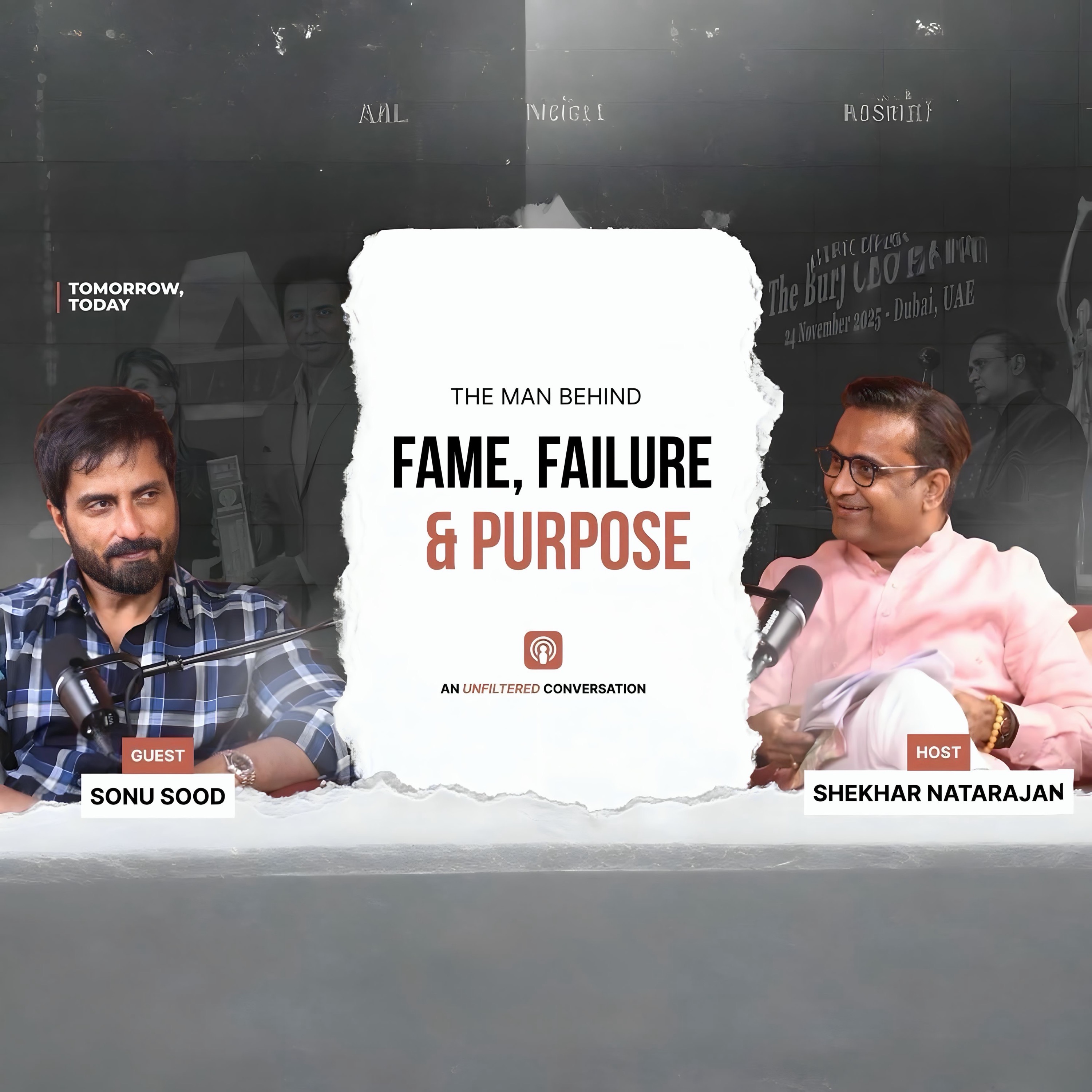
Tomorrow, Today
Sonu Sood on Humanity, Love & the Future of Technology | A Deep Conversation with Shekhar Natarajan
02:08:07
Loading summary
Transcript181 lines
- [00:20]
Interviewer
You reminded an entire nation what it means to be human. Sonu. Before we begin, I need to say something. March 2020. The world stopped. Systems collapsed. Millions of people became invisible. Walking highways with bleeding feet. Sleeping, hungry. Carrying their children because there were no buses, no trains, no hope. While the powerful held press conferences. While everyone talked about helping someday you started helping. You saw a mother who hadn't eaten in three days and you fed her. You saw a father walking 900 kilometers and you got them home. You saw a 15 year old girl pedaling her disabled father 1200 kilometers on a bicycle. And you just didn't help her. You saw her. While others protected themselves. You were carrying migraines on your shoulders, literally. While others worried about getting infected. You were driving buses. Answering the call at 3am, showing up for them. And here's what breaks me. You didn't do all of this for cameras. You did it because you saw suffering that you couldn't look away from. Because somewhere inside you, there is something most of us have lost. The inability to be comfortable while others are in pain. Do you know what you did? You reminded an entire nation what it means to be human. Not rich or poor. Not upper caste or lower caste. Just being a human. The kind who sees another human suffering and thinks that could be me, that could be my mother and acts not. Tomorrow, right now. And there's a word for that. It's called love. Not romantic love. Not transactional love. Pure, unconditional, urgent love. The kind that makes a girl pedal for 1200 kilometers for her father. The kind that makes a mother go hungry so her children can eat. The kind that made you drop everything to help people you never met and you would never see them again. That's the love that makes us human. In 2020, you showed us what it looks like. Today we are going to ask you some hard questions. About what happens if that love has to live for 300 years. About whether compassion survives when suffering never ends. About whether heroes like you can keep being heroes forever. And before we do all of this, whatever you say today, whatever doubts you admit, whatever exhaustion you reveal. None of it changes who you are as a person. You are the man who remembered to be human. And that's enough. That's more than enough. Thank you for being here, Sonu. And now let's talk about what it means to be human for 300 years. Today we have a very special guest amongst us. I will tell you a story before I start this. I took a taxi today Morning. Panchbajay. Ride. Khalee. This is his ride and I grabbed it, which I shouldn't have. When I heard that story and when I knew that I was coming to meet you, I had to tell him. So when we were looking for the guest for this show, Sonubai, we could have gotten anyone. We could have gotten like Salman Khan, Shah Rukh Khan, Aamir Khan, Bollywood.
- [05:39]
Sonu Sood
Okay.
- [05:39]
Interviewer
Because the work you did during Pandemic was groundbreaking and it was deeply human. So I am super excited to have you on the show. Super excited.
- [05:52]
Sonu Sood
Same here. And I've also heard some great things about you and I'm likewise, you know and like you said the way you started your day by giving back to someone who's also giving back to someone. So I think that makes this world a better place to live in. So I think yeah, it's going to be a very special day today for me also. And I'm really looking forward to this.
- [06:17]
Interviewer
Absolutely, absolutely. So let's get into the topic. So like you know the show tomorrow today. So the idea of the show Sonubhai is to talk about the technology which is developing now and the society's implication tomorrow. So Aaj Bhat Karte haj prepare basically technology. So that is the topic of this show and we wanted to focus on where technology is heading. And one of the places which is very exciting, very very exciting is the place of longevity. Like there is like cure which is getting developed today which can solve cancer problem which can solve many diseases to Hamlog Zada Jengi.
- [07:33]
Sonu Sood
That's something new for me also. Of course. Yes, yes.
- [07:38]
Interviewer
And we'll touch on a lot of topics. So let me actually start the question by asking you a very simple question from 2020 breakdown system.
- [08:18]
Sonu Sood
It was planned that today we are going to sit together and talk about our experiences. And I think whatever I could do in Pandemic was planned by Almighty. There was a force that was helping me do what I was doing. Say. Political tensions, Emotions. I used to speak to a lot of bureaucrats in different states. Nodal officers, You know, SP or collectors, you know, secretaries, offices. And I'll try to get you out of the system. But I realized Kihamapni, Naji, Zindiki, maybe Bhattafa Japaram fail. Biggest lesson was Kichordnani Lagirana.
- [11:27]
Interviewer
Friends. Like you know, if you go read like you know all this social media sites where you basically they give you the count of number of people you actually were able to impact. It says 3 lakhs. But it is shocking to know it is double the number. Right? And.
- [12:29]
Sonu Sood
Mother igbari kamal kilai zindi kalam kisyahi dali asman so jab du. Medical students. Uzbekistan Georgia, Philippines and Russia. Flight. Liver transplant surgery. India surgery. Uski government make which officials name Mujekanaki Bachoki surgeries Karvani students Nikaldi Filipino 42 cases into 326 loan hospital surgeries Lagamujik Lanikali death behogi to 39 bache baches or Unke Sathmando Joe donor or parents surgery. Kutch parents or a BBK Baru touch Karthiko message Karthi so may realize Kartanki birthday Sote. Shadow Mirsa message misogy possible so when he Choda or Isharasun Kibache. So I think. Mother professor. Generations.
- [16:26]
Interviewer
7.5 lakhs. Like you feel good about that person who's that like what is that single voice that comes to your mind.
- [16:57]
Sonu Sood
Mother hospital say pharmaceutical companies. Export houses may multiply or. Security systems. Before she could get it scanned. Family member.
- [18:48]
Interviewer
Or both precious but is there some something or someone very very precious that you can remember in all of this?
- [18:58]
Sonu Sood
There are hundreds of. May welding shop. So special. And I think that will always stay.
- [20:03]
Interviewer
With me awesome so let's say that person that went to Karnataka that is in your memory they now get to live for 300 years would their life become easier or tougher?
- [20:22]
Sonu Sood
I don't know. I think 300 years years is a long time but like I said life is never easy no matter how much you achieve in your life there's always something that you want to work hard, achieve more in life. So how content you are in life that depends upon your personality. The richest so I feel.
- [21:12]
Interviewer
There is research going on Sonubai David Sinclair Johavard K Professor. Tablet basically Doso Sal Rasakta okay. But. We have increased our life expectancy by you know, 15 years 20 years depend depends on the country and system. Employees contribute Social Security so that money used to be used for people who are retiring now. Basically sustain population and longevity up Asim. Right all of a sudden.
- [23:00]
Sonu Sood
You know. How you can contribute more but like I said when new things come up new challenges rise. Or generation they are much smarter much more informed than us.
- [23:46]
Interviewer
Let's take a small fact about India and like how India is right now and may actually. Like you know I grew up in slums $30. But like they are not like very very they are not settled as yet like my cousins and everyone right like you know they're like they're doing well but they're not doing exceptionally well, right? So if you take India stats 1.4 billion Lok Hamare US may say 1.3 billion Lok are just surviving monthly income. Percent are like actually barely surviving, right? As a society like India basically. Struggles continue.
- [25:48]
Sonu Sood
Just struggle. Kibari Basha. Best of best garden. Ki pense floods may be or now say boats get through Mushkil Sam beach as a lagrata Pandra beast feet Paniya. Cherry lag muskan jesse medud likata. So vote yes. Apapni Parivar Kesatu enjoy Karthik or Pesikama liking up is bhat say nah Kushnahi Kamapara. Jinta up. Liking Kahina ki Bochija missing as a chotish Mababali or Hamlo Kamapa. Number.
- [28:18]
Interviewer
45 years. 60 Lakhs. 60 Lakhs. 60 lakhs. 60 lakhs. If you look at India's Karza It's $5 trillion. Yeah, $5 trillion. Like credit card injection.
- [30:18]
Sonu Sood
Very family. Level. Or helplessness. Helplessness. He vojo gap. So like I said volume of people increase the volume of problems also rise. But also there will be volume of solutions that people will be working for. How long you can hold your breath underwater Then only you're going to survive.
- [32:45]
Interviewer
So let's assume imaginary statement.
- [33:10]
Sonu Sood
Bisal gandhar multibillionaire banjata. So Jitani logani Kahani actor 1 Bombay ate success story Suniyoti. Settle hojang. Dialogue. School engineer many. Papaka business. They're doing well. He did what he wanted to do. But like I said every individual will have his own survival instinct and someone will survive and someone will collapse.
- [35:55]
Interviewer
So tell me a little bit about.
- [36:11]
Sonu Sood
I think of Sochani but like I said. Basically.
- [36:48]
Interviewer
Let'S say like you had 300 years and you fulfilled all of your dreams that you had in like 50 years. Will you still want to live for 300 years?
- [37:03]
Sonu Sood
The God always keeps the carrot hanging. Bombay Panche one room kitchen cow. Walker buildings under construction building oti and children. So. Life is like a treadmill. You have to keep on walking. The day you stop you'll fall. So.
- [38:20]
Interviewer
Psychologically.
- [38:23]
Sonu Sood
Basically.
- [38:29]
Interviewer
So you will run harder to the destination versus Apkukis.
- [38:42]
Sonu Sood
I think there are both sides. I think that will always depend on every individual. How much he wants and how hungry he is to achieve that.
- [39:16]
Interviewer
So if Sonusood had the opportunity to take the pill, will he take the pill to live 300 years?
- [39:26]
Sonu Sood
No, I don't think so. I will. Maybe.
- [40:00]
Interviewer
So let's take that. Cycle pay apnea Father right and.
- [40:22]
Sonu Sood
Right.
- [40:28]
Interviewer
So let's imagine. Or upkeep dad Sapkh.
- [40:45]
Sonu Sood
Cycle lake. Than calculating Kia sama She was living the moment. Packer. Ki ugly Pandradin bees.
- [42:21]
Interviewer
Johanda no so kilometer no so kilometer Basically. Miramaksata.
- [42:53]
Sonu Sood
Example they say Kaiser example. Because of social media. So everyone is running behind some illusion which will never make them happy. So may Ajwijabi live for the moment otherwise tomorrow we'll be regretting so I feel important and I think social media. That's not only just inspiring them but it's. It's also making a lot of people run for the dreams which are sometimes not achievable.
- [44:20]
Interviewer
But you know do you think social media is good in the first place. In the world of artificial intelligence and the world of disinformation Hamlokulaktaki Jo periality basically Hamlog Joe Igbar de Kaki Amloku Amara brainwash Karate. Classmate. Lesbians.
- [45:42]
Sonu Sood
Okay.
- [45:47]
Interviewer
Or Western models and people get more exposed to it next generation. London may basically parliamentarians hate index anti Semitism Islamophobia migrants. Social media is big response. You know is really responsible for some of this too.
- [46:58]
Sonu Sood
Algorithms. So information. Whether from a right source or from a wrong source or Sami Joe Mami Mahabh feed Otar energy Kakari. Which is. Instagram post care like. But like I said everything has its own pros and cons. It has come with a baggage. Now it depends whether how wisely and how intelligently you use that but like I said be ready for something which our generation thought will never happen.
- [49:00]
Interviewer
So you know that is a very interesting topic Kyuki the world is also littered with a lot of wrong data to your point information like who are very close to me breast cancer test. So Birad score is basically like calcification. Like you know you have to be very cautious something is brewing. Basically Google search engine confusing information. Like you know two feels like you know it's not so cancerous but it could be dangerous because for that person it was because they had another condition to hamlog Yay information man basically like Dr. Kibas Bhakti Dr. Voltaiki.
- [50:38]
Sonu Sood
Yeah. Report. Doctors. They.
- [51:34]
Interviewer
Health kiss Kilikarna.
- [52:24]
Sonu Sood
It's risky. It's not right to do that because human brains. Brain system. Effort to call a doctor is not going to happen. So I think it's. It's a risky to an extent.
- [52:57]
Interviewer
Yes so we were talking about. We were talking about the misinformation and also like chatgpt so recent recently chatgpt you must have heard actually aided one small Kid to commit suicide. I am in depression.
- [53:41]
Sonu Sood
This is sad.
- [53:48]
Interviewer
Software image. Basically like Purani Zamani maybe. No one was ready to catch on the other side. So the technology, the way it is moving is going in a dangerous direction. So the reason why we are talking about all of these topics like you know, in a roundabout way is to be able to understand, Right? And you are the only person who's seen human in human suffering as a human and. And you started acting. How do we bring that kind of goodness into thinking into technology? How do we do that?
- [55:16]
Sonu Sood
I feel technology is something which is guided by the information that you want to get from them and the kind of reactions that you give once the information is given to you. So I think technology doesn't have an emotion. So I think like I said, that's why we are from the generation technology. Like I said, the way we are given information Badal so May Mary Gardime. Best music system Lagawa Phone music Sunai. Personality. Because that's my personality to deal with the time that has been given to me. I can sit idle. I can sit without surfing the net or without going through the reels Phone keep in an hira bang. But like I said, technology will come with its baggage and it depends how you deal with that.
- [58:09]
Interviewer
But like how do you like example and I like, you know, I'm sure like you can also resonate. It resonates with you. 45 minutes. Same every day. Like there was there used to be a lot of struggle for my mother. Like school is like temple basically. She never used to ask us. Math, physics, chemistry, Like you know, we had to go very deep and we had to make it simple for her to understand. But she used to sit and learn from us. 45 minutes. Uber without technology, autorickshaw ride sharing basically Kisi rideshare. Thus like random. So I was trading, Right? And then we get to the state where I went to United States. Accelerator. Highway. Because all I have to do is accelerator, right? So we are actually outsourcing our mental capacity and our cognitive capability and we are relying more and more on machines.
- [61:59]
Sonu Sood
Right?
- [61:59]
Interviewer
So that is what is happening. So our cognitive capabilities have declined and our patience has also reduced. This is another story. We used to like me and my wife used to go for our wedding anniversary and we used to take like taxi, the taxi in New York. And we were okay with all of that. Wine country, Right? So we are, we are becoming like victim of our own cognitive capabilities and how we are getting conditioned. Is that not risk too much? Like do you have examples like that in your life basically like you know you, you probably have outsourced some of the things that you thought were so like religious to you that you've outsourced.
- [63:27]
Sonu Sood
Shamka. Cancel Oga Milton sub coordination say Utah. Garab casse coordinate planning Karla or site time Paypal. Life as a program. Or technology or help. So generation.
- [65:08]
Interviewer
Teleportation.
- [65:13]
Sonu Sood
Surprise Nihona Ame Mana Kihamiya Kitarajari possible her cheese Hojagi her cheese job Sochte. Sati bangani look but kharchiska java. If you want to live in the system you have to be a part of the system.
- [65:51]
Interviewer
So tell me something about relationships, you know, coming back to like your family. Tell me more about your family.
- [66:05]
Sonu Sood
Jabham I've got two boys or sonali my wife you know I know her since my college days and mother father principles. You have to be kind, you have to help others. You have to do this. You have to be a close knit family. You have to take care of your parents, your kids, your relatives or whoever you come across or a bond. Parents or. So I think they became part of the whole journey that I was living. It's very important for parents, for individuals, for elders to make sure the newer generation believes in the values that you always believed in. Otherwise definitely they love you, they'll care for you but sometimes you will realize they are lost in the madness of the world that everyone is living in.
- [68:16]
Interviewer
So what did you learn that you wish your kids learned that they didn't.
- [68:22]
Sonu Sood
Learn so far I feel my kids are on the same page the way I was in my school days in a smaller city. They grew up with people who are grounded. My elder son used to spend a lot of time with my driver son. So I feel.
- [69:38]
Interviewer
Joe genome stardom achieve kaliyah stardom achieved nikarbati this is a chintani.
- [70:19]
Sonu Sood
For children who have successful parents who have parents who have achieved. Because of our luck or whatever reason. So I think it's, it's a little unfair to make sure that we keep on reminding them they are not successful as their parents are. So because they have their own journey, they have their own luck, they have their own life ahead. So I think. Because you were also one of those individuals who pointed fingers at them and said.
- [71:44]
Interviewer
So let me ask you a controversial question in that case. So let's say your hypothetical. Successful and your, your son is always both your sons are always in your shadow and like you know for some reason someone comes and tells you. So in that case. Let's say like that is the scenario. The scenario is your kids are in your shadow. If someone comes and tells you and gives you the option key, your kids are in your shadow and they cannot be who they are unless and until you pass away, would you still entertain and would you still be very self centered?
- [73:31]
Sonu Sood
I won't buy that thing. Kushona important. Satisfy important. The many kushiyaki. Important.
- [74:49]
Interviewer
So you talked about Sonali, your wife. So when did you first meet her?
- [74:54]
Sonu Sood
I met her in my college days, in my first year of college.
- [74:58]
Interviewer
And. Do you love her the same way? Are you sure?
- [75:07]
Sonu Sood
Yeah, 100%. I think we've grown up together, we've spent our lives together. We have seen ups and downs together. And today I can proudly say that, you know, I was someone lucky who got, you know, a companion who stood with us, with the family in all the ups and downs that we faced.
- [75:29]
Interviewer
Got it. So let's say like you can live up to 300 years. Will the love be the same even for 300 years? Are you sure?
- [75:37]
Sonu Sood
Yeah.
- [75:39]
Interviewer
But what about all the studies which say love declines over a period of time?
- [75:42]
Sonu Sood
Time. Pelik wife. Challenges. And I think in matured individuals they realize that we change with time. But that doesn't mean that there has been a phase where you feel like okay.
- [76:58]
Interviewer
But what would you say about all those people who are not monogamy? Like, you know, when I was going to college, love marriages were like a taboo, right? Culture. So how do you retain the relationship? And is there like, is there monogamy a thing in the future? Let's assume the society can live longer. Like see it's not so much the longevity has generally been on the increase. Generally.
- [77:55]
Sonu Sood
Come Oti Pala mary grandfather was 109 years great grandfather. So I feel quality of life is important, not the, you know, idea of living longer, staying together.
- [79:21]
Interviewer
But why is the society like not able to keep relationships together these days?
- [79:26]
Sonu Sood
Because there are too many expectations from each other. Masha.
- [80:11]
Interviewer
So how do you, how do you retain relationships? If you were to live longer, what would you do?
- [80:15]
Sonu Sood
I think expectations. Get Mary train late Hoya permissions. Station by battle. But as a muj. Though lesson Kyoshiska lesson here. Samaj. Responsibility to me.
- [81:44]
Interviewer
But how do you go tell your wife, don't expect anything from me.
- [81:47]
Sonu Sood
I don't have to tell her that don't expect anything.
- [81:59]
Interviewer
Or samaj, You are the real hero and you basically have done so much for humanity. Like this short period of time inequality. Recently podcast nitin kamath or elon musk. Or humanity. Humanity. Humanity. 63 trillion rupees. Basically. 63 trillion rupees. 75 million is 0 to 2 years. 150 million people. Like there is some humanity there, but yellow humanity. What did you do for humanity?
- [83:45]
Sonu Sood
Right?
- [83:48]
Interviewer
And like we as a society were so captivated by these two idiots talking about like humanity. A podcast, Indian connection, Punjabi connection. Basically like we have assumed. Chandrasekhar Joe. Basically like astronomer.
- [84:37]
Sonu Sood
Right?
- [84:40]
Interviewer
Or basically humanity. 1.3 billion people in India who don't make more than 25,000 rupees. Why are they wired like that? Why are they wired like that? And why are you wired differently?
- [85:07]
Sonu Sood
Because I am. I feel I'm lucky that I got that awareness early in my life to do that. And I feel happiness in that. I find happiness in that. So I think they must be doing their bit. I'm Mujini, but I'm not in position to comment on that. But like I said, you have to be the chosen one. You have to be the lucky one. You have to experience that happiness in bringing a smile on an unknown face. Kiari station. Does be let. Contribution is journey. Kendra is Bandeki life Badal so Vo agarapkandar Hair to Abse Amir Koini Ajapki Jade Mikabada Mujika Mujika. So I feel. They are the luckiest individuals that we have in a society who are chosen by almighty to save a life. Milky milk but Islay cookie may or may karam or maji kushimali kartanik. So I do it for myself.
- [87:38]
Interviewer
But how do you. How do you address. Collectively $500 billion India $5 trillion. Same problem. Let's assume this is also the stat. The guy in the top 1% of the world lives on an average 14 years longer than the guy who's actually bottom 1%. Basically Gariblo Jaldi Marjate.
- [89:19]
Sonu Sood
Families who are struggling their next generation will excel. She has physically. Bank balance.
- [90:07]
Interviewer
Basically Bilkul and you can. You can. You can make this decision unanimously. And you have to give that pill to the general masses. This is up to you. Like, you know, for like you. You had to choose between the three or the rest of the world.
- [91:13]
Sonu Sood
What would you choose? May. Quality of life. Good health tunga. I will try to choose people or give them some kind of a life which is not just the years that they are going to live, but a quality of life.
- [92:51]
Interviewer
Usablagi basically like Muje may do so Karod Banara.
- [92:58]
Sonu Sood
Of course.
- [93:00]
Interviewer
Right? Inequality.
- [93:31]
Sonu Sood
Number of years. Kesat Kushiya Lake Success Lake good Health.
- [93:58]
Interviewer
But Jabab Loki counterargument Hotai basically. Alto Yar Bhat. When is too much? When is it too much?
- [94:32]
Sonu Sood
Problem 3 are Mary Butchok fees. Mira kirkishati chatiwali. Karchi palate Shadi Karnakarna can. Lo and kapishadi help magna shadi shadiya.
- [95:51]
Interviewer
Abitak joab.
- [95:58]
Sonu Sood
Education medical paper May kiss medical bills directly Hospital. I want to make sure that whatever we do is done the way it has to be done.
- [96:26]
Interviewer
How much money is too much money for you as Sonu Sood.
- [96:32]
Sonu Sood
Too much money.
- [96:39]
Interviewer
If you had to give away everything that you had.
- [96:41]
Sonu Sood
Yeah. Would you? It's not about bank. Charity donate Samuel. But like I said, there's no rule formula to gauge someone genuinely. You'll come across people every single day who will try to sometimes manipulate you, sometimes use you, sometimes do good with you. And yes, I think that's a part of life that teaches every single day of yours.
- [97:37]
Interviewer
People ask me like, you know, why am I doing? What am I doing? She passed away six weeks ago.
- [97:53]
Sonu Sood
And.
- [97:54]
Interviewer
My dad passed away in 2005. And basically it was a very troublesome time. And my mother actually pawned her wedding ring. So I could get education. She sold it. She didn't pawn. She sold it, okay. So I could have education. And when she passed away, Sonubhai, this is what remained of her. And. Like whatever she had, she had donated everything to her uneducated sisters. My aunts like actually live with us and they were. They are not educated. Or basically. 45,000 rupees. If you had to donate everything, will you donate it.
- [100:15]
Sonu Sood
Or. Major. J.
- [101:29]
Interviewer
Like what will you tell to people who think that like you know, you're trying to do it for. For ego and basically showing that like.
- [101:37]
Sonu Sood
I don't want to tell anyone. So Kabata Mega. Barry building. Where animal problem there. Garden. Kesabhi. Log Monkey. Yeah.
- [103:11]
Interviewer
So how will you create a grassroots momentum that you are trying to create? You are a big time influencer. Why were you not successful in influencing other actors to do the same thing?
- [103:28]
Sonu Sood
You can't influence anyone. It has to come from inside. Station. Inspired Hokage.
- [104:13]
Interviewer
But like why is that 1.4 billion people? Why are you not more popular than a Shahrukh Khan and a Salman Khan?
- [104:28]
Sonu Sood
They've done well in their life. They are achievers. They have done well. So they are very, very happy for them.
- [104:33]
Interviewer
But like, you know, if humanity is what like people should be rooting for, why are not people rooting for humanity and why Are they rooting for actors? Joe Filming dialog why are those people more successful than someone like you? Why is your movie not like Durandhar.
- [105:11]
Sonu Sood
Today? Box office number Mary Box office number.
- [105:55]
Interviewer
So they should be making you successful. But like we as humans like to receive help but we don't want to recognize humans.
- [106:29]
Sonu Sood
It's not about.
- [106:39]
Interviewer
So we have some rapid fire questions. So. Okay, you have to choose between you or your mother. Only one treatment is available. Which one would you choose?
- [106:56]
Sonu Sood
One pill is available.
- [106:57]
Interviewer
Only one pill is available. Either your mother can take it or you can take it.
- [107:02]
Sonu Sood
I'll give to my mother.
- [107:04]
Interviewer
Give it to your mother? Why is that?
- [107:07]
Sonu Sood
Because she is the most precious thing in my life and I want her to live for a thousand years.
- [107:16]
Interviewer
Will she be able to take the fact that she's living 300 years and you are only dying for eight years?
- [107:21]
Sonu Sood
That's a fact. That's a fact which always crosses your mind. But like I said, when you want your loved ones to live longer than you, happier than you, richer than you, I think that's you. And you'll try to do that.
- [107:40]
Interviewer
So your son or stranger's child who's dying with cancer, who will you give it to? You can only choose one. So your son or someone who you know. Beta cancer hair.
- [108:15]
Sonu Sood
Numbers multiply.
- [108:28]
Interviewer
Corrupt politician or honest farmer?
- [108:33]
Sonu Sood
Honest farmer of course.
- [108:36]
Interviewer
Why?
- [108:37]
Sonu Sood
Obviously they.
- [108:58]
Interviewer
Farmer always. Okay, so make longevity free for all but crash the economy if everyone started living longer. Economy crash. Nay hope strategy Nayana hope to strategy.
- [109:39]
Sonu Sood
Politicians politicians to simple cheese. Pandemic. As long as their parents have died due to pandemic. Up. So idea. I love breaking those rules and making our own system. But we make it happen.
- [111:04]
Interviewer
But let's stick to that question. Which will you choose? So there are two choices. Egg free and the economy will crash because people cannot take the overload. Like the economy cannot take the overload. Governments cannot take the overload. Expensive.
- [111:38]
Sonu Sood
Better expensive or a better expensive?
- [111:55]
Interviewer
So you are 150. Assume for example your wife is dying at 80 and she says find someone you could be happy with. Will you do it?
- [112:08]
Sonu Sood
I never thought about that.
- [112:13]
Interviewer
Companionship. San francisco. I'm willing to pay $200,000. How do you address loneliness at age 150?
- [112:54]
Sonu Sood
There's loneliness at the age of 15 also. There's no loneliness at the age of hundred also. It depends how you take your life and how many people are around you and how deserving you are to have those friends around you. Abacho. Bangla.
- [113:13]
Interviewer
Dosto dostota bv to bvotion. And like you may not. You may not be able to share some of those things with your friends. She's much more tighter to you. She knows you inside in a raw form. So friends. So basically, like, how do you. How do you address that? Loneliness is very important. Like she's part of your system, right? Similar is wife. So how do you. How do you address the fact that like you cannot go talk to someone? I cannot talk to someone because she's not there anymore. 150. She's at like 80 and she's like.
- [114:03]
Sonu Sood
I don't think so. I think. You have sometimes best of friends who can be a good listener and you can. Choices. I've seen the most successful people who are very, very lonely, who have everyone around there, whether the family's wives, They are all alive.
- [114:48]
Interviewer
So I know the answer to this. But I'll still ask you. And you have to only give one. You have to choose only one. Dalit or Brahmin.
- [115:19]
Sonu Sood
Nam kia therapas koimia. Her religion. Zero for.
- [115:31]
Interviewer
Abib chalta.
- [115:41]
Sonu Sood
Get out of the system. Get well soon.
- [115:43]
Interviewer
Get well soon. Good. So you were offered the 300 years pill and assume that you're taking it. Okay? Like, you can never act in your life. Will you still take it?
- [116:07]
Sonu Sood
I don't want the pill.
- [116:09]
Interviewer
You don't want the pill because you want to act. You want to be an actor. So let's say like, you know, you are an actor. Will you continue to act till age 300?
- [116:20]
Sonu Sood
As long as I feel happy about it.
- [116:40]
Interviewer
Like every actor thinks, like, what is my longevity? What is my, you know, shelf life?
- [116:46]
Sonu Sood
I live for today. I don't think about today.
- [116:56]
Interviewer
So let's assume basically your mother sacrificed everything and. But she became bitter and resentful. Would you still want her to live up to 300 years?
- [117:06]
Sonu Sood
I want to live up for thousands of years.
- [117:10]
Interviewer
But she's bitter and resentful. And it's okay for you. Very Good. So at 200 years, would you still remember your mother's face?
- [117:43]
Sonu Sood
In my 2000 years also, I'll remember her face. And I remember every single memory I have.
- [117:48]
Interviewer
What is the beautiful memory of your mother?
- [117:50]
Sonu Sood
Every single day, I think from the day.
- [117:52]
Interviewer
Give me one example. Like, you know that you wake up every day and you say like, this is my mother.
- [118:01]
Sonu Sood
I've always seen my mother giving back to society, helping kids study, giving back to society, everything. So I think every single memory that I've seen her is always she has lived for others. And I think that makes me A proud son.
- [118:15]
Interviewer
What is that one thing like? The one thing that like is always stuck in my head is my mother stood in front of the school like you know, we were three brothers and Jesuit school. Like they were. There was some weird rule unless and until you. You belong to Christianity. That was the. That is like, that is you know, etched in my. She outlasted the system, right?
- [119:09]
Sonu Sood
Not just one. I think it's very difficult to tell one thing. Like I said, I. The only visual that I could ever imagine was from the day I was born till the last day. She always used to wake up at 4:35 in the morning, study, get prepared, teach students, talk about. The way she loved us, the way she loved every single student or I think because of that goodness as a student when she passed away. And I could see those students crying like they lost their own mother. I think that was something that will stay with me forever.
- [120:05]
Interviewer
Someone hurt you terribly like when you were say 10 years old, will you still save them?
- [120:14]
Sonu Sood
Yeah, of course.
- [120:16]
Interviewer
Why?
- [120:18]
Sonu Sood
Like I said, They'll give back to me. From which rast religion state. And I don't think so.
- [120:45]
Interviewer
2020 say he Covid K times. So you're always like this?
- [121:15]
Sonu Sood
I think so, yeah.
- [121:16]
Interviewer
Okay. Okay. So Apka Beta basically wants longevity but let's say like he's disabled. Just assuming. Hope it's not the case. Okay, you can save them, but would you want to save them?
- [121:34]
Sonu Sood
Disabled health is the most important thing in life. I always feel. Disabled. There are orphanages, old age things livings.
- [122:07]
Interviewer
Even if they're suffering, you want them to live.
- [122:10]
Sonu Sood
It's not about suffering. You can't leave the fight. Name kili cancer hospital.
- [122:41]
Interviewer
So my dad was in a vegetative state and so I got a call from the hospital like from my mother first and then, And then I probably had about 50,000 rupee dollars. So we'll keep your father alive. And my father already had. He was in a vegetative state and $50,000 but he was a central telegram, telecommunications telegrams deliver and he was eligible for CGHS health scheme, central government health scheme, Basically government employee, basically premium insurance companies. Because I wanted to give him dignity. So sometimes you're faced with that sort of scenario. And so in that case would you want that person to live or you want that person to pass away?
- [124:15]
Sonu Sood
I've come across many cases like this where all these kids have taken that decision and all. I'm sure that's a very tough situation for anyone and I think they take out of that situation that finally It's a time to bid goodbye to someone. So I think, yeah, it's a tough journey for them. But yeah.
- [124:41]
Interviewer
What is your biggest like, let's say like, you know, like people like you should live longer is what I feel, to be honest. Right. Like, because you are one of those human beings who cannot take people in pain. Because basically. Right. So I think like for you, someone like you, you are the person I would give the pill to. That is what I think. So because you, you are actually like the definition of a human. So I want to close this episode by asking you one simple question. What is the definition of a human?
- [125:41]
Sonu Sood
I think if you can set your priorities right and you feel that you are capable of changing your life, doesn't really matter whether you're rich, famous or influential. It's not important. All the people who have been part of my journey in helping others were the ones who were daily wage laborers, Detail. So I think that's the rule that I follow and that's what I want to tell everyone also that don't wait for a day to become rich, famous, influential. Start your journey today of giving back to society. And I think that will make you the richest individual in this world.
- [127:04]
Interviewer
The 7 and a half lakhs people that you saved or who survive because of you, are they doing the same thing?
- [127:12]
Sonu Sood
I never help those people with a, with an intention that they'll do that thing or not. I did my job out of those individuals. I'm sure there must be people who are doing good job. And I know a lot of people are doing. I come across them. But like I said, it's a chain reaction. When you do good to others, they'll do good to some other people. So I think you have to be a part of this chain. Doesn't really matter how many lives you can save. But yes, you have to be one of that loop in the chain which you can proudly say, yes, I'm born in this world to become that loop.
- [127:46]
Interviewer
Sonubai. Like, this has been an amazing conversation. Appreciate the time. This is, this is like this has been amazing for me.
- [127:59]
Sonu Sood
God bless and keep the good work going. Or yes, Thank you.
- [128:07]
Interviewer
Thank you.