← Tomorrow, Today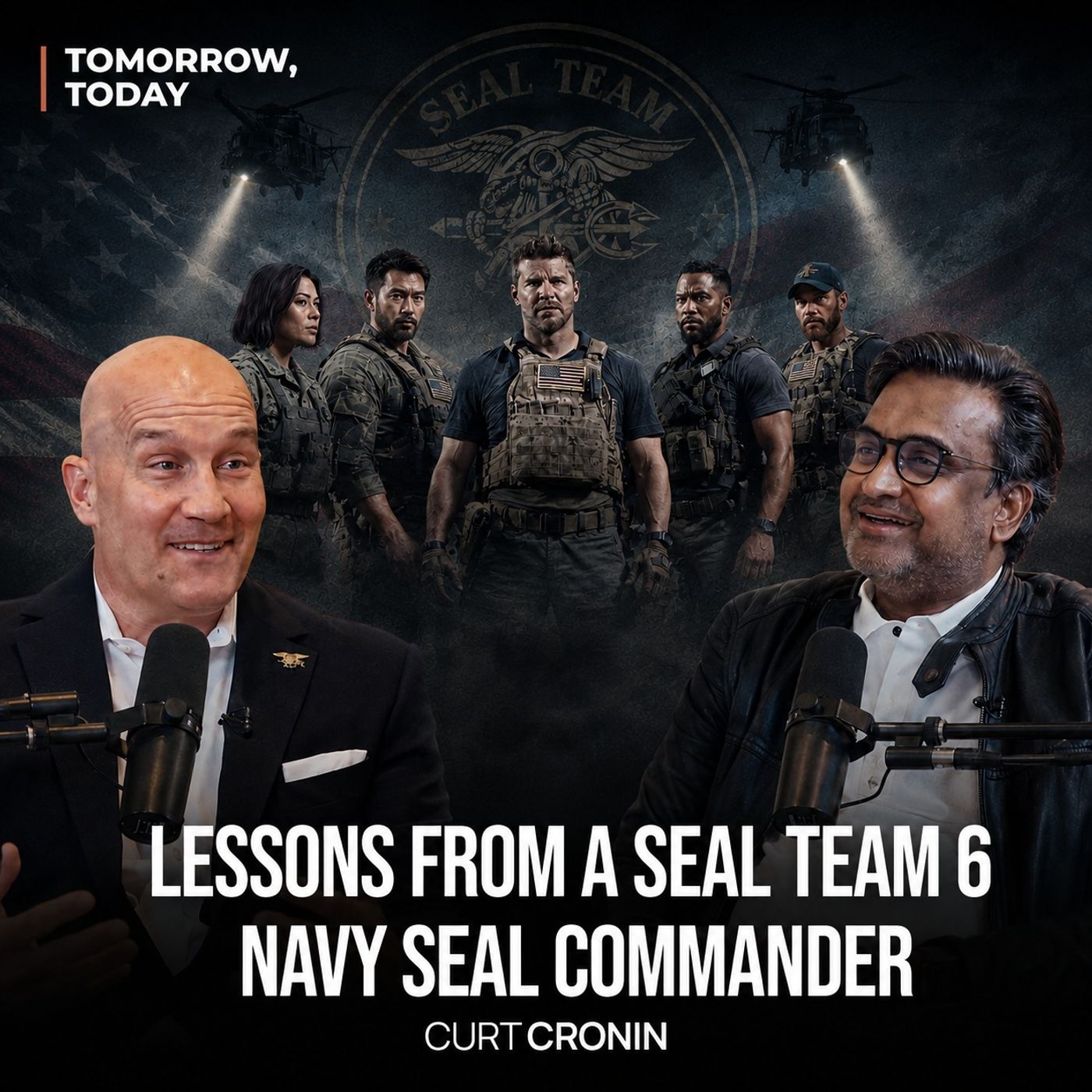
Tomorrow, Today
The Untold Truth About SEAL Team 6 | Curt Cronin
01:52:47
What does it really take to become one of the world's most elite special operators? In this episode of Tomorrow, Today, Shekhar sits down with Curt Cronin, a former U.S. Navy SEAL Team 6 operator, to explore the mindset behind some of the world's most demanding missions. Curt shares his journey from growing up in rural Illinois to earning a place in one of the most elite military units. Together, they discuss leadership under pressure, teamwork, mental resilience, life-or-death decisions, innovation, and the human side of conflict. Beyond the battlefield, the conversation explores how lessons from military service can help entrepreneurs, leaders, and anyone striving to perform under pressure. This isn't just a conversation about war. It's a masterclass on purpose, trust, courage, and becoming the best version of yourself.
Loading summary
Transcript222 lines
- [00:00]
A
Is that fun moment where something that is not visible becomes visible and once you see it, you can't unsee it.
- [00:10]
B
I did not have the physique. Two, I never had the mental capacity. And three, I, I don't think I could have done it.
- [00:19]
A
In overwhelm. You'll do things that feel natural, but emotion often gets you killed. Like,
- [00:30]
B
But instead of like addressing the problem of why that person is doing that, we just like simply put a label and want to take them out.
- [00:37]
A
Right? And there were 12 people that the moment they hit the finish line, they quit because they had set in their mind that this was the stop line. Foreign.
- [01:15]
B
Welcome to another episode of Tomorrow Today with Shekhar Natarajan. I'm really, really excited. Like I, I've always dreamt of being part of the armed services, being part of serving the nation. One, I did not have the physique. Two, I never had the mental capacity. And three, I, I don't think I could have done it. But it's my incredible honor to actually welcome today to the show Kurt Cronin who was an ex Sealy Team 6 guy and now he's doing something phenomenally great. And I want to unpack the journey of Kurt, ask him a lot of thought provoking questions as it relates to basically country nations. What does it actually take to be a SEAL Team 6 person? What does it mean to basically be in the war front trying to protect the country, the psyche of the people and technology where it is headed, the impact in the society, how is it used in the warfare? Many questions to kind of like go through. So I'm excited Kurt to have you here. So I'm excited to have you, like you're my newfound friend. Like I've been super fascinated just meeting you, talking to you, getting to know you as a person. I think this is going to be like a phenomenal, phenomenal episode. I'm so looking forward to it.
- [02:38]
A
I can't wait. Your presentation yesterday was extraordinary and eye opening and really to me genius is that fun moment where something that is not visible becomes visible and once you see it, you can't unsee it. And I thought as you described, hey, how do we now ensure that the future of technology serves the humans and is in service of virtues and values and is not a bolt on to follow I thought was extraordinary. So I'm really looking forward to this conversation.
- [03:03]
B
Absolutely, Kurt, I love it and I think we are kindred spirits in that regard. So Kurt, I would love for the audience and just as of today morning, we clocked 500,000 subscribers. We just launched it.
- [03:22]
A
So congratulations.
- [03:23]
B
Yeah, just three months ago. And you know, it's been a phenomenal journey, like, you know, bringing like a lot of great people, unpacking a lot of interesting stories. But I think your story is extraordinary, very extraordinary because it takes a lot to become a SEAL Team 6, like squad. Right. And so I want my audience to know all about you, who you are as a person, where did you grow up, you know, what made you who you are, the journey, and just unpack it for us. Sure.
- [04:05]
A
I think for your audience the most important thing to know is it's all just been following the path and none of it was planned. And it's literally been, you know, as we were discussing ahead of time, it's following the path through a series of portals at the time. All feel like death and some more real physical danger than others. But each, each one is a requirement to shift identity, to be able to serve at the next level. You know, I was, I was a tiny farm town kid in rural Illinois.
- [04:38]
B
Where in Illinois?
- [04:39]
A
Dwight, Illinois, about 90 miles southwest Chicago. And I thought at about the rate that crops grew, you know, because it was a very rural community and it was very, I felt very privileged to be able to raise almost in a different time relative to the world that I entered later. But my family and my father and mom always took us, they were passionate about nature. And so we had a van. We didn't have much money, so we had two car top carriers. So we drove to all the national parks and we had one car top carrier full of luggage and one full of tents. And so we would camp all over the national parks. And getting into that sense of awe is always a sense of grounding and getting to be a part of something larger than ourselves. And we drove through a national monument one time, the gates of the Naval Academy. The marine gate guard made a mistake that changed my life. He mistook my dad for the superintendent of the Naval Academy and saluted him. And my dad's like, this is amazing. You're going. And I was 16 years old. I was asleep in the back of the van at the time. And I thought, it's 10 to 1, guy to girl ratio. I'm kind of into girls right now. I'm not that good looking of a guy. There's no way I'm ever going to get to date here. I don't really like guns. I don't know if I want to march around like tin can soldiers like this. None of this seemed to be a calling for me. And so I actually, when the application time came, like I said, hate teams. I love individual sports, and did everything possible to not get accepted. And as they would have it, one of our dear friends knew a congressman, so helped us to get the appointment. I was an Eagle Scout. I've come to learn later that an Eagle Scout and a sibling that that's been successful are two of the highest correlations for success at the Naval Academy. And so I happened to have, unbeknownst to me, a lot of the criteria that would allow acceptance. And then I got accepted. And I had just gone to a university in southern Illinois, and I'd gone for the incoming freshman visitation night, and it was awesome.
- [06:46]
B
And you fell in love with that?
- [06:47]
A
I was like, that's where I'm going to go. And I remembered the acceptance came in the mail, and we were sitting at the kitchen counter, and my dad said, are you going to go? And I said, no. He said, unconditional love. You can always come home, but you're going to try this. And so I went with reluctance and hesitation. And of course, that. That led to I day kicks off, and they're screaming about shoeshine and name tags. And of course I'm like, guys, relax. Which didn't go over well. So I was ranked dead last in my company to begin with. And I remember I was suffering all the way through Thanksgiving, and I read James Webb's A Sense of Honor, and I read that book. And I remember reading it and thinking,
- [07:30]
B
how did you get hold of it?
- [07:32]
A
A friend gave it to me. I don't remember how I got it, but I remember I was on the airplane home because I literally had zero times. I'd been scrambling. I did not understand the test I was in. The test was, can they give me 48 hours worth of tasks to do in 24 hours? And can I prioritize? But as a people pleaser, I was trying to do it all. And so, of course, I was failing at everything. And I read the Sense of Honor, and it was about a plea, but the Naval Academy. And I was reading it and like, wow, that plebe is doing some really stupid things. And I blinked twice. And like, that plebe is me. And it was fascinating. That's why I love community. That's why I love relationships. I love being able to reflect in the mirrors. That story reflected to me a truth that I couldn't see in myself. But the moment I saw it, it fundamentally changed my entire experience because I went from, oh, there's no way I can possibly know everything that they know into. My quest now is to resonate with confidence, clarity and conviction. And it completely shifted my entire experience on a dime. And it was. There's so many moments in life where the moment like my, my four meditations right now are for awareness because I can't act on that which I'm not aware of, discernment. So if I have greater awareness, ideally better actions, wisdom, because, you know, I can teach knowledge, but wisdom must be earned and grace, because there's so much beyond that which I can do. And so, you know, those moments of awareness where all of a sudden there's clarity and that which was opaque now becomes clear, changes everything.
- [09:02]
B
So before you got to even getting to age 16, how were you as a student? Like, what did you do? Like, you know, like, like how was schooling? What is the role of your mother, father, your grandparents? Do you have siblings? Did they influence you? Like, all of, like, I would love to hear all that. Like, because I think like, you are who you are because. Not just because of you, because all of the other things which actually go with you.
- [09:27]
A
I'm a huge fan of lineage. And remember my grandfather flew for some of the first night fighters in World War II. And so he was, I can easily say he is my hero. You don't know it. At the time, I just had this powerful presence and he was completely humble and self effacing. But when he, you know, flying the first time on radar at night, you know, overseas, and then he came home from the war and took everything he had and broke sod in Colorado where there'd never been any farmers and started farming. And so he was just such a fascinating builder and a courageous person of principle. That definitely had a massive impact on me and on my mother and then my parents. It was fascinating. I wasn't aware that mom and dad was really two separate people until I was at the Naval Academy and started to see, oh wow, they were such an amazing dyadic front that it gave me a. And really they served two different roles. Mom was always really like the safety net and dad was always like the shoot for the stars. And the combination of the two meant you could take any risk because you always knew that they were going to cover. And at the same time, it was always stretching limits. Like the Naval Academy was well outside of what I ever would have fathomed as possible. And so that's always my quest is like, how do I show up for others in the way that was done to me? And that allowed me like left my own devices, I would have had a completely different arc. And so it's been such a blessing to have all the miracles of the humans that have continuously showed up and provided support, pulled me in directions that I would have never intuitively done myself.
- [11:06]
B
And like, siblings, like, what is the role of your sibling? What do they do?
- [11:09]
A
And they're amazing. And I'm the oldest. I have a sister that's three years younger, and her brother. It's three years younger than.
- [11:17]
B
What do they do? Like, they're all.
- [11:18]
A
My sister is a lawyer, and she's kind of been all. Traveled all over the world, and now she does. She loves helping to do estate planning. And how do you do intergenerational planning? And my brother followed me at the Naval Academy. I had a choice, the Naval Academy, between seals and Medical, and I chose seals and my brother chose Medical, so we ended up getting both. And so he's now a doctor at Walter Reed.
- [11:40]
B
Oh, wow. Fantastic. That's where, like, you know, like, they treat the president of the country and so on and so forth.
- [11:47]
A
Right.
- [11:47]
B
Okay, great. Like, you know, what a Great. And like, your father was basically, you said, like, he was into farming. Was he into farming?
- [11:53]
A
That was my grandfather. My father's a veterinarian. He was Dr. Dolittle. And a lot of, like, my kinesthetic nature, I think, comes from him because he would, you know, the animal can't tell you what's wrong. And so he would intuit what was wrong. And then, of course, you're treating the owner, and you're helping the owner to understand, you know, the pain that their pet's in. And being the oldest was fantastic because all the large animal calls, I got to go out and be the assistant to either hold the twitch for the horse if they're delivering or deliver the puppies. And so it was an incredible experience, understanding. And I can express it now in a way I didn't understand the way he intuited and felt his way through here. Here was the thing that was the most correct and most authentic to do.
- [12:36]
B
And so school, like, growing up before you got into Naval Academy, like, how are you as a student,
- [12:48]
A
teacher's pet? Like, you know, I am a recovering people pleaser. So it was always any task that was put in front of us. My assumption was just, like, it's for my best interest. So, like, I would study as hard as I could possibly could, like, try and achieve everything. And so, like, I studied, got straight A's in schools, and, you know, I was always a hard worker. I was Never the most talented. And we were chuckling earlier like, I think I had most improved player for every single sport, every single season, never was valuable. So I think I started very low bar, but it was always a fun challenge to see how much could I push the limits of where I was and how can I. One of my basic philosophies is what I don't want to when I die. My greatest fear is to meet the man I could have become. You know, so ideally, the gap between the potential and what was manifested is as close as possible to reality. And so I was gifted with so many amazing coaches and mentors to follow. And I love taking on mentors because when you read a book or you meet someone, you get their entire lives experience. They can share with you in a couple hours and you can import all of that wisdom into you and then help make yourself better.
- [14:00]
B
So going to the Naval Academy and choosing the SEAL team, right, the SEAL team, you don't choose, the SEAL team, chooses you to be part of it.
- [14:12]
A
Yes, both.
- [14:14]
B
Right.
- [14:14]
A
So of the thousand students, it felt like there was roughly 100 that wanted to go into the special operations community, into the SEAL community. And there were 16 billets. So it was fiercely competitive. So we basically, the full four year academy process was really working toward that service selection and service assignment.
- [14:34]
B
Is it competitive or is it like, is it camaraderie? Is it competitive? What happens? Like, how do you get to be the 16?
- [14:40]
A
I would say it's extremely competitive, but it, but it had an unbelievable sense of camaraderie, of we're all trying to compete for this. You know, it's a coopetition. Right. We all knew that There was only 16 slots, but it was, it was an extremely. My favorite moniker from the SEALs is Team Guy. And I think it is the superpower of the seals is that it is, is about the collective. And so like, to me, it's fascinating. It's actually by. It's not by design, it's by default. So if you think about it, the Navy in the 1700s, when the United States Navy was formed, you didn't have communications platforms that you could communicate when you're at sea. And so the Navy, unlike the army, that was always centralized and was always, you could always, you're always connected to your boss. The Navy was commanded by negation. And so the guidance was, you can't do this, you can't do that. Anything else inside this band you can do. And because you're working in the water, you always had to work in collectives. And so you enter the information age and we happen to be used to working in scrum teams, like small units that were worked autonomously. And so like it's fascinating, you know, what led us here and then now we get to decide what we're going
- [15:45]
B
to do with it is like so the SEAL team and the way the army operates, it's completely different, I'm sure. Right. Like, you know, the way they approach problem solving, thinking.
- [15:55]
A
Well, I would say the lineage right now we're on the information age and like the Joint Special operations command really 2001 has continued. Right. So these shared lessons have made us infinitely closer than, than in the past where, where our lineage came from. But you always have, you know, some of that tradition passed down.
- [16:14]
B
Yeah, but like they always compete. I, I remember like, you know, there's always a football game where you guys compete and like, you know, everyone celebrates whether the army wins or the Navy wins. It's so fascinating because see all of the guys that I've worked for, the most fascinating leaders I work for and I'll name a few of them for you. Like one of the guys who I, who was actually not my boss but like, who was much senior to me at Walmart, his name was Brent Beebot. And Brent was a submarine guy. Okay. But he was the Walmart's E commerce supply chain guy. Okay. Then my boss was Chris Altmeyer, West Point graduate.
- [16:56]
A
Okay.
- [16:57]
B
And then I had like Luke McCallum, he was the head of naval reserves. The second, second in command. Like so basically if anything were to happen to the head of Navy, like you know, this guy would step in right from the Naval Reserves, like, and he's, he just retired like recently. But he would all, he would actually go off on duty and you know, he would just. And you like, you know, like so I was administratively, I used to work for him but like he was never there. So I used to always for Chris. And so Chris gave me the directions, the administration capability and all of that. But Luke was such a fascinating guy. And one thing that I, I know like, you know, they, they like every time these games are played, there's so much fun and drama.
- [17:43]
A
Absolutely.
- [17:44]
B
And they what they, what they really used to, what I really liked about all of those guys was you know, if the meeting starts at 3:30, the meeting starts at 3:30 and you shut the door behind at 3:30 and like you're not allowed after 3:30 by the way.
- [18:00]
A
No fail mission. Absolutely.
- [18:02]
B
So that sense of discipline and that sense of like, you know, logistics, I think all Logistics was run by people from armed forces and they made like great logisticians for some reason or the other. So I want to understand the psyche of like, like what it actually, what happens to you when you're in army or navy or like C team. And like what happens to you like psychologically what happens to you as a person, like your compass and where you are and how you point yourself. So talk to me more about that. It's very fascinating.
- [18:41]
A
You're intuiting a lot of it. I would say the easiest is to talk about buds, right? And so, you know, people think about BUDS or Basic Underwater demolition slash seal school, they think of it as unbelievable physical rigor. And it is physically rigorous, but it's only physically rigorous to test for mental and spiritual resiliency. I remember spiritual, I think, yeah, for me. And that's not necessarily religious spiritual, but like source. Because to me, if you're going to be in full surrender to a purpose, a mission, to me that is a, that's a spiritual endeavor. That's beyond me. So to me, like that's beyond just the individual self. And so that's the most fascinating part of it is it's ingrained into you that you cannot do it alone. Right. If you ever, if you ever leave your swim buddy and run off by yourself, you're going to get, you know, extra emi. Extra military instruction. You're going to, you know, you're going to suffer and running with a boat on your head. It's fascinating because if the six are moving in unity, then the synergy is fantastic. And you can do pretty amazing things. The moment that somebody pulls their head out from underneath and the weight is transferred and it's unwieldy and all of a sudden you cannot perform the task. We do log pt. So you literally can't lift the log unless everyone's lifting as one. And so you learn like, okay, here's what we can do as a collective. And so that the part is the most fascinating part of becoming a team. You know, like I have five kids, three of them teenagers. And so they're going from dependence to independent. And their quest is I don't want to be surrendered to my dad's orders right now. So I'm, I'm doing everything to separate and become independent. And the military, I really think does an amazing job training for interdependence. And that culmination comes to when you get to the most high end missions where, you know, he said, what's my favorite moment in the military was when you're we were in the desert. It was in rock at the time. But, like, the rotors spin up, and then when the sand hits the outside of these rotors, you've got, like. It's like. Causes sparks. And so you've got this two rings of lightning around this outside of this helicopter. It's completely pitch black, and you're completely adrenalized. And, of course, you board the helicopter and you're sitting about as far apart as you and I are, and then you've got night vision on, but then you kind of move it up in 45 and give a quick head nod. And the head nod means my life and yours and yours and mine. And I now understand that is like, that's the coherent field. We're now in full surrender to the mission. Everyone now becomes a collective. That hive mind or that flow state that now allows each person to have that complete dynamic subordination with it. So when those 10 helicopters fly off simultaneously, I said, kirk, can you clear anything that comes your way? I'd say absolutely. And do you have any idea how? None. But it was a complete trust that the helicopter pilots are completely in charge until the moment you land. And then the reconnaissance team leads you out because they're the most qualified to lead. And then without 100 meters of the target, the breachers come up front to get the door open. And as soon as the doors open, the assaulters come up. And so it's this dance where everybody knows that the moment it's theirs to do, you're required to do it. And the moment someone else's helicopter pilots are not good on target, SEALs can't fly helicopters. It becomes that fun part where it is that as a collective, the interdependence allows you to do that no individual could do. And so that, to me, is the most fascinating part of service at the highest level and service to each other.
- [21:56]
B
Wow.
- [21:56]
A
And Steven Pressfield's one of my favorite authors. There's a section in Gates of Fire where he talks about, how do you get ready for combat? And it's interesting because when you deploy, you deploy for the big things. You deploy to protect your family, to protect the nation, to protect others. That was really my calling, was I thought, we've got this incredible gift that we never even asked for our lives. And the greatest threat, I thought, to humanity was terrorism. Someone taking that gift from you without your. Without your permission. And so that was what led me to that first calling, was, okay, can I. Can I stand the line between those who would do Baharm and those who couldn't defend themselves and could I surround myself with individuals that could, that could complete these impossible missions. And so that, that was where the initial calling came from. And that level of service was so, it's so exhilarating when you can, when you are really, when you really realize the power of the collective.
- [22:48]
B
Wow. So obviously that all of this has to be rehearsed, choreographed, understood. Like, you know, you're running through all the simulations, all the scenarios, all the possibilities, eventualities, like like, how does that happen? Like, like, are you, like the 16 gets selected and then like are the 16 going through the rigor or the 6 is going through the rigor or what's happening? And like how do you form the team of six? How do you form, like, you know, you were 16, right? So how do you form this team of six and like, you know, what is the simulation? What happens like the war games and what are you trying to like, you know, fight for? I would love to understand what's fascinating
- [23:34]
A
because part of it is learning to plan for anything and everything and then at a certain level you have to forget it all so that you can be in a flow state. That's the most fascinating part is like we would do contingency planning and work through every possible scenario that can go wrong. So logically you have to think of everything that could go wrong. And then once the operation starts, you have to kind of release that and now trust that the person, the point man in the front, were going to completely respond to whatever he says. CQC close quarters combat is one of the most fascinating and dynamic aspects. Because if we stack on the door, if there's four people, the one man's hold, the responsibility is to hold the door. The two man is then to make sure, okay, do we have everybody in the stack? Are we ready? And if you give them that squeeze when the one man goes through, he might go left, he might go right. You don't know which one he's going to do, but he knows completely that the person behind him is going to go the opposite way and then the three person is going to follow behind that. And it's fascinating because when I, if I enter a room, if I go to the left, so I have no idea, all these threats over here, I'm completely vulnerable to. But if I get distracted and I don't cover my area responsibility and look over at theirs, then I'm actually have left my whole team vulnerable because they're not going to look where my responsibility is. So the interdependence of if I'm focused on my 45, then 360 into 45, I have an 8x mathematical advantage on anyone that I'm functioning as a team. And so now all of a sudden I'm focused here. If I clear my threat, then I take a second sweep and help and then I can go help anyone. But first I have to do what's mine to do. And then, and so it's fascinating that the fact that you can now go into a room where people are set up and waiting for you, but because you're functioning as a collective, you can still overcome almost any odds.
- [25:16]
B
Wow. So how do you, how do you train for this? Like, you know, where do you put, where do they put you in training? Like, what happens? Like, you know, are you underground? Are you, like, you know, are you, are you in a desert? Are you, are you in like simulation room?
- [25:32]
A
Like, that's easy. Wet and sandy. I mean it is how you train for it is learn to get comfortable being uncomfortable in every condition and in combat, that would be getting comfortable being uncomfortable with a threat to your life. The way they simulate that in training is you're going to go sit in 60 degree surf for hours on end and all they're testing is do you have a mental fissure? I mean, I'll never forget, I think it was the second week of buds. We had this four mile timed run. So we ran down the beach, we came back the beach and that the finish line. The instructor kept running and there were 12 people that the moment they hit the finish line, they quit because they had set in their mind that this was the stop line. And you can see the horror in their face as they're now out of BUDS forever. But when the instructor turned around a hundred meters later, because they were able to go to what they perceived as a finish line, but they could not go when there was no perceived finish line. And so that becomes the constant resilience training. Can you continue against all odds with no finish line? It's very easy to think another, another, you know, two hours, another five minutes, but now there is no finish line. And that, that's the part that's the most fascinating was the operations that you, you know, Buzz was hard, but it's the easiest thing that we ever did because then you just have to not quit after that. You're driving yourself. You and your teammates are each collectively driving. Okay, we have to keep persistent until we complete the mission. And there is no and so that's the fun part is can you persist, as you know as an entrepreneur, when the moment you start a company, everything is wrong with it. And then all you're doing is starting to fix things that are not yet functional. Can you live not knowing the unknown? The unknown, like, can I live that zero to one where I'm creating from vapor? There's no model. It's never been done before. That's the really exciting part is all the training at first is teach you all the patterns. Here's all the tactics in the past, here's all the things that have been done only so you can get to the point where you release all of those and you go with, what are we going to create as a collective? That has never been done before. Which is really the innovative thing that's going to be required to win in a new environment.
- [27:41]
B
So all of the training is primarily to get your mental capacity up so you could actually deal with the unknown.
- [27:51]
A
I would say to become a learning organization.
- [27:53]
B
To become a learning organization.
- [27:54]
A
It was fascinating. We had such a privilege of. We get to work with the best free fallers in the world. Like, you know, these professionals that that's all they did. They had thousands of jumps. And at first it was confusing because I'm like, well, if they're so much better than me, shouldn't I work with somebody with 100 jumps or 200 jumps? But the reality is, if I don't have much time, the best training is if I have zero skills and they have infinite skills. The gradient between my skill and theirs, I will learn so much more and I won't learn any bad habits because they're actual masters at what they do. And so now I can learn at an exponential rate. And so the most fascinating thing was when you go into a training with an expert, whether it's a diving expert or shooting expert or you have to completely surrender and learn from them. Because if I resist, they're going to tell you to do things that feel really awkward, like move your. I remember the first time I jumped out of a plane, they said, no matter what, don't tuck your legs. So, you know, you get to jump. It tends to be a very emotional event the first time you jump out of plane. And so he's like, at the end we got to the ground, he goes, did you. Do you tuck your legs? I'm like, no. And then showed the video and they're basically wrapped around in the back of my head. Yeah. In overwhelm, you'll do things that feel natural, but emotion often gets you killed. Right. When I Jumped out of a plane. If I'm rigid, then I'm going to be unstable in the air and I might fall into my back. And if I open my parachute, my shroud lines get wrapped into my back, then I'm going to die. But if I fall and I relax, as my instructors told me, I'll fall down through the flat through a column of air. And same thing when I'm under a ship. If I'm at 66ft or 2 atmospheres of pressure and I lose my air source, what's the response? Hold my breath. If I hold my breath on compressed gas, the air will expand four times and blow up my lung. But if I can go with my training and continue to exhale the entire time, the air will expand as I go to the surface and everything. And so it's fascinating how we had to learn to override the things that felt good but weren't actually healthy for us. And to me, it's in life, whenever, when I feel threatened, get an argument with my kids or with my wife, like, in the end, that's not productive. It feels certain in the moment, but like the, the easier would have been, can I hold that space for grace? And, and can I hold these, these conflicting perspectives long enough for us to come to resolution instead of conflict? So to me, it's, it's all one continuum. It's fascinating the different dynamics.
- [30:05]
B
But would like, you know, on that topic, right, like, would like people not think that it's conflict avoidance if you're trying to, like trying to find time and grace in the moment? Like, you know, someone would say, like, oh, you're walking away from the situation. Like, that's the, that's the common response you get.
- [30:20]
A
It is it is often considered a weakness. I would say one of the greatest challenges in our world today is waiting. I call it saving the space for graces, waiting that extra few moments in uncertainty because uncertainty is uncomfortable. And to me, the most. Patience is not a superpower of mine. So it's a learned skill. But if I can hold that space for grace and if I can wait to make a decision in uncertainty a little bit longer, I have continuously been amazed at what additional unfolding occurs that could not have occurred in any other way.
- [30:58]
B
Give me an example.
- [30:59]
A
I mean, the most crucial example is in one operation we were working in a foreign country where it was rumored there had never been any Westerners. And so we were going to do a patrol 17km out to see if we can get access to the target that we'd never had access to. And so at the time, our host nation counterparts were very concerned. They said, if we go out there tonight and the tribes find us, they're going to kill us. And so we were very lightly armored and we were literally just going on reconnaissance. And so we started this drive and first we were going to take Humvees. If you've never driven a Humvee, put on your bucket list. They're amazing, you can't get them stuck.
- [31:42]
B
Unbelievable.
- [31:43]
A
And they said, hey, we're not taking the humvees, but you can take armored suburbans. And so there's my first deviation. Like I really wanted to go do this and so all of a sudden make this deviation from here. Here's what I, what was the right thing is a 10,000 pound suburban on a dirt car is different than a dirt road, is different than an armored car. And then our host station counterparts wanted to drive one of the cars. And so now I can't share the same technology with them. They had the old green hexagon. I've got Gen4 vision, so I can see everything. But now, no, I really want to go. So I start to deviate. So we drive 16 of the 17km and I get a call, stop, stop, stop. And I get out of the car. And my host nation counterpart has perfectly or imperfectly driven the car off the road and completely high centered this 10,000 pound car so none of the four wheels are touching. And I had one aircraft overhead that called out, we have four vehicles approaching, high rate of speed, 10 minutes out. So I had a contingency plan. We planned for this. Everybody gets out of vehicle three, gets into vehicles one and two and starts driving. At this moment I see what feels to me like a blinding white light. And so he'd pull that his iPhone and called his boss and said, the crazy American wants to leave the car behind. He said, no, stay with the car. So now I've lost unity of command. I now realize it's Wednesday and so this is a Friday in this country. So like none of the experienced guys had come, they'd sent us all new guys. And so they didn't know what to do and were scared, so they started smoking cigarettes. So I'm assuming if the enemy has thermal, thermal capacity, like I'm lighting off signal flares and say here's where I am, while at the same time one person trying to dig out the car. I have one person on the radio and the vehicles are now five minutes out. And when they got to within 300 meters, they split and did what's called an L shaped ambush. So this is a great tactic. They're basically dividing my firepower in half for two targets instead of one and kind of doubling theirs. And then they called out, hey, they jumped out of the, out of their vehicles, they're at 5 meter intervals and they're leapfrogging toward me. So now this is another great tactic because the stable people can fire accurately and the people are moving, so it's a great fire and movement. Well, conversely, my team is smoking cigarettes, right. So like, you know, you can see how this is unfolding. And so they get to within 300 meters and I hear that metal grate that you'll know once you've heard it. You can never unhear. It's the, it's a weapon coming off safe. And so my sniper's going to engage them because he can engage at 300 meters. Their weapons were really only good to 100 meters, so he was leveraging our advantage. And every scenario I'm mapping in my head right now, nothing works. Like, we might win this firefight, but we're not going to get 100 miles to the nearest border. And so without, if I was tense and forced into a decision, if I had him engaged, then I know that that doesn't work out. But I didn't have any certainty as to what was going to happen. So I just gently put my hand on his leg and said, just hold, please. So they come within 200 meters now, 100 meters when they can engage us. He's looking at me kind of like, I'm trusting you, but this is, what's the plan? Within 75 meters, 50 meters, and all of a sudden there's intense yelling back and forth between one of my cigarette smokers and one of the team coming toward us. And they run toward each other and embrace and a hug. And I asked my interpreter what happened. He goes, my cousin. And so there was zero possibility of this opposing force, that my team was terrified of being family members in this, in this region. And then one of the others jumped in the car, unheisted our vehicle and got us out of there. So in the end, that saving that space for grace, that waiting to make a decision for something to unfold was the only reason I'm still here today.
- [35:29]
B
But it could have backfired as well. Like, you know, what if it was not the. It could have not the relative. What would have, what would have gone through your head like they were already 50 meters close to you? What would happen in that scenario?
- [35:43]
A
I mean, the Other scenario is we get wiped out. Like we took risk. And so like that. That to me is like the, the following the path and following the, that tug of this is what feels most true and most right even though it may not support logical analysis is what's required in all aspects of our lives.
- [36:03]
B
Absolutely. So tell me this. So what is, what is that? All of the training actually trying to test you for all the training that you went through, like to be a Seal team 16 person and did any time in that journey of training, did you feel that this was not meant for you or like I don't belong here.
- [36:27]
A
It's funny you ask it that way because people ask all the time, did you ever think you were going to quitting buds?
- [36:34]
B
I don't think that's in your DNA.
- [36:37]
A
Well, I made the decision because. Because I took one of those 16 slots from a whole bunch of people that wanted it. I made the decision, if I don't like this the day after graduation, I'll quit. But I'm not going to make a decision at 2am When I'm cold with a boat on my head as to what my feet, my strategic future should look like. And so to me it's, you know, when you said what's the ultimate learning? I think it's ultimate creativity, ultimate adaptability, commitment, service to others. And to me like that all of those are the things that are required. Most of the heroic things you hear people getting medals for in combat are people doing superhuman things in service of others. It's never in service in themselves. At service of my friend was in danger and I did something for them in service of them. And so the intention, you mean? Yeah, and then the creativity is most of the time when we're under stress, you know, we start to collapse our creativity. We come out of flow state. And so if we can hold that space, then that's where we can hold the options for adaptability beyond.
- [37:43]
B
Is that what they teach you to be in a flow state?
- [37:47]
A
I think we're moving towards that awareness now. But like we would say your whole mission as a, as a SEAL is, you know, people say you rise to the occasion. The reality is you fall to the level of your training. And so if other people have lesser training, then your whole goal in any special operations community or any military is if we have the resilience to be able to maintain awareness and not go into if, if I'm responding, not reacting, you're ahead. So far ahead because now you have access to all of your resources versus fight or Flight.
- [38:20]
B
Got it. Got it. What a fascinating story. So what missions did you go out on? Like, you know, I know some of them may be confidential, but if without disclosing the location, the identity of what we are trying to do. How many did you. How many missions did you go out on? What did it like, you know, did you lose a friend along the way? You know, how did it profoundly change you, your outlook? And what were you actually, what were you seeking in all of these missions? What were you after?
- [38:56]
A
Yeah, I think those are. Those are great questions. I think as I relate, it started with. I wanted to stand the line between those who do harm and those who couldn't defend themselves. And so it's very easy to.
- [39:05]
B
Who decides that?
- [39:07]
A
Well, it's very easy to go to get war thinking we're the white knights and they're the bad guys. And it's the cleanest and easiest for you to do if someone is telling
- [39:15]
B
you, like, that's the bad guy and you're the good guy.
- [39:17]
A
The difficult things, Right? And so I would say that the target that was most influential is the seventh raid that I ever went on. So direct action. And we were going after this was an improvised explosive device maker. So they were making IEDs to kill Americans. And so we were patrolling toward this target, and the team was up front. They had several compounds, the high threat compounds, and there was a couple of little ones that were left. And so I was in the back of the train. The officers were always in the back. And so I ended up being the one man in the door. And the two men gave me a squeeze. We entered the room and there was this creature moving in the corner. I couldn't tell what it was, so I shined my white light and it was this little girl with down syndrome that he chained in the shed. And it just hit me. I'm like, everyone's doing the best they can with the resources they have at this time. They don't know what to do with her. So they chained her in the shed. And I went into the house and they're planting IEDs to kill Americans because that's how they're making $5 a day. Because when we disbanded the military, they lost their. Their livelihoods. I'm like, wow, if we want people to make better decisions, we have to give them better choices. And so that was. I said, let me see if I can get to work in out of embassy operations and see if we can stop war in the first place. And then that progressed into, well, is there a way we could build invisible squadron and not have war at all? Like, is there a way we could help humans to shift consciousness to have greater awareness and greater capacity to then no longer need to go to war? And that's my well worn path from a counter uncertainty as terrorists to a counter uncertainty of hope, which is what I call my quest through storytelling. And Broadway is like, can we tell stories that allow people to have a new awareness, to give that furthest 20 inches in the universe head center to heart center? Can we get access to the heart center and be told stories that the goal of our stories are never to tell you what to think? There's too much of that in the world. It's, can I get you to think? Can you sit there in the experience of the heroine or the hero? Can I suddenly go, huh? Like I love we're here in London Shakespeare. Like, you get the end of a cathartic play. You're like, wow, maybe I should clean that up in my life, right? And so that's the fascinating part of can I build a story such that I get to. If some. If you reflect something to me that at first I only thought it was my. In what I thought, but you reflect it to me and like, oh, now I can take action on that because I've been seen, heard and understood by one other. And that allows us now to come into community. It's so powerful in a room with a thousand of our closest friends, those actors and actresses on stage, holding those coherent fields. To me it's magical when you come out and go, my favorite is if I can sit there at intermission. And the kids go, oh, I understand my parents. The parents go, I understand my kids. And all of a sudden there's unlocks of awareness that otherwise we're shielded from.
- [42:00]
B
But I want to go back to the question I asked you because, see, the reason I intentionally bring that question up is the video that I talked about, the AI video that, you know, that talks about the country and the existence of the country. So we always label the guys who don't believe in what we believe as enemies mostly, right? Like our belief system, we have that tendency. We have a tendency, like, you know, my belief is different than your belief, obviously. You have to be like a moron to not believe me. So I'm gonna like, tag you, like whatever I want, and I'm gonna go after you. And so, you know, over the course of humanity, we have created like so many interesting things, things called countries, things called boundaries, things called passports to actually like immigrate from Point A to point B, things called religion and resources. You know, we are after resources now, like, you know, oil or minerals and all of this. And there has been, like, 5,000 wars in the country in the name of religion. Right? Because someone thinks their belief is better than the other guy's belief. So who gets to decide all of this? Like. Like, I know that the country is claiming that, like, that guy is a terrorist. Like, this guy, like, you know, you talked about the IED guy. He was just, like, making a livelihood, I guess, writing, like, making bombs. But he was a misguided missile. Who's doing that? But instead of, like, addressing the problem of why that person is doing that, we just, like, simply put a label and want to take them out. Right. So are these operations and this kind of training and rigor and all of this is. Is it not tribalism that, like, is basically inflicting another tribe, saying that they don't believe my thoughts and hence I have to go after them? Is that what it is? Or is it something different than that? I know there are bad people in the world.
- [44:07]
A
I think there's all gradients.
- [44:09]
B
Yes.
- [44:10]
A
And that's one of the things that we would talk about before every operation. Like, the. The hardest operations were the ones where friends or companions had been injured in other areas because there's a great desire to exact vengeance. And our mantra was, we can never become that which we're defending against.
- [44:38]
B
Got it?
- [44:38]
A
And so that is, in war, you see, you instantly see both things, right? You see the worst of humanity. You see the moment the light fade from someone's eyes were pretty stinky hulks of flesh pretty quickly. And you see people give their lives for their friends, like in the most heroic of humanity. And so you see the entire spectrum of human behavior. And so then I think it's when you. When you have the privilege and responsibility of seeing something like that, it's like, how do I now bring that back? Because that's. I think it's often easier to do. Heroic courage, like, in those moments of stark decision, it's easy to see the polarities. The civilian world has actually been very jarring for me because my friend Jordan hall calls it infinitesimal. Courage, I think is much harder because it's easy to not see the true outcome of, like, this little deviation or this little shift. And then all the time, I know in the end what extreme that leads to. Like, it that goes down that slippery slope to either end of the spectrum. And so, to me, that that is incumbent upon all of us is how do we live with infinitesimal courage? How do we now courageously address all that we see? And I do believe in that, that quote of all it takes, you know, for humanity failures enough good men, good men and women to do nothing.
- [46:02]
B
Right?
- [46:03]
A
Because it's so much, you know, the, the, the loud polls tend to speak with great certainty and the discerning middle tends to be silent. And, and I think that's the scariest, the scariest part of our world today is like, can we all speak our truth?
- [46:20]
B
Can we all, can we all coexist?
- [46:23]
A
Can we all coexist and can we share our truth with each other? Because in the end, my daughter's five right now she's in her tribal phase. Like, Ellie's world is Ellie's world. Right. And so can we progress, you know, then into, okay, there's your view and my view, and then we're always going to have conflict, but can we also get into next progression of there's your view, there's my view, there's some objective reality and then there's some space for grace where all of us can align together if we can hold that tension. And so that, to me, that's, that's the fun part of like, can we, can we play. Can I get into conversations with people holding the polar opposite view of mine and, and understand where they came from? Can I get into their shoes and at least understand. I may not agree, but can I understand where perspective came from?
- [47:06]
B
So is, is like war, like, and like being in the combat doesn't not disorient you, like, in the sense.
- [47:15]
A
Ask me another way.
- [47:17]
B
Like, you know, you see so much blood, then you see so much trauma and like, like, you know, sometimes you, you to your point, you become the one that you're fighting. Right?
- [47:31]
A
Yeah. The goal is not to. I mean, I think the goal is not to. But it all comes back to. I love the Einstein quote. Like, you have one fundamental decision to make. Like, I'm born into a friendly or a hostile universe, and all decisions come from that.
- [47:43]
B
Yeah, but like, there's so much like, you know, war and crime. Like, you know, like, like, you know, you see, you hear about all these stories about like, people, like, you know, people misbehaving with like, the victims so much. Right. Like, so what happens, like, in the war field? Like, you know, do they, like, is the psyche, like, lost and, you know, something happened to them that they became so perverse that basically the very people that they were trying to protect or like, protect the dignity of, like, they're trying to actually, like, make them vulnerable. Like, like what happens? And then when you look at like, all of the people who I have encountered, like, and seen the sorry side of it, right, like, you know they suffer from ptsd, right? And they're so traumatized and they've sacrificed so much for the country, the identity that they were fighting for, and the country shit cares about them. Why are they like the sleepless men sleeping on the, on the streets, hungry, with no food, no place to live, and the government cannot take care of the same guys who was actually sent to the war to fight for the country. Which country are you fighting for? So, so when I look at all of these realities, like, you know, I just like, wonder like, you know, what is this all about? Can you unpack some of that?
- [49:02]
A
I think the. Yeah, the most authentic clarity I can give would be my own experience.
- [49:09]
B
I would love that. And so I'm not making sense to you.
- [49:13]
A
Yes, yes. I'm just trying to make sure that there's many shades of shades. So, like, the most clear is your post traumatic stress disorder. You're going to see terrible things in combat. You will see the worst of things. And so post traumatic is a. Because I've seen something, I feel guilty and I'm overwhelmed by it. And so as humans, like I love Viktor Frankl, we always have the freedom to choose, to choose what that meaning is. And so, you know, my own personal experiences when I was leaving the seals, there was the largest loss of life in, in our history was a helicopter got shot down. Extortion one seven. And that was all the greatest men in my life I'd ever known. And I was so ashamed and so sad that I went into, I think, you know, went from the pre. Tragic in life as we think that everything works out. The tragic is when suddenly something happens is so beyond anything we could have fathomed. Like, all of a sudden nothing works out. And so in that moment, I was in so much shame that I wasn't there. That, that it's quite likely I would have chosen that path because it, it felt so overwhelming that there was. Didn't feel like there's another choice. In my experiences in that tragic space, like, I don't think we can pull ourselves out. I think it requires the grace and humanity of others. So my wife and my mentor were the two that knew something was wrong. And my mentor said to me, like, the one thing that, like, if you watch Marvel Endgame, like, they know that when Dr. Strange like, hey, there's a 1 in 6 billion chance. Like the one thing that probably changed the course of my entire life. He said, kurt, you can't make anyone else's life better by destroying your own. He said, if you really want to honor the memory of those men you considered infinitely greater than you, teach others what you learned from them. And that converted it from post traumatic stress disorder into post traumatic growth disorder. Like I almost got kicked out of the naval academies. I couldn't talk to the people across the table for me. So speaking and sharing is not a natural skill set for me. It is an evolved skill set based on desire to serve the memory of those men and share what I learned from them. That lineage that was passed to me, if I haven't had the responsibility, never asked of passing on what they represented to me, then that's my quest is now to share that with others. Because if I can share that with others, but I learned from them, then ideally it can get passed on and we can start learning proactively versus reactively. I think humans have the capacity for massive change, for massive creation, for massive good. It is when we move into fear, to me like that you can feel like when a group is shoulder to shoulder and aligned, whether it's the Spartans or whether it's entrepreneurs, the initial founding team. And then over time when people get scared, they start to shrink their responsibilities and we assume separateness. And then the gap, just like in a relay, the gap is when there's that space that no one covers because they're afraid that they can't do it. And so all of a sudden those spaces are where the separation occurs. And then we have to judge others because now we go from I'm scared, so I'm going to start colluding and I'm going to start judging and I'm going to start making stories about others, which always leads to pain and suffering. Where the discovery model is I'm accountable for whatever happens in my life, whatever occurs. I'm fascinated by the result. And that allows me to like full accountability, collaboration and play. Right. And play is the ultimate non death learning experience. And so that's where if we can get into experiences. I love training. I loved like there were so many training ops. I died, but they were training ops and that's what allowed us to survive in combat. And so I do believe it's possible to look. If I'm looking for evil, I will always find it. If I'm looking for good, I'll always find it. And it becomes what do I choose?
- [53:21]
B
Yeah, it's such a moving Story, Kurt. Like, you know, like, so well, I'm very emotional hearing this because I see the. See, I have a brother who's bipolar, you know, and basically, like, you know, no one understood him. And I also used to despise him. Like, that would be the right word, actually, to be honest. Like, you know, I felt my parents, you know, spend exorbitant amount of time and attention on him. And I did not have the maturity and the realization at the time to understand that they were trying to protect the weaker one of the three, right? It was not like a conscious, like, you know, they were biasing him versus us and other things. And, and so when I see like, you know, these people who have given so much for the country, right? Like, and I, I know my brother, like, you know, he. He could just wander off one day, we wouldn't know. You know, my. My mother would actually have him sleep in the full moon night in a mosque so all of his like, demons would go away. Like, you know, all these like, stupid beliefs that we all have, right? And I. A lot of shadows of him I can see in these guys who are like, who are war veterans who sacrifice their life, their limbs, their body for an identity that we all fight for. We say, like, this is my country, and the country just forgets them. You know, it is like me forgetting my brother and his sacrifices. I'm. I'm in United. I. I literally came to United States because of my brother. So it is like turning my back on my brother and saying, like, you know, like, I don't care about you. So. So, you know, I, I see a lot of that and it disturbs me a lot. And that's why, like, you know, I, I wonder, like, who are we fighting for? What is the identity? Who created that identity? Should that identity exist? You know, because in the world of technology and sometimes this is my belief and I don't know if it is right or wrong. Sometimes in the world of technology, like, you know, like, are governments better choices? Is technology a better choice? Because the technology would never do something like this, right? We as humans, like, want to like to pick up a white fight, and we want to basically find that, tag the other guy and go after like the land, the resources, the money, and like, whatever motivations are. Right, right. Oh, this fellow is not complying with me, so I'm going to bomb the. Out of him. So, like, you know, we as humans, like, feel very egotistical about a lot of things and do like all these unnecessary things in life. And I'm not like picking like a person in the world. I think like we are closer to a World War III than like we were ever now. You know, to be honest. You know, so because the world has gotten so polarized and so I feel, I feel like, is technology a better government and a governance structure? Should we have countries in the first place? What do you say about that? Do you lose your tribalism for the greater good of the humanity one?
- [56:49]
A
I would say I don't believe that technology is better.
- [56:52]
B
You don't think it is?
- [56:52]
A
I believe that technology is in service to the humans. And for me I would just go to logic versus heart, center or spirit. I, I believe that logic often fails to create and bring forth the greatest aspects of what I believe we are to be human. And so I think technology is an incredible enhancer, enabler of humanity. But I believe in humanity. I believe. I loved your question yesterday. If we're asking the wrong question from fear and it's often if I'm in a weak state and I'm asking from a fear based, how do I win? How do I survive? I always shrink versus expanding into how can I serve? How can I be of service? The moment we ask those questions, we can race towards very different solutions. And so I've seen humans do the most horrific and the most amazing things and I believe that's why I have five kids. I mean I've seen so much death, the creation of life. Whenever I come home and you see like a small child, like in their innocence and purity, I'm like, okay, this is how we start. Like we may have corrupted ourselves with viruses and programs along the way, you know, which, to use your technology metaphor, but in the end, this is how we start and this is ultimate. That date of grace.
- [58:11]
B
How do you nurture that? How do you basically ensure that that childlike curiosity and that grace remains in, in the world that is so polarized.
- [58:25]
A
But the fun part is I think it's two ways, like depending on where you are. Like if we only have the ever present now I can remember that which I've forgotten when I tried to reprogram myself in fear. Or I can learn, you know, and evolve, right? So like to me it's both. And I used to, as an achiever, I used to love, like I have to learn more and achieve more and do more now. Now I love, okay, how to remember what I knew and I forgot what are the things that I knew when I was young. And I love interacting with youth. I love finding people better than me. I love being the dumbest guy in the room. Because your presentation yesterday, I'm like, Or when my mentor did this course, magic of skiing for 40 years, and I walked into the room that my people. You just felt love and you felt joy, and you felt. Felt, like, ultimate freedom, you know, the ultimate freedom of expression, because I can be me and not be judged and be safe. And so, like, I think we can create containers like that for each other.
- [59:24]
B
Beautiful. Beautiful. So what did. Like, what did you gain from the 19 years that you spent in. Like, in. In the SEAL Team 6? What did you lose? Like, obviously, there are gains and losses. It's never, like. Like, all gains and no losses, or no, all losses and no gains. So what are the two things that you gain and loss?
- [59:49]
A
I think the most stark thing I can say I lost is naivety. Like, I remember coming home after my first combat deployment to my hometown, and many of my friends at the time had never really left, you know, 100 meters or 100 miles of that. Of that. And there was. I'd now seen war. I'd seen the web, destructions of weapons. I'd seen exercise of power. I'd seen. And so I'd lost some of that naivety, and I lost some of that.
- [60:20]
B
Did you. Did it make you cold?
- [60:23]
A
I would say it made me sad. Like, oh, I would love to go back to that naivety into that childlike form. And then the thing I gained is the other side of it, is the clarity on the other side of. I saw it all and came back to the fundamental truth is love. And so it came, like, kind of comes full circle. Like, I saw the expression of love in the most dire of circumstances. And so, like, I would never go back. I would never lose that experiment, that experience, because now I have the depth and complexity of. I've seen. Like, they talk about most generations, if the kids think that their whole family was great, then lineage is not useful. But if they know that their families struggled across generations and recovered, then they're like, oh, this is just a phase, right? So the authenticity gives them the strength instead of the false story. And so, like, getting the chance to live through all of that, and the fact that I'm still alive is a miracle. Like, there's, like, 6 million ways at least that I should not be here. And so then it's like, you know, every single day, I wake up with joy that I am here. And so if I'm here, how can I be of service today? What can I bring that would bring joy to others? That would be Creative.
- [61:40]
B
Beautiful, beautiful. Like, I want to go back a little bit to the story of my roots, right? Like, you know, a lot of people I've talked a lot about, like my early days and other things. And you know, my father always protected us. So he used to deliver telegrams, you know, like for 175 rupees. And so he protected us. And I tried to understand, like his makeup, his DNA, of who he is as a person, why did he behave the way he did? Because like, you know, till you, till you get to age 20, you're a renegade in the family. Like, you know, you know, like you like father what? Like, you know, you say this, I'll do that, right? And then like, you know, from age 21 to 40, like it's all about you and your life. Like you don't care about anything else, right? Like you just like. And then like at age 40 plus, you begin to understand. Oh, like, you know, I need to discover, I need to find out my roots. Let me go find out what happened and why is the context the way it is? Why did he behave the way he did always, right? And I want to actually go back to the roots. And it's interesting because like, you know, I see a lot of interesting things that you brought up as well. So not my father, not my grandfather, not his father, but the great, great, great grandfather, he was one of the richest guy in the city I lived, okay? He, he basically there's a city called Sikindra Bad, which is like Hyderabad and Secondary Bad, right? And so in those days, my great, great great grandfather was a diamond merchant, okay? And he owned half of the city, literally, like, you know, like all the land and everything. And he would actually go out to another city called Pondicherry and he would go bring diamonds and then they would actually sell it to the Nizam, the guy who actually was a ruler, like, you know, the Persian ruler of the city I lived in. And so they used to trade all the time, right? And then his next generation came about and his next generation, like they got into like, you know, some defense projects, this and that. He over leveraged himself, right? And he got like, you know, you know, you know into like a lot of like vices, right? Like everything that you could think of. And then he would write off all his land and like, you know, property and like to all the different people that he got ever engaged with and his accountants and all that stuff. And then like there came a day where like literally this is a story, you know, my, my dad's cousin actually was relating to all of us recently is there was a day when basically like, like the, the Nizam, like the. The Nizam guys showed up and they said, like, you know, like, you owe us a lot of money and you cannot even take a single penny out. You just have to walk the house now, like, with whatever you have. So they literally. My grandmother was having her bath and everything. She took off all the jewelry that she had, set it on the, on the, on the table, and then she went for the shower. And all of this, like, kind of unrolls, right? And they literally walked out with nothing. That shame that they lost everything they could never get out of. And so my grand. My. My father's grandmother ended up going to another family and they lived there with their brother. And so my grandfather and his brother actually grew up in that family. And then, like, you know, they actually are related to my father because my father's family, like my father and everyone was taken care of. My grandfather was taken care of and they lost their kids, their parents. So my father then inherited the kids from this family and then he actually gave them, like, education and other things. So they lived with us, my aunts live with us. And. And so it's generationally, we've been like, you know, getting like, moved around, like, from a. From taking care of each other. And so my father never wanted us to, like, you know, he used to always say, never get into any wisest. Don't drink, don't smoke, don't go after women. We wondered, like, what the heck is telling? Like, you know, he would like, just like, enforce all of this and he would, like, you know, enforce the fact that, like, you know, the tradition of our family is to take care of each other and take care of everyone around us. So I think the now when. When I look at my generation and everything beyond, right, like, you know, if I look at my culture, cousins and my. Their family and everything, we are not to that age of like, what my great, great, great grandfather was, but we are settling down into a rhythm because the generation that like, stopped this cycle of like, bullshit is my dad's generation. They really focused on education. They really focused on, like, kindness, passing kindness. They never like, basically like, let all of the bad thoughts come to you and they protected all the kids to basically behave and move in a different direction so that, you know, that wisdom and that thinking is so important to know. Where do you come from? Right. It's a beautiful thought. And that is at the essence of, like, what I'm trying to build Right. Like, if I can capture what my dad did and how he got us the escape velocity, I feel like everyone who's, like, cursed out there with some sort of baggage, like, the way they are, people are not born poor. Like, they are actually contracted to be poor. But we can break the contract and give them a better life. And that can only happen in the world of technology. That's what I believe. But if it's pointed in the right direction. So I share the story because, like, you know, everything that you talk about, like, you know, in terms of the way you. Your mind was set up, you know, the endurance that you had and the. The. The personal dilemma that you had and the coming out of the, like, you know, this. The Navy SEAL team and now transitioning into the world of, like, telling stories is super fascinating. And, like, it's. It's like, it's endearing to me to hear that. So I want you to unpack the story a little bit about, like, what are you trying to do with, like, Broadway now? What a switch from being, like, a SEAL Team 16 guy to becoming the Broadway guy. What are you doing in Broadway? Tell me more about it.
- [68:47]
A
Well, in the end, the quest is to tell stories, to allow humans the options to evolve. I mean, if he's like, what's always been my meta calling that seems like we're very aligned is like, how do you help awaken human consciousness? Or how do you shift human consciousness? Or how do you increase the sophistication and capacity? And so to me, there are stories like the James Web, the story that I read in the book that changed my entire future at the Naval Academy, because it was a mirror that reflected something that I could not have seen without that mirror. And so to me, the most powerful art, like, I would say no training in it. But, like, I only get one of two responses. I either get, like, authentic, like, you get that sense of awe pulled into the story and have complete loss of time for the entire production, or, you know, it's plastic, but those ones that are authentic, where I can walk out and go, wow, I just saw A Hero's Journey. Hadestown is one of my favorite of all time. Ancient Greek mythology, the story of Orpheus and Eurydice set, you know, in New Orleans, of all things. But you get to watch depending and depending on which stakes. I've seen it, you know, dozens of times now. Whether am I aligned with Orpheus, who's literally going into the fires of hell, you know, with his gift, which is a song, you know, and to go out of Hades and bring his bring his love is up. Or am I Eurydice, who, hey, I got tired and I sold myself to Hades, right? Or the other love story of Hades and Persephone, right? And how he had started as a young man with love and had regressed into control. And Persephone, the most radiant force that brings life to the earth. And then when she's down in Hades, like, depressed on the other side. And so it's fascinating. Each one, depending where I am, resonates differently with me on, oh, this is the lesson I pull from it. And that's the. To me, a great story is one where the inner truth that I have not yet accepted, it helps me to tease it out and become more conscious of it so that I can now take action. I can increase that awareness. So to me, that's the most exhilarating aspect. And also, it's sometimes very difficult for you and I have a conversation about, hey, you did this, and it hurt me. Right? Or we can tend into our fight or flight. But it's very easy for us to talk about a story where in this story this happened. We can both be clear that, like, hey, that wasn't a good action. Well, I felt like that at this point. So to me, the stories give us a common context to have a conversation. I was born and raised in Star wars, and so, like, it's easy to be Luke Skywalker in the Jedi Knight or Darth Vader. And so it's fun to have caricatures that allow us to have common conversations. The older I get, the more I realize all of us are on a different planet. Like, I've had 49 years and 300 days, and you've had your time. And at this moment, we get to connect together and we have the. The assumption I used to make is that we have common context and my words mean the same thing to you. But it was so fascinating when I was in the military, the different government services you could very clearly understand words meant different things. So my example, my Exos nameplate said, be brief, be blunt, be gone in the seals. And so I went from there to the embassy, and I went to meet with the ambassador. And so I'd read his entire State of the Union. I don't know if anybody ever read it before. I'd highlighted three sections. I thought I could help. Said, sir, here's the three things I can do for you. And he says, no and kicks me out of the office. I'm like, I was communicating my language. I watched everybody else and realized, oh, in diplomacy, anything before two cups of coffee is a crisis. Anything that's a crisis, they just say no to. So I was invoking a crisis and saying no. We always tease about the NSA with the brilliant engineers. How do you know an extrovert at the nsa, they look at your shoes, not theirs. And so, so verbal communication is ignored. If I was able to use the military equivalent of Slack, everything got done because that's the language that they understood. And so I had to realize, oh, I have to shift and match and model the communication if I want to be heard. And so, so many times I'll make an assumption that we're in the same field having the same conversation, but we're actually using words that mean massively different things. And so that's the fun part of, can we get into a story with enough context that we can go, okay, here's what we're actually talking about here. And then we can expand the possibility in communitas together.
- [72:52]
B
Fascinating. Fascinating. So you buying up a lot of IP on the Broadway, is that right? So, like, tell me more like, you know, so what is the IP you're buying? How do you go about buying that ip? Like, what comes out of the. Out of the buying of the IP on the other side?
- [73:09]
A
Well, it's a fascinating process. Like, we have Tina runs all development. Tina Kokomalli. She's forgotten more about the arts than Oliver. No, she's brilliant and she's the best of everything. Seen it. Taking a script and going, here's what it would look like. We came into a workshop, and then how do you take a workshop into an out of town where you can develop it? And how do you take that into Broadway? And so, like, whether it's Hunter on the creative production side, whether it's Tina bringing the development. So to me, it's fascinating to get this piece of art to the point where. And the audience gets to decide, did we get the art right or not? And if we don't, it closes. And if we do, then we get the opportunity to take that story and tell it across the globe and in different ways. And so the. That's the.
- [73:49]
B
So are you buying? What IP are you buying? Like, are you buying, like, the shows and, like, their ip or like, so give me an example of that.
- [73:58]
A
Like, you know, like, well, there's really three different forms. Right. The most fun is taking a story from a script into a production and then, you know, got it from. Basically from Vapor, something brand new, like maybe happy ending, like a Hamilton. Yes. But Hamilton's before our time and epic. Right. But like, you know, this story about all. All of a sudden now you have a complete understanding of history, and Hamilton would have been lost. But I mean, just that's what's.
- [74:21]
B
So.
- [74:22]
A
It's fascinating. Yeah. The second is you can take something that's already been created in one format. Maybe it was a movie, maybe it was a book, and then you recreate it in another format, like Moulin Rouge. Like, there's the movie and now there's the Broadway show. And then the third is, how do you license something and take it into a completely different format so you can have the experience in a different way? So, like here in London, we have, like, the Paddington experience, where now instead of reading the book about Paddington, it's based upon the books, but now you get to move through the experience. And that's what I love about your world, technology. Where now we can do things we never could have done in the past because of technology. We have rumble boards. And so you can be sitting in a room and it feels like you're on a train. You get the experience of being on a train. Or one of the more interactive productions that we're doing called Dungeons and Dragons, where now David Carpenter's put this software together where when you walk in, you scan the QR code. And so during the course of the production, there's one hundred and eight decisions that you get to make as an audience. And so there's three improv players on the stage. And so they come to a decision, should you run or hit him? And all of a sudden, now there's hundreds of thousands of different solutions that could happen over the course of the night. So now, instead of watching the art, you're not driving the art. And so to me, that's what gets really exciting about the future of storytelling for my generation. The visionary process of, like, okay, imagine doing the goal setting of, hey, here's me going on a run. And I think there'll be the ability to now have that same process. But instead of, like, the limits of my imagination, like, we can now have, you know, complete realistic scenarios. And so we can learn even faster. I mean, that's the part that's really excellent. We can enhance the human experience, enhance human aliveness by allowing us to have simulations and stories that are even more real than they used to be on our own and collective experiences and stories.
- [76:07]
B
Very beautiful. So stories have been also, like, used as a weapon. Right. So how do you go through the process that it doesn't get weaponized I was recently in Davos and I was talking to people and they said, so tell me more about the world of AI. What is going to happen? I said, go watch movies. And they were like, everyone was chuckling, and I said, like, no, no, I'm
- [76:42]
A
like, really serious about it.
- [76:44]
B
I said, go, like, watch all the movies. And then all of the doomsday scenario that you could ever think of is actually being told in a movie. And so we are actually creating the reality in the movie first, and then actually, like, we are experiencing that in real world. Right. So I think that it's sort of a weaponization of, like, our thinking. Right. So how do you go about, like, steering it in the right direction, so
- [77:10]
A
to say, well, by letting go of the handle, right? And so you. To me, you'll always know great art. Like, I remember I was. I was at a show with Tina one night, and I was literally sitting there and I was mad, and she's laughing at me, and she goes, why? Do you know why you're mad? I'm like, no, but I'd like to know. And she's like, like, they're telling you what to think. Like, there was the narrative on the stage and then there was the voiceover that was telling me what to think. And I was furious. So to me, like, that's propaganda or that's trying to push an opinion onto someone. The greatest art tells you a story and you get to draw the conclusion. And so to me, like, that. That is the obligation of an incredible storyteller, is. I'm not trying to tell you what to think. Then that's a fail. I have to leave a gap for you to come to your own conclusion. And then you're engaging their human. Engaging them to learn that they. We can only evolve by deciding ourselves, that we're. That that's what we conclude. So to me, the most epic stories are the ones that allow us to come to our own conclusions. And they're. It's often known because at the end, if you ask someone, here's what they learned, each person says something different because it resonated as truth to them and allowed them to uncover something that otherwise was uncovered.
- [78:27]
B
Well, very beautiful. Very beautiful. So, Kurt, like, tell me this. And it's completely okay, like, you know, if it's an uncomfortable question for you. SEC basically said that, like, you know, there was misrepresentation of sorts, right? You're a decorated, like, you know, war hero. You have, like, two bronze medals. You're a SWAT Team 16 guy. I'm sure. Like, you know, if you're very popular, like, you know, people want to take you down. I've experienced that many times in my life, Shreya. People who don't even know, like, talk shit about you. And personally, like, they get, like, very vindictive. Where the. Did that happened? Right. So. And so. So tell me more about that story. I want, like, I want everyone to hear your version of it, which is very important for people to know.
- [79:22]
A
It was harrowing. Right. Like, we were in. We were. The world had just shut down for Covid. Not just. It shut down in March for Covid. So Broadway's closed, and we get this email that we thought was a hoax in September that. That was like, hey, you know, it had my partner's name spelled wrong. And, like. And so we thought it was a hoax. And they're like, oh, no, that actually there's an investigation going on, and with the sec. With the sec. And so, like, I had. We had built everything to the utmost of integrity. My word is my bond. And all of a sudden, the very nation that I've fought on behalf of for multiple deployments is now questioning my integrity and. And really destroying my reputation. Because, as you know, in the industry, like, once they've questioned your integrity, everyone's assumption is that you're guilty until proven innocent.
- [80:11]
B
Yeah.
- [80:12]
A
And so now we're. Broadway's closed. We're already under duress now. We're under an investigation. And of course, they never say, like, what they're investigating, so, you know. You know, like, turning every scrap of paper we've ever had. And so.
- [80:26]
B
And why did SEC get involved in this?
- [80:28]
A
Well, I'll never know. They don't. They don't tell you. And so, like. But they just, you know, they give us everything you have, and then they ask, you know, lots of questions. Now, truth be told, it's a private
- [80:40]
B
entity or a public entity.
- [80:41]
A
Like, yeah, it's a government.
- [80:43]
B
Government entity.
- [80:44]
A
So it was. We made a mistake because we didn't understand. We went to subpoena enforcement thinking that we would get to learn more about what they wanted to know. And in the end. And I had a great friend that was like, what are you doing? Like, I don't fab my wife. I don't fab the sec. I'm like, no, no, I'm on. I'm on their behalf. I'm just trying to learn more. So we. We didn't. I mean, this is. You talk about language. We didn't know how to communicate. And this is one of my One of my errors, I'm continuously, in any conversation. Am I communicating with them in their language or in mine? Like, am I. If I'm communicating and do I have the financial acumen to communicate with the correct financial terms, do I have the connection. Communicate with the State Department, the CIA, the S. Like, how do I. And so I had an incorrect communication. So we. We changed law firms, we learned to communicate effectively. And then, you know, we were ecstatic when two harrowing years later, like, everything was completely dropped and it was closed. And so, like, you know, I am now, like, as with any portal that you go through, I'm now grateful for it because there are so many things I would have never learned in any other way. But having my integrity questioned when my goal was to do everything completely correct was. It was the searing identity crisis for me.
- [81:54]
B
How did you come out of it?
- [81:58]
A
Well, the fun thing is, I continue to learn as I get older, is we don't get to choose how people respond to us. We don't get to choose what happens if we're going to get canceled, if we're not going to get canceled. And so to me, that is. Then it's my job to do the thing that is most true, authentic, and right for me and do the most good while I'm on the way.
- [82:24]
B
So I know, like, you know, you're a. You're a man of very high integrity, and, like, you know, you cannot, like, do what you did and be deployed 13 times in combat and trying to save the world and trying to save the people that were around you. Like, if you didn't have that, like, you know, people wouldn't trust you. Like, they would have sniffed you even before that happened. So I'm with you on this, you know, So I believe you because as I said, like, you know, like, no one knows you till, like, basically you're so popular that someone wants to take you down. Like, if you're a nobody, like, everything is fine. Like, you're. You know what I mean? Like, you know, like the guy who's walking down the street, who cares about them. But if you're someone, someone wants to take you down. And that's just the reality of life, you know? So that's what happens. And, like, you know, and I've come to. I've come to just, like, ignore that noise in life, you know, I think
- [83:24]
A
it's amazing discipline because to me, that. That is allowing distractions. Like, it is taking you off of your purpose in life by. By allowing yourself to be distracted. So it is Both just to make sure that throwaway, it's the greatest service and it's the greatest courageous act you could do is to continue on in spite.
- [83:43]
B
Yeah, but you know, you could, you could actually lead like your life two ways. Right. Like you know, you can answer every critique along the way and every turn you make. Then you never reach your destination.
- [83:53]
A
Absolutely.
- [83:54]
B
You know, like you're always like, you know, like you're, you're looking backwards and forwards and sideways and saying like, you know, like, you know, am I, am I going in the right. You begin to self doubt and you, you, you begin to basically like, you
- [84:06]
A
know, and leak energy everywhere. Exactly. As a recovering people pleaser. That's why I spent all my energy was trying to make sure I pleased everyone. I'm like, oh yeah, it's a fool's errand. Yeah.
- [84:15]
B
And like, like you said, like, you know, time is a grace. And I like, you know, over time and over consistent like actions and like you know, your intentions being like rightly placed, eventually you prevail. You always prevail. And that's what I believed in. So there are many highs and lows and many people like you know, do say many things and some people who haven't even like known me like say things, you know, and I just say okay, great, like that's your point of view. And I don't respond to that mostly. And people sometimes think like I should respond, I should do something about it. Like, you know, I just don't.
- [84:48]
A
No to your point. I found many times I was providing energy to continue the conflict and just by, by pulling the plug, then it stops it. There's nothing to push against. One of my friends training cell always has to make a comment on anything that you do because that's their job is to help. And so you could tell one of our cadre was all spun up and was going to yell at the team and like who did this? And my point man, one of my favorite people goes, that was me. I screwed it all up. And then he had this, you could tell he had this whole head esteem and then the guy took full accountability for it. It's like, like the balloon was empty. There was nothing left. It was, it was one of my favorite examples of like that was me. Yeah.
- [85:33]
B
What are gonna, what can you do about it? Yes. So now coming to technology. So what excites you about artificial intelligence? What scares you about artificial intelligence?
- [85:45]
A
I mean, what's exciting is the increased capacity. Yeah, it's so exciting.
- [85:52]
B
But in combat forces like you guys were Always exposed to technology, right. The modern ones.
- [85:56]
A
I mean, it was amazing when we went from we couldn't see at night into all of a sudden we could see at night and it was green. And then we went to fusion goggles where I could see thermal, so I could see heat and light. And so like the increased capacity, the increased sensitivity was the fact that I could jump out of an airplane and the parachute would open. Like, I mean, there's so many miraculous aspects of things that we could have not done in any other way. I mean, the fact that you communicate to people like anywhere across the entire space. I mean, technology revolutionized our ability to connect with other humans and make sure that we were all in that same space together.
- [86:33]
B
So what excites you about AI? The capacity and the capability and then
- [86:38]
A
the capacity for shortening my cycles. I love like dictating into whichever, whichever chat I'm using and then building it and then having a kickback thoughts and perspective and like being able to take things that would have taken me days and instead in five minutes I have a turn and I can, you know, give it perspective and turn it the access to knowledge. Right. And then I think part of the.
- [87:01]
B
Do you believe in that knowledge, sir?
- [87:05]
A
Yes. I love it as a, as I always view as a rough draft. And so like, to me it is.
- [87:10]
B
How do you cross check?
- [87:14]
A
Usually I'll take it to like, I'll get a 90% solution and I'll take it to like the human that's an expert and say, what do you think of this like, and bounce it off of the ecosystem. But I love my friend General Nixon, I used to talk about, like, to drive the best decisions, you have to take unsorted data and turn it into information, which then drives knowledge, which informs judgment, which drives decisions. And so to me what's useful is you can get all kinds of information rapidly. Now what is scary is what's the sourcing? Do I know where it's from and do I know its current reliability? And so that becomes the fun part of do I have the discernment? Do I have the ecosystem? Who do I now go to to fact check and to proof check and to make sure I'm responding with information that's useful.
- [88:00]
B
I think that is a very dangerous trend that I see happening to this world. You know, I'll give you two examples. Like, the first example I would give is my own personal example. And I'll tell you, like, why this is very dangerous the way it is moving. So obviously growing up in slums, we didn't have access to anything. Like, you know, I used to walk and like, the. The school was like a temple for us. You know, it's like the most sacred place of our lives, right? Like, that's the place you go. And God will bless you with knowledge which will give you the escape velocity that was like what was trained in our head. We would do that, like, without. So I never missed the school, not even a single day when I was a kid till like 10th grade. Then I was like, free will. I, like, I was only like 59% on 60% attendance. I used to beg with the professor, get the 1% and go write the test. So this is you turn a renegade. But, like, you know, till then, like, you know, I was like, you know, I was like, oh, my God, like, school is religion and like, you know, it's a temple.
- [89:08]
A
So.
- [89:09]
B
And. And then, so 45 minutes both ways. 45 minute going out, going 45 minutes, coming back. And I used to hold my brother's hand. We would walk. And then like, you know, in. In grade 10, like, you know, someone said like, these. These kids are poor. So they took pity on us. And basically they brought us a bicycle. I got a bicycle. Okay. Super happy. So what used to take me 45 minutes now takes me 15 minutes. Point A to point B. Same point A to point B. So, like, less energy, like, more capability, right? I come back, right? I come back. Then, then I said, you know what? Like, you know, this is so, so cool. Like, then after a while, like, you know, I used to do a lot of projects, this and that, and in my house, I used to, like, have the most amount of money. Can you believe that? Like, my. Not my father, not my mother, I used to. Because I used to, like, make money everywhere. Like, just go work here and there, like, do something. Like, you know, I would sell, like, things that, like, people never even thought of. Like, to sell to people. I would just sell and make money. And so I. So I used to say, okay, great. I got like, you know, 10 rupees in my pocket or 5 rupees in my pocket. I'm so lazy today I'll take an auto rickshaw with like, five other shared people. Like, you know, I don't even know Uber before Uber, without technology. That's what happens in India, you know, ride sharing. And I used to go from point A to point B. Now my mind is playing the mental gymnastics. Do I want to be lazy or do I want to, like, ride for 15 minutes? Right, right. Then I go to the third stage, a fourth stage where I come to United States. And in United States, I never had driven a car in India right away. Never. Zero never. I don't even know, like, how to, like, what's the steering, what's the. I don't know what was a brake? What is an accelerator? I don't know any. So then I go and then start, like, driving. I failed the first test, and then I got, like, the second test, like, through. And think about, like, how. How big of a failure I'm like, I can't even drive a car. So anyway, so I get into a car and then, like, you know, you only have to know. I. I kind of sort of learned the trade. Like, you know, you only have to know two things. You know, when to brake and when to apply accelerator. Don't even figure out, like, the accelerator, like, you know, the whole steering wheel piece of it. Yeah, just keep your hand. Just. Just steers itself, right? And then comes the world of autonomous cars where you don't have to decide anything. You just sit in the car and it'll drive itself. So over a period of time, like, you know, even now, if I have to take control of the car or I'm going from London to us, my mind freaks out for the adjustment. I cannot adjust because I've given my cognitive away. Okay, and the same thing now, like, let's assume the same scenario that you mentioned. I was recently doing a podcast about longevity, and we asked the question, what are the downstream impacts of longevity? Let me try to understand. I said, like, women at the age of 45 get, like, 20% of the women get, like, Alzheimer's. That's what, like, ChatGPT and Claude, which is anthropic, told me. And I said, like, this doesn't make sense for a second. Like, I at least had the wisdom to say, like, stop. Like, this doesn't seem right. Like, you know, like, I don't know of 20% of boys, women, like, suffering from Alzheimer's. That's not true. And then I go and, like, search and search and search and search and search. Like, and like, you know, what it was trying to do is, like, it was trying to connect, connect all the dissimilar studies out there in the world into a reality that never existed and told me that the actual reality is from the age 45 till, like, a woman dies, there's 20 propensity that she may end up getting Alzheimer's.
- [92:56]
A
Very different than May versus going to. Yes, right.
- [93:01]
B
So how do you fact check this damn thing? Because, like, you know, if you get into my, my world of the car example, you're going to very soon find that you're very lazy and you don't even check for reality. And you blindly assume what is coming out of these like stupid systems which is feigned on wrong data and puts like dissimilar things together because it thinks it's very similar in the same neighborhood and associates them and says this is the reason why and confidently presents itself as the answer. That's the scary part. It's so confident. It says like, oh my God, like when you read it, like it'll say like this is this absolutely the truth. And I begin to worry about gut scenario quite a lot. Like imagine like, you know, we are so fast paced, we just want to get the work done. We don't check the reality. And then you start like putting you become the source of disinformation. That's the scary world I feel.
- [93:59]
A
Well, in every your entire vignette is it is now in a world of technological ease, it's going to be on us to have increased discipline in order to if we don't have to work out because we can be taken everywhere. Like what are we doing to increase our mental acuity? Like what is the workout we're doing to, to increase and make the vitality of our bodies? Like what are we going to do to make sure that we're having the conversations with people that we wouldn't have to have? Because now, I mean, my son told me, dad, phones aren't for talking, they're for texting. Because in his world he doesn't, he can text and now he gets to control the environment, doesn't have to, hey, I don't know. In a conversation the interpersonality can be unmeasurable. And so it's going to be on us to say and you know, most work that we used to do would be there'd be things I had to do to survive. Well, if all of our needs are covered for now, what's going to be incumbent upon us? The blessing and the curses. Now ours is going to be what are we going to create, right? If we don't have to do anything, then all of our energy goes to what everyone's fantasized about forever. All it is is what we're called to do. And that also means like we're going to have to do what we're called to do because that's the only thing that's going to be uniquely human and unique to us. And so it's fascinating because we will get the thing we've always wanted, which is to spend all of our energy, increasing amounts of it, on the thing that we're called to do. And it will no longer be avoiding that calling because we're doing the things we have to do to survive. Like now we will. I think the exciting piece is we get to thrive, to follow that, that bliss that we get when we're doing what's ours to do, but we'll be required because there won't be anything else to do.
- [95:36]
B
So what do you tell about all those guys who talk about the doomsday scenario where like, people will lose their jobs, will not have anything to do and like, you know, and then they have to do something in their life. So what, what do you tell those guys? Or like, what's going to happen? What do you think is going to happen?
- [95:53]
A
That's, that's the choice. You have the choice to say, I lost my job and I have nothing, or I now have my needs taken care of and I, I get to choose that which I'm going to do. Which means what? What are we going to do to clean the container to be able to be as awake, aware, conscious and present as we possibly can to each other in a space instead of succumbing to the algorithm and doomsday surfing. What am I going to do to get present? What am I going to do to explore? Like, what am I actually here to do?
- [96:25]
B
How do you do that?
- [96:27]
A
For me, it's several things. One, I love getting into places of awe. Like, things where I'm like, that are inspirational. They talk about. If you're looking at your computer screen, you think about in the terms of a day, if you're looking across the room, in a week, if you're looking across a mountain range like, like off in the distance. So how do I get in a place of awe? Two, how do I surround myself with people that inspire me? Like, I love being surrounded by humans that when, I love that when one can do another can do. Like, how do I get into a place of imagination and be surrounded by, you know, birds of feather flock together. How do I. People that are imagining impossible things and trying things. Because that just like, oh, okay, I can try that can integrate, that, can play with that. It requires physical discipline of. I have to have embodiment. Like, I have a ritual that I've developed. If I do 30 to 45 minutes of physical embodiment followed by breath work, followed by meditation, I'm probably fifty to a thousand times better that day. And I'll tell you with humility, the number of days I don't do that is humbling, because even though I know that's what's required, I don't always have a discipline to do it. So it becomes like it's going to be coming upon us like. Like, what are the things that we need to do that we all find individually to get into a peak state, to allow ourselves to be most creative, to be most of service?
- [97:39]
B
So what is your routine like on a daily basis? Like, what do you do? Like, you being the. So tell me, like, you know, what was your routine when you're a Navy SEAL guy? What is the routine like when you left the Navy seal? Like, what is the routine like now that, like, you know, you're a. Like this Broadway entrepreneur? And then what are you going to do 10 years from now and AI is going to do everything. Let's put it all together.
- [98:09]
A
Well, I gave you a little bit. How do I get into my practices and rituals? I think my daily rituals are pretty strong. My annual rituals are pretty strong. First thing I do for the year is, okay, here's that 10% of the year, those five weeks, one week for my wife's family, one week for my family, one week, one week for my intimate family, you know, one week for adventure. So, like, my. My annual rituals are pretty strong. My daily rituals are strong. The part that I'm working on now is like, my weekly, you know, and monthly rituals. Like, how do I increase the strength of those cadences to have. I'm trying to put in, like, what is the weekly like? I got to go an epic run in Hunold park because I knew this trip was coming up, so I need to get into state and get ready for that. So I had an amazing sunrise run, and it completely changes my entire week when I get three hours to myself to go, go reset, you know, in a place of awe and then. But the number of weeks I miss that is, you know, humbling. So to me, it's. What are those cadences and rituals that allow me to now I, like, have to read, like, what are the podcasts that I find inspiring?
- [99:09]
B
It's.
- [99:09]
A
It's unbelievable to me when I make sure I'm listening to a podcast whenever I'm in transit. It's humbling when I smoke through, like, four podcasts in three days because I. All that time that would have been otherwise lost in transit, that now I get to use that net time, you know, to expand in a very different way. And it's so much fun because I'll feel like, like, wow, you and I have been in great intimate conversation, but in the end I've been listening to you, you know, talk to somebody else. And so to me, anything I can do to increase knowledge, increase awareness and then increase presence. So how can I reset my phone to where at night it's off. And so now I'm actually going to sleep. Instead of responding to every single text, like the number of disruptions. I just took my son to New Zealand and we were completely off the grid for five days. And it was unbelievable, the clarity I got as a human just not being constantly interrupted.
- [99:58]
B
Did you switch all the form or what?
- [100:00]
A
There was just no service. Like it was in the middle of nowhere. So like we were on a five day trek and so it was fantastic. It was, it was mandatory discipline.
- [100:10]
B
I do this ritual, there's something called vipassana, which is like a 10 day meditation where you just set off everything and then you just go and meditate and the food is bland and you just like, you know, just exercise and like, sort of like, you know, you are focusing on the breath. Boy, when you come out of it, it's the most blissful thing that you can find. Even like a day or two days of just being for yourself and not being connected is amazing. It's mind bogglingly amazing.
- [100:43]
A
So absolutely, yeah.
- [100:44]
B
So I love it. I love it. So let's basically go to the rapid fire questions. The SEAL team insertion behind the enemy lines or Broadway opening night. Which are higher stakes for you?
- [101:01]
A
One immediate, one long term.
- [101:05]
B
Which is immediate and which is long term?
- [101:08]
A
Insertion behind lines. You're going to find out really quick opening night, you're going to get some in the impact of the next several years.
- [101:15]
B
Stan McChrystal or a Broadway director who runs a better team.
- [101:22]
A
Very different teams. Stan's one of the greatest leaders that I've ever experienced. So like Stan McChrystal wins over overall, all of them.
- [101:29]
B
Okay, a mission with a perfect plan that falls apart in the field or an improvised mission with no plan that somehow works.
- [101:37]
A
Improvised mission that somehow follows the path
- [101:42]
B
so your kids know everything you did in combat or they never know. Which one do you want to choose? Either they can know or they don't know which one you want for them to know.
- [101:54]
A
They will know. And I increase their knowledge as I find they're able to accept it.
- [102:01]
B
So 19 years, invisible, silent and in the dark. Now you produce Broadway shows. Okay, which one is closer to you to who you are actually right now? Like, which one is. Is it like the machine guy or is it like the Broadway guy?
- [102:15]
A
Well, they are all unfolding aspects of me required to get to where I am today.
- [102:19]
B
So it's contextual.
- [102:23]
A
I couldn't lead the team now because I've evolved to a different calling now. So, like, I'm now doing the thing it's mine to do now. It probably won't be mine to do in five years. It'll be fasting to see what's next.
- [102:32]
B
What's next?
- [102:33]
A
Okay, good.
- [102:34]
B
Commander, investor, consultant, guide, father. Is there a version of Kurt Cronin that is just Kurt without a role?
- [102:45]
A
Ideally, that's my quest now. I'm trying to go from human doer to human being. And that's a whole new quest. So, yes, and I hope so.
- [102:55]
B
The farm town kid who won most improved, improved athlete year over year would not recognize the man sitting here. Probably Right. Like, you are like a completely different guy. Does that feel like a success or a loss?
- [103:10]
A
Feels like joy. Joy like the evolution that the kid couldn't see to see how many iterations that it had to take.
- [103:18]
B
Got it. You believe story changes the world. Wars also change the world. Okay, which one are you prouder of, the war or the story and why?
- [103:31]
A
I'm much more proud of everything. Proactive versus reactive. I find we go to war and we can't find a proactive solution. So my whole quest is how do we get more proactive so we no longer have to go to war?
- [103:42]
B
Okay, so tell me more about, like, your aspirations for artificial intelligence. What do you aspire for the world to be? What concerns you about artificial intelligence?
- [104:04]
A
Surrendering. I mean, to me, leadership is a simple term. It's. You only surrender your leadership to another human, or in this case, if you'll get to a greater outcome, then you get to your own. And so I have great confidence that a human, in the end, has your best interests at heart. My greatest concern would be humans surrender their autonomy without discernment and are unaware that they may be going up down a path that they did not intend to go down.
- [104:37]
B
Got it. So nations are they needed.
- [104:45]
A
I think nations are going to become more like states. Like, if you look in the US system, like the states were under a federated system. It's fascinating as we look at cryptocurrency and everything else, and we have a universal currency. I think we're going to continue to. Humans always find ways to try and identify themselves, and it's often identified by contrast. And so we have all different ways to do that. That over time, I think the collective is. How do we now get to the point where human is a designator?
- [105:13]
B
So you believe in the world that basically we could have a global view of the world and a global. But who decides what virtues and what values we need to follow? Who decides that in that world, ideally,
- [105:30]
A
we will get enough backing and forthing in conflict to find what are the compromises that allow us to come to solutions. Whether it's look in US history like the three fifths, compromise, compromise, or like they come to solutions that are not perfect. But we continue to move towards a more unified and peaceful and egalitarian whole.
- [105:46]
B
But like, is it really possible that we can do that? Because, like, every time, like, people don't agree with each other, then they break up for land. Like Somaliland, example, Somalia. And then the Somaliland. I didn't even know the difference till I met the guy who runs Somaliland, by the way. So I was like, I was scratching my head because I had to interview the guy and I'm like, what is Somaliland?
- [106:08]
A
In a world of scarce resources, humans always get scarce. Like, as more abundance is created, my greatest aspirational hope would be there's enough abundance that there is no longer fear. If there's no longer fear, allow us to step into our greater angels versus our lesser.
- [106:24]
B
Got it. So you believe in the world that basically, like more of a unified view of the world and unified view of us as humans.
- [106:36]
A
I don't think it's gonna be an easy ride. We humans tend to learn through crisis. I tend to see when the crisis is bad enough. That is when humans become their best.
- [106:46]
B
But what makes you think, like, because we haven't done it in the last, like, gazillion years. We haven't like, done that. Dinosaurs have come and gone, but humans have been the same.
- [106:56]
A
I don't know.
- [106:57]
B
I'd be that. No, in the sense, like, we still continue to power, like, fight for power, control and dominance for different reasons. Like, you know, it was. It was for, for land or religion sometime, and now it is for like, technological problem, you know, proficiency. And like, tomorrow it's going to be something else. Are we ever going to give up our instincts about like, like us being like animals and like trying to fight for things?
- [107:24]
A
I believe so you think so it.
- [107:27]
B
What gives you hope?
- [107:28]
A
Gives me hope is I look at like, the lineage that we've all come from and all the, all the innovations that have happened over time that humans have. Like, I love George Washington when they tried to make him A king three times. And he continued to turn it down and said, no, it's. It's like we the people. And so like there are grass shoots where in our peak state. And yes, we have setbacks, but to me, that the trend lines are continuous evolution and learning.
- [107:51]
B
Got it. What is your. What is your single biggest advice for kids coming out of school, to an entrepreneur, to a Navy Sea guy and to a father and to a guy who's actually part of a society? If. If I were to break all of those five down, like, earn advice each
- [108:17]
A
for each one of those, probably very similar.
- [108:21]
B
What is that?
- [108:22]
A
Courageously do the thing that you're most afraid of as soon as you possibly can. In doing so, collect as many people that are so much better than you. You're scared to go connect with them and go connect with them anyway. Ask them for perspective, advice and mentorship in helping you to become better than you are. Because I think we get so concerned about not being enough. When I was concerned about not being enough and I didn't reach out and actually give people the relevance that they would have desired. Because an honor to be asked to help. It's an honor to be asked. In fact, a great friend didn't call me. I'm like, oh, I guess I'm not your friend. No, no, I didn't want to bother you. I'm like, well, no, that's what I exist for us to connect and resolve it. And then if you can find the path that is more toward love, follow that.
- [109:12]
B
Got it. One final question from you because, like, you know, you've been. You've been in the front lines and you put your life at stake. What is happening to the world today? Why is it happening?
- [109:27]
A
A friend of mine said, whoever thought it was a great deal to connect a billion people all at once. And so I believe that we now have so much information that it's easy to get into silos and pockets of knowledge that potentially before you wouldn't have known there's a crisis somewhere else. We would have worried about the thing that's closest to home. And so I feel like we now get my greatest frustration with humans. I think if I expressed it would be so many people say, we need to do something, it's too big, I'm going to do nothing. Where in the past, if it feels smaller, there was potentially more momentum because everyone was doing the thing that's theirs to do and doing that small part. And so for me, what is happening is in many cases, it's like, this is too Much bigger than me. So I'm going to put my head in the sand. Whereas I think our greatest calling is. I love the quote from the Talmud. It's not ours to finish the work nor are we dismissed from it. So like what is it that I can do? And my friend Jimmy Wheel will talk about like, okay, first I have to center myself so that I have capacity, then I have capacity to take care of my family, then I have capacity to take care of the community. And then I fax this capacity and take care of the world. And so how do we do self care, family care? Like how do we now give ourselves that telescoping ability to expand?
- [110:35]
B
And so do you think, do you really think like we are closer to a World War Three?
- [110:40]
A
Well, by definition, if it's in the future, we're closer to World War III than we've ever been. So. So I think that one's easy to say.
- [110:47]
B
Yes.
- [110:48]
A
Do I think we're going to all out war? I think I, I believe humanity knows that the mass level of destruction that we could is that we're not going to do that. Because in the end everybody loses. Right. The game theory doesn't work out and that everybody loses.
- [111:03]
B
Got it. So you still have hope for humanity?
- [111:05]
A
I do.
- [111:07]
B
Okay. What gives you that hope?
- [111:10]
A
It's an intrinsic knowing that I've always
- [111:12]
B
had and it worked always for you. Very good. Anything that you would like the audience to know about you? About anything that we haven't talked about?
- [111:23]
A
No, I would say thank you for this conversation. Thank you for the opportunity to bear witness to the deepest truths. And the whole goal is can we encode it in a way that like is transmitted wherever it's seen, that someone can ideally feel like they are seen, heard and understood in a way that now an inner voice, the calling that they had can now, they can now step into it.
- [111:45]
B
So thank you, thank you for that. Like, I love the conversation. This has been the most fascinating conversation for me because I have like the deepest admiration for what you have done and the sacrifices you made. You know, I'm on the road for the last three, four months or five months. I haven't seen my son for probably two and a half months or two months now.
- [112:06]
A
Right.
- [112:06]
B
Like I've just seen him for two days. And I know like, you know, for the 17 deployments you had in the 19 years that you worked, or 13 deployments you had for the 19 years you worked, you must have missed your family. You must have done so many sacrifices that people can't even comprehend. So thank you for your service. Thank you. You're an amazing guy and you have an amazing intention, and I know, like, basically, like, great things are going to happen to you and let your hope prevail. Yes. Thank you. Thank you so much. Take care.
- [112:41]
A
Thank you.
- [112:41]
B
Thank you.