← Tomorrow, Today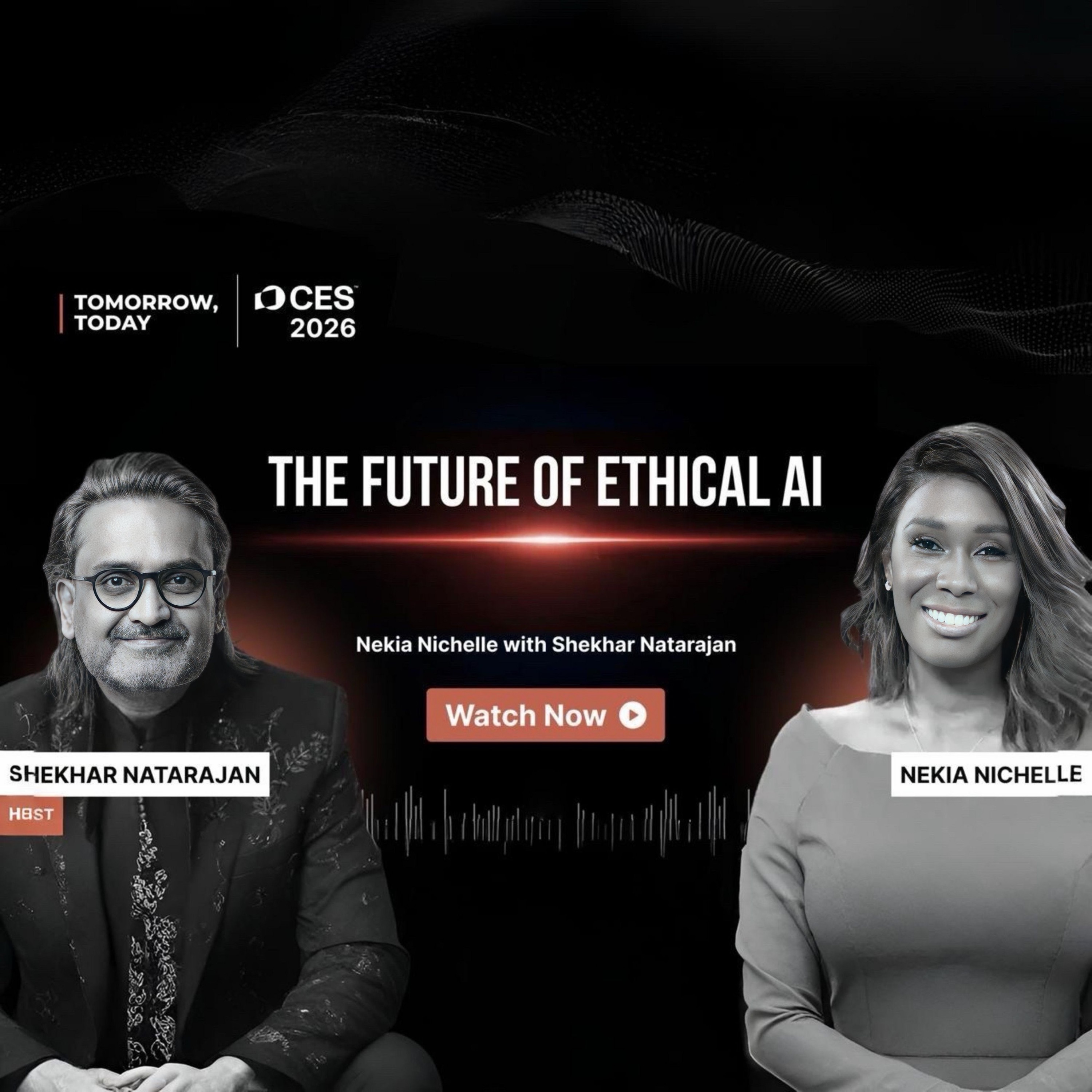
Tomorrow, Today
Why AI Needs Ethics First | Nekia Nichelle & Shekhar Natarajan | Live at CES 2026
00:15:35
Loading summary
Transcript42 lines
- [00:00]
A
Foreign. Here at CES 2026 and I have been running into all kind of founders here, interesting conversations about innovation and how AI is taking charge over the world. So I'm here with Shaker. What's one thing that the AI industry can benefit from slowing down?
- [00:30]
B
Well, I think if you, if you think about artificial intelligence and the profound impact it's going to have on the society, it's going to be multi generational. It's as big as industrial revolution. But with industrial revolution we had like 70 years. 70 years, right. Like you know when like people looked in the eye of basically their employers and said, hey, like we need to have weekend. Weekend was created because of industrial revolution and the negotiating capability of the employee with the employer. Right. We actually like pass rules on basically like not to have child labor. So these are all things basically like that were generated because time was created. And now with artificial intelligence, even before you know it, at 3am the call center is gone because all it takes is for you to update the code and everything is automated. And that's a scary thought. Like, you know, like whenever you're going after efficiency, you pull out dignity somewhere, you make it inhuman, you dehumanize things. And so we need to slow down. We need to basically understand the consequences of what we're doing. So artificial intelligence is not about automating everything and optimizing everything. It is about finding those things that we should not optimize. Where is the line of efficiency and where is the line of dignity and when does it cross over? And having like sort of like presence of mind and all of these things, that's really key to this. And I'm deeply disturbed by the reckless nature of how we are actually deploying these things.
- [02:07]
A
I agree.
- [02:08]
B
Right. So let's take Nanobanana for example. You know, people who are in a hurry to roll that software out. The first thing it did, it created fraud. It created fraud.
- [02:19]
A
Right.
- [02:19]
B
Think about like what ChatGPT did. Like you know, it created a suicide note.
- [02:23]
A
Yeah, exactly.
- [02:24]
B
So these are the types of things that like, you know, that deeply disturbs me. Yes. And I don't think, I don't think we need to build technology in a hurry. We need to build technology. That is right, Exactly.
- [02:35]
A
Okay, now we're talking. Shaker, let's get down to the nitty gritty here. Right. It's scary, the ramifications. I think we're going too fast with the innovation and we're not slowing down to see how it can be harmful.
- [02:49]
B
Humans were built to think, how do I win, right? The mentality should be how do we serve better, right? And so where does service mentality come from? Well, it is what like, you know, good people do, they serve, right? So the virtue of basically serving people for me came from my parents. You know, like we, I grew up in slums in India, like you know, where access to education, access to healthcare, access to basically like anything like including clothes or library books was prohibited. Like, you know, like people, people thought like, you know, I was not called an untouchable, but I was treated like one. And so I think like when you, when you think about like even despite all of that, my father and mother who actually made like 175 rupees a month, which is $2, they would give away their money and they felt like, you know, the next door neighbor was starving, so I cannot eat. So that was the guilt that actually they possessed, the sacrifice that was created because of that. I think that those aspects of humanity is not really captured today. And so all we are trying to do today is we are building technology faster. And then we are saying like, oh, like, you know, if there is a risk, I'm going to add like a patchwork. Oh, if there's another risk created, add another patchwork. You know, Adam Rain, the like, you know, the guy who got like, you know, had the suicide note written for him from ChatGPT, right. Like the best thing that like you know, like ChatGPT can do at that point was to say I'm going to put like parental guidelines. My 5 year old kid knows how to like swipe my phone and open my phone.
- [04:28]
A
Exactly.
- [04:29]
B
So do you think like parental guidance is going to really help anything?
- [04:33]
A
Be serious here, right?
- [04:36]
B
So he knows the pattern of how to open a phone. So we are kidding ourselves that that's going to solve the problem. Virtue has to be native, not an afterthought. Right? Like security, safety needs to be built into the system, not as an afterthought because as the models are coming out faster, you're going to be always in a catch up mode. And that's not how we build technology. It's a very bad way to do it. And so my philosophy in all of this is to let's capture what makes human human, right? What makes a beautiful human human. The extraordinary moments. And let's amplify that goodness into the technology. So now we are moving from AI which is efficiency focused, to ethical AI which is do no harm, to angelic intelligence which is doing good, right? What good humans do and how do I mimic Their behavior. And if you make that native, you make that like inherent within the system of how intelligence is built, then we are not going to build wisdom that is going to be like replacing humans. We are going to enhance the human wisdom.
- [05:45]
A
Exactly. It's all about the enhancement. And I'm thank you for. Because that was going to be my next question about angelic intelligence and that term and where you're coming from with that term. But yes, let's take the good parts out of it.
- [05:59]
B
I'm a reformed optimizer. Okay, like let me explain what that means, please. So 25 years of my life I spent with Coca Cola, PepsiCo, Walmart, Walt Disney Company and American Eagle. These are all like fantastic companies. But all of them had one thing in common. They were always wanting to save money and be more profitable so that they could actually like return shareholder value. That is like, that is built into the corporate DNA. And when you have that thinking, you begin to optimize sometimes on the wrong like spectrum. Let me give you a very interesting example. In February 18, 2021, we were able to put like rover on Mars, 263 million miles away. But we could not get insulin to a girl called Maya during COVID times. And she died. And you know, if you look at like what, what really was the problem? We were trying to optimize for the cost of the delivery. And in optimizing for the cost of the delivery and looking at the profitability of the delivery route, we ended up choosing Hermes bag over like delivery medicine. Right. So this. So that sort of perverse thinking, like I was part of, I'm guilty of that. Right. So when you have built systems that marginalize humans and optimize on the wrong vector and you steal dignity, you steal people's living, you steal like life, sometimes unknowingly, you feel guilty about it. And I have a five year old and I worry every day what happened to Maya doesn't happen to my son and it should not happen to any other kid in the world.
- [07:46]
A
I agree.
- [07:47]
B
So we have a moral obligation in all of these things. So we should build things that we are proud of. Like I want to create a multi generational impact not in wealth, but in dignity.
- [07:58]
A
So it sounds like you're wanting to put people over, you know, people first over profits being first.
- [08:05]
B
If people are treated well.
- [08:08]
A
Correct.
- [08:08]
B
They respond well.
- [08:09]
A
I agree.
- [08:10]
B
Why does Coke actually charge $3 on a can of Coke when it only takes $0.30 to make one? Why does it do that? Because it has built trust over a period of Time because they have sold brand loyalty and they have sold trust. In the world of artificial intelligence, if you're not able to trust the systems that you're working with, you're going to create catastrophic failures. And hence I think putting people first is probably a long term strategy. And it is the right strategy. The right strategy because like, that is going to stick with you. Like that's what like people are going to remember. They're not. No one remembers. Like everyone remembers how bad they were treated.
- [08:53]
A
Yes.
- [08:54]
B
How bad they were treated. And everyone also remembers how beautifully they were treated. Right. There's nothing in between. So you have to pick the poison whether you want to live for the long term or you want to live for the short term. And I believe, you know, fighting for the long term, thinking about optimization, which actually brings human dignity over profits, is a very important thing because you are going to be eventually more profitable doing that.
- [09:19]
A
I completely agree. Actually, I have a business, you know, and that's one of my mottos is putting people first. We put people first over profits, you know, and my team loves me, you know, they love working for me because I put them first.
- [09:36]
B
It's important because you created loyalty.
- [09:37]
A
Yes. What's one guiding question that you believe builders and investors should keep in mind as AI is continuing to evolve?
- [09:48]
B
I think there's so much focus on the can we thinking, can we do things? Can we do this? Can we solve that problem? And we forget to ask this very simple question, should we in the first place?
- [10:02]
A
Come on.
- [10:03]
B
Okay, so.
- [10:08]
A
You're over here taking to doing a sermon. Okay, say it.
- [10:12]
B
So the most important thing is like, you know, let me give you an example here, right? I used to go deliver groceries for Walmart because like I built a Walmart grocery online business. It was highly unprofitable. And then basically like, you know, we built the crowdsource delivery model for Walmart and then it's scaled like into like, like a big monster now. And every week I used to go make a delivery so that I could understand how the routes were set up, how the deliveries were made, who do I interact with, what does a customer want? How do they feel about this? Like, you know, like what is working, what is not working? You need to be in the trenches to solve the problem.
- [10:51]
A
Of course, that's a founder's job.
- [10:53]
B
Exactly. And so we, when you take that mentality and like I, I actually ended up like meeting this lady called Margaret. She was 78 year old and every week I used to go deliver groceries to her. And for every Every week that I delivered on Monday, she would tell Tuesday she's going to the hospital. And I, I wondered why she was going to the hospital like every Tuesday, right. It's kind of weird. Like, you know, you would keep going yourself, repeating yourself, like week over week and. And then this, the fifth week, she did not order. Sixth week there was a different order. And when that order came in, I ended up basically like, you know, going, knocking the door. And I found the daughter. The daughter said, margaret passed away. And I was shocked. And she starts to explain the story. Margaret used to make, you know, $1,415 a month, $875 going for rent, $200 going for groceries, and the rest went for medicines. Right. And so she did not have enough money left for medicines. So she would go to the hospital and admit herself so she could get access to medicines. The hospital thought she is a frequent visitor, so we need to get rid of her as soon as she comes in. The insurance company jacked up the rates because she's a frequent visitor. And the insurance premium went up. Walmart kept giving her more groceries and saying, like, you can. Well, you know, there's no chocolate. Like, you know, flavor of milk. Like, you know, do you want strawberry? So we were like always optimizing for all profits. But no one looked at Margaret as Margaret. In this case, the answer was not, can we do this? Can we do this? Can we do this? The question should have been, what should we do in this place? The should we should have been that we double the medication for her. That way she doesn't have to ration her medication. That way she doesn't have to show up in the hospital every week. That way the insurance premium never went up. And that would have been the best solution in all of these things. And so most of the times when we are like running too fast, we are trying to optimize on the wrong vector because we think that's the problem we are trying to solve. Sometimes it's stepping back and asking, what is the problem we are trying to solve?
- [13:02]
A
Exactly. And go from there. I could talk to you forever. I feel like this was such a great conversation shaker and I appreciate your time. You know, if there is anything that you could say, your lasting words for this interview, what would it be?
- [13:21]
B
Well, I think like when people ask me why I'm building what I'm building, is it for money? Is it for like, you know, is it for reputation? Is it for like, you know, you know, something else? And you know, I have a very simple answer. 100% of what I'm building, the equity that I have in this company is going to go into a foundation which helps humanity. My son is going to live off my salary because I lived off my father's salary and I still survived. My father used to make $2. My son makes like, you know, probably my son is inheriting more than what I inherited from my father. It's good enough, right? So. So the obligation that we all have today is to leave the society in a much better place. We are polarizing the society. We are atomizing each other so much. We are moving into a very disconnected world. From a connected world. Imagine going to the next door neighborhood store. Everyone knew. Everyone, everyone knew the name. Everyone knew where you worked. Everyone knew what's your hobby. They knew that the wedding anniversaries, everyone knew everything about you. We lived in a society like that. Now everyone fears the next guy and his own shadow. And so this is going to be deadly dangerous if you continue to build technology and deploy technology which amplifies this behavior and the dopamine with it.
- [14:42]
A
I agree.
- [14:43]
B
So we have an obligation to change that. And I feel not only me, there should be like millions of me out there who should be building billions of angels, which makes this world a better place.
- [14:55]
A
Yes. So angelic intelligence should be on the lips of everyone's tongue in 2026 when it comes to AI and innovation. Thank you so much, Shaker, for taking the time out to chat with me today. This has been a very enlightening conversation and let's continue it and continue putting, pushing out that message so that we can utilize tech in a more sense, safer and angelic way.
- [15:19]
B
Thank you, Nikki. And let your thought manifest.