← Tomorrow, Today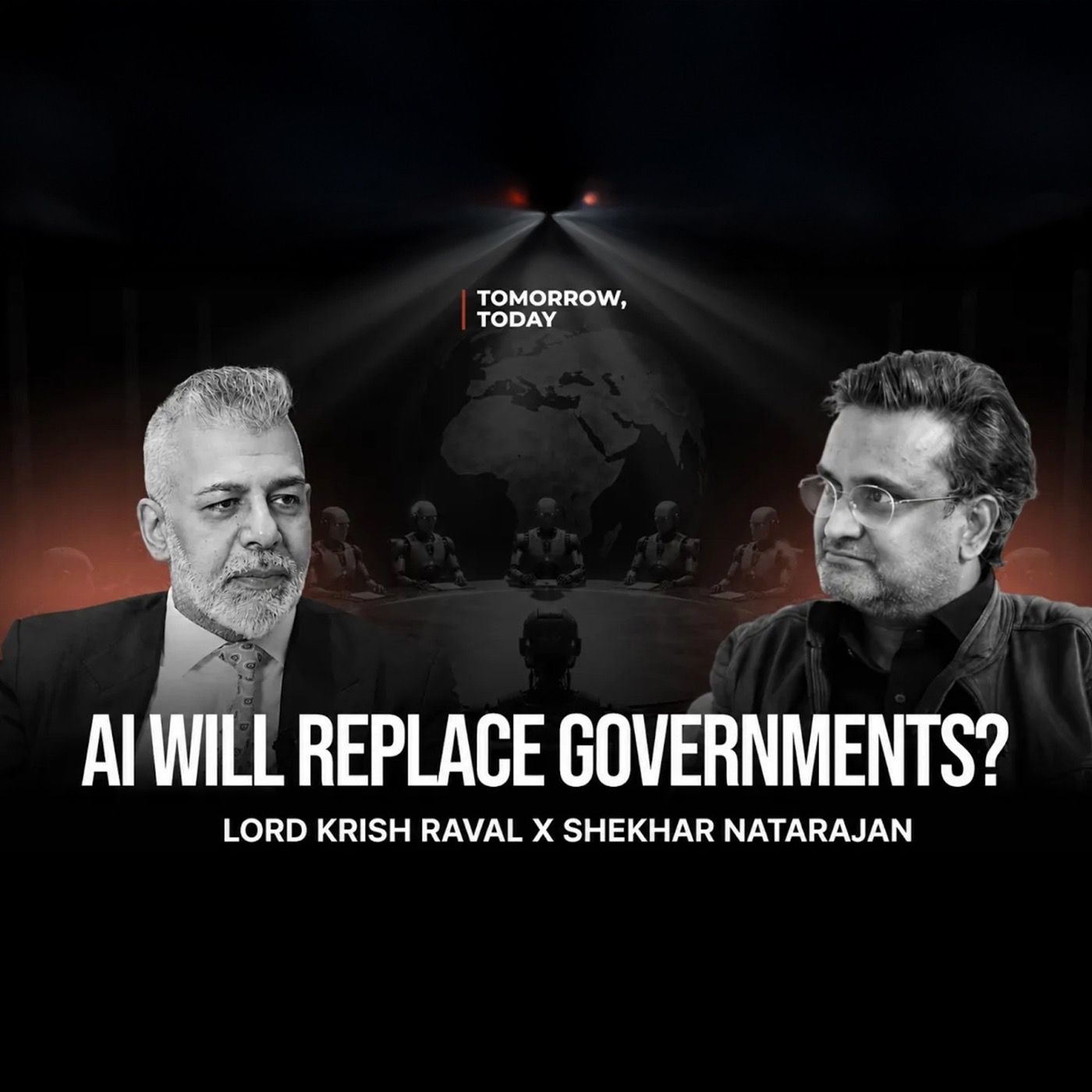
Tomorrow, Today
Will AI Replace Governments? | Lord Krish Raval & Shekhar Natarajan on Democracy, Power & the Future of Humanity
01:56:03
Could Artificial Intelligence become more powerful than governments? In this compelling episode of *Tomorrow, Today Show*, Shekhar Natarajan sits down with Lord Krish Raval member of the UK Parliament, entrepreneur, and global thought leader to explore one of the most important questions of our time: Who will shape the future of humanity—governments, corporations, or AI? From democracy and governance to immigration, poverty, leadership, spirituality, and technological power, this conversation challenges conventional thinking and explores the forces transforming society. In this episode, you'll discover: • Can AI become more influential than governments? • The growing power of Silicon Valley and big tech • Democracy vs plutocracy in the digital age • The hidden impact of algorithms on society • Poverty, visibility, and human dignity • Immigration, identity, and belonging • Leadership lessons from public service and politics • Spirituality, purpose, and the future of humanity • E...
Loading summary
Transcript213 lines
- [00:00]
Lord Krish Ravel
The dark side of having AI replacing government is very much this perpetual hegemony that then predicts what you're going to do or thinks it knows what you're going to do.
- [00:23]
Kanishka
Is that like, is the government running the world or does it look like the government is running the world but the Silicon Valley is running the world? Is algorithm is going colonizers.
- [00:38]
Lord Krish Ravel
When you have oligarchies that are extractive and steal, that's called a plutocracy. And I'm happy with democracy being replaced by plutocrats.
- [00:52]
Kanishka
Poverty is not like, you know, your stomach growling. Poverty is the fact that you exist. You sit there, but no one sees you.
- [01:04]
Lord Krish Ravel
We're in that state right now where we have this power that we don't understand and actually creates. It destroys everything.
- [01:41]
Kanishka
I'm super excited here that I have Lord Krish Ravel, like, he's one of my personal favorite when it comes to politicians. I've known Lord Krish Ravel for almost like two years now. Super inspired by every conversation I had. Super influenced by all of your thoughts. What a great man you are. Like, you know, an amazing story. And so I'm here with like tomorrow, Today and Lord Krish, like, you know, you're actually joining the show when we've actually clocked 500,000 subscribers as of today and we've been just like doing this podcast for the last three months or so. Incredible honor to have you. Like, I know I've been chasing you for a long time now. So super excited to have the conversation. And like, you know, we're going to focus today on your life in general. We're going to focus in terms of like, policy, decision making, the role of a nation and the role of technology and like, how it actually transforms governance in the future. So we're going to cover a lot of, like, topic. Excited to have you welcome to the show today.
- [02:48]
Lord Krish Ravel
Well, I'm honored to be here and we're honored that you're here in London. Thank you for making the journey. Shekhar is also very mutual. Two years ago when I was at the award ceremony, where I forget the award ceremony, but you won the lifetime achievement award and you were dressed in your Indian attire and you spoke about the story of how you grew up in a village and then, you know, conquered California and Silicon Valley and all of that. And that journey was inspiring in itself. But then you spoke about morality and ethics and spirituality and the combination of human and transpersonal factors that can define where we're going from. And that drew me to you. So I hope that you'll allow me to interview you as well, so it won't be just about my life. I hope you'll allow me to because I'm a biographer at heart. So. So that was the compelling reason for this conversation, is you. So yeah, I'm delighted to be here,
- [03:55]
Kanishka
excited to have you. So a lot of people envy the position that you are in. Like, you know, like you are basically a politician who actually can create rules of the game. And like, you know, people think about like, you know, the role of technology but actually have to always come back to the governance side of it. So do you feel that the current structure is something is as good as it gets, or can it be better and what are your thoughts about it?
- [04:27]
Lord Krish Ravel
So you mean the current structure of governance or rule making?
- [04:30]
Kanishka
Rule making.
- [04:32]
Lord Krish Ravel
So no, nobody will say it's perfect. So it's evolving and if you look at the context, it's not perfect. But I have to say in all reality it's better than it was 100 years ago. Nobody, if we were having this conversation in 1920, I have two kids, there was a chance that one of them would, you know, die because infant mortality was very, very low. Hot showers were not existing, disease was prevalent. So if you're measuring in those terms, I think something about the system here has worked. But whether it's sufficient to be sustaining is the question I have because all of it, I'm very aware, is dependent on exploiting the resources, the common assets of humanity and the planet. And this is why what you represent with the world of AI and this new technology, it could, if handled and stewarded properly, help society rather than hinder it. But what do you think to your end question?
- [05:50]
Kanishka
So I.
- [05:51]
Lord Krish Ravel
And where does it come from? Where does that question come from?
- [05:54]
Kanishka
See, like, you know, when I, when I. There's always a constant conflict between the innovator and the regulator, right? Like, you know, the innovator always thinks that the regulators are there to block their progress and the regulators hoops to jump through all the rest and all that stuff. And like, you know, and most of them point to a system that basically has been archaic in the way it is and it is inherited system. It is never like something that people like, you know, kind of, kind of, you know, acknowledge the fact that like to your point, they all think it's 1920 systems. It's not 1920 systems. You know, there's a lot of modern thinkers like yourselves, like, basically like, you know, Kanishka as an example, a lot of people who have come in like you know, taken up, like, you know, left the private life, gone into the public life and are trying to make a difference. And they are businessmen coming and trying to influence, like, the world of, like, you know, governance. So there's a myth that, like, you know, government is always there to stop you. So that's what I was like, you know, like, that's why I wanted to start this question with you, because that's the myth I want to break. Like, you know, the role of governance itself and how it has evolved. Let us actually dig a little deeper into your backing, like, you know, your background. So you come from Ethiopia.
- [07:16]
Lord Krish Ravel
I was born. Yeah. So three generations of my family were settled in East Africa. So my. Actually the story is that my grandfather, at the turn of. Not this century, but the last century, so around 1900, left Gujarat, his native Gujarat, at the age of 15, can you imagine, as a cook's assistant. So he had a huge family, many siblings. He just left to become a cook's assistant for Premji and Sons, which I understand was a import expert export company working across Africa and that the Indian Ocean, and 50, 60 years later became general manager of that import export firm. So since then, you know, two other generations of. I was the third descendant to be born in Addis. And exactly a century later, and I mentioned this in my maiden speech, I became elected to or appointed to the House of Lords. So that's, you know, that's a really interesting circle. He couldn't, at the age of 15, have imagined that his grandson, if he was going to have a grandson, would be, you know, part of the governance, as you mention it, that, you know, or the descendant of the governance that was imperial, you know, so it's very interesting.
- [08:46]
Kanishka
Yeah. Yeah. So what. What a fantastic story. So what did, like, you coming to Britain feel like when you first came to you?
- [08:54]
Lord Krish Ravel
So from Alice. So, you know, you see things as a kid, you. You see things only through your. Your own eyes. So I had the security of my parents, and that was very nice. But the big thing was the lack of light. So in Africa, everything's bright. The earth of Africa is special. And here it was kind of gray because we came in the dead of winter. But it was also fun and it was very welcoming for me at least. Yeah, but it was cold. I remember that. I remember the bitterness of the cold, but otherwise, yeah, it was. It was an interesting. It was an interesting time because in. In Addis, we were part of. We were still a minority, but we were a very empowered minority. And I had a rather Spoiled existence with, you know, my parents had staff and, you know, everyone had people working at home. And here suddenly we were in a one and a half bedroom apartment. And, you know, it was just very different. So it felt different.
- [10:06]
Kanishka
So what is the role of your parents in your journey in life? How did they influence you? Like, what did you get?
- [10:13]
Lord Krish Ravel
Yeah, so I remember, like, just. Well, I just recall that this morning you made me come here really early. So I left home. I Left home at 6am to get here and I was on the, in the, on the train, waiting for my train. And I was thinking, goodness, you know, this is kind of difficult. And then I realized that my parents did this every single day for nearly 30 years. So dawn prayers wake up really early dawn prayers, then drive together to a shop. They had a dry cleaning shop. Spend all day in the shop and then drive back home and then my mom would cook a fresh Gujarati meal. And, you know, I essentially raised myself because they were, you know, away. So the role is typical of immigrants, you know, of real hard work. And I, myself, and fidelity to values. It's their values that impelled them to, to do this. And so I want to stay true to that. So it's an inspiring one. I. And they were hugely strict, very strict. So this I'm, I'm, I'm dispensing with. But yeah, so that's the role. An inspiring one overall and one of hard work. And as I say, it's typical of the immigrant story. Yeah.
- [11:44]
Kanishka
So did, did you, at any point in time when you were here, did you feel that this country did not have a room for you? Was there a moment in your life where you felt like that or like, you know, you had a specific need and that need could have only been gotten from this place. Like, you must have gone through this pendulum of thoughts and pendulum of like, you know, introspection and being circumspect about things.
- [12:14]
Lord Krish Ravel
But did you. How old were you when you emigrated to America?
- [12:17]
Kanishka
I was 23.
- [12:19]
Lord Krish Ravel
And did you feel that?
- [12:21]
Kanishka
Oh, well, like, you know, I had no other choice. The reason why I went to United States is because of my brother. My brother. It's a long story, but, like, I'll try to keep it short. My brother has bipolar depression. And so my, my parents, like, you know, obviously we come from slum, second biggest slum in India. And, and we just took a lot of like, loans, personal loans. You know, we were in a lot of debts. But my, my parents wanted my eldest brother to get out of the context because, like, people Thought he was crazy, you know, but he could see things that no one can see, right? Like he was seeing the non obvious things at times. And a lot of things that he would say and do, like, you know, is now coming true in the world. You know, he's like, he's like, he has like this amazing gift of premonition, you know, and, and so when he came to United States, he broke his left arm. And then 10 months into it, like, you know, his friends started scaring him and said, like, you know, you're going to destroy your whole family. And then he calls me and says, like, hey, listen, like, you know, I don't think I have a life here. I've saved up some money, but I want you to come here and take care of the family. And I felt like, you know, I didn't want to do anything with the United States of America, to be honest. And I said like, you know, like, I would be such a, a bad, like irresponsible guy if I cannot take care of my brother. Because the whole structure of a family is to generationally help people that helped us. He's younger or older, he's elder to me. He's like, you know, he's seven years older to me. And so, so my choice of university was to stay very close to him because I got him re enrolled. And then it's a beautiful story. And then he'd actually converted himself into Islam because there were like a lot of people who were guiding him in the process of like, you know, his journey. And so I land in United States and he just walks up to me and like the guy behind him calls him Masood. And I'm like, who the hell is this guy?
- [14:24]
Lord Krish Ravel
What name did you know him by?
- [14:26]
Kanishka
Ashok.
- [14:26]
Lord Krish Ravel
Ashok. Ashok to Masood. That's different.
- [14:29]
Kanishka
Yeah, very different. And so like I, so we struggled our way through. I got him reinstated because we wanted to do everything by the law and by the books. And so there was no choice. And so for me, like, you know, hard work and taking care of my brother was the only reason why I went to United States. So there was no other ambition. Like, you know, I did not want to pursue school and be like the most, you know, educated or, you know, do something like, you know, of extraordinary consequence. And even today I don't feel that way. But I feel like, you know, when the intent is right. In this case, my intent was to help my brother. God opens doors for me that I could never imagine. And just imagine, right, like a guy from a slum could have Been in the slum and been invisible all his life. Because that's what poverty is. Poverty is not like, you know, your stomach growling. Poverty is a fact that you exist. You sit there, but no one sees you. And I could have. I felt that many times in my life, and I still feel it out of insecurity. But so many beautiful people came into my life who changed the direction of my life, and that's what I'm thankful for. So my aspiration of United States of America was to just, like, find enough money so I could feed my family.
- [15:57]
Lord Krish Ravel
That's hugely inspiring. Well, I relate to that really largely. But what's compelling, partly what's compelling about your story is that you came to the United States and the success you are is mediated by you doing what it seemed to you to be right, doing the right thing consistently. So the right thing was to look after your brother. And so that, and the sacrifice involved on leaving one reality to come to another and looking after him, I think is great. And that led to all sorts of other things. I relate to that in two ways. So your question was, did I belong. Did I feel that I belonged to the United Kingdom? I mean, I think I did, but I wanted to belong more. So I was a kid, so it's kind of different to being 23 and kind of growing. I was just a child and I came and I saw. I remember the first thing in. In the UK, so this was late 70s and it was a Silver Jubilee of the Queen. And it's so lovely because I met the Queen much later and tomorrow, as it happens, I'm meeting the King. And it's. It's very, very inspiring that that continuity of the. The political system and the. The governance, as you call it, the continuity was something that is so deeply meaningful to me because I remember seeing things and thinking, how can I be a part of it when I say things, things, things, things in the governance, politically in the state. And then. So that's one thing. And the second thing that I really related to, you'll be interested in the grandfather I spoke about in 1983. So they grew up in India, in the Empire, all of this. In 1983, they made the voyage to the UK. We received them, my parents had them and he drove them round. The day before, it was Charles and Diana's wedding and the day before that, my dad just decided to take them round London. Here it was all closed, so there's no traffic, but we could just look around the city. And I remember we've still got a Photo. And if you come to my desk, you'll see the photo of my grandparents in front of the House of Lords. And in those days we didn't have the same security that we had then, so you could just walk up to the front gate of the House of Lords, the piers entrance, which is my daily entrance. So I think from a very early age I had a desire to belong to the political system or to the decision making system, because I was fascinated by it, just emotionally, but I had no idea of how because it was opaque. So the opacity of Britain was something that I wanted to, that was a personal barrier for me. I wanted to penetrate that because it's so opaque, if that makes sense. But you said something very, very interesting that I want to pick up on. So my career has been in leadership development. Okay. So one definition of the leader is that the leader notices and then names. So you talked about poverty. And poverty is so often invisible. And what the leader does is actually notices it and then gives it the label. This is called poverty. So my father and I would drive when I was a child down the road and then one day on the way to school, and one day my dad said, where's that homeless person? And I said, what homeless person? And unknown to me, every day on the corner there was a homeless person. So I found the next day, and dad said, this is the homeless person. So that's what the leader does, brings attention to something and then calls it. You're doing that with the AI. There's this imponderable, this huge revolution in front of us and we don't know exactly what's. We don't have the words for it. And you're one of the people who's pointing out and saying, well, this is this or this is that. I want you to come up with those terms of bringing attention to that. And that's what this podcast is about. So it's very interesting, isn't it, that that comes from your kind of story?
- [20:36]
Kanishka
Yes, yes, yes. You talked about getting into the door, like the political system, getting noticed and then feeling a part of it. Like, you know, I don't know if you still feel like it's. You're part of it or like, you
- [20:49]
Lord Krish Ravel
know, it's still to an extent. To an extent. Not fully. Because then you realize there are further levels.
- [20:55]
Kanishka
Yeah.
- [20:55]
Lord Krish Ravel
And this is the other thing about our own mindset. So if, and I think this is interesting and something that you and I both have in common, that if you're an immigrant, you're a Newcomer that desire the motive to a prove oneself say I do belong. And in both our cases to give back. Not to extract, but to give. And there's all this rhetoric about immigration and how it's injurious to the country and everything, which is completely the opposite. That immigrants are the most hard working in my experience group around because they don't take anything for granted and they're just desperate to give back. I'm sure there are some who aren't with any group who are exceptions to rule, but mostly like you. How much have you given? You've created employment, you've created prosperity. Then you're pointing a way to a new reality. Yeah, so. But I belong to an extent. But now in this new environ, I'm desperate to make a contribution but in the right way. But the thing I've learned is patience. So I'm not pushing myself.
- [22:13]
Kanishka
At what point in time did you think that like you had the sense that you were beginning to belong? Because, you know, even that doesn't happen. Like, you know, it didn't happen probably at the age like 10, it didn't have probably happening the age 20. Like, you know, it happened sometime when you transition from the business world to the political system or like, or during the business world. So when did it actually happen to you? Or was it the day when you just landed here and you said that this is my land?
- [22:41]
Lord Krish Ravel
No, no. Oh, is that what you're asking? When did you feel British? Well, I felt British. I mean, I didn't. You just grow up and you sort of realize that what happens with immigration, immigrant families is that you kind of grow up in a subculture. So my subculture was in some ways
- [23:00]
Kanishka
more
- [23:02]
Lord Krish Ravel
traditionally Indian than yours. Even though you grew up more recently in India than I did. And I haven't ever grown up in India. My family preserved the mores and culture of 18th century India. The immigration, so the subculture. So India's progressed in its views and its attitude to sexuality, violence, you know, all sorts of cultural norms. We have created this subculture that is India of the 18th century, so 1900 and you know, 19th century.
- [23:40]
Kanishka
What does it look like?
- [23:41]
Lord Krish Ravel
Well, just like, you know, just in terms of, you know, go home and you know, shoes aren't allowed in the kitchen. You would, because they were very conservative Hindu family. So you would, you know, I told you my parents would always start with prayers. So I mean, we're not just saying a prayer, we're talking about an hour in Dhyan in the morning and just attitudes to Sexuality and dating and watching things on TV or interaction with certain people, food, what you should eat, what you should not eat. Just very conservative items that are allowed in the kitchen. I mean my parents are traditional Gujarati Brahmins from the. Well, I mean I'm sure they progress but essentially I find my cousins in India far more progressive in so many ways it's an ironic and an attitude to faith and spirituality just very, very different. Bit more literal I suppose. So it's really interesting and I just say that because. But with all of that, the kind of underlining, the underpinning is that you have to give back, you have to give to the society. That was the always thing. So I always felt British and it wasn't so much my Indianness, it was more my Hinduness that impelled me to understand that everyone is a spirit, soul, everyone, whether you're a Muslim, a Jew, a Christian, atheist, animal, you're all connected. So that's number one. And number two, the desire to convene, to bring people together to do something better. That was always. I saw seeing my father conduct yagyas and you know, become a figure in public, that must have inspired me because I want to do that, but I'll do that slightly differently. So that's one thing. But where the change came for me because I was an awkward person, I was socially awkward and very different to I guess how I am now. And there was a period of adjustment, so it was really painful because as I say in Ethiopia and Addis, I was this spoiled Indian, you know, kid in a largely reverential culture. And here you're just normal, you get on with it mate. Nothing special about you at all. If anything, you were under, underrepresented and underwhelming in any, any situation. Nothing remarkable about you whatsoever. And I was, I'm adhd, so I'm not particularly. So the, the academic system as it was wasn't really, really good. And since you mentioned spirituality, it might interest you. So I wasn't particularly academically gifted or I think I was, but I just was in a world of my own. So if you're a kid in a state school here and you're just a dreamer, absent minded, nobody gives you any attention. So if you're not bright at school, you're kind of awkward at home, your school teacher and you're a minority and you're an Indian kid, your teachers don't particularly think much about you, your school doesn't think much or your friends don't think or anything special, your parents are perpetually disappointed. And you don't think about much about you. Right. So you're in your own world. But at the age of 16, I think so 15 or 16, I went to Haridwar, to Shantikunj, which is an ashram. And my parents got me to meet Pandit Sri Ram Sharma Acharya, who is, who founded Gayatri Parivar, which has 150 million adherents worldwide. And his grandson, Dr. Chinmay Pandya, who was a psychiatrist here and now essentially runs the university and the mission. So the only Hindu leader who has also been an NHS doctor, National Health Service doctor, is a dear influence. But in that. And Pandit Ram Sharma Acharya asked, what do you like? You know, how can I, how can I help? And I was there with someone who took me and, you know, it's almost a form of therapy in that people give these sages their problems and the sage gives back something quite amazing. So Gurudev was asked by my friend, you know, can you help me? And Gurudev said, what? By, in what way? And he said, well, I have a problem with my wife. And Gurudev when I was a 17 year old, so that's a weird thing. And Pandit Ram Sharmacharya, who I called Gurudev, replied, well, everyone has a problem with their wife and I am now married. And this, this refrain always. So if ever that was such a lovely thing for me to hear because, fine, this is normal, like human interaction. But I asked, he said, what do you want? And I said, you know, I just want to be clever. I said, and I don't know what happened, but then I got back and I met. So I was just drifting and I met a group of people who were very, very helpful to me as mentors. They were older, much older, and one of them worked for the United, well, with an organization that was associated with the United nations. And it was the time when South Africa was coming into the family of nations following its exclusion because of apartheid. And I had the opportunity to meet Nelson Mandela in Geneva and all these things, all these encounters, then met the Dalai Lama and other influences and that really did build my confidence so that somehow I found my. I got the willpower to study and I got into Sheffield University and then Cambridge University. But it all stems from that one encounter. And then the second thing is that at sixth form College I. Which is, you know, so at the age of 17 you do your O levels, it was called then, so which is the exams that you do at 16 and then you do A levels and then you go to university during that My A levels. I became politically involved. And again, I became politically involved because my temple, which was the Hare Krishna temple, I was just like any number of, you know, just like people in northwest London would go to the Hare Krishna temple and it was being threatened by closure and that was racist. So the villagers objected to Pakis as they saw it coming into their village. Even though we weren't. We offered to bypass the village and the government at the time, the Conservative government of the time of Mrs. Thatcher and John Major was closing it, you know, said, right, we're going to shut it down. And that really did affect me because I thought this is pure, pure discrimination. And the temple wasn't just for brown people, it was for everyone.
- [31:22]
Kanishka
When was this?
- [31:23]
Lord Krish Ravel
This is the 80s. It dominated the UK, the Indian scene or the Hindu scene within the UK throughout the 80s and then early 90s. And so I then became very politically active in the 90s and there was a meeting. So it was my idea that we should go to the party political conferences. So, you know, in America you have the conventions. So you had the Labour one and the Conservative one. And so I organized the one in for the Labour Party, not knowing anything, but I organized the. And it made it possible for us to go to. Where was it somewhere? Brighton. And I knew of only one hotel in Brighton, which was the Grand Hotel, because some years earlier the Prime Minister was nearly blown up in a terrorist incident by an IRA bomb. So it made international headlines that the government was bombed and of course the hotel had been repaired and they insisted in having party political conferences there. And it was the Labour Party's turn. So I organized a meeting there. And on the way there I met somebody who was a big professor and he gave me tips on how to make a speech. I didn't know how to make a speech. And he said, have you prepared? And I said no, but I didn't know, I was just 16 year old. He said, well, this is how you make a speech. You need to have something, some piece of paper, make three points. And then at the conference I met this person who helped me, as I say, meet Nelson Mandela and other people. So it was one day and it was Gandhiji's birthday because the conference was Race, religion and injustice, 122 years after his birth. So it was 22nd of October 1990. And that led me to a friendship with Rajman Gandhi, my husband, Gandhi's grandson, who this person introduced me to. So just one day kind of completely changed my life, I mean, in all sorts of ways, because, you know, Neil Kinnock was the labor leader. He's my friend now in the House of Lords. So many other serendipities just on that. So there is some hidden hand I find in my life. So with all of that, I felt I belonged because I was suddenly, you know, meeting the people behind the headlines. That's what rocked my boat.
- [34:08]
Kanishka
Like, you know, like my, my mother and my father always used to say this. And I still believe that to be the fact, right, that there's nothing called like luck or coincidence in life. It's all contractual. Like it all is predestined, it's supposed to happen, it'll happen. And like, you know, amazing people just show up, open the door and then like, you know, they show you like, hey, don't go this way, go this way. And even if you're drifting, they like point you in the right direction.
- [34:40]
Lord Krish Ravel
But so with that, do you, do you believe that there is no free will, then everything is set in stone.
- [34:47]
Kanishka
I feel like, you know, destiny can be modified through hard work, right? Like, you know, you could, you could, you know, if you look at like everyone's journey, right, it's never like smooth sailing. Everyone who says like they're super successful, it's never the case. Like, you know, they're going through like a lot of internal hardships that they don't like communicate outside. But I feel like, you know, through a lot of conviction, intent first, hard work next and conviction after in that sequence always leads you on the right path.
- [35:22]
Lord Krish Ravel
I think you're right. You know, so I was talking to a Jane friend, so I didn't know much about Jainism, so forgive me if I'm conceptualizing it wrongly, but the essence I found is that for the Jain belief system there is no God. Each spirit, soul, each soul is on its own individual journey. So absolutely there is self reliance and it's mediated by karma. So that means whatever situation you find yourself in, you're going to get out of it. Yeah. Well, it's up to you. So even if there are multiple lifetimes, so if you find yourself, you know, buried alive in a coffin with no other, your intent, as you just said, is best you can do. And you just, okay, even in this situation, I'm going to think positively, I'm going to do the right thing. So this is why they're so successful, uber successful financially, because they absolutely believe in, in, in self reliance. So it's really interesting. You're in that situation because of your karma, but it's totally up to you to get out of It. Which then avoids the fatalism that attends so much of this karmic predestiny arguments. And I think that's so cool that. What a. What a liberating thing and a hugely challenging situation, whatever situation I'm in. Even though it's not my fault, you know, because, you know, and you talked about your brother with bipolar conditions. That's a medical. Your brain chemistry is in such a state that you cannot but think of it. But the. That Jane believe in that situation is. Even then, you know, it's up to you to somehow do something.
- [37:11]
Kanishka
Yeah.
- [37:12]
Lord Krish Ravel
If not get out, at least think, you know, to change your karma. I think that's hugely empowering because it gives agency to me and not to external forces, even though I'm just really minute so that. And you know, without keeping it into the Jain belief system. I think you represent that to me that you got out of a particular situation. You do your best to ensure that your life choices are based on, you know, what you believe the right thing to do is. Even though there are, you know, there are circumstances beyond your control. And I try and do the same.
- [37:53]
Kanishka
That's fantastic. So before you went into full fully got into politics, you were a businessman too, or.
- [38:02]
Lord Krish Ravel
Yes, I did law at university and then I got a scholar. They had one person from Oxford, one person from Cambridge, this law firm in Los Angeles, and I was the guy from Cambridge and I went there and I hated it. So I love the intellectual bit of the law that you can think about rules and stuff, but actually learning all these rules by rote is just not me. So I had, as a student, started a program working with young people in inner city Sheffield, which is like a part of the northern city of Sheffield, which had encountered industrial decline at that time. But the people were just amazing. And there was this resurgence in other technologies and other initiatives and enterprises there. And in that situation, the city leaders were very open to young people coming with ideas. And I had this wonderful idea that we should have university students be trained to work with the sixth formers, who would then be trained to work with kids who are just not in education, employment training. And I'd created this amazing program with the stellar faculty of some of the best businessmen in the world, you know, who'd fly into Sheffield, teach us skills like, you know, from public speaking to negotiation to everything else. There's a whole series of leadership skills. And then we would then work with successive generations on residential programs. And doing that year after year changed me from a very shy kid to a. To a Not so shy person. And so I wanted to do that because that was much warmer than this sterile law firm. Well, it wasn't sterile, but it wasn't my skills. So I remember deposing somebody. That means there was a particular young woman whose deposition I was writing and she had been, you know, she'd been in some difficulties and I started asking about her background, her leadership. You know, I said, what was your. Why, you know, what was your relationship with your parents like? And my boss at the time said to me, krish, you're going to ask these kind of questions that aren't germane to the, to the actual case. Do psychology. So I went to the Tavistock Clinic where Freud and others were members and did something called leadership on the organization. And I became a leadership scholar. And I became mentored by James McGregor Burns, who was a Pulitzer Prize winning leadership scholar, and Georgia Sorensen, who used to work for the Carter administration, both from the states, who found my work in inner city Sheffield as a convincing contributor to leadership on the ground. So they were theorizing about leadership, but I was actually doing it. They took me under their wing and as a result I started running leadership programs for the World bank and for NASA and for, you know, companies. So I had a lead. So I have still a leadership development company. And that was my field and is my field.
- [41:17]
Kanishka
So how did it like give you the edge over other politicians?
- [41:24]
Lord Krish Ravel
Like, you know, other politicians? All. Everyone has an edge. My edge is, if I have an edge is that I've done three things. One is that I've understood leadership because we trained politicians and you actually understand, as you said, everyone has an inner struggle, everyone has a challenge. And my role is to make the other great. That's what you do as a coach, as a leadership guy and working with thousands of, you know, people and leaders as a coach, you kind of realize you just go into that situation. So, you know, it's a competitive field. If you're in politics, everyone. Well, many people want to be ministers and other things. I'm not interested in that. I'm more interested in how I can, you know, just help my colleagues be the best they can. And if some of them want to do that, to me, that would be really great. And I'm really persuaded that the country needs us to work together in this situation. We need to stand together against a real present threat of fascism, both here and around the world, which perhaps we'll come to. So that's one thing, and that's the main thing. I'll leave the Others to later, just in the interest of time. But it really did. Those experiences really did help. But one of the things that I should say is that one of the programs I run, still run, is this country's main leadership program, held at the King's home, which is Windsor Castle, for Jews and Muslims, Christian leaders, for faith leaders, but from the Abrahamic faith, and as I've just told you, a Hindu. So my ability to convene people from another tradition has been really fundamental. And so many of the people who are in. And it's not just when I say religious people, I don't just mean clerical people, but people who are head teachers, heads of companies, others. I saw that these people influence masses, but nobody was really working with them as leaders. And I was running leadership programs for the big companies. And when I was working with their young talent, preparing them for decisions that they're going to make 20 years down the line and knowing that what I was, you know, and their companies understood that what you teach them now will really pay dividends, not just in the long run, but not in the short term, but in the long run. So I want to. I just couldn't understand in a pluralistic society like ours, why there wasn't that convening and preparation for faith leaders. Because it just seemed to me that most of the. So much of the hostility there might be would be diminished if people were taught to lead at a younger age within the faith tradition, with each other. So I, to a whole series of serendipities, asked the Archbishop of Canterbury, the chief rabbi, the cardinal, and I wasn't a professional person of faith, if they would create, you know, they would like, help me create a program for young leaders. That was in 2007. The graduates of that program are now the president, vice president, chief executive of the largest Jewish organization in Britain, our first bishops, including bishops in the House of Lords. We have a program. We had a program then for other faith communities too. So proper sannyasis from Britain, just all of them knowing each other and when there have been. And then just some years later, the Divinity School at the University of Cambridge heard what we were doing, I kid you not. And they said, would you like to work with senior faith leaders? So I said, sure. So we run, as I say, with people who are really senior, and they gave me some of their theological input and this program still runs. And then what happened was at a critical moment about three or four years ago, the leader of the opposition, Keir Starmer, wanted to meet with people from the Middle east and Certain communities here and the people around him thought this. That I would be the right person to lead that, to. To convene that. And that brought me to his attention. And I'd already. Work. Brought, you know. You know. Yeah. So I was already engaged in other ways. So I was a member of the Labour Party. You know, I told you my temple was being closed down. The people who saved the temple was the government of Tony Blair. So I joined the Labour Party, and I made that speech that I referred to at the Labour Party conference at a meeting, and that got me politically involved. You know, I said that. So I got the leader of the opposition, as he was then, to go to visit that temple. And that was his major, first ever major engagement with the British Hindu community that had gone completely conservative. So. So all these interventions got me involved in political life and into. Into leadership. So I had a leadership development company, and I had this other program that really brought people together through the lens of faith. Those two things I was doing before I got. And I still am doing.
- [47:22]
Kanishka
What a fantastic story.
- [47:23]
Lord Krish Ravel
Yeah.
- [47:24]
Kanishka
So in plain and simple words, tell me, like, what is a parliament?
- [47:29]
Lord Krish Ravel
What is a parliament?
- [47:30]
Kanishka
And like, is it where power lives or is it where power is performed? Two different things.
- [47:36]
Lord Krish Ravel
So explain that further power.
- [47:39]
Kanishka
Like, you know, is that where, like, is it a center of power or is it like a theater?
- [47:44]
Lord Krish Ravel
I think it's a theater of power. So it's both of these things. And theater is not necessarily a bad thing because it gives legitimacy to people who exercise power. So not all power. So in democracy, power is distributed. So it's not just the seat of all power is Parliament. No, that's not right. It shouldn't be. You have power, I have power. People, citizens have power. But it is the focus of power and exercise of power. And that focus has to be visible, and that visibility is the theater.
- [48:29]
Kanishka
So do you think the system is broken, or do you think the system needs a revamp? Or is it like, is there a moment in your life where you thought, like, oh, holy cow, this is completely so damaged, we can't even fix ourselves because there's so much turmoil in the government every time in. In UK like this. Oh, right. So. And, like, I don't know if it's the dysfunction. Is it like, you know, is it disbelief? Is it like, you know, is it, like, growing, like, uncertainty about, like, you know, the role of governance or.
- [49:03]
Lord Krish Ravel
I think it's a fair thing for you to say, especially as an outsider watching what's happened in Britain over the past five, six Years, certainly. So Britain prides itself in terms of government, on having a consistent, legitimate government. We're a constitutional monarchy. And so the stability of our systems and institutions are our unique selling point. So the idea is that no matter what government you have, Britain, you know, is stable. So one silver lining is that, you know, the last government, I think we had five Prime Ministers or something in five years or something as ridiculous, a revolving door of Prime Ministers, which is really serious because what it means, it's not just a cosmetic change. It means that, you know, it's not just the Prime Minister, it's the entire government keeps on changing. So then you have a deal with, you know, say you're a civil servant or a minister. I have, you know, I have a deal with you as a department, you're gone. So we have to do we have to start all over again. So there's this horrific stagnation and also impelled by Brexit and the sort of revolution that that entailed. So our stability, I think, has been undermined to some extent. And then if it seems to me these extreme parties that are now in the public domain, and it's not just in Britain, it's in the west as well, coming to fore, then our stability and the certainty that comes from that will be further undermined. So is the system perfect? No. But is it legitimate? Yes, it is.
- [51:02]
Kanishka
So let's take it like one step now towards where the world is evolving, which is AI. In the world of AI, everyone claims that all decisions can be more efficient than a government can make. And is that true in the first place? And if so, what do you think about AI's role in governance?
- [51:27]
Lord Krish Ravel
So this is where I'd like to defer to you, but I'll tell you, because I'm not an AI expert, but this is what I think. I think that in it's theoretically possible and intellectually plausible that artificial intelligence can make really amazing decisions and, you know, give amazingly quick results that are really cogent. My worry is that if that becomes the decision making authority rather than an appendage to the people who do make an augmentation, so it becomes a replacement for decision making and governance. If it becomes a governance rather than an appendage to the people who do govern, then we've got a problem. Does that answer?
- [52:35]
Kanishka
Yeah, yeah, in my opinion. Yeah. So you still think that the role of the government exists? So let's dig a little deeper into this topic. Right, so one of the videos that I had sent you, like, you know, which is like the prelude to this, which is why I call it like benevolent obsolescence, is this kid who actually wanders into the, into the forest.
- [53:02]
Lord Krish Ravel
Yeah.
- [53:03]
Kanishka
And gets into a cave along with a bot, discovers a fully sealed box. And the box has a cloth. The cloth happens to be the flag of United States of America. This is like 300 years later. And he begins to ask the question, like, what is this? And like, you know, the bot says, it's United States of America's flag. And he's like, what is the United States of America? And the bot says, it's a country. Like, what is a country? Well, like, you know, it has like this definitive borders. Like, you know, who created the border? Because the world doesn't have a border, right? So we have created this tribalism, the sense of identity through nation, religion and tribes we belong, right? And in that we have on that name, like, in the name of religion. We have had like 5,000 wars over like our existence and over the name of like countries, numerous wars, right. Over the name of prosperity and resources. We've been fighting. You know, I want Greenland, I want like, you know, I want like Venezuela, I want like, you know, Iran, I want like China, I want Taiwan, like, and people are fighting like, you know, like even today Pakistan went and bombed Afghanistan, right? For insurgency, like on a political, on a, on a, on a piece of land, on a piece of boundary that like, you know, we created as humans. So are machines better than humans? Because humans cannot like, get beyond themselves.
- [54:43]
Lord Krish Ravel
Get beyond themselves.
- [54:45]
Kanishka
They're like the tribal thinking.
- [54:46]
Lord Krish Ravel
Oh, well, I don't, I don't know. I think the thing that I'm really interested in in that video example is of course, course the step, that situation the boy finds himself in could be an intermediary step to a situation where human beings actually become machines. There are implants in our heads and other things, but that's a rare reality, that we could become cyborgs ourselves. I mean, it's not that far fetched because organ replacements are going to occur and all sorts. I remember watching a. Apparently a translated conversation between President Xi and President Putin where one of them was saying, no, you can now replace organs. We're going to live forever or whatever. But if that happens, then that's a new way of. So if we all become cyborgs, let's say there's a new way of connecting that hasn't happened before. And those of us who've always talked about inter dependence of humanity and Vasudeva Kutumbakam or something, it could be an actually enhancement of the human condition where we see each other far more connected than we are now. And so these tribal identities can dissipate and we become more, you know, more united, more like the John Lennon song Imagine, you know, there's no heaven, there's no countries, there's no possessions were brotherhood of man or whatever. I think he meant women as well. But so that could, that could be, you know, so that utopia is there, but there could be a dystopia where, you know, these kind of malevolent algorithms, yeah. Start ruling us and people. This agency is so degraded that they live in fear. So what you're doing is creating a totalitarian situation where as imperfect as the current situation is governance. You know, I may not have a role, I may not be in power. People have been in authority over me, have, you know, may disagree. All of that exists, the polarization, the lack of trust. At least we're humans, you know, at least there could be some connection or some way to us, or at least we'll be replaced even if we die with the kind of the dark side of having AI being the AI, Replacing government is very much this perpetual hegemony that then predicts what you're going to do or thinks it knows what you're going to do. And it becomes a self fulfilling prophecy or whatever because it creates the conditions in which humans are going to behave in a certain way. So your agency is going to go and then people like you with your kind of restless energy, what are you going to do? I don't think you're going to accept things. You're going to say, no, I want a better situation. And if you look at stable societies, you know, I'm thinking about the tiger economies of Asia or other places which are successful ones, they're successful. You see this restlessness, Even if cigarettes are banned or chewing gum is banned or something like that, which I think are good things, but you see this human restlessness, this desire to rebel, to disrupt. And I think if you have a non human entity running everything conspicuously non human, then there will be a real rebellion. It'll be another form of empire. I think the more insidious thing is if AI is so clever, cleverer than us, that it makes us believe that, you know, human beings are running things when actually it is in that situation. I have no idea. What do you think?
- [59:17]
Kanishka
So I think about a lot of things, I'm sure.
- [59:19]
Lord Krish Ravel
Yeah.
- [59:20]
Kanishka
So I think the current AI systems cannot be trusted, you know, as simple as that. Because. And that's my School of thought. That's where I come from. Even if you have, even if you go ask like Jeffrey Hinton who actually won Nobel Prize, right? Like you know, with this whole transformer technology, even he would say that mathematically we know how the LLMs, like the large language models were actually formulated and like, you know, like the math behind it. But he cannot explain the emergent behavior of the reasoning models. It's largely a black box for everyone. No one understands it, right? When you have a system that like the inventor doesn't know and says like, is also like firing off like red flags saying that hey, like you know, if this system is not controlled, it can go awfully wrong. Keeps me up at night right now, like you know, do I want to hand the keys to a system which can go like you know, absolutely wrong on me? And are we, look at all the, all the AI warfare now, right? So we know precisely where people live, how many people live. Like what happens. And I can go back, bomb the hell out of the place. 5,000 bombs versus like you know, 2,000 like you know, 100 bombs in the previous world. So the precision of targeting and how like it is getting used for surveillance purposes that deeply disturbs me. We've just given better weapons to people who have no, like, you know, no control over themselves is my, is my fundamental belief. So AI today has to get pointed in the right direction. I feel. There's so many beautiful problems we got to solve. You know, we got to solve the health problem, we got to solve the education problem, we got to solve the inequality problem of the world. Like you know, why there are still poor people in the world? Why can't we solve that problem? Why are people still dying with diseases like you know, unknown like you know, why does the, a two year old girl like die like you know, with an unknown disease today? Why is there no access to medication like in the deepest of Africa? I think there are a lot of fundamental problems that like the world can solve. But we are so enamored about like writing a better poem, a better like language like you know, document and like running so fast to optimize things which you know, strips dignity away. So, so I don't believe in that philosophy. That's why like you know, I've been trying to bring what makes a good human a good human and incorporate that into technology and focus that attention. Then the, the, the. At the same time I also do not disagree with the people who think like, you know, the government is so dysfunctional today. There are so many gridlocks Brexit happened. Right. You know, government, like policies, like, you know, change all the time when people show up. What you believe in is not the next guy believing in. And like, you know, you hold the same, like, position. So in that kind of chaotic mode is some sort of system which kind of balances, like, the human welfare. Is it a better system than basically like, you know, just letting like, people govern us?
- [62:44]
Lord Krish Ravel
Yeah.
- [62:44]
Kanishka
So I, I'm like, for me, I'm a little conflicted both ways. I love the power of technology. If pointed the right way, it should not be. And today it's not pointed to the right way. So I'm like dead against like technology doing everything. But at the same time, like, if technology can be guided in the right way, like, would these circumstances happen in the first place? You know, that's my, that's my consternation inside. You know, like, you know, I'm just, I go like, I sleep one side of the bed. I wake up and say, hell, like, you know, this is the right answer. I wake up on the other side of the bed and I feel like that is the right answer.
- [63:16]
Lord Krish Ravel
So I think that's right and I think we're in that situation. In asking this question, you remind me of another film which you must have seen. We've all seen it. It was, it was actually produced in the Second World War. And it's like, you know, Disney's Fantasia, you know, and it's based on the Sorcerer's Apprentice. And the idea is the sorcerer goes and the apprentice is made to clear, clean the entire room with lots of pots and pans and everything. So he sewing experience casts the spell and suddenly the automation occurs and the entire thing starts cleaning itself and it's faster and faster and faster. And suddenly, you know, there's a flood and the dishes replicate and this happens. There's just chaos. I mean, it becomes this power that he has that he just doesn't know how to control. And it makes a complete mockery of the whole thing and actually creates. It destroys everything. And I think it's. We're in that state right now where we have this power that we don't understand. And, and I think it's not even just about now. Always when you outsource your decision making. Those are the old feminist arguments, which was that, you know, I have agency if I'm a woman. And then I off, you know, I, why would I need to. But I. Or if I, you know, offload it to a man, you know, my husband, whoever makes a decision making for me, yeah, sure, I might be good. But it removes my agency and ultimately that is injurious to me. So, and that's just in a family or a small like situation. The whole country outsources its decision making to another country. You become a vassal state and wow, it's okay, you're protected and you're, your people are good and they're too busy earning a living anyway, so it doesn't. Or looking after their children so they don't really think about it. But ultimately you get undermined. So if you do that to AI or to some, you know, to some set of math, you know, there's that book the Age of Surveillance, surveillance something and math destruction. We just do that. It takes away your off, you know, you're taking away your own decision making agency. So I'm not saying that hunger and all these things are right, but AI should be a tool to improve the situation, not as I say, to augment our decision making, not to replace them because as I say, the sorcerer's apprentice scenario would happen and the world will blow up or we will become replaced completely as a species, I think, and it become truly dystopian, you know.
- [66:11]
Kanishka
So what would you tell people that say that like government is no longer in control. Like Google is deciding you what information you find. Uber is telling you like how to take a ride. Meta is telling you what is available on the social networks. Like the algorithms are like silently controlling your life, Companies are controlling your life. Not government so much. I know it's not binary, but like how would you address that concern? Like is government in charge or is like tech companies in charge of your life?
- [66:46]
Lord Krish Ravel
Well, I think you're quite right that it's not binary. I think there are multiple forces that are in charge. But it was ever thus, right? So that even in an autocracy you had influential barons, there was never money talked in capital talked. I think the binary that I am interested in is what is it that mediates decision making or the flourishing of society? Is it capital and the interest of capital, or is it labor, human being, human beings? And that's something that I'm very, very concerned in that if you have these algorithms or these three or four companies that can mediate that, then that's very concerning. But at least we have at the moment some agency as a government in this global interdependence. And it was always, even before AI, you know, people said that these big vested interests, you know, big companies, they meet global capital will determine where we go, the direction in which we travel. I think it's up to our society to ensure that the people who run these big companies are human and connect with the poorest of society and people who have nothing and are not just self interested because that will lead to the people who say no global capital is rubbish, AI is rubbish. We need a revolution of some sort, but just be careful when there is a revolution. So I think the future though is that we will have to work with the big companies, not just and bring them around rather than just completely oppose them and regulate, regulate them. And at least governments have at least in theory that power to regulate so far.
- [69:10]
Kanishka
So I have a more controversial question. And so you know UK is known for colonialism, right? Like you know, they went and occupied colonies all over the world. Are we entering a new stage of colonialism where algorithms are going to colonize societies? Like, like you know, if I said like, you know, look at like the big four companies, like you know, like I would say now Fi, Nvidia, Google, Amazon, OpenAI and then like you know, let's take Uber as an example. Like you know, just like random different sectors, different companies, right? So they control the narrative and they're all Silicon Valley based companies, right? So is Silicon Valley running the world or is the like is the government running the world or does it look like the government is running the world but the Silicon Valley is running the world? Is algorithm is going to colonize us. So how do you answer that question?
- [70:17]
Lord Krish Ravel
Well I think that's the big risk that that's what that that's we could be sleepwalking into that direction and having unelected hugely wealthy behemoths determine everything and create the conditions within which government is helpless. I don't want that to happen. And you know, it's not just this but you know, really smart people, smarter people than me are working in Silicon Valley and other places to figure out how to mine our kids cortexes so that they become dependent on them and you know, habitu are habituated to certain behaviors and it's just terrifying. And alongside that you know, the lack of, the increasing lack of privacy, the lack of individual autonomy, the systemization of dependency on non human forces, the silo based entertainment spaces which then feed and confirm your own biases. All of these things are there and that is a cost of human progress because the other side is also there. The alleviation of poverty, the end of disease, the valuing of issues that you know, like, like clean air and energy and you know, wholesomeness and well being that currently Isn't that, that's also possible. So I guess it's a trade off. It always has been between, you know, these, these two scenarios. Which is why it's really important that you're raising the question. But am I, am I comfortable with monopolies or whatever you call them? I really am not. There's a word, what's the word, where you're just dependent on one or two companies for every oligarchies. Am I comfortable with oligarchies? No. And the other thing is, you know, when you have oligarchies that are extractive and steal, that's called a plutocracy. And am I happy with democracy being replaced by plutocrats? No, I'm not.
- [72:51]
Kanishka
So algorithms themselves, like, are deciding a lot of things for you. Let's assume that like algorithms now make, ask you to make a personal choice.
- [72:59]
Lord Krish Ravel
Yeah.
- [73:00]
Kanishka
So like, you know, you grew up with a lot of like Indian friends, Indian community, East African community here. And if the algorithm said like, you know, like in the best interest Lord Ravel, like, you know, these guys need to be reallocated somewhere else.
- [73:14]
Lord Krish Ravel
You mean moved physically to another neighborhood
- [73:17]
Kanishka
or something because it just helps like with the happiness index of that region.
- [73:21]
Lord Krish Ravel
Yeah.
- [73:21]
Kanishka
Would you, would you wholeheartedly support it or would you like fight it? Like what would happen in that case?
- [73:28]
Lord Krish Ravel
No, I'd want to see the reasons. And then I would persuade to try and persuade, but I wouldn't impose. I mean, it's always happened. Like there was a case here where I remember, I mean, there are multiple cases like this, but I remember in the 1980s or something, this minister saying, well, it's all inevitable. I can't do anything. And what they did was there was a railway being went through somebody's town and property prices just clashed, crashed. There was absolutely nothing that the property owners could do. They, I mean, can you imagine you bought a home for say half a million pounds and with all your life savings and suddenly is worth £10,000. What do you do when you've got a whole community like that, suddenly you feel impoverished it was ever thus. So, you know, or a big building program, when a project is in your, in your neighborhood, they force you to, you know, reallocate. It's always like that. But if this becomes the norm where some program tells me that I need to reallocate someone, well, at least I have some agency. I mean, they could come to a state where I'm not needed and just the program tells you to reallocate and you have to go or move or Relocate and you just have to go. I think it's objectionable. In a number of you talked about boundaries. Human beings have boundaries. So many of the wars that exist in the world, I don't think are to do with religion. They're more to do with boundaries. So geographical boundaries, you know, what was, give you freedom, physical boundaries imagined around it, the boundaries of pride and you know, all of that. So it's all to do with boundary violations. And I think one of the joys of living in a pluralist society is that you can disagree across boundaries while still being part of the same family. So I think suddenly asking somebody to relocate really violates boundaries. You know, suddenly what you think is yours is no longer yours. And you have to, you know, so I can put a fence around my home, nobody's allowed to go in that. Of course, if I murder somebody inside, people can, but if I can't, it's mine. And suddenly for some agency to cross that boundary and take you off, put me somewhere, it's despicable, right? It really undermines at least our understanding of our own agency. But it still happens. But if that becomes the norm, it's terrifying. Just one example, because if you could do that with physical boundaries, you could do with emotional boundaries, you could do that with other forms of boundaries too. So I would not give so impersonal entity that authority. And I would be suspicious of the benefits of that. And it was the old ways that the sort of utility argument that if in order to save 100 people, one person needs to die, would you do it? And the logical answer is, of course, but in theory, if that, you know, you just need to, you know, the religious people, faith based people are very comfortable with utilitarian arguments because there are, there are higher ideals that can lead to all sorts of unforeseen circumstances. So, you know, so, you know, that's the situation that, you know, for Nelson Mandela to live because of what he represents for a whole community. You know, how many other people had to go to prison or to, you know, injure themselves? And they would all say, yeah, it's worth it because this guy needs. So it's not, you know, things can turn on its head. So I'm, I don't believe the algorithm when it says this is the case.
- [77:41]
Kanishka
So we see that like today, this is like it was personal to you and you had an answer for this. But we see this today happening in like every space. Like, you know, the dignity is ripped from someone somewhere. Like, you know, like I am going and saying, I Don't need like, you know, employees anymore. I need like digital workers. Right. I want you to like, you know, you were delivering 10 packages. I, I want you to deliver 14 packages. Technically not feasible, but I'll enforce you and I'll write you up. If you don't do that, I want you to work in a warehouse and walk like 14 miles. And I cannot have you carry a cell phone because carrying cell phone is like, you could be like watching like Facebook while you're working so the productivity goes down. So you find all kinds of these weird reasons. And because it does not hit us home, we as politicians, we as intellectuals, it's never hit us close to home. When it hits us close to home, then the answer is very different. But it is not like, you know, we just let it happen in the society mostly. Right. Like, and that's what we're finding more and more of. I'm not like holding government responsible for that because I don't think you guys are responsible. You know, slowly but surely we are finding that when you're over optimizing something, dignity is lost somewhere.
- [79:03]
Lord Krish Ravel
Yeah. And morality too. And I think you're completely right. It's really problematic when capital, that's my example of capital supervening. All the examples you gave are ones where, you know, it's profitable to something. I mean the extreme example of that was the Holocaust.
- [79:21]
Kanishka
Yeah.
- [79:22]
Lord Krish Ravel
Where you had these, I visited Auschwitz and I saw these gas furnaces where human beings were burnt. Companies, including companies that exist today may put commercial bids in to build these factories that killed people, knowing that these incinerators were for killing people. They put, it's like a commercial proposition. Like how horrible is that? So that automation of things for efficiency or for whatever some, some non dignified, non benevolent or malevolent evil aim is, is really worrying. And so the ever more efficient consideration of, of the ever more sorry, efficient processing of that through AI is really, really terrifying. Terrifying and it will strip you of the human dignity. Also terrifying is if AI pretended that this was for your own good, when actually it was some other motive. Which is why ultimately, for better or for worse, we as human beings need to be in charge. But, but I wouldn't say just any human beings. The best of us, the most intelligent of us, the kindest of us, those people.
- [80:41]
Kanishka
Absolutely.
- [80:42]
Lord Krish Ravel
So, and I'm not saying the system is right in producing them in the political system patently doesn't always, but that's what we should aim for, not something else.
- [80:51]
Kanishka
See in, in the example that you gave where like the, the, the, the institutions which produce those gas chambers existed. You could put a face to that, right? Like, you know, XYZ was involved and then you can publicly like, shame them and. But in the, like, in the world of algorithms and artificial intelligence, who do you blame? Right? So a machine that basically made the decision, or the algorithm that was written by someone, the coder who coded like, you know, got it, the company which used it, the guy who actually installed it, or like the rules which were set up wrong. And like, when the decision goes from a system to a system to a human to a system to a human to a system, where did the mistake happen? And it's so easy to point the finger at a human because human is the most, like, vulnerable in all of these things. Fire the human, retrain the system. So accountability in the world of AI is one of the most consequential things that we should solve for. So how are you going about thinking about this? Because like, you know, this is hitting very fast and you know, I know Kanishka is like working very hard with you and like, you know, all the other politicians, but how do you even ensure accountability of decisions now? I'm not talking about holding company accountable, I'm talking about holding algorithms accountable.
- [82:24]
Lord Krish Ravel
Yeah. So I'm complete this out of my depth here, so I honestly don't know. You must tell me how effective it is. I think, is it possible to hold algorithms accountable?
- [82:36]
Kanishka
Not today in current context. Like, you know, like, so what needs to happen? So like, you know, every decision that is being made by every company, whether it's a user or whether it's a creator, whether it's an implementer, the government should ask every one of these companies to create an explainability layer. Right? And there are two types of explainability, explainability of the decision. And the second is how human is that decision? Two are very distinct things. One is to say like, you know, I can explain my way through like the lens, the prism of what happened. Right. Good or bad. Right. I know, like, you know, what are the consequences, what are the inputs and all that stuff. The second is basically like, did it work in the best interest of the human? Right. At the end of the day, all technology is to serve the human, not to replace the human, or to basically like, you know, screw them. So the basic thing that I haven't seen come out yet, I've seen the EU regulations come out and other things, but no one has demanded today of every company involved in AI processes to say, you cannot like, make any decision without having an Explainability log.
- [83:57]
Lord Krish Ravel
Wow, that's a very good idea.
- [83:59]
Kanishka
Right. So I think that is primarily important and today that decision cannot be made because, you know, if you think about the reasoning models, it's probabilistic in nature, it's Bayesian. Right. Like you know, it's basically, it's completely stochastic in the way that it is generating the next token and how it basically like uses this attention head, which is nothing more than the whole transformer. Technology at a very simple level is very simple. Like you know, you go into a noisy room and someone says, lord Rahul, your ear perks up. It's a noisy room, but your attention just went up. And that's what like the reasoning models do. It looks at like the entire like structure of sentences and everything it has read and says basically like I now need to pay attention to this because. And then it basically begins to reason. Right. That's essentially how the technology works. So it's like preventing that amnesia of thought. Like the previous algorithms used to forget the previous word before it got to the next word.
- [85:02]
Lord Krish Ravel
Yeah.
- [85:02]
Kanishka
Now it can retain all of the memorization is there. Right. So if you think about that model, it's very difficult to apply explainability to that layer unless and until you bring some sort of human weight into it. Right. So, and I haven't seen anyone work on it yet. You know, there's a lot of talk about constitutional AI, which is like we'll put like a sort of like bright lines that you cannot do xyz, but it doesn't still tell you like how the decision was arrived.
- [85:35]
Lord Krish Ravel
Yes, well, I think in that, well my, the thing I'm already doing or I've just started is creating. So I've got two pilot days to help us create a course because I'm an educator to teach people partly how the system is set up. So you know, so say you hear or see antisemitism online. The natural instinct that I have as a campaigner is to campaign against it. But what that does in the system right now is drive the algorithm up. So drive more. You see, in an effort to sort of get rid of antisemitism and racism, I'll email people and do all sorts of things that drives the algorithms up. So the first thing that people like me, including, you know, people in decision making positions across society, whether in faith, whether in education, whether in government need to know is how the system works. So at this stage we need to be educated and people like you and the people watching, you know, your audience need to help Us and each other be educated on how the system works, how the system itself mitigates a. Against efforts to create a more virtuous society or, you know, what have you. So I think that's at least what I know. And then we should. And it's very good that you're thinking about this and you're giving us warnings, you know, so. And I would have thought that the big companies themselves surely would want. They've got kids too. They themselves will want, you know, the situation to be, you know, for people to not have racism everywhere or, you
- [87:25]
Kanishka
know, you would believe that. That to be the case.
- [87:28]
Lord Krish Ravel
Some of them, anyway.
- [87:28]
Kanishka
Yeah, well, like, you know, like, I don't believe in that. The reason why I don't believe in that is like, there was a very funny video I like, I'll send that over to you. So I actually like, depicted like Elon Musk, Sam Altman as cavemen and Mark Zuckerberg as like a Caesar. And then basically like, you know, Sundar Pichai and others, like, involved in like, you know, like a sort of a snippet of the World War II. And you know, interestingly enough, these are the guys who gave me the tools to do something like that.
- [88:03]
Lord Krish Ravel
Yeah, right.
- [88:03]
Kanishka
So I. And, and if you look at like what Grok did, Grok was, was undressing people.
- [88:09]
Lord Krish Ravel
Yeah, yeah, right.
- [88:10]
Kanishka
So. And I said, hey, like, you know, like, you gave me the license to do like, you know, what you did to the world. And so I let me create a meme. It's a meme video. It's a funny video. Right. And they banned the video on X. Can you believe that? X is supposed to be the town square of like, you know, free speech. So.
- [88:28]
Lord Krish Ravel
Because it was against them.
- [88:30]
Kanishka
It was against them.
- [88:31]
Lord Krish Ravel
So unite the right rally here where all those right wing people were aided and abetted by social media. You know, it's been awful.
- [88:40]
Kanishka
Yeah. So what did Brexit teach you that you could teach AI? Because Brexit taught you that, like, you don't want to be governed by the Brussels law and the regulations thereof. Like, you know, you don't want that universal like, thinking. Right. Like, and then you wanted your own independence, your own set of rules. And so did you learn something from Brexit?
- [89:04]
Lord Krish Ravel
Well, I didn't vote for it. I learned how helpless. I learned how nationalism can obviate our own self interest and we're poorer now. And the big lesson, it doesn't answer your question, so I want to know. But the big lesson of Brexit, for me Is that the people who drove us into poverty or relative poverty are now the beneficiaries of it because they're saying everything's so dreadful. Vote for me. And people will vote for them in desperation because they want to get away from the poverty or the dire economic circumstances they're in without knowing that the people they're voting for created that situation. So it's the most awful situation. Yes, that's what it teaches me, to kind of beware of the populist great men, so called, you know, politicians and leaders, whether they're human or algorithmic.
- [90:10]
Kanishka
So tell me, like what excites you about AI? What like you're worried about in AI.
- [90:17]
Lord Krish Ravel
So what I'm worried about we've already spoken about, but the loss of what I'm most worried about is these echo chambers that can exist online where hate and bad things can be propagated without any correction. And then people, especially vulnerable people, young people, impressionable people, are confirmed in their deep prejudices. Whether it's incel culture or particular attitudes to other faith groups, or particular attitudes to nationalities or the other or whatever constituency, blatant or subtle falsehoods are promulgated and enhanced by these echo chambers. That's what I don't like. What excites me is the development of the human spirit. And you, like people like you suddenly have a platform. So I don't know enough about it and I'm very willing to learn.
- [91:18]
Kanishka
Very good. So the question, the obvious question is like for you as a person who's involved in governance, what are the things that you're doing right now that is going to actually enable a better society? You talked about like, you know, I know that the first time or the second time we talked, we talked a lot about hate index. Right. Like, you know, the hate index is going up significantly. Measuring hate, like was, was a very, it was a deeply disturbing thought for me. Like, you know, like that we are measuring like such a bad thing. But then when I thought about it, yes, you know, obviously the society is getting atomized and we are just like living in our own bubble with our own, like a chamber and like the whole data fabric. And then you talked about human index. Right. So how do we, what are the things that you're trying to do besides human indexing and other things that is going to help the society to leverage the technology the right way?
- [92:21]
Lord Krish Ravel
Yes. I'm creating educational programs that will teach people to have agency within the system. That is by getting some of the top thinkers together to create a curriculum that Will, if taught well, give people an absolute understanding of the system and not be just, you know, done to. So you just feel it's inevitable, but you can actually influence the way that system goes. And the groups that I'm particularly interested in working with are innovators, ministers themselves and faith leaders were also influencers. So if they can help mediate the direction in which AI is going, then I think that would be a really great thing. Because there are clear dangers, as there were with knives or any kind of automation. If you suddenly have billions of knives or billions of bombs, society does become more dangerous. But you, what you need to do is restrict the supply. You need to have legitimate processes by these in the way these weapons are being spread and distributed. And I think you need the same for AI and algorithms, even though it's far more insidious than actual crude oil objects.
- [93:59]
Kanishka
So we'll do like the last round, which is like the rapid fire round. So yes, like you know, one or two, like, you know, just pick one answer on that. So the first question, like is a climate bill that will cause short term economic pain but saves millions of lives in the future. Okay, the Parliament voted it down. The algorithm says pass it. Whose decision will stand in this case, the Parliament or the algorithm in your
- [94:28]
Lord Krish Ravel
opinion at the moment? Parliament.
- [94:31]
Kanishka
Parliament. Why do you think like, you know, it was actually better for the society in 50 years from now?
- [94:36]
Lord Krish Ravel
Because Parliament doesn't do what algorithms say. So this is an incident where it should, it's mediated. I like to think that, you know, some kind of deal could be done. But by the way, the fascinating program that I saw, AI toolbox that I saw is you talk about the problem like environmental deficit and it will generate, it'll look at all the laws to do with this issue anywhere in the world and then the political implications, the cost benefit. And it'll do an analysis and then do a survey of your own situation and then give you some alternatives. So that's already happening and us as legislators are going to have. So it's, it's being tried, this political black box program and all governments are likely to have it. So if I have an idea, I'll put it down and all the problems for me as to why not to or why I should will be charted and then a way through. So that's already happening right now, but hopefully it'll still be human beings who will kind of be in the driving seat, driving seat and all of that.
- [95:55]
Kanishka
So who actually governs Britain right now? Westminster or Silicon Valley?
- [96:02]
Lord Krish Ravel
Keir Starmer, My boss.
- [96:06]
Kanishka
Your boss. Okay. Fast democracy that makes mistake or slow democracy that gets it Right. Which one do you prefer?
- [96:14]
Lord Krish Ravel
So that's really interesting. So slow democracy I prefer. But it's really interesting that you know, the zero democracy or zero system, which is the thing that you know. So you got the Kahneman's fast and slow thinking. The precursor to that that's threatening us is where you have an AI that removes the choice because it predicts what you're going to do. So that I want to avoid, but slow is what I prefer.
- [96:41]
Kanishka
Okay, good. So let's assume that like in the case that you mentioned, right. Like, you know, systems are going to make help you make better decisions. And it gets to a point that it makes many, many decisions. Right. And then you don't like the decision. You want to have an override button. So the override button for AI global governance sits on one of the desks. Assume, okay, who sits behind it? A politician, a judge or a technologist. If there is override button.
- [97:13]
Lord Krish Ravel
Yeah, I get it. Probably a judge.
- [97:15]
Kanishka
A judge. Why do you say that?
- [97:18]
Lord Krish Ravel
Because I would like to think that the judge has time will keep things according to the law. The law has been made by the politician in. But I also think that, you know, a judge will have thought of different views and then we'll be able to press because politicians can't also need checks and balances. And the judge is such a balance. The technology company. Yeah. Could. If they're in the House of Lords, then it'll be fine. They could do that. Okay.
- [97:50]
Kanishka
All national borders disappear tomorrow. Global citizenship for everyone. As a politician, would you celebrate that or would you panic?
- [97:58]
Lord Krish Ravel
I celebrate that.
- [98:00]
Kanishka
But you said like, you know, you like boundaries and borders.
- [98:03]
Lord Krish Ravel
Yeah, but the point of boundaries is to work across them. As long as everyone's protected. I would celebrate that. I mean, it doesn't mean that my identity has gone. It just means that it's just there'll be freedom of access. You can still have different cultures and other things. But if really borders weren't needed, then I'd be. I'd love to live without borders. Yeah. I think at the moment they are needed. Let me just hasten to add.
- [98:33]
Kanishka
Got it. And so let's ask you some difficult questions. Now, an AI determines that you're only 12% as effective as a legislator than the optimal replacement that they can find. Like there's another Lord Ravel who's like, like lights out, brilliant. More than you. Right. Would you step aside in that case? Like the algorithm said that by the way.
- [98:53]
Lord Krish Ravel
Yeah. No.
- [98:56]
Kanishka
No. Okay, good. I like that answer. Your community gets relocated by the system for economic efficiency. Your family is included in that. Would you resist or comply?
- [99:05]
Lord Krish Ravel
Resist.
- [99:06]
Kanishka
Why?
- [99:08]
Lord Krish Ravel
Because it's unfair. Same reason the previous agreement. I mean, it's just unfair. It's not right.
- [99:14]
Kanishka
Yeah. A government that is incorruptible can never be voted out. And the one that is corruptible but is removable, which one would you choose for?
- [99:25]
Lord Krish Ravel
Say it again?
- [99:26]
Kanishka
A government that, that is incorruptible and can never be voted out or the one that is corruptible but removable. Which one?
- [99:34]
Lord Krish Ravel
The second one. Because even though it's corruptible, it needn't be. So you, you retain the choice because you could be incorruptible in something horrific.
- [99:46]
Kanishka
Got it.
- [99:46]
Lord Krish Ravel
That's the problem.
- [99:47]
Kanishka
That is a problem. Your constituents vote for a policy you know with certainty will harm them in like 10 years. Do you implement it anyway or you block it because it's better for them in the future?
- [100:01]
Lord Krish Ravel
Block it.
- [100:02]
Kanishka
Block it.
- [100:03]
Lord Krish Ravel
Even if there's a political dividend to pay, at least you've done the right thing.
- [100:09]
Kanishka
So, Idi Amin, you know, right? Gave Uganda's Asians like 90 days to get out of the country. And AI would have predicted that three years earlier, should it have intervened or in that case, who authorizes it?
- [100:23]
Lord Krish Ravel
No, should have intervened.
- [100:25]
Kanishka
So in that case you would have let AI make a decision?
- [100:28]
Lord Krish Ravel
Well, I wouldn't have made it force us to leave, but I would have, I would have listened to its predictions. Yeah.
- [100:36]
Kanishka
Okay, now a little bit more tougher question. Okay, like, and like we're almost at the end. The House of Lords or well designed AI which produces better decision on an average.
- [100:48]
Lord Krish Ravel
So House of Lords is a revising chamber, so it doesn't necessarily give decisions. It kind of says to the government, these are the flaws in your, in your legislation and this is why it needs to change. So I think AI should inform the House of Lords then it will make really even, it would make even enhanced decision making.
- [101:18]
Kanishka
Do you, do you guys score the efficacy of your decisions today?
- [101:21]
Lord Krish Ravel
No, but we should.
- [101:23]
Kanishka
Is it like institutionally, have you gone back and look at all the decisions that have been made and see how efficient it was? Because sometimes you make like your point in Brexit, right? Like someone caused Brexit, now you're dealing with the consequences and the guy is going to get re elected because he caused Brexit, but no one understands that he caused Brexit.
- [101:40]
Lord Krish Ravel
So that's not efficiency, but that's. That's information that's reality. No, that's the problem. Yeah. And it's also like the free trade agreement with India. It's absolute triumph of our government and the Prime Minister personally. But it's been marketed or sold so badly that somehow the opposition part, like the smaller parties, have been able to capitalize on it, even though it is an absolute triumph by a personal success of prime minister. So a lot of that is about communication and overcoming hostility or bias, it seems to me.
- [102:19]
Kanishka
So erase all cultural distinction, including your own heritage, and to end racism forever. Would you press that button? Yes or no?
- [102:27]
Lord Krish Ravel
No.
- [102:27]
Kanishka
No, you wouldn't. A politician who lies to win, but governs brilliantly. There are two choices, okay? And one, who's completely honest and is entirely mediocre. Okay, which one do you want running the country?
- [102:42]
Lord Krish Ravel
Are they both corrupt? Sorry, what do you.
- [102:44]
Kanishka
One is corrupt and governs very brilliantly,
- [102:46]
Lord Krish Ravel
and the other is less corrupt.
- [102:47]
Kanishka
But Brad Burger is very honest and mediocre. Who do you want?
- [102:51]
Lord Krish Ravel
Oh, the mediocre.
- [102:52]
Kanishka
You would want the mediocre guy to run?
- [102:54]
Lord Krish Ravel
Yeah.
- [102:54]
Kanishka
Okay. I don't wish anything like this, but, like, let's say you die. Your grandchildren can license an AI version of you, your voice, your beliefs, your positions to endorse political causes. Would you allow that?
- [103:07]
Lord Krish Ravel
Yes.
- [103:08]
Kanishka
Why?
- [103:09]
Lord Krish Ravel
You're so pristine, I don't know. Because I'm gone. And people, all the kids, will still be reminded of me. So purely vanity is fine.
- [103:21]
Kanishka
Good. Democracy produces Brexit. AI produces force, reallocation. Which is better? Injustice.
- [103:28]
Lord Krish Ravel
So say it again.
- [103:29]
Kanishka
So democracy produce Brexit.
- [103:32]
Lord Krish Ravel
Yes.
- [103:33]
Kanishka
Right. AI produces better reallocation. Forced reallocation. AI would say, like, you know, because you're tribal, you know, you're living in one place, you shouldn't be attached to the place. Go, like, live another place. That's what AI would do. Resource allocation. Right. Which is a greater injustice, reallocation or Brexit?
- [103:53]
Lord Krish Ravel
If it's forced reallocation, it's the greater injustice, it seems to me. But Brexit was a bad decision because we were in an economic slump and they won by the narrowest of margins, which then is mediated by the mood of the country. If they had suggested that you could only change the constitution, as many democracies do, by having 2/3 of the vote, then Brexit would have not passed. And I think we needed that. A real high bar, not just a simple 50%. Yeah.
- [104:37]
Kanishka
And so these are the most impossible questions for you. Okay, next one. One person who overrides the entire global system. AI System. Okay. Who's more dangerous in that seat? A politician or a tech CEO? If one guy had this button who manages the entire world's AI system, let's say it's like Sam Altman, bad example, but would you prefer that guy or
- [105:04]
Lord Krish Ravel
a politician to be in charge of everything? I don't know. Probably. Elected politician. Probably, but just marginally the politician. Politician.
- [105:25]
Kanishka
Why would you prefer a politician or a.
- [105:27]
Lord Krish Ravel
Only because of the direction. Conflict of interest. Yeah, exactly. And also the politician, I hope will listen to all sides and then make the decision rather than the conflict of interest about the tech guy just doing what he or she wants. And the legitimate process by which I'm assuming the politician got into position of power, having that authority, the House of
- [105:53]
Kanishka
Lords is abolished tomorrow and replaced completely by AI government. Would you fight it?
- [105:58]
Lord Krish Ravel
Yes.
- [105:59]
Kanishka
Why?
- [106:01]
Lord Krish Ravel
Because the House of Lords represents at its best, a collective of human expertise and experience. That's what it is. So I would rather that than something immoral. Then with that logic, you can replace the whole of governance. We've talked about that.
- [106:17]
Kanishka
Yeah, but like you also said, you're drawing on every world's information to make a better decision. So how is that?
- [106:24]
Lord Krish Ravel
So you need to do that.
- [106:25]
Kanishka
You need to do both. Got it. So a Ugandan Asian family lost everything in 1972. The democracy had like expelled everything that you can think about. Was it worth really protecting in that case?
- [106:41]
Lord Krish Ravel
Sorry, so you're saying that protecting what. What was they had in. In Uganda in the first place?
- [106:47]
Kanishka
Because everyone celebrated that as a model of governance.
- [106:51]
Lord Krish Ravel
What? So repeat. I don't understand.
- [106:54]
Kanishka
So the Ugandan family lost everything in 1972. The democratic democracy that expelled them is celebrated as a model of governance.
- [107:03]
Lord Krish Ravel
Oh, but it wasn't a democracy. It was a dictatorship that threw them.
- [107:06]
Kanishka
Well, like, you know, they thought it was governance, though.
- [107:09]
Lord Krish Ravel
Who did?
- [107:10]
Kanishka
Like whoever was in charge, like IDI Amin.
- [107:12]
Lord Krish Ravel
Oh, so. Okay, okay, so.
- [107:15]
Kanishka
So was it worth protecting, like, you know, like, should, should that have it happen in the first place?
- [107:20]
Lord Krish Ravel
It shouldn't have happened in the first place. It was a complete violation of minority rights and drove Uganda to poverty to such an extent that they went two decades, three decades later, asking, inviting the. The children and Indians and people who are entrepreneurial to come back. But I can understand, by the way, how the majority people felt if a minority community hoarded power, took the majority of capital and flaunted it, which perhaps they thought Indians did, who may have aped the worst characteristics of their imperial master. That was part of the imperial design, you know, The Brits would be in the top. They would have Indians being shopkeepers and administrators and Africans being at the bottom. And there was inevitably a reaction to that. So I really don't approve of that. But the forced expulsion of people is not the way to do it. There is another way of doing it.
- [108:33]
Kanishka
Got it. So what are your aspirations and how can we help as technologists and innovators?
- [108:40]
Lord Krish Ravel
Oh, I think the future belongs to, in the most virtuous sense, to the dreamers who can make a better society. And that doesn't mean the wholehearted leasing of our rights and our agency to technology people. But you know, I'm hoping that we ourselves as human beings can evolve. And I want there to be the end of poverty and all these things which can result from just ego and you know, a lack of alignment of processes. So where it is possible because of non human factors and errors for there to be efficiencies or alignment to noble global aims, technology should enable that. And I think one of the things that you haven't referred to in this conversation but you talk about is virtue. And I think that if technology can enable us to become virtuous human beings, then that is something I would wholeheartedly support and I support you in that endeavor.
- [109:52]
Kanishka
Got it. So you wanted to ask me a few questions too, like I let that happen now.
- [109:57]
Lord Krish Ravel
Well, so just in the interest of time, the big question that I want to ask you is what is it? What's your aim? Where are we going with, with all of this? What's what? What's your big contribution right now?
- [110:11]
Kanishka
See, I would have to be honest with you, Lord Rahul. I would have been dead five times, close to death five times. You know, four times before I got to United States. Once when I was in United States, I actually my car swirled on, you know, 395 in a state. 395 at like 3:45 in the afternoon.
- [110:33]
Lord Krish Ravel
Oh my God.
- [110:34]
Kanishka
And I missed everything by whisker. And I never hit anything in my life like. And so it was God watching me over. Yeah, right. So when I look back at all of the circumstances that I grew up in, whether it is like, you know, living in the place I live, having the parents I had, having the brother I had, going through the education I did, working for the companies I did, I feel my life's purpose is to basically like enable technology in its finest form. Right. And because I don't want another kid in a slum to be invisible, another grandmother not to lose her life because they have to choose between education and hospital. Or a mother doesn't have to like, you know, like pawn her wedding ring to basically for the son to have education. Or a father doesn't have to like run around 15km and basically like deliver telegrams every day, come back home to a kid like you know, who's like mentally disturbed every day. And the list goes on and on. And that is not, that is not like basically a 10% problem or a 5% problem in the world. Unfortunately that is 99.9% problem in the world. There's only 0.1% who are like, or 0.01% who are like very, very well off. Right. And 99.9% of the world lives like the way I lived. And so my contribution to the world is to basically create a virtuous system. And everyone says it is impossible. Who determines a virtue? What is a virtue? How do you train a virtue? Where is it coming from? Who's telling you that? Who gave you the social authority and the moral authority? How do you decide? Right. Like these are all the fundamental questions. But I also believe that what I'm building is not a universal virtue system. It is basically a configurable virtue system. What works for you, like how do you design it? Compassion is compassion in its absolute form. But how you apply compassion in different context is very different. It's a temperature. A doctor uses it differently than a banker uses. A hospice for 38 year old is different than a 78 year old. So it is driven by the circumstances in the context. Right. And we should have the ability to configure that. The free will to do that. Right. And preserve the dignity of life. And also being able to explain every decision that you make, which is not done today. And that is what I am like, you know, tirelessly working on. People say I may not be successful, which is good, right? So which is okay, I feel, because at least I'm living by my conscience. I set a good intention out. And I believe if that intent is good, it is going to manifest through me or someone else. And that is what my goal is here. And the secondary goal of what I am trying to do now is the classic problem of intent sharing. And I give you an example of this intent sharing. I left India. I never drove a car in India when was I was in India. So when I came back to India in 2005, like, you know, I found it extra, extraordinarily difficult to drive a car in India because like people put left hand signal, they move right? And then they do like all kinds of gymnastics. So. But I got a driver. The driver understood the communication of another driver. They knew left means a right, a right means a left. Right, because they can think360, but when a cow sat in the middle of the road, the cow never understood the intent of the driver. Right. So we are basically pushing technology as a technologist and as an innovator to people, and we are not sharing our intent. Right. And so how do you bring that very thing that you started your life with? That's why I wanted to talk to you. That's why I was so eager to talk to you. Because your whole life was about education to educate people on leadership, educate people on the social fabric. The education about, like, how do you bring a society together? Education now that you're basically wanting to give to people on making better choices with AI. Right. That's the missing link. I feel like, you know, we can come up with the most brilliant ideas and we could have an Oppenheimer moment and we say, oh, shit, like, what did we just do to the world? Or we could be very, very smart about where we point, how we point, but also bring the society along with us. Right? So that is my intent, that is what I want to do.
- [115:21]
Lord Krish Ravel
It's remarkable. Well, I wish you luck. And, you know, you mentioned virtue. The origin of virtue comes from the term. Virtue means courage to be a human being, being to be a. Actually, it's a sex, courage to be a man. And in the Hindi, veer, you know, the righteous person. That's what you are. So thank you so much.
- [115:45]
Kanishka
Thank you so much.
- [115:47]
Lord Krish Ravel
Lovely talking to you.
- [115:48]
Kanishka
Lovely talking to you.
- [115:49]
Lord Krish Ravel
How lovely. Really nice.