Podcast
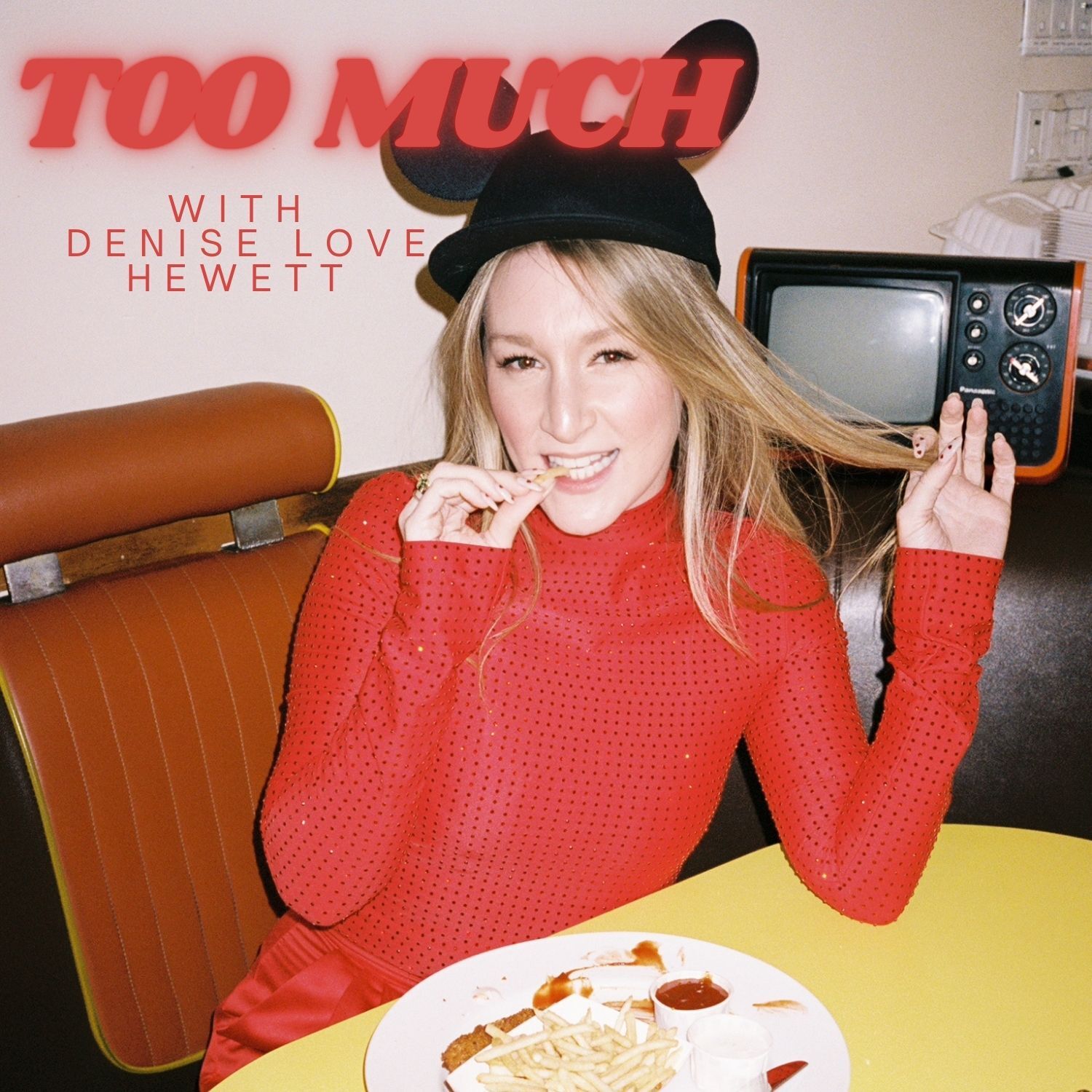
Too Much with Denise Love Hewett
Hosted by Denise Love Hewett · EN
Denise Love Hewett, Celebrity DJ, public speaker, and host of Too Much, gives you the tools to explore new blueprints for the new world. You'll discover different, big, and unapologetically authentic pathways to success in business and life, without betraying your soul to get there. We're a place for outsiders, change-makers, and those who live boldly in their truths or would like to!
Through magical thinking, curious conversations, and speaking new blueprints into existence, you'll build an abundant life where being "too much" becomes your superpower. We want to maximize the human experience, find the goodness in the gray, allow just as much space for the grief as for the joy, to step into our biggest and fullest timelines.
We feature honest conversations with entrepreneurs, authors, celebrities and inspirational humans for the everyday rebel, visionary, and heart-centered person who wants to stand deeper in their purpose to build a better world.
You've got so much to contribute, and the world needs your particular brand of TOO MUCH!
Follow Denise and the podcast @deniselovehewett and @toomuchwithdlh
42episodes
Episodes
Newest firstAll episodes

Q&A: What I Got Right (and Wrong) in My 20s, Workaholism, Love, Purpose, and Career Pivots
4w ago00:17:48Tap to summarizeToo Much goes into the mailbag for the very first time. In this listener Q&A, Denise answers five questions that hit close to home — on overachieving young and not stopping to savor it, the fear that slowing down will make everything fall apart, waiting for a relationship before letting your life begin, finding purpose in your 20s by learning what you don't want, and whether 31 is too late to pivot careers. (It's not. Most women start businesses at 40.) Real talk, no filler — and please keep the questions coming. Topics covered: early career boldness · workaholic recovery · hustle culture · life on hold · dating intentionally · finding purpose · career pivots in your 30s · starting over You can follow this podcast @toomuchwithdlh and Denise @deniselovehewett You can find the Magus Deck at www.worldofthemagus.org
Transcribe →
Awe is the Antidote with Dacher Keltner: Why Wonder is Our Best Defense Against Power Corruption (BEST OF)
Jun 2900:49:32Tap to summarizeIn this reairing, how does power change our brains, and what can we do about it? In this episode, emotion scientist Dr. Dacher Keltner from UC Berkeley reveals the shocking neuroscience behind power corruption and why awe might be our best defense against toxic leadership. We learn about: The Power Paradox: Why we gain power through social intelligence but lose it once we have it How power literally rewires your brain and shuts down empathy Simple daily practices that activate oxytocin and reduce anxiety Why authoritarian tactics ultimately fail and what sustainable power looks like How one minute of daily awe can change your life Why online life increases hate and reduces human connection by 5-10x Practical strategies for maintaining ethical leadership in toxic environments Dr. Keltner is one of the world’s foremost emotion scientists. He is a professor of psychology at UC Berkeley and the director of the Greater Good Science Center. He has over 200 scientific publications and six books, including Born to Be Good, The Compassionate Instinct and The Power Paradox. He has written for many popular outlets, from The New York Times to Slate. He was also the scientific advisor behind Pixar’s Inside Out, is involved with the education of health care providers and judges and has consulted extensively for Google, Apple, and Pinterest on issues related to emotion and well-being. You can follow him www.dacherkeltner.com and @greatergoodmag You can follow this podcast @toomuchwithdlh and Denise @deniselovehewett Email hello@deniselovehewett.com for any suggestions or to submit questions for advice.
Transcribe →
Is College Still Worth It? Inside the NYU Program Beating the 'Job Apocalypse'
Jun 2200:47:13Tap to summarizeIn this episode, Denise sits down with Dean Victoria Rosner of NYU Gallatin School of Individualized Study — Denise's alma mater — to unpack why traditional higher ed advice is failing a generation entering one of the toughest job markets since 2008, and what one program is doing differently (with a 93% employment-or-grad-school rate within six months to show for it). This episode includes: Why "follow your passion and the rest will figure itself out" might be the worst career advice of the last 50 years How to build transferable skills instead of betting everything on one career lane The phrase "academic advising in the age of the job apocalypse" — and what it says about the state of higher ed right now AI, "cognitive offloading," and what's actually happening in classrooms Why an individualized, interdisciplinary education might be the best preparation for an unpredictable career This episode is for anyone who's ever felt like their degree didn't prepare them for the real world, or who's trying to figure out how to stay valuable in a job market that keeps rewriting the rules. You can find Gallatin at NYU @nyugallatin You can follow this podcast @toomuchwithdlh and Denise @deniselovehewett Victoria Rosner is the Dean of the NYU Gallatin School of Individualized Study and Professor of Humanities and English. Her books include Machines for Living: Modernism and Domestic Life (Oxford University Press, 2020); Modernism and the Architecture of Private Life (Columbia University Press, 2005; winner of the Modernist Studies Association Book Prize), and The Global and the Intimate: Feminism in Our Time (Columbia University Press, 2012; with Geraldine Pratt). She is co-editor of Gender and Culture, the preeminent book series on literature and gender, published by Columbia University Press, as well as founding co-editor of the web-based archive Pioneering Women of American Architecture, a project that recovers the histories of US women architects born before 1940, and which received the Docomomo 2022 Advocacy Award of Excellence. Rosner’s work has been supported by the National Endowment for the Arts, the National Endowment for the Humanities, the Graham Foundation for Advanced Studies in the Fine Arts, the Arthur Vining Davis Foundations, and the Columbia University Center for the Study of Social Difference.
Transcribe →
The Singles Tax: Revisited with Renée Sylvestre-Williams
Jun 1500:52:51Tap to summarizeWhat does it actually cost to be single in North America — and why does that cost fall hardest on women? In this episode, Denise sits down with Renée Sylvestre-Williams, Toronto-based journalist, finance writer, and author of The Singles Tax — a groundbreaking look at the financial, legal, and social penalties that single people pay just for living outside the coupled-up norm. We go deep on why this isn't just about money. It's about a system that was designed for a demographic that is rapidly becoming the minority — and hasn't caught up. From the gender pay gap and unpaid caregiving to the housing crisis, tax policy, and the over 1,000 legal benefits tied to marriage in the US alone, this conversation names what so many people are quietly experiencing but rarely see reflected back at them. In this episode: Why the singles tax hits women — and women of color — hardest The real reason the pink tax is about more than razors How housing became financialized and why "just get a roommate" is a policy failure dressed up as advice Why 46% of the US population being single means the system is overdue for a redesign The invisible social tax: who shows up for single people's milestones? How to build financial peace when the structure isn't built for you If you've ever felt like the system wasn't designed for your life — you're right. And this conversation is the one you didn't know you needed. You can find Renee at @reneesylvestrewilliams and https://budgette.substack.com/ You can follow this podcast @toomuchwithdlh and Denise @deniselovehewett Renée Sylvestre-Williams is a Toronto-based writer and journalist who has worked in the finance, business, and investing space for over 15 years, and has been published by some of North America’s top publications, including The Walrus, Canadian Business, The Globe and Mail, and the Toronto Star. She is the creator of The Budgette, a newsletter about money for single people.
Transcribe →
Romantic Rebellion: The Philosophy Behind Sistine Spritz
Jun 800:46:40Tap to summarizeWhat if you built the entire world of your brand before you ever formulated the product? That's exactly what Lauren Alexander and Kate McClamb of Sistine Spritz did — and it's just one of the unconventional moves that's setting them apart in a saturated beverage market. In this episode, Denise sits down with the co-founders of Sistine, a cleaner, California-forward take on the Italian aperitivo spritz, to talk about building a business that doesn't betray your values — and trusting the timing of the universe while you do it. We get into: Why they chose branding over formulation first The difference between borrowing customers (VC-style) and building real community How they used astrology, tarot, and numerology to time product launches (including a video that hit 500K views the day it dropped) The sugar truth about Aperol that nobody talks about What the Pygmalion Effect looks like inside a co-founder relationship Why rock bottoms are the best growth generators you'll ever have If you're building something slow, intentional, and deeply yourself — this one's for you. You can find Sistine at sistinespritz.com and @sistinespritz You can follow this podcast @toomuchwithdlh and Denise @deniselovehewett
Transcribe →
Why women get worse financial advice (and what to do about it) with Amanda Holden
Jun 100:56:16Tap to summarizeWhat if the reason you feel behind financially has nothing to do with your choices — and everything to do with the system? Amanda Holden spent years inside Wall Street investment management before leaving to build Invested Development, where she's taught over 25,000 students to invest with clarity and confidence. In her book How to Be a Rich Old Lady, she dismantles the myths the finance industry has sold us and offers a radically honest blueprint for building wealth — even inside a broken system. In this conversation, Denise and Amanda cover: Why women are routinely given worse financial advice than men The real reason "stop buying coffee" is terrible financial advice How creatives and entrepreneurs should actually think about money What ethical investing actually means — and why ESG funds are closer to greenwashing than you think The truth about the stock market vs. the real economy Financial nihilism, the apocalypse retirement plan, and why investing is still worth it Wealth as a collective possibility — and what that looks like in practice Why your financial failures are not yours to own Whether you're just starting out, rebuilding after setbacks, or questioning why the whole system feels wrong — this episode will meet you where you are. Amanda Holden is the founder of Invested Development and author of How to Be a Rich Old Lady. Find her online as @dumpster.doggy You can follow this podcast @toomuchwithdlh and Denise @deniselovehewett
Transcribe →
Healing the Success Wound with Brooke Taylor
May 2500:56:37Tap to summarizeIf you've checked every box — the title, the salary, the accolades — and still find yourself lying awake wondering why it doesn't feel like enough, this episode was made for you. Denise sits down with Brooke Taylor, transformational career coach, former Google marketing lead, and author of the newly released Healing the Success Wound, for a clarifying conversation on ambition and identity. Brooke has coached thousands of leaders and what she's found consistently, across all of them, is a root cause that almost no one in professional development is willing to name directly. Brooke calls it the success wound. We get into the two power sources that drive ambition (only one of them is sustainable), the five archetypes of the success wound, and why the very strategies that made you successful may be exactly what's keeping you from the next level. We also talk honestly about what change actually requires — and why it usually involves hitting your knees before you're willing to do things differently. In this episode, you’ll learn: The root difference between the success wound, perfectionism, and imposter syndrome The two power sources of ambition: fear vs. the true self The 5 archetypes of the success wound — and how to spot yours Why 65% of adults never reach the self-authoring stage of development Why readiness is a decision, not a feeling You can find Brooke at @brookevtaylor and brooketaylorcoaching.com You can follow this podcast @toomuchwithdlh and Denise @deniselovehewett Brooke Taylor is a globally recognized transformational career coach, keynote speaker, and the leading authority on a phenomenon she pioneered known as the “Success Wound™.” With a career that began in the high-pressure hallways of Silicon Valley, Brooke spent years as a Marketing Lead at Google, where she was honored with the Google Global Sales Award. Despite her outward accolades, she experienced firsthand the "manic ambition" and burnout that often plague high achievers, leading her to a profound personal transformation and the eventual founding of her coaching practice.
Transcribe →
The Philip B Masterclass: Hair Science, Scalp Health & Why Everything You've Been Told About Hair Care Is Wrong
May 1801:14:44Tap to summarizeThis week, Denise sits down with Philip B, one of the most sought-after hair and scalp treatment experts in the world, for a full masterclass on what actually makes hair healthy, why the beauty industry has been getting it wrong for decades, and how a kid sorting rollers in a 1960s Beverly Hills salon built a brand now sold in 50 countries. Philip B breaks down the real science of scalp health, including a live pH demo that will change the way you shower , and explains why most haircare products, even the expensive ones, aren't solving your problems. They cover why tap water is the number one enemy of healthy hair, the truth about popular shower filters (they don't change the pH), how to think about haircare like a bank account, and why the "clean beauty" trend may be doing more harm than good. Philip also shares the story of building his brand from scratch in Beverly Hills, mixing formulas in his kitchen, getting a Vogue feature that crashed his phone line with 500 calls an hour, and landing in Neiman Marcus with a little help from Paula Abdul. This episode is for anyone who has ever wondered why their hair changed after coloring, why it tangles the second they get out of the shower, or how to actually treat a problem scalp. In this episode: Why the scalp is the foundation of all hair health (and why most people ignore it) The pH science behind tangling, frizz, and hair breakage — demonstrated live Why shower filters don't fix the real problem How to repair chemically damaged hair using the "bank account" method The botanical ingredients that actually work on dandruff and psoriasis Philip's origin story: Beverly Hills, Vogue, and building a global brand from a kitchen Why your zone of genius feels "too easy" — and why that's the point Philip B, hair and scalp expert to celebrities, sold in 50 countries, and named by Forbes as one of the products worth every penny, joins Denise for a full masterclass on the science of healthy hair. They cover pH and why tap water is wrecking your hair, how to repair chemically damaged hair, the truth about clean beauty, and Philip's incredible origin story from Beverly Hills kitchen to global brand. This is the episode you send to every woman who's ever been frustrated by her hair. You can follow him @philipb or philipb.com You can follow this podcast @toomuchwithdlh and Denise @deniselovehewett #HairCare #ScalpHealth #PhilipB #HairScience #HealthyHair #HairTips #ScalpTreatment #NaturalHairCare #HairCareRoutine #PhilipBHair #DamageRepair #HairEducation #TooMuchPodcast #HairMasterclass #BeautyScience
Transcribe →
Learning the Practice of Grief with Kara Hoppe
May 1100:51:43Tap to summarizeWhat if grief wasn't something to get over — but something to get fluent in? This week, Denise sits down with psychotherapist, death doula, and author Kara Hoppe for an expansive conversation. Kara works at the bookends of life, supporting new parents and walking alongside those in the dying part of life, and she brings a rare, grounded wisdom to a topic most of us have been taught to avoid. Together, they explore grief not as an emotion that happens to you, but as a practice you can cultivate. A skill that, when developed, doesn't just help you survive loss, it expands your entire capacity to be alive. They get into: Why the people who disappear when you're sick aren't bad friends — they just don't have the tools yet How befriending your mortality might be the most life-affirming thing you ever do The surprising link between expanding your grief container and expanding your capacity for joy What the dying actually regret (it's not what you think) Why grief was never meant to be a solo act — and what it looks like to carry it communally The relational filter Denise uses in dating: have you been taken to your knees? What legacy actually means, and why it doesn't belong to us This episode will change how you love, how you show up, and how you think about the time you have. Kara Hoppe is the co-author of Baby Bomb and the creator of the We Are Mortal course. Find her at karahoppe.com or @karahoppe on Instagram. You can follow this podcast @toomuchwithdlh and Denise @deniselovehewett “Not to think of grief as a journey we finish but grief as a language, it's to become fluent.” Jon Onwuchekwa
Transcribe →
What AI Is Really Doing to Human Identity, Creativity & Trust with Bob Hutchins
May 400:49:39Tap to summarizeSomething shifted when AI got good at writing. You started wondering: did my coworker write that apology — or did the machine? Is this birthday message from my friend, or was it generated? Does it matter if you can't tell? Bob Hutchins has a name for what you've been feeling. He calls it proxy failure — and it may be the most important concept for understanding what AI is actually doing to human relationships, creativity, and trust. Bob is an executive AI consultant, doctoral researcher, and one of the rare thinkers who approaches artificial intelligence not with hype or doom, but with genuine psychological depth. In this conversation with Denise, he breaks down why this moment in history is different from every other technological disruption and what we actually have to do about it. In this episode, you'll hear: Proxy failure — why AI has broken the oldest social contract humans have: the assumption that language comes from a living, feeling person The University of Pittsburgh poem study: AI-generated poems outscored Shakespeare until readers were told which was which. What that reveals about where meaning actually lives. Why AI is different from every other technology wave (the printing press, the internet, the smartphone) and the one thing those waves never threatened The rise of the generalist: why being told to "stay in your lane" may have been the worst career advice of the last 20 years AI literacy vs. AI fluency and why knowing how to use it is completely different from knowing how it works on you How to use AI as a thinking partner without outsourcing your thinking Bob draws from media ecology, behavioral psychology, and systems thinking to offer something the AI conversation desperately needs right now: nuance. This is a conversation about what it means to be human when the machines get very, very good at pretending to be one. Subscribe to Bob's Substack for his ongoing research: https://bobhutchins.substack.com/ and follow him on IG: @bwhutchins You can follow this podcast @toomuchwithdlh and Denise @deniselovehewett
Transcribe →