← Top Traders Unplugged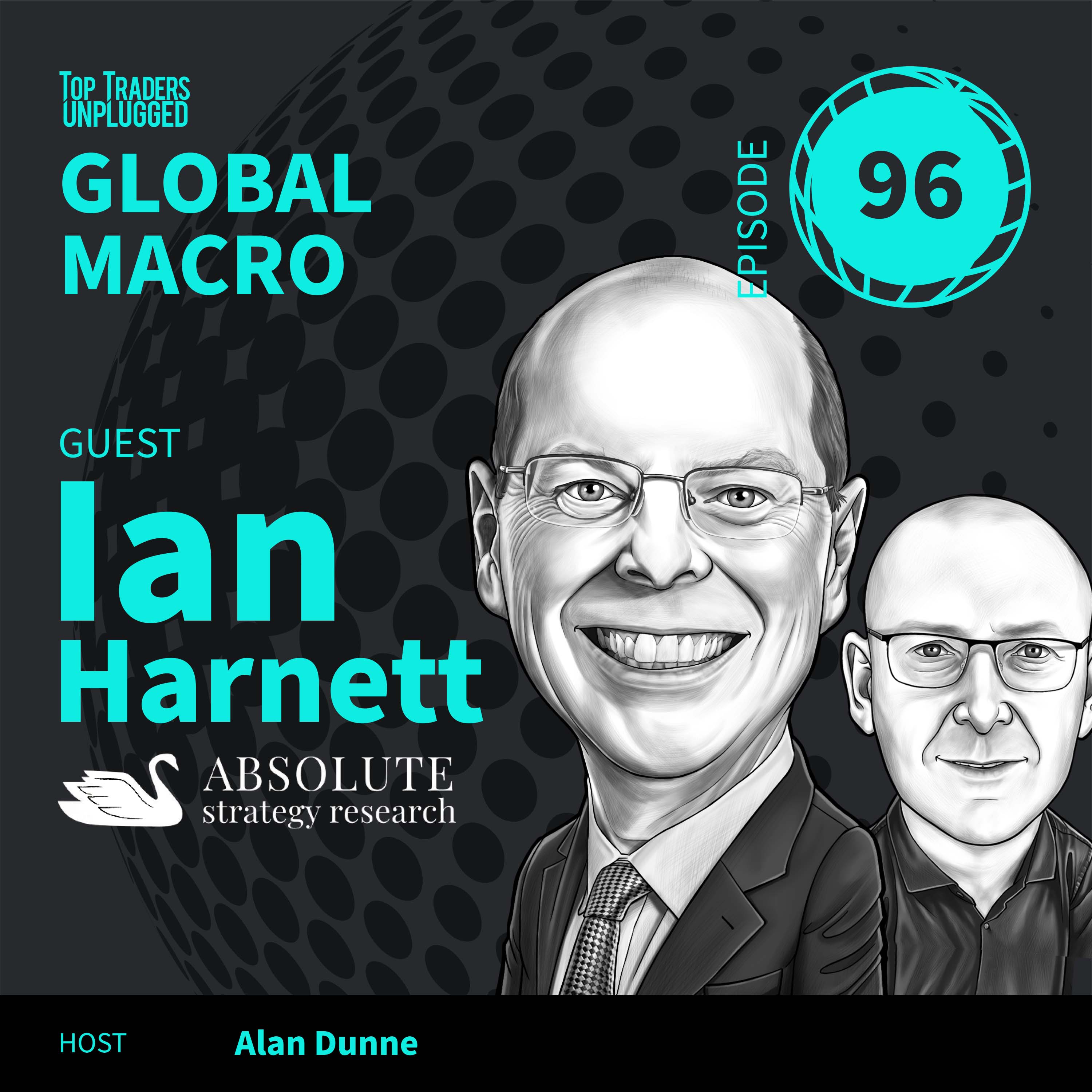
Loading summary
Transcript109 lines
- [00:07]
Ian Harnett
That four way coalition that I outlined starts to fracture very dramatically and at that point I really would be selling the dollar. That is going to be the point at which you'll say, well, hang on a minute, this is just, there's a lot of rogue elements here. And so unless there was something that materialized to stabilize the ship very dramatically. So that to me seems to be one of the biggest gray swans out there.
- [00:38]
Podcast Host (Nils Kostrup Larson)
Imagine spending an hour with the world's greatest traders. Imagine learning from their experiences, their successes and their failures. Imagine no more. Welcome to Top Traders Unplugged, the place where you can learn from the best hedge fund managers in the world so you can take your manager due diligence or investment career to the next level. Before we begin today's conversation, remember to keep two things in all the discussion we'll have about investment performance is about the past and past performance does not guarantee or even infer anything about future performance. Also understand that there's a significant risk of financial loss with all investment strategies and you need to request and understand the specific risks from the investment manager about their product before you make investment decisions. Here's your host, veteran hedge fund manager Nils Kostrup Larson.
- [01:33]
Podcast Host (Alan Dunn)
Welcome or welcome back to another conversation in our series of episodes that focuses on markets and investing from a global macro perspective. This is a series that I not only find incredibly interesting as well as intellectually challenging, but also very important given where we are in the global economy and the geopolitical cycle. We want to dig deep into the minds of some of the most prominent experts to help us better understand what this new global macro driven world may look like. We want to explore their perspectives on a host of game changing issues and hopefully dig out nuances in their work through meaningful conversations. Please enjoy today's episode hosted by Alan Dunn.
- [02:18]
Alan Dunn
Thanks for that introduction Niels. Today I'm delighted to be joined by Ian Harnett. Ian is co founder and Chief Investment Strategist at Absolute Strategy Research. The firm has been in existence just coming up to 20 years now, so celebrating their 20 year anniversary this year. Ian's a veteran of the markets. He's been around for about four decades in markets now. Started off as an economist at the bank of England and then worked with Soc Gen, NatWest and UBS, where at UBS he was Chief European Investment Strategist. So Ian, great to have you on. How are you today?
- [02:52]
Ian Harnett
Thank you very much. An invitation Alan?
- [02:54]
Alan Dunn
Not at all, no. I followed your work through your career at various times. So great to have the chance to chat and as we always do to start off, we like to get a sense on how you got interested in markets and I suppose before that even economics. What was that?
- [03:11]
Ian Harnett
Well, you know, I have to say I'm afraid it goes back a long way that I think I wrote my first economics article on the shape of inflation when I was probably at primary school.
- [03:20]
Alan Dunn
Okay.
- [03:22]
Ian Harnett
But that was of course back in the 1970s and that was when inflation was quite rampant. But my father was an accountant and we obviously talked about finance. But it was also very much at school where first of all I found out that I actually quite enjoyed economics when I did at A level, but also in history, learning about the impact of great economists like Keynes in the pre war, post war period and thinking, well actually maybe this is something that can make a difference of the world rather than just, you know, being an interesting academic study.
- [04:03]
Alan Dunn
Very good. Well, these days you're trying to make a difference to people's portfolios, I guess. And it's. We're at an interesting juncture. I know you've written a lot lately about the, I suppose you might call it the regime shift in the world. And you know, we had Davos recently and Carney speaking about rupture and, and I know that's a theme you've picked up on. I mean, to put that all in context, I mean, how would you kind of characterize that regime change, the most salient features of the new regime?
- [04:34]
Ian Harnett
I think the key thing that we're talking about at absolute strategy is the way that the relationship between stocks and bonds that all of us have known for that 40 year period, it's really changing that. After four years where Central banks have consistently missed their inflation targets, we are starting to see people saying, hang on a minute, maybe the way out of this debt problem is a little bit more inflation and less reliance on keeping the nominal side of the economy under control. And that encourages a shift away from having bonds as the safe asset or the natural hedge in your portfolio, if you like. You know, most funds are going to be probably more than 50% invested in equities.
- [05:28]
Alan Dunn
Yeah, and I mean, obviously we had the experience in 2021, inflation spiked. You know, as you say, it was the first. It was for most of us, it was the first real experience of inflation. You know, obviously you would have had it back in the 70s and maybe we, you know, some of us might remember that. Some of us, yeah, but it was really, you know, prior to that people talked about the possibility of a resurgence of inflation, but people didn't really Believe it. But to see it, inflation rates get back up to whatever it was, 7, 8%, maybe even a little bit higher, was something. And Obviously then in 2022, we saw equities and bonds sell off together, proving the points that the spot and equity correlation is not always going to be negative. Since then, obviously inflation has come down and there's mixed views. Obviously it's still running well above target in the US close to 3%. But there are still those who believe, well, take out the impact of tariffs, that it would probably be closer to 2%. So, yes, there are plenty of people that kind of would agree with your I suppose, synopsis of maybe inflation being more of a challenge. But then it's not a universally held view. I mean, what do you think are the key factors that will keep inflation more elevated here?
- [06:39]
Ian Harnett
Well, I think when you think about some of the changes that we're seeing in society and the investment that will need to be made, that shift in the economic structure tends to create increased costs. The second thing I think is to recognize that a world that becomes more fractured, where we get this weaponization of trade, economic growth, potentially less globalized, that those long, thin supply chains that allowed companies to access the lowest cost possible price of labor, lowest possible price of goods and the lowest price of capital, those are changing and that is likely to push inflation pressures up as well. So those are the kind of things, I think, Alan, that make us feel that structurally inflation's going to come down. Tactically, the thing we've been talking to clients about is that every central banker in the world should be entirely grateful to the Communist Party of China because actually the exported deflation in goods prices is actually doing a lot of the work of holding inflation down. If you look at service sector inflation in the U.S. even in the Eurozone, it's 3, 4% still. So I think that central bankers need to be a bit careful about patting themselves on the backs.
- [08:10]
Alan Dunn
Yes, for sure. And I mean, we'll probably get into China in a bit more detail later. But just on that point, is that something you see? I mean, hitting a limit? Obviously there's a lot of people saying that this, the rest of the world isn't going to absorb China's surplus on an ongoing basis. How do you see that playing out?
- [08:27]
Ian Harnett
Well, I think that, you know, that's one of the big problems for China, which is that they do have to generate more of a domestic growth narrative. And our China economist, Adam Wolf, who's excellent, is still very concerned that with the housing market, which is A key source of wealth and confidence for Chinese consumers still under pressure that that's very difficult to achieve unless you have a big fiscal expansion. And that's what the Chinese authorities don't really want to do. And yes, clearly in a world, a more fractured, this more fractured world, America's not going to want Chinese dumped goods, Europe's not going to want those dumped goods either. And so that's going to make it a much more complex trading environment for everybody.
- [09:14]
Alan Dunn
Yeah, I mean, you've touched on the weaponization of credit of capital. Obviously it was very much to the fore at Davos when, you know, when Trump floated the idea of more tariffs in Europe and then the debate was around, well, what can Europe do? Could Europe try and impose some measures to dissuade investors investing in Treasury? So I mean, we've already had the weaponization or conflict in trade. So obviously capital could be the next frontier. How do you see that evolving?
- [09:46]
Ian Harnett
I think we're seeing it, I think we're seeing it occur relatively softly at the current time, but it could shift to being a much more aggressive method, which is that if President Trump takes against Canada, for example, then if we've got tariffs on goods, why shouldn't American fund managers that are over invested in Canada, for example, have to pay a surcharge on that? Eventually you do get to the case where you potentially get capital controls reemerging and you know, clearly something back to the 1970s. But let's hope that we don't get to that stage. I think what we're seeing is that particularly say for somewhere like Europe, Europe has a problem because, you know, if you, if you, we still have a number of, you know, separate economies, we rather than, you know, capital markets union in a world where you're relying on your domestic capital much more because, you know, you, you know, you see investors saying, right, I'm going to stay at home or, or governments even directing you to stay at home. You know, a bit like Rachel Reeves in the UK trying to encourage the, you know, the retail investors here to invest in the UK then Europe actually just doesn't really have very effective capital markets. And so, you know, even Germany, you know, where with the type of fiscal expansion they're talking about for both infrastructure and for defense. Well, there's a lot of debt issuance coming through and if it has to all be absorbed by Germans. Yeah. Then that's German institutions and that's problematic. And again could push by some of these bond yields higher.
- [11:32]
Alan Dunn
Okay. And I mean, obviously there's Been a lot of talking suggestions in Europe. We had Drag ease report out and there's been a recognition of the need to do something productivity and equally the likes of Macron has talked about the potential European surplus of capital and trying to redirect that back. Sounds like you're not very optimistic on anything dramatic changing in Europe in terms of mutualized debt issuance or anything like that.
- [12:03]
Ian Harnett
No, you know, I think the, you know, one of the things again we've said to our clients is that actually the best thing that could happen to the Eurozone is a French financial debt crisis. Because to get a capital markets union emerging in anything less than five years and the it'll be here in five years is something that we've heard for at least the last five years and you know, I suspect we'll hear it for the next five years if we don't. Europe has lacked that Munich moment for capital that it had for defense. And it really took a very unsubtle comment by JD or set of comments by JD Vance, 15 minutes turned on it, on its, you know, of European policy on its head. We need something like that to galvanize European politicians. And you know, at the Draghi report, Draghi's comments recently, they're not enough. You're going to have to have something that's large enough that it doesn't completely destroy the European Union, but important enough that the rest of Europe has to say, right, we're going to stand with this and create bonds. And actually that would be the strongest way to challenge America if Europe created a large safe asset know to offset as an alternative to Treasuries. There's $9.6 trillion of EU money currently invested across U.S. treasuries, U.S. equities and U.S. credit. You know, that might well not be retaliatory repatriation, which obviously would be very much the weaponization, but more economically driven repatriation.
- [13:55]
Alan Dunn
And I mean from the US side, obviously we've had a number of conflicting cross currents in terms of the weaponization of capital. On the one hand you've had, I suppose a tacit approval of a weaker dollar is one thing, but at the same time a desire for the dollar to be the reserve currency. You've got, you know, these deals that they've cut to attract capital in as well, but at the same time concerns about funding the deficits and obviously going back to Moran's paper, some kind of extreme kind of policy proposals around trying to maintain capital inflow. So I mean, in this world of more fragmentation Potential capital wars. Do you see the US Being more of a winner or a loser or at more or less at risk?
- [14:46]
Ian Harnett
Well, at the moment, I think they've been a very strong winner. If you look at the White House website, President Trump is talking about having secured 9.6 trillion. So quite interestingly, that's the same amount as Europe could shift offshore. They're bringing capital into the US and as you say, quite often in exchange for a reduction in tariffs. So, you know, looking in more detail at that national allocation, there's a commitment of about $6.7 trillion. You know, that's a big amount of money from national governments. And the net effect is that that's actually seen tariff levels come down, the median tariff levels come down for those countries that are playing that game with America from 25% to 15%. So, you know, the point we've been making is that this is. It's almost like paying tributes to the monarch, you know, and there's some academic work around neo royalism for those people that want to have a look. You know, the policy wonks are going down this route that actually getting access to the monarch, you have to pay up front for it. This is very. So America, I think, is, is doing a very good job from their perspective at trying to offset the risks of that capital flight. And, you know, with Europe saying that they, you know, they would do a $600 billion deal, Europe's actually at the moment saying, we'll play by your rules. So that sounds to me like America winning.
- [16:32]
Alan Dunn
Yes. Now, I mean, there is a bit of skepticism around some of these numbers. I mean, every time Trump loves to quote a 500 billion, it seems like for every baseline, for every deal, and then there's always a question, is this stuff that was going to happen anyway or not? But it sounds like you think there will be genuine flows.
- [16:51]
Ian Harnett
I think the point that we've made to people is let's imagine that this was all funneled and this is not the case at the moment. It's being funneled at the discretion of President Trump or being funneled through individual areas. But let's say this was funneled through a new sovereign wealth fund. And there was that discussion about a US Sovereign wealth fund being created and only a third of that number materialized. You would still be talking about a fund that is as large as the Norges Bank. And the Norges bank is one of the 10 largest holders of nine of the 10 largest U.S. companies. Just think what, you know, that impact would have in terms of capital market allocation and we're actually already seeing it with some of these direct investment deals that the American government's doing in terms of aiming to secure mineral rights and resources generally around the world.
- [17:55]
Alan Dunn
Yeah, I mean taking a step back and looking at what's been achieved today, obviously we're, we're probably just over a year into Trump 2.0. And I mean for a lot of the first year there was kind of discussion like what's the ultimate objective here? Is it reindustrialization of the US or is it just to fund the deficit with the tariffs? I mean you mentioned this kind of neo royalist era, which does sum it up very well. I mean what's your take? What's the economic ideology if there is one driving this?
- [18:33]
Ian Harnett
I think we believe that the Trump administration and remember this is a broad alliance of three or four different groupings, the Republican right, the Tech Bros. The unilateralists and then the multilateralists. But what they're coming together to do is to roll back the economic and social structures that to back towards the Reaganite era. They're trying to create a new Republican era that will survive for 20 years in much the same way that you know, that that Reagan Thatcher axis did in the 1980s. And I think that is where they are trying to get to. And I think both of the things that you mentioned, Alan, are on the agenda in terms of the re industrialization of the United States. But I also think that let's go back to Scott Besant's three arrows and he loves Shinzo Abe, but he came up with the 3% GDP growth, 3% deficit and 3 million barrels per day more energy. And you know, I think what lies at the heart there of this is the Republicans aiming to get the deficits under control through higher nominal growth. So this is another reason why we're much more comfortable with the idea that the economy will be run hot to get those debt ratios under control. But to offset the inflation risk to some extent you need that energy, you need cheap energy. And that's. So I think this is at the heart of, of, of what we've also some of the policy measures. But here's some. It seems to me to be a very broad brush and a very ambitious project that the Republicans are working towards. And the midterms are going to be a bit test of that.
- [20:32]
Alan Dunn
Yeah. Before we get on to midterms, I mean do you think that's realistic? I mean it had a great ring to it. Three, three, three. But you know, obviously we've had the Big beautiful bill which made zero progress towards heading towards a 3% deficit. Now, obviously the great hope is, as you say, that economic growth is strong. And it was talk about deregulation. Obviously we've seen that with respect to maybe AI and crypto, stuff like that. And obviously productivity has picked up, although it's debatable what's driving that. So I mean, do you buy into that narrative of a supply side?
- [21:13]
Ian Harnett
I think we can still see that the momentum behind those ideas. So the deregulation of finance, Lorby and banks, we've clearly seen the deregulation around the crypto areas. I think what Scott Besant understands probably better than most, and I think he's a very accomplished economist and investor, is that the counterpart to the public sector deficit is the private sector surplus. So the only way to get that 3% debt ratio that they want need effectively to keep the rate, the interest payments under control is that they have to get investment coming through. They have to get consumer spending. And historically the only way that really you've got the deficits down for governments in terms of debt to GDP is, is you've always had to get the rest of the economy to take on debt.
- [22:12]
Alan Dunn
Okay.
- [22:13]
Ian Harnett
Yeah, okay. Debt to GDP ratios actually had never come down, apart from 19, since the 1950s, since 1952 briefly, and then in the post pandemic period. But they stabilized where they started pre pandemic look at total debt ratios. So, you know, I think, you know, I think that's at the heart of this. They're going to run, try and re lever the housing market, right, relever consumers, you know, let them borrow against their crypto assets. What could possibly go wrong?
- [22:45]
Alan Dunn
Exactly? Well, you mentioned running the economy hot and obviously we've had the announcement now of Warsh as the nominee to be Fed chair. And again, lots of different views on Warsh. And he has at times sounded hawkish and at times sounded dovish. How do you think he'll play it in the early days?
- [23:08]
Ian Harnett
I think the thing that strikes me about Chair Elect Walsh and I had the pleasure of listening to him at the Atlanta Fed conference a couple of years ago where he was actually in front of a number of Fed presidents, regional presidents. It did seem as though he was chair in waiting even at that stage. So he is taken very seriously. His ideas, I think, are taken very seriously within the Federal Reserve System would be my perception. And so I think that he is likely to want to deliver those lower interest rates that President Trump will suggest. But what I would like to point to is that the speech that he gave that day in 2024, and I think a couple of other people have picked up on it, was actually about bringing the level of the central bank balance sheet down. And it also fits with an article that Scott Besant wrote about the scope, curtailing the scope of the Federal Reserve and the range of activities of the Federal Reserve. So the way that I could see this playing out is that actually the negative surprise for markets could be that Chair Warsh says, okay, no more bond purchases, no more MBS purchases. We are going to reduce the size of the balance sheet. But you know what, that reduces global liquidity. And so you could get those bond yields coming down or interest rates coming down because we actually start to see, you know, some of those, some of the froth coming out of markets. And in the past, rates have responded when the froth has come out of market. So it, it may not be quite as market friendly as I think a lot of people would like, but I can see how he could reconcile getting, you know, rates down. But you know, it's, it's probably around that of qt. Accelerating qt.
- [25:22]
Alan Dunn
Yeah, I mean, obviously the Fed has totally shifted how it conducts monetary policy into this excess reserve system. So there is some debate as to what he says is really plausible because obviously when they've tried to shrink the balance sheet before, it's led to problems in the repo market, et cetera.
- [25:41]
Ian Harnett
And I think one of the things that's been a feature of the discussion that I've listened to over the last couple of years is the discussion about the ample reserve system. And so I think there could be some quite interesting technical changes. And it wouldn't surprise me that we see some of at the same time that there's deregulation for banks, that there might be some changed views around how the reserve programs work and maybe the US moving something closer towards what we see in Europe and the uk.
- [26:17]
Alan Dunn
Okay, so taking all of that together, it sounds like you're quite upbeat or moderately so on the US economic outlook. Is that fair to say?
- [26:25]
Ian Harnett
Yeah, for the moment, Alan, it seems maybe. I don't know whether it's contra consensual or not, but actually we're sticking with that overweight US view. It is a very unusual environment to have double digit earnings expectations and expectations of rate cuts. The closest that we came to it were 1996 and 1998. On both occasions, equities gained 20 to 30%. And the point we've made to clients is that it's so unusual that it's unlikely that it will persist to the end of the, the year. You know, it may do. And you know, this is the game that, that, you know, the administration are trying to play strong growth, lower rates. But if it doesn't, well, which way would you like it to converge? Historically, if you get lower rates because earnings growth is tanking, then that's never been good for equities. Normally, you know, the, over the last 12 interest rate cycles, when you've had a pivot, you know, I think, you know, 10 out of the 12 were, were negative and the median decline was about 20% or 24%, I think was the figure that we, that we calculated.
- [27:42]
Alan Dunn
Yeah.
- [27:43]
Ian Harnett
So, you know, the markets will actually be much healthier, ironically, if we manage to keep nominal growth healthy and rate expectations start to get revised out.
- [27:54]
Alan Dunn
Yeah.
- [27:55]
Ian Harnett
So I think that that's a more stable environment for markets.
- [27:59]
Alan Dunn
I mean, I think the general sense, my understanding is of investors is of fairly bullish sentiment at the moment, kind of reflecting what you're saying. Growth looks good, but then the Fed still expected maybe to ease at some point, if not sooner rather than later. I mean, I know you do your own asset allocation survey in absolute strategy research. What are you seeing in that survey?
- [28:22]
Ian Harnett
So the asset allocation survey is still giving us that same kind of outcome around both the global economy and also the outlook for equities versus bonds. I think the interesting thing is that people have become more ambivalent about the direction of bonds. They've also become a bit more ambivalent about the direction of inflation as well. So there's question marks that are opening up here. But what we are seeing is a bit of a move towards what one might class value trades, things like commodities, emerging markets. So there's a recognition that the core investments that you've perhaps had over the last 10 years are starting to lose some of their shine.
- [29:16]
Alan Dunn
Okay. I mean, obviously not only are you doing the survey, you're speaking to a lot of investors. I mean, when you talk to them about this regime change in, in the global economy and also as you mentioned at the outset, that change potentially in the bond equity correlation, are you seeing many tangible changes in portfolios on the back of that?
- [29:36]
Ian Harnett
So not really. And one of the points that we make is that historically, when you get to get the rotation out of the US you need three things. First of all, the dollar needs to come down. Well, we've seen a bit of that, but it's stabilized. Secondly, you need the global economy to grow rapidly and can that happen without China being a bit more dynamic. But the third and most challenging element is that the US ROEs have to disappoint relative to the rest of the world. And at the moment, given how much those margins those roes are being driven by the US tech companies, effectively, you're saying you've got to have a tech blow up. And if that happens, the risk is that you would then move to what we call a correlation. One event. Yes, the markets come off, everything loses value and then you want to be in low beta. The trouble is that some of the things that you might want to rotate into emerging markets, commodities, historically, they can be quite high beta. So what we're seeing from clients is that one or two people are making that rotation a bit more towards commodities, a bit more towards the emerging markets, but they tend to be larger funds who say, I'm so large, I recognize that, Ian, but I'm so large, if I don't start now, I'm never going to get there. So. So.
- [31:18]
Alan Dunn
Well, it is something we've seen. We're recording on the 5th of February, but in the last week or so, maybe a couple of weeks, this outperformance of value versus growth, we've had days where the NASDAQ is down, but the Dow is holding up or even up. And if you look at the sectors, industrials and materials doing well and we've had this, I've just heard this expression, this SAS coupleips. Hey, I only heard of that one today. But obviously the software, the SAS sector is getting hit badly. I mean, as you say, normally if you get a big sell off, everything gets dragged down. Is this, I mean, if you were kind of advising on strategy, sectoral allocations, are you at the moment, we would.
- [32:01]
Ian Harnett
We're sticking with that more positive cyclical view.
- [32:05]
Alan Dunn
Okay.
- [32:06]
Ian Harnett
You know, because you know, you're, you're and, and you know, the com. The, the interesting thing about value is that non US value has been outperforming for about 18 months. If you think the banks, European banks have been on a raw global basic resource. Stocks have been since the start of 2025, I think up 50, 60%, almost relative. So we've seen non US value outperforming growth already. I think that the challenge for people, and I think this is one of the big something that my colleague Will Moss wrote about for our clients very recently ahead of the SASS apocalypse, which is the irony is that people are thinking that by rotating into private equity and private credit, they're diversifying away from tech what the last week has shown them is that actually the largest holdings of private equity and private credit are in tech. And actually listed high yield has got less tech exposure than private credit.
- [33:22]
Alan Dunn
Yeah, interesting. Yes.
- [33:24]
Ian Harnett
So how you diversify in this environment is really challenging, I think.
- [33:31]
Alan Dunn
Yeah, that's interesting. I mean it just shows you what the labels are put on things don't, doesn't matter how.
- [33:36]
Ian Harnett
Absolutely. I can't say anything. Having worked for investment banks for 20 years, I couldn't possibly comment about that.
- [33:41]
Alan Dunn
Yeah, yeah, but it's true. I mean high yield would traditionally have higher exposure to things like energy, wouldn't it? Yeah, yeah.
- [33:47]
Ian Harnett
And you know, one of the things that we've been talking to clients about thinking about where you can get, you know, superior returns and, and if there's a very high correlation between equities and high and, and, and credit. Yeah, High yield credit I think is actually a really interesting asset class now because it's, it's one of the few things that does have what it, what it says on the, on the tin. Right. You know, so investment grade post gfc we saw a big rise in the lowest grade investment grade triple b from about 30% pre GFC to over 50% now. You know, a lot of high yield stuff got revamped into investment grade or if it wasn't capable of being got away in the public markets, it's gone to the private markets. So actually high yield I think really is, you know, what you're dealing with, you know, the scale of risk. So you know, I think that, you know, this is, you know, if you want that enhanced yield, I would actually go into to that space rather than to. Sorry, a bit of a digression.
- [34:58]
Alan Dunn
No, no, it's, I mean definitely private credit is topical at the moment and what you say is definitely.
- [35:04]
Ian Harnett
I mean as long as the key point for, about, about that we say for credit and credit really is important because you'd never have a bear market in equities without having a bear marketing credit.
- [35:17]
Alan Dunn
Exactly. Yeah.
- [35:19]
Ian Harnett
But you're not going to get a bear market in credit until you have cash flow crises. So this is where that nominal growth. So the phrase we've used to clients is nominal, nominal, nominal, nominal GDP growth. If it's over 4% then your nominal earnings are going to be fine and that means your nominal cash flow will not be challenged. And that's the mistake we made in 2023. So put our hands up. We don't always get it right. We thought the slowdown that was likely to come and did materialize in real terms. But because inflation was still high, the nominal earnings, the nominal cash flows weren't stressed. And so we didn't have a big market, you know, as large a market kind of sell off as we might have had. So you know, that for us is really what we're focusing on with clients. We're saying watch those nominal numbers, watch those nominal cash flows. And even in things like the tech sector as well.
- [36:24]
Alan Dunn
We touched a bit on the dollar and weakened last year somewhat, but not dramatically. And sentiment certainly got quite negative towards the dollar as last year progressed at times with the sell us mentality. And then it's probably dipped down a little bit at the start of this year, but has recovered. And then was it last week or the week before? You know, there was talk of the Fed were checking rates in dollar yen, which is kind of a highly unusual event. What's your sense on you know, say from a fundamental perspective, the fundamental drivers. And then what's the US administration, are they changing tack with respect to the dollar with that checking on rates?
- [37:10]
Ian Harnett
I think the point we've made about the dollar is that our chief economist Dominic White has done some great work around what kind of dollar rates you would need to re equilibrate the current account and the trade account and the capital account. And that points to a decline of something like 15%. But the question is when and against whom. And I think that's one of the, and that's one of the challenges that you have if you want the dollar to come down. Something has to appreciate and clearly it doesn't seem as though the Chinese authorities can be very keen on that. Europe is probably also wary about seeing the euro go very much higher than this. Again, this is one reason why the European inflation rates have been under control. But it's going to depress growth to some extent at some stage. And historically that might see the euro rates or people think twice about whether euro rates would go up and effectively the euro is doing the kind of monetary tightening that rates might have done potentially. So you really, you're left against the yen and you know that is the problem there is how much of unwinding that yen carry trade would then disrupt other financial flows globally. So you know, that's the big risk, but you know, the big decline in real effective exchange rate terms has definitely been the end.
- [38:54]
Alan Dunn
Yeah. So you would say that that's the one that's the outlier then that that's the one that should be material.
- [38:59]
Ian Harnett
Absolutely. We've got a lovely chart of B effective exchange rates back to, you know, 40 odd years. We love our charts, we love our history. Yes. And you know, if you renormalize it around 2012 and you can see that, you know, Japan's been allowed to devalue against the rest of the world. You know, this has been, you know, they are, you know, under the Biden administration, they were very definitely seen as the floating, you know, the, the unsinkable aircraft carrier. And that is one reason why we still like Japanese equities. We think that they're seeing their roes going up, they're getting big competitiveness gains from this.
- [39:40]
Alan Dunn
Yes. And obviously they're running monetary policy with negative real yields. So that's I guess positive for the equity market.
- [39:46]
Ian Harnett
Yeah. And our view would be that some normalization of that over the next couple of years seems very likely. The trend towards higher, higher interest rates in Japan will probably continue but it'll be at a, at a, at a slow pace, I suspect.
- [40:04]
Alan Dunn
I mean there has been this fear that we would get a blow up in the JGB market and higher yields and it could have big second order impacts. But we have had a huge run up in yields but no major impact on currencies or elsewhere. I mean has that been a surprise?
- [40:20]
Ian Harnett
I think the fact that the currency moves haven't been that large. Personally looking at the US dollar yen chart, it seems to me that to really unwind, I know people will say oh well, the technicals suggest that the carry tray is being unwound and look at the longs versus shorts. But if you look at actually how the currencies behaved, it really needs to get back to about 120, I think to unwind and appreciation from there would really start to cause problems. But the idea that we could see some repatriation to Japan away from international assets as yields go higher seems to be perfectly sensible. But I was looking at some numbers earlier this week. The Caribbean has higher exposure to US assets than Japan does now. But of course that's hedge funds.
- [41:15]
Alan Dunn
Hedge funds, yeah.
- [41:18]
Ian Harnett
There's other sources of risk that could come through and.
- [41:23]
Alan Dunn
Yeah, well, I mean the one asset that you could say we're seeing the fears about the dollar or fiat currencies in general is obviously gold and then obviously silver as a corollary. I mean people pointed to the debasement trade but I mean it is striking the magnitude of the move we've seen in gold. You've been a student of economics and markets going back to the 70s. I think it's fair to Say the moves we've seen now have been as great if not greater, which seems surprising. I mean, why do you think we're seeing such big moves in metals markets at the moment?
- [42:00]
Ian Harnett
So I think we're seeing a range of factors coming together, Alan. First of all, we've been talking about gold and alternatives to the dollar for a number of years. So David Bowers, my co founder myself, very strongly believe that the BRICS plus group have come together because they want to get away from being beholden to the US authorities and their control of the financial system through the dollar and swift. And even back in the aftermath of the pandemic, sorry, the gfc, Bob Zirlik, who was the head of the World bank at the time, proposed that there should be a new global currency built around effectively a commodity backed sdr. And I think that that group are taking that to heart. And we've seen those BRICs plus purchases of gold, central bank purchases of gold rising almost monotonically for the last two to three years in the aftermath of the Ukraine invasion and the sanctions on Russia. So I think that that process is coming in, playing into it. But then on top of that, if you do think that central banks have missed their targets for multiple years, then you might start to look for other asset class houses, but also this willingness to move towards a range of alternative assets as your inflation hedge. So I don't think it's necessarily just a debasement trade and sadly all our models are broken down in terms of real yields and the dollar. So that to me says that it's this structural storm quarry that is also playing a role. Yeah.
- [43:56]
Alan Dunn
And do you think it's, it's literally, I mean, do you think these central banks are possibly accumulating enough gold to create a new system anchored on gold?
- [44:05]
Ian Harnett
Well, I, I, you know, I think it's, it's going to be more than gold because it's going to have to. But then we, you know, for those of us that have been around long enough, there were lots of stories about China over accumulating copper.
- [44:18]
Alan Dunn
Okay. Yes.
- [44:19]
Ian Harnett
And other, other type of base metals. So something basic, some, some kind of, of shift where you did see something supported and you know, a, some kind of nominal anchor, you know, backing currencies.
- [44:36]
Alan Dunn
Yeah.
- [44:36]
Ian Harnett
I don't think is an impossibility to see within the next 10 years. But the point we've made to clients is that the shift away from the dollar has been taking place for almost 20 years. Yeah, it's lost, you know, its share of, of global reserves Currency reserves has come down 10% over that 20 year period. It's been a trend decline, but the shift up in the gold side is very definitely accelerating. But again, the point we make is that all that's happened in terms of people's reserves is that they've gone back to where they were in 1998, just as we were introducing independent central banking. So maybe people are recognizing that the experiment with independent central banking inflation targeting is probably coming to an end. Interesting.
- [45:30]
Alan Dunn
I mean, that was another feature of the old regime. Obviously we had globalization, falling inflation and obviously central bank, independent central banks and inflation targeting. I mean you were probably, well, obviously you started at the bank of England in the old era when it was between the bank and the Treasury. I mean, what would that look like, do you think? I mean, the reason they went to independent central banks is because politicians meddle on interest rates and eventually you get higher inflation. Is that ultimately where this plays out?
- [46:01]
Ian Harnett
It was to try and gain credibility for the politicians, which was actually, you know, again, probably a way of just trying to let them spend more, ironically. But the mechanisms in a non independent framework work well because you actually see monetary policy and fiscal policy working together to get the best outcome for the economy. You know, I'm probably at the extreme and I'm not sure that independent central banking has worked well for society. There's an asymmetry in terms of willingness not to raise rates because they don't want to be blamed for a recession. So anytime unemployment goes up, they'll cut rates, but they don't want to raise rates when, as we saw in the inflation shock, inflation goes up. So it's been tremendously beneficial for financial markets, for profits, for the rentier class, as it's referred to.
- [47:03]
Alan Dunn
But that was arguably asset purchases and a particular byproduct of the financial crisis and the influence of Bernanke, I guess, and people like that.
- [47:14]
Ian Harnett
But if you look at capital, if you look at Labor's share of national income, the rise in inequality, then we wonder why we have greater, you know, populism, high levels of populism. So I actually think, I think, I personally think that a shift towards a more balanced central bank treasury relationship is probably quite healthy.
- [47:40]
Alan Dunn
Yes.
- [47:41]
Ian Harnett
For society as a whole, you know, the alternative becomes much less palatable.
- [47:46]
Alan Dunn
Yeah, and we, I mean, we can obviously see that taking shape to an extent in the U.S. already, you know, with, you know, Warsh and Besant both talking about no Fed treasury accord again or.
- [48:00]
Ian Harnett
Yeah, and I think that, that, you know, the, the markets might be nervous about that. And they might well be right to be nervous about it because again, what it would argue for is probably a bit higher inflation, wages being allowed to get, you know, a bit more purchase relative to profits and bond yields being modestly higher. But again, the administration will try and stop that rise in bond yields because they want to re lever the housing market and that's why low energy prices are so critical to them. Sure.
- [48:37]
Alan Dunn
And if we were to get that type of dynamic, obviously we can see it possibly playing out in the US and I guess in the uk even during COVID there was nearly direct financing of, of the, of the deficit. Obviously in Europe it's different. We've got a treaty. Very hard to unwind all of that. But could you have this kind of two speed scenarios more independent in some places and do those places have stronger currencies then or not or how would you say?
- [49:05]
Ian Harnett
Yes, and maybe that is the answer. They would have the strong currency. But remember that Christine Lagarde came from the dark side.
- [49:14]
Alan Dunn
Sure. Yes.
- [49:15]
Ian Harnett
So you could argue even there we've seen some politicization at the central bank and certainly a voice that's more attuned to the political environment.
- [49:25]
Alan Dunn
Yeah, interesting. We mentioned the midterms very briefly earlier on and I think we were talking earlier, you were saying there is this sentiment out there that maybe we'll just have this administration and eventually things will return to normal. And if that was the case, maybe the first step towards that would be a Democrat resurgence in the midterms.
- [49:49]
Ian Harnett
How are you seeing it currently? The predicted markets are only suggesting a 20% clean sweep for the Republicans, 37% for the Democrats. I think the administration will do everything that they can to try and win those, to certainly limit the losses on the midterms and preferably win them and certainly keep control of the House if they can. My big fear for markets is that if it becomes certain that the Republican administration are going to lose in a big way, then I think the risk of internecine warfare at the heart of the U.S. administration becomes great. And that four way coalition that I outlined starts to fracture very dramatically. And at that point I really would be selling the dollar. That is going to be the point at which you'll say well hang on a minute, this is just. There's a lot of rogue elements here. And so unless there was something that materialized to stabilize the ship very dramatically. So that to me seems to be the one of the biggest gray swans out there.
- [51:06]
Alan Dunn
So presumably for the moment their playbook is to get the economy running hot this year if possible, and that to.
- [51:13]
Ian Harnett
Boost prospects for the Republicans and keep unemployment low, keep households happy or as happy as they can be, if you believe some of the survey numbers, and I think there's quite a lot of doubt around those. But the risk is that if that doesn't happen, then you're in for a much bigger period of volatility. And particularly if President Trump just says, well, he did say prior to the election, the 2024 election, that do we need midterms? And so I'm sure the rubbishing of the electoral process will start soon if it looks as though it's going that way.
- [52:00]
Alan Dunn
Yeah, I mean we've talked about this regime shift, changed international order, talked about impact on the us, Europe to an extent. Where are the other winners and losers in this new environment internationally?
- [52:18]
Ian Harnett
Well, I think that we see, you know, the world probably fracturing into four elements. There's actually some international relations theories that suggest that 5 is the optimal number. But at the moment we can't work out where the, where the fifth would be. But the four groups would be Fortress America with Canada, despite Mark Carney's desires actually having to link up with America and Mexico. You know, the USMCA negotiations this year will be critical. You have the Asian bloc coalescing around China. I call it slurotic Europe because I really don't see much of a driver there without capital markets union. But then there's a non aligned block of the Middle East, India, Turkey, South Africa, the BRICS without the R and the C. Really that would be an interesting group where I think investment opportunities will be strong and if we see a rotation towards either commodities or emerging markets, they all stand to gain. The other area that we've emphasized is, and David Bower, my co founder, is particularly keen on is this idea that if we do see a Trumpian donroe policy emerge and the Western hemisphere is viewed as America, then a rightward shift for a lot of Latin American economies as the counterpart to gaining access to a US security umbrella would actually see the potential for a lot of RE rating in Latin America.
- [54:09]
Alan Dunn
Yeah, and it sounds like Europe is a loser in this environment. And you know, one of the things we heard a lot of last week is the end of the rules based system, international system, which it's kind of is term nearly synonymous with Europe.
- [54:26]
Ian Harnett
Yeah, Europe, Europe is built around a rules based system and the, you know, the framework that Europe has is a very rules based framework. You know, regulation is its core competency and I might say over regulation at times. So yeah, you know, I think Europe, the risk for Europe is that it does get left behind with the demographics and you know, it is regulating growth areas like AI very aggressively. Now that again, that may be the right thing for the very long run for society but you know, for the next five to 10 years it could see capital and labor and intellect, you know, go elsewhere where it, where it can experiment more freely and develop more freely.
- [55:18]
Alan Dunn
Yeah, I'm just conscious of kind of bringing it together in terms of like asset allocation. I'm sure a lot of your plants you're working with are thinking about asset allocation not just for the next kind of three to six months, but kind of six months to three years or five years even. I mean there's a lot of uncertainty there as we don't know how the midterms are going to play out. We don't know how that would impact the dollar. But I mean if you were thinking about asset allocation on that time frame, what are the obvious or the high conviction shifts?
- [55:46]
Ian Harnett
I think that the thing that we've been talking to people about is to identify the entry points that they would want to make for some of the assets that are likely to be long term winners in a world of stronger nominal growth and higher inflation and positive stock bond correlations. So that does take you towards a more value driven framework rather than growth. It takes you towards dividends and income and it takes you towards, towards commodities and emerging markets. As I say, the risk is that if you have a hiatus moment, making those moves early probably won't damage you too badly relative to other areas. And I think we are starting to see signs that the growth bubble, and we do believe the AI bubble is a bubble that, that is coming to a close. But you know, that rotation I think is one, if we're right, it's going to be a five to ten year rotation. Yeah, that means you don't have to be in it for the first six months.
- [57:01]
Alan Dunn
And I mean one of the parallels people have been drawing recently is kind of with the 90s, the mid. Are we closer to 95 or 99? But equally, I mean you could equally draw parallels with the kind of late 60s and, and nifty 50 and the higher inflation environment there. I mean you've been in the markets for four decades. Do you see obvious parallels between now and period in the past?
- [57:24]
Ian Harnett
I worry about is 1929, I'm afraid. Alan.
- [57:27]
Alan Dunn
Okay, right, yeah.
- [57:29]
Ian Harnett
I think if we're in that 1990s parallel, I think we're definitely past, I Think we're into the 1999. We've talked about this being the end game for the AI bubble. Yes, We've got everything that you need. Exponential returns on a log scale, buying each other's companies activity, buying each other's goods, doing that via vendor financing. But the last bit of this is always excessive capex and the problem is that you run out of people to sell to, they have the cash flow crisis and then you just get your, your margins absolutely whacked. But remember that most bubbles when they burst, they do give back over the next five years. Everything, all the outperformance that they ran out relative to.
- [58:21]
Alan Dunn
Yes, yeah, well, interesting. Conscious of time and we do like to, as we wrap up, just get you some reflections. I mean you've been in the markets a long time for people who are now starting off in your career maybe want to get better at macro at economics. I mean, what do you think? Any things you've read or done that have been very helpful for you in your career?
- [58:44]
Ian Harnett
So I think that there's, there's lots, there's just I've, I, you know, a.
- [58:49]
Alan Dunn
Lot of books behind you, a lot.
- [58:51]
Ian Harnett
Of books behind me. There are a tremendous number of helpful books. Reading, you know, is, is, is really important but, but I think the other thing is to recognize is that in the last five years a lot of people feel that macro hasn't been important and isn't going to be important anymore. And I think that's a very dangerous assumption. So understanding where we are in the economic cycle and thinking about those macro relationships I think is very crucial. And reading, you know, excellent commentators, you know, who are strong on their macro like John Orthers and Rob Armstrong. Not wanting to limiting to those, but those are people that I've enjoyed listening to, working with over the years, you know, and just getting yourself more up to speed. Hard to identify any particular books and that's one of the lovely things about being a strategist rather than economist. There's loads of textbooks about economics, are very few about investment strategy.
- [59:59]
Alan Dunn
Right, interesting. Yeah, well maybe you'll address that someday now that you've hit your two decade anniversary. But thanks very much for coming on Ian. Obviously our listeners can follow your work at Absolute Strategy Research and I can't.
- [60:17]
Ian Harnett
Feel link and things like that.
- [60:19]
Alan Dunn
Yeah, exactly. Well, great, thanks a lot. And from all of us here at Top Traders on Unplugged, thanks for dialing in and we'll be back soon with more content.
- [60:29]
Podcast Host (Nils Kostrup Larson)
Thanks for listening to Top Traders Unplugged if you feel you learned something of value from today's episode, the best way to stay updated is to go on over to itunes and subscribe to the show so that you'll be sure to get all the new episodes as they're released. We have some amazing guests lined up for you, and to ensure our show continues to grow, please leave us an honest rating and review in itunes. It only takes a minute, and it's the best way to show us you love the podcast. We'll see you next time on Top Traders Unplugged.