Loading summary
Transcript41 lines
- [00:00]
A
Foreign.
- [00:07]
B
I think it leads to a breakdown of the system, both and most importantly the political one. And I understand why we're getting right wing government. I understand why we're getting populist politicians. The contract with the voters is not working anywhere in the world. But we need to understand that this is a slow moving sort of grind towards lower productivity, lower disposable income and a debt issue that is unresolved because the politician is not willing to take that political bet that they need to deal with this outstanding debt.
- [00:43]
C
Imagine spending an hour with the world's greatest traders. Imagine learning from their experiences, their successes and their failures. Imagine no more. Welcome to Top Traders Unplugged, the place where you can learn from the best hedge fund managers in the world so you can take your manager due diligence or investment career to the next level. Before we begin today's conversation, remember to keep two things in all the discussion we'll have about investment performance is about the past and past performance does not guarantee or even infer anything about future performance. Also understand that there's a significant risk of financial loss with all investment strategies and you need to request and understand the specific risks from the investment manager about their product before you make investment decisions. Here's your host, veteran hedge fund manager Nils Kostrup Larson.
- [01:39]
A
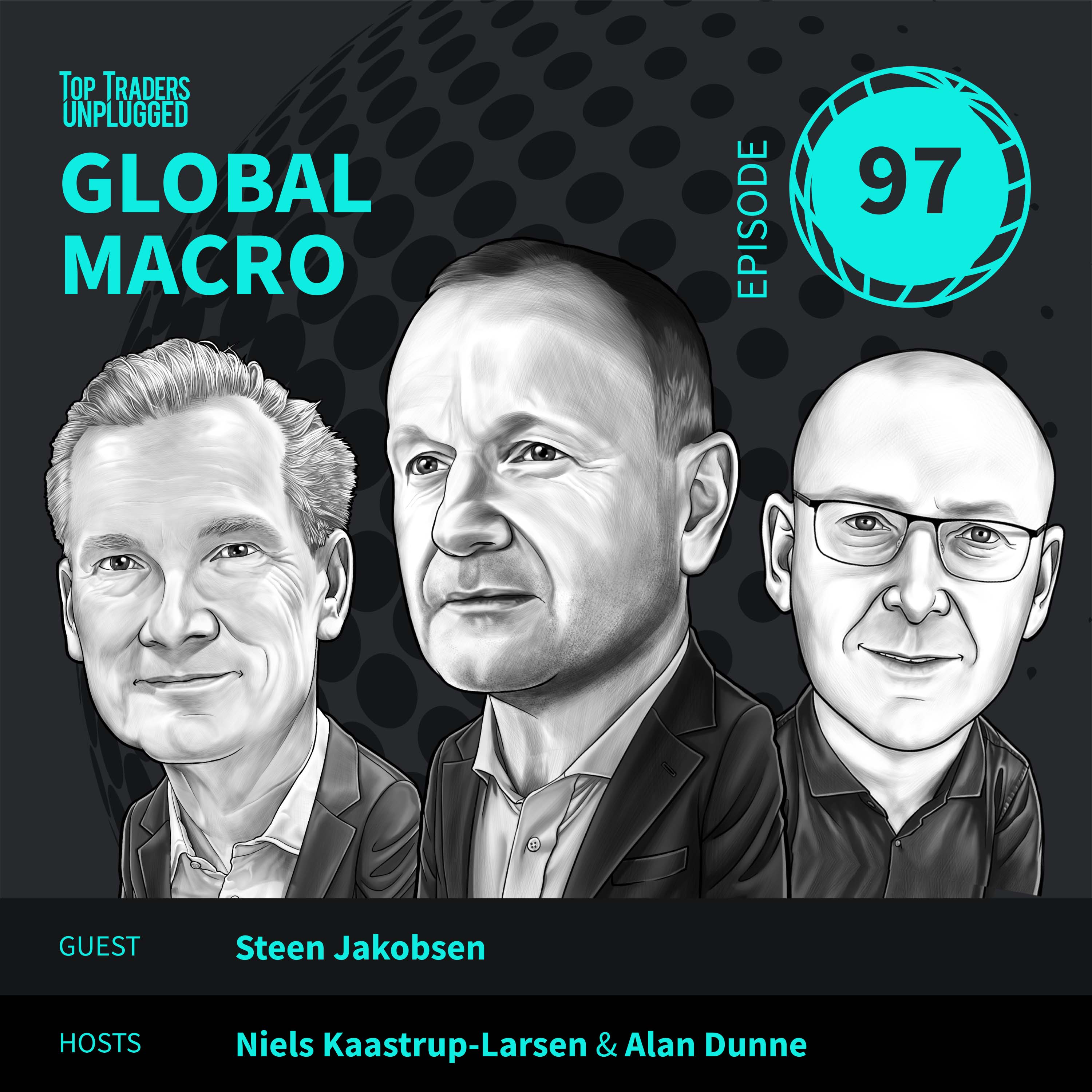
A new world order is becoming clearer by the day and in our Global Macro series, I, along with my co host Alan Dunn, want to dig deep into the minds of some of the most prominent experts to help us better understand what this new global macro driven world will look like. We want to explore their perspectives on a host of game changing issues and hopefully dig out nuances in their work in places that others may have missed. And we want to share our journey with you. Our guest today is no stranger to voicing strong opinions about the future path of the global economy, interest rates and inflation, which is why we enjoy these exchanges of opinions. So please enjoy our conversation with Stijn Jacobsen. Stan Jakobsen welcome to the podcast. Alan and I have been looking forward to our conversation. How are you doing? I hear that there is a little bit of snow in Copenhagen these days.
- [02:35]
B
Yeah, so if I have any excuses for my terrible looks, it's due to half a meter of snow, which I think is record in the last 20 years in Copenhagen. So even navigating a big city like Copenhagen is a business issue today. So I'm dressed for the occasion today.
- [02:51]
A
Yeah, sounds good, sounds good. Now as mentioned or we very much have been looking forward to our conversation today and for my Part I have followed your work from a distance for many years and what I really like about what you do is that you've never been afraid of being kind of very specific about what you think people should do and how to position yourself in, in these, you know, turbulent markets, so to speak. And, and even though we don't provide investment advice on the podcast, I think listeners today will really enjoy our conversation. Now I know we have a hard stop today, so I'm going to make it super short, but since it is the first time you're on the podcast, I would love if you would just tell us, you know, for two minutes what kind of brought you into this world of finance, you know, economies and, and also kind of what quickly led to where you are today. That was not very elegantly put, but I think you know what I mean.
- [03:45]
B
I understood the question, which I think is the main purpose of communication, isn't it? Yeah, it's, it's kind of a semi romantic story why I got into the market. So my, my favorite uncle, my dad's kid brother was as to this day probably still the biggest foreign exchange trader in Scandinavia. A chap called Ole Jacobsen, funny enough, same surname and he ran the Dansk Bank's trading desk for 25, 30 years and he actually did one of the first hedge fund in Europe when he ventured out to start that. So as you can imagine that was a little bit of a hero. And one day uncle invites me into this massive trading floor and for the listeners just think Wall street movie and you know, everything is ringing and bells are going off and people are shouting and having fights and I just said to myself, I gotta be here. This, this is the place to be. And then I took the normal progression which was at the time to take a degree in economics while I worked. Actually I couldn't get into his department, but I worked at Intenska Bank's economics department to get some sort of basic skills in programming to writing and notes which I guess to some extent serves me today with, with the few nerves I serve up. The career has been pretty much in, in sort of running proprietary money for some of the major banks. Some, some names that's disappeared but Swiss Bank, Core, Chase Manhattan, Christiania bank, which is now. Nor of them have pretty much changed names but. And a little bit of, you know, at Swiss bank we had a quite unique thing where we were both selling to sort of hedge funds and everybody else and also trading proprietary money because at the time hedge fund only wanted to talk to traders. So it's always kind of I've done this and that. But I guess my real claim to fame, if I don't have any fame, but if I would have had any fame, is that I joined Saxo bank in 2000 and was part of the executive team to build what is still to this day a formidable machine in online trading. And within that period I instituted and started and founded Outrageous Predictions, which I'm sure a few of the listeners know of. I know you do, Nils, because we have met on number of occasions when I've been presenting them, which just very shortly is 10 ideas not correlated. Not trying to get anything right, but just provoke people to think, which is also my mantra in terms of conversations like this. I'm not here to convince anybody about anything. I'm just here to throw up what I have in terms of thinking.
- [06:33]
A
Yeah, actually I will say that we have adopted the Outrageous Predictions because once a year on the podcast I get together with all the co hosts and we all have to come up with one outrageous prediction. Mine for 2026, just for full disclaimer, is that despite all the wishes from the administration in the US to lower rates, they will eventually have to raise rates later on this year. But let's not get into what I okay, I think as we can already tell, this is going to be a good conversation. Now, I think everybody will agree listening to this, that we are at a and we're trying to navigate kind of a dangerous macro environment that is somewhat different from what we have seen historically, at least in kind of our working careers. We have global alliances that are breaking down that leads to fragmentation and we see these global blocks being built up. We have a loss of trust in the institutions that usually guide us. We have massive debts and weak public sector balance sheets. We have growing wealth and income inequality. We have angry voters in some countries, we have military power being demonstrated and we have much more competition in that area and so on and so forth. But instead of sort of, sort of asking you a specific question to begin with, I would rather turn it around and ask you what questions should investors be asking themselves at the moment given this change in regime that we're seeing?
- [08:07]
B
That's a great way to phrase a question into a macro environment like we have. I think number one question, and I think you know the answer already, is that you need to decide whether for the first time since in the last 15 years, you need to hedge your dollars. If you are non US dollar investor, it's been good Latin, as we say, that you shouldn't do IT fund management business is based pretty much built on that. It averages out over time. It's not a big issue. But I put out there's a number of ways you can look at this tectonic plate shifting. One of them is the 400 monthly average. I put in a chart on euro dollar. If you do DXY is already broken and euro dollar it hasn't yet. And it sort of failed exactly at the time where we got the announcement that was going to be the central banker. And we all know what happened after that. But, but I think this concept of. Let me just run through why that is. I mean it, it is not, it's not a trade, whether you're long or right. It's a regime shift that goes into your question. It's a regime shift that I think if, if I was writing a macro letter and getting paid for it, I speech by Trump made everyone realize that this is a dangerous game. This is a game where you can have whatever opinion you want on Trump, but this is going to have impacts on your assets as such. So for me that was why it's not a trade, but a regime change. The second thing is that the benchmark most widely used is of course MFCI World, which is 60% dollars. So you were born with 60% dollar exposure. And here comes the interesting kicker. Why is that sort of important? Well, let's imagine just for the argument's sake, we have a quiet river running out of MSCI World, but let's say to the tune of 5% a year, that 5% needs to go into liquidities. That is significant our pockets that are significantly smaller. So when you take the biggest capitalized, most liquid market and you start to buy Latin America, Scandinavia and all this, you see what we see right now as we sit here today. You have all time high in emerging market. The Scandinavian economies are doing extremely good. The new sort of go to saying in Europe is you can buy a relatively cheaper equity, but you can also more importantly be part of the solution to the issues that Europe have on infrastructure, defense, taking money home and everything else. And I think if you want to put it into just one event, one catalyst, I think Davos became that event and then was also the story. A weaker dollar basically lead to the rest of the world have a pickup in growth. And that's, you know, of course also what we've seen over the course of the last month that the economic data both for the US and for the rest of the world are picking up significantly. So much so that we may end up at a 4% world going with this year against sort of a backdrop of expectation of 2.9.
- [11:15]
A
Yeah, absolutely Alan, I'm going to bring you in here. What's there's as you can tell Alan, there's a lot we can a lot of directions we can go. But I'm curious to hear where you want to go.
- [11:26]
D
Well, maybe just picking up on that. I mean as topical as you say, some of the data have been stronger. So I mean listening to the Fed recently they were more upbeat on the economic outlook. We had stronger PMIs. So you know, started this week I would have been of that view. Then we had that notably weaker employment number out of the US which obviously was part of the reason for movement in markets. Bond yields correcting back down again. So I mean, yeah, useful just to get a sense on where you see the trajectory. As you say, it sounds like an optimistic view on growth. Do you not put too much emphasis on the US labor market data?
- [12:12]
B
I think the answer straight up and down is you need to think of the US economy as the K shaped economy. The employment data comes into the lower end of the K, the K that turns down and the economic growth impulse, tax benefits, tax deductibility, capex spending goes to the top part because of course until very recently it became very much a market expansion and a wealth effect that sort of triggered into that economy. So I think Alan, we are dealing with similar to what you do in your stuff. As I understand it, some people trade five minutes, some people say 15, some trade a daily, weekly and monthly. We are just on different timescales in the lower part of decay we are really almost at a collapse in terms of the thing. And what is interesting going to Niels argument on inflation or his forecast, you've probably seen truflation have the last reading at 0.9% but when you start looking at why is it at 0.9% it is every sector related to the consumer that is dropping in price. That is the, the price margin in these different categories are really coming off. And that ends up with me, Alan, not, you know, not knowing what's going to happen. But I will say that I'm pretty sure the lower K will play a bigger and bigger role going into the second part of the year. And I think that is also what Kevin Walsh wants to do when he gets into the Fed. He wants to get certainly the short term interest rate down and that way reduce the burden of the economy. But I am very similar to Nils thinking this is a very short abbreviation due to these different time lags that we operate with.
- [14:00]
D
Fair enough. You mentioned the Trump speech at Davos, which was obviously a real eye opener for everybody and as you say, very much symptomatic of that regime shift in the world. And I guess we've been talking about this regime shift for a few years now on certainly on top traders Unplugged. It feels like we have and there's a lot more risk in the world. It feels like a lot more uncertainty. At the same time, equities keep grinding higher and we could be into a higher inflationary world. But that may or may not benefit. It might benefit some stocks, might not benefit others. I mean, from an asset allocation, from an investing perspective, do you think the equity market is just not adequately reflecting the risk, or do you think it's other asset classes like fixed income that are more at risk in this new regime?
- [14:50]
B
I think to a large extent it's actually embracing exactly what you're saying. So I penned a note a couple of weeks ago that I called state capitalism. If you think about what is going on in the world, it is that the state, the government, the resourcing, the allocation, the policies, the fiscal impact is more and more going towards the government sector and the government sector. Deciding whether that is Trump on Truth Media or it's the way the big beautiful bill is adding $5 trillion worth of debt to the US which is going to be financed according to Fed and Walsh. In the short end, good luck with that, because the market makers in Treasuries are today a quarter size of what they used to be just in 2007. So you can see all of these things are really driven and forced into a very, very small hole or very small door for the exit, which will increase volatility that we to some extent have seen recently. But more importantly, I think we end up in a situation where state capitalism, the first impulse or the first derivative is low volatility. It is almost in an analogy of sort of real world that not only do you have tailwind atom, but you're also driving downhill in the early parts of this cycle because, you know, you're dealing with an economy where you have inelastic supply, infrastructure, energy, metals, resourcing, you have geographical constraints, for instance, in uranium, because most of the processing needs to happen in Russia. And then you have known demand and known demand that is being written up every single day almost in terms of the demand. So if I was just having no position and just advising people, my advice would be for 26, you start with full loaded deck in the first quarter and then you take 15% off every new quarter until we get to the midterm.
- [16:52]
D
I mean you mentioned outrageous predictions out of consensus thinking and you talked about the dollar weakness which is kind of a consensus view. I mean most people I think have been bearish in the dollar for a while and last year was a bearish view. Can you paint a positive. It feels very hard to paint a positive scenario for the dollar given the kind of credibility in the US But I'm always thinking about that possibility given the kind of the general sentiment in the market. I mean could you see a scenario maybe on U.S. economic outperformance or what would it take, do you think, for that bearish dollar view not to play out this year?
- [17:31]
B
Liquidity constraints globally it will be as per usual, something driven. I just touched briefly on the treasury market operation, the repo, the shortage of capital capabilities in that area. I think the number one, one most likely event to do that will be sort of an accident waiting to happen in the treasury market due to the huge amount of issuance and the lack of real balance sheet to take those deals. And it is not something we macro traders like to talk about because as soon as you start looking at the Fed's balance sheet it gets extremely complicated. You actually have to do some work. Anyone can have an opinion about the dollar but having an opinion about how the functioning and the plumbing at Fed goes on, as we all know, there's very few people who can actually master task and even those that do do it, they, they get it wrong. But, but, but I'm pretty sure that you know, I, I believe in flow and, and, and stock. The stock is that, you know, the market maker doesn't have the balance sheet to take all that money. Which means, you know, the repo is going to happen and that means the Fed basically is going to do these repos with primarily money market funds which is going to get short term Treasuries and, and then the, the market's going to get liquidity. So, so yeah, it's a very fine balancing act. I also think to be fair, the Fed is aware of this issue and I think that's part of what Wash wants to deal with. But yeah, liquidity will be number one. And then of course escalation of which we don't want to talk about, but an escalation of war or anything similar to that effect.
- [19:11]
D
Yeah, interesting. I mean on that point you're touching on Awash and a lot of different views as to what he's Going to represent. Obviously he's been hawkish at times. More recently he sounds a bit dovish. He's floated the idea of this kind of balance sheet reduction but there's kind of skepticism. Well can that really happen given the way they conduct monetary policy? So it sounds like he could be quite a game changer but at the same time maybe not. What's your read?
- [19:39]
B
I don't have a REIT and I think that's the best read to have because he needs to sit down with the new board and we know the Fed chairman, at least through Powell and Greenspan and Benanga and everyone else they have one big advantage and that is the day before the actual FOMC meeting they call every single member of the Fed board to sound out what is your opinion. How do we create a consensus. That is something I'm pretty sure Powell is extremely good at from what I hear of Awash. He has a slightly different temper to, to, to Powell so it would be very important how he, he conduct that role in terms of practicality and I know it's very low practical Alan, but I think it's, it's really essentially about being, I mean any, any manager, management guru will tell you a good manager is not the smartest guy in the room but the guy who can create a consensus, get people to work for him that, that what the market have as an issue for wars that he's, he's definitely one of the smarter kids. He was one, I think he was the youngest Fed governor. But whether he can actually step up and take upon the role of the office of the chair relatively to Fitcher being washed that will dictate exactly what kind of answer you will have to your question. Alan.
- [21:04]
D
One of the things we've talked about in this whole area of regime change and different kind of norms has been the kind of rolling back of well, not quite the Fed's independence yet, but certainly more threats to the Fed's independence. How do you see that? You've been in the markets whatever three, four decades, I guess in this period the general trend has been towards inflation targeting, central bank independence. That's kind of, we've all grown accustomed to that. Do you think this is going to get rode back everywhere or just more in the US and what impact would that have over time?
- [21:39]
B
I think in China, when you do business in China you should always start by praising them and then afterwards you can criticize. I'll do the same to the Fed and say Fed has managed to be the backstop and reacting at the Times where we need them in terms of providing liquidity not only to the US market and everybody else, we can still see that. But in terms of what Fed is not good at is forecasting it is that they are often behind the curve. They are very much, it seems reactive to what the market thinks. I mean it seems to me sometimes without being jealous that one or two of the major investment banks is the primary input to what Fed expects the market to do. There's no doubt it's a very professional organization. There's no doubt it's a very talented organization. But you know, most of their models was built in the 1950s 70s by Howard. The first model they used didn't even have foreign foreign assets. And you know, today 55% of earnings in S&P 500 comes from overseas. So I think the upset could be that wars actually have the willingness and the ability to have this exact conversation about what is it the, you know, the Fed and the FOMC is going to do. I don't think anyone really believed the dot plots as a sanguine policy for the future. And going back to Fogo, Fogo always said essentially what Fed is trying to do is have one number that is the right inflation and one which is the R dot. What Volker said, which I think is still respect as one of the best central bankers ever, he said in some, some economic cycles, some part of the economic cycle you need to have a 3% inflation target and in some parts you need to have a 1% inflation target. It is not a fixed model because the economy is evolving and nothing says that. More than which I want to mention the sell off that we've seen in software. But if you put it up in the helicopter instead of focusing on what's been going on in terms of the sell off, don't forget Deepseek made hyperscalers not able to get money on providing you and I with chat functions scale to boutique functions. They came Gemini which basically have the whole stack and cheaper ways to conduct a policy and then now you have Entropic. So inside the space of pretty much just a year we'd have three technology events. That's really not only changed the earning outlook but also change the mechanics of how productivity and the economy evolves from here. And I'm not going to side with whether Anthropic can actually do software. I think that's very doubtful helpful they can actually do that. But people love fantasy and rainbows and chasing those and that changes the dynamics of the economy. So what I'm trying to say is that the way to assess the US economy going forward today relatively to pre deep SEQ is two very different models.
- [24:40]
D
Yeah so it sounds like do you buy into that warsh view then that AI is going to be be dramatically disinflationary in the next 12 years?
- [24:51]
B
Unfortunately I have the wrong age Alan, so I'm, I'm, I'm a technology skeptic. No, I, I think the biggest issue is what is playing out in, in, in the market day by day now is that if, if deepsea took away the profitability of interference asking for, for quotes and if Gemini and Google owns the data as the only price for doing everything on their stack and now Entropic can, can you know replace to a large ext the software companies but also I'm pretty sure the consultancy companies then we have impacts which is significant in terms of what goes on. Does that mean that the rainbow we are chasing is you're going to reach it? No, it doesn't. And I think my personal experience with using a number of these chatbots is that if you have a very specific script you're doing extremely well. If you fail, you get rubbish answers. So my base case is this simple. If you have closed databases, for instance in medicine, in law, whatever, it's absolutely productive because you can find number solution and text faster and better. But if you have open ended databases similar to what is on ChatGPT, it's actually probably not only redundant but it's probably negative productivity because you create so much waste and disinformation and everything else. So in, yeah, so in other words in a control environment where basically it's a data set that sits on its own And I'm often thinking about, I read the book about Renaissance and I'm sure both of you did that as well and being the nerd I am, one thing stood out for me. They had 225 PhDs. Right. How many people does it take to build a model? 1, 2. So basically the book told you that they have 21010 people doing one thing and one thing only which is to clean the databases. So in the evolution of data and using AI, whoever has the cleanest database set will have the highest amount of productivity. The more you dilute the database, the less productivity you get from it. The worst being these made of answers and everything else we see as a big trend. So you can hear a typical economist on one hand, on the other hand as well Alan.
- [27:21]
A
Yeah, I want to go back to kind of these big 30,000ft questions we talked about the regime change, we talked about a lot of it is driven by geopolitics and so on and so forth. So I'm curious to know changes in the world order, whatever we call it, what does that do for say the global monetary system? The free movement of capital, debt burdens inflation overall. In your mind, what should we expect, what should we fear, what should we hope for?
- [27:58]
B
Being slightly provocative. I wrote a piece for Vegan Region, you know the newspaper Nils, which is the most intellectual newspaper in Denmark and I ended it by saying King wrote this piece about state capitalism and my last line was welcome to the modern version of the Soviet Union. For some reason they took it out of my article when it was published. But the, the point being that we live in. If you live in a state rooms or run system with no price discovery and it, I know it sounds like an economic concept, but basically in a system where the market doesn't dictate the marginal price of anything, where it doesn't allocate the resources, then ultimately you have and can have, as I said in the early part, where the government takes over, the government creates an impulse, you get growth, you get better feeling to some extent, you definitely get more demand driven but that peters out because remember if that is all debt financed and it is for most of these economies. When I went to take my economics degree, I was always told that credit is future demand being used today. So basically you are reducing the amount of demand you'll have at the other end. And if it's not, as per Allen's question, met by a huge massive increase in productivity. And to some extent you can say the models of China right now shows us that if it does anything it is, it reduces the margin, profit margin and it leaves redundant a huge part of the economy because with these AI, you've seen electric cars, you've seen it in batteries, you've seen it in solar, there's so much capacity because it's mechanical and it's done the right way that you killed this system. So I think to go back to where I started, I think we are living the modern version of a Soviet Union which did very well in the beginning and then all of a sudden it fell behind as the market came to understand that they couldn't allocate according to price discovery. One interesting note, which is nothing to really a macro argument, but I did a study on what kind of regime does well best over time and to no surprise to you probably, but to me democracy is by far the best system. So the Less democratic a system is, the less democratic a country is, the more likely it is not the next five years, but over the next 20 years that there will have an economic cycle that leads to collapse simply by the fact that in an open economy and in a democracy, it is the consumer who decides which product they are buying. So I think to me, I'm not sort of a full turning guy or whatever, but I have Learned through my 40 years of being in the business that the only way things change is because they break down. So I think this ultimately, without being pessimistic at all, I think it leads to a breakdown of the system, both and most importantly the political one. And I understand why we're getting right wing government, understand why we're getting populist politicians. The, the contract with the voters is not working anywhere in the world. But we need to understand that this is a slow moving sort of grind towards lower productivity, lower disposable income and a debt issue that is unresolved because the politician is not willing to take that political bet that they need to deal with this outstanding debt.
- [31:23]
A
Yeah, well, speaking about the fourth turning, actually we just recorded with Neil Howe and it'll come out a couple of weeks after this episode comes out, so we'll hear what he has to say. I have actually listened to the conversation and then people should definitely pay attention to his view. Now you talk about this, at some point it's going to turn from what might have worked in the beginning, but then suddenly it turns and it may end up badly, things breaking down before it gets better. So given that all of us has been in the markets for quite a few decades, we all know that that sentiment actually makes a difference in the sense that things can look great one day and you know, a week later all changes. And one of the things that I guess I get, you know, I, I also started in Danske bank and then on the bond fixed income side and, and so fixed income to some degree is something that I always feel is, is very important also for, for equities and other things, you have to pay attention to those yields. And so far we are not really seeing any stress as such. And even though inflation has been higher at times than the last few years, we've not really seen the bond vigilantes come out and punish for bad fiscal policies or anything like that. But I'm curious to know whether you have any sense of what might change that. Where do we suddenly. A little bit like the tech bubble, which some of our listeners will remember that it all looked Great until the day it didn't, and then it all changed. And I'm curious in terms of what you might see could be that catalyst that changes the way people view their willingness to finance, for example, debt at certain levels or just simply require a high risk premium.
- [33:20]
B
First of all, I will comment that all these kind of of breaks and breakdowns that we see takes longer than we think. We can easily have dinner table conversation about why it should happen and we can even wish or hope that we were able to predict it, but it just takes longer because the governments and the system ability to sustain and keep the momentum going is almost infinite in nature and in structure. But I think if we break it down in what would be warning signals, I think a breakdown in the dollar would be a significant. I've often said around econometrics and PhD in economics, whatever, and one question I like to ask people is that if you can have only one indicator for the global economy, which one would it be? I think quite a few would choose crude, for instance, because of the impact on both nominal and disposable income. But I would choose the dollar. I think if you use the dollar as a. A strong dollar is good for the US and bad for the rest of the world, and a weak dollar is good for the rest of the world and good for the dollar. So you get a very, very strong sense, and it's pretty classic when at least over the last three years while we were in a stronger dollar environment, that returns became a little bit less attractive when this dollar was rallying. I think part of what we see now is the weak dollar fuels that whole, whole earlier part of the conversation we had. So that would be number one. The other part is that again, going back to the managing of the debt at treasury and Fed, they really need to get something done. I wouldn't be surprised if you could get Yankee bonds, buy America bonds or something which is not only forced into the banks but also forced into the pension system. And that's one of these ways that it actually extends beyond what we sort of. If, you know, in Keynes's analogy, the market can stay irrational longer than you could stay solvent. Right. So I don't think it's imminent, I don't think it's coming, but I think the dollar will be the first sign.
- [35:30]
A
Yeah, no, absolutely. I mean, it's interesting. It's also to see some of the, I guess what Scott Besson had been talking about trying to get stable coins and other kind of instruments engaged in a way that maybe that's the way for them to get more money into the US treasury market and so on and so forth. But let's stay with something that is also I think top of mind of many people right now. And over the years on the podcast we have a few go to commodity people actually that has been on the show and of course a lot of them feel that oh, this is the time for this big commodity super cycle. But one of the people we always come back to, Adam Rosenzweig, he mentioned something maybe a year ago or so where he said in their analysis it usually is a change of monetary system that triggers the real, the true commodity super cycle. It's actually not all the other noise where it's kind of false starts. And I think a lot of people might remember when the Ukraine conflict started and, and metals and all of that really went parabolic for a few weeks. A lot of people came out saying oh this is the beginning, but it completely was not. But this might feel a little bit different this time maybe with the combination of this changing in regime monetary system. I don't know. I'm curious if you have an opinion about this and if you do, what are the prospects in a world where, where commodities suddenly become much, much more dominant, so to speak.
- [37:10]
B
There's the military aspect which is clearly seen in the American, the US strategy for the world where they, you know, basically saying the world is split into three. The left side including Greenland apparently is the US the middle part is to be split between Russia and Europe and the right part is, you know, mostly China, but also Japan can. If you live in a world where we are doing the inverse of what we've done for 200 years, which is trade bartering and, and, and negotiating and multilateral agreements, then you end up with a marginal higher price of everything. So it, it's pretty clear to me that, and, and maybe that's a second angle to this that if you're right about your coal, it's probably also because the system is breaking down slowly because of these inflationary pressure that comes through the, the Chinese you. Because you know, early on it's price doesn't matter for, for some of these resources because government needs it as a strategic resource. That's the, the government slash defense one. But ultimately that as, as they say in the futures market, you know, the best way to get prices up is, is, is, is getting them even, even lower. Right. So, so, so I mean it's, it is extremely complicated and I, I'm at least humble enough to know that I don't have any ability to forecast it. But there's no doubt to me that I lived through the 92 devaluation, the 87, the 97 Russia LTCM WTO in 2002. I've been there for every single crisis. Pretty much I am having a hard time explaining even myself what is going on in the process marketplace and how we can glue all this together while maintaining an extremely relative low volatility and a pretension that everything will be fine and it will work out. I mean if there was a, a chat GBT function that could call the bs, I think it will be that radar will be at 100 out of, out of 100 for, for, for the narrative that we create. Behind that narrative, however, there is when you have breakdowns, you have new birth, you have new ways of assessing the market and you have new ways of doing bartering. So is it necessarily all bad that Europe needs to do more defense and do more infrastructure investment when they've been so far behind? Germany through their frugal policy, staffed their economy of resources so poorly was the IT infrastructure during COVID they couldn't do homeschooling in Germany because the bandwidth was not wide enough enough. So I think yes, there's a lot of negative things we can put on the wall. But I also think you will find that our ability as industrial people and thinkers will also take us in a new direction. And it will probably be maybe less GDP focused, more quality, focus more towards sustainability. Not because it's a vogue word, but simply because that's the best way to produce things in accurate. So I think we will see massive changes at the margin in everything that is under sort of the ESG thing. And at the same time I think productivity will come. But it will come, I like to say, and that is my. And I think you're unfortunately you heard it a few times. I call what we live in the 9010 economy. 90% of the S&P 500's value is digital IPs, right? It's intangible assets. 10% is tangible assets. So to put it very simply, for the world economy to function and offer the demand that the 90% demand, the 10% needs to grow to 25, 30%. That is one thing. And that is you immediately as a CGA thinks commodities. I as a conscious economist immediately think, okay, what is in the 10%? The 10% is real people, real mining, real products, real engineering, real water, real everything else. So if we are forced through higher prices in commodity to do and use it better, and if we Live in an economy where you need to grow the 10% of the economy which is tangible assets to 2530, you're going to see massive improvement productivity. The bad news for us in banking and the like is that the better bay job in the future are people who can actually deal with innovation on the ground at university. I'm pretty sure in five years time engineering again is going to be one of the most popular and project design that lives under the ESG and whatever. I really think that is the blessing in disguise for this breakdown of the system that if we end up growing the pie of the 10% which is tangible assets, to 25 life, it's in the real economy. It's not a chatbot that can do that. It's, it's. I mean, it may help you with writing the report afterwards, but someone needs to sit down and solve these solutions.
- [42:18]
A
Yeah, that's, that's great, great, great thought, Alan. I'll send it back to you and then we'll be mindful about, you know, that we only have a thing for another 10 minutes or so.
- [42:28]
D
Sure. Well, I mean, like, we're talking about the possible breakdown of the system at some point. And, you know, you've kind of alluded to many risks as we've gone through the conversation in terms of, you know, disruption from AI and then we've got fiscal risks in the us you know, in the last week we've had the software stocks coming under major pressure. Crypto has unwound to an extent. I mean, it's always, you know, unequally. You reference some of the crises you live through in, in the early part of your career. LTCM, Russia, Asian crisis, et cetera. We had Covid in 2020, but we haven't had as many crises, I would say, in the last number of years. It feels like to me, okay, we had a yen carry unwind, not a huge deal. We had svb, it was dealt with. So we haven't had a kind of a major crisis like those that you've spoken about. It's always hard to pinpoint where it's a vulnerability. But are there any of the things you've spoken about earlier that you're more, more focused on as the possible stress point in the system or the thing that could trigger the next significant kind of crisis event for the markets and the economy.
- [43:42]
B
In terms of the markets, I think market concentration is the single biggest issue so far as I see it play out. To some extent, the market concentration has meant that we've had a rotation that's been very healthy partly back to Europe and partly back into mining and and the 10% of the economy are called the tangible assets. So that's sort of just a shift between pockets. One DD rate in valuation and the other re rates obvious. But if it was to come to an effect where you know Nvidia disappointed or whatever I think the system extremely fragile. Didn't Mike Green once say that the market the way that private investor invest is like having out of the money put at 1% volatility and when all of a sudden everyone needs to hit the door it's going to be massive. So the concentration risk the way we have been conduced and charmed by all these online easy ways monthly payment and essentially we end up buying really 10 stocks and the rest is like pennies on the dollar in terms of exposure. That is the single biggest risk. I'm with my Green. But having said that going back to what nil try to get me to do to predict when the world's falling apart. Mike Green's been saying this for a minimum. I see it as five year story in terms of what goes on. But remember and this is key I think after 40 years in the market the system's ability to continue going is almost infinite. So you really need to think in terms of what breaks it down. If there was a migraine event they will fed with right liquidity as a first stop that would get the market to rally back in but the issue would remain the same because people would have the exposure. So you have to bail them out like the Swedish bank model in the early 90s, whatever. So I'm very concerned. Concentration is number one to me in terms of the outward risk. I think at a smaller level energy could really start to rise in price because of the shorter I mean and I mean energy and energy Verizon uranium seems to be, you know, on a fly and we need uranium. There's plenty of rain in the world but there's not enough processed uranium. So energy could again and has often been sort of a catalyst for the move. But market concentration sits number one with me in terms of what you asked.
- [46:11]
D
Interesting. Just if we have time. Curious to get your thoughts on metals and gold. I mean more from the perspective of what is it telling us? Do you think it's about how markets at the moment that we've seen such big moves? Obviously there's always narratives around what's driving it. Previously we could explain gold with real yields in the dollar and then that went out the window and then it was okay. It's central bank buying, fair enough. But the sides of the moves have been of the order that we haven't seen since the 70s. And you would say, why are we seeing such big moves? They don't seem justified on a kind of a debasement narrative of is it the kind of retail coming into those markets, is it Asian buying, or is it telling us something about how markets are operating? Or is it that the liquidity that came into the market post Covid is still flushing around, do you think?
- [47:04]
B
I think there, as we clearly seen on the correction, there's been speculative froth. It is also true that technically Chinese investors was allowed to buy gold and silver. So that's really a change that really increased the net demand and you had a speculative fever. But what the gold tells us is very simple. We have a huge debasement. I tell all my clients that they show me their balance sheet for their family office and whatnot, and Swedish, Norwegian, German marks and dollars. And I say, can you just do the same thing, but do it in gold for me, because that's your real purchasing power. So it just tells you that the dollar is. I mean, the euro dollar may not be going off, showing that the dollar devalues, but gold is telling you that the purchasing power of what is left in the US is really going down significantly. And probably last year the euro was what, off by 8% or something? Roughly. If you have deducted 5 to 8% off the dollar every year as an investor into the U.S. people are going to stop looking for the U.S. and investment place, although they keep saying, and that's probably true, that they are most productive, most innovative, the biggest capital market. But know money goes where they feel safe and where they feel it is. So it is to me very, very clearly a debasement trait that encapsules and warns us of everything we discussed in this program today.
- [48:28]
A
I've got two short questions for you, Steen, before we wrap up. One question I had actually, which I'm generally very curious about, and that is who do you follow? I mean, you mentioned Mike Green, but I mean, who do you follow? Who you've. You've been around for a long time and you are exceptionally well informed about all things global Mac. But who do you. Who do you follow that you feel these are interesting people other than top traders? Unplugged, of course.
- [48:51]
B
Yeah, of course. The number one is top players. Number two is. Well, I have the advantage of running three macro sessions a week with the seven. One is with the biggest hedge fund in the world. One is with family offices and another one is with European based managers. So I sit for an hour, I just share it. I just say hello, that's pretty much the only thing I contribute. But, but I sit have the benefit of talking to some of the smartest people around the world in, in that of course that gives me a huge amount of input. And we are, you know, although we are not tech savvy, we have created a, a WhatsApp dedicated line for all of it because there is a. With the complication of the market today, there's a huge need for, for sharing. So that's probably my number one sort of contribution. And then of course I'm a former client or friends with all the major investment banks, which I read. I don't read them to put on a trade or get an idea, but I need to establish consensus. I need someone, they have wicked smart guys in specific products or in specific companies. So I read that as an input. But generally speaking, I listen to a few podcasts, but I'm not very loyal. If I start listening to something that last time was good and it gets boring and predictive, I just turn it off and turn it to the next one. So I'm sorry Nils, really have. But I will say if you want to sort of cheat something out of me, I'll say anything that Stanley Dargan Miller says I'm listening to.
- [50:26]
A
So actually I'm hoping, now that you mentioned a WhatsApp group, I'm hoping that you will do the same that they did at the Pentagon and by mistake include someone like me in your WhatsApp group.
- [50:37]
B
You haven't open yet. You can definitely join the European version if you want to. So just WhatsApp me afterwards.
- [50:44]
A
Anyways, last question. We could have gone in many directions. Just anything we should have sort of brought up that we didn't bring up that you want to mention towards the.
- [50:54]
B
End, Steen, I think the big dollar, the Davos speech as a catalyst, the inability to sustain debt over time, the new Soviet Union breakdown. I think we hit all the right buttons. Of course it's not a prediction. It's not that people should go home and buy a, a ticket to Noah's Ark online to, to, to, to escape from this. As I said a number of times today, this is an extremely slow moving process which the system will fight against. But we need a breakdown in the political system to reestablish good tone, good respect, good order, everything. And as I said on the, on the real economy, don't worry about the commodity sort of blowing out the economy. The commodity part is, is the 10% they need to go to 25. Part of that is that we need to do it smarter, better, more efficient. So you know, I really firmly believe that the micro level economy is genius. I think most of the macro central bankers and policymakers are, let's put it diplomatically challenged.
- [51:57]
A
On that note, Steen, this was a tremendous conversation, as good as we definitely knew it would be. So thank you so much for for your time. We know it's a busy day for you. Make sure you follow Steen's work because as you can tell from this conversation, we are certainly living in a true global macro driven world and it's perhaps more important today than ever before to stay well informed. From Alan and me, thanks ever so much for listening. We look forward to being back with you as we continue our global macro series. And in the meantime, as usual, take care of yourself and take care of each other.
- [52:32]
C
Thanks for listening to Top Traders Unplugged. If you feel you learnt something of value from today's episode, the best way to stay updated is to go on over to itunes and subscribe to the show so that you'll be sure to get all the new episodes as they're released. We have some amazing guests lined up for you and to ensure our show continues to grow, please leave us an honest rating and review in itunes. It only takes a minute and it's the best way to show us you love the the podcast. We'll see you next time on Top Traders Unplugged.