← Top Traders Unplugged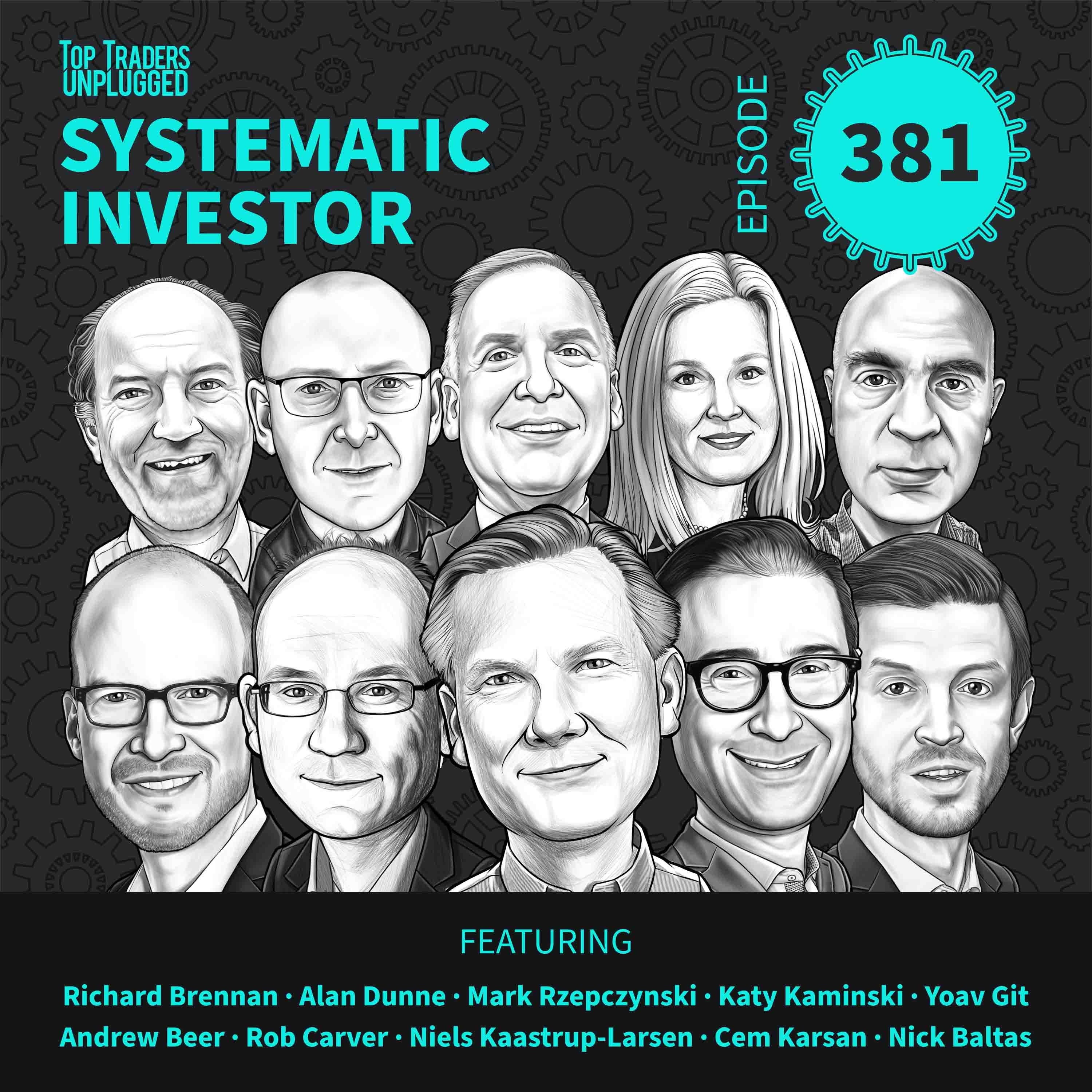
Top Traders Unplugged
SI381: Process Over Pain: Trend Following in an Unforgiving Market (Group Conversation Part 2)
01:03:39
Loading summary
Transcript64 lines
- [00:01]
A
You're about to join Niels Kostrup Larson on a raw and honest journey into the world of systematic investing and learn about the most dependable and consistent, yet often overlooked investment strategy. Welcome to the Systematic Investor Series.
- [00:23]
B
Welcome or welcome back to this week's edition of the Systematic Investor series with Katie Kaminski, Jem Kasang, Rob Carver, Mark Rasulczynski, Rich Brennan, Alan Dunn, Nick Bolters, Andrew Beer, Yoav Gitt and I, Nils Kasser Larsson as you can tell from this introduction, today's and last week's episodes were very special because it's the time of the year where all 10 of us get together for one big conversation and debate. So firstly, let me start by thanking all of you for making the time for this extended recording today, with which I really have been looking forward to. And of course for all the time and energy you have put into making all the amazing weekly episodes that we have published this year. It means a lot to me and based on the feedback that we get, I know it means a lot to our community. We recorded our conversation on December 17th and last week we published part one of the conversation and today you'll be joining us for part two. We got a great lineup of topics across the two episodes. And just to mention some of the themes that we will be covering in this group conversation. These are things like the impact of market selection on trend, following the massive bull cycle in non correlated investments and how three years in it's still in its infancy. We're going to be talking about the period 2023 to 2025 which has been characterized by large dispersion between trend managers. We're also going to be debating whether model design decisions are ever obvious. We're going to look at the trend and performance and how much data you really need in order to make any inference about manager performance. We're going to be debating process stability in a changing market landscape and also if we should have more high volume versions of CTA products. And finally, we have a topic about drawdowns, whether long drawdowns or deep drawdowns are to be desired or which is worse. So really, it has been a packed agenda across the two episodes and I really hope you enjoyed. So with that, let's rejoin the conversation.
- [02:36]
C
Well, there are two questions that I have that I'd like to ask the rest of the panelists. One is about the AI revolution and modeling. So I know that we see that everybody is getting on the AI bandwagon and I was doing some work with the Harvard Business School and we were assessing new entrepreneurs. And it doesn't matter what the problem is, they know that they have to have AI involved in it. So how are you now? I'm going to ask everyone else, how are you using AI to improve your models or to improve your research process? So that's one question. And the other question has to do with this total portfolio approach. And Alan and I touched on this a little bit in our last podcast. But there's now strategic asset allocation versus tpa. And what does that mean for trend following? Is a TPA approach good or bad for trend following versus strategic asset allocation? So is this going help CTAs and trend following if there's a new portfolio approach? So those are my two questions that I am focusing on.
- [03:52]
D
The TPA is probably an easiest question to answer in a sense that in principle this should be really good for CTAs. Okay, so in terms of, I think Jamin talked about uncorrelated strategies and, and if you start looking at CTAs within a normal allocation process, which just looks at total portfolio allocation, you should allocate an insane amount of risk to CTAs. Okay. And like in. I don't mean insane. Like even if you expect your sharp ratio of your other portfolio to be one and a half and you think that CTAs are 0.5 sharp, then in order to maximize your sharp, you need to essentially have a 1 to 3 allocation to CTAs. So I'm looking really for forward to the CTA industry running 25% of all assets under management, which will bring us to, you know, a mere sort of 30 trillion actually. So really looking forward to that happening in reality. I suspect not. I suspect. I think it's a good thing that allocators are actually beginning to think about the portfolio as a whole rather than, oh, here is the hedge fund bucket. This has got 20% allocation. Within this we have to have macro, we have to have long, short, we have to have real estate, we have to have private credit or whatever. And then CTAs get like 2% where they make a zero difference to the overall portfolio in terms of convexity, in terms of diversification. So I think it's a good thing for you to think holistically about CTAs. And I've long argued that really you should think about CTAs in the context of the asset classes that you're holding in your own portfolio. So if you're a fixed income manager, you should think about fixed income cta. If you're A fixed income exposure. If you're an equity manager, it's a very different story.
- [05:48]
C
So.
- [05:49]
D
But I don't expect that to happen. I think that the TPA is a buzzword. I think it's a management consultant speak. It's some governance and discussion. And I don't really see huge flows flowing into CTAs in practice. Flows follows performance and that will be the most determining factor of flows into the CTA universe. And I can't blame people because at the end of the day that's exactly what we are trading. We are trading performance. Performance flows follows performance and that's absolutely fine. So I don't imagine a huge change in behavior from TPAs. If you want me, I can comment about AI, but generally the approach has been very cautious on our side. It is able to help us in coding. It helps us to in terms of summary of client discussion. It's helpful in terms of summary of lots of the way that we think it's actually useful for testing. You know, I can feed my presentation to an AI and it comes back and it's oh my God, I didn't actually mean to say that. So the AI has. The fact that the AI has not understood what I said, that's been very useful for me to rethink the message and what is the absolute message. But I suspect other people have used AI in a more creative fashion so I will let them comment about it themselves.
- [07:13]
B
Alan, over to you.
- [07:15]
E
Yeah, I think TPA is interesting and we did chat about it. Mark, I think there's a few different lenses you have to think about this from. And I think if you take from the pure return lens, what Yoav said is correct. The GIC and J.P. morgan Asset Management had a paper out last year. I think it was looking at if you construct a hedge fund portfolio and optimize it on a standalone basis versus if you optimize the hedge fund portfolio in the context of an overall portfolio alongside traditional assets, you get a different allocation, you get much more allocation to CTA macro commodities when you optimize in the context of the overall portfolio because you're going to have less allocations to long short equity and credit and strategies like that which pick up factors which you already have in your portfolio. So I think that that's a valid perspective. I think another perspective is that if you think about what a trend following program or a CTA does, it does TPA already. It evaluates the markets and assesses where are the best risk adjusted returns, where the best opportunities in real time so it's evaluating coffee and sugar and cocoa and all of these markets and allocating risk. And that's the idea of tpa. You don't have static allocations to different markets that you dynamically allocate risk to where the opportunities are greatest. So in that sense, adding a trend following program or a CTA on top of 60 40, you're already building a more TPA like approach. A complicating factor though then is, I mean the whole point of TPA seems to be to empower these investment teams. So rather than just sticking with strategic asset allocation, they, they can decide, okay, we want to have more risk in these areas. So how do they account for the fact that, you know, if you're allocating the hedge funds, which is, which are already making tactile bets in certain sectors, do they look through that or do they have to adjust for that in terms of their own views as well? So I think that's where it remains to be seen how it plays out. But I think in theory there are a couple of reasons why it should be very positive for CTAs.
- [09:31]
F
I completely agree with Yoav on this in that people are going to come up with an allocation that they like, that they think makes them look good and smart, that their investing committees will like, that their clients will like, that they can explain in good times and bad. I mean, in a strategic asset allocation, manage futures is a 25 allocation. Right? It's just, it's sort of mathematically obvious. There aren't many things you have out there that have zero correlation to stocks and bonds and do well when you need it the most, that you can scale and do in liquid fashion. You know, back to the, the paper that Alan mentioned, you know, it was, it was true actually. CTAs were basically on almost every statistical measure like in terms of alpha generation, correlation characteristics and, and performance when you need it the most. There just wasn't much else there. The, the POD shops come pretty close. But where TPA could be very useful is it could break the anchoring around indices and allocations. So a typical institutional allocator in the US has about a 6% allocation to hedge funds today, of which managed futures, according to kind of the broad classification of hedge funds is sub 10%. And so you're looking at about a 50 basis point allocation. It is extremely difficult for the guys who are in charge of running those hedge fund portfolios when they are benchmarked to these hedge fund indices to take it from a 6 or 7% allocation to a 30% allocation, which is where it should be. It is. Even if they believe that the Sharpe ratio of equity long short or the diversification benefits of equity long shorts would be a pale shadow of what you would get from this strategy, it is still very, very difficult from a career perspective to break away from, from, from how they are anchored to these, you know, these, these benchmark like measures. And so I, I think a glimmer of hope and in that I think, I think that most people still view it as a largely unlikable strategy for some of the reasons we've described because it doesn't have the kind of the, the warm and fuzzy of, you know, I get to talk to some guy about whether he thinks, you know, we're going to be in recession in a year. But I do think that breaking that anchoring mechanism and having people kind of start with a blank sheet of paper then come back to the table thinking about things in statistical terms is going to be positive for the space. But my caveat is that I think it is, I think maybe Alan may have just added that space. A lot of it is theater around people trying to come up with, you know, basically get, get a broader mandate, it sounds cool, etc. Etc. But, but you know, cautiously optimistic.
- [12:05]
B
Well, before we move on to the next topic that Rich will bring, I certainly need to hear from Jim because I think we left out one strategy that is also mentioned often in this context and that is of course volatility. And I know that UJEM has had some great conversation with David Dredge recently, very much on, on, on this topic.
- [12:25]
A
Yeah, look to take a step back from this conversation, I think you know, we get really deep on trend allocation and that's part of why people listen to us. But I also think it's important to step back and look at the big picture. 95% of the world invests in the most simplistic basic way, which is they go shopping for stuff and most of those things they diverse. They think diversification is probably buying more things in different ways, which we all know are highly correlated on the tail and even much more correlated than people realize. This move to diversification non correlation is practiced by a relatively small portion of the investing world. We can get into the details of how and why, but I talk to RIAs all the time and one of the first questions I ask when I talk to RIAs is what do you think the Sharpe ratio is of the S and P over the last 125 years? What do you think the Sharpe ratio is of a, you know, a 6040 portfolio the last 125 years. Do you know how many of the hundreds I talk to know or even have a guess on that answer? Answer. Zero. Zero. And by the way, does anybody here have a sense of what that is, by the way? 0.35. Both of them, zero correlation, you know, zero diversification benefit of bonds versus stocks, zero. Yet that's what 95% of the world does. So this idea that we need to be talking about these little details of diversification, how it fits, let's get the big picture right? Let's get the. And there's several things. There's diversification broadly meaning true diversification, things that are not assets. Let's start there. Trend following. So one of those many things because second you have assets are going to be correlated by definition in certain ways. But, but two niels. The one thing that tons of academic research points to is the one thing that is a true consistent diversifier. And the most important thing in portfolio is, is a long volatility hedge. To our conversation with David Dredge which was my most, you know, my favorite of the year, we have so many. He, he gives this incredible metaphor which is so the more you dig into it, the better it is. So many people go look at long volatility and like, much like a lot of other strategies, but particularly long volatility and they say, oh, this returns zero over the long term. You know, this thing is. This thing makes me go slower. Why would I allocate to something that makes me go slower? That sounds like an awful idea to 99% of people, but that's like looking at your brakes on a race car. Like these brakes make me go slow. You gotta get rid of these brakes. The reality is long volatility and this applies to other things in different ways are brakes on your race car. And the net result of removing the brakes from the car means everybody goes slower because you're going to have turns and you can't go around those turns without brakes at full speed. So what stocks and bonds actually is is a matter of is going slower. There's no diversification benefit. You just go slower. And people do that because they're worried about flying off the tracks. Brakes, though importantly don't just make sure you don't go off the tracks. And this is the critical part. That's everyone, everybody thinks oh, long volume, that'll make sure you stay in the tracks and you don't fly off. The more important part of that metaphor is the brakes give you control the brakes allow you to slow down into the turn and accelerate out. You win races, you go faster by having Vol in the portfolio. What do you do with brakes? You don't sit on brakes and sit on gas all day. Yeah, that will make you go slower. What you do is you have brakes in the, in the car. You hit the brakes when, when you're coming around a turn and there's risk or you, you know, up it a little bit. You always have a little bit in the portfolio. And guess what? When that, when those brakes pay off and give you control, that gives you the ability to monetize, push on the gas, go faster down the straightaway. This we're trying to build race cars, trying to build control and risk management, the portfolio. But risk management doesn't mean we go slower. You can't eat sharp Sortino, but if you get a balance sharp sortino, if you get control of the portfolio, you guess what, you can go a heck of a lot faster. And I think that's what we all need to be thinking about. And that's the big picture. And again the, I think this broad communication will serve make an incredibly greater impact to the majority of allocators. Right, than, than the little details, given how overwhelmingly the whole investment world, the majority of the investment world is completely doing things that again didn't exist until 1985 and doing it simply because of recency, BIA and a lack of needing to really manage risk and understand risk in a meaningful way.
- [17:41]
B
All right, Rich, all the way from Australia, what do you want to discuss?
- [17:48]
F
Well, I thought I'd bring up this.
- [17:51]
A
Idea about process stability in a changing market landscape. So we all accept the fact that markets change all the time, but that doesn't, to me that doesn't necessarily mean your process should change all the time. So I think one of the biggest mistakes of investors make is changing their rules in response to recent outcomes. But a stable process does not eliminate drawdowns. In fact, you must embrace your drawdowns. That's part of the process. But what a stable process does do, it doesn't eliminate the drawdowns, but it does prevent panic and behavioural drift. So what allocators really need is not a promise, they say, of smooth returns, but clarity on how the strategy behaves when conditions are uncomfortable. And this stability builds this trust, especially when these markets are so noisy, as we all know they are. So I suppose the question I've got to ask people is how much change of our trend following strategies is evolution versus how much is really just reacting to recent pain. I'll take a first stab at that. Even though I'm not the trend follower in here, I think I do have an important thought here is I think trend almost by definition at least started out as really thinking about things in up down and catching the up down. And the reality is we, and here in ball world, we think about distributions of outcomes and really taking this framework of how is the distribution different in this environment, how is it and why is it different? We have actually a pretty good ability to predict distribution. Predicting direction is hard. But if you can broadly predict broad distribution of regime and that does change, then you can really more accurately have a sense of what type of trend model is going to work better in a different environment. And I think taking that broad approach and that mental kind of model, as opposed to just back testing and seeing how it performed and what performs better and optimizing to that, is going to get you to a much better place, I think from a forward process. And volatility plays a huge role in that.
- [20:18]
F
Right.
- [20:18]
A
If we can, if we can think about, you know, what the width of the distribution and how fat the tails are in different environments, that input, which again is broadly easier to predict, can play an incredible role. So I agree historically that has, we've been taking the wrong process and there has been just a lot of curve fitting and naturally kind of, you know, getting to the last best outcome. But I do think, you know, this ability to think forward on distribution based on supply and demand and factors that are changing in the market can really pay dividends and, and do the opposite. I think there's more of that happening than ever.
- [21:00]
B
Great, Andrew.
- [21:02]
F
So, so Rich, it's interesting you say that because I have very funny conversations. People, they ask, so we've been replicating the, the, the space for about 10 years and I get questions from people, they say, like, tell us all the changes you've made in your model and the answer is none. Zero. Not a line of code, not an instrument. And that is not what they want to hear. Right? They want to hear that five years ago we decided that there was an 11th factor that we should throw into it, that we decided to switch up our window lengths because we had some sense that, I don't know, Trump's election was going to change window lengths or something. What I've said to people, I said, look, we have an extremely high bar and it's very hard not to change what you do because back to your point about response to pain, there are, of course, there are always periods where you're going to go through and you're looking at it constantly and thinking about, God darn it, why didn't we make that change six months ago, or wishing we'd done some other things. The problem goes back to the point that I raised before, is that it's not obvious whether those will have an impact on a going forward basis. And what I've often said to allocators, and this actually dovetails with something that Alan asked for a little while ago, is I said the very, very best outcome for you. So the easiest thing for you from a fund manager selection process should be you can look at our entire track record and know it's completely consistent. You don't have to think about, you know, whether these changes were good or bad that we made and whether they had an impact and what. And what world would have been like the. But I said the other. The second thing is the very best outcome for you on a going forward basis if you invest with us, is 10 years from now you ask us the same question. We said we still haven't had to change anything. I'm slowly winning hearts and minds with that. But it is a very, very, very contrarian view. Feels like a loss of power and control. But what it does is it comes back to what I've said about there's an owning the investment process and the investment decisions in a very real way that I think people outside of this space. Cliff Asens, I think is a great example of somebody who runs a quantitatively based business but is very good at owning their decisions and is very good about saying, okay, we picked this factor in the following time and it was a terrible decision on our part to do it, or things are working in our favor. And boy, we're flipping heads and flipping heads and flipping heads. And I think what Alan said about the difficulty of an allocator in this space is this idea that when things go badly, it just feels like bad luck. And you don't really have a narrative necessarily as to why it's going to recover. And so I think this idea of that there's a difference between those individual decisions that people make and the broader asset allocation thesis that one is trying to make and the source of alpha and excess returns. And those are really the challenges on a going forward basis.
- [23:59]
D
Having consistency and staying true to trend is a really important decision. But I think there are two aspects which are important in making any changes to your strategy. The first one is like truly actually understanding the causes for performance or underperformance that is actually Measuring things properly. And the second thing is actually understanding your thesis and staying true to your thesis. Okay. And I'm going to give two examples on that. So the first one is about benchmarking. So we've seen performance last three years has been difficult. And you ask yourself what has possibly caused this? And then you need to break your process. It says, the reason why I've not been able to perform well is because maybe the asset itself has had a sharp one. But in the past I've been able to extract maybe a sharp 0.4 out of a market which had a sharp one. But now suddenly I'm only able to extract 0.3. Okay, that's cause for concerns. For some reason my model is broken down. But to doing that, you actually need to be able to measure the data. You actually have to say, well, actually if we see historically we've seen assets that have trended a sharp one, like the underlying asset has trended sharp one, what do we see in the last three years versus what we've seen in the past? And by the way, I think for most CTAs, this has stayed roughly constant. Because I think the reason why we have seen the underperformance in the last few years is not because the model doesn't work, is because we've seen this volume compression that we're talking about. We have seen just less outliers, we've seen less outside trend. Okay? So the first thing that gives you comfort is actually just being able to measure which parts of your model are actually not performing. Okay? So being able to break it down is like before we even start a discussion, you actually have to understand what's going on. And then it comes to the question of what is your thesis? And we talked a little about the design choices that we make in the CTAs. What is obvious, what is not obvious. Like if what you are selling to the investor is risk factors which are not financialized, okay. Or risk factors which are financialized or a certain speed. So suppose if you are a very fast trend follower and you say, well, I'm not able to make money, I'm going to drift away from that space, that's actually going to be very bad. You're just going to lose your investors. In our case, if we say we want to concentrate in markets with very low beta to the financialized universe, then things that you can actually measure is the physical properties of those markets and how they've become more financialized. So one of the things that we monitor on an ongoing basis for Example if we're looking at, we're looking at iron ore. I was with traders in Singapore in iron ore. So in the past, in the past, nobody was trading it. No, CTA was trading it. These days I was talking to the guy, to the traders from one of the big broker house and he said, well, about 70% of the volume in the front month contract are CTAs. Okay. To me that's a warning sign. I just don't want to trade this market, I don't want to trade the front month in iron ore anymore because it is completely financialized. And the market, the underlying properties of the market have changed. And it doesn't mean, it doesn't trend well. It doesn't mean. But the program, the thesis of what we are giving you as an investor is all about we are giving you stuff that other people are not trading well. That market is no longer in that category. So sometimes it really depends. I mean, it's great. If you're saying I'm going to give you the most financialized and I'm going to give you replication of the city of the soc gen index, then actually you don't really need to do much. You just, if you just follow a mathematical exercise. But actually I think understanding the markets that you're trading, understanding what is the thesis that what you're doing, providing the investors and staying true to that, it means that you may be throwing out markets which trend very well. You might not have a gold exposure because gold is very highly financialized and you don't mind actually not having it. You just have to be true to what you've promised the investors. And I think changes in the portfolio which reflect that, I think are changes which you. Which are about following process in a very changing, in a very fast changing world.
- [28:42]
B
All right, we're gonna move over to Nick and then we're gonna head over to Rob and hear his secret topic because we're not aware of that.
- [28:51]
G
Look, I'm going to be brief because it's a super nice question by the way, Rich, right? I mean, is the pain an invitation to change your model? I would say no. Is the pain an invitation to think about changing the model? Maybe. And let me explain that. Right. So I'm going to maybe use the same thing that we started discussing about those V shapes. It happens once you're fine, you kind of understand what's going on. You go back to your investors, you have an explanation. Everything is what it says on the tin happens again. The dollar yen happens again. The liberation day that Kind of makes an invitation for you to kind of look through, you know, is there any blind spot? Is there something that the market is kind of telling us? Should we somehow change the model? Is it the right time to do so? I think the bar, as I said earlier on, is extremely high. I think underperformance and pain is an invitation to reflect upon. But you know, we try to be extremely, extremely averse to just change the model just as a response of underperformance, specifically when it's fully explainable. And that's back to Yoav's point, maybe a soft comment on what Andrew said. I think there's a subtle difference between an underlying model and a replication model. So as long as the underlying managers change or not, their model doesn't necessarily make their application of the aggregation better or worse. I think to the extent, and you tell me if you know if I'm getting that incorrectly, right, to the extent that those managers do not become super quick in the way that they behave and therefore our application model lags too far behind, I think it will remain to be successful. Obviously you kind of played at the benefits of the averaging and I guess a good question is, is the objective to minimize tracking error? Probably not, because obviously the outperformance is important. Actually, I'm sure this year you're happy to have this kind of high tracking error. Now, is that an indication that the model does work, yes or no? I guess we don't really have a straight answer, but I think to my point, kind of summarizing on this one, their application model almost has an assumption on how the average underneath behaves. And as long as that remains through time, you don't really have to change your recipe, right? Even if the underlying managers change their models, if the sum of those chains is kind of somewhere, I know some up to zero, you're already done, right, with your application. I don't know. I don't want to speak on your behalf, but I think that's how my thought process kind of went through as you were speaking. But thanks, Riz.
- [31:22]
F
Good question. So look, first, Nick, I mean, you know what we do very well and those are all the key questions, right? If everybody goes to a 15 day model, it's not going to be a surprise, right? It would be foolish. We'll be talking about it, right? Everybody's abandoned long term trend, medium term Trend, everybody's doing 15 or 20 day model and everyone's become crable or something. And so no, of course you have to, you know, you have to look and Reflect and try to be intelligent about the underlying thing. It's just, it's, it's. But unless it indicates that there is something and try and, and, you know, try to understand what it is and what's causing the deviation and whether that, that that's consistent with it. I, you know, what I would say. And again, because I think there were so many fascinating parts this overall conversation and just to bring a couple of different things together, like one of the things that, that this whole idea of you presented incredibly interesting data that over the past three years, slower and simpler has worked better, which obviously has benefited us, presumably, and certain people, the ETFs, more broadly, things that have been simpler. But what I think is missing from this space is because in the US Mutual fund market, for instance, a lot of firms have been going in the opposite direction up until the past three years. Like their claim to fame was moving into, outside of the, in the hedge funds as well, moving outside of the simpler strategies and adding more and more things. So as an allocator, when I look at it is. And again, maybe people say this, but again, I think this is where sort of like, you know, somebody's saying, like, yeah, I made a really big mistake over the past three years. I gave up this much return by adding these things that haven't worked well in this regime. I didn't see this regime coming. I'm still trying to understand what it was because I didn't have to do this, but I did. And it's cost me 1100 basis points of returns relative if I've done nothing. That kind of ownership of the design decisions that I think that's just sort of, I think if you do that with dispersion, it makes it easier for allocators to locate the managers. It's that you have all these decisions that are made and then kind of raising the hands and saying, well, it didn't work because the markets just are weird. And so, you know, I think, and I think Yoav makes this point, Rich has made this point, et cetera, is that there is something about owning the decisions and why they're being made and staying true to it in some fashion. That's what also helps allocators to figure out how to put together this mosaic of exposures to a space that's really complicated for most people.
- [34:03]
B
All right, let's jump over. Well, actually, we're going to jump down all the way down to Israel now, because that's where you are today. You have what's on, what's on your mind Right.
- [34:12]
D
So with your permission, I'm going to steal your very own question because I think that's the way the discussion has been going here. And it's about risk management, it's about drawdown, it's about staying true to your hypothesis. And I think it's also about the discussion that Ken was talking, Jim was talking about the volatility and the having the brakes and the outsized gains when things aren't going well. And I'm going to talk about drawdown. So you asked questions, what's worse, having a long drawdown or a deep drawdown? And I think what is very interesting to me is that when we have discussions with allocators, I'm trying to explain to them that CTA drawdowns are actually very distinct to drawdowns in other industries, in other hedge fund managers. And what I mean by that is that normally for most, most, most positions and most hedge funds, big drawdowns or very sharp drawdowns are to do with like poor risk management and just events playing against the big positions. So they will be losing money because things happen, okay? So, you know, you happen to, you know, you know, you know, the big shorts. Imagine you have the big shorts. You put a position on the housing market and the housing market tanks and suddenly you have a big drawdown and you have to explain to the investor. And actually you can, you can tell a story. Which I think that's the discussion that Andrew was talking about earlier with CTAs, it's almost the other way around. It's the, the reason why CTAs tend to lo. Is mostly because nothing happens, okay? So obviously when there is a position on, and there is an event on, on day one, like if there is Liberation Day, then you suffer. But the consistent drawdown really comes from recognizing that CTA is a little bit like buying straddles, okay? In the same way that the volatility straddle, volatility insurance is about buying straddles at various times, okay? And that means that we pay for them through trading cost. Maybe not in the case of Andrew, but in the case of most of the assets that we trade, we essentially replicate an option. We replicate a trading profile which is a straddle, and we will lose money if nothing happens on this market. And in fact, in a normal cta, most years, most of your markets, you will lose money, okay? And I think investors kind of puzzle about it. They go, what's going on here? And the truth is, because you will make outsized returns when there is a trend in one of your markets that will more than compensate. So you don't actually need 50% of your markets to be winners. You just need maybe 40% of your markets to be winners to have a good positive year. Okay. And the reason why you might have a situation where you are in a drawdown is not because you haven't been able to capitalize on trends. It's not necessarily because there was a big event and you badly risk managed yourself. It's to do with the fact that instead of having 40% winners, suddenly you only had 35% winners or maybe 30% winners. And that's a very different drawdown profile which is actually very difficult for investors to accept because what you find is that you would like, the Allocator would like to go to the IC and say, yeah, he got this call wrong. He didn't. So he made a bet about who's going to be the Fed German and that bet went sour. But we really trust this guy. He's come from a great pedigree. So we're going to stick with these guys. With the CTA's drawdowns are much more difficult because there isn't necessarily a one event that will explain the drawdown. It's just a very consistent event where we've seen a volume compression and the percentage of winners has just shrunk below the break even point. And that's something that we have seen in the last three years which has been very difficult for the industry. So I think it's not about, I think in CTAs you don't necessarily see a very deep drawdown, but you might have a go through a situation where for a long period the events like volume compression is basically made outsized trend very difficult to harvest. And I would like to hear the panel's view about that.
- [38:49]
B
Katie, over to you.
- [38:51]
H
I love this yav. We, we actually wrote an interesting paper this year about managed futures drawdowns and sort of studied them and looked at sort of the historical largest drawdowns for managed futures. And we have this really interesting bubble chart in there where we look at sort of the time of the drawdown, the depth of the drawdown and then we also look at the recovery period for drawdowns and what we find is if you look at but what's happening during a lot of our very challenging environments, they tend to be pretty good environments for equities. So when things are stable, we didn't look at volume, but you can imagine when equities are doing well, volume is also often, often lower and then the recovery for the strategy since it tends to be very cyclical, was much faster. When you have sort of a challenging equity environment or things changing and what happens there is you just have a higher hit ratio of trending things which kind of mirrors what you were saying. So I think at least qualitatively this study for managed features drawdowns was kind of explaining some of the things you just talked about. But I also focused on, and I think this is important for why I care a lot about dispersion driving behavioral effects is that you know, if you look at most of the fund of funds who have studied our space, there's, it's very difficult to pick a winning manager in any one year. And if you look at sort of sort of drawdown periods this, the strategies on average tend to recover. So if you look over when there's been a very challenging period of performance, usually that's followed historically by one or two years of very positive performance. So I think that is something that it has that although we can have skewness in the short term or we can have persistence in the short term, we tend to have mean reversion over longer time horizon. So I think understanding that for investors is important because if you try to sort of pick tops and bottoms, you're basically trend following, trend following, which I wouldn't suggest, or trend falling squared, which is an interesting strategy. But yeah, so interesting. I don't know if you saw the paper, but I think this paper does give some insights on that.
- [41:15]
F
So fascinating point is I think the perception of risk in the space is far greater than it is. And again this goes get sort of the narrative disconnect spaces have like a 15, 16% drawdown over 25 years. Like a child's play compared to equities. And now for a while you could say again, bonds have had, didn't have a drawdown for 20 years basically and now you've had a 15, 16% drawdown. So I think, I think, but I think also going back to the point about, you know, sort of how to communicate the alpha generation, the space back to investors, I think where at least we've seen it is that is that you're going to go through like the space is going to make money, a lot of money when the world changes a lot, when there's a big change in information and there was no inflation and then there was a lot of inflation and no one thought inflation was going to come back and then everyone was totally confident inflation was going to 10%. Right. So you get this kind of big shift over 24 months. The reason I think you can, I think what you can do is you can take that idea and explain to the total portfolio people and the asset allocators that, that this is what you do badly. Your whole business is designed to build these long term capital markets assumptions and not change what you do. And so when you have a noisy market like this year or last year, where the world really doesn't change very much, right. We haven't had that catastrophic return of inflation or deeper tariff induced recession, we haven't had some crazy contagious bond market tantrum. So when there's a lot of noise, but the world doesn't change very much, of course the strategies get us dropped, struggle, you're getting knocked in and out of getting whipsawed and knocked around all day long. But my God, if a year from now equities are down 50%, what are you going to do with your portfolio where you're all in on the AI trade across equities, rates and pretty much everywhere else you have it? So I think again, what's so fascinating about the drawdowns in this space is that they're just not that big of a deal in the context of any asset. It's some, somehow it's difficult to explain to people because then you say, oh no, what's really good about the space is that they cut, you know, losses as they start losing money on things. They don't, they don't hold on to things with a white knuckle, knuckle grip. But a lot of allocators want to hear that. You have a, like an iron spine. You know, it went, you, you, you, you were still buying, you were buying Bitcoin at 20000 because you knew it was going to recover. Like so people are. And I, I think that's the sort of need for some sort of anthropomorphism and storytelling to get it passed through the gates for the average alligator.
- [43:57]
B
This was a great question, by the way, Yoav, I have to say. But I have a little bit of a follow up question mainly to Andrew because I learn a lot every time I speak to Andrew and today I've just learned that actually we don't even have to have a research department and investors will be just fine if we say that. But the other thing that is very interesting, I'd love to hear your thoughts about this. So in the ETF world, my, my perception is that I think people think this much more along the lines of it's another stock, it's another ticker. So I actually wonder whether drawdowns are even really being considered in the same way. When people look at, at the performance of your ticket, do they even talk about the word drawdown or is it just like with an equity? Oh, yeah, it's maybe not at a new high, but the word drawdown, when I think about equity investors, they never use that word. Does that come up in your world or you're part of the world?
- [45:03]
F
Oh yeah, People don't like drawdowns. They don't like it because you can see it every day. You can see it every minute. Right, right. And so I, you know, Alan made a point about sort of how do you talk to people about the space? Or at least how do I talk to people about the space is. I think the problem is when you have a space with wide dispersion.
- [45:22]
D
The.
- [45:23]
F
Allocator'S natural response, and it's a very rational response from a career perspective, is you pick the guy who's been doing well, who has a good brand name. That's a rational fund selector investment decision that's persisted for 50 years. The challenge that it does, the way it flows through in sort of to use it discretionary in terms of like a negative feedback loop or something like that, is that what happens is a typical allocator who is not as well versed in the statistics of no persistence of alpha and a wide dispersion will tend to oversell a given an individual manners of outperformance relative to the space because they want to get it into the portfolio. There's something in their incentive structure where they've been asked, you know, go find us the best person in this space. And so if they go back and say, hey, I don't really know, but this guy's done better, this woman's done better over this past period of time. That's not really what the person on the other side wants to hear. So they tend to get more and more confident. It happens with every hedge fund strategy. It starts out with like, I really don't know who's the best equity long short guy. By the time you're sitting in front of the investing committee, we found the very best, the guy who could do no wrong. Right. So what happens is though, that people, people get worried about elevating the manager and then when it goes badly, they don't have a narrative around that you have in other asset classes. But to your point about it, because when people have been trained that when equities go down, if Anything. It's a buy. If anything, buy the dip. And so what they're looking for in this space is some sort of a story that explains the rebound. And people in this space tend to be very financially sophisticated, which kind of leads to a sort of a level of honesty about it. We don't really know that it's going to rebound. You know, we don't, It's. We're actually gotten out of the positions that we lost money on, but we think we're going to find new, new, new trends and opportunities on a going forward basis. And that, that honesty and equivocation actually plays against the broader adoption of, of, of the space. But, but I think, I think, you know, back to the point about if you can get people to focus on this as a strategic long term allocation and basically get them focused on day one, not on the gears and how they work, but as much in terms of the broader benefit and why it makes the overall portfolio better. That's my thesis as to how I can get this to become a standard allocation in people who are not going to want to engage in debates as to model lengths or number of positions. But when we do this in five years, you'll know if I was right or not.
- [48:06]
B
Okay, cool. All right. Now before we go to, before we get to our outrageous predictions for 2026, we need to hear from Rob. And he's been keeping us in suspense as to what he might bring up.
- [48:19]
I
Yeah, and it's definitely not because I hadn't thought of anything until I went to get coffee. That's, that's definitely not the reason, honestly. Yeah. So as we're getting towards the outrageous section, I thought I'd be a bit outrageous because, you know, you guys are, are all very serious and intelligent and clever and it's all very worthy and stuff, but people have probably fallen asleep listening to all that. So let's stir things off of it. So one thing that occurred to me is we were kind of worried about selling our product to kind of mainly institutional investors or serious people. There's actually a big untapped market out there we haven't thought of. So it occurs to me that if you say, like Joust says, maybe we've got a sharp one strategy, you know, maybe slightly lower, then even if we run that at sort of half Kelly, we could be running at sort of annualized risk of sort of 40, 50%. And if you think we've got positive skew, you could probably push a little bit higher. And actually if you look at the kind of retail market over the last few years. People want volume, they want massive returns, they want massive outliers, they want things that are going to go up and down a lot. They're not that interested in kind of worthy things that are trying to track the SGCT index with its sort of single digit standard deviation. They're interested in weird crypto coins and meme stocks, all this kind of stuff. So actually I think we should be going for that market basically. So I think everyone should go to their, you know, their sales team now and say, right, we want a high volume ETF product. Off you go. Because it's high volume, you can put the fees up a little bit higher as well because fees should be in there as a proportion of volume. Let the money come in and this time next year everyone's going to be living in much nicer houses and our backgrounds on this video are going to look very, very nice indeed. So I welcome your feedback on my excellent suggestion.
- [50:21]
B
Well, you mentioned the word etf, so I have to ask Andrew High Vol CTA in the ETF land does that.
- [50:28]
F
There are a million different kinds of ETF investors. A lot of people have come to us and said, can you do 2x versions of what you do? I had this, I was actually on a TTU one. So there's a guy named Corey Hofstein in the us has pioneered the use of who's basically bolting managed features on. He's basically recreated portable alpha, calling it return stacking and put it into ETFs. And I was with Niels once and Niels I think asked me, why don't you do that? And my response was, well, I think it's a niche market. And then I got chased around by angry villagers with pitchforks on Twitter for about two weeks for having what they perceived as having insulted Corey, which it wasn't that at all. I said Innovator was just sold at 2 billion. It's a niche product. The buffered or the covered call ETFs are niche markets. You can have a multi deca billion dollar niche market in the ETF world. So I think there's a market for all of this stuff. If you'd ask me whether there's a market for 2x Tesla ETFs again, I think where I think the big money is are the people who are risk averse and who spend 80% of their mental energy how to avoid being embarrassed. That's my debt. So I think that there is an enormous amount of opportunity to create products that can be huge in individual markets. I just think you have to try it and go out and talk to people who would be users of it and try to figure out a way to monetize and I think more leveraged products is the flip side of the portable alpha coin. How do I do things with less capital?
- [52:06]
A
I'll add one thing to that. I wouldn't say leverage as much as capital efficiency. The return stack. Ndo we've been talking about yield stacking, similar thing for five years before these ETFs were launched. There's a reason that options were introduced. The options Exchanges started in 1971. 1If interest rates go higher, it is the simplest, most important thing in the world to be capital efficient. Nobody's cared about that for 20 years because interest rates were zero, right? That trend towards capital efficiency, which again in this general people call leverage, is what I think is critical. And so the 2x3x the growth in those I don't think will be because people want more risk per se. It's just they want to be more capital efficient efficient. And I think there's a ability to, to lump things in together. If you separate them, they're less capital efficient. But a lot of these strategies when lumped together can be dramatically more capital efficient. So I do see that trend continuing, but less because of a need for leverage and more for, for that reason.
- [53:13]
H
I love this question, Rob. It's really fun. The reason it, it's fun to hear is that, you know, when we think about the old school cta like back in the day there, you know, they were sort of, I guess gunslinging high Vol like, you know, but what was missing in that world was monthly prints. So basically like you didn't have a liberation day, you didn't have a ticker where you could kind of publish it. And then that was more retail actually in some ways, especially in the US and then what happened was institutions got into CTAs. And Niels is one to talk about this because he knows all the old school CTAs, institutions got into it, assets got bigger, vols got down. You know, it was much more about managing that, the size. But I do agree that there is some, you know, there is a segment of the market that wants higher risk, wants something a little different that goes back to the dispersion of products. But I guess one thing that's going to be hard to see is like that daily print, right? So you know, you kind of wish that you could do some things that they do in private equity like smoothing or sort of monthly or quarterly reporting which unfortunately most of us that's we're daily liquids. So I do think that it's going to be great when it goes up just like bitcoin and it's going to be terrible when it goes down. So you know, you could lose, have people rush in only to like be disappointed once it doesn't go the direction they wanted.
- [54:48]
B
I'll turn to you Alan now but I just want to intersect one thing before and that is as Katie referred to back in the day in the 80s and early 90s, the Barclay CTA Index were running at an annualized volatility of between 20 and 25% and since then it's gone down and actually in the last few years we are now below 5%. And just FYI Alan.
- [55:13]
E
Yeah, I mean I agree with everything that's been said. There's been that institutional trend for lower volume but there has been a little bit of a swing back. You know we have seen some managers launching high volume trend again in the last while and we obviously have some data points of high vol managers, very successful, longstanding Paul Mulvaney So we know how that plays out. They go through exceptional periods, raise some assets, they have a drawdown, lose a lot of assets. It's, it repeats. So presumably that would be the same if we were seeing high volume trend in the ETF space. But at the same time I do think there is that trend increase of knowledge of capital efficiency. So maybe it is more, not just trend at high volume but more balanced products at reasonable volume. Because the challenge in the market in most wealth management portfolios is you want more risk, we'll give you more equities whereas in fact you should have a balanced portfolio and then decide how much leverage to apply to it. And I think we are seeing a bit more of that now with return stacking and with portable alpha products. So yeah, it's not just, it's balance plus leverage and high volume I would say.
- [56:31]
C
Excellent.
- [56:31]
B
We'll start with you Andrew. What is your 2026 outrageous prediction?
- [56:38]
F
I think institutions start buying ETFs in the manage future space. I think the probability is that is quite low because I think most allocators at institutions have a business card that says hedge fund analyst and they have a hammer. They're going to look for hedge funds. I think they like it but I think you will see some. I, I think there's a, it would be very, very significant. But I think if you see institutions starting to look at ETFs as a plausible way to, to get exposure to the managed future space. That would be very outrageous and significant.
- [57:14]
B
Katie, I'm excited to hear your outrageous prediction.
- [57:18]
H
I think for me the biggest thing we've been talking about is like how there seems to be something brewing whether or not it's, it's good or bad. So that the boom and bust cycle, to me I think next year could be a roller coaster that we could have sort of rates go lower, overstimulation of the US Economy and we could, things could look awesome and then suddenly things could fall apart. And so I think for me, I think 2026 could be a pivotal year to see that macroeconomic change of what happened in the news this year. So I think that's my prediction is that we will be on a roller coaster next year.
- [57:59]
I
Rob, what are you on as I'm being the funny guy today? My prediction, outrageous prediction is that the next Fed chair will be Jared Kushner.
- [58:09]
B
Fair enough. Rich and outrageous predictions from down under.
- [58:14]
A
I think in 2025 I said that.
- [58:16]
D
2025 in the prediction segment of the.
- [58:19]
A
This show we'd have the low orbit commercial space station. I'm doing that for 2026.
- [58:28]
B
Fair enough. You're entitled to. Alan, what's your outrageous prediction?
- [58:32]
E
I'm revisiting one from not last year, the year before. So I think next year will be the year of the bond breakout. So US 10 year yields up to 6% and then down to 3 and a half percent.
- [58:45]
B
Very good, very good. Nick, what are your thoughts for next year?
- [58:48]
G
That finally we'll see rates trend.
- [58:51]
C
Okay.
- [58:51]
B
Yeah, that would be nice. Good. Jim, I think you may have won last year, so at least that was pretty good call. So what are your thoughts for next year?
- [59:01]
A
That 2026 will in a lot of ways look like 2022. The pain trade will be market down, volume down and interest rates up. Nobody wants to sell stocks take their winners. Everybody's putting a band aid in terms of long volume. I do think longvol can it could be again implemented the right way to make money. I'm talking more like VIX and implied volume broadly. And then I think again interest rates going higher is is could be a pain point for some that are still in the bond space for diversification.
- [59:44]
B
I think we're all going to root for you to to be the winner for next year.
- [59:48]
A
I think trend has a great year anyways as part of that again.
- [59:53]
B
All right, Yoav, what's your prediction for 2026?
- [59:57]
D
Equity is up 25%. That will make me Happy. But I'm afraid I'm kind of, I'm kind of in the camp of 6%, 10 year rate most.
- [60:10]
B
Fair enough. And Mark, what is your position?
- [60:13]
C
So last year, 2025 I thought was the year of the optimist. I think that a lot of people came in, they were, they were very negative of what we would see for 2025. I was an optimist. 2026, I'm now going to be a pessimist. You're going to see higher inflation which means higher yields on Treasuries. We're going to see some credit crises. We've seen some start in 2025. We're gonna see that it's gonna carry over to 2026. We're gonna see stable to down equity markets. Not because the Russell 2000 is gonna do poorly, but we're gonna see some of a bubble burst for our Mag 7 which is such a high weight in the S&P 500 that's gonna put a pale on all equities. The positive side, we'll see a resurgent Europe. So we're starting to see it this year. I think that they're going to start to get their house in order. So if I was an optimist, it would be an optimist in Europe.
- [61:16]
B
Fantastic. I think that was everyone except for myself and I'll keep mine very short. Actually. My prediction is that despite all the pressures on the Fed and despite Trump electing the next Fed chair very shortly, the Fed will end up having to hike rates next year at least once. So that's going to be my prediction for, for 2026. On that note, let's wrap up part two of our year end group conversation. We hope that you've enjoyed it as much as we did making it for you. And if you want to show your appreciation for all the work that the amazing co hosts put into making these episodes each and every week, I would encourage you to head over to Apple podcast or Spotify or wherever you listen to your podcast and leave a nice rating and review. We really do appreciate all of them. Next week I'll be back with Rich to kick off the New Year in style. So this is your chance to have him tackle some of your questions and also feel free to suggest some topics you think that would be relevant for us to discuss. And of course you can email them to infouptraders on plugged in from all of us at Top Traders Unplugged. Thank you so much for listening. We look forward to being back with you next week and until next time, Happy New Year and take care of yourself and take care of each other.
- [62:44]
A
Thanks for listening to the Systematic Investor Podcast series. If you enjoy this series, go on over to itunes and leave an honest rating and review and be sure to listen to all the other episodes from Top Traders Unplugged. If you have questions about systematic investing, send us an email with the word question in the subject line to infooptoptradersunplugged.com and we'll try to get it on the show. And remember, all the discussion that we have about investment performance is about the past and past performance does not guarantee or even infer anything about future performance. Also, understand that there's a significant risk of financial loss with all investment strategies and you need to recommend, request and understand the specific risks from the investment manager about their products before you make investment decisions. Thanks for spending some of your valuable time with us and we'll see you on the next episode of the Systematic Investor.