Loading summary
Transcript79 lines
- [00:01]
A
Welcome to Top Traders Unplugged in markets. Success doesn't come from predicting what happens next. It comes from being prepared for what you can't predict. In each episode we go deep with some of the world's most thoughtful minds in investing, economics and beyond to understand how they think, how they prepare and how they decide and the experiences that shaped how they see the world. No noise, no. No shortcuts, just real conversations to help you think better and invest with confidence.
- [00:36]
B
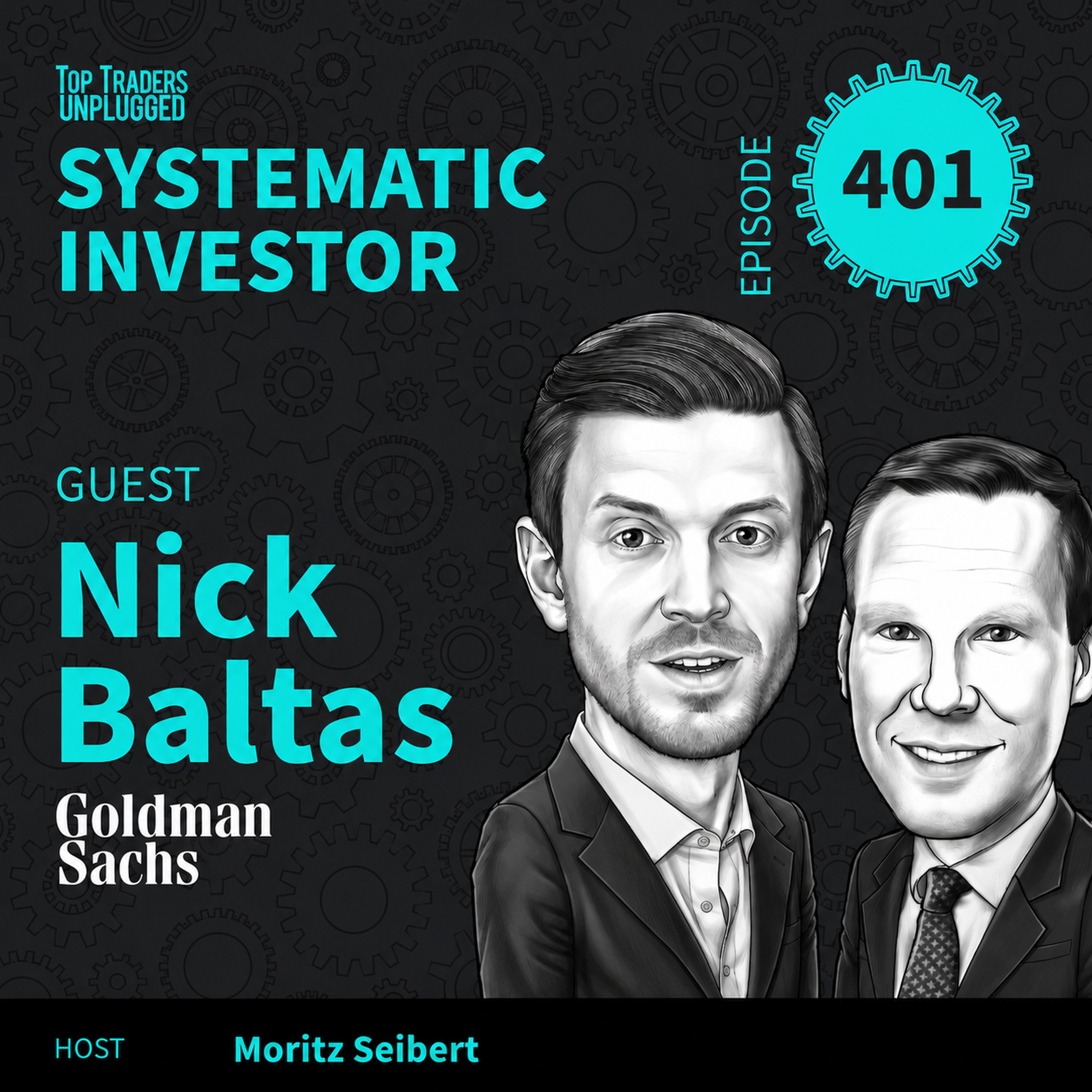
Welcome or welcome back to this week's edition of the Systematic Investor series with Nick Balters from Goldman Sachs and I, Moritz Seibert from Tucker A Capital where each week we take the pause of the global markets through the lens of a rules based investor. Today I'm sitting in for my friend Nils Kastor Blarsen, who would normally be recording this show with Nick, but Niels is traveling this week and therefore unable to get in front of the mic. So Nick Niels likes to start this show as usual with his what's been on your radar lately? Question. And I'd like to pick this up and ask you, well, what's been on your radar lately? What's been keeping you busy? What's top of mind?
- [01:18]
C
Yeah, I know Nils does that and you know, it's good to see you more. It's been like what, six months we're here together.
- [01:23]
B
Yeah, six months or something like that. Yeah.
- [01:25]
C
So yeah, it's always a pleasure to kind of connect again with you. What's been on my mind frankly is very, very busy, very busy with no client activity. Obviously the markets have been keeping us up on our feet for some time now, you know, complacency and at the same time eager to get to what the next phase of this macro situation is. Certainly takes a good amount of our time. I'm spending a good of my, I guess, quasi free time on exploring how all this AI frenzy is going to impact both the way that we do things on the day to day, but also how research is going to change from this point onwards. So it's more of an exploration phase at the moment kind of ideas and creativity comes into play. Obviously at the same time we try to make sure that is kind of an underlying process as to how we do things and how we would want to be doing things going forward. But, but I would say this is something that I'm spending a good amount of my time. I know coding has always been part of my day in the recent years, bit less so. But now there was a chance of kind of going back to it and it's kind of nice to see how you can start building even tools for your own kind of personal life through the new technology. So I think a combination of very busy client activity, some travel, there is nothing that is on top of my mind that I would just flag as one. It's just a very, very busy period. Thankfully in a few hours I'll be heading out for a week of a holiday so that's basically what I have on my mind baby that I need this one week to spend with a family and the kids.
- [03:02]
B
Yeah, yeah, well deserved. You told me. I wish you a great holiday and like you the markets are keeping us busy. I mean not necessarily from putting trades on but just the ups and downs and all the volatility, especially in the petroleum markets continues to be a big theme. Luckily trend following strategies are doing quite well this year in in light of the situation and as far as I'm concerned I had a great day in Zurich yesterday was inclines I met a common acquaintance of ours as I've mentioned we shall not mention his name but it's been just a great day there. It's a great city, everybody seems to be doing well.
- [03:41]
C
True, true. Very good friend. Very good friend.
- [03:43]
B
Very good friend. So yeah, he definitely says hi. Now there's quite some interesting topics I'd like to discuss with you today Nick, but before we go there, there's usually a trend following update that Niels does and I just want to follow. I just like to follow the same schedule. So here's the performance update as of yesterday night which is Wednesday evening, May 20th month to date and year to date. Performance number for the BTOP index it's up 1.46% for the month and more than for the year. As I've mentioned, trend following is doing quite all right this year. The SocCen CTA Index similar numbers 1.55% positive for the month and up about 12% for the year. SocChen trend a little better 2.11% for the month and up a little bit more than 12% for the year. The Short Term Traders Index is up about a percent this month and up 6% for the year. Equities MSCI World up 2.4% for the month and 8% for the year. Bonds they're down about 50 pips for the month and down about 25 bps for the year and the unbeatable S&P 500 total return index is up 3.19% for the month and 9% for the year. Isn't that amazing. I mean, you just don't bet, don't bet against the S&P 500 anymore. I mean, every time I look at the performance and I report to somebody, you know, what's the performance of The S&P 500?
- [05:14]
C
It's always up, it's hard to beat. It is hard to. It has become harder to beat, but I guess eventually becomes a bit of concentration. But not on S and P itself, but you know, the three, four, five, six constituents within.
- [05:28]
B
Right, so the AI stocks and the Magnificent Seven, maybe?
- [05:30]
C
Yeah, precisely, precisely.
- [05:32]
B
And then, you know, there's the big event coming up with SpaceX, which will probably increase that concentration quite a bit.
- [05:40]
C
I mean, yeah, we're all kind of following the news over the last couple of days, right. With evaluations and so on and so forth. So I think that's going to be quite a. Quite an IPO to remember.
- [05:49]
B
Yeah. So as you mentioned, Nick, we chatted about six months or so ago and when we recorded it was the topic was about the QIS space at large. Like, you know, how many assets are there, what types of clients do you have, how do you wrap the exposures into what type of, like is it swaps or nodes or options and these type of things. And maybe this is a good point to reconnect and catch up and ask you what's been happening lately in QIS land? What have clients been interested in? Is there any theme that attracts clients and grabs their attention? Anything that's standing out.
- [06:26]
C
So generally in terms of themes, you wouldn't hear something that is dramatically different. I think the whole QIS space has become a vehicle of expressing specific macro views. Frankly speaking, it has departed, at least for some time now. The premise of designing an uncorrelated stream of return that you're going to put on top of your SAA and it's going to do the job no matter what. I think has started being utilized to express macro views, some of which can have a systematic expression. Said differently, somebody could possibly argue that in a year to date not being long equities and maybe long oil on the back end of the macro dynamics, or maybe shorting some bonds is a macro call that they would want to deploy, which is not too dissimilar of arguing that, hey, a trend following expression of that is nothing more than what a QI solution could deliver in this regard. So to go back to your question, the theme, I think for the year, or at least in the early days, was more about how the whole AI capex is going to impact positively Profitability for the equity market and more broadly for the economy. And soon after that, obviously with the geopolitics, things turned quite substantially. We're kind of pricing in rate cuts and now we're kind of debating how many of rate hikes we're going to see. So I think that pivot around March led to memories of 2022, I should say there has been discussions along the lines of is inflation picking up again, clearly in the news and in the public releases. That's exact exactly what we're seeing. So the question then becomes, is that going to be stick? Is it going to start impacting how equity and bond correlation plays out? Is that a story that, you know, relates back to the days of dispersion dynamics of maybe interest rate volatility trend following to your point, the good performances here is maybe the consequence as well as the invitation of another good year in this regard. So I should say this. Anything that I would basically kind of put forward as a thematic is around inflation. And obviously pockets of inflation relate to maybe some equity hedging at times. And obviously you look at the marketing like, okay, do I actually need a hedge at this point in time? It's actually the V shape in March was very different to the ones before. It was the one that kind of dropped at. It didn't drop dramatically, but it did drop over the course of like a couple of weeks. And then the recovery was very, very quick. I think we have rarely seen this type of a dynamic. Typically you see a fast way down and a bit more of a kind of slow recovery was the other way around. So, so that's the main theme, frankly speaking, you know, inflation, if you were to put like a tag on it with all the small kind of subcomponents of it, one being equity hedging, the other one could be maybe some opportunistic pockets. I think we're going to discuss later on for commodity curve, there's a good question as to whether commodity curve is in a mean reversion kind of dynamic at the moment. So these are more like smaller pockets of expressing a macro view to my, to my point in the beginning. Right. So that's what we're seeing. But, you know, I would say, you
- [09:38]
B
know, quite busy what I forgot to ask last time we were speaking, it's one of the questions left over. But from a broader perspective, I'd be interested whether you see across your business any cyclicality in client interest. Is there like bursts of interests when risk is on or risk is off and they want to hedge or does it correlate with a bull market in the S&P 500? Or is it more like a constant flow of interest and also then transactions where it's kind of like, yeah, we're kind of like doing deals every month no matter what the markets are doing.
- [10:15]
C
So there is cyclicality in the interest, but I would say there is generally stable flow of conversations and activity. It's obviously a good thing for the overall industry. But the thematics, or maybe I'm going to maybe again repeat myself, the macro views that investors have could be expressed with a systematic solution. So QIS becomes in the vehicle. So to your point, if there is a risk of mindset, you'll see more of a defensive tilting either of portfolios or reduction of risk on the exposures or deploying some defensive components to it. You know, if, if the mindset is more of a recovery or maybe a normalization, you would see a bit more volatility selling, maybe some carry trades and less so you kind of seeing, as I said earlier on the vehicle, that will do the job no matter what, like the alpha engine, you still have those needs every now and then. But the cyclicality I would say comes and goes more with the microdynamics and then the QIS solutions just become the vehicles to express those views. Maybe the one thing that I personally keep on using as an anecdote is that specifically when it comes to defensiveness, you end up seeing, broadly speaking, an act of regret and a reactive function rather than a proactive. So for instance, you know, we can, we can speak about trend following because in 2018 involved Magedon did not perform obviously because of the reversion. 2020 wasn't a stellar year, at least during COVID And the reaction there was, you know, how about we know, we end up buying some volatility as a defensive component. And then, you know, obviously 2022 came about that you had the spot down, volt down, long volume did not deliver, trend following did. But obviously the micro environment was the one for trend following to deliver. So then post 2022 you kind of had the reverse. Okay, long volume was not the defensive trade, at least for this market. Let's go back into trend following. But then some disappointment came because of some of the V shapes we've seen in the last couple of years. So I think this act of regret is not necessarily healthy from a, from a product design standpoint when it comes to managing those portfolios. So if there's one thing that we typically try to bring forward is that specifically for some of those pockets of more strategic views. It's not let's follow what did well yesterday, but rather let's take a step back, see what we're solving for and strategically allocate to it. So that's maybe the only one that in addition to the cyclicality somebody should argue maybe let's let the cyclicality alone take a step back, assess and allocate on a strategic basis.
- [13:00]
B
Could be easier said than done.
- [13:03]
C
Absolutely right, Absolutely. And you know, it's nobody has an infinite horizon of investment and everyone is assessed on on, on the basis of performance. So obviously carrier risk is the, is a key consideration here that is not easily quantifiable. So I'm with you on this one
- [13:15]
B
100% as you mentioned, we're going to be speaking about commodity curve carry and how it has done in but before we go there and then also into some other details, I'd like to bring up a very interesting article that I found written by Greg Zuckerman from the Wall Street Journal. I think it was published about a month or so ago on 20 April and its title is Wall Street Brings Sophisticated Quant Strategies to the Masses. So let me maybe within a minute or so frame, frame the discussion and let me cite some interesting parts from that article. Here we go. Quantitative investment strategies for clients are one of JP Morgan's fastest growing business. The bank has seen QIS revenue rise 30% so far this year from the same period in 2025, according to people close to the matter. That is an acceleration from the 25% growth seen in recent years, making it one of JP Morgan's fastest growing businesses. Goldman Sachs Asset Management, so that is related to you, for instance, now manages about 175 billion in quantitative investment strategy funds, which equates to about 5% of GSAM's overall assets under management. According to PremierLab, the overall size of the QIS space is now about 1 trillion and about 3 trillion when you include leverage. And either way, the profits are piling up for the banks which charge investors depending on the complexity of their trades, QIS revenue is nearly risk free. Something, by the way, I wouldn't necessarily agree with, but let me continue. QIS revenue is nearly risk free and generally reliable. Since the trades are preset, banks don't have to set aside as much capital for these trades relative to other kinds of businesses they're doing. So let me stop there. Just some background. This was an interesting article about the QIS space. I thought because it was, you know, it continues with pros and cons. But it kind of like looked at the space from a different perspective, I thought. Is there anything you'd like to add to this?
- [15:28]
C
I mean, QIS as an industry has been receiving progressively more visibility. Right. It's not the first time that there is an article in, if you like, broader interest media. And that in itself is a data point that is worth obviously observing and acknowledging. You know, some of those articles obviously come with catchy titles in one way or the other. And now I wouldn't be able to comment too much on that, otherwise we would have to make sure that everything. Exactly. So I don't want to make any specific representation here beyond the fact that it is a solution that in itself has become of broader use because of the use of technology and data and trading capabilities. At the end of the day, banks do sit in the middle of buyers and sellers. They have the ability historically to deliver portfolios of stocks or commodity futures or tradable assets in a variety of formats. And I think the benefit of having a bank operating a QIS business is that there is also a structuring pedigree underlying it. So something we discussed, I believe last time is that those profiles can be delivered in a call option, in a. In a capital protected structure, in an OTC swap. So the access to it has become easier over the years. Some of those articles obviously come up and say the place is crowded. I mean, my response to it is that it's always the easy way.
- [17:10]
B
Let me stop you there.
- [17:11]
C
Because brand following has the same problem historically, right? It's always crowded, right? It's always like, no, let's point the
- [17:17]
B
finger because there's pros and cons. And I thought the article was actually quite balanced and well done because it does mention the pros and cons. And so the pros or the advantages mentioned are. For instance, I'm citing again from the article for institutional investors and allocators, QIs are very convenient. It's outsourced infrastructure is essentially quant as a service. Bespoke implementations are possible. They're operationally easy to access through swaps and other wrappers. Like you've mentioned, you have this easy go to point to get the exposure that you want or maybe the hedge that you want and you have it essentially outsourced to some other trading desk and you don't have to do it yourself. And so this is the good thing. The cons or the disadvantages? The potential disadvantages that were mentioned is the flows may result in crowding and synchronized positioning in practice, many Bank QIS offerings look very similar, if not identical, and they often provide overlapping exposures. Too many investors doing the same trades can reduce the potential for profits. It's probably true.
- [18:27]
C
I mean, I would say that's a textbook definition of crowding. So I don't think it's delivering anything new that we did not know. I would say from designing systematic strategies, whether we sit on the buy side or the sell side, ultimately it is very important to be prudent on risk management and on how we consume market liquidity. So from that perspective, of course we can have the argument that there is more demand. But I guess to the extent that somebody approaches the design of a strategy or an investment in a prudent manner, they should account for incremental flows into a specific premium or overlap of positions between different strategies. And then we tend to think, or I tend to think of looking at the flow as a whole rather than strategy by strategy in isolation. So that's important. Obviously the externalities are there and can be there, but it's not dissimilar to any other type of investment type. It can be a discretionary call that delivers too much of concentration. It can be inflow into private equity markets, for instance. Anything that has excess demand can lead to subdued returns. So the question then becomes, is the market deep enough to consume the demand? And that is something that we on the design side have to be very, very focused on, obviously working with trading very closely. That's something we would always monitor and make sure that if a particular feature in the market seems to be crowded out, then we should make sure that we look at our design better, or maybe we have a conversation with, with our clients. And frankly speaking, these are all sophisticated investors looking into sophisticated designs. And this whole exercise is more than just, oh, here's like a supermarket of possibilities. Let me just get one or two. Because they've had a good backtest, I think the industry has matured substantially to design and assess those investment vehicles. And the last thing that I would also flag is that this flow that arguably has been growing, part of it is genuinely new, but part of it is also a replacement one. So if I were to say that there is a trend following strategy, sometimes it could be a replacement of a different strategy or a city exposure or vice versa. And this is never quantifiable because it's impossible to track it down. Right. Um, so that is another consideration.
- [21:09]
B
Pocket. Right, Pockets.
- [21:10]
C
Precisely right. Precisely so. And that was also how this business, broadly speaking as an industry, kind of came about. Came about what could be systematized. And what is the value of systematizing a process vis a vis a more of a discretionary kind of allocation? I'm not sure whether I'm answering any question, but I don't think there is a specific question to be, to be answered more than kind of giving my kind of remarks on this one. Right.
- [21:36]
B
So I mean it's, it's a general, it's a generality like you say, the textbook definition. Too much money thrown at any one thing will destroy or impact decay its return potential. Right. We can see this in all sorts of strategies. QIS should not be any different. I, I have no reason to, to, you know, to back it up. But you know, when you look at some of these, say more niche QIS strategies, say liquidity provision to the BCOM or GSEI role window, maybe there is some decay that you can spot. Maybe there is too much money chasing these opportunities. I do not know. You know that better than I do. But clearly there, there are impacts, right? It doesn't go without side effects.
- [22:17]
C
I think that's why I think it's very important to look through the details and understand the driving force of, of any strategy. So you mentioned congestion. It's actually a very good example. So congestion shouldn't be there in the first place. In other words, there should be no reason why somebody is rewarded of pre or post rolling those commodity futures. Aside from the fact that there is perhaps some passive demand for those benchmark rolls because they happen to belong to commodity benchmarks. So if the market operates in a way that is creating an opportunity that can be harvested, it's actually the reverse that there is an arbitrage that should be there. It is purely a consequence of supply and demand imbalance. And obviously the more of that you do, the less of the performance you should expect to have. Precisely because you're capitalizing on an arbitrage that shouldn't be there in the first place. This is very different to arguing that selling volatility for instance, could wipe out the premium. Perhaps the magnitude can drop. But nobody could argue that being on the side of the insurer is now if you like, a non rewarded trade. Unless somehow human beings become risk loving rather than risk averse. But last time I checked, those utility functions remain to being upward and concave rather than convex.
- [23:37]
B
You don't sell insurance for free.
- [23:39]
C
Exactly right. So I think from that perspective the crowding argument is perhaps an input into the time variation of risk premia. But could that be a reason for the wiping out? It depends and the dependence has to go to the underlying reason why a specific investment philosophy has been successful. And if there's an underlying source of risk that is captured and delivered, the reward for it should be non negative more often than not. So that's how we kind of look at it and that's how we typically approach it or I approach it in my research kind of focus areas very well.
- [24:17]
B
The quote that I thought was most interesting and then we can move on. But this one I thought was really good. So let me read that. Aggressive hedge funds have been trying to profit from the growth of qas programs by anticipating their traits, says Arnab Sen, who used to develop qas products at Barclays before joining Paloma Partners as a portfolio manager. These funds try to act before the QIS programs can, resulting in a cat and mouse game that can cause unusual movements in various investments. It exaggerates moves in the market. This was the first time I heard that hedge funds may be front running the QIS triggered trades. And I'm not sure how they can even like most of your index methodologies aren't, you know, you don't have the full detail. You can't just download them on the Internet and you know, find, find out what exactly is going on. I think you have some redacted versions, but the full technicalities aren't usually in the public domain, are they?
- [25:21]
C
I mean obviously part of that is, is, is in, is part of the IP and it's not too dissimilar to how a hedge fund would operate in, in this regard. Right. So obviously there are details that matter and these details are not. The importance of those details ultimately protect the end investor. Like we owe to deliver what we feel is to be delivered. And in this regard, part of the IP has to remain with those that you eventually allocate to it. Now could we argue that we can front run any strategy? I mean again, that's a textbook design, right? That's a textbook, it's a textbook assumption. So I don't know specifically what comment I could make on this one beyond the fact that it's put on a piece of electronic paper. Could be the case and could not be the case. At the same time, I think it can easily be put down as a claim in the same way as we can say CTAs have been crowded for the last 15 years and therefore that's part of the reason of sometimes a good performance.
- [26:24]
B
Maybe we should reach out to Paloma Partners and Arnab Sen specifically and ask him to show the P&L of his front run QIS trades see how it's doing. But I guess he's going to decline the invitation. Anyway. Let's leave that article from the Wall Street Journal aside and move on and speak about Commodity curve carry which we agreed to do in our pre call. The reason we want to speak about this is because it's one of the QIS strategies that shall we say, has suffered some damage this year in light of the curve dynamics and the substantial increase in volatility in commodity markets across the board. Especially obviously in the, in the energy markets where we've seen if not record backwardation, but then close to record backwardation in WTI and rent curve shifts in a very rapid period of time, very short period of time, which has, I presume caused some drawdowns. So why don't we just or nick you specifically. Why don't you just you know, respect or you know, report from a broader perspective how the strategies have done, how bad the damage is, what the outlook is, why these strategies work. I mean, take it where you want to go.
- [27:48]
C
So commodity curve is probably the most long standing systematic strategy that has, that has been designed in a QI's format. You know, it probably goes back 15 years. I guess for those that are not very much aware, just a very brief intro. This is about rolling commodity futures exposures on the back end of the curve and shorting the front. Typically the front is very steep in a contango shape and therefore the roll yield is very expensive. So by shorting the front you end up kind of getting a differential yield versus rolling the back. So this differential return of the back versus the front across commodity markets is what we call commodity curve. It's a, it's a carry trade and ultimately tries to achieve the yield differential from those, from those roles on the back and the front. And that is done across a variety of commodities. You know, the benchmark universe of BCOM as well as kind of more frontier markets are now utilized for those trades. What is the primary risk here? The primary risk here is that, you know, by you shorting the closest to be delivered contract, you are exposed to what we call shift into a backordation which in, in layman's terms means that a commodity market with close to spot delivery is going to rally substantially. In other words, for a commodity to rally in the very short term, it's more likely that there is too much of demand or too little of supply and most of the times commodity prices would shoot up because there's a supply shock and that's exactly what happened in. That's exactly what happened in March, obviously with the situation in the Middle east and the stress of Hormuz and all that lot. The price of oil as you just said, more it's skyrocketed. So those curve positions that were shorting the front were significantly impacted. I should add to that that year to date performance has also had another catalyst that didn't actually recover from, from it and that was the kind of natural gas moves in January. So that was for those that remember there was like a weekend or so that the weather forecast became much more kind of negative in the US and at the time the demand for natural gas actually increased in anticipation of cold weather. So that had the first kind of negative kicker into a curve strategy that obviously became significantly greater coming into kind of March to your earlier point. So drawdown was quite significant. So if you look into kind of simple implementations of a curve strategy, I know we're talking about something like 10% for instance. And this is certainly the largest we have seen since we have data.
- [30:51]
B
Is this the largest ever, the worst drawdown for these type of strategies right now?
- [30:56]
C
It is indeed, let's say for the last 40 years. And if you were to kind of focus in the most recent period, it's possibly like not this, you know, two times the largest we have seen so far. I think the previous one was in 2018.
- [31:09]
B
Quite significant.
- [31:10]
C
So it is quite significant. And 2018 was more of a, of a natural gas shock. What I should say is that because the, because the drawdown came from a very well understood move that in itself is the number one risk factor when it comes to a curve carry trade possibly will connect it to the earlier point that there is no arbitrage here, that is that is to be captured at no, at no risk. There is an underlying source of risk for which investors are rewarded. Yes, the drawdown has been quite significant by all means. I would say historically most of the drawdowns have come either by weather shocks to my earlier point or from some sort of supply disruptions or like some outages or some geopolitical conflicts. And it, it looks quite similar to 2022. You had a similar situation in Q1 2022, but at the time the impact of the move was less aggressive because you know, if you remember it came obviously from, from Russian oil. It was initially sanctions and then obviously self imposed by, by Russia themselves kind of cutting, if you like the supply chain. But also the production that was kind of controlled at the time was a fraction of the one that we're currently kind of facing. So the impact was smoother through time and less aggressive on the downside. But that's maybe the closest in terms of fundamental dynamics of a drawdown to the one we're kind of experiencing today. And I think maybe a bit more technically now, not only the, if you like, the Russia situation was easier because of those dynamics, but because it was slower, you ended up kind of benefiting from a slight recovery. Whereas now because you're rolling out of the current contract, you're almost crystallizing the negative piano. It's a bit more of a technicality. But the way that the impact into the strategy happened back then versus now had less of of an effect as it had today. So I can pause here if you have any points to make. Right.
- [33:16]
B
Well, is this a good time to buy? Well, that is not the question you're going to answer, but let me rephrase it. Do you, do you, or maybe, maybe you will answer it because there tends to be some inversion to this. Or I would have rephrased it and said, are clients calling you now to redeem and get out of the strategy because they can't stand the pain? They have that 10% drawdown, as you mentioned, in that naive implementation or whatever implementation it is, there is going to be some drawdown that is certainly inconvenient and it's very large relative or the largest relative to the history of the strategy, or are they more like, well, this is a great time to buy because it's now probably, or it might be relatively cheap now relative to the return expectation going forward.
- [34:00]
C
So two things I would say. So, so curve carry historically was the driving force of systematic strategies in the, in the, in the commodity space. But in the year of 2026, there are other ways of extracting some positive returns from the commodity markets which had allowed the investor base looking into the space of diversifying the exposure across other type of premia. And why I'm saying that is because the benefit of having diversifying sources of return in a portfolio context allows you to weather quite well the period through March. And I would say perhaps because of that or perhaps because it's very well understood that this is the risk and therefore we're exposed to it and we're experiencing it. You know, the reaction from the market has been much less aggressive than what was the case, you know, a few years back. So I would say in this regard there is more of patience in the sense that a recovery phase which would bring prices down will make the strategy benefiting from it and will benefit the strategy from it, both because of the yield differential on the front of the back and the spot movement that is going to happen on the front. Now, is that the right time to enter? My claim would be that obviously in the very short term risk is still there. The situation is unresolved. And as you said in the, in the beginning, it is the theme that we're looking day after day where the oil price is going to go. And sometimes it shoots up, sometimes it shoots down. But the news is driving the price more so than the supply demand dynamics. So I think there's much more of an implicit impact into the oil price itself. But I should say there's certainly a future to the strategy. There's nothing fundamentally harmed by a risk realization. Of course, at the same time you can have, you can have investors that hit specific risk limits and that can cause in itself and downsize. I mean that's, that's, that's, that's by design. But I should say to summarize, I should say that client reaction has been relatively similar to what I have personally seen in the trend following space in the last few years. We know what we're exposed to. The ultimate risk is realizing we're fine to take it because we're here to harvest the premium in the medium term. And it is to marry your point the strides that over the longer term has had very strong and positive returns for commodities without necessarily decaying in the magnitude. And I think that also goes back to what are the principles that deliver the premium in the first place? Why is it there? The last point I should say is that implementation matters. There are implementations that beta heads the front and the back. There are others that are a bit more dynamic in the selection of the curve and the points of the curve that they would roll. Some implementations would bring you very close to the spot price, so you'd close the spread so you're not exposed to the market anymore. Some of them would beat ahead the front and the back so they would be less impacted by the move because the front is more volatile. So you reduce your exposure. Maybe too technical now, but you know, you get the point that there are variations that have actually been positive year to date.
- [37:21]
B
Oh really?
- [37:22]
C
Yes. So interesting. Think about it. Let's, let's, let's do the most basic one of them all. If you are dynamic in the selection of the back in a backwardation state, you'll come to the front. If you come to the front, you close the spread so you're not exposed to the market anymore. And in that closing of the spread, if you're also bit adjusting the front, you're even less exposed to the front. So in this transition of closing the spread, you're also reducing the front exposure and then the whole thing is substantially more diluted than obviously being like no, I'm long the F6, I'm short the F0 and I'm just stuck on it. On a dollar neutral basis.
- [37:58]
B
Yeah. Or contract neutral basis.
- [38:01]
C
Correct? Correct.
- [38:03]
B
Yeah. Interesting. Look, I mean I don't have any, you know, detailed knowledge on this. I'm definitely not a forecast. But you know that the backwardation that we're seeing and Brandon wti I mean it's insane, but. Yeah, but that, that does not, that does not mean that it couldn't get even more insane, right? I mean this is, this is markets. What is it about $20 now difference between front and whatever, like you know, 12 month out or something like this? Roughly. I don't have the exact numbers, but I mean could it become 40? Why not? Right? I mean if there is a complete crisis and people are like just scrambling for barrels and there's this massive supply shock and we don't have enough going around, the front can be bid up.
- [38:49]
C
I think the interesting thing is that in the current macro dynamic with, with obviously this shortage of supply that you know, we observe and it's, it's in the hard data as well, there are some snippets of news that talk about how the production engine is now kind of almost like learning to operate with lower supply. So it's a good question whether the market can absorb the shortage rather than the fundamental exposure that the economy has on it is just no static, hard to quantify.
- [39:24]
B
Yeah. I did speak with an oil trader in the Middle East. He told me that there's a, there's big efforts being made of moving barrels by train, you know, getting into different offloading points and unloading points and even trucks are running to get to Oman and you know, kind of like bypass the Strait of Hormuz and you know, the, what is it? The east west pipeline in Saudi is in capacity.
- [39:49]
C
So it's fascinating though, right? It's fascinating because you know, we're talking about financial markets and then as soon as you start speaking about commodities, you're talking about like the actual physical.
- [39:58]
B
Yeah, the real thing.
- [39:59]
C
The real thing, right. So it's quite fascinating actually getting into this space.
- [40:02]
B
Love these markets. Anyway, let's leave it there with a commodity curve carry. Maybe in six months time we're Going to reconnect and it'll be recovered. Who knows exactly. But back to our most favorite topic. Trend following I guess is, is, is something that goes with the systematic investor series. At least this is how it started. So trend following performance in 2026 I think we've said is actually quite good from your perspective. One of the questions that always came up is like alternative markets, smaller markets versus standard markets, more markets versus less markets. I think you have it all in your QIS suite of products. What's been performing best? What's been performing worst?
- [40:48]
C
Let me start. Where should I start? If I start from the markets that perform the best, I mean alternative markets in my mind and you know we can disagree on the definition because you know there is no clear differentiation between what, what makes a market alternative or, or conventional beyond maybe just liquidity. The, the more kind of, let's call it conventional markets that I think they have outperformed, you know, we can look into maybe non kind of become or non benchmark commodities year to date. It hasn't been a specific good period for that part for the trend following space. The interesting thing is that if you start looking into different premium like a reversion or skewness dynamics, the exact opposite. So the benefit of diversification of premium also prevails across all markets. So specifically in the commodity space that we were kind of, we were talking about kind of benchmark markets have done very well capturing obviously the precious metals in the early days of the year and then January. Yep, precisely. And then kind of moving into the energy markets and benefiting very, very strongly in the, you know, in the recent period. So pretty much like in a straight lineup in a way on the commodity front and the other asset classes obviously being long equities, short the dollar, short bonds. You know, I, I, I rarely remember a period whereby all four major asset classes have been contributing positively. And this is one of the, one of the few we know. Interestingly in raids I know I remember kind of discussing year end with, with, with a crew here what would be my bet for the year. And so far no, it didn't start as I was anticipating it. But you know, since the beginning of March I think the, the rates trend has picked up which is actually like an interesting observation to haven't had it for two, three years actually now since 2022. So performance has been very strong. I think benchmark markets have been delivering the principal components in all fairness. So the equity, the dollar, the energy complex and the rates one. So the whole spectrum has been delivering economic Trends have done well as well, frankly speaking, pointing into kind of rising or falling growth but certainly being help by some precious exposure. And then obviously diversifying components to trend following like reversion, like carry things that I have been very vocal about for another year continually, continuously adding performance. It's been actually quite, quite a very strong year for the whole spectrum. I would say if I were to make a classification to your question as to how broad or how centralized somebody should become when it comes to trend following program in my mind, stylistically solving for defensiveness, somebody should go with a core market universe because all you're trying to achieve is the principal component moves maybe with a slightly lower long term adjusted returns. Looking for long term adjusted returns, I would go broader that perhaps will have a cost in terms of how much defensiveness you get. And I think this was in a, in also in a paper from man that was actually quite nice a couple of months ago.
- [44:07]
B
Correct. They looked at different portfolio compositions with more like alternative markets, more markets, less markets. And that's exactly what they, what they showed is like if, if you have a smaller concentrated portfolio of macro markets, you have that positive skew defense.
- [44:21]
C
Exactly.
- [44:22]
B
Especially during equity drawdowns. But your long term expected shop ratio performance potential is maximized more when you add all these alternative markets because they're, you know, I use syncretic bets on something different. They materialize at some point in time.
- [44:37]
C
Precisely. But I don't think this year it's necessarily the recipe for disaster nor for outperformance. Yes, fine. If we just look into the non benchmark commodities, maybe the trend following space has not been very lucrative, but the reversion one has. But that's a bit more of a kind of handpicked selection round rather than like, you know, a bigger group of assets.
- [45:01]
B
No, it matches my observation. I mean when we look at the Soption CTA index, I mentioned the performance numbers earlier, it's up about 12% or whatever it is. Right. So that's the largest 20 CTAs. There's a big exposure to the big macro markets. So they're doing well with these type of markets. There are some CTAs out there trading concentrated portfolios that are up 50%, some are up 100%. They have these massive years and then when we go down the list and we look at the managers that are more in the alternative markets space or have a broader portfolio that includes smaller markets, we at Tucker Hay, we're one of them. We're not really catching up with these or we're not there because the other markets have been a drag this year. We have allocated risk to them and they haven't been performing as well. Whereas if we had all the risk in, you know, silver and gold and the energy markets, we would have done much better. But that by no means says anything about what will happen next month after the fact, between now and the end of the year.
- [46:04]
C
Right after the fact, we always know.
- [46:06]
B
Exactly.
- [46:06]
C
That's true. That's true, that's true.
- [46:08]
B
Hey, there is a question and that relates as we're closing down. There's a question that came in for you, Nick. Relating, I presume, to trend following. So let me bring it up. It's a listener question from Vladimir. So here we go. Researchers and practitioners in the rules based investment community publish prolifically on the topics of the role of CTAs in portfolios, various signals and factors, portfolio construction, etc. There's little work and less conversation about execution. So the question is, is there alpha in execution? Is there discretion in execution and when is that discretion exercised? What are the go to and preferred execution strategies that minimize slippage? Is there a case for execution optimization per asset or asset class? And what percentage of time is spent on execution R and D research and development? Keep up the good work. Thank you Vladimir for the question so long question summarizing is there alpha in execution? How do you execute? How do you minimize slippage? And is it kind of like a market by market distinction that you could possibly make saying we're going to be executing the S&P 500 in a different way than we're going to be executing Cocoa?
- [47:24]
C
So I think the question can be answered very differently when it's posed to kind of a qas business versus some kind of CTA that are managing, I guess with the fiduciary element following portfolio. So maybe my answer would be kind of perhaps different to yours, Morris. Right, because we're kind of sitting on the opposite seats of that question. So broadly speaking, QIs would typically deliver on a guaranteed basis some closing price or some twop. Let's put it this way. In this regard, the risk of achieving whatever price reference price has been quoted in the index documentation lies with the trading desk. But ultimately whoever is exposed to this systematic strategy will get whatever they can calculate effectively by, to your earlier point, doing the sum product of quantities and price changes. So in this regard our attempt is to make sure that getting into the market is a passive exercise precisely because we would want to avoid having any impact whatsoever. And the way that both From a design standpoint, but also from a risk management standpoint approach. The problem is we want to deliver the strategy and the strategy just. There is no execution alpha. That in itself will become part of the return. And therefore, in this journey of delivering as passively as possible the reference prices in the documentation of the index, the attempt is be passive, be thoughtful, market by market. That is class. With the trading desk, they have the ability and the clarity to decide upon how and when they would execute into the market. I think this is very different to running the strategy yourself, because in that case you can benefit from it and therefore your clients can benefit from it above and beyond a guaranteed closing price, which obviously at times can work at your benefit, sometimes at your expense. So I think there is certainly value in doing execution research. And by no means am I saying here that we should not focus on that. It is purely the, if you like, the boundaries that AQAS business operates under, that makes that more of an internal focus rather than, if you like, an externally deliverable profile in this regard, fair enough. But to get your thoughts right, because I think you are much more on that right than myself.
- [49:55]
B
No, and you're absolutely correct to say that it is a different perspective that we need to take because through your index documentation, you promise and you guarantee, say, a settlement price to the client and you're marking the strategy at exactly that price, and that is where it is transacted. Now, if you trade at a different level to that price, that is slippage. And that positive or negative slippage, it can't be either direction is on the books of Goldman Sachs, you know, with all the netting impacts that you have. But it's essentially for you to manage that, and it's your risk to manage that. And it's not something that you're mirroring onto the client. In our case, that's different because every time we realize slippage, it is again, either positive or negative, but it's directly routed on to the client.
- [50:42]
C
Because that shows up in the.
- [50:43]
B
Because it shows up in the P and L. Exactly. And so to summarize, I think there is. I'm not sure if alpha is the right word, but there is value in execution and executing efficiently. And all of these markets, this is one of the questions Vladimir has, is like, is there different execution strategies per market? And my answer to that is yes, there is. Because all of these markets operate in a different way. In the order book, they have different settlement procedures, different settlement windows, different periods of time. Some have like 30 seconds, some have 30 minutes to settle. Trading Brazilian live cattle has a very different settlement window than trading live cattle in the US on the cme, the liquidity profile and the liquidity concentration is very different. So there is value that you can extract. And maybe an episode that Vladimir, if you're interested in that's worth listening to is my conversation with Tom Babbage from Gresham and he did speak about. So they trade alternative markets, day trade markets such as propane and butane gas and smaller markets. And he has reported that these are markets where you would in expectation, assume that the slippage is going to be much higher relative to if you traded the S&P 500E mini futures contract, which is very liquid. And he reported that their slippage in the past year has actually been nil. And the way they do it, they do a lot of R and D in execution as they have a more kind of patient approach to getting into the trade. They're not forcing themselves to immediately transact and consume liquidity from the order book. They sit there, they can wait. It's more like he said, it's still systematized and rules based, but it's more like a human element to the execution process to get you into a trade. And he said there is value there. If we didn't do it in that thoughtful way, they would probably pay 2 or 3% in slippage per year. And now they do not because they have a specific focus on doing it efficiently. I can only echo that, not to the same extent as Tom Babbage, but clearly there is missteps that you can avoid easily by executing poorly. And there is value by executing efficiently.
- [53:16]
C
I can only believe that. I can only believe that.
- [53:21]
B
Nick, to wind it down, a final question I'd like to ask you, and that is my question, it didn't come from a listener. Do you have a QIS index that does trend following on single name cash equities only? I think it's an interesting space, but as I may have overlooked something, but I've never seen an index that does that. And I was wondering, with all the indices that banks come up with, why is it not there? If it is not there, I might be wrong.
- [53:53]
C
Yeah, I don't think you'll find it on the street, but maybe I don't know the industry at that level of depth. Obviously, broadly speaking, the single stock space has always been thought as a, as a cross sectional space. There is a pocket I should buy, there's a pocket I should sell, and that's a relative trade rather than like a Time series one, and obviously momentum is the better expression after following the single stock space. But momentum is now buying the winners, sorting the losers. And I think part of the reason why this is the implementation that you know, you typically see more of is because a more time series implementation would be probably like timing the market in a way, like buying the stocks when the market is kind of rallying and then kind of selling them when the market is selling off with a bit of cross sectionality here. I don't necessarily think that this is a bad idea and I'm sure it's going to have positive return partly because of the market timing ability that it would have. There was no if I have good recollection of this one. I think there is a very interesting paper by maybe it's Jacades and Goyal, I hope I'm not wrong. A couple of years back, maybe three, four, five years ago, looking into the difference between a time series implementation which is trend following, and a cross sectional implementation which is momentum. And the focus there was to look into single stock implementation because you have the breadth to do momentum cross sectionally, but also you can do a trend following strategies to your point. And what they show is that one is very similar to the other, plus some market timing mechanism. If you have 100 stocks and you go long 60 and you go short 40, it's almost as if you go long and short 40 as a cross sectional momentum and then the remaining 20 will give a bit of a beta to the market. So what they're trying to show is that the two implementations are kind of sister implementations of the same premium with an additional market timing element. So the question then becomes, where is my return coming from? How is that attribution of skill delivered from a market timing mechanism versus a cross sectional premium? So to, I guess to paraphrase, all I'm trying to say here is that. But what you're saying is not, I guess it's not a question that doesn't have any value in it in the sense that I can see the value it can bring. Maybe the one thing that has become more popular is something that came up a few years back called factor momentum, which is looking into cross sectional premia and allocating between value and quality and growth and so on and so forth on the basis of their relative momentum. But that in itself will start picking up sometimes it is trend on the factors that have performed so indirectly. Maybe that's an expression in the single stock space of a trend following strategy which is doing trend following at the factor Level, which is long short in itself as a design. So the, the vehicle itself is long short, but the allocation is done on the base of time series momentum onto them. And that I think primarily comes from some of the kind of slow moving flow in the equity factor space, now that, you know, it's available in an ETF format and other type kind of retail. Retail wrappers. So that's how we'd look into this one. I have a feeling that there is an ETF in this kind of trend ETF space that does single names. Cannot recall who that is.
- [57:30]
B
Yeah, well, it's that. That definitely doesn't seem to be a crowded space because we both don't know off the top of our heads whether it exists or, or whether it's an etf. But so I, you know, maybe it's food for thought, maybe something for your research team to look into at some point and come up with an index. I definitely find it interesting. Anyway, it's been an hour, so on that note, Nick, it's been great to chat with you again about the QIS space. Oh, you're raising your finger. You found something?
- [58:00]
C
Yeah, you know, from memory, I think that was the Chesapeake trend and I think that's the one that does the four asset classes and then single names. There you are.
- [58:11]
B
Oh, yeah, they. Yeah, yeah, so. So Jerry and the Chesapeake team, they have that on top, on top of the other things.
- [58:17]
C
But, but I had in mind, I was like, no, unless I check it, I don't want to put the name down. That's the one for.
- [58:24]
B
For sure. I, I can confirm that that is the case. They're trading single names. But I was like, but obviously on top of oil, on top of rates, on top of copper and so on and so forth. And, but as a kind of like a standalone version, just, you know, single name, single name trend. Yeah, maybe. Food for thought. Maybe at some point we'll have that index as well. Would be interesting to follow, I guess, and compare it to the S&P 500. Like everything is compared to the S
- [58:53]
C
and P. Such an incorrect benchmark for a long, short strategy, but anyway.
- [58:58]
B
Yeah, well, it's an incorrect benchmark for trend following strategies too, but nevertheless we're comparing it to the S&P 500.
- [59:06]
C
I know.
- [59:07]
B
Anyway, let's wrap it up here, Nick. I hope listeners that you have enjoyed it as much as Nick and I enjoyed chatting to each other and making the conversation for you next week. I think Niels will be back and hosting the show again. And meanwhile, if you have any questions or if you'd like to submit a question for the next episode, please email us at infooptoptraders unplugged.com and we will do our best to bring your question up from Nick and me. Thanks so much for listening and until next time on Top Traders Unplugged.
- [59:39]
A
Thanks for listening to Top Traders Unplugged. If you feel you learned something of value from today's episode, the best way to stay updated is to go on over to your favorite podcast platform and follow the show so that you'll be sure to get all the new episodes as they're released. We have some amazing guests lined up for you and to ensure our show continues to grow, please leave us an honest rating, rating and review. It only takes a minute and it's the best way to show us you love the podcast. We'll see you next time on Top Traders Unplugged. This podcast expresses the views of its hosts and the guests appearing on the podcast as of the date of its recording, and such views are subject to change without notice. Top Traders Unplugged do not have any duty or obligation to update the information contained herein. Furthermore, Top Traders Unplugged make no representation to its accuracy and it shall not be assumed that past investment performance is an indication location of future results. Moreover, wherever there is a potential for profit, there is also the possibility of loss. This content is made available for educational purposes only and should not be used for any other purpose. The information contained in this podcast does not constitute and should not be construed as investment advice or an offer to sell or a solicitation to buy any securities or related financial instruments in any jurisdiction. Certain information contained herein concerning economic trends and performance is based on or derived from information provided by independent third party sources. Sources Top Traders Unplugged may believe that the sources from which such information are obtained are reliable. However, Top Traders Unplugged cannot guarantee the accuracy of such information and has not independently verified the accuracy or completeness of such information or the assumptions on which such information is based. This podcast, including the information contained herein, may not be reproduced, copied, republished or posted in whole or in part in any form, without the prior written consent of Top Traders Unplugged.