← Top Traders Unplugged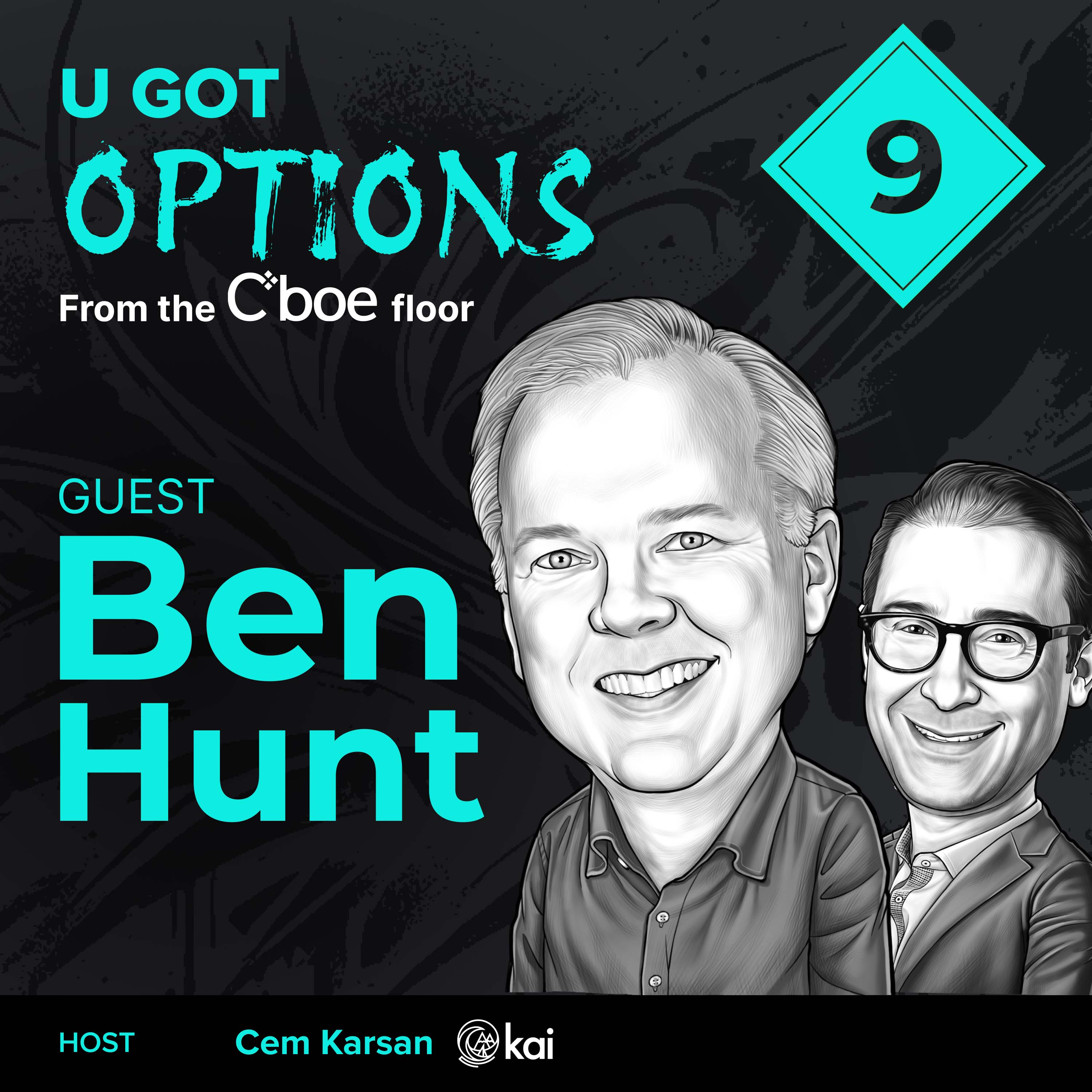
Loading summary
Transcript183 lines
- [00:04]
Introductory Announcer
You got, you got, you got your trade. You bet, you bet, you bet, you bet your money just got made convex.
- [00:12]
Podcast Host (Top Traders Unplugged Announcer)
Welcome to you Got Options, an exciting series right here on Top Traders Unplugged, hosted by none other than Jen Carson, one of the sharpest minds when it comes to understanding what's really driving market moves beneath the surface. In this series, Jen brings his deep expertise and unique perspective, honed from years of experience on the trading floor to candid conversations with some of the brightest minds in the industry. Together, they unpack the shifting tides and underlying forces that move markets and the opportunities they create. A quick reminder before we dive in, you Got Options is for informational and educational purposes only. None of the discussions you're about to hear should be considered investment advice. As always, please do your own research and consult with a professional advisor before making any investment decisions. Now, what makes this series truly special is that it's recorded right from the heart of the action on the trading floor of the cbo. That means you might catch a little background buzz. Phones ringing, traders shouting as Jem and his guests unpack real world insights in real time. We wouldn't have it any other way because this is as authentic as it gets. And with that, it's time to hear from those who live and breathe this complex corner of the markets. Here is your host, Jem Carson.
- [01:30]
Jem Carson
Hello and welcome back to youo Got Options from the CBOE floor, presented to you by Kai Media and Top Traders Unplugged. Today we talk to Ben Hunt, one of my favorite of all times. Ben is an old friend going back 10 years. We talk about the power of narratives, how important it is to play the players in the game and, and how AI and narrative are changing the game when it comes to markets. You're going to love this one.
- [01:56]
Introductory Announcer
Check it out, yo, live it up. Don't settle for less. You got options. Put your skills to the test. It's your call, time to strike, make your move, grab the mic, mic, mic. You got, you got, you got. Execute your trade. You got, you bet, you got, you got. Your money just got made. You got you facts.
- [02:20]
Jem Carson
Hey, welcome back to a little you Got Options. I have one of my favorite people, actually, we have an incredible story. We actually probably met about a decade ago.
- [02:30]
Ben Hunt
Yeah, it's been a long time. Yeah.
- [02:31]
Jem Carson
Through a good friend of ours, Brian Portnoy. He and I have a reading group, a book club that we do, which is absolutely an incredible group of guys talking about the world and how it's changing. And we were fortunate enough to have Ben Who's a good friend of Brian's as well. Popped through about a decade ago and that. What an incredible.
- [02:52]
Ben Hunt
Time flies, man. Yeah, 10 years ago. Yeah, yeah, yeah.
- [02:56]
Jem Carson
But so wonderful to get you here and kind of share those conversations here.
- [03:00]
Ben Hunt
It's great to be the rest of the world. It's great to be here.
- [03:02]
Jem Carson
Yeah.
- [03:02]
Ben Hunt
I really appreciate it.
- [03:03]
Jem Carson
A lot of people are familiar with your kind of seminal work and Epsilon theory. I mean, and if you're not, by the way, go read, subscribe.
- [03:14]
Ben Hunt
Oh, thank you.
- [03:15]
Jem Carson
I mean, some of the most insightful stuff, and he's been doing it for. When did you start epsilon theory?
- [03:20]
Ben Hunt
About 13 years ago. Crazy enough. Yeah. 14 years. Yeah, 13.
- [03:24]
Jem Carson
14 years. And I think over a hundred thousand people subscribe and read your work.
- [03:30]
Ben Hunt
Yeah, yeah, yeah. Pretty. Yeah.
- [03:32]
Jem Carson
Pretty incredible. And if you're not familiar, you know, a lot of talk about narratives, a lot of thinking about the messaging and the players in the game and how they react kind of within, within the broad story of where this world is. And, and I love the, the nudge.
- [03:52]
Ben Hunt
Right.
- [03:52]
Jem Carson
How, how, how important the nudge is in, in, in our, in our current world and political environment. But a lot of people don't know your connection to financial markets as.
- [04:02]
Ben Hunt
Yeah, yeah.
- [04:02]
Jem Carson
And.
- [04:03]
Ben Hunt
And the origin story.
- [04:04]
Jem Carson
Yeah. And. And so I'd love for you to kind of just lead us off with a little, you know, how did you get involved in markets? How did you start and how did you get involved in markets?
- [04:13]
Ben Hunt
Yeah, sure. Well, I, I mean, ultimately, I. Is because it's the biggest game in the world. And like you, I know, Jeremy, we're game players. We love that intrinsically. And I'm sure, like most of the people watching game players, poker players, you know, it's not just playing the cards, it's playing the player. And this where we are, right? It's all about playing the player more than ever, too. More than ever. And what's always been my field and my focus. We'll talk about what that has been. Right. And why it got focused on the markets is about, well, you know, playing the players in an environment like a big distributed game like markets or politics. What you're really looking at is what are the stories? What's the information flow out there? What's driving player behavior? What, what you think. You think that they think that you think, you know, and you would, you would think that'd be an infinitely recursive loop, but it's really not. It's really something that you can measure and study. So I got started in markets Late I was a political science professor of all oxymorons. But the, but the thing there was, it was at Harvard in the 80s and that was really where the scientific study of inference, which is all the rage now. You talk about Jensen Huang when he's talking about their revenues. It's about, well, there's the model training, but where the real money's from is from inference. It's from using generative AI to get to pull nuggets of information.
- [05:58]
Jem Carson
That's what that GROK purchase was recently about.
- [06:00]
Ben Hunt
Right. It's all about inference. And so I was there at the beginning and inference is getting needles out of a haystack. Where, you know, in the past most of those haystacks have been structured data. What's possible now? This has always been my feel. How do you get those needles, those pieces of information, signal out of unstructured data, out of the stuff we read, out of the things we hear, out of a transcript of this conversation, all of that. So we're very used in markets to dealing with structured data, flow data, tick data, you know, price, all of the structured data. What I'm telling you is that the real fertile ground, the undiscovered country, is applying that same level of rigor to unstructured data. And that's what I've been doing for 35 years.
- [07:00]
Jem Carson
Amazing. Absolutely amazing. So how did you start that process of doing it and where are you now?
- [07:09]
Ben Hunt
So the start of it was in, like I say, academia. Right. So some of the very early work on inference, the math is the same math we were using back then. No one's invented cold fusion when it comes to understanding patterns in unstructured data. Those patterns, by the way, you can use fancy terms for it like semantic structures and semantic search. What we're really talking about is story. We're really talking about is narrative. There's a, the meaning, the thesis, the idea. It's not sentiment. It's not. Are you using nice words or mean words? That's a mistake. There's very little signal in sentiment. Very little. There's also very little signal in what's called topic clustering. Like let's do a Google search for how many times they mentioned AI in this earnings report. There's actually very little signal in that. Interesting where there's signal because this is what drives our own decision making process is in how does, what's the story that's being told?
- [08:16]
Jem Carson
What are the logical frameworks on this?
- [08:19]
Ben Hunt
Or the, you know, I'll call it logical maybe, but, but it doesn't matter if it's logical, it matters if it rings true. Fair to you as a human.
- [08:28]
Jem Carson
I meant the word logical.
- [08:29]
Ben Hunt
It's that old Colbert.
- [08:30]
Jem Carson
I gotta be careful with semantics.
- [08:31]
Ben Hunt
Yeah, yeah, yeah, yeah, you do. You do. So it's that old Colbert saying of it. It's. It's truthy. Yeah, right. It's maybe not truth with a capital T. I have no idea what truth is with a capital T. But I can tell you when a story is truthy, when it sounds right. And that's what clicks for humans. Always has and it always will. Now, like I say, the math to understand that hasn't changed. It's very simple math. Three things have changed, though. The first is our access to the data. So right now, you know, our company, we get everything that's published in the world. Every language, every transcript, every broadcast, every blog. You name it, it's all available. You get it overnight. The other thing has changed is just computing processing power. I mean, I was, you know, coding stuff on a DEC mini frame, and that'll take some of you viewers back, and others will have no idea what I'm talking about. But you, you know, you'd code it. It wasn't quite card punch, but it wasn't far from that. And you have to wait till the next day to get the computational power that's in my iPhone today.
- [09:45]
Jem Carson
I'm dating myself, but my dad, who was a PhD structure here, used to bring me the punch cards, the punch cards I used to do like math and draw on a punch card. So it.
- [09:54]
Ben Hunt
It's really insane because the, the math we do here, it's not. It's not fancy math, right? It's a little bit different from typical math that we feel in our normal world is kind of network math. Matrices, you know, that's not important. What's important is it's not complicated. You just have to do it at massive scale because what you're trying to find out are the connections between words and ideas on just a crazy scale. And so, you know, the, the computational power that's available today. I mean, we're a small company, there are 11, 12 of us, but we've processed over 500 billion tokens just in the last couple of months. It's crazy. I mean, OpenAI sends you a little medallion for every hundred billion tokens you process. And so availability of data in a crazy degree, availability of processing power. And the third one is LLMs, because we were doing this stuff by hand, and now it's just all there that you can just Plug into the wall and use.
- [11:01]
Jem Carson
So take a step back. Obviously, the computational ability, the amount of information, data available, it makes complete sense. You don't even have to have the exact right model. Right. I mean, obviously that matters. I'm going to get to why I'm saying that, but let's go back to the models. Right. You said truthy.
- [11:20]
Ben Hunt
Right.
- [11:22]
Jem Carson
There's a lot of gray in words. There's a lot of mapping I would assume is hard. And I don't want you to give away your secret sauce by any means. No, but at the same time, conceptually, this is. But how does one take and map language and, and, and, and the, the truthiness of it and the connections, you know, you said the math hasn't changed, in a sense.
- [11:43]
Ben Hunt
Yeah.
- [11:44]
Jem Carson
Like, what are those, those core ideas? How do we conceptually think about them, at least.
- [11:50]
Ben Hunt
So the real secret to this.
- [11:51]
Jem Carson
Yeah.
- [11:52]
Ben Hunt
Is you can't ask AI to do it. Yeah, don't ask AI. You ask one of the guys around here who's, who's been trading something for 10 years. Ask you about, you know, S&P 500.
- [12:06]
Jem Carson
There's something. You have to have a sense of it. Right.
- [12:08]
Ben Hunt
You have to have a sense of what are the stories in your experience. What are the stories, what are the ideas, the themes, they come and they go. But you know all the stories because you've lived this for a long time. So that's where you start.
- [12:25]
Jem Carson
How do you do that mathematically? Again, I'm not asking you to give up your secret sauce on how you do this, but, like, just, I want a better conceptually understand it where, what are the starting points of, of mapping language.
- [12:36]
Ben Hunt
And, and the first step is understanding that you're trying to get at meaning. You're trying to get at the idea. Yeah. I'll give you an example. Yeah. Right. So a story that I'd like to track, and we track thousands of these, is I'm bullish on financial services. Right. There's that story. Now, that's a story. There are a thousand different ways to say I'm bullish on financial services. And there are a couple of dozen of reasons why you might be bullish on it. And those reasons, they'll be duplicated. It's the same story. There are a finite number of scripts for saying, I'm bullish on financial services. I'm bullish on this company. I'm bullish on consumer discretionary. I'm bullish on, you know, boons, whatever. The thing is, there are a finite number of ways to Say that at it to communicate that meaning of bullishness. Now what we used to do is we would try to deterministically construct all those different ways you could say bullishness. And it ends up being this vast model, language model. And it's actually pretty good at then going through everything that's published in the world and saying, oh, here's a hit for that. And you track how these stories are waxing and waning over time. The problem with that though is that there are more ways to say, to connote that meaning than I could figure out or you could figure out by writing something down. And that's why these language models are so powerful, because they have a probabilistic embeddings, the probability of any word or group of words of being associated with what we're talking about.
- [14:47]
Jem Carson
You get all the grays as well.
- [14:49]
Ben Hunt
Basically you get all the grays. So you cast a much wider net and actually the net is actually a much better net than something you construct yourself.
- [14:58]
Jem Carson
Just like options are.
- [14:59]
Ben Hunt
Right. So what it allows you to do is, is it lets you use LLMs as an operating system. And I, and I can't tell the viewers how important it is not to ask open ended questions of AI because they'll give you an answer, but the answer is going to be they're going to tell you what basically what you think you want to hear. Right? What you must do is you must. It's called context engineering. And this was true 30 years ago and it's true today. You have to think of AI LLMs as an operating system and you have to not just dole out little bits at a time what it's reading and looking at. You have to do all that indexing and stuff yourself. The most important thing is you have to tell it what it's allowed to think about. So you only let it think about those stories that you want it to look at. And if you do that. And then there are other steps too. Sure. It's an amazing tool for not just getting at word choice, not just getting at like Google Search, how many times do they talk about this? But really getting at the heart of this bullishness story. When did it start, how's it peaked, how's it changing and what's. And where is it going?
- [16:36]
Jem Carson
So we had breakfast before we sat down today and one of the things you mentioned when we were talking before was that, you know, you used to manage money in several different hedge funds and use some of these tools, you've returned money. And the reason Largely is because these models are so powerful and useful in so many places across not just markets, really is this concept that you started with, it's just playing the players, the game theory piece. In every decision we're making, so much of our decision is not just what are the just mathematical odds of things happening, is what is the other person thinking? And how does that change the probabilities?
- [17:16]
Ben Hunt
Yeah.
- [17:16]
Jem Carson
Or what is the other party doing? So speak a little bit about the other types of things that you're doing and how this fits into broad decision making, and then we can come back to.
- [17:24]
Ben Hunt
Well, and this is if I've got one piece of advice for all the people. You know, kind of starting out with managing money. Right. Is in what you're doing. And you'll know if, if, if. If how you're managing money isn't working, you should give the money back before you start losing money. Yeah. Because, I mean, our business is like, I'm a big Godfather fan. Right. So. So in. In Godfather 2, you know, that is this great line is, you know, you know, he always made money for his partner.
- [17:58]
Jem Carson
Yeah.
- [17:58]
Ben Hunt
You got to say it in the voice. But that's when you're managing other people's money, A, that has to be your only focus, and B, you just. You always have to make money through partners. So the hedge fund we had, the first time I gave money back, it was a lot of money. It was a little over a billion dollars. Right. Long, short equity. We've been running it for about eight years. Did great in 05, 06, 07, and we had a great year in 08. Great year in 08. That's when money came flowing in. But In March of 09, when the Fed moved to forward guidance and intervention, it's like you. You flip the switch in our returns. Right. And we were, you know, longshore equity value with a catalyst, kind of all these kind of typical things. Right. But even then, I was really focused on stories. And what changed was that the stories we had about fundamentals didn't matter anymore. It didn't matter anymore. It was the story that the central banks were telling. It was the influx of CEOs who tell a story, tell the right kind of narrative about their company, didn't matter what reality was. So our returns flatlined. We never lost money for our clients, but I could tell, you know, what we were doing, it just wasn't working. So we gave all the money back in 2012. And that's when I started writing Epsilon Theory about figuring out, well, how do you Manage other people's money when the fundamentals don't matter, when it's not reality and your knowledge of reality, but it's about how is reality being presented. Yeah, the perception of reality. So that took me back to my. All my academic days, the software company I'd started, and that's when I started writing Epsilon theory was about this. How do we understand the structure of unstructured data? How do we understand stories and the stories of markets? So that's been this effort, you know, since then to. To figure that shit out. And we made some real advances in 2020. We made some more advances in 2022 and thought, oh man, you know, we should, you know, get the gang back together again and put together a fund to trade on this. And so we did. I mean, it. We started off with a couple hundred million and it's a good thing. Performance was. Was good. But then we had another big advance in the technology. And at that point, it was. The technology here is so.
- [20:50]
Jem Carson
Touches everything.
- [20:51]
Ben Hunt
It touches everything and it's so powerful. It's like you invented the microscope to really see at a high degree of magnification these invisible things, these stories that we know are really important, but are invisible. Yeah. So we gave all that money back again so we could really focus on the technology. And that's what we're doing now. Yeah.
- [21:15]
Jem Carson
So cool. Couple different stories. What are the types of things? If you're at liberty to talk about it, sure. What other, what are the types of things are you using this in? Just to kind of paint a rounded picture of a real life kind of application other than market.
- [21:30]
Ben Hunt
Oh, well, I mean, like, we just, we just signed a deal with a Major League Baseball team. So the MLB draft is coming up, and again, there's this old notion of, you know, you don't just play the cards, you play the players. And so what we can pick up is what are the draft tendencies of this team? What are the draft tendencies of every other team? So that when this MLB team is doing the draft and they know that, you know, different rounds of the draft, you got three teams ahead of you, you know what their tendencies are. Right. And then it. Anyway, we're really excited about it. I think it can totally change the game. Yeah.
- [22:13]
Jem Carson
Especially when you have that many participants with more each having probably distinct personalities. That's like a perfect application.
- [22:20]
Ben Hunt
So working with a Defense Department group for looking at. And this is my political science patent from way back when. Right. Which is looking at domestic media and other countries as they're trying to Tell the story to get there, to drum up popular support for either police action at home or for aggressive action otherwise. So like we ran this on Russian domestic media before the Ukraine invasion, wrote about it on Epsilon theory. Because when you look at the. Again, the stories they were telling in Russian domestic media to their own people, forget about what they're saying internationally. That's not it. You need to look at what they're telling their own people. And the stories they're telling was about the threat of NATO, how Ukraine was this front. How in our conclusion was, this isn't a feint, this isn't a limited anything. They're going in full force and were able to write about that before they actually did. It's those kind of things we're able to do for marketing.
- [23:25]
Jem Carson
I remember reading about that at the time. Amazing. Yeah. So on that note, now let's take. You have this political science background.
- [23:38]
Ben Hunt
Yeah.
- [23:38]
Jem Carson
You have this incredible tool that you've kind of developed and this way of thinking about decision making and how you can use that to your benefit.
- [23:45]
Ben Hunt
Right.
- [23:47]
Jem Carson
What are the big narratives that are going on now? And all facets of kind of.
- [23:53]
Ben Hunt
I'll give you two. Yeah, I'll get, I'll give you two. And one important thing to know is that the stories we tell, you know, I'm going to talk about markets. There are three kind of big categories of stories that we tell. The first story that we tell is what is what's happening now, right. The Fed is hawkish, let's say that could, that could be a story. Another type of story is, well, what happened in the past, which is actually kind of interesting because oftentimes we kind of retcon the past to tell you something about the current future. And so there's a set of stories that'll be about, well, the Fed was dovish in the past because XYZ and those can be interesting, right? Because they're. When we're kind of changing the way like say retconning the past, that can be interesting. But I think the most interesting ones, and you see these a lot in markets because markets are forward looking creatures. What do we expect the Fed or whoever to be, Right. What are the expectations? There are stories about what's coming down the pike and it's those, I'll call them forward looking stories. It's like, I don't know, we have the PMI survey, right. Where they ask the purchasing managers what are the current conditions and what are your expectations of future conditions. Right. It's those expectations that get the most play and have the most impact because that's how markets work, right? So what I will tell you is that right now, in the description of what is with the American consumer, it's as bad, I'll say negative sentiment to use that word, as we've ever measured. And for all of this, we've got 10, 12, 15 years of data going back here off the charts for the consumer is afraid to spend household credit over overextended. These are stories that you would get in, not necessarily just in financial media, but just in general media about what is the current experience of the US Consumer. Okay, Right. Now contrast that with the stories you get in financial media about expectations of consumer spending.
- [26:28]
Jem Carson
But the future expectations are right.
- [26:30]
Ben Hunt
We're crazy positive. I mean, I mean the stories, the volume and that's the way to think of it. It's not like I say, it's not word search, right? It's the story that the US consumer is going to rebound, spend more. There's a bottom formed, all these different ways of saying it. The density of these stories is off the chart. You haven't seen this density of stories saying loud story, the loudness, the volume of stories saying consumer spending is going to surprise to the upside. You haven't seen this volume of stories since a we were coming out of COVID and So it's like 2021 since you've seen this level of a volume for these stories. At the same time, even though the stories about what is the consumer being really weak are very loud, stories of we expect the consumer to be weak are incredibly low and soft. That's why. Right. So, so look at a chart of, I don't know, I'll pull up, say, so you know, the dollar. So you know, dollar tree, dollar general, those stocks have killed it this year. Subprime finance companies this year. They've, you know, year to date, these guys are up, you know, 10, 15%. Right? Easy. Yeah, easy, easy. Because expectations are, it's going to be great. Now I'm a long volatility guy at heart, you know, and so when I look at this, my take is the market has gotten ahead of itself in its expectations and that the, the asymmetric risk reward is actually that there can be a news event either a scheduled macro event, earnings event where we go, oh crap, you know, the consumer is not rebounding the way we've gotten so bulled up about it. Right. The market has gotten incredibly bulled up on consumer spending going into Q1. My personal sense, and this isn't for my personal sense is the consumer is actually really weak. Certainly the bottom slice of the K shaped economy is. Maybe that doesn't matter, maybe I'm wrong. But we're all familiar with what these stories are about to bull us up on consumer spending refunds. The tariffs are going to be reversed. You know, just tune in, you'll hear those stories.
- [29:08]
Jem Carson
And so just a signal. Now does the, does the market, let's say the news conflicts with that current story and now moves that story.
- [29:22]
Ben Hunt
Right. You'll see it roll over.
- [29:23]
Jem Carson
To see it roll over.
- [29:24]
Ben Hunt
We see. So we see the expectation story roll over and it has not. Right. So this expectation story has been going.
- [29:31]
Jem Carson
Straight to Betsy before it rolls over or do you wait for the signal that it's rolling over?
- [29:36]
Ben Hunt
That's the thing. I'm not going to put this on because I'm not going to get in front of this. Right. Because you don't have to. Because I don't have to. This can run. So there's got to be. This is why I've always wanted to think and talk about pairing this with options. Options where you've got an opinion on timing, you've got an opinion on timing and you've got these scheduled events where maybe the news happens, maybe it doesn't. You know how the news is being priced. What I'm telling you is the story's being overpriced.
- [30:07]
Jem Carson
You know where the likely convex outcomes could be. You can highlight that.
- [30:12]
Ben Hunt
That's it.
- [30:12]
Jem Carson
Right?
- [30:13]
Ben Hunt
That's it.
- [30:13]
Jem Carson
And then you can, you can kind of take a. Yeah, a small, a high impact, kind of low risk.
- [30:22]
Ben Hunt
But I'm sure as hell I'm not going to set it up until I still see the story start to roll over.
- [30:26]
Jem Carson
Interesting. Yeah, that's what I would think. That makes sense. Very interesting. So that's on a maybe more micro level. Actually let me add one more question here on the micro level before we get to a bigger macro conversation as well. Tied to that.
- [30:36]
Ben Hunt
I got one for you on that too.
- [30:37]
Jem Carson
I loved, I, that's, that's the fun. So I just talked to Neil Howard, so. Oh yeah, Neil's great. Yeah, we're, we're all friends, so. But on any, any signal on things like inflation and other broader macro, I mean, you're talking about growth and demand, which is important obviously. But obviously in this world, you know, interest rates and inflation, bigger kind of macro signal, other things like that that you're seeing or thinking about.
- [31:01]
Ben Hunt
Oh yeah, so. So I think one of the real values of what we do is that we show the volume of the story on both sides of a coin usually. And we're all, we're all human like this. Like you've maybe you've got a view on inflation. I've got a view. And so when I'm listening to the news, I'm keen to hear when people are agreeing with me. Right. And I'll say, oh, everybody's talking, you know, everybody's agreeing with me. I get excited, I get, I get bowled up because I get the confirmation and I don't pay attention to the volume of the story on the other side. So for a lot of issues AI CapEx built there's enormous volume on both sides of that coin that, oh my God, this is a bubble that's going to burst or nothing stops this train. Right. There's enormous volume on both sides of that.
- [31:59]
Jem Carson
Interesting.
- [31:59]
Ben Hunt
Right. Which honestly, when there's a lot of volume, story volume on both sides, I don't think there's a lot to be done with it.
- [32:06]
Jem Carson
Sure, yeah, it makes sense.
- [32:07]
Ben Hunt
But it does tell you that's what the market cares about. So if you have your own information, your own view on it, the market cares, bring you back to inflation, bring you back to recession. Market doesn't care about either of those topics. Right. The level of volume on both sides of that coin, both sides of the inflation coin, both sides of the recession coin is way below average.
- [32:36]
Jem Carson
So by volume. Right. Because it's going to do one or the other and people are going to be surprised is going to work or.
- [32:45]
Ben Hunt
Right. By Vol. When the story starts to turn.
- [32:48]
Jem Carson
Starts to turn. That's right. That's the signal on that.
- [32:50]
Ben Hunt
Because, because stories can be dormant and muted for a long time. Because it's. Because nobody cares. Nobody cares. What you're looking for are the inflection points on the story. That's super interesting.
- [33:03]
Jem Carson
Yeah. Because you can use it for direction, but you can also use it for distribution.
- [33:09]
Ben Hunt
Right. Yeah, exactly. So, so the, the, the, the easiest use of what we do is look for a story that's dormant. Yeah. That you think and be prepared and be watching for it. And when the dormant story starts to.
- [33:25]
Jem Carson
Get undormant, then get involved, then you.
- [33:27]
Ben Hunt
Get involved because it hasn't been discovered yet. Right. And that, that's where you make your easy returns. When the market discovers a story, the we can say oh yeah, that's a problem.
- [33:38]
Jem Carson
Oh yeah. Just a little tick in whether it's in dormancy or whether it's conflict to signal. And that's really the key and it's going to see that you really cheap.
- [33:46]
Ben Hunt
Yeah. On volume terms because it's been dormant for so long.
- [33:49]
Jem Carson
Incredible.
- [33:50]
Ben Hunt
I love it. I love it.
- [33:51]
Jem Carson
So let's shift to kind of a bigger. Now let's use the same tools and the same lens and stock talk a little bit bigger picture. So politics and things that aren't just.
- [34:01]
Ben Hunt
Markets that will affect markets, but.
- [34:04]
Jem Carson
Global conflicts. What is the administration doing? What is it? What does the people think it's doing versus maybe what it is. Do you have any thoughts or any signal on.
- [34:13]
Ben Hunt
Yeah, I want to give you one specifically. And again, not sure when this going to air.
- [34:17]
Jem Carson
Yeah.
- [34:18]
Ben Hunt
Right.
- [34:18]
Jem Carson
Which I love.
- [34:19]
Ben Hunt
But right now, as we're talking, you're in the middle of the Greenland thing. Right. And there. There's an article yesterday about a small Danish fund getting rid of its Treasuries. Today there's an article about a somewhat larger Swedish pension fund saying, we're out. Yep. Yep. So it's this, I'll call it. It's the Sell America trade. Right. Which was a prominent narrative after Liberation Day, after April of last year, what we're seeing. So we've. We've got a whole set. We call them. We call them semantic signatures, which is. Sounds complicated, but what we mean is it's a story, it's an idea, it's a theme. There are lots of ways to think about Sell America. There's. Is it foreign central banks looking for alternatives to U.S. treasuries? Right. That's one. Is it foreign asset owners pulling money out of US equity markets? Right. Is it US asset owners moving assets abroad? So what we've seen just in the last week is an enormous spike in all of these repatriation narratives. It's not where it was for April, but it is growing with a bullet, with an absolute bullet. And the really interesting part of this is that, look, it's the thing, I'd argue that has driven us home. BIAs and US outperformance for the last whatever, 15 years has been inflow of capital to US markets in every way. You want to express that that tide is changing Now. This is a melting iceberg, Right. This is not an, oh, my God, overnight thing. But like any melting iceberg, this is important. This can go on for a long time. That is absolutely happening. Foreign asset owners moving money back home. Yep, that's happening again. Where it becomes a crisis is if US money managers start moving money out of the us. You never saw that narrative start in April and May and June of last year. That narrative stayed Dormant. Even though you had these big spikes in foreign central banks doing this, foreign asset owners doing that, US home bias, you know, is being questioned. US losing dollar dominance as a, you know, as the reserve currency. All those stories spiked, but the US asset owner leaving never really even budged. That story is starting to move now. It's not at a, anywhere near kind of alarm bells yet. But, you know, I was mentioning about a long dormant story that's starting to pick up. This is a story I don't know that we've seen in 30 years, and it's starting to pick up.
- [37:49]
Jem Carson
Well, the incredibly important part about how you can fit this in when we're talking macro or something big like this too, is the reflexivity of it. Right? Because if people lay out, and that creates a belief more broadly, like for example, in a big picture that maybe the currency is overvalued or that the exorbitant privilege of the dollar, the Fed's losing control, that can lead reflexively to those outcomes.
- [38:18]
Ben Hunt
So I'm often asked, do narratives drive price or does price drive narrative?
- [38:24]
Jem Carson
Both.
- [38:24]
Ben Hunt
And the answer is yes. The answer is yes. The answer is yes. So what you're describing is exactly what gives story narrative a momentum quality to it, however, because there is all this orthogonal stuff happening and it has a dynamic of its own. The momentum quality of story is, you know, $10 word alert orthogonal to the momentum aspect of Kaise. Right. And that's pretty freaking cool.
- [39:02]
Jem Carson
That is cool. And it's super interesting how it goes on for a long time when that narrative is right, but when it starts to turn, it can be a dramatic kind of move. And again, great place to use options.
- [39:18]
Ben Hunt
Right.
- [39:18]
Jem Carson
Great time and way to phenomenal it is.
- [39:21]
Ben Hunt
I mean, I say this has always been my dream is to try to, you know, share this with people who know, who have forgotten more about options than I will ever know. Right. But. But that is exactly the opportunity. And there are the dynamic of when what I'll call it, so there's a name for it, it's called common knowledge. And Keynes wrote about this back in the 30s is at the heart of his newspaper beauty contest. And you know, it's not what you know, it's not what you think, it's not even what you think that other people think. It's what we all think that we all think. That's what common knowledge is. And that's what drives the outcome of newspaper beauty contests, which are markets. So the dynamic of that is you're looking for these common knowledge moments, which is A variation of the Emperor has no clothes. So easy example was Biden's debate performance. That was a common knowledge moment where we all saw what we all saw, right? And there's no amount of, you know, the party functionary saying, oh no, he's actually quite sharp when you get it. But no, we all saw it. We all saw with our own eyes.
- [40:40]
Jem Carson
We just didn't know if everybody else saw it or if that was the comment.
- [40:42]
Ben Hunt
But because it was, we know that everybody was watching. That's what becomes a common knowledge human. So you can measure that, you can measure the half life of stories and whether they begin to be amplified through a common knowledge effect. That's exactly what we do.
- [41:03]
Jem Carson
And no bigger common knowledge problem or thing than the US Federal Reserve is dominant and is exorbitant privilege of the US dollar. So that of all things to be watching, a shift in that obviously the.
- [41:17]
Ben Hunt
Idea of fiscal dominance, again, these are other narratives that we track. It's hugely important. Mostly it's hugely important because all of your models that you've got, and a lot of people have got, I'll call them linguistic models. They're basically looking at a Fed statement to see if this word changed or that word changed or what happened to the dot plots, right? If, if fiscal dominance is what matters, then the efficacy of those models you've built on dot plots and Fed statements, they're much less impactful. They won't work the way you thought they would work.
- [41:53]
Jem Carson
100%. Just read Arthur Burns.
- [41:54]
Ben Hunt
Yeah, exactly, right.
- [41:55]
Jem Carson
I couldn't agree more. And that is, by the way, a story we've been talking about for a while. But that hasn't been central narrative. And I am, even though I don't use your models, there is a lot more tuning into that and you're seeing it work.
- [42:09]
Ben Hunt
Importantly, again, this is what I meant about how traders, right, immediately get what I'm, I'm at. Because you are immersed in news flow all the time, right? And you may have your own view of things, I'm sure you do, but what you know is that your view doesn't really matter.
- [42:26]
Jem Carson
Doesn't matter till right until the rest.
- [42:30]
Ben Hunt
Of the world comes around to it.
- [42:32]
Jem Carson
I guess to kind of put a bow on this. Obviously, you know, game theory and playing the players is critical. Probabilities are not just what you think in a kind of blank slate world based on the numbers you see is happening. It's also a matter of what others think and how they might move in their sentiment. Like you talked about, if we start Deploying that, using options, as we talked about, is an incredible way to take something that is not conventional wisdom that may start to turn and may see an incredible shift like you're getting signal that's a vulnerable sentiment, maybe that's churning so incredibly powerful in that sense. But how do you locate what those items are? Is that all qualitative? Is that all like just a sense of what's important? You know, how do you, how do you know what to look at and what opinions matter the most and where are the things that might be driving the next sentiment?
- [43:38]
Ben Hunt
So the way to use this, the way to use this, and this is why we said, you know, we're not going to do a little hedge fund on this. We want to make the data available, right, to everyone involved in the excavate. Because I think I know, I think I, I think I've got a good view of what's important with, I'll call it AI technology. Like I've been doing this for 35 years. I think I actually have deep substantive knowledge of this area. I also think I've got deep substantive knowledge of the companies and the, the trading dynamics, at least in equity world. So that's been my, my field. I, I don't know a damn thing about fx, right? I don't know a damn thing about consumer discretionary, right? I don't know, I don't know a damn thing about so much. Right? The way to use this is what do you really know? What do you really know? And that that could be flow data. That could be. I know, I know structured data. I know market dynamics of this particular trade. It could be, oh, I know the fundamentals of this space really well. And way to use this is to figure out when does my substantive knowledge, my deep knowledge, when does it freaking matter?
- [45:01]
Jem Carson
And you just set off like a big light bulb in my head as you're talking and I guess you're going to find this something interesting and I think the listener will as well. I've talked about before. Have you look at historic data when we see period broadly like we're seeing now, right, like the 60s and 70s or maybe like the 30s, 40s in a sense where there's less control from Federal Reserve and dominance in a sense of, of one entity who has pure power or a more kind of placid time with less kind of conflict. I get into why one kind of similar there. But when you enter these periods, you have a dramatic departure in how things move. Regime change truly is a dramatic change in the distribution of not just one thing, but of everything in these periods, I'll give the 60s and 70s as the most near kind of example. We see incredible FX movement. You mentioned fx. Obviously interest rate volatility and distribution go through the roof. Precious metals, things like that, commodities, while they start to move in ways that are completely different.
- [46:15]
Ben Hunt
Right.
- [46:16]
Jem Carson
But equities themselves, you would think, oh, those would be more volatile in some strange ways become less volatile. Nominal assets, you know, in that sense that are have a push pull become less volatile on. There's certain assets that dramatically change their distributional. It's not just everything that becomes more volatile.
- [46:35]
Ben Hunt
And can I tell you why that is? Sure. The, the reason why that is, and you put your finger on it, you say there's a regime change. Correct. Right. So when you move towards. You want to call it multipolar, when you call it more independent policy. There is. After the great financial crisis, there was no difference between central bank policy and the. In the developed world, they were all singing from the same hymnal, the same choir book. Right. There was no difference to make money in an asset, whether it's fx, whether it's. Don't fight the rates. Rates and FX are the two best example of this. You need difference, you need difference between national policies. Today we have that difference because as you put it, the regime has changed.
- [47:25]
Jem Carson
Put it another way, I completely agree. We're in a room and there's one giant strong person with all the weapons piece to control.
- [47:35]
Ben Hunt
Exactly.
- [47:36]
Jem Carson
But the second there starts to be for any reason, a lock, lack of control. I'm not saying that person is not powerful anymore, but there are others. It becomes a multipolar much more. You don't go from just, you know, slightly volatile to more volatile or whatever. You have a complete. The dimensions of volatility go from 2 to infinite.
- [48:03]
Ben Hunt
Global macro is trading rates and FX. That's what it is. That's global macro. Right. And to make money with that, it only requires difference. And that's what we've got today.
- [48:16]
Jem Carson
And so critically now, tying this into what you're talking about, not to go off on a tangent, the more untethered markets may be to a certain kind of fixed system with certain fixed rules, the more narrative is going to matter, the more because we don't know a change, it's easy to see hurting. And because there's less constraint, the possibilities are greater, I would think.
- [48:44]
Ben Hunt
I don't know.
- [48:44]
Jem Carson
Do you agree with that or do you.
- [48:46]
Ben Hunt
Oh no. So there have been three structural changes that have that cement the role of Narrative telling and the efficacy of narrative telling in our lives. Right. So the first one is there's a structural change in the way news is delivered to 24 7. You see it here, the financial. And I'm using air quotes here, the financial news channels. I'm using air quotes because there's. There's not enough hard news to fill the time. So on all of the financial news stations, the time is filled by people presenting story, by people giving their opinion. Right? That's what fills the time. So that's. That's structural change number one. Structural change number two is these little things we carry around with ourselves all the time. A little dopamine machine. We immerse ourselves in constant messaging. Right? We do it to ourselves. We give ourselves over to the constant messaging. Third, structural change. And it really was the GFC that did this, where central bankers said, we're going to start using our words for effect, not for what we really think. Not that we're lying, but we're using them intentionally to try to change investor behavior. And the enormous success of that was picked up by every CEO. Today's CEO. You're not being evaluated on, can I get an additional turn of operating leverage or, you know, what's my capacity utilization? In the Des Moines factory, It's, can I tell a story that gets a multiple?
- [50:38]
Jem Carson
That's right.
- [50:38]
Ben Hunt
Right. Because multiple is Elon Musk is the wealthiest man in the world. Absolutely. It doesn't matter what Tesla's deliveries were. It doesn't matter. It matters is can he tell a story about robots in space 20 years from now?
- [50:54]
Jem Carson
I couldn't agree more. I think that's so true.
- [50:57]
Ben Hunt
So all of this stuff cements the role in. Of narrative in our lives. We've done it to ourselves. It's embedded in the structure of our technology and our media systems. And it works.
- [51:15]
Jem Carson
All right, the last piece here, which I think is we talk about playing the players, but now what about playing the system that plays the players as we grow? Right? Because we talk about reflexivity. AI is going to become omnipresent at some point who are on the cutting edge, on the front edge of something that I think will is transformational and critical. It's a huge part of the power of AI, is bringing it. I often talk about this concept of knowledge is volume dampening. Right. The more we learn and the better that we get at doing these things, the more reflexively it reverses the outcomes. Obviously, that that is it.
- [51:55]
Ben Hunt
Is it knowledge is volume dampening or the spread of knowledge is volume Dampening.
- [51:59]
Jem Carson
Well, yeah. I mean universal. Not, not a single person.
- [52:02]
Ben Hunt
Right, right. Because private information. Right. Yeah, yeah.
- [52:06]
Jem Carson
Semantics about it.
- [52:06]
Ben Hunt
Yeah, yeah, yeah, yeah, yeah, yeah.
- [52:08]
Jem Carson
But 100. So, and so my, my next question is kind of a two part question would be one, how do you think AI and narrative are going to begin to. I mean I know how you can use it now, but how is it more universally going to be shape how we are, how markets trade and, and, and, and that you could talk about it in time frames, like in your mind, like.
- [52:33]
Ben Hunt
Sure.
- [52:33]
Jem Carson
The next one, two, five years, the next 10 years, next 20 years. What is your thought? I mean.
- [52:37]
Ben Hunt
Yeah. Who knows? Yeah, yeah.
- [52:39]
Jem Carson
Well, if anybody would have a sense.
- [52:41]
Ben Hunt
In front of you. I mean one enormous dynamic is what all the pod shops are doing. Right. There's trying to delete to. You know, it's this idea of agentics. Right. You're trying to create an AI agent that can replace your consumer discretionary pod. You know, so, you know, Izzy and Blaine, that whole crew, right. I mean what they would love to do is replace their very expensive people with AI agents that would do the same thing. Sure. Everyone involved in this space of AI and markets has been gunning for that. Yeah. And we're still a million miles from you. Yeah, we're still a million freaking miles from you. And my.
- [53:27]
Jem Carson
And the narrative is as much closer than people think, which probably should be a.
- [53:32]
Ben Hunt
Well, and that's the other side. So. So the way that AI is being used very effectively today is for AI slop. Right. It's for the generation of content and stories to magnify the nudge that we would get from a political party, that we would get from a corporation, that we'd get from a central bank. That's totally happening now. Now, personally, for what we do, I don't care. Right. Because I often get that question. Well, is the story that you're picking up on, is it. Right. And I said I don't know and I don't care. Right. Because I. That's your job. Right. Honestly, to have that view of what reality actually is. All I can tell you is how reality is being presented. And the two trends we see are a, there's been a fragmentation of storytelling, meaning there are a lot of discrete stories that are being told in markets all the time, but the firepower behind those stories has grown significantly. So I don't see any spread of knowledge. What I see is the spread of truthiness of stories that sound accurate. Right.
- [55:01]
Jem Carson
So say people out there who realize the power of this, that are then trying to like move the sentence, not sentiment but the story. Yeah.
- [55:11]
Ben Hunt
And look, and we track this stuff too. We published a couple of pieces differentiates. So I mean you can basically you're tracking like patient zero. And the easiest place to track this is on some of the Reddit in the subreddit boards where you can actually trace where it started. And the way it works is you'll get somebody with a position and you can. I call it snowballs. Right. You start like a dozen different snowballs at the top of a hill in hopes that one of them picks up traction and starts being organically amplified. So it becomes an avalanche because you're positioned to profit from the avalanche. That's when you, that's when you. That's the rug point.
- [55:54]
Jem Carson
The new form of activist investing. In a sense it is like in.
- [55:58]
Ben Hunt
The same way that the job of any S&P 500 CEO is to tell a story that generates a multiple activists and you know, it's the names we.
- [56:10]
Introductory Announcer
Know.
- [56:13]
Ben Hunt
Around the meme stocks we know the whole game is to start that snowball rolling down the hill. That's how you make your money with activist conversion. You can track them.
- [56:24]
Jem Carson
Do you have clients that don't need names but that, that, that don't just use it in the original way we're talking about, but really to find out where there's vulnerability and that where they can actually themselves drive stories to, to create better outcomes for themselves. Because I would think that's also a place where this ultimately goes. Right?
- [56:43]
Ben Hunt
Not. Not in markets. Yeah, right, not in markets.
- [56:47]
Jem Carson
But politically it also applies to politics. Right?
- [56:52]
Ben Hunt
It applies a million percent politics. Where, where we've had some conversations let's say has been within consumer brands because brand awareness and brand creation, the original nudge, right. It's all story. It's all nudge. And, and to date it hasn't been. Although you could do it say where is fertile ground for creating a brand that applies to this rising self perception of identity of a consumer graphic as a consumer demographic. Where we see it now mostly is with some. How's my brand working? Because I saw a story about your marketing dollars. You know, you know, half of it is wasted. You just don't know which half. Right. And so you're actually, we're actually able to track what do these ideas that you're trying to drive into markets actually getting traction.
- [57:54]
Jem Carson
Well one thing's for clear, incredibly powerful stuff whether in markets or otherwise. And, and, and also I mean it's just fun. Oh it's definitely fun. I, I, we could talk for hours. I'm sure we will again. But, but wow. What, what incredible powerful stuff and, and, and a brave new world. I will say I think you know, for we talked 10 years ago at that TRP. I can only imagine what 10 years from now, given the advancements, you know what those conversations will be like.
- [58:21]
Ben Hunt
Look, my hope, my strongest hope is that we get decentralized distributed AI. We need open source AI in the worst. I mean open source AI just means that the weights are and you can run it on a local machine. Right? That's going to tell the tale.
- [58:40]
Jem Carson
Yeah. The risk is that we get centralized control AI, especially with these types of tools and this ability to nudge exactly right. Analytical way.
- [58:50]
Ben Hunt
Exactly right.
- [58:51]
Jem Carson
Ben, thank you so much for sitting down with me. What an incredible conversation.
- [58:55]
Ben Hunt
Thanks for having me. Yeah, thanks for having me.
- [58:56]
Jem Carson
And hopefully we'll do it again in a year or two.
- [58:58]
Ben Hunt
I'd love that. All right.
- [59:05]
Podcast Host (Top Traders Unplugged Announcer)
Thanks for listening to Top Traders Unplugged. If you feel you learned something of value from today's episode, the best way to stay updated is to go on over to your favorite podcast platform and follow the show so that you'll be sure to get all the new episodes as they're released. We have some amazing guests lined up for you, and to ensure our show continues to grow, please leave us an honest rating and review. It only takes a minute and it's the best way to show us you love the the podcast. We'll see you next time on Top Traders Unplugged. But before we go, we just need to remind you that this podcast expresses the view of Kynexis LLC and the guests appearing on the podcast as of the date of its recording, and such views are subject to change without notice. Kynaxis LLC and Top Traders Unplugged do not have any duty or obligation to update the information contained herein. Furthermore, Kynexis, LLC and Top Traders Unplugged make no representation to its accuracy and it shall not be assumed that past investment performance performance as an indication of future results. Moreover, wherever there is a potential for profit, there is also the possibility of loss. This content is made available for educational purposes only and should not be used for any other purpose. The information contained in this podcast does not constitute and should not be construed as investment advice or an offering of advisory services, or an offer to sell or a solicitation to buy any securities or related financial instruments in any jurisdiction. Certain information contained herein concerning economic trends, performance and other data is based on or derived from information provided by independent third party sources. Kynexis LLC and Top Traders Unplugged may believe that the sources from which such information are obtained are reliable. However, each of Kynexis, LLC and Top Traders Unplugged cannot guarantee the accuracy of such information and has not independently verified the accuracy or completeness of such information or the assumptions on which such information is based. This podcast, including the information contained herein, may not be reproduced, copied, republished or posted in whole or in part in any form, without the prior written consent of Kyle Nexus LLC and Top Traders Unplugged.