Loading summary
Transcript572 lines
- [00:01]
Daniel Tosh
This episode of Tosh show is brought to you by Progressive Insurance. Do you ever think about switching insurance companies to see if you could save some cash? Progressive makes it easy to see if you could save when you bundle your home and auto policies. Try it@progressive.com Progressive Casualty Insurance Company and affiliates. Potential savings will vary. Not available in all states.
- [00:30]
T-Mobile Announcer
Introducing Family Freedom from T Mobile. We'll pay off four phones up to $3200 and give you four free phones all on America's largest 5G network. Visit your local T Mobile location or learn more@t mobile.com familyfreedom. Up to $800 per line via virtual prepaid card. Typically takes 15 days. Free phones via 24 monthly bill credits with finance agreement eg Apple iPhone 16128 gigabyte $829.99 eligible trade in eg iPhone 11 Pro for well qualified credits end and balance due. If you pay off earlier, cancel contact T Mobile.
- [00:59]
Daniel Tosh
Hey guys, it's me, Daniel. Do me a solid. I don't ask for a lot, but like and subscribe to this podcast also you could rate it highly. I would appreciate, maybe even write a review. Maybe we become best friends. Here's a. You're not gonna know the answer to this and it's just so juvenile, but I believe I've had a mental theory for a long time that birds try to on people.
- [01:25]
Adam (Professional Falconer)
Why did you insist that I wouldn't know the answer to that?
- [01:29]
Daniel Tosh
Tosh show. Posh show. Tosh show for show. Hey guys, it's me, Daniel Tosh and welcome to Eating Chicken Fingers.
- [01:42]
Eddie
Chicken Fingers Eatin Time.
- [01:44]
Daniel Tosh
It's the only podcast where I invite guests on and we eat mild chicken fingers.
- [01:50]
Eddie
Maybe not even sauces to dip them in.
- [01:52]
Adam (Professional Falconer)
No.
- [01:54]
Daniel Tosh
And we just see how long until they break. Oh man, it is good to be here. Back in Malibu, where'd you go? I'll tell you where I went, Eddie. I left the comforts of Malibu and headed up to Solvang. Now, I don't know if you've ever been to Solvang or if you've ever heard of Solvang before, but if you're new to this podcast, you're gonna need to know I love California. And. And there's just all these places in California that are so ridiculous but completely different and bonkers from other places. Now, Solvang is a. What is it? It's a Danish community. You know, it's just the most quaint little town you've ever been in. There was a cuckoo clock store Big sign in the cuckoo clock store to not take any photos. Like, I'm going to take a photo. I took a photo. I also asked the lady that worked there. I was like, so do you. You have to set these every day or do you stop them? Who's winding these things? I wanted to stay till the hour to see, to watch, you know, 200 cuckoo clocks go off at the same time. I didn't feel like waiting four minutes. I hear at Christmas it's just heavenly. You ever been?
- [03:15]
Eddie
I have been, yeah.
- [03:16]
Daniel Tosh
You've been to Solvang?
- [03:17]
Eddie
I've been to Solvang.
- [03:18]
Daniel Tosh
Did you. Did you have a good experience?
- [03:20]
Eddie
Yeah, it's beautiful.
- [03:21]
Daniel Tosh
What time of year?
- [03:23]
Eddie
I think it was like, October.
- [03:24]
Daniel Tosh
Okay. Were they setting up for the holidays?
- [03:26]
Eddie
Not setting up yet. I didn't notice any kind of holiday.
- [03:29]
Daniel Tosh
Where did you stay?
- [03:30]
Eddie
It was like one of those. We go live with other people in the house. They feed. What is it, a cult?
- [03:37]
Adam (Professional Falconer)
No, not a cult.
- [03:38]
Pete
I think you're thinking of a cult.
- [03:40]
Daniel Tosh
What are you talking about? Living with other people in the house?
- [03:42]
Eddie
It's a bed and breakfast.
- [03:43]
Daniel Tosh
Bed and breakfast. That's what you're thinking of. But I went up there for. For my wife's cousin Amanda, her birthday. We had a birthday party for her up there at Alisol Ranch. And this is a horse ranch. Now, normally, I think that you'd pay less money to be near a barn and the animals right in your backyard of your hotel room, but here they charge you just a fortune to just be amongst it. Anyway, it was nice. Now, I rented our hotel room for two nights, but you get a third night free. I stayed one night. Well, I don't like to do things too long. So I went up. I took the family up, and we went up there in the afternoon and we went to an early dinner. By the way, the dinner, you have to wear a sports coat, and I wore my Stetson hat. They pride themselves on tradition of yesteryear. You get to the restaurant and the food's good enough. The restaurant's a little banquet y hall. And then they're like, oh, what's your name? And I'm like, oh, I'd like to sit by the fireplace. You're gonna sit where your table is. And then I find out that it's. This is your table for your entire stay. Meals are included. Now, while the hotel rate is exorbitant, everything is included. And when I say everything, they won't let you tip them, like at the restaurant. Anything more, you just. It's all included. 22%, I believe, is included. Probably wouldn't have gone that much, but whatever. So this is your table. I've never been on a cruise ship, but it felt like that. So tomorrow at breakfast, I'm gonna have the same people sitting around us. You get it?
- [05:30]
Adam (Professional Falconer)
Yeah.
- [05:30]
Daniel Tosh
So you gotta, like, get to know people. Community. No, I don't like that. I'm not getting to know anybody. So, anyway, I left after one night, but I did a full. I went up there in the afternoon, did that night. You know, they had a outdoor movie theater for the kids with popcorn. You know, we went swimming in the pool. That was fun. You know, Amanda's riding horses everywhere, and I stay the whole next day into the evening. And then we're gonna drive back when it's the kid's bedtime. That's my say.
- [06:01]
Adam (Professional Falconer)
So.
- [06:01]
Daniel Tosh
It was almost like a day and a half, but only slept one. It doesn't matter. I went to a rodeo. It was the last rodeo of the season up at Alisol Ranch. And I've never been to a rodeo, as you probably could guess. But I dressed up in my western wear, and it was like, you know, a cool 91 degrees out. So that's just uncomfortable. It was fun. You know, they. They wanted the kids. They let kids do an event, and that was fun. They ran out there. I just kept saying things that were inappropriate, and my wife was getting upset. She's like, well, I would just. The people around me definitely could hear. I just kept saying, so this is a rodeo. How long do I have to stay here before I stop caring about women's reproductive rights? You know, it's stuff like that. I'm poking the bear.
- [06:54]
Adam (Professional Falconer)
Yeah.
- [06:55]
Daniel Tosh
I'm with the people. But I mean, is it fun? Sure. If you've never experienced actual fun, I will say this. Was it fun? No, not at all. But when the horses run really fast, they did some sprint race back and forth, and one horse was just so much faster than everyone else. When it ran by, I was like, oh, wow, that is. That is impressive. That is a beautiful animal going way too fast. They asked Amanda to be in it. She was going to herd some cattle or something for time. The lassoing, you know, where they. One person lassos the front, the horns, and then the other person gets the back legs. And you get points if you get. You have to get both horns and then both back legs, or there's deductions for whatever. But what I learned, and maybe this was just a bad rodeo, is that they're not very Good at it. You know, a lot of, a lot of unsuccessful attempts. And then occasionally when somebody would get one, you're like, whoa, that was amazing. I ate a lot of pastries while I was there. The little Danish pancakes, they're real proud of those. But then the hotel is famous, says, it says that they have famous donuts. So in the morning it's, you know, you can just take what you want, everything's included. So I just asked for a to go box and just stacked up half dozen donuts and went back to my room. That's exactly what I did. I might have only been there one night, but I ate three days worth of donuts. That's what I was telling the person when I was taking all the donuts. I was like, just so you know, I have the room for three days, but I'm only gonna be here one morning. He's like, hey, you can take as many donuts as you want. I'm like, well, you gotta justify it. Felt like you were looking at me. May look like a lot. I saw a lot of animals though while I was there. I tried, I talked to them. I, I said, listen, if I bring my pig up here and just set him over the top of the fence here and walk away, you guys aren't going to get rid of it, right? You're going to keep it. And they're like, well, we, we, you can't do that. And I go, of course you can't do that, but I'm not going to go to jail for doing it. Right, right. And you're going to take care of my. Because I was trying to get rid of my pig because they had a whole, they had, they had so many animals. They had two mini cows and by mini cows, they're still 500 pounds. They're beautiful. You could talk me into getting a mini cow, bunch of rabbits. There was a beautiful albino rabbit that I played with. Saw some predators while I was there. There was a bobcat just stalking my front lawn at the hotel. Speaking of predators, today's guest. Whoo hoo. Enjoy. Eddie, you've owned a number of domain names over the years for various businesses you wanted to get running. Now you never got them off the ground because you're lazy. But none of those businesses took off because you didn't know how to run an online business. Well, the future is here, thanks to Shopify. With Shopify, you can easily build a website with one of their many ready to go templates to to match your brand style. They have AI tools. It can enhance your product's photos, write product descriptions, generate discount codes, take over your finances and if people haven't heard about your brand, Shopify can help find your customers with easy to run email and social media campaigns. I have a business degree from the University of Central Florida in Orlando and I can tell you customers are important to a business. Shopify is always around to share advice with their award winning 24. 7 customer support. But only use this for business related questions. They're not around to help you decide where to eat. Now you're wasting people's time. Turn those dreams into and give them the best shot at success with Shopify. Sign up for your $1 per month trial and start selling today at shopify.com tosh shopify.com tosh okay, time for our weekly standup comedy wrap up.
- [11:02]
Will
Alex. I didn't get to any stage shows, but I did switch to T Mobile with their new Family Freedom offer.
- [11:09]
Daniel Tosh
Okay, I'm waiting for the punchline.
- [11:11]
Will
Well, my old phone bill with AT&T was a joke, so I'm doing a whole new bit with T Mobile. They paid off my family's four phones up to $3200 and gave us four new phones on the house.
- [11:21]
Daniel Tosh
I gotta work this into my routine.
- [11:24]
T-Mobile Announcer
Introducing Family Freedom, our lowest cost. To switch our biggest family savings all On America's largest 5G network, visit your local T Mobile location or learn more@t mobile.com familyfreedom up to $800 per line via virtual prepaid card typically takes 15 days. Free phones via 24 monthly bill credits with finance agreement eg Apple iPhone16128 gigabyte 802999 eligible trade in eg iPhone 11 Pro for well qualified credits end and balance due if you pay off early or cancel contact T Mobile.
- [11:51]
Interviewer
I've got Dan Morgan here on the pod. Say hi Dan.
- [11:54]
Dan Morgan
Hey, how's it going today?
- [11:55]
Interviewer
It's going good, man. Tell us who you are and what you do.
- [11:58]
Dan Morgan
I'm Dan Morgan. I'm an attorney and a managing partner at Morgan and Morgan, which is America's largest injury law firm.
- [12:05]
Interviewer
That's pretty awesome. I think I saw a billboard of yours recently that said 20 billion. 120 billion is an insane number.
- [12:13]
Dan Morgan
Yeah, 20 billion recovered. It's actually, I think somewhere north. Probably closer to 22, 23 after this year. And each year we get bigger and badder and our army grows. So the number will hopefully keep getting bigger and bigger as time goes on.
- [12:26]
Interviewer
Awesome. So how does someone get in contact with Morgan and Morgan what would I do if I got into an accident?
- [12:31]
Dan Morgan
Probably the easiest way is dialing pound law. That's £529 from your cell phone. We are always open. Our call center is always waiting to take your call. 247 365.
- [12:41]
Daniel Tosh
Wow.
- [12:41]
Interviewer
Dan Morgan from Morgan and Morgan, America's largest injury law firm. Thanks for coming by the show.
- [12:46]
Dan Morgan
Thanks for having me. Visit forthepeople.com for an office near you.
- [12:52]
Daniel Tosh
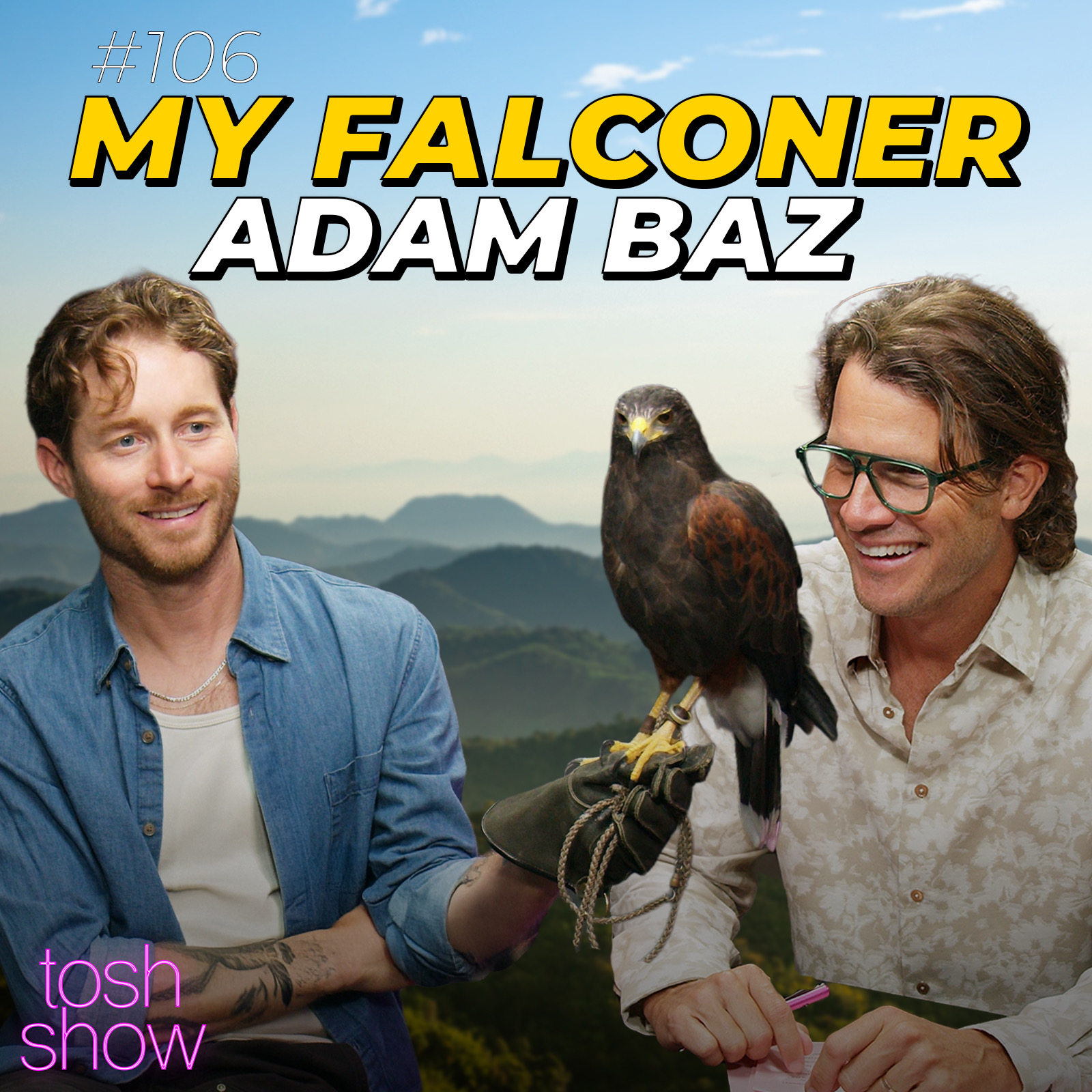
Pa show. My guest today has a job that's 50% bird training and 50% convincing people that his raptors will not peck their eyes out. Please welcome professional falconer Adam and whatever his al's name is.
- [13:07]
Adam (Professional Falconer)
Thank you.
- [13:08]
Daniel Tosh
What is your ozzy?
- [13:10]
Adam (Professional Falconer)
Owl's name is Ozzy.
- [13:11]
Daniel Tosh
Good name for your owl.
- [13:12]
Adam (Professional Falconer)
I have a hawk also with me.
- [13:14]
Daniel Tosh
What's his name?
- [13:15]
Adam (Professional Falconer)
Jasper.
- [13:16]
Daniel Tosh
Jasper?
- [13:17]
Adam (Professional Falconer)
Yeah.
- [13:17]
Daniel Tosh
How long. How old's Jasper?
- [13:19]
Adam (Professional Falconer)
Jasper is 7.
- [13:21]
Daniel Tosh
How old do falcons get?
- [13:24]
Adam (Professional Falconer)
All these birds, I'd say in the wild live maybe eight to 12 years, but in captivity, 30, 35.
- [13:30]
Daniel Tosh
I always like it when it goes that direction.
- [13:33]
Adam (Professional Falconer)
Yeah. It's better than the other way around.
- [13:35]
Daniel Tosh
It makes you feel so much better.
- [13:36]
Adam (Professional Falconer)
Agreed.
- [13:37]
Daniel Tosh
Yeah, but you hear about, like, an orca and you're like, oh, they live 50 years in the wild and two in captivity.
- [13:44]
Adam (Professional Falconer)
Right? Yeah.
- [13:45]
Daniel Tosh
I don't know that. I don't know if that's true or not. That might have been a bad example. Nothing I ever say is factual. I always have to point that out.
- [13:51]
Adam (Professional Falconer)
I think you're right. I think that that sounds like something I've heard before.
- [13:54]
Daniel Tosh
First question, do you believe in ghosts?
- [13:57]
Adam (Professional Falconer)
I do not. No. Hard no on that one.
- [14:00]
Daniel Tosh
Ooh, hard. I haven't had a hard no in a while.
- [14:03]
Adam (Professional Falconer)
Yeah.
- [14:04]
Daniel Tosh
It's refreshing to talk to the sane. Yet you're a birdman. I want you to know I too, am a birdman. Okay.
- [14:11]
Adam (Professional Falconer)
It's nice to meet you.
- [14:12]
Daniel Tosh
Well, I've got chickens.
- [14:13]
Adam (Professional Falconer)
Oh, same. Yeah.
- [14:15]
Daniel Tosh
I've got one silky and two showgirls.
- [14:18]
Adam (Professional Falconer)
What's a showgirl?
- [14:19]
Daniel Tosh
Showgirls are very much similar to silkies, but they have a bald neck and then like a big amount of hair at the top. Hence the name showgirls.
- [14:27]
Adam (Professional Falconer)
Got it.
- [14:28]
Daniel Tosh
You know, they're smaller eggs, but they do the job.
- [14:32]
Adam (Professional Falconer)
Yeah.
- [14:33]
Daniel Tosh
Now, I'm sure you know because you've probably listened to every episode I've had, but one of my. One of my showgirls was killed by a hawk.
- [14:43]
Adam (Professional Falconer)
Oh, okay. So this is. This is kind of personal, this interview a little bit. Okay. I didn't know What I was stepping into.
- [14:49]
Daniel Tosh
Well, I'm just gonna. I'm giving you all the information up front. I have in my backyard this one huge tree in an adjacent property, not mine. A couple hawks live.
- [15:01]
Adam (Professional Falconer)
Yeah. We have chickens also, and we have a lot of hawks. Well, I have, obviously hawks, but also wild hawks in the neighborhood. And we kind of just going into it, knew it was gonna be like a let be type situation.
- [15:12]
Daniel Tosh
Have you lost a chicken?
- [15:13]
Adam (Professional Falconer)
We have lost four. None to hawks, all to coyotes, unfortunately.
- [15:17]
Daniel Tosh
Okay. The coyotes, oddly so stupid, don't come to my front yard ever. Always in my backyard. They can't mess with my pig. My pig's too big. Can't mess with my dog. My dog's monster. But. But the chickens.
- [15:29]
Adam (Professional Falconer)
Chickens are in the front and they're loose.
- [15:31]
Daniel Tosh
Yeah, almost all day, every day.
- [15:33]
Adam (Professional Falconer)
And the coyotes fenced in, I assume it is.
- [15:35]
Daniel Tosh
But they can climb any fence.
- [15:36]
Adam (Professional Falconer)
Yeah, but I guess coyotes don't like to feel trapped, like they'll go into something, but if they feel like they'd be stuck in that environment and they don't have an easy way of escaping, they're hesitant. We didn't. We've never had a coyote get into our farm, but we have had chickens get out, and then the coyotes kill them on the street. So sadly, we had six chickens. The four smartest chickens, which were the ones that were able to figure out how to get out, all got killed. So we're left with the two dumbest chickens. We.
- [16:04]
Daniel Tosh
Ignorance is bliss.
- [16:05]
Adam (Professional Falconer)
Yeah. So, yeah, that's where we're at. It's pretty cool farm.
- [16:08]
Daniel Tosh
Where did you grow up?
- [16:09]
Adam (Professional Falconer)
I grew up in upstate New York.
- [16:10]
Daniel Tosh
What was childhood like?
- [16:12]
Adam (Professional Falconer)
It was a little boring.
- [16:13]
Daniel Tosh
Siblings.
- [16:14]
Adam (Professional Falconer)
I have siblings. That's not why it was boring.
- [16:16]
Daniel Tosh
No, no, I didn't. I didn't piece that together.
- [16:18]
Adam (Professional Falconer)
Yeah, I do. I have. I have two sisters. I grew up in, like, a rural area in upstate New York. I was, like, a punk skateboarder troublemaker. I was bored. You know, it was like corn fields and dairy farms, and I just wanted to be in an urban environment. Had no interest in the outdoors whatsoever. My dad is a fly fisherman, so I think kind of from early on, there was something in there. I always say, like, falconry is a little similar to fly fishing in some ways.
- [16:43]
Daniel Tosh
Do you know how to fly fish?
- [16:45]
Adam (Professional Falconer)
A little bit. I've learned from him. But it's hard.
- [16:48]
Daniel Tosh
Well, of course it's hard. Almost, I would say, impossible. I'd like to visually just watch it, actually. I like to just see one person Doing it. And then I think in theory, I always think it'd be funny just to come wading out next to him and just talk to him.
- [17:03]
Adam (Professional Falconer)
Just ruin their. Like people go out just to be alone in the stream and then you're just there.
- [17:07]
Daniel Tosh
I just want to say hi.
- [17:08]
Adam (Professional Falconer)
Microphone.
- [17:09]
Daniel Tosh
Hey, you look like you're doing pretty good. When did you head out west after college?
- [17:13]
Adam (Professional Falconer)
Whenever that was.
- [17:14]
Daniel Tosh
Where'd you go to college?
- [17:15]
Adam (Professional Falconer)
Bard College. It's like a small liberal arts school in upstate New York.
- [17:19]
Daniel Tosh
Also in the middle of nowhere.
- [17:20]
Adam (Professional Falconer)
I could walk to it from my parents house.
- [17:22]
Daniel Tosh
Okay.
- [17:22]
Adam (Professional Falconer)
Yeah. So I was like. When I graduated, I went to reluctantly but unregrettably went to a small college that was in the town I grew up in. Then immediately when I graduated was like, I gotta get as far away as possible. Move to Portland, Oregon. That's where I kind of started getting into the outdoors, I guess. Fitting place, you know, beautiful. I started hiking.
- [17:41]
Daniel Tosh
I mean where you lived was also.
- [17:42]
Adam (Professional Falconer)
Oh yeah, absolutely. But it's in a different way.
- [17:44]
Daniel Tosh
Yes.
- [17:44]
Adam (Professional Falconer)
Yeah, it's more agricultural, like pastoral. The, you know, the Pacific Northwest is like old mountains, like raw nature, beauty.
- [17:52]
Daniel Tosh
Did you major in falconry or.
- [17:54]
Adam (Professional Falconer)
No, it's not a thing. No, that's not a thing. No, I didn't. In undergrad I studied art and political, just basically two made up majors. The whole falconry, bird thing is all later in life. I worked as a bird biologist for nine years. That's how I kind of got into falconry was through biology and conservation. How I got into bird biology was honestly, I think I just had a crazy mushroom trip one time in the woods and was realized that birds were beautiful and they could fly and they can sing and they're colorful and enigmatic and they just come and they disappear. And I got kind of totally obsessed with the idea of learning how to identify them. So I started bird watching as a hobby. I have a little bit of an obsessive personality, so I get really into things and then that kind of led to falconry. But. Sorry, there's a. Really. To answer your question, I did eventually go back to grad school and I did get my degree in ornithology, which is the biology of birds.
- [18:48]
Daniel Tosh
Do I have to keep saying raptor or can I just say bird?
- [18:53]
Adam (Professional Falconer)
Well, it's up to you. But yeah, raptor is the correct term that that includes falcons, hawks, owls and eagles. So falconry is specifically relegated to flying predatory birds, birds of prey, raptors.
- [19:08]
Daniel Tosh
Did you ever have a bird as.
- [19:09]
Adam (Professional Falconer)
A pet prior to this Nope.
- [19:11]
Daniel Tosh
Okay. Because there is a. There's a distinct line between, like, bird watching and people that have birds as pets. I've always felt. Yeah, I always felt there's a real line there.
- [19:20]
Adam (Professional Falconer)
There's a leap. Yeah. No, I don't know. I honestly. I was working as a bird biologist and I heard an interview on NPR with a falconer who was working professionally as a falconer, and that really kind of appealed to me. And at the time, I was, you know, it was like the age where all of my friends were becoming freelancers. You know, it was like the gig economy was huge, and I was working in an office as a biologist, crunching numbers and writing up reports, and it was meaningful work, but I was in an office and I wanted to be outside. That's why I got into bird watching, was to be outside. So falconry seemed like a really compelling idea. And then I just kind of dove right in.
- [19:58]
Daniel Tosh
You weren't one of those weirdos whose favorite comic book character was Hawkeye, were you?
- [20:03]
Adam (Professional Falconer)
No. I don't even know what that was.
- [20:04]
Daniel Tosh
He's Jeremy Renner. Right. Jeremy Renner was Hawkeye. He never had his own Marvel movie, but he was a character that had a bow and arrows. Made no sense. Yeah, there's one season of his show. It was canceled. The only thing I know about Jeremy Renner is he's the guy up in Tahoe that got ran over by a snowblower.
- [20:22]
Eddie
His snowblower got out.
- [20:24]
Daniel Tosh
Yeah. It was a tragic story. He milked it for a long time, though, if I'm being honest. By the way, I don't know anything about the Hawkeye franchise. Eddie the dork over there?
- [20:35]
Eddie
Nah, that's John.
- [20:37]
Daniel Tosh
You don't deflect to another dork.
- [20:39]
Eddie
Nah, another dork gets us going.
- [20:41]
Adam (Professional Falconer)
Own it. You gotta own it.
- [20:42]
Daniel Tosh
You were a drummer in a band?
- [20:44]
Adam (Professional Falconer)
Yes.
- [20:45]
Daniel Tosh
You played in multiple bands?
- [20:46]
Adam (Professional Falconer)
Yep. In Portland. I played music. I did that. That was kind of what I tried to do career wise for about eight or ten years, and then.
- [20:54]
Daniel Tosh
See, I can't believe that you gave up being a drummer for the financial security of falconry.
- [20:59]
Adam (Professional Falconer)
You'd be surprised. Well, you think drummers make a lot of money?
- [21:02]
Daniel Tosh
No, I just didn't.
- [21:04]
Adam (Professional Falconer)
Neither do Falcons.
- [21:05]
Daniel Tosh
The transition seems almost absurd.
- [21:08]
Adam (Professional Falconer)
That's fair.
- [21:09]
Daniel Tosh
How bad was your band if you had a switch from being a drummer to falconry?
- [21:15]
Adam (Professional Falconer)
No, it's just my falconry is really good. That's the thing.
- [21:17]
Daniel Tosh
Ah. You were originally drawn to a falconry because of the hunting aspect. Are you a hunter?
- [21:23]
Adam (Professional Falconer)
I am But I wasn't previously. I guess this is important. I think this is important to know that is the definition of falconry. At its core. Falconry is a hunting sport, and it's been that way for 5,000 years. So you can't really get into falconry and not also hunt, legally speaking. And in terms of the way that this is all regulated and the way our licenses come from, to own these birds, it's as a hunting sport through the Department of Fish and Wildlife. So you have to have a hunting license, you have to have a falconry license. And it is basically encouraged, if not required, that you hunt with your birds, at least for the first two years.
- [22:01]
Daniel Tosh
Where do you go hunting here in Los Angeles with your birds?
- [22:04]
Adam (Professional Falconer)
Not really in the city. I go out kind of near Joshua Tree or mostly up near Bishop.
- [22:08]
Daniel Tosh
And why do the birds come back there? I'm gonna start with real some dumb questions.
- [22:12]
Adam (Professional Falconer)
Why do they come back?
- [22:12]
Daniel Tosh
Yeah. Why don't you just be like, all right, thanks. Fucking asshole, I'm gone?
- [22:16]
Adam (Professional Falconer)
Well, sometimes they do.
- [22:18]
Daniel Tosh
Do they?
- [22:18]
Adam (Professional Falconer)
They absolutely could.
- [22:20]
Daniel Tosh
No, but they could. Of course they can. But do they?
- [22:23]
Adam (Professional Falconer)
I've never had a bird voluntarily fly away. I have kind of temporarily lost birds. But I guess the short answer to your question is it's a combination of trust and food. Mm. They trust that I'm not gonna hurt them, and I'm benevolent. But more than anything, they trust that I'm going to feed them consistently and regularly. By the way, that's one of the reasons that they can live to 30 years in captivity versus 12 years in the wild. And they're not necessarily the smartest animals in the world, but I think they're smart enough to know that they kind of have a good thing going on.
- [22:51]
Daniel Tosh
How long do you train a bird? Are you always training?
- [22:54]
Adam (Professional Falconer)
Kind of always training. Okay. I mean, that's kind of my philosophy on training animals in general, whether it's my dog or the horse or the birds, is you're always training. Because if you're not actively training, you're just undoing the training that you did. I have a pretty well trained dog, and so people have asked me over the years, like, oh, could you train my dog? Or what do you think about this trainer? I was going to send my dog off to, like, a six week intensive training program, and there's no harm. But the problem is you could have your dog trained to the nines at a facility, and then you bring it home, and if you start cutting corners and you don't reinforce that training, I Mean, dogs are smart animals and all animals are opportunistic and they will find ways to circumvent the training. And that training doesn't just stick permanently. Like you have to constantly reinforce it.
- [23:39]
Daniel Tosh
That's why. That's why I don't even bother. Yeah, Carl. I just let him. I'm like, what? He's bit my kids, both of them, but both times it was their fault. So I was like, I don't care. Yeah, like, they. Like, one time, my daughter, like, was a year and a half old, she's like, I was like, oh, it was so good that you put his food down. And then. So then she went to, while he was eating his food, to grab his food away, to do it again, to put it down again, because she wanted the reward. And then he just bit her. And I'm like, good for you, Carl. Get away from his food now that you put it down.
- [24:08]
Adam (Professional Falconer)
Got it right.
- [24:09]
Daniel Tosh
It's not his fault anyway. I mean, it wasn't hard. He latched on. He let her know, like, hey, get away from me. Maybe I shouldn't say that. It doesn't matter. My point is, I agree with you. You gotta constantly train him. And I don't do that. So it's on me.
- [24:25]
Adam (Professional Falconer)
But to answer your original question, I guess, was it how long it takes to train the bird or how long I train them? Like the base level training, meaning you get a bird that's essentially wild, totally untamed, untrained, doesn't know you from the next guy. It could be anywhere from three weeks to three months. It's pretty fast.
- [24:41]
Daniel Tosh
Where do you get a falcon from any of these raptors? Where do you buy?
- [24:46]
Adam (Professional Falconer)
I buy them from federally licensed breeding programs. But you can trap wild birds as well?
- [24:51]
Daniel Tosh
You can trap?
- [24:52]
Adam (Professional Falconer)
Yep. And you need a permit, a license to do this. Just to be clear and to get that, you have to do a two year training program, an apprenticeship. But during that first two years, you're actually required to trap a wild bird. You have to start with a wild hawk after you complete it.
- [25:08]
Daniel Tosh
Joining a gang.
- [25:09]
Adam (Professional Falconer)
It is a little bit. There's like, there's an initiation kind of a situation. Yeah.
- [25:13]
Daniel Tosh
I've never been in a gang, but I'm just guessing. Yeah, I've seen movies.
- [25:16]
Adam (Professional Falconer)
Yeah.
- [25:16]
Daniel Tosh
So you trapped a wild bird?
- [25:18]
Adam (Professional Falconer)
Yeah. My first bird was a red tailed hawk.
- [25:20]
Daniel Tosh
How'd you trap it?
- [25:22]
Adam (Professional Falconer)
It's called a balshatri trap. The best way to think of it is like a shoebox that's made out of heavy duty chicken wire and A.
- [25:29]
Daniel Tosh
Little stick and rope on it.
- [25:30]
Adam (Professional Falconer)
Not quite. So you put a live mouse inside, and then you tie a bunch of little slipknots with string or fishing line all over the outside, and you find a bird that you want to and are legally allowed to trap, and you drop the box out of your car. Usually it's on a farm road. I did it up in Oregon.
- [25:49]
Pete
And.
- [25:49]
Adam (Professional Falconer)
And then you drive away and you go a couple blocks down and you sit with your binoculars looking back at the trap. And if the bird's hungry, which they usually are, wild birds are always hungry, basically, they'll come down trying to get to the mice, and then they get temporarily stuck on the trap. And then you peel around and go and just basically dive on the whole mess and grab them.
- [26:10]
Daniel Tosh
And is that. Is that interaction, Is that fun or terrifying?
- [26:13]
Adam (Professional Falconer)
Both.
- [26:14]
Daniel Tosh
Okay.
- [26:15]
Adam (Professional Falconer)
Yeah.
- [26:15]
Daniel Tosh
Yeah.
- [26:15]
Adam (Professional Falconer)
I mean, it's fun and terrifying for me. I would say it's probably just terrifying for the bird.
- [26:19]
Daniel Tosh
Well, yeah.
- [26:20]
Adam (Professional Falconer)
First few days, I won't lie, are terrifying for the bird. The way that you bring them home, this is just kind of like one of these things that's taken for granted. It's just a normal thing to do in the falconry community. But when I tell people this who are outside of the falconry community, they think it's just a really bizarre thing, which is that when you get your bird and you remove them from the trap, you need to get them home somehow. And they're not just going to sit calmly on your passenger seat because they're a wild hawk.
- [26:45]
Daniel Tosh
Okay.
- [26:45]
Adam (Professional Falconer)
So we generally take a pair of pantyhose and we cut off the ankle, basically make a tube, and you just slip it over the bird. So they're just kind of like stuck in women's pantyhose like this. And then you just sit them on the passenger seat of your car. So, like, I remember that very vividly, like, driving home and there's just a hawk staring up at me in pantyhose. You know, it's like a very bizarre.
- [27:06]
Daniel Tosh
Imagine getting pulled over right there and explaining all of this. No, no. You have to understand. You have to put pantyhose over this live hawk that I just caught. I've got a license, I'm totally trained.
- [27:18]
Adam (Professional Falconer)
But the hawk's terrified. You know, I mean, they're not, but they very quickly, within like two to three days, start to trust you and lose the fear. Yeah.
- [27:25]
Daniel Tosh
Cause they're eating good now. Yeah, exactly. They're no longer eating rodents that have been poisoned by, you know, God knows What people are trying to do. And I take responsibility for that. Cause I have an owl box and I got a barn owl that lives in it.
- [27:36]
Adam (Professional Falconer)
Oh, nice.
- [27:37]
Daniel Tosh
So then I had to stop using the rodents, you know, poison on the rats because now it's gonna kill the owl. You get it? I don't have to say it to you, you understand?
- [27:47]
Adam (Professional Falconer)
While it's good of you and you gotta say it to your audience, it's.
- [27:49]
Daniel Tosh
Important I can say it to my audience. Listen, guys, I'm sure you've got acreage. How much does a. From a breeder, one of these birds cost? Ish.
- [28:00]
Adam (Professional Falconer)
800 to 5000 in the United States, but most of them are like maybe 1 to 2000.
- [28:07]
Daniel Tosh
Can I capture a pelican legally?
- [28:09]
Adam (Professional Falconer)
No.
- [28:10]
Daniel Tosh
Oh, God damn it.
- [28:11]
Adam (Professional Falconer)
And nor can I, by the way.
- [28:12]
Daniel Tosh
Oh, I bet you could, though.
- [28:13]
Adam (Professional Falconer)
No, I can't. I cannot.
- [28:14]
Daniel Tosh
I know. You know how you catch a pelican different from. From a falcon is you sit on a pier, you start talking slowly, but.
- [28:22]
Eddie
He'S up to you.
- [28:22]
Daniel Tosh
You get fishing, eventually he'll come on over. I've always wanted a pelican. I think they're awesome. Might be my favorite animal. That doesn't matter. How hard is it to get a permit?
- [28:31]
Adam (Professional Falconer)
It's pretty hard.
- [28:31]
Daniel Tosh
Besides having to catch one in the wild, that part seems to.
- [28:35]
Adam (Professional Falconer)
You have to do a two year to become a falconer. You have to do a two year training program. To start the two year training program, you have to pass this, like, comprehensive written exam, kind of like, I guess the sats for falconry.
- [28:48]
Daniel Tosh
There's no way I could get a falcon. What's the old timey leather football helmet birds have to wear?
- [28:53]
Adam (Professional Falconer)
Oh, gosh, I should have brought one. Well, it's called a hood. Basically, the hood is a very traditional piece of falconry equipment. It's a set of blinders. It's a blindfold. And birds in general, but especially birds of prey, have exceptional vision. They can see maybe 8 to 12 times better than us. And so a lot of their brain activity is busy processing visual information. And so it gets fatiguing, you know, it can get. They can get overwhelmed and overstimulated, especially in an urban environment.
- [29:22]
Daniel Tosh
Got it.
- [29:23]
Adam (Professional Falconer)
And so the hood helps them relax, basically.
- [29:26]
Daniel Tosh
Okay.
- [29:26]
Adam (Professional Falconer)
I only use them on birds if they show me that they need it. You know, some birds are calm. I have a falcon at home. I didn't bring her today, but she's a great bird. She's just really high strung, you know, very fast, kind of anxious bird. And so she has to wear the hood anytime she's in transport.
- [29:42]
Daniel Tosh
All right, what birds, what raptors are you bringing out right now?
- [29:47]
Adam (Professional Falconer)
Let's bring out the hawk first.
- [29:48]
Daniel Tosh
Jasper.
- [29:49]
Adam (Professional Falconer)
Jasper.
- [29:49]
Daniel Tosh
Jasper's coming out.
- [29:51]
Adam (Professional Falconer)
All right. I'm gonna try to keep him from pooping somewhere.
- [29:54]
Daniel Tosh
Yeah, well, don't worry about that. If that happens, it happens.
- [29:58]
Adam (Professional Falconer)
Yeah.
- [29:59]
Daniel Tosh
So this is what if, right when you open it, just all hell breaks loose.
- [30:03]
Adam (Professional Falconer)
This is the last Tosh show ever.
- [30:06]
Daniel Tosh
Oh, I would love to go out this. Oh, fuck you. That thing is real?
- [30:12]
Adam (Professional Falconer)
Yeah. So this is Jasper and he's a type of hawk called a Harris's hawk.
- [30:17]
Daniel Tosh
Uh huh. You keep a leash on their foot at all times?
- [30:20]
Adam (Professional Falconer)
Well, not when I'm flying them. This just gives me something to hold onto when I don't need to fly him. Obviously when I fly him, I take it all off. Oh.
- [30:28]
Daniel Tosh
Oh, man. I didn't know it was going to be a projectile.
- [30:30]
Adam (Professional Falconer)
Shit. I'm so here. Do you want me to clean that up? You sure get it.
- [30:35]
Daniel Tosh
But I almost hit an outlet. And what if he would have gotten electrocuted from that?
- [30:38]
Adam (Professional Falconer)
Is that possible? Come all the way back up.
- [30:41]
Daniel Tosh
Here's a. You're not gonna know the answer to this and it's just so juvenile, but I believe I've had a mental theory for a long time that birds try to shit on people.
- [30:52]
Adam (Professional Falconer)
Why did you insist that I wouldn't know the answer to that?
- [30:54]
Daniel Tosh
Well. Cause I don't think it's a real. Nobody's ever gonna spend money on this study. But I feel like when I watch like seagulls and stuff, or pelicans fly over a group of surfers, I feel like they hold it and. And then they wait to fire.
- [31:06]
Adam (Professional Falconer)
Yeah. No, I don't know, like statistically the answer, but I think that there is some validity to that.
- [31:10]
Daniel Tosh
Okay.
- [31:11]
Adam (Professional Falconer)
I do think it's like, whether it's their aiming or it's a stress response. Birds absolutely do poop when they get upset.
- [31:18]
Daniel Tosh
Like, I always think it's impressive that they can fly and shit. Like, that's just neat. Imagine if you were at a full sprint and having it just.
- [31:26]
Adam (Professional Falconer)
I've never tried it.
- [31:28]
Daniel Tosh
I have, but it was. It was unfortunate.
- [31:30]
Eddie
How far can the hawk see?
- [31:31]
Adam (Professional Falconer)
That's a. That is kind, kind of the way people often frame that question, which is understandable, is how far can the bird see? The better way to think of it is how much better can the birds see? Because like, you know, if you're on a boat on the ocean, you can See, hypothetically, forever. You can see the curvature of the Earth. That's hundreds of miles away. You can definitely see more than 12 miles, right?
- [31:51]
Daniel Tosh
Oh, I don't know.
- [31:52]
Adam (Professional Falconer)
You know, have you ever noticed that when you're on the ocean, I mean, you can see the horizon line is.
- [31:55]
Daniel Tosh
Curved, the Earth is flat. Go on.
- [32:00]
Adam (Professional Falconer)
So. But the difference is, like, he can see every little detail of every little ripple in the wave, you know, a mile away, whereas you can just see that maybe 30ft in front of you. And that's what allows them. When they're circling 500ft in the air and they look down at the ground, I mean, they have to be able to differentiate between a small brown mouse and a small brown pine cone and know when it's worth diving down and grabbing it, you know?
- [32:24]
Daniel Tosh
So is there anything you should not do around?
- [32:27]
Adam (Professional Falconer)
I mean, generally, these are their weapons, their feet. This is how they kill their prey. He can squeeze about five to six times harder with his feet than I can with my hand. And I have a pretty firm.
- [32:39]
Daniel Tosh
And he won't squeeze your hand?
- [32:41]
Adam (Professional Falconer)
No, I mean, he doesn't like this. And if I keep doing it, see, he kind of stomps and he'll. He'll growl. You hear him growling?
- [32:47]
Daniel Tosh
Yeah.
- [32:48]
Adam (Professional Falconer)
He's letting me know he doesn't appreciate it.
- [32:50]
Daniel Tosh
So we're doing it.
- [32:51]
Adam (Professional Falconer)
But my point is. Oh, he wants to sit up here. My point is, he's not aggressive. But, yeah, I mean, generally, you shouldn't touch their feet. All right, you done, Jasper?
- [33:00]
Daniel Tosh
All right, Jasper. Thanks for shitting on us. Look at that. If he fired one off on this table. How often do you have to fly your birds?
- [33:11]
Adam (Professional Falconer)
I try to fly them every day.
- [33:12]
Daniel Tosh
Every day they're supposed to fly. And you just. So your neighbors just fucking hate you. How does this work? You just have crazy animals flying out your backyard all day?
- [33:21]
Adam (Professional Falconer)
I never. I don't. I rarely fly them at my house.
- [33:23]
Daniel Tosh
You go someplace every day?
- [33:25]
Adam (Professional Falconer)
Yeah, because. For a couple reasons. One is this is my job, so I don't really. If I can help it. I get paid to fly them. So I. You know, that's just. So I figure if. If I need to train a bird, I might as well bring it and get paid to do it somewhere. So I don't fly them at home that often because wherever you feed them, they will start screaming and begging. And I try to keep it quiet at the house. So if I was to feed them every single day in my backyard, they would be loud.
- [33:52]
Daniel Tosh
They'd be screaming, are you Allowed to have them at your house.
- [33:55]
Adam (Professional Falconer)
Oh yeah.
- [33:55]
Daniel Tosh
Even though.
- [33:56]
Adam (Professional Falconer)
Okay, yeah, yeah, it's all inspected. They send a warden from the fish and game department, comes to your house, comes to the house.
- [34:01]
Daniel Tosh
That's gotta confuse your neighbors too.
- [34:03]
Adam (Professional Falconer)
And they're no joke. I mean they're bulletproof vests. They're heavily militarized, like wildlife.
- [34:08]
Daniel Tosh
I've seen Yellowstone. Yeah, I know what the fishing game does. They fucking kill tourists from California. That's their whole job. Falcons, they could do. They go 200 miles an hour.
- [34:18]
Adam (Professional Falconer)
Peregrine falcons have been clocked I think that high, but it's not in a natural setting.
- [34:24]
Daniel Tosh
What is it, a vacuum? Where are they getting up to 200?
- [34:27]
Adam (Professional Falconer)
They were dropped out of an airplane at a really high altitude. So it's like a totally contrived. It wouldn't happen in nature. In the natural world. Peregrine falcons, which are the fastest animals in the world, they can dive over 150 miles per hour.
- [34:41]
Daniel Tosh
And they dive and then they just smash into their prey, killing their prey. And they have something on their brain or skull that allows them to absorb such a shock without them being basically killed when they crush into things. So much so that I don't know if you're familiar that Football now has been studying them for CTE and their concussions. I don't know if they're going to try to inject falcon gel into players heads. But they've got to come up with some scenario where these people can. Because falcons can smash and they don't get concussed or anything.
- [35:21]
Adam (Professional Falconer)
Yeah, you're 90% right.
- [35:23]
Daniel Tosh
Thank you.
- [35:23]
Adam (Professional Falconer)
That's only 10% wrong.
- [35:25]
Daniel Tosh
As long as I was 90, by.
- [35:26]
Adam (Professional Falconer)
The way, I've never, and that's a generous 90%.
- [35:28]
Daniel Tosh
I've never been 90% right about anything that I've regurgitated from someone else in my life.
- [35:34]
Adam (Professional Falconer)
Okay. So yes, falcons do collide with their prey at high speeds and they are I guess an anatomically engineered to help with that. But they hit with their feet. You're thinking of woodpeckers which excavate holes in trees with their beaks. So they just repeatedly smash their head into hard wood. And so football helmets are engineered based on like the specific angles and structure of woodpecker skulls.
- [36:00]
Daniel Tosh
I certainly wasn't thinking of woodpecker. I got bad intel. I got bad intel. Such a different.
- [36:05]
Eddie
Just jump falcon to woodpecker, whatever.
- [36:08]
Daniel Tosh
You ever fucked with a woodpecker?
- [36:09]
Adam (Professional Falconer)
I do fuck with woodpeckers. I have fucked with woodpeckers. My master's thesis in grad school was on woodpeckers.
- [36:17]
Daniel Tosh
Does hanging a CD on the side of your house actually prevent them from coming back?
- [36:21]
Adam (Professional Falconer)
It could help, but probably not.
- [36:23]
Daniel Tosh
Okay.
- [36:23]
Adam (Professional Falconer)
Yeah, hiring a falconer would help. Well, what's a little business plug there?
- [36:28]
Daniel Tosh
That's fine. Let's talk about your business because it's, you know, many tiers. You do education with children, you can hire you to get rid of rodents or. Not rodents, other birds.
- [36:40]
Adam (Professional Falconer)
Other birds, mostly. Yeah.
- [36:41]
Daniel Tosh
Okay.
- [36:42]
Adam (Professional Falconer)
Yep.
- [36:42]
Daniel Tosh
And what are the other things that I'm missing?
- [36:44]
Adam (Professional Falconer)
Basically the photo and film industry.
- [36:46]
Daniel Tosh
Okay. A rap video. Because Lord knows you want a fucking falcon. But my question is, is the rate the same for all three of those things or is it different?
- [36:55]
Adam (Professional Falconer)
It's tiered. I mean, I try to make. The cheapest of all of them is the education. The education. Because I believe in it. And I have. So I have, like, on my website, you can sign up for these interactive falconry experiences. So I have a lot of families that come. They bring their kids or that's maybe a couple celebrating an anniversary or birthday. I try to make that affordable because it's fun to do and I want people to get to meet them.
- [37:17]
Daniel Tosh
What's the rate for that?
- [37:18]
Adam (Professional Falconer)
Usually a private session is about $400.
- [37:20]
Daniel Tosh
Okay, guess what, guys? I'm going to hire. I'm going to hire Adam for. For my son's elementary school.
- [37:25]
Adam (Professional Falconer)
Oh, that's awesome.
- [37:26]
Daniel Tosh
There we go. That's the first thing I'm doing now. There's a new principal there, so she's probably not gonna be thrilled with this.
- [37:34]
Adam (Professional Falconer)
Why not?
- [37:34]
Daniel Tosh
I don't know. Because as soon as you tell a new person in charge, hey, we're gonna have these raptors on campus. You might wanna not wear loose clothing that day. Has any kids ever gotten hurt from your demonstrations?
- [37:49]
Adam (Professional Falconer)
No. I mean, the birds are really well trained. And obviously I wouldn't ever bring a bird that was anything other than well trained into a situation like that.
- [37:56]
Daniel Tosh
You call your company. Hawk on hand. Do you have any clever slogans about two in the bush?
- [38:04]
Adam (Professional Falconer)
No. Thank you.
- [38:05]
Daniel Tosh
Oh, all right.
- [38:07]
Adam (Professional Falconer)
I'll be going home and editing my website immediately.
- [38:11]
Daniel Tosh
When I used to do a TV show, I always hated using real animals because I always felt bad for the animals when they came on. One time I had a kangaroo on set, and that handler was basically just all day long having to fight this kangaroo. I'm like, all right, Jesus, bouncer at a bar.
- [38:34]
Adam (Professional Falconer)
I get it.
- [38:34]
Daniel Tosh
I mean, I think it was intense. It was intense to watch.
- [38:37]
Adam (Professional Falconer)
That feels like it's so out of place for the kangaroo, which I guess you can make the same argument about an owl in a rap video. But most of the time when I bring my birds to do music videos or commercials or photo shoots, people want them flying. And they're so well trained and they've grown up around humans. So, I mean, it's a little small in here, but, like, they'd fly happily in here, Just as happily in here as in the wild, you know, I mean. Cause they're flying, they're coming back to me. I'm giving them food. They're just doing what they've done every day their entire life. So it's not stressful for them.
- [39:07]
Daniel Tosh
What's your food? What's your food of choice for them?
- [39:09]
Adam (Professional Falconer)
Mostly mice. And alive? No, no, frozen.
- [39:12]
Daniel Tosh
And how do they eat this?
- [39:14]
Adam (Professional Falconer)
Frozen mice I cut up in little pieces.
- [39:17]
Daniel Tosh
Oh, you're making me want to puke.
- [39:18]
Adam (Professional Falconer)
With scissors.
- [39:19]
Daniel Tosh
I'm just. Oh, just got scissors. How could you get worse? It just got worse.
- [39:24]
Adam (Professional Falconer)
Yeah, like, you know, meat. Heavy duty meat. Scissors.
- [39:26]
Daniel Tosh
I'm not good with that here. And I eat meat.
- [39:29]
Adam (Professional Falconer)
Well, I was vegan for about eight years, and then when I started eating.
- [39:33]
Daniel Tosh
Meat, you got happy again.
- [39:36]
Adam (Professional Falconer)
I just was. I was like, I want to at least once participate in the process from beginning to end. Because it's weird and just kind of disembodied to just go to a grocery store and get this little plaque packaged thing in Saran wrap. You don't have to think about the.
- [39:52]
Daniel Tosh
Fact you don't get your groceries delivered. Come on.
- [39:55]
Adam (Professional Falconer)
It's true. Yeah. Let's add another level of removal.
- [39:58]
Daniel Tosh
Thank you.
- [40:00]
Adam (Professional Falconer)
You open your door. It's just right there.
- [40:02]
Daniel Tosh
Perfectly open my door. My house will put it in.
- [40:05]
Adam (Professional Falconer)
You have acreage, third levels.
- [40:08]
Daniel Tosh
There's three levels. The pest control service, by the way. So who is hiring you?
- [40:13]
Adam (Professional Falconer)
I mostly do, like, pigeon, crow, and seagull control.
- [40:16]
Daniel Tosh
Where. Who needs that removed?
- [40:18]
Adam (Professional Falconer)
Hotels, resorts, shopping centers. You know how California has a lot of these, like, outdoor plazas. Shopping centers.
- [40:25]
Daniel Tosh
So outdoor shopping plaza hires you to come to get rid of their pigeon problem. Horizon. How often do you come and how long?
- [40:31]
Adam (Professional Falconer)
It depends. But usually I would say like 8 to 12 times a month, couple times a week.
- [40:36]
Daniel Tosh
You come a couple times a week.
- [40:38]
Adam (Professional Falconer)
For just a few hours at a time.
- [40:40]
Daniel Tosh
And pigeons are like, okay, we don't hang out here.
- [40:43]
Adam (Professional Falconer)
You know, If I show up Monday, Wednesday and Friday for three hours at a time with falcons that are chasing and intimidating and scaring the pigeons, do they actually catch a Few pigeons, sometimes they can catch them, but the goal is not to kill them, it's just to haze them, scare them. And then, you know, over the course of several months those pigeons will just learn, you know, they don't want to build their nest there, they'll move elsewhere. So it's a very like, humane way of doing it because you're not necessarily eradicating the problem, you're just moving it. You're kind of honestly creating a problem for someone else.
- [41:11]
Daniel Tosh
Uh huh. I know what you're doing.
- [41:12]
Adam (Professional Falconer)
Which it's a great business model on.
- [41:14]
Daniel Tosh
The riff raff to go to the other side of the railroad tracks. How many professional falconers are there?
- [41:20]
Adam (Professional Falconer)
Couldn't tell you. I don't know.
- [41:21]
Daniel Tosh
I mean, you guys ever have conferences?
- [41:23]
Adam (Professional Falconer)
Sometimes. There's not a lot of us and I don't go to them if we do sometimes.
- [41:29]
Daniel Tosh
So they occasionally hang out. You're not on the chat rooms? There's not?
- [41:32]
Adam (Professional Falconer)
No, I kind of do my own thing.
- [41:33]
Daniel Tosh
Do you know any other local falconers?
- [41:35]
Adam (Professional Falconer)
I would guess there's maybe let's say 30 to 40 falconers in the greater LA area. Probably most of them, just because we live in a city, do work as falconers. But the rest of the country, I mean, let's say there's 5,000 falconers in the U.S. i would guess that 80% of them have no interest in working as a falconer. This is generally not a job, they're just hunting.
- [41:56]
Daniel Tosh
What are they hunting for?
- [41:58]
Adam (Professional Falconer)
Sage grouse, rabbits, squirrels, ducks.
- [42:02]
Daniel Tosh
And it's just a form of hunting that's entertaining for them versus like why is, why is that more effective than a gun?
- [42:10]
Adam (Professional Falconer)
It's not. So falconry began 5,000 years ago. This was before we had invented guns and gunpowder. So at that time this was a pretty reasonable and legitimate way to catch food. Then with the advent of gunpowder, falconry became kind of eclipsed as like an actual survival tool. You know, it's a sport. People like fly fishing.
- [42:28]
Daniel Tosh
Got it. I get it.
- [42:29]
Adam (Professional Falconer)
I mean it's enjoyable. You can't be good at it without deeply understanding the behavior of your birds and their prey and the whole ecosystem and the timing and you know, all of it. So it's a really kind of like holistic, I guess, undertaking. It's very enjoyable. It is not very efficient. You go out all the time and you don't catch things, but that's okay. I mean your worst day hunting as a falconer, you're walking with your dog and your bird through a field in the middle of Nowhere. You know, at dawn or something. I mean, it's pretty. Pretty beautiful moment and you just get to watch and listen and be a part of it.
- [43:01]
Daniel Tosh
Yeah. But you and I both know that's the worst day. The worst day. You end up fucking fighting off a bear. Something. Yeah, it's not. Can't be fun. Did you watch the TV show Showgun?
- [43:11]
Adam (Professional Falconer)
Yes. Yeah.
- [43:12]
Daniel Tosh
What was the bird that. He was.
- [43:13]
Adam (Professional Falconer)
That was a falcon.
- [43:14]
Daniel Tosh
Yeah, he was obsessed with falcon and.
- [43:15]
Adam (Professional Falconer)
That was kind of like more traditional falconry for sports.
- [43:18]
Daniel Tosh
Did you love that show?
- [43:19]
Adam (Professional Falconer)
I liked it. I wouldn't say I loved it, but I liked it.
- [43:21]
Daniel Tosh
You didn't love it?
- [43:21]
Adam (Professional Falconer)
No, I thought it was good.
- [43:23]
Daniel Tosh
How did you not love it? I just thought. I mean, she was the hottest chick I've ever seen in my life.
- [43:27]
Adam (Professional Falconer)
Yeah. Yeah, that's true.
- [43:28]
Daniel Tosh
I just could. I just kept looking at my wife the whole time and just angry. Just angry. I was like, what are you talking. Look at her.
- [43:36]
Adam (Professional Falconer)
Yeah.
- [43:37]
Daniel Tosh
How are you guys related in species? Are you in a relationship?
- [43:41]
Adam (Professional Falconer)
Yeah.
- [43:42]
Daniel Tosh
How long you been dating?
- [43:43]
Adam (Professional Falconer)
Seven years.
- [43:44]
Daniel Tosh
Married?
- [43:44]
Adam (Professional Falconer)
Not. Not quite. Oh.
- [43:46]
Daniel Tosh
Are you interested?
- [43:47]
Adam (Professional Falconer)
Yeah, of course.
- [43:48]
Daniel Tosh
Don't show me. Of course. Seven years. At some point you got to do it.
- [43:51]
Adam (Professional Falconer)
I know.
- [43:51]
Eddie
Will a hawk bring the rings to propose?
- [43:53]
Daniel Tosh
Oh, that would be beautiful.
- [43:54]
Adam (Professional Falconer)
No, but I. That is a service I offer.
- [43:57]
Daniel Tosh
Really? People want hawks at weddings?
- [44:00]
Adam (Professional Falconer)
Yeah, some people. Not most people. I wouldn't. I don't. But. And no judgment to any clients out there, but yeah, I have like. We call it a. The wing bearer package.
- [44:09]
Daniel Tosh
Oh, man.
- [44:11]
Adam (Professional Falconer)
Yeah.
- [44:11]
Daniel Tosh
So they have to have like one of your scissor cut mice up there.
- [44:16]
Adam (Professional Falconer)
Actually. Actually, yes, they do.
- [44:18]
Daniel Tosh
To lure it.
- [44:19]
Adam (Professional Falconer)
They do. Yeah, they do.
- [44:22]
Daniel Tosh
This episode of Tosh show is brought to you by Progressive Insurance. Do you ever find yourself playing the budgeting game? Well, with the name your price tool from Progressive, you can find options that fit your budget and potentially lower your bills. Try it@progressive.com Progressive Casualty Insurance Company and affiliates. Price and coverage match limited by state law. Not available in all states. Let's map out this week's amazing destinations and travel tips.
- [44:56]
Will
Honestly, Will, I didn't plan any trips, but I did switch to T Mobile with their new family freedom offer.
- [45:03]
Daniel Tosh
That's not the itinerary we're following.
- [45:06]
Will
Well, I'm departing from AT&T and embarking on a new journey with T Mobile. They paid off my family's four phones up to $3200 and gave us four new phones on the house.
- [45:19]
Adam (Professional Falconer)
Bon voyage.
- [45:21]
T-Mobile Announcer
Introducing family freedom, our lowest Cost will switch our biggest family savings all on America's largest 5G network. Visit your local T Mobile location or learn more@t mobile.com familyfreedom. Up to $800 per line via virtual prepaid card. Typically takes 15 days. Free phones via 24 monthly bill credits with finance agreement eg Apple iPhone 16128 gigabyte $829.99 eligible trade in eg IPH well qualified credits end and balance due if you pay off early or cancel contact T Mobile.
- [45:49]
Interviewer
I've got Dan Morgan here on the pod. Say hi, Dan.
- [45:52]
Daniel Tosh
Hey.
- [45:52]
Dan Morgan
How's it going today?
- [45:53]
Interviewer
It's going good, man. Tell us who you are and what you do.
- [45:56]
Dan Morgan
I'm Dan Morgan. I'm an attorney and a managing partner at Morgan and Morgan, which is America's largest injury law firm.
- [46:02]
Interviewer
That's pretty awesome. I think I saw a billboard of yours recently. It said 20 billion one. 20 billion is an insane number.
- [46:11]
Dan Morgan
Yeah, 20 billion recovered. It's actually, I think somewhere north. Probably closer to 22, 23 after this year. And each year we get bigger and badder and our army grows. So the number will hopefully keep getting bigger and bigger as time goes on.
- [46:23]
Interviewer
Awesome. So how does someone get in contact with Morgan and Morgan? What would I do if I got into an accident?
- [46:29]
Dan Morgan
Probably the easiest way is dialing pound law. That's £529 from your cell phone. We are always open. Our call center is always waiting to take your call. 247360 wow.
- [46:39]
Interviewer
Dan Morgan from Morgan and Morgan, America's largest injury law firm. Thanks for coming by the show.
- [46:43]
Dan Morgan
Thanks for having me. Visit forthepeople.com for an office near you.
- [46:49]
Daniel Tosh
Pa show. What about the. What about the Eagles? Philadelphia Eagles? Eddie a big fan. Do you. Do you enjoy their pregame routine of their. Don't they have a bird flying around like an idiot?
- [47:02]
Adam (Professional Falconer)
No, I don't love. I'll be honest, I don't love that use of the birds.
- [47:05]
Daniel Tosh
Thank you. I don't love it either.
- [47:06]
Adam (Professional Falconer)
Feels a little. That feels a little like you've gone a little too far.
- [47:09]
Daniel Tosh
Right. You don't see the Dolphins parading a big old tank into the stadium, but.
- [47:16]
Adam (Professional Falconer)
I mean, to each their own. I try not to. You know, I don't go around the world judging the way other people do things unless it's outright cruelty. But that for me is like I don't just flying my birds in a stadium with 30,000 screaming people doesn't feel like.
- [47:28]
Daniel Tosh
Listen, I couldn't agree more. The tush push also should be illegal. Do you consider your birds pets, or is it just a working relationship?
- [47:36]
Adam (Professional Falconer)
I don't. I don't consider them pets. I would. I kind of like to refer to them as working birds, working animals, because I think. Well, one. I don't ever want to be misleading and give the wrong impression to the general public that this is just some frivolous, easy thing to do and you want to. You know. You think it'd be great content for your TikTok videos to have an owl as a pet or something. I mean, they make horrible pets, and. And it's illegal. And so I want to be very careful not to romanticize it or anthropomorphize it, whatever the right term is, you know, in terms of them being pets. But also, they are not affectionate animals. They don't love me. They never will. They don't want to spend that much time with me. They don't dislike spending time with me, but they're just using me for food. And so if your goal is to have, like, a very affectionate relationship with an animal, this is not the group of animals for you.
- [48:25]
Daniel Tosh
Jesus, man. It's got depressing.
- [48:29]
Adam (Professional Falconer)
But that is a really important.
- [48:30]
Daniel Tosh
I just. I wanted your falcons to love you. I don't know why.
- [48:34]
Adam (Professional Falconer)
I know a lot of people do know. They don't. They really don't.
- [48:36]
Daniel Tosh
And Al. Is this Al up all night long?
- [48:39]
Adam (Professional Falconer)
No, he's kind of. We've kind of switched him over, so he's. He's not really nocturnal.
- [48:43]
Daniel Tosh
Does he read? Why. Why are Al smart?
- [48:48]
Adam (Professional Falconer)
They're not.
- [48:48]
Daniel Tosh
They're not smart.
- [48:49]
Adam (Professional Falconer)
No. Honestly, it couldn't be further from the truth.
- [48:51]
Daniel Tosh
They're dumb as shit. Good to hear.
- [48:54]
Adam (Professional Falconer)
Yeah. That's like I always say, they have a. Owls have, like, a good publicity team, you know, Everybody thinks they're wise.
- [48:59]
Daniel Tosh
Mm.
- [49:00]
Adam (Professional Falconer)
They're really not very smart birds. Hawks and falcons are way smarter.
- [49:03]
Daniel Tosh
Good to know.
- [49:04]
Adam (Professional Falconer)
All day long.
- [49:05]
Daniel Tosh
That's the fact of the day. I always like when I learn something because I'll say that for the rest of my life.
- [49:10]
Adam (Professional Falconer)
You'll offend some people with that one. People love. I just. People love owls. I don't know why. People are always very drawn to owls.
- [49:17]
Daniel Tosh
I hated the owl in Winnie the Pooh. He's always like a buzzkill. I was more of an Eeyore guy. Just like the moroseness. Oh, man.
- [49:30]
Adam (Professional Falconer)
Yep. There's Ozzy.
- [49:32]
Daniel Tosh
You know that to just people that don't experience this at all, it's just terrifying.
- [49:37]
Adam (Professional Falconer)
Is it yeah, it's just, like, terrifying.
- [49:39]
Daniel Tosh
I've never been this close to an owl in my life. Should I pet him or.
- [49:44]
Adam (Professional Falconer)
No, you can pet him.
- [49:47]
Daniel Tosh
Yeah. Look at. That's as soft as it gets. We're good. We're done petting. I'm not afraid of him, but he's. Yeah, I am.
- [49:55]
Adam (Professional Falconer)
He elicits different, stronger responses from people. I mean, the eye contact and just the intensity. Some people find it adorable, some people find it terrifying. Maybe a combination of both. Yeah. He's actually the. Honestly, he's the most probably docile bird I have. And I've raised him since he was a baby, so I'm kind of all he's ever known.
- [50:13]
Daniel Tosh
And when you have to commit to this for 30 years. Jeez, you imagine showing up at somebody's house and you fucking see a goddamn owl. You'd lose your mind. That is so. That is, like, the most majestic thing ever. There's an argument that that's better looking than an eagle.
- [50:30]
Adam (Professional Falconer)
A lot of people think so. They almost don't look real. They're just. There's not really any other animal that looks like them. And humans have been drawn to owls for thousands of years because of all the birds, they look the most like us. This is why people think owls are wise, by the way. Because his eyes are on the front of his face on the same plane.
- [50:48]
Daniel Tosh
Yeah.
- [50:49]
Adam (Professional Falconer)
Like a primate. The other birds, almost every other bird, their eyes are on the side, which is more reptilian.
- [50:55]
Daniel Tosh
Does that work with birds as where you start to look like your owner? Because I'm starting to look at you right now. I'm like.
- [51:00]
Adam (Professional Falconer)
You're like a little bird.
- [51:01]
Daniel Tosh
Like, he might look like an owl.
- [51:03]
Adam (Professional Falconer)
Yeah.
- [51:04]
Daniel Tosh
Yeah, they look similar.
- [51:06]
Adam (Professional Falconer)
Yeah.
- [51:07]
Eddie
Tootsie Roll pops.
- [51:08]
Adam (Professional Falconer)
That's all he eats. Yeah. Oh, he wants to fly. So I might.
- [51:12]
Daniel Tosh
Do your thing.
- [51:12]
Adam (Professional Falconer)
Toss him back in.
- [51:13]
Daniel Tosh
Put him in his thing. Sorry. Thanks for coming out there, Ozzy. Look at Ozzy. That's as pretty as it gets. I've. I got too much glass in my house. And don't say I should put stickers on my windows. Cause I'm not gonna do that. All right. But occasionally, and by occasionally, I mean way too often, I hear the thud.
- [51:30]
Adam (Professional Falconer)
Yeah.
- [51:31]
Daniel Tosh
I have successfully brought so many birds back to life. Now tell me if what I'm doing is completely wrong. I take a damp towel and I lay it over them for like an hour. And then I take it off and they fly away.
- [51:43]
Adam (Professional Falconer)
I wouldn't make it damp. I would just put a towel. I would Put your clothes. I mean, look, if you're bringing them back to life.
- [51:48]
Daniel Tosh
Not always. Not always. Sometimes I'm taking a sad trip.
- [51:51]
Adam (Professional Falconer)
You have a bird that has hit a window or hit by a car and it's stunned. Point being, if you find a bird on the ground, something's amiss, it's not flying away immediately. Generally the best thing to do is put a towel in a little cardboard box, put the bird in the. In the box on the towel, and just put it somewhere safe and quiet and dark. Not in your home, just, you know, maybe up on a fence, under a tree, in the shade. Point is, you want to get it away from predators like cats or other birds or raccoons and just let it be. And oftentimes they're just in shock.
- [52:24]
Daniel Tosh
I'm always shocked at how many hummingbirds take a dive because I'm like, you can fucking levitate. Why are you going 100 miles an hour into glass?
- [52:32]
Adam (Professional Falconer)
Yeah.
- [52:33]
Daniel Tosh
It angers me. I yell at the hummingbirds as I'm trying to bring them back to life.
- [52:37]
Adam (Professional Falconer)
But they have a pretty good recovery rate. I think they get stunned and their whole brain shuts down. And then they'll. If you warm them up, like with hummingbirds, sometimes the best thing to do is keep them warm in the palm of your hand. I mean, obviously not squeezing them, but because hummingbirds go into what's called torpor, so they can actually, like, lower their body's operational speed and basically go into a state of torpor. And so if you warm them up, it's almost like a reptile coming back to life.
- [53:05]
Daniel Tosh
You like reptiles?
- [53:07]
Adam (Professional Falconer)
I don't. I don't really know.
- [53:09]
Daniel Tosh
How many animals do you have to feed every day of your life?
- [53:12]
Adam (Professional Falconer)
Well, right now we have 10 chickens, two goats.
- [53:16]
Daniel Tosh
Full size goats.
- [53:17]
Adam (Professional Falconer)
They know. They're, you know, Nigerian dwarf goats, so they're minis, but they'll still take out a coyote. Those animals are.
- [53:23]
Daniel Tosh
Keep them near the chickens?
- [53:24]
Adam (Professional Falconer)
Well, I do.
- [53:25]
Daniel Tosh
Yeah.
- [53:25]
Adam (Professional Falconer)
They all live together. Okay. We have a miniature pony.
- [53:28]
Daniel Tosh
You do.
- [53:29]
Adam (Professional Falconer)
We have a little farm at our house. Sounds like you do too.
- [53:31]
Daniel Tosh
No, I. Yeah, I've got some animals.
- [53:33]
Adam (Professional Falconer)
And then I have my birds. Any given time. Five or six owls, hawks, falcons. Well, I have a dog.
- [53:40]
Daniel Tosh
What kind of dog you have?
- [53:41]
Adam (Professional Falconer)
Avishla.
- [53:42]
Daniel Tosh
Oh, Avisla is a beautiful animal. They got some energy, though. Jesus Christ. Everything you have involves, like, needing.
- [53:48]
Adam (Professional Falconer)
I know.
- [53:49]
Daniel Tosh
To go fucking four country miles.
- [53:51]
Adam (Professional Falconer)
Yeah. And then. Yeah, two. Two full size horses.
- [53:55]
Daniel Tosh
Two full size horses. Honor your property.
- [53:57]
Adam (Professional Falconer)
No, those are at a barn in Burbank. Yeah.
- [53:59]
Daniel Tosh
Is your girlfriend into all this, too?
- [54:01]
Adam (Professional Falconer)
Not the falconry as much, but she rides horses and she kind of actually handles the farm mostly.
- [54:06]
Daniel Tosh
That's a shame, because I have a perfect girl for you if things go sour with your current girl. Adam, my wife's cousin. Oh, you guys, that could have been a perfect match. Just all she. She's just a horse person.
- [54:19]
Adam (Professional Falconer)
All right.
- [54:19]
Daniel Tosh
Yeah, you know, maybe a little too much.
- [54:22]
Adam (Professional Falconer)
Yeah, well, there's definitely, you know, horse girl's archetype that.
- [54:25]
Daniel Tosh
He's a horse girl.
- [54:26]
Adam (Professional Falconer)
Yeah, I'll stay. I'll stay with where I'm at.
- [54:28]
Daniel Tosh
Well, I'm just saying, if things. You never know what happens. One of your birds goes crazy, takes out.
- [54:34]
Adam (Professional Falconer)
Your girlfriend's really gonna love this, by the way. Well, I mean. No, she will. Cause look what I just said. Staying true.
- [54:40]
Daniel Tosh
Uh huh.
- [54:41]
Adam (Professional Falconer)
Told her we're basically on the road to marriage. Gave her credit. This is the most important one she could care less about. To credit for running the farm operationally. So I hope she'd probably never listen to this, but. What?
- [54:54]
Daniel Tosh
She's a huge fan. You don't think she subscribes already? God damn it. All right, everybody on the show gets a gift. I think you're gonna love this. I got you a cajon.
- [55:04]
Adam (Professional Falconer)
Oh, yeah?
- [55:05]
Daniel Tosh
Yeah. Because you need a cajon.
- [55:07]
Adam (Professional Falconer)
This is amazing because you can sit.
- [55:09]
Daniel Tosh
In Highland park in a drum circle and bang away. Can you do some damage on that thing already?
- [55:14]
Adam (Professional Falconer)
I might move back to Portland with this, honestly. But you want to know, I don't know if I realize this, but this also could function perfectly as a barn owl box.
- [55:23]
Daniel Tosh
I mean. Yes.
- [55:24]
Adam (Professional Falconer)
So this was like, actually the best gift you could have given a drummer turned falconer.
- [55:29]
Daniel Tosh
Look at that.
- [55:30]
Adam (Professional Falconer)
Come on.
- [55:31]
Daniel Tosh
Are you really going to put that on a pole and stick it 50ft in the air?
- [55:34]
Adam (Professional Falconer)
Honestly, I probably will because I don't think I'm going to play it. Is that okay?
- [55:39]
Daniel Tosh
Of course.
- [55:39]
Adam (Professional Falconer)
That's your gift.
- [55:40]
Daniel Tosh
You can do whatever you want with your gift.
- [55:42]
Adam (Professional Falconer)
Thank you.
- [55:43]
Daniel Tosh
You're welcome. Here, Also got you a whirly bird. Okay. Now this thing. I can't. Every time my son does it, he spins it right into my daughter's face and she screams. You'll love. That's good. We'll get rid of that.
- [55:57]
Adam (Professional Falconer)
Thank you.
- [55:58]
Daniel Tosh
I got one other thing for you. I don't know if you have room for it or not, but.
- [56:01]
Adam (Professional Falconer)
Oh, my God.
- [56:03]
Daniel Tosh
Okay, okay, okay. Hey. Hey, buddy. That's Panda. Panda, Amanda.
- [56:09]
Adam (Professional Falconer)
Nice to meet you. How you doing?
- [56:10]
Daniel Tosh
That's Adam. Okay. Get this pig off my desk. How you doing?
- [56:13]
Adam (Professional Falconer)
You want to leg up?
- [56:17]
Daniel Tosh
Which place takes the crown for most unbearable hipsters? Portland or Highland Park?
- [56:24]
Adam (Professional Falconer)
Portland. Well, gosh, that's a tough one. It's a different breed of hipster.
- [56:28]
Daniel Tosh
I know.
- [56:29]
Adam (Professional Falconer)
Oh, man. Portland's really pretty excruciating. Portland really is just a parody of itself. You know, you watch, like, Portlandia. It's. Honestly, it's not that far off. It's really a hard place to live.
- [56:43]
Daniel Tosh
I just.
- [56:43]
Adam (Professional Falconer)
I would never. I loved it when I was there.
- [56:45]
Daniel Tosh
I love it.
- [56:46]
Adam (Professional Falconer)
I would never be able to go back.
- [56:47]
Daniel Tosh
I would never live there. I love every minute I'm in Portland. I would never live there. All right, Adam, thank you for being on the show.
- [56:53]
Adam (Professional Falconer)
Thank you for having me.
- [56:56]
Daniel Tosh
Such a firm handshake. People tell, you have a firm handshake.
- [56:59]
Adam (Professional Falconer)
I try to strike like a. No, you don't want to be that firm. You don't want to be that. You know, I like to be limp.
- [57:04]
Daniel Tosh
Yeah, I like to be limp and be.
- [57:05]
Adam (Professional Falconer)
You were pretty. You were pretty limp.
- [57:07]
Daniel Tosh
No, no, that was my firm.
- [57:09]
Adam (Professional Falconer)
Oh, that was firm.
- [57:10]
Daniel Tosh
I had shook your hand before. I knew that I had to come in hot.
- [57:13]
Adam (Professional Falconer)
Oh, man.
- [57:13]
Eddie
You think you're sick.
- [57:18]
Daniel Tosh
PA Show. I want to thank Adam for being on the show, and I want to thank him for considering to take Potato to his farm. I'll let you know if that actually happens. In the meantime, Potato, if you're watching, and I know you are, stop destroying the yard. Oh, the amount of sod I have to replace. All right, well, let's do our new segment called Pete's Poisons. It's where we take poison and we give it to Pete and see if he can survive in this new segment called Pete's Poisons. Then we're gonna follow that up with a new segment called John's Jitters. Okay, please. Well, we just do things, and we see if John gets the jitters.
- [58:04]
Eddie
I'm gonna touch a lens on a camera.
- [58:07]
Adam (Professional Falconer)
We gotta think of some alliteration for Eddie.
- [58:10]
Daniel Tosh
Oh, wait a minute. Dylan. Dylan's dongs.
- [58:14]
Eddie
Dylan's dongs.
- [58:15]
Daniel Tosh
That's where we sit Dylan down, blindfold him. Right. And just slap him with dogs putting.
- [58:21]
Eddie
Glizzies in his mouth.
- [58:23]
Daniel Tosh
Oh, Dylan's dongs. That's going to be a good segment.
- [58:25]
Eddie
Let's keep that one.
- [58:27]
Pete
Follow our Patreon.
- [58:30]
Daniel Tosh
Yeah, you're going to head on over to our Patreon for that bonus content. We got some plugs. All right, let's do Our plugs here. We got Eddie's tour, my tour. I'm selling a property in Tahoe. Wouldn't that be fun? You're listening to this podcast and then now you own a piece of Tosh history. What else we gotta get to? Oh, Amanda, we gotta see if we have any. You got any fresh new voicemails?
- [59:06]
Eddie
Eddie got some fresh ones.
- [59:07]
Daniel Tosh
Okay, let's hear the first one.
- [59:09]
Pete
Eddie touch again. Hey, just started watching the newest Toss show as I do every Tuesday night. Spoiler alerts. What about those of us that have not seen season five of Yellowstone? Can you please have Daniel not spoil such great things?
- [59:30]
Daniel Tosh
What is going on? Eddie Hutch is abusing our phone line just to call you now.
- [59:36]
Eddie
Yeah, it's just supposed to be Amanda based questions.
- [59:39]
Daniel Tosh
He's abusing our phone number. It's supposed to be a phone number for potential suitors to leave their information about why they think they would be a good fit to date my wife's cousin. Now I've got this guy Hutch calling constantly complaining about the show because you graciously, after a live standup show, said, hey, let's be friends. I'm worried about our safety if Hutch shows up here. Pete, you got to give me a heads up. All right? Is there any other potential suitors calling? Yes.
- [60:15]
Pete
Hey, what's up, Daniel? My name's andy. I am 6ft tall. I just turned 40. I'm white. I live in Manhattan beach, and I voted for Kamala. Very liberal in that regard. I am a veterinarian, so definitely got the equine experience. And I do love horses. I've always said I'm interested and excited to have kids with the right person. I am divorced once. I don't have any kids, but definitely very interested in meeting and getting to know Amanda. I laugh easily. I've been a big fan of yours and your show for a long time. And I'm an aspiring surfer. So, yeah, I think he'd have a good time with me, but I think, more importantly, Amanda would have a real good time with me.
- [61:10]
Daniel Tosh
Whoa. I mean, this. This might be. This might be a winner.
- [61:14]
Eddie
Yeah, this is great.
- [61:16]
Daniel Tosh
I gotta. We'll do a little background check and we'll set that he's local, he's white, and that's. I'll be honest, that's actually a strike against him. Not because he's white, because he announced that he's white. You don't announce that you're white. We assume you're white unless you announce otherwise. This guy seems like he's a home run. I just hope he's just not always announcing how white he is. That's the only thing worrisome. No, nothing bad. That's great. All right, we'll give that a shot. We'll see you next week.