Loading summary
Transcript69 lines
- [00:01]
Zibby Owens
Hey everyone, it's Zivi. I am so excited to tell you about something I've created just for you, the Zip Membership Program. ZIP stands for Zivi's Important People. It's for anyone who loves books, stories and wants a little peek behind the scenes at what I'm up to and what's on my mind as a Zip member. You'll get exclusive essays, a new podcast called Zivvy's Voice Notes. No interviews, just usually discounts at Zibby's Bookshop, a free ebook, and more perks. I wanted to create a space to connect authentically and deeply, and I'd love for you to be part of it. If that sounds like your kind of thing, become a Zip today. You're already important to me. Now let's make it official. Go to zibioens.com and click subscribe. And if you already subscribe, you can upgrade to the membership program. And now onto today's episode of Totally Booked with Zibby. Thanks for listening.
- [00:56]
Equip Health Representative
We live in a culture obsessed with dieting, weight loss and exercise, and that can make eating disorder behaviors easy to miss. But the reality is eating disorders are serious mental illnesses that take a major toll on your health and your life. But recovery is possible. Eating disorders are more common than you might think. Chances are you know someone who is struggling with one. Or maybe you're struggling yourself. If you're concerned about an eating disorder in yourself or a loved one, I want to introduce you to Equip. Equip is a fully virtual evidence based eating disorder treatment program that helps patients achieve lasting recovery at home. Every EQIP patient is matched with a multidisciplinary care team that includes a therapist, dietitian, medical provider and mentors. And you get a personalized treatment plan that's tailored to your unique goals and challenges. Equip treats patients of all ages and all eating disorder diagnoses. It's covered by insurance and there's no wait list. If you think that you or a loved one could be struggling with an eating disorder, don't wait to get help. Visit Equip Health to learn more. That's Equip Health.
- [02:01]
Sarah Gibson Tuttle
Hi, it's Sarah Gibson Tuttle, the founder of Olive in June. Can I tell you the one thing that always makes my day better? A fresh manicure. But here's the thing. Who has the time or budget to go to the nail salon every week? That's why we created the Olive and June Gel Mani system. It gives you that same glossy, long lasting mani you get at a salon for so much less. It comes with everything you need. A pro level LED lamp, salon grade tools, our damage free gel polish that lasts up to 21 days. Just prep paint cure and you're good to go. And the best part? It's so easy and super affordable. So skip that $80 salon appointment. Get that salon quality look at home on your schedule. Head to oliveandjune.com DIYgel20 and use code DIYgel20 for 20% off your first gel mani system. That's oliveandjune.com DIYGel20 code DIYgel20 for 20% OFF your first gel mani system hi.
- [03:01]
Christy from Back to the Bar
This is Christy from Back to the Bar. You've probably heard about GLP1 weight loss medications and the side effects that can come with jumping in too fast. That's why I love Noom. Makes getting started easy. Their microdose GLP1 program begins with a smaller dose and gradually scales up based on how your body reacts. The Noom GLP1 microdose program starts at 99 and is delivered to your door in seven days. Start your microdose GLP1 journey today at noom.com that's n o o m.com Noom micro changes big results average weight loss 8 pounds in first month meds and personalization based on clinical need and not available to all individuals. Medications are not reviewed by FDA for safety, efficacy or quality. Pricing based on first month only.
- [03:50]
Zibby Owens
Hi, this is Zibby Owens and you're listening to Totally Booked with Zibby, formerly Moms don't have Time to Read Books. In my daily show, I interview today's latest, best selling, buzziest or underrated authors and story creators whose work I think is worth your time. As a bookstore owner, publisher, author and obviously podcaster, I get a comprehensive look at everything that's coming out and spend my time curating the best books so you don't have to stay in the know, get insider insights and connect with guests like I do every single day. For more information go to zibbymedia.com and follow me on Instagram ibbyowens.
- [04:34]
Zibby Owens (Host, Interviewer)
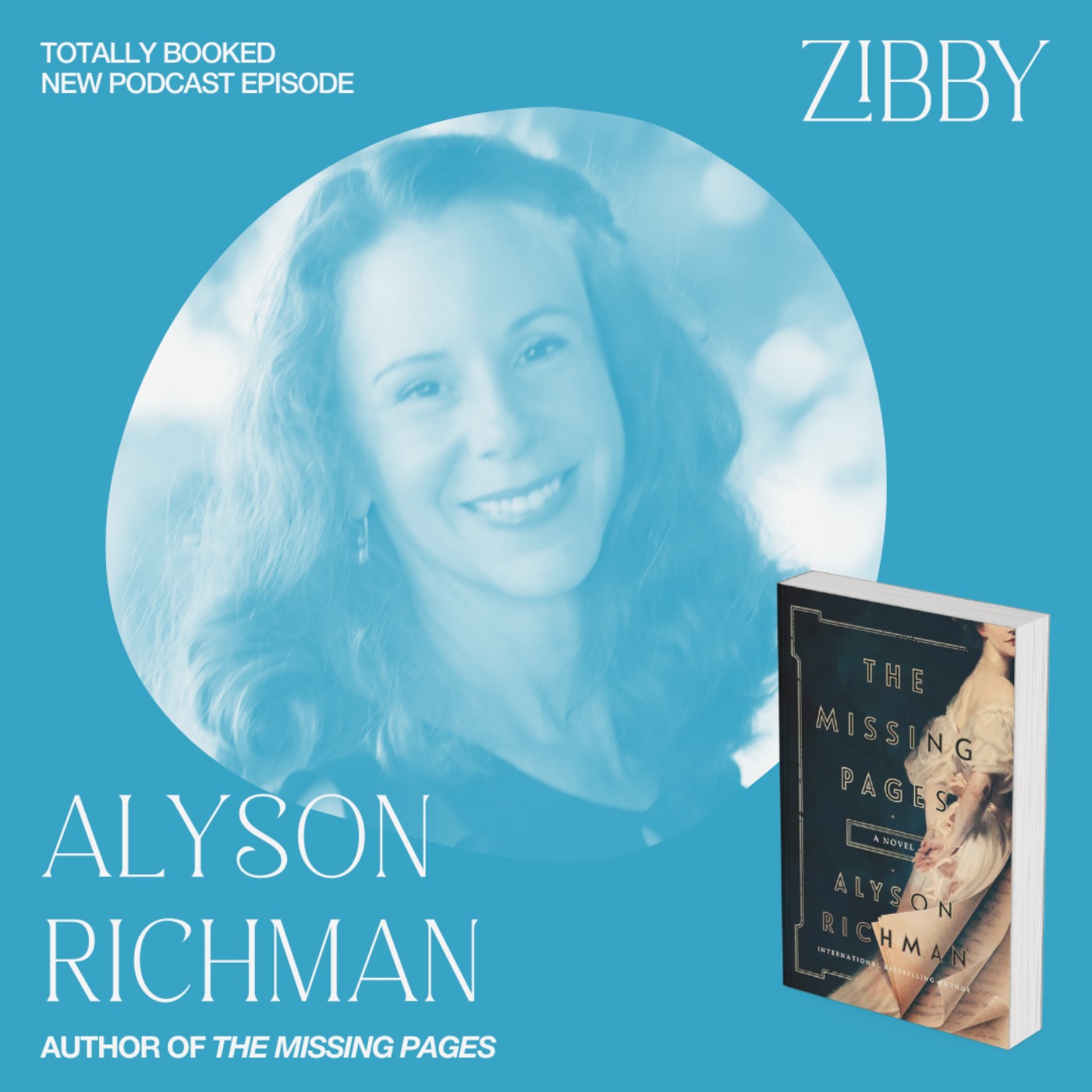
Alison Richman is the author of the Missing Pages. Alison is the USA Today and number one international best selling author of 11 historical novels including the Time Keepers, the Thread Collectors, the Velvet Hours, and the Lost Wife. Allison graduated from Wellesley College with a degree in Art History and Japanese Studies. She herself is an accomplished painter and her books combine her deep love of art and historical research. Allison's novels have been published in 27 languages and have reached the Bestseller lists both in the United States and abroad. She lives on Long island with her husband and two children. Welcome, Allison. Thank you so much for coming on. Totally Booked to discuss the Missing Pages. I was so impressed with you when we were both in Boca at an event together and I got to listen to you first. And I was like, oh my gosh, first of all, I can never follow you. This is crazy. And second of all, like, what a presentation. What a story. Oh my gosh. And I was like, how have I not talked to her yet? Anyway, so welcome and sorry for the delay essentially.
- [05:35]
Alison Richman
Oh, I'm so honored to be on your podcast and I just appreciate you helping me shine a little light on the Missing Pages.
- [05:42]
Zibby Owens (Host, Interviewer)
Not like you need to have a little light shine. This book has done so well. Your career is insanely impressive. So, anyway, okay, the Missing Pages. Tell everybody what this book is about, please.
- [05:54]
Zibby Owens
Sure.
- [05:54]
Alison Richman
So the Missing Pages actually is a historical fiction novel. It's inspired by the true life legend surrounding Harry Elkins Widener, who was a 27 year old book collector who perished on the Titanic. If you were to take a tour today at Harvard, you would learn that his mother, after he perished on the Titanic, taking with him a rare and precious book, created this beautiful library for him in his honor. And there is this special memorial room for him in which his 3,000 volume book collection is there, his original desk and chairs. And his mother to this day had in her behest that fresh flowers were to be put on his desk in order to conjure up the sensation that at any moment he might walk in, take a book from his shelf and sit down to read. So I take this legend and I have him tell in his own words, as a ghost inside the library that his mother built in his honor what really happened in those last moments of the Titanic, whether he did in fact go back for a book or whether he went back for something else. And there is a dual timeline with the Missing Pages about a young girl who is a student at Harvard who has suffered her own loss. And she is working as a page inside the Widener Library. And she believes that Harry's ghost is trying to communicate some. Some unknown chapter about his life that he wants her to discover. Wow.
- [07:21]
Zibby Owens (Host, Interviewer)
Well, first of all, the plot is amazing. The pacing, the suspense, like I was flipping madly to figure out, like, what happened and everything towards the end. So, ghost. It doesn't feel like a ghost story the way you would think of it, but it's actually just in part a love letter to books. But also this Titanic piece of it. I emailed you that the book was so good, it inspired me to rewatch Titanic start to finish, which I had not done in I don't even know how many years. So I watched it with my younger son and. Which, I don't know, maybe that was a mistake because it was kind of scary. But anyway. But just imagining then Harry Widener on the boat, he didn't get a part in the movie. I don't know why, really.
- [08:03]
Alison Richman
But, I mean, it's kind of crazy that he. His story hasn't really ever been explored either in film or in a book prior to the missing pages. He's such a, you know, sensitive and dashing figure, 27 years old, very close to his mother. I mean, the legend surrounding him. I should have said this earlier, but, you know, part of the legend is that his mother had room in his lifeboat, her lifeboat, and she was imploring him to get on with her, but that he told his mother that he had to go back to his cabin for this rare and precious book. So it's, you know, also a story. The missing pages you mentioned, it doesn't seem like a ghost story. And I appreciate you saying that because it's not a spooky story. What I wanted to do with creating a voice that is one of a ghost is give him the opportunity, as I said, to tell the story in his own words, but also to impart this soulfulness, this sense of how do we see people we love grieve after we die? How do we try and show them signs after we die that we're still around? And so that sort of sensitivity and soulfulness I wanted to put in the ghost voice, not to make it that he's hiding behind bookshelves trying to scare students at Harvard. Right.
- [09:19]
Zibby Owens (Host, Interviewer)
Well, you have a line sort of midway through the book from. Let me just read this passage, if that's okay. In the Lowell House Library room, Violet took the book out from her backpack. It was slender, no more than 100 pages. But as soon as she began reading it, the words felt like they were meant just for her eyes. And then in italics, you say, the dead do not die. They simply shift from body to spirit. But the spirit lives and breathes. Take it from there and talk. Also, I know you spoke at our event about your own personal loss and the signs that came to you and how that is a part of the book itself. Can you talk a little about that?
- [09:58]
Alison Richman
Absolutely. So one of the things I talked about when we were in Palm beach or Boca Raton, together was this sense that I really wanted to explore how the Soul continues. Marilynne Robinson says that the soul is the great mystery of the human being, unique to us. And so creating a voice of a character that I want my readers to feel tethered to. I mean, every single one of us, unfortunately, have suffered some sort of loss. And maybe it's too bold to say, but I would think that most of us are always looking for signs that the person who has gone to the other side is still very much around us. And so I hope I don't cry. I'm known for crying. I had this thing happened to me when my son was one year old. It was right at his birthday, and I went into his toddler bed to wake him up. And I was waking him up and he popped up and I said, happy birthday, Zachary. And when I turned my head, I noticed on his windowsill there was this white sparrow. I'd never seen a white sparrow before. Usually I think of them as being dark heathered brown, but its breast was completely white. It made me stare at it just because it seems so remarkable. And I said to him, oh, look at that beautiful bird, Zachary. And, you know, he was looking and the bird didn't go away. And so it was very strange because he kept on looking at my son. So I got him out of the bed and we went closer to the windowsill. And you would have thought that the bird at that point when he had two faces, like, pressed to the windowsill, that it would have flown away. And yet the bird did not fly away. And it continued to look at my son, and it's be kind of pressed against the window pane. And I just sort of paused and I said, zachary, I really think this is your Grandma Zelda coming to say happy birthday to you. And that bird probably stayed, and I am not exaggerating, a good five minutes with us before we actually had to get on with our day. And my son was 1, and he didn't want to stare at the bird anymore. But when I was writing the novel, I was trying to think of ways to show how Harry Widener tries to send those he loves signs from the other side. And to me, the most moving passages are, you know, for example, the scene after his mother is grieving in her home at Linwood hall and she can barely get out of bed. The maid pulls the blinds, and on the lawn she sees, you know, all these different birds who have come to sort of, you know, basically perch there. And it's so strange. There's cardinals and there's blue jays and everything that it feels almost like a miracle. And when Eleanor Widener comes the window, she knows in her heart that this is so strange. It has to be her son. But you also see the first person narrative of how he's desperate to show his mother that he has not left her, that his energy has surrounded her. So he summons the birds and he has this power to do it. And so that's. I think the beauty of being a novelist is that you do have magic at your foot, you know, fingertips, to be able to create these scenes. But I wanted those scenes to touch you, to think all the things in your life where you might feel that someone you have lost is around you and to believe that that wasn't an accident.
- [13:14]
Zibby Owens (Host, Interviewer)
Oh, I love that. I have signs for lots of key people in my life. And I was actually this morning thinking, like, what would my sign be? Do I get to choose? Like, could we, like, have a go plan with the kids? You know, like this.
- [13:29]
Alison Richman
I thought that the other day I saw, like, I get ladybugs in my house every time right before it becomes spring, they just appear. There must be nest somewhere. And I always make a big deal to the kids, like, oh, the baby ladybugs are out. And I think, I'm going to be a ladybug for my children.
- [13:44]
Zibby Owens (Host, Interviewer)
I already have. Ladybugs are taken already. For me, they're already my friend Stacy, so we can't do that. And rainbows are my mother in law. And, you know, anyway, I needed to find something unique.
- [13:53]
Alison Richman
Books. Books falling off the shelves.
- [13:56]
Zibby Owens (Host, Interviewer)
Books falling off the shelf. Okay, yeah, that'll wake them up. That'll wake them up. Speaking of books, you write so beautifully about books in this book that takes place in a library. So there is so much bookish joy to be found in here. And I just wanted to read one more line about that. You write early on. You say, it was my mother who revealed to me the world that existed in the inches between the reader and the writer, where two souls could mingle without ever touching. She believed a good book spoke through you. Love that. Oh, my gosh. All right, tell me about your love affair with books, because there must be some of that in you to infuse the book with all of this love and joy.
- [14:37]
Alison Richman
Well, you know, probably much like you, Zibby, I loved to read from a very young age. Books became my solace. You know, there's a joke in my family. Every time I was naughty and my mother sent me to my room, I was, like, delighted because Then I just had time to sort of, you know, read books. You know, she'd say she'd peek into the bedroom, and I'd be, you know, have my feet crossed, and I'd have a book, you know, in front of me. And I was like, this is not a form of Totally.
- [15:00]
Zibby Owens (Host, Interviewer)
I was like, wait, that's. That's my punishment. That's what I would have chosen to do anyway.
- [15:05]
Alison Richman
Yeah. I actually wonder if, like, I. Knowing that would be my punishment, that I did, you know, these things with my. Gotten to fights with my brother, just, you know, to be incarcerated in my room with my. My library of books. And I also played librarian. You know, I. I would put all my books and make, you know, take index cards and do checkout times and have my brothers come in, and I try and match them with a book and, you know, tell, you know, stamp it and all these things. I loved books from an early age, and I guess to be a little bit personal, I always felt a little bit like an outsider. And when I found a book that I loved and a character spoke to me or a book moved through me, it gave me sustenance. It gave me something to always have. My mind is very active, so to be able to always have a narrative in my head, it formed who I am. And as a writer, I've never written a book before that is, as you mentioned, like a love letter to books and what it means to be able to surround yourself with bookish people. So we see Harry Widener in, you know, through his own eyes, describing how he comes to become an antiquarian book collector. His junior year at Harvard, he walks into Rosenbach's shop in Philadelphia. ASW Rosenbach was a premier, a Gilded Age bookseller. And he starts to learn the book trade through Rosenbach and starts to acquire books, to increase his library and to make bids in very competitive auctions for rare books. And I loved creating those scenes. I love showing how Harry, as he becomes this young adult, starts surrounding himself with people who are his people. And he falls in love with this young woman who works at Quaritch limited in London, which is a bookseller that exists to this day. They are the ones that sold Harry the Little Bacon, which is a book of Francis Bacon's essay, so small it was the size of a baseball card. And that's part of the legend that he went back for that particular book. And so I learned when I went to Quaritch in London to read his letters, to kind of capture his voice and the correspondence between him and Bernard Quaritch and subsequently the letters from Bernard to Rosenbach, that Quaritch actually had a sister and her name was Charlotte Quaritch, and she was a gilded age female bookseller. She worked in her brother's store. It was actually their father's store. She took over after her brother died. So I create in the missing pages Ada Lippenhold, who becomes this love interest for Harry and for me, she's the ultimate book heroine. You know, she loves to read, she's sassy, she knows her own mind. She doesn't want to be a trophy wife. She wants to have a career. And yet that's grounded in fact. It's not stretched out of, you know, the ether. It's someone who really was living in 1912, who loved books, who was working and trading in them. And I just, just love doing that.
- [18:03]
Zibby Owens (Host, Interviewer)
That's so fun. I love how Harry was late to their date and she's like, okay, well just meet me at my, you know, ladies hotel at like the Barbizon or wherever it was. Like, just come to the dining hall and like the one guy there in the sea of women and she's like, you can handle it.
- [18:18]
Alison Richman
Yes.
- [18:19]
Zibby Owens (Host, Interviewer)
Wait. Backing up. What made you feel like an outsider?
- [18:23]
Zibby Owens (Host, Sponsor Segment)
Today's episode is sponsored by Wayfair. The new year is here. It's time to get back into an at home routine that you love and you can elevate your space with Wayfair. As you all probably know, Wayfair is like my favorite brand and I actually have a whole new storefront that I put together of all of my favorites, which you can check out on my Instagram and then go to Wayfair.com to explore. From bedding and mattresses to storage solutions for every room in your house, Wayfair is your one stop shop. Refresh your living room with accent pillows, mirrors, and even faux plants for way less. I've refreshed some of my kids rooms with carpets and mirrors and blankets and it's so easy and convenient. Everything that Wayfair has for your home is easy to find and there is a huge selection. Get organized, refreshed and back on track this new year. For Way less. Head to Wayfair.com right now to shop all things home. That's W-A-Y-F-A-I-R.com Wayfair Every style, every home. And don't forget to check out my storefront.
- [19:35]
Equip Health Representative
We live in a culture obsessed with dieting, weight loss and exercise. And that can make eating disorder behaviors easy to miss. But the reality is eating disorders are serious mental illnesses that take a major toll on your health and your life. But recovery is possible. Eating disorders are more common than you might think. Chances are you know someone who is struggling with one, or maybe you're struggling yourself. If you're concerned about an eating disorder in yourself or a loved one, I want to introduce you to Equip. Equip is a fully virtual evidence based eating disorder treatment program that helps patients achieve lasting recovery at home. Every Equip patient is matched with a multidisciplinary care team that includes a therapist, dietitian, medical provider, and mentors. And you get a personalized treatment treatment plan that's tailored to your unique goals and challenges. Equip treats patients of all ages and all eating disorder diagnoses. It's covered by insurance and there's no wait list. If you think that you or a loved one could be struggling with an eating disorder, don't wait to get help. Visit Equip Health to learn more. That's Equip Health.
- [20:41]
Sarah Gibson Tuttle
Who here loves when their nails are done perfectly? Me. I'm Sarah Gibson Tuttle and I started Olive in June because let's be real, we all deserve to have gorgeous nails. But who wants to spend a fortune or half their day at the nail salon? That's why I created the Gel Mani system so you can have that salon quality gel manicure right at home. And guess what? The best part, each mani only costs $2. Yup, you heard me, $2. No more. 60, 70, $80. Salon trips that eat up your day. Now you can paint your nails whenever you want, wherever you want. And trust me, you're going to be obsessed with your nails and everyone is going to ask you where you got them done. And here's a little something extra. Head over to oliveandjune.com and get 20% off your first gel mani system with code DIYGEL20. That's code DIYGEL20 for 20% off your first mani system at oliveandjune.com DIYGEL20.
- [21:37]
Alison Richman
So it's interesting, I kind of feel like I'm always the outsider. I grew up in a very, very small town called St. James on Long Island. I was the only Jewish girl in my whole grade at public school. I was always in the clouds, always reading. I had two brothers who were very different than I am. I just, I don't know. It's just, you know, I think then when I went to high school, I went spent part of my high school in Japan. And so here I was this like five foot nine, red haired, like giant walking through the streets of Japan, also always feeling like an outsider. So I think a lot of my life I've always been the person outside looking in. And that lends itself to being a writer because I think your observation skills are so important to creating fiction where people can see what you're imagining and feel what you're imagining. So I think it ended up being a good thing. But I think that when I look back of how I developed that sense of never being part of a big group is sort of defined me and probably made it easier for me to spend all my time just in front of a computer writing.
- [22:47]
Zibby Owens (Host, Interviewer)
Do you feel you're an outsider now? I feel like you're so part of the author community. And do you feel. Do you still feel that way or not?
- [22:56]
Alison Richman
I feel one foot in, one foot out, I suppose. And I don't know if most writers feel that way. I'm also someone who, I don't know, I feel everything is very fragile. And at any moment anything could sort of come undone or break. And so there's a natural tendency. Tendency for me to sort of cocoon myself. And I, you know, I think that is part of book building when you're. When you, you know, just to put it back more on books and not in. Since there.
- [23:23]
Zibby Owens (Host, Interviewer)
Sorry about that. Sorry, I can't help. I can't help myself.
- [23:27]
Alison Richman
Allison.
- [23:28]
Zibby Owens (Host, Interviewer)
I just need to dig.
- [23:29]
Alison Richman
You're a great journalist as well. I think this sense of how do you build a world from the first sentence to the last, that it's your world that you created and that you have control over it when we all know there is so much outside of our control on an everyday basis. And so I love that. That's the one thing in my life I can't control. You know, I'm always scared something's gonna happen to my children or something's gonna happen to someone I love. And that in a book, when you are writing it, you make the decisions, you have that ultimate authority. And that is such a gift, you know, and I think, you know, to have in your career to that. When you're working on something, you have that. Yeah, you're in the. You're in the. You're steering the ship. Ship. I do love that about writing Titanic. Hopefully I won't crash any icebergs, but I do like that. And I think that probably would be an interesting podcast to see how. When you have a panel of authors, their childhood and their experiences, how does that shape them to become a writer, because you do have to sit in front of a computer every day and you have to kind of love it. If you didn't like it, I mean, you'd be pulled away and you'd never get your manuscript done.
- [24:38]
Zibby Owens (Host, Interviewer)
Oh, I have lots of views on this because I have an essential 2,000 plus panel of authors who have. I think the most common characteristic of authors is anxiety. And how do you work through that? I think many authors, myself included, if I may have approached the world from one step back, observing all the time. And that's how you can tap into that?
- [25:05]
Alison Richman
Yeah. Yes. I mean, like a sense of also that catastrophe is imminent. So writing a book about Titanic, it just was perfect for me because my husband always jokes that, do you just think of the worst thing possible? That can always happen.
- [25:19]
Zibby Owens (Host, Interviewer)
My husband jokes that too. I'm like, yes, I need plan B.
- [25:24]
Alison Richman
Plan C, plan D. Yeah, I don't.
- [25:26]
Zibby Owens (Host, Interviewer)
Even think I make enough plans. I just like, imagine the worst.
- [25:29]
Alison Richman
Well, there's never enough plans to be.
- [25:31]
Zibby Owens (Host, Interviewer)
I mean, that's true, that's true. I don't know. Just stay super busy and not think about it. What are you working on now?
- [25:41]
Alison Richman
So right now I'm working on a book about Edith Wharton's time in Paris during World War I, where she basically was responsible for a transport of several thousand Belgian children to Paris during the devastation of the Belgian border. And she set up these hostels, almost these shelters for children and had lace schools in them in order to teach lace making so that the Belgian skill would not die with all the destruction that was happening in Belgium. So it's a story about her humanitarian work during World War I. And then there's a dual timeline about the Mount, her country home in Lenox, Massachusetts, and their pursuit to get her existing library back on their shelves in 2005 and how that happened. So it explores different angles of her library and also her work during World War I that people. A lot of people don't know about.
- [26:33]
Zibby Owens (Host, Interviewer)
Wow, I love that. Have you ever been spilled on at a book festival, aside from the one we were at? Or is. Was that the only time.
- [26:42]
Alison Richman
That was the only time at a book festival that I had a tray of ice cold water spilled upon me.
- [26:49]
Zibby Owens (Host, Interviewer)
Oh, my gosh, I felt so bad for you.
- [26:51]
Alison Richman
And as you know, it was funny because after you. After it happened and you said, I'm glad it wasn't hot water. That's true. Like, I would have, you know, that would have been really devastating. And in the case of the water soaking my Dress. I wasn't wearing white, so, you know, I was lucky for that. It was cold. And I did have a dress in my suitcase in the. In the green, green room. But, you know, there's always something that can happen. You have to be prepared.
- [27:13]
Zibby Owens (Host, Interviewer)
Well, you had the best attitude about it. And, oh, my gosh, we were sitting, like, I don't know, five feet apart, and I just, like, watched it in slow motion, like, no, I can't believe this is happening.
- [27:24]
Alison Richman
That was something that definitely had never happened before. But I'm trying in my old age not to expend energy getting up, you know, upset about things that actually aren't such a big deal, you know, so it was okay. I had time to change. Right? It was all right.
- [27:38]
Zibby Owens (Host, Interviewer)
And you had already given your talk, which is.
- [27:40]
Alison Richman
Yeah, that's true.
- [27:42]
Zibby Owens (Host, Interviewer)
Lots of. Lots of bonuses to be found on a given day. Now, if you lock yourself in your bedroom, just like when you were young, what would you be reading? What would we find you reading?
- [27:52]
Alison Richman
Am I child or it's now.
- [27:54]
Zibby Owens (Host, Interviewer)
No, I mean, like, I just meant I'm fast forwarding you on the bed as a kid and now, like, fast forward to you, like in modern day.
- [28:01]
Alison Richman
Yeah, so what. I mean, what I tend to read when I'm. For pleasure, when I'm by myself in my room, is literary fiction. I'm always looking to sort of up the ante in how I craft the language of my books. I'm not so interested necessarily in plot, learning about plot, because then I would, you know, I don't want to steal anything from anyone, but I love language so much. And my first, you know, love was actually painting. My mother is an abstract painter. And so I came to writing just because I ended up being an art historian, art history major in college. And all of my professors kept on saying, you know, you have a real gift for bringing the painting alive, telling the story behind the painting. And I love to do that because I love putting, you know, subjects in historical context, looking for clues, researching, you know, what people were wearing at that time. The. The psychological relationship between artist and muse. All of that I loved and lended to me to building out a story. But I love. I love things that are visual. I feel like when I'm writing one of my books, I love to make it very sensory rich that you can feel, that you can smell everything that's wafting through the pa, you know, that I'm describing. If Harry Widener's mother is creating a party on the last night of the Titanic that you can Smell the perfume. You can smell the food that's being served. You can feel the rustle of silk. You know, you can see the shimmer of stars against the dark, black sky. That, to me, is a way of painting with words that I love to do. And so to go back to your question, when I'm reading, I love to find someone who. Their visual field speaks to me. So when I am reading them, it comes alive. And I feel immersed in that landscape that they create and that texture and palette that they have that's unique to their style of writing. That's what I love to do. So I'm reading now a book by Lucy Steeds called the Artist and the Feast. And it's a debut. I mean, I should just retire now. It's so beautifully written. I'm just humbled as an author when I read it. So perhaps there's a little masochism in what I read because I love things that are so good that they humble me and they make me feel, you know, that I have to work even harder with my next book.
- [30:13]
Zibby Owens (Host, Interviewer)
I don't think it's masochism. I think it's motivation. It's motivation and inspiration and something we all need. So do you have any advice for aspiring authors?
- [30:25]
Alison Richman
So my advice to aspiring authors is don't make writing daunting. Don't make it, you know, your first book, be Mount Everest, that you have to climb it every single day. I think for me, and when, I mean, don't write, tackle it every day. I don't mean not don't write every day. I mean, don't feel that you have to reach the, you know, the highest point every day. I think for people who are starting out, the most important thing is actually consistency and saying to yourself, you know what, I'm working a full time job, or I'm a mother of three kids and I don't have that much time to write, but I have a story inside me to then just say to yourself, I'm going to write for 30 minutes every day, or I'm going to write 500 words every day or 100 words every day. Make it something that you think you actually can achieve. And slowly, I mean, you know, because you're a novelist as well, that, that it's the building blocks of a story, and the building blocks can be very small, but eventually it gets completed. So you just have to stick with it and do it. And sometimes I have to say that to myself, Allison, you have to write one page every day now for the next two months, and then you're going to have the last 30 pages that you need. But that discipline to just do it and not expect it to be perfect. I think sometimes we just have to be a little easy on ourselves.
- [31:44]
Zibby Owens (Host, Interviewer)
Love that. I need that advice. And, you know, just as a last parting thought, Harry Widener's mother built him this beautiful inner sanctuary of part of Widener Library, this office within the larger collection, which he also brought to life. And all of that which you. Speaking of creating art with pen or paper, you brought this whole thing to life as well. For me, if there was a place that you could craft to honor yourself, what would it look like?
- [32:17]
Alison Richman
Oh, my God. That is a really wonderful question. You know, part of what I'm going to answer kind of dovetails to the fact that when Eleanor Widener built the Widener Library, everything outside Harry's memorial room is basically white marble. And the central room, when you walk into the vestibule and you see it from the staircase, it's done in this varnished oak. You can see his portrait illuminated by a light. It really feels like the beating heart of the structure. It's warm, it's in contrast to the white. So, for me, I would want to be able to create a room. I mean, it sounds a little bit macabre, but I would love my children to still live in the house I live in now, and I would love them to have a room that was a library that has not only books that their mother wrote, but all of the children's books that I've ever read to them. And I would want. I would want the books that I have that I write, doodles or things about that I want in my novels to be in there so that my beating heart, my soul, was still part of this house, that I hope they'll use the country home at some point, but just this sense that I still live and that my heart still is in that structure. So I might be pulling from Eleanor because obviously, obviously, he. It's a library room within a library. But I think it's a beautiful way to end our talk, that books are a reflection of who we are. And inside those pages, we do put a bit of our soul. We do put our thoughts and our dreams, our fears. And again, I don't want to be a downer, but there is something beautiful to know that when I am no longer here, my books exist. My voice is on those pages. And I think even if no one in the world is interested them, I hope my children, my grandchildren and great grandchildren will look back at what I of parts of me that are on on a page and feel that I'm still alive with them, that I still speak to them, and that I haven't really gone too far.
- [34:28]
Zibby Owens (Host, Interviewer)
So nice. I'm also a crier. All right, well, thank you so much, Alison. Sorry to dig deep. And it was fun.
- [34:38]
Alison Richman
It was fun. And I think it's, you know, it's appropriate because this book is, I mean, as we said, it's about the sou. It's about what makes us unique. And we all have a story, as you know. You know, story of how we came to write stories. So I appreciate everything you do in the world. So thank you, Zibby.
- [34:54]
Zibby Owens
Thank you, Allison. Thank you for listening to Totally Booked with Zibby, formerly Moms don't have Time to read Books. If you loved the show, tell a friend, leave a review. Follow me on Instagram, Iby Owens and Spread the Word. Thanks so much.
- [35:09]
Zibby Owens (Host, Interviewer)
Oh, and bye.
- [35:09]
Zibby Owens
Buy the books.
- [35:17]
Podcast Advertiser / Narrator
Hey, listeners, meet Russell.
- [35:19]
Alison Richman
Hey.
- [35:19]
Podcast Advertiser / Narrator
Russell just launched a fitness app, and he needed to get the word out to busy professionals looking to stay fit. So I turned to acast. I used their Smart recommendations feature to easily find shows that talk about health and fitness. Booking sponsorships through their platform was a breeze, and just like that, my app was in their ears during their morning run. Sounds like a smart move.
- [35:39]
Sarah Gibson Tuttle
Russell.
- [35:39]
Podcast Advertiser / Narrator
Russell, how's business looking now? Sweat is pouring, and so are the installs. Spread the word about your business with podcast ads on Acast. Start today at go.acast.com advertisement.