← Totally Booked with Zibby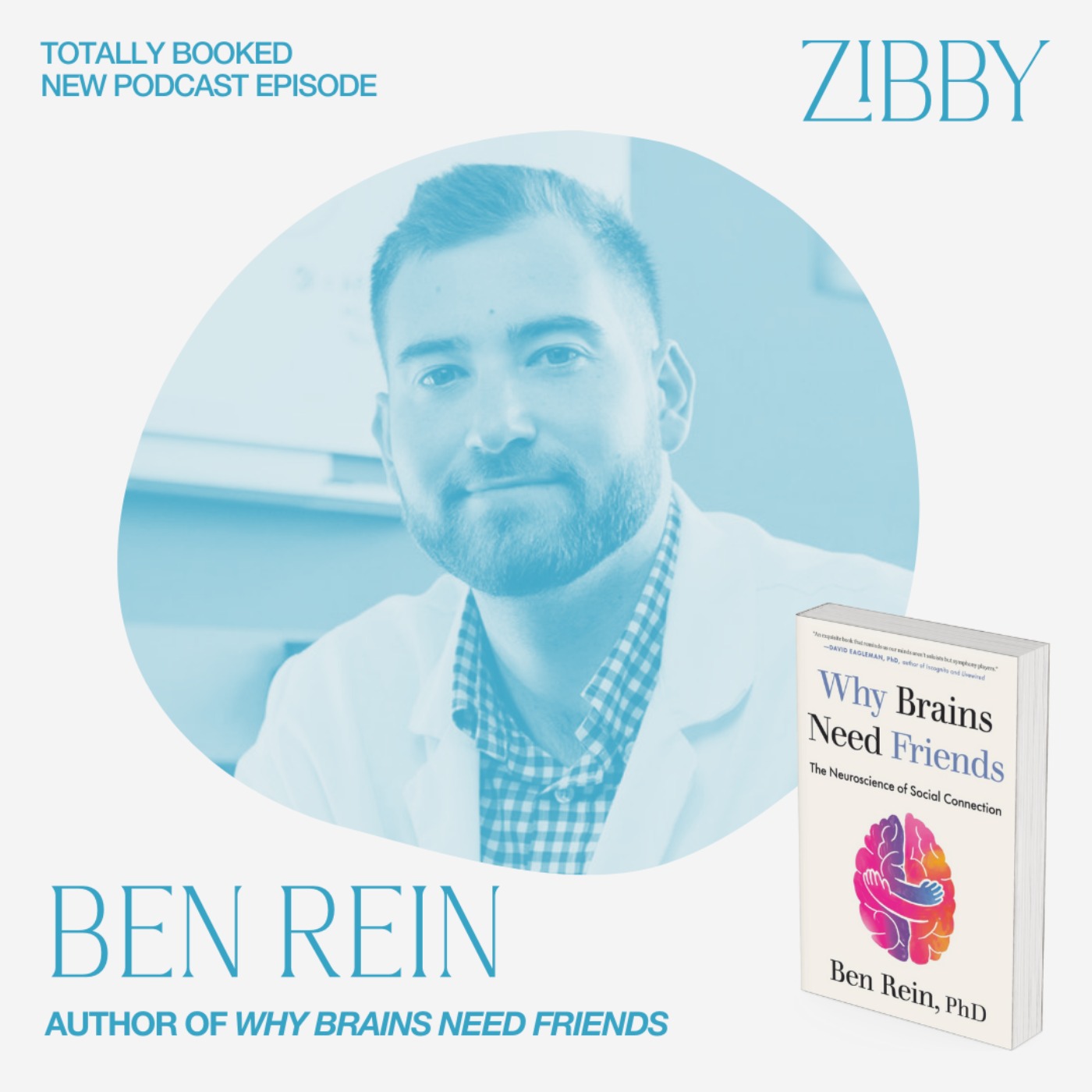
Totally Booked with Zibby
Ben Rein, PhD, WHY BRAINS NEED FRIENDS: The Neuroscience of Social Connection
00:29:47
Loading summary
Transcript50 lines
- [00:00]
Narrator/Ad Voice
Did I talk too much?
- [00:01]
Ben Rhine
Can I just let it go? I wish I would stop thinking so much.
- [00:06]
Sponsor Voice
Take a breath. You're not alone. Counseling helps you sort through the noise with qualified professionals. Get matched with a therapist online based on your unique needs and get help.
- [00:16]
Zibby Owens
With everyday struggles like anxiety or managing tough emotions.
- [00:20]
Sponsor Voice
Visit betterhelp.com randompodcast for 10% off your first month of online therapy and let life feel better. A PSA From Instacart It's Sunday 5pm you had a non stop weekend. You're running on empty and so is your fridge. You're in the trenches of the Sunday scaries. You don't have it in you to go to the store, but this is your reminder you don't have to. You can get everything you need delivered through Instacart so that you can get what you really need. More time to do whatever you want. Instacart for for one less Sunday Scary. We're here.
- [01:00]
We all love our pets, but we love to travel too, and sadly they can't always come along for the ride. Don't stress. Trusted Housesitters connects you with verified sitters who'll stay in your home and care for your pets, all in exchange for a place to stay on their travels. So while you're off exploring, your pets get to stay safe and happy at home, right where they belong. Find a loving in home pet sitter today@trustedhouse sitters.com.
- [01:33]
Zibby Owens
Hi, this is Zibby Owens and you're listening to Totally Booked with Zibby, formerly Moms don't have Time to Read Books. In my daily show, I interview today's latest best selling, buzziest or underrated authors and story creators whose work I think is worth your time. And as a bookstore owner, publisher, author and obviously podcaster, I get a comprehensive look at everything that's coming out and spend my time curating the best books so you don't have to stay in the know. Get insider insights and connect with guests like I do every single day. For more information go to zibbymedia.com and follow me on Instagram. Ibbeowensk Ben Rhine is the author of why Brains need the Neuroscience of Social connection. Ben Rhine, PhD, is an award winning neuroscientist, Adjunct professor at Stanford University, clinical Assistant professor at SUNY Buffalo, Chief Science Officer of the Mind Science foundation, and a renowned science educator. Dr. Ryan's research focuses on the neuroscience of social interactions and outside of the lab. He also teaches an audience of more than 1 million social media followers. Dr. Ryan and his Research have been featured on major media outlets, including Entertainment Tonight and Good Morning America. And he has received awards from the National Academies of Sciences, Engineering and Medicine, the Society for Neuroscience, and elsewhere. Welcome, Ben. Thank you so much for coming on. Totally Booked. I'm so excited to talk about why brains need the neuroscience social connection. I am obsessed and have been talking to everyone who will listen about various parts of the book since I read it. So congrats and welcome.
- [03:15]
Ben Rhine
Wow. Well, thank you. That means so much. Yeah, I appreciate that. Thank you for having me. Thank you for all you said about the book. And maybe you hear this often from those you have on the show or authors in general, but I'm in this sort of strange purgatory space where my book's not in the real world yet, and so only a few people have read it, and you're one of the people. So to hear positive feedback really means a lot because I'm in this fearful state. So thank you. And I can't wait to dive into these questions. You have.
- [03:40]
Zibby Owens
No, it's period of time very well. And it is great. And I was talking it up to. To even my colleagues at work, and I was like, so he starts it off by saying he doesn't believe in jargon. So even though neuroscience is on the COVID don't be intimidated by that. It is totally consumable for the masses and takes very complex concepts, explains them, and makes them relevant to everybody. So, yeah. So why don't you. Why don't you start off by explaining a little more about the book in general and why you decided, why you researched this, why this is an area of interest. I love all the backstory of you and your intellectual and sort of educational pursuits leading up to this. Why do you care so much about it?
- [04:21]
Ben Rhine
Yeah. So for those who are meeting me through this podcast, I'm a. My name's Ben. I'm a neuroscientist, and I studied the neuroscience of social interaction, and that's putting it broadly. More specifically, I've studied things like the neuroscience of autism Spectrum disorder or the neuroscience of empathy, these various things that are associated with social behavior. And so in my. Well, starting in my life when I was young, I've always been interested in why everyone is sort of different socially. Why are some people really extroverted and some people are really shy and reserved, and they don't really like interacting where for others, it's like the best form of nutrition that could feed their brain. I've always thought that was fascinating. And that's how I landed in my career. I just described that I'm studying this on a neuroscience level and there's a whole story behind that that of course I talk about in the book. But I'll leave that out for now unless you want to dive into that. But the reason I wrote this book is because we've become aware, most people have become aware of this issue we're facing, that we're more isolated than ever before. People have fewer friends. This loneliness epidemic, smoking or being isolated is as bad for you as smoking 15 cigarettes a day. We keep hearing all this stuff, but I don't think people really truly understand what's at stake. In the same way that maybe people understand you shouldn't eat an unhealthy diet or you shouldn't, you know, get two hours of sleep a night or you know, all these different things that are kind of fundamental pillars of health and well being. People have a general grasp of it. But socializing, I kind of feel like is, is underserved from the neuroscience perspective. You know, what does it really do for your brain? Why is isolation so bad for your, for your brain? Why is it as bad for you as smoking 15 cigarettes a day? What does that even mean? Like, what is that referring to? And so, you know, I am an extrovert. I really, I get a lot of joy and pleasure in my life from socializing and I'm even better served by that knowing that from my neuroscience background that it's good for my brain. And I just want everybody to understand this. And, and I'm a science communicator. And by that I mean I share science with the masses. I try to get people to understand neuroscience. And so I present it in a way that anybody can understand in short form videos on social media. And you know, I've had a five plus year journey with that now. And I've come to realize how separate from society science can often be and the negative effects that can have on science's relationship with society. So I wrote this book for anybody to understand. I mean, I want this message to resonate. I'm so glad Zivi to hear that it has with you. And yeah, and like you mentioned, the very first page that you open to is my no big words clause. I basically say there's, there's just too much jargon in science. It's totally not necessary. Anything that you use jargon for can probably be explained. And if I have to use jargon in the book, I have an appendix explaining that stuff. So it's, it's really Meant for anybody. And yeah, so thank you for your review of it and positive feelings.
- [07:07]
Zibby Owens
I took the quiz and I never knew 100% if I was an introvert or an extrovert because I really do like my time alone and all of that. But as it turns out, I'm a total extrovert. I mean, I do talk to people all day, but I prefer like this type of one on one interaction. Anyway, I was off the charts on your little quiz, so anyway, that was enlightening for me to learn about myself. Some of the things that I keep repeating to people are just little tidbits that I found and not one of, like, necessarily the bigger concepts, but they illustrate a concept. For example, the creativity challenge of Zoom itself. And here we are on Zoom, and you talk about how, because we are so focused in this medium on each other and just this little square, we aren't taking in the signs and signals around us. And actually, if you have a brainstorm on Zoom with your colleagues versus a brainstorm with people in an actual place, you're foregoing all of the signals and inputs you're getting just from like, looking around the room and hearing things and smelling things and getting all of that. So that actually you're much better off brainstorming or doing anything creative with a group off of Zoom and in person. And now there is a reason why instead of just saying, oh, it's better when we're in person, there's evidence as to why it's better to work in person.
- [08:24]
Ben Rhine
Yeah, yeah, absolutely. I mean, the truth is, probably this podcast would be better and more interesting if we both walked around the rooms we're in right now. Or, I mean, if we were in the same room, ideally. But, you know, if we were, you.
- [08:35]
Zibby Owens
Can, you can just go walk around your room right now and just carry my, my, just carry it around. I'll wander around here and we'll see how it gets.
- [08:41]
Ben Rhine
No, but that, yeah, it's so interesting because, you know, a little more detail on the study that you're referring to. They found that basically, yeah, people were less creative when they weren't meeting on Zoom. And, and they thought, yeah, maybe it has something to do with the fact that we are collapsing our attention into this, you know, rectangle on a screen. It's not, it's not lifelike. And so as we collapse and focus our attention, maybe we're also sort of restraining our creative thinking. And so what they did is they actually, they counted how many of the props that they placed around the room. People noticed and, and they found that the more props people noticed around the room so that, you know, therefore the more, you know, they engage with their surroundings, the more creative they were in this brainstorming. And the people on Zoom noticed much less of their surroundings. And yeah, I think it's, it's fascinating. I actually, I posted a video about that on Instagram and TikTok and unfortunately there were a lot of people commenting and saying things like, oh, like you've been bought by big business. Like they, they want us back in the offices. I'm like, no, no, this is just unbiased science. But yeah, it's, I mean, it's fascinating. And that, and that of course lines up with much of the other research I share in the book about why in person is best when it comes to socializing.
- [09:52]
Zibby Owens
Yes. And how even what might be thought of as insignificant interactions are actually hugely important. And all that, of course we all know, was lost during COVID But the day to day interactions of checking out or checking out of a store or returning something or passing someone on a bus or whatever, all those things are so crucial to us as human beings. And yes, as you've explained, we've adapted to learn without them and that we've learned that it's okay, we're just going to text, we're just going to do it online, that it doesn't necessarily mean it's good for us or better. And you gave the example of like not sleeping many hours. Yes, we can adapt to it, but like it's not the best.
- [10:32]
Ben Rhine
Right. Yeah, I mean, and that, that is, I think, what's been happening. I think for many, many reasons we have been sort of receding away from one another. And it starts with, you know, a lot of this daily interactions that we're missing. Like you described, you know, we, we've we've become very good at automating pretty much everything, you know. And you go to the bank, you used to talk to a teller. Now it's an automated teller machine. Right. Atm. You call the bank and there used to be a person. Hello, how can I help you? No, now it's a press one for this department. And on and on and on. You can basically point to any structure of society that has been. And everything's been automated. And I don't think that's good. I also think aside from the fact that that is causing us to spend less time interacting, it's also probably impairing our sense of community and belonging. Because when you go to the grocery store or whatever and you Talk to the butcher and they, you know, they chop you up some meat to bring home and you talk to them for a couple of minutes, you get that sense of, okay, hey, I have like an ally here. I have a person in my community that I didn't know was on my team. But in a two minute conversation, we found some things in common. And that's so comforting for your brain, right? It tells your brain you are safe, you are protected, you are among friends. And when we lose that, and especially when we're seeing all this very divisive, hostile content on social media and all these videos meant to be inflammatory, and that's becoming the way that we engage with society more and more. I mean, that is doing very serious damage to our sense of belonging and our place in society. And in the conclusion of the book, I tell the story of this, like, incredible day where basically everybody treated me amazing for no reason. And it was this like, transformative experience where I came out of it feeling like I was proud to be human. And that was such a strange feeling because it made me realize, oh, I had kind of lost sight of that. I was sort of not proud to be human anymore. And when these people taught me and showed me what it's like to be kind and loving and caring just by nature, it made me reconnect with that. And I think that everybody deserves that experience.
- [12:40]
Zibby Owens
Well, I love actually the end of your book because. Can I just read something from that? Because I feel like this is my philosophy. This is my philosophy. This is like how I have come to understand the world as well, but I've never seen it with a whole book to support it and then as a conclusion as opposed to just, yeah, I think love is like really important and like, this is why we're here. But not to spoil, you know, some of the outcomes of your research, but you said while writing this book, I came to a major conclusion about the meaning of life. I think that love, social connection and relationships are why we're here. I know, I know this may sound ridiculous, but hear me out. We humans were placed here by some force. It makes no difference whether you believe that force is evolutionary or religious or something else. The important question is, what keeps us here? What gives us a will to live? What kept our ancient ancestors from feeding themselves to nature? And what stops us from, from lying down and never getting up? To succeed as a species, we must be motivated to stay here and remain alive. There must be something that makes us want to exist and enjoy existing. And I believe that something is the Love we have for each other without the joy we experience from our social bonds, would life be worth living? There's nothing more powerful than the love for a child, a partner, or a best friend. For many, the thought of leaving these people behind is too painful. And to embrace death. Research supports this idea. There, There it is. Meaning of life. Boom. It can all go on with your day. This is it.
- [14:07]
Ben Rhine
Allow me to just say that was like a personally special moment for me just now, like, here. I haven't heard anyone read a section of my book before, again in that strange purgatory. And that really meant a lot to me. So thank you for sharing that.
- [14:19]
Zibby Owens
You're welcome. No, it's so true. Because what else is there? I mean, you also go into all of the psychedelics and how with some drugs, like, you literally feel. Feel like you are one with the universe and like, you are the truth. There is no boundary for the ego, Boundaryless ego or whatever. And so what does it mean to be part of the universe? What are we doing here? What does. What are our brains even doing? Like, what are we doing here? So I appreciated the synopsis. You know, simplistic, yes, but, like, profound. Really profound.
- [14:51]
Ben Rhine
Yeah. And I tend to think of life that way. I mean, when you really take a step back, and this is something I hope that my book does for readers, is it forces you to take that step back and look around and think, my gosh, almost everything about our existence has some tie to social nature, like our social nature and social interaction. And, you know, at the core, what you just shared, you know, this sort of meaning of life. I mean, what would life be without love in these relationships? And on the other end of that, you know, there are people out there who, you know, commit acts of harm and hurt others because either they're protecting their group or they're, you know, trying to eliminate a rival group. And there's almost anything that happens in the world can be tied back to relationships. And, you know, and I also think it's funny, if you look at how we spend our time, this is another one of those, like, zoom out moments where it's like, oh, yeah, the way we spend our time. I mean, aside from socializing, we might spend our time alone at home. Well, what do we do? We like to scroll social media and look at content from other people. If we watch tv, we are watching usually stories about social interaction, right? There's some sort of social. There's never, almost never a show or a movie that's about one person by themselves. The whole time. And if it is, it's like a survivalist thing, right? The storyline is always about.
- [16:11]
Zibby Owens
I've seen one of those. Yeah, they do exist longer side but anyway, keep going.
- [16:17]
Ben Rhine
But yeah, the storyline about with movies and TV shows is usually about, you know, two groups competing or one person, you know, rising through their life and dealing with challenges with other people or romance with other people. Like you can always find the social nature and everything. And I just think that when you start to recognize that, it really changes the way you sort of engage with the outer world.
- [16:40]
Narrator/Ad Voice
You know how everything's a subscription now. Music, movies, even socks. I swear.
- [16:45]
Sponsor Voice
If to continue this ad, please upgrade.
- [16:46]
Ben Rhine
To Premium plus Platinum. What?
- [16:48]
Narrator/Ad Voice
No. Anyway, Blue Apron.
- [16:50]
Ben Rhine
This is a pay per listen ad.
- [16:51]
Sponsor Voice
Please confirm your billing.
- [16:52]
Narrator/Ad Voice
Oh, that's annoying. At least with the new Blue Apron there's no subscription needed. Get delicious meals delivered without the weekly plan.
- [16:59]
Ben Rhine
Wait, no subscription?
- [17:00]
Narrator/Ad Voice
Keep the flavor. Ditch the subscription. Get 20% off your first two orders with code APRON20. Terms and conditions apply. Visit blueapron.com terms for more hey, I'm Paige Desorbo and I'm always thinking about underwear. I'm Hannah Berner and I'm also thinking about underwear, but I prefer full coverage. I like to call them my granny panties. Actually, I never think about underwear. That's the magic of Tommy John. Same. They're so light and so comfy. And if it's not comfortable, I'm not wearing it. And the bras? Soft, supportive and actually breathable. Yes. Lord knows the girls need to breathe. Also, I need my PJs to breathe and be buttery, soft and stretchy enough for my dramatic tossing and turning at night. That's why I live in my Tommy John pajamas. Plus they're so cute because they fit perfectly. Put yourself on to Tommy John. Upgrade your drawer with Tommy John. Save 25% for a limited time at tommyjohn.comfort. see site for details.
- [17:58]
Sponsor Voice
We all love our pets, but we love to travel too. And sadly, they can't always come along for the ride. Don't stress. Trusted House Sitters connects you with verified sitters who will stay in your home and care for your pets. All in exchange for a place to stay on their travels. So while you're off exploring, your pets get to stay safe and happy at home, right where they belong. Find a loving in Home Pet sitter today@trustedhousesitters.com.
- [18:29]
Zibby Owens
And I also loved your chapter on dogs. I love the evolution from wolves and how dogs DNA has adapted alongside of ours. Not that we are Becoming dogs, but just that they have learned to adapt to the universe in the same way. And how looking into dog's eyes increases the oxytocin for both parties. But even though they were derived from wolves, looking eye to eye into a wolf doesn't release any of that. And how the importance of one adaptive measure, the eyebrow is like so huge as your dog. Perfectly timed barks Zoe. Thank you for that. Anyway, how that one adaptation from an evolutionary perspective changes our relationships and how we feel and our emotions. Anyway, I found it absolutely fascinating.
- [19:16]
Ben Rhine
Yeah, I am obsessed with dogs. I mean, you know, the fact that my dog just barked and I'm not upset, you know, she's a part of my life. She's like a child. Right. I. I love dogs. I love the science of dogs and human dog relationships. And yeah, I mean, the general idea here is that dogs have pretty much hijacked our human to human or even parent to child bonding systems in our brain to make us love them because we survive. You know, this. There's always a. An evolutionary explanation for me at least. And humans survive really well in groups. That's why we like being around each other. Humans and dogs survive really well in groups. That's why we like being around each other. And why you love your dog so much. And your dog loves you too. And what you just described is, is exactly sort of the. The glue. Right. When you look into your dog's eyes, you and your dog produce oxytocin, which is referred to as like, the love hormone. What oxytocin really is, is a social reward chemical. Basically, it makes us feel pleasant being around others, and it's reinforcing. It makes us want to spend more time with them. So you'll experience a ton of oxytocin around your children or around your loved ones or your romantic partner. And so, yeah, dogs at some point evolved this because wolves don't have it, but dogs do that. They produce oxytocin, which is how basically we came to be unified. And it's funny because there's all sorts of other amazing features that dogs have evolved. One of them is puppy eyes. So dogs have this ability to raise their inner eyebrows, and it's super cute. Wolves literally don't have that muscle. They just straight up don't. And so at some point, what happened was, you know, just to also explain a little evolution, it's not that a dog just sprouted this. There was some sort of genetic change on accident, that one dog had this ability, and the humans around it said, oh, my gosh this dog is so cute. I want to take that one and have that one. And then that one reproduced. And then we sort of, we were the evolutionary force, we selected for that. And now all of our domestic dogs have that ability. And what's funny is there's a recent study that basically proved that all over again. Where they looked at dogs in shelters and they found that dogs who used that muscle more were much more quickly adopted from the shelter, which is like we are the same humans that we were way back when. We chose these dogs because of this feature. And yeah, humans and dogs have a really long relationship, up to 40,000 years. It's thought to be that we've been living together.
- [21:42]
Zibby Owens
My gosh. Amazing. Yeah, that was sad. So sad. The part about the shelters and how it's literally life saving this adaptation is, you know, the puppy eyes and the glistening eyes. And then I think about my dog Nya, who's behind me and how like if I go to leave the house and not bring, and don't bring her, she just stands there and is like, what? And of course you make the argument against Botox, which is good because I actually haven't had Botox. I'm like, I think the only one in New York City. But anyway, about how it changes how people can read and relate and respond without those, you know, trigger, without those signs to let people know how they're feeling.
- [22:17]
Ben Rhine
Right? Yeah. So a big part of understanding what others feel is actually mimicking what they're doing. We don't really notice it, but we tend to mimic all sorts of things, you know, body language and facial expressions. Especially if you see someone upset, the muscles that can, that make you look angry or upset start to activate and vice versa. If you see someone happy, you start to. The muscles that, that will pull your lips up into a smile, they start to activate as well. And, and this kind of feeds back into your brain and tells you, hey, you know, you're smiling, which means they're smiling, you feel happy, so they're happy. And it's just sort of a piece of how empathy works in the brain and body. But Botox, it's toxin, it paralyzes the, these nerves and so it prevents that mimicry and, or at least, you know, it can get in the way of that mimicry, not totally prevent it. And because of this, people with Botox, they struggle to identify and understand what other people's faces are telling them about their emotions. So yeah, if you, if you have, you know, paralyzed these important muscles and nerves in your face, that feedback to your brain, you may struggle to understand what others are feeling.
- [23:24]
Zibby Owens
Yeah, that's why I'm looking older than my peers, because I do this for a living. No, I'm kidding. And then another thing, and I'm jumping around a lot here, but that has changed in my own behavior, is that now I am like using emojis with abandon. Like I am using them. I always thought they were sort of like a shortcut in a negative way. But in your book, you explain how even that addition of emotion from an emoji's face is enough to show what you mean, how you feel, and get people to empathize with you just from adding a little symbol.
- [24:00]
Ben Rhine
Yeah. I love these things that you're pulling out from the book. This is awesome. Yeah, because, you know, when we're texting someone, like right now, even we're virtual, but still we can see each other, hear each other. There's so much social information. If this was a text interaction, you know, you're stripping away all of that context and those social cues that frame the emotions of what you're trying to say. And. But there are, yes, there's studies that show that people's brains react to respond to emojis where the emoji is showing some expression, whether it's pain or whatever, happiness. They respond in a similar way to human faces. Not exactly one to one, but similar. And so, yeah, maybe when we're interacting online, we can add an emoji here or there and trigger your brain to think, okay, that's the emotion that is assigned to that. And maybe that seems a little bit obvious. It's like, well, yeah, that's why I use emojis. But there's neuroscientific validation that that actually may help. And when we're dealing with these really one dimensional interactions where oftentimes things are misunderstood and you know, fights can happen and, you know, it's. It can be bad. Maybe throwing an emoji in there, especially around a message that might be un. Difficult, it might be difficult to interpret, maybe it could prevent a fight and, you know, smooth things over and keep the conversation head in the right direction.
- [25:17]
Zibby Owens
I love it.
- [25:18]
Sponsor Voice
So good.
- [25:19]
Zibby Owens
So your book is convincing, right? I buy it. I am sold. What do people do if they read the book and they're like, yes, I totally get it, but I don't feel like I know the next steps to not being socially isolated. Like, some people work at home and they rarely go out or they might want more friends, but they're maybe not the best at making friends, or they're not where they're retired and they're home all the time, and they just don't know what to do. And then that, of course, leads to depression when you're isolated, and it's like a bad feedback loop. So for anyone listening who's like, yeah, okay, I know all this, but, like, I wish my life were different, but it's not. How can we help those people?
- [26:06]
Ben Rhine
Well, let me first start by saying if you are isolated, it's probable that your brain will react differently to socializing. Being isolated changes the way the brain reacts to social information and in a negative way. So when you do go out and socialize, it's probable that you will not experience as much social reward. You might, you know, not trust people as much. You might have some just sort of strange sensation of not feeling like yourself. So be prepared for that. And if you do, just be ready to go through maybe one or two or three interactions before you feel like yourself. Also before you even get to that stage, it's important to understand that people often underestimate the value of an interaction. We basically have all these really unfortunate pitfalls built into our brains that prevent us from connecting with others. You know, we think basically we just. We're not good at judging how people are going to respond to us, and that often holds us back from connection. So if you are thinking, what's to be said here? And you're like, maybe I should interact more, but you have hesitations, please just try to throw those hesitations away. Everybody experiences that. It's very, very common. And the reality is that you will feel better after the interaction than you expect. And also that people are more accepting of your interactions or you're approaching them for an interaction than you would anticipate. Now, as for how to actually do this, how to sort of emerge back into socializing. So I have three suggestions. The first is try to recognize where you are just shutting out interaction that you could be accepting. That could mean someone's calling you and you're like, yeah, this isn't really important, or I don't really feel like talking right now, or work is more important, whatever it is. And so you, you know, you let the call go to voicemail or, I don't know, whatever it is, there's so many ways this could happen, right? Someone knocks on your door and you're like, oh, my gosh, I'm gonna. I'm gonna go hide. I don't want to answer the door right now. I mean, if it's a salesperson. Sure. But you know, these types of things where we are deprioritizing interaction, try to avoid that, try to pick up the call, try to answer the door, try to meet with friends, you know, and another example of that is you have plans with friends and then at the last minute you get. You feel too tired and so you, you flake on them. You don't show up. You know, try not to do that. That's an easy one. The second one is you can look for those micro interactions that we've replaced, as we mentioned earlier. You know, all those things that are automated. So instead of ordering your groceries on Instacart, go to the grocery store. Sure, it might take you a little bit longer, but you'll probably feel better after. You know, there's. There's so many different examples of this. You could, you could see your doctor on telemedicine or you could just go into the office. You know, anything like that, where you're discovering you're placing a screen between you and someone else. Try to put a human in front of you, you know, or. And like this, this just happened to me, a colleague, he, we live in the same city and we work at the same university. And he said, hey, you know, do you have time for a call in the next couple days? And I was like, just come over to my house. Let's just like actually talk in person. We can do this. Right. It's just a car, a car ride that is separating us. Let's not let that get in the way. And we had such a better conversation. Now, the third, if you want to really build community or build more socializing in your life, I would suggest looking into like themed groups, I suppose. So finding other people and groups that are already existing that are things that you like. So let's say you really enjoy mountain biking or karate or, you know, Shakespearean theater or something like that. See if you can find some sort of group in your area that is already gathering around this concept. And there are apps for this. I know there's something like, I think it's called meetup. There's things like this. If you can find those groups and you can enter a social interaction where right off the bat you already have something in common that is really satisfying for your brain and very comforting because what often gets in the way of connection is the sort of perceived division or, I'm sorry, the sort of perceived dissimilarity. Right. What's different about us? And nowadays, unfortunately, we've gotten very good at noticing you know, how we are different from others, whether that's politically or religiously or whatever it is. But if you can enter with all of you all have one foot in the same boat, you all agree on mountain biking is awesome, and you can kind of forget about all those other dissimilarities, that's really supportive for finding connection. And I'm sure you'll end up, you know, liking these people and maybe making some friends.
- [30:30]
Zibby Owens
Amazing. And then one last quick question. How did you get, like so many social media followers, like, how did you take this content, which is fascinating, I admit, and turn it into something that is going viral?
- [30:46]
Ben Rhine
That is a mystery I'm not sure I truly know the answer to. I mean, I'll tell you what I think my first video that I ever posted was back in Covid, and it was me explaining how to wear a mask. And I only posted that video because I was trying to download it to my phone to share with my friends and family. And I happened to film myself on TikTok and the video ended up going viral and got like 1.6 million views. And I think the only reason that video went viral is because I was speaking to my friends and family. I was genuinely not trying to go viral. I was just trying to help my friends and family. And without really thinking about it, I ended up building that into my ongoing videos until eventually my content became sort of characterized by this casual nature where like, yes, I was talking to you as a PhD holding neuroscientist working at Stanford University, but I wasn't in a lab coat and talking down to people and using jargon. I was just like, to me, this was separate from the lab. And so I was just explaining things just like I would to my mom or my grandma or my wife, you know, And I think that's what helped is that people understood it and they felt, wow, you know, this is science and it's rigorous, and I don't think this guy is like selling supplements or something. He's actually trustworthy. And it's explained at a level that I've never really been able to understand it before. And so, of course, as you mentioned at the very beginning, you know, I built a lot of that into the book because, you know, I, I want people to understand. I think we, we science deserves to have a better relationship with society. And I've also been there myself where, you know, I, I was afraid of neuroscience for a lot of my academic career, and then I eventually made the leap and started studying it. But for a while, I thought I wouldn't be able to handle it, and I could. And so I just want everyone else to not be intimidated by this subject because we all have brains and we all deserve to understand them.
- [32:40]
Zibby Owens
Great. Amazing. Ben, congratulations. Why Brains Need Friends the Neuroscience of Social Congrat. Social Connections. Congratulations.
- [32:48]
Ben Rhine
Thank you so much. I really, really appreciate it.
- [32:51]
Zibby Owens
Thank you for listening to Totally Booked with Zibby, formerly Moms don't have Time to Read Books. If you loved the show, tell a Friend, leave a review. Follow me on Instagram ippyowens and Spread the Word. Thanks so much. Oh, and buy the books.
- [33:14]
Sponsor Voice
We all love our pets, but we love to travel too, and sadly, they can't always come along for the ride. Don't stress. Trusted House Sitters connects you with verified sitters who will stay in your home and care for your pets, all in exchange for a place to stay on their travels. So while you're off exploring, your pets get to stay safe and happy at home, right where they belong. Find a loving in Home Pet sitter today@trustedhousesitters.com this holiday give the gift that.
- [33:45]
Says let's cancel plans and just lounge. Meundies has dropped their new holiday collection and it's made for maximum cozy we're talking soft as snow, ultra modal fabric, festive prints, and loungewear so comfy your couch might get jealous. Onesies, hoodies, joggers, even delightfully quirky holiday designs. You're welcome. Knock out all your holiday gifting needs with deals up to 60% off@meundies.com acast enter promo code acast that's meundies.com acast.
- [34:19]
Code acast you know what's faster than your paycheck? Literally everything. It's time to get your pay up to speed with Earnnin. You can access your pay as you work instead of waiting days and weeks for a paycheck. Get up to $150 a day with a max of $750 between paydays. No interest, no credit checks and no mandatory fees. Because, I mean, hey, it's your money. Download the Earnnin app now to get it and join millions of people making any day Payday that's E A R N I N Earnin is not a bank. Exosomes are based on your earnings and risk factors. Available in select states. Expedited transfers available for fee terms and restrictions apply. Visit Earnin.com for full details.