Loading summary
Transcript113 lines
- [00:01]
Zibby Owens
If you love to travel, Capital One has a rewards credit card that's perfect for you. With the Capital One Venture X card, you earn unlimited double miles on everything you buy. Plus you get premium benefits at a.
- [00:12]
Clint Bentley
Collection of luxury hotels when you book on Capital One Travel.
- [00:15]
Zibby Owens
And with Venture X, you get access to over 1,000 airport lounges worldwide. Open up a world of travel possibilities with a Capital One Venture X card. What's in your wallet?
- [00:27]
Clint Bentley
Terms apply. Lounge access is subject to change. See capitalone.com for details. Hi, this is Kim and Pen Holderness.
- [00:32]
Zibby Owens
From Laugh Lines and today we want.
- [00:33]
Clint Bentley
To talk to you about Boost Mobile.
- [00:35]
Joel Edgerton
Yeah, you know the holidays are full of joy, aren't they? But let's be honest, a little chaos too. Between family gatherings, travel and all the shopping, it's easy to forget yourself in the mix.
- [00:46]
Zibby Owens
Boost Mobile helps make things simple with.
- [00:48]
Clint Bentley
A $25 unlimited plan giving you unlimited talk, text and data for just $25 a month.
- [00:56]
Zibby Owens
No trade ins, no contracts, no stre.
- [00:58]
Clint Bentley
Straightforward savings that keep your wallet feeling.
- [01:01]
Zibby Owens
Very merry and bright.
- [01:02]
Joel Edgerton
Yeah, because the holidays are about connecting.
- [01:04]
Clint Bentley
With the people you love, and Boost.
- [01:06]
Joel Edgerton
Mobile makes that part pretty easy.
- [01:08]
Zibby Owens
Visit boostmobile.com to start saving.
- [01:11]
Clint Bentley
After 30 gigabytes, customers may experience lower speeds. Customers will pay $25 per month as.
- [01:15]
Teddy Schwarzman
Long as they remain active on the Boost Unlimited plan.
- [01:18]
Zibby Owens
Saving Abigail is the true story of the global fight to rescue a three year old child stolen this holiday season. Give a gift like no other. Give a real life miracle you can.
- [01:28]
Teddy Schwarzman
Hold in your hands by Saving Abigail.
- [01:30]
Clint Bentley
The unforgettable story you won't want to put down.
- [01:36]
Zibby Owens
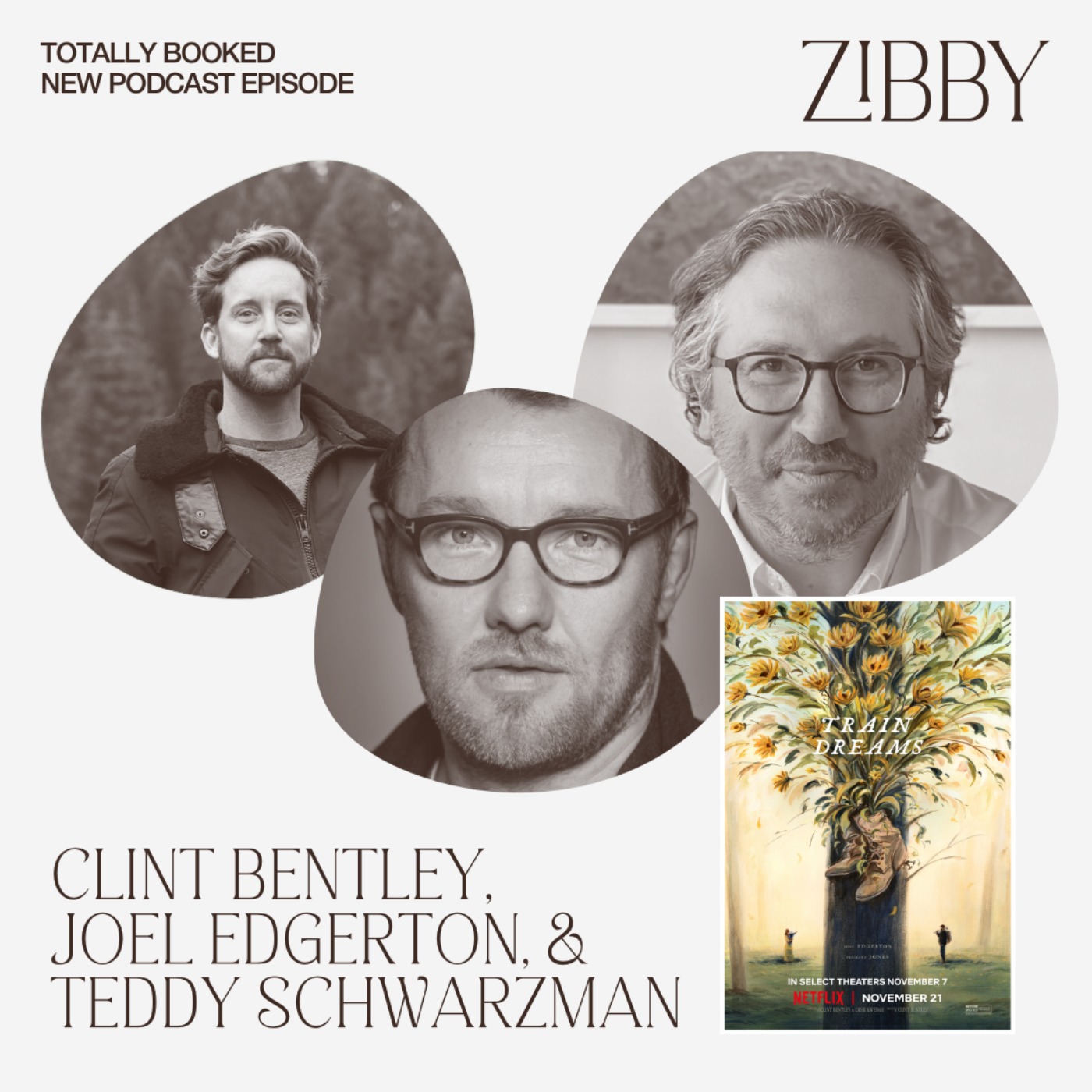
Hi, this is Zibby Owens and you're listening to Totally Booked with Zibby formerly Moms don't have Time to Read Books. In my daily show, I interview today's latest best selling buzziest or underrated authors and story creators whose work I think is worth your time. As a bookstore owner, publisher, author and obviously podcaster, I get a comprehensive look at everything that's coming out and spend my time curating the best books so you don't have to stay in the know. Get insider insights and connect with guests like I do every single day. For more information go to zibbymedia.com and follow me on Instagram Ibbeowensk today is a really special recording because this is about my brother Teddy's movie Train Dreams. He is a producer at Black Bear and to celebrate the release of Train Dreams, which has gotten so much critical acclaim, we had him and Clint Begley and Joel Edgerton at Zippy's Bookshop. Let me tell you a little bit about Clint, Joel and my brother Teddy and then you can listen to this really interesting conversation. I. I mean, I hope, I hope you find it interesting. I know I did. Clint Bentley is an Academy Award nominee. He's a writer, director, producer whose debut directorial feature Jockey premiered in competition at the 2021 Sundance Film Festival where Clifton Collins Jr. Was awarded the Special Jury Prize for Best Actor for his role. Bentley and his longtime collaborator Greg Kuidar co wrote and produced the film which went on to enjoy further global festival success with screenings at TIFF, AFI and over 30 festivals worldwide. Win winning the Audience Award at the AFI Film Festival. Bentley and his producing partner Quadar recently launched their production company Ethos to develop their own original, individual and joint projects and to champion artists under the innovative and equitable financing model that they pioneered on Jockey and further developed with Sing Sing. Bentley co wrote and produced Sing Sing with Kuidar which earned them an Academy Award nomination for Best Original Screenplay. Sing Sing received a further two Academy Award nominations with one for lead actor Colman Domingo and as well as numerous Golden Globe, Independent Spirit Award, BAFTA and Critics Choice Award nominations. Both AFI and the National Board of Review named Sing Sing in their Top Films of the Year lists. In addition to his film work, Bentley received a 2026 Pushcart Prize for his short story Cairn that first appeared in the Iowa Review. His fiction has also appeared in the Baltimore Review. Joel Edgerton is an acclaimed Australian actor, writer and filmmaker. Born in Blacktown, New South Wales, a graduate of the Nipean Drama School, he began his career in stage and screen before gaining international attention as Owen Lars in Star Wars Episode 2 and 3. Over the years he has starred in a wide range of films including the Great Gatsby, Zero Dark Thirty Warrior, Black Mass Loving, for which he earned a Golden Globe nomination, and the Gift, which also marked his directorial debut. Edgerton's versatility extends to voice work, stage performances and co writing Netflix's the King. Most recently, Egerton starred in Appleton TV's Dark Matter and Charlie Pollinger's the Plague, which premiered at Cannes. He also produced the award winning Sundance documentary Daughters and appeared in the Boys in the Boat, directed by George Clooney. He is now starring opposite Felicity Jones in Train Dreams, which you will be hearing about now. This was adapted from Dennis Johnson's novella. He has also wrapped production on Netflix's Australian limited series Boy Swallows Universe and continues to take on projects as both actor and producer. Edgerton's filmography is marked by collaborations with top tier directors including Ridley Scott, Ron Howard, David Lowery and Jeff Nichols. Notable past roles include Thirteen Lives, the Stranger, Master Gardener and the Emmy winning Amazon series the Underground Railroad. A frequent contributor to Australian cinema and theater, he continues to split his time between Australia and London, maintaining a dynamic presence across film and television and stage. Teddy Schwarzman is CEO of Black Bear As Black Bear's CEO Academy Award nominee Teddy Schwarzman oversees all aspects of the globally renowned independent studio founded in 2011. He has been the driving creative force behind more than 40 feature films, including such acclaimed titles as the Imitation Game, Sing Sing, Naiad and Mudbound. With 17 Academy Award nominations among them including a best Picture nod for the Imitation Game. Schwarzman also recently produced Clint Bentley's Train Dreams starring Joel Edgerton and Felicity Jones For Netflix David MacKenzie's Relay, starring Riz Ahmed and Lily James, David Mikode's Christie starring Sydney Sweeney, Merritt Weaver and Ben Foster and the Rivals of Umzia King starring Matthew McConaughey, Angelina Looking Glass and Kurt Russell. Schwarzman also recently served as executive producer on David Ayer's action hit A Working man, starring Jason Statham and Osgood Perkins horror sensation Long Leg. Schwarzman is a member of the Academy of Motion Picture Arts and Sciences, the British Academy of Film and Television Arts, and the Producers Guild of America. He sits on the Board of Directors of the Academy Museum of Motion Pictures, the Gotham Film Institute and the Pacific Council on International Policy, as well as the Leadership Committee of Cedars Sinai's Board of Governors. He is an honorary member of the Board of Visitors for the Duke University School of Law. And he is my brother.
- [07:11]
Teddy Schwarzman
Enjoy today as one of the producers of the movie, the moderator of this Q and A and much more impressively, Zibby's brother. And so I know my sister would much rather and would do a much better job moderating this than I, but the fact that she is out of town stepping in to gracefully spend some time with two of my favorite people, you know, in Joel Edgerton and Clint Bentley. This is a very wonderful thing for me to be able to sit here with you guys. We do so much time sort of going around and trying to convince people to see our movie in train Dreams that we rarely get the time to actually sit and think about the creative process, why the film exists, how we can will a film into existence, how that process happens. I know a lot of people here are authors or aspiring authors and so I think we'd love to try and use this process to talk a little bit about Train Dreams by way of case study and give you some insight into what that adaptation process was. And at a certain point it leaves us and becomes yours. So I thought maybe we would start with Clint. Clint Bentley, to the extent that you don't know, is one of the most humble men that you'll ever meet, but is also one of the most talented and has been involved with a number of exceptional films, from co writing and producing Trans Pecos to co writing and directing Jockey to co writing and producing Sing Sing that was nominated for numerous Academy Awards. Was that last year or the year before?
- [08:53]
Clint Bentley
It was last year.
- [08:53]
Joel Edgerton
Last year.
- [08:54]
Clint Bentley
Oh, my gosh.
- [08:55]
Teddy Schwarzman
So last March last year and now you're back again with Train Dreams, which you co wrote and obviously have directed. I guess maybe just take us through how you tackle the idea, you know, of adapting Train Dreams. How familiar were you with Dennis Johnson and just the task and responsibility of that adaptation.
- [09:18]
Clint Bentley
Well, and thank you all. Echoing thank you all for being here, please. And Teddy's also a bit humble. Teddy, the only reason that Sing Sing existed in and got to go to the place where it had multiple Academy Award nominations and the only reason Train Dreams exist is because Teddy believed in it and. And with the apparatus of his company, Black Bear, put their heart behind it and wouldn't have been able to make the film without, creatively or otherwise. Train Dreams. I was. I was familiar with Dennis Johnson. This was actually the first one of his that I'd read only because, like, it had come out during, like, it was one of the books to read that year and I was just out of college, I think, when it came out and I was on the road. And it's a nice size for any of you who've grabbed a copy, like 116 pages, you can slip it in a backpack. And I read it and I was blown away by it in kind of a very mysterious way that I didn't quite know, like, what. Where it fit, you know, in terms of, like, as a novel. It's just. It's just such a strange, beautiful little book. But it also, like, stuck to me. And over the years, I would always think about it. It all sent me on a trail of, like, reading everything of Dennis Johnson's that I could. But I wouldn't have thought about it as an adaptation because it's such a. For those of you who haven't read it, it's only 116 pages and yet it encompasses 85 years in a person's life. It's stream of consciousness. It's all over the place. And until I was after Jockey was approached by some of our fellow producers who had the rights to the book and were trying to adapt it and asked me about adapting it. All that to say I felt a ton of responsibility to it out of love for the. For the material and out of love for the author, and did not want to do a bad version of not only this book, but any of Dennis Johnson's books. But then I also. I don't know why, maybe out of stupidity at the time, but, like, just felt a lot of freedom from it as well and felt like I was translating it into a new medium. And so I didn't feel like I had to do anything. I felt like I needed to be true to the spirit of the book and then outside of that and true to the spirit of Grineer, the character, but then outside of that, could kind of do what needed to be done to put it into a new medium and use it as a springboard to talk about things that I wanted to explore, either that I found in the novella or that I wanted to explore because of the novella, if that makes sense.
- [11:41]
Teddy Schwarzman
Absolutely. And I think, you know, I'm excited to get to Joel, but I just want to follow up really quickly, which is, you know, what was it within Train Dreams that you felt was important to bring to the world? Like, why adapt Train Dreams? What did the book and slash, the adaptation you hope to create, like, what did it signify to you?
- [12:03]
Clint Bentley
I think a lot, like. And the things that we connected over, I think all three of us at the. There's a lot that felt exciting about it cinematically in terms of what it felt like it could do in terms of jumping around in time. And it had a love story. It had death, it had logging, it had all these different things. It interrogated our relationship with nature and the natural world around us. But at the bottom of it, it was just the story of Grineer. And taking this. It felt really compelling and. And like a beautiful task to take this life. And the thing that I think is special about the book that it does is, like, take this life that barely even be talked about after he's gone. Maybe, you know, in this little town of Bonner's Ferry, once the guy died, you know, they would, like, someone would vaguely mention him at the feed store and, like, oh, the guy who lives in the woods and take that life and show it for all of its beauty and depth and power as a.
- [13:03]
Teddy Schwarzman
Life, you know, And, Joel, I guess I should go back and I'm sure Everybody who is here knows who Joel Edgerton is, but except me.
- [13:14]
Clint Bentley
Joel's fine, Soul's fine.
- [13:18]
Teddy Schwarzman
But from, you know, one of the best actors working today, you know, an incredible human being and also an incredibly skilled filmmaker in his own right, to the extent that you haven't seen the Gift. And. And he's working on his own projects that he promised he would share with me that he didn't. And I just want to make sure that I continue to let him know that I'm hurt by that process. But Black Mass, Great Gatsby, I mean, you know, Golden Globe nominated for Loving and now two time Golden Globe nominated for Trainees. You. You know, I personally can't think of anybody else encompassing who Robert is. And yet I think there's always a bit of a kismet that comes into how projects come together. How did you first get exposed to Train Dreams and how did you get involved with the project?
- [14:20]
Joel Edgerton
So I had been gifted the novella on the heels of the second film I directed, which was an adaptation. The only time I've ever made a movie that was an adaptation of Boy Raised. And I was gifted the novella, you know, on Rap by somebody on the crew. And when someone gives you a book, you know, it's different from walking into a bookstore. It feels like the person knows you and maybe they think that this book might mean something to you. And it did. I read it immediately. In fact, I think I was just telling Clint, I reread the book for the fourth time on the plane, knowing I was coming to a bookstore. I was like, no, I'm just gonna. Just read the first couple of chapters. And again, I was just drawn right in, didn't leave my seat, read it in one sitting. And as Clint points out, you know, you dive into the entirety of one man's life in such a short span of time and you drop in in different moments and they're out of joint. They're out of time, as in the structure. I was immediately taken with it so much that at the time, I tried to get my hands on the rights to the book. I inquired after it as a filmmaker, and they were taken by a bunch.
- [15:37]
Teddy Schwarzman
Of people, which explains why he's not willing to work.
- [15:44]
Joel Edgerton
And I put it out of my mind. And then, I mean, I'll tell you, the reason why I looked for it, look for the rights is, I think, for maybe some similar reasons to Clint. And I think the book, for those who've read it and for those who haven't, when you do, which I encourage you to it's there to be sort of in a way that some novellas don't. Some novellas or some books are real. They're quite obvious in that they guide you through something. There's no real. What I'm trying to say is that Trained Dreams allows you to reach in, and you can illuminate certain things in it for yourself. It can become quite a personal thing for you about any number of things, about the environment, about life and work and family and grief and all these things. And some of them, almost all of the things that Robert goes through, a person with a long life will have experienced. Though you might not be a logger, you've worked in some way, you have a relationship with family and connection to that and community and so on. But there are things that might really connect with you. And for me, this celebration of a normal, otherwise ordinary person and the dignity and the majesty of a simple life, to me, was really extraordinary. And we don't often see that in cinema. In cinema, we often are looking to view the life, fictional or true, of somebody who did something amazing, who saved something, who invented something, who. Who stands on a higher shelf than most of us feel we sit on. And so, yeah, I'd looked after the rights, and weirdly, of course, one of the most strange things that's ever happened to me in my work life is that four years after that phone call where I realized that the rights were unavailable, I get a call about meeting Clint and playing the character in the film. And I was like, I wonder if this guy and these people know how much I'm invested in this character, in this story. And by the time that that had happened, like Clint, I was a young father. And anyone who's read the novel or has seen the film knows how much more invested on an emotional level I was to what happens to Robert within the story.
- [18:25]
Teddy Schwarzman
I guess that's a great segue into, you know, it has been fun even from when we. When we first started to talk about how are we going to talk about this movie, which is something that generally we all hate to do because it's so nice to make the work itself and then have other people talk about it rather than try and tell people why something is interesting or why it's important. But I think, you know, we first premiered the film in Sundance, you know, where we brought it without a home. And now we're very grateful to Netflix that the film is, you know, in front of millions of people around the world. And every once in a while, these stories, you know, turn into Success stories. But I think, you know, just going through that process of, oh, no, this is a look at one man's life as technology and innovation and industrialization passes them by. Or no, this is a look at a simple man who stood for simple things and understood all the journeys of life that come in those small moments. Or no, this is a story about family or for some people, it's a story about loss and grief and pain and finding a way through it. There's hopefully something universal or at least personal, if it's not universal, that I think that hopefully people can find in. In Robert's Journey. But I guess asking you one more question. What, like, what was it for you outside of. I completely agree with you that, you know, we generally look for. For ip and obviously here we have, you know, Pulitzer Prize nominated novella, you know, from one of the greatest authors. And yet it's still a. It's still, you know, an intimate slice of life. And so we tell stories, you know, at least in my world of, you know, the guy who saved World War II, you know, and cracked the Enigma code. Or the woman.
- [20:31]
Clint Bentley
Right.
- [20:35]
Teddy Schwarzman
The woman who swam the longest in history. Right. You know, and you're trying to do the biggest or the most because that in and of itself feels, feels like it makes it IP property. And here is like the antithesis of that. This is someone who really leaves behind no markers. Right. Leaves behind, you know, there has no names on any buildings, has no signs of their own individual achievements, but is part of our fabric. But I think trying to figure out for you, Joel, sort of is a long winded way to get back to like, what did you see in yourself in Robert?
- [21:16]
Joel Edgerton
Well, I think we all see ourselves as ordinary and I think that relates to even people that from the outside we view as extraordinary. I think we all relate to the idea of having imposter syndrome, that it's curious that even the CEOs of, or the bosses at Netflix, who you would consider in the business world somewhat extraordinary, successful people, probably also relate to the story of an ordinary person. Because I think that in all of us, we see ourselves as not that special. Regardless of whether a stadium full of people think is special. I think rock stars still see themselves as not worthy. So the idea that every single one of us is extraordinary, I think is a really great mantra to have in life. Forget about movies, forget about anything. It's like, do not disregard anyone, whatever their shape, color, gender, size, origin. Everyone has a great story inside of their life. Everybody is an interesting character. And by that theory, all of us are extraordinary and it levels everybody, CEOs, kings, you know, masters down to everybody that lives below the ground floor in the spectrum of social life. So I'm really. I think people think my life is extraordinary. I know in my soul when I brush my teeth and look in the mirror, I'm just an average dude. And I'm constantly trying to not see myself as anything other than that, because I'm not. I found something really emotionally moving in the story of Robert because I think that it's full of the stuff that we will all go through in life. And there are some parts of it that I can't even express or explain or articulate that just constantly drew me to that story. And when Clint reached out, it was like a no brainer that I wanted to be a part of the film.
- [23:28]
Teddy Schwarzman
And Clint, I guess there's getting the task of saying, okay, I'm going to take on this challenge. And then there's actually figuring out two things, many things.
- [23:40]
Joel Edgerton
Right.
- [23:40]
Teddy Schwarzman
But how are you going to write it and how are you going to direct it? Right. And you have a long time collaboration with one of your best friends. Because I'm trying, but with one of your best friends. One of them.
- [23:54]
Joel Edgerton
Right, right.
- [23:56]
Teddy Schwarzman
He would say his best friend, but you know, they would say it's only a 15 year collaboration, but with Greg Kuidar, who directed Sing Sing. But the two of you have just done a masterful job of not only adapting stories, but of conceiving stories and creating worlds that have very strong personal stakes and really strong humanity that just goes all the way through them, that brings audiences with while never being cloying and never pandering to your aud, I guess. What's the process that you go through for writers in the room of actually adapting? How do you find the spine of how you're gonna adapt? How do you figure out how many parts you want the story to be In a writing collaboration? Do you split it up between plot and dialogue and then we can get into directing. But how do you make the thing?
- [24:53]
Zibby Owens
Today's episode is sponsored by Aura Frames. Okay, who else is looking for easy, thoughtful, fabulous gifts to give people that you love? I mean, who is not looking for that? Well, I have the answer for you. Aura Frames is the answer to every holiday gifting moment. And you'll never have to struggle again to find the perfect gift. This is so personalized because you can load this digital frame with all photos of people you love, the recipient people they love. All you have to do to get unlimited free photos and videos is download the Aura app. Connect to Wi Fi and you can preload photos before it ships. And you can keep adding photos from anywhere, anytime and add a message before it arrives so you can share your videos all year long. And yet you're giving it right for the holidays. A gift box is included. Every frame comes beautifully packaged in a premium gift box with no price tag. So don't wait. Win the holidays now with Aura Frames for a limited time. Save on the perfect gift by visiting auraframes.com to get $35 off Aura Frames bestselling carver matte frames named number one by Wirecutter by using promo code Zibby at checkout. That's a U R A frames.com promo code ZIBBY Z I B B Y this deal is exclusive to listeners and frames sell out fast, so order yours now to get it in time for the holidays. Support the show by mentioning us at checkout. Terms and conditions apply.
- [26:28]
Teddy Schwarzman
Now.
- [26:28]
Zibby Owens
Goodbye while I go fill another frame for a very lucky recipient in my family. Today's episode has been sponsored by Quince. When it comes to holiday gifting, I want to give things people really love. Beautiful, timeless pieces they will wear for years. So that's why I'm going with quince. From Mongolian cashmere sweaters to Italian wool coats, everything is premium quality at a price that actually makes sense. Quince has something for everyone. Soft cashmere sweaters for $50 that look and feel like designer pieces. Silk tops and skirts for dressing up, perfectly cut jeans for everyday wear and outerwear that actually keeps you warm. I've been wearing my new quince coat with this fur collar on social media, so you should be able to see me wearing it on Instagram Ibyoens I love it and of course it would make a great gift. The Italian wool coats are also amazing standout pieces. Beautifully tailored, soft to the touch and crafted to last for the seasons. Every piece is made with premium materials from ethical, trusted factories and priced far below what other luxury brands charge. The craftsmanship really shows in every detail. The stitching, the fit, the drape. It's elevated, timeless and made to wear on repeat. There are just so many options. I can totally see myself giving my friends one of their beautiful options like a sweater or one of their coats for someone really special. And as if that isn't enough, they also have stuff for home, bath, kitchen and travel. Come on, find gifts so good you'll want to keep them yourself with quince. Go to quince.com zibby for free shipping on your order. And 365 day returns now available in Canada, too. That's Q-U-I-N-C-E.com zivi to get free shipping and 365 day returns. Quinns.com zivi.
- [28:31]
Teddy Schwarzman
This holiday season, Capital One reminds you.
- [28:34]
Joel Edgerton
To give yourself the gift of 1.5% cash back with the Capital One Quicksilver card.
- [28:38]
Clint Bentley
Can I earn 1.5% cash back on Burt's? What if you sent your true love two turtle doves plus a partridge and a pear tree?
- [28:46]
Joel Edgerton
Sure.
- [28:47]
Teddy Schwarzman
But why would anyone want that?
- [28:49]
Joel Edgerton
The song was very convincing.
- [28:51]
Zibby Owens
Earn 1.5% cash back on all your.
- [28:53]
Joel Edgerton
Holiday purchases with the Capital One Quicksilver card.
- [28:57]
Teddy Schwarzman
What's in your wallet?
- [28:58]
Clint Bentley
Terms apply. See capital1.com for details.
- [29:04]
Teddy Schwarzman
Yeah, just your secrets.
- [29:06]
Clint Bentley
It's very easy. I'm selling a book later, different for everyone. And I think part of the, like, frustration and Joel can speak to this, having just finished another script. And part of the frustration, but also the excitement is like, you get into it and you start a new one. You're like, I feel like I've never written a script before. It's all just as difficult, even though you've got more tools in your toolkit. But this one in particular, I felt a shape for it pretty quickly from a general overall shape of what the plot would do or the story would do of, like, okay, we're going to start the first half of the movie. We're going to introduce. We're going to meet this guy at his death and then which the opening changed as, you know, last minute. But like, but like, the first half of the movie is going to be. I don't want to spoil it for anybody, so. But just the first half.
- [29:58]
Teddy Schwarzman
People here have seen the movie. That's great. How many people have read the book? Okay, how many people were here for the food?
- [30:08]
Joel Edgerton
How many people came in here to buy a book and then got forced into sitting down?
- [30:15]
Clint Bentley
I just came to get a book. Door is locked. But I found a shape pretty quick. I had an idea for a shape pretty quickly that, that ended up being the shape of the movie, which is like, there was a event in the, in the book that's very big with a fire that's going to, like, break the story in half and kind of upset this guy's life. And then the second half is going to be, how do you get on after that? Now, that's, that's one thing. Then you get into it. And Greg and I, like, got into it. And then it's the. That's the real work. It's like, okay, how do you do this? And I mean, just in. Briefly, in nuts and bolts. Like, we do a lot of outlining since it's two of us. So you're getting on the same page. And then we take it in chunks. And so one person will take these three scenes, I'll take these two scenes, and then we'll swap them. And so we don't get too far ahead of each other because you're also discovering things within those scenes. You're like, oh, that's going to be great later. There's one thing I remember, and I hadn't thought about this in a while until something you were just saying, but the. What's it about? I think that was. That was something I really struggled with because you're always looking for that in a movie of. Well, it's about this guy who's crack. Trying to crack the enigma. But really it's about acceptance of self, right? And finding your place, you know, like. And I didn't. I never could find that thing in this book. And I kept struggling. I kept wrestling with it. And I was like, well, it's about. It's about the marriage, right? But that's not what it's about. Well, it's about grief, but that's not what it's about. And it's funny because I think, like, I remember back to. I've got a writing mentor who's a novelist, and he teaches at Appalachian State University, and he teaches this book. And so I called him and I was like, mark, I need your help. Like, what is this book about? He's like, don't do that. This book is about life. Like, that's the magic of it, is that it is about everything. And even though, like, it's so spare and, like, if you try and whittle it down to, like, one thing, it's gonna ruin it and you're gonna. And you're gonna lose the magic of it. And I think, like, we were lucky. And one thing that I've learned, I don't know how to take forward necessarily, but, like, we were lucky that it was an ip, quote, unquote, because, like, it gave the freedom to be able to, like, let it be loose and let it be novelistic. And I think if I had just thought of this story in the same way, either a, I wouldn't have had the confidence or the. Or the understanding to, like, know how to, like, fit all that in there and. And to. And to Find the flow of it. But then also, nobody ever would have, Nobody ever would have approved it as a. And, and I think gone with it as a. Like it. Having that to, to lean on was helpful. I don't know if I answered your question.
- [33:11]
Teddy Schwarzman
Yeah, yeah.
- [33:11]
Joel Edgerton
But I, I, I think that's part of the reason why I feel like, you know, and this is partly the result of responses from people watching the movie. And I'm sure, you guys, we all feel the same things. It is different things to different people. And then, and that if it had been narrowed down to one singular, purposeful premise, that perhaps it narrows the ability for that blank canvas aspect of it for people to reach in. Because one of the things it is for me is it doesn't answer the question of the meaning of life. I don't think anything will. But it circles around these questions of why are we here? What is the purpose of things, especially when really terrible things happen to you in life. And then what happens after that line in the sand of your life is, you know, the world keeps turning and swallows up events and things get easy, but you move on. And I've heard Clint say many times that, you know, the great thing about human beings is they're able to get up. And there's this necessity somewhat to just put one foot in front of the other and keep going. And so the movie can be very different for people who have had these bigger, more seismic experiences. And in that sense, it translates into a slightly more hopeful feeling than some of the more, not naive, but younger, more unblemished lives who haven't been through some of these big events, who can see a greater sadness in it, perhaps because they know that there's an impending danger in the world that may be in front of them at some point.
- [35:01]
Teddy Schwarzman
I also think that, you know, sometimes, you know, we sort of put on, we'll put on the works that are in front of us, our own experience in a way that I don't think any of us quite fathomed. Like how this film, at the time that we premiered it in end of January, would have, you know, to now really, you know, starting to really come out to the world, could have impacted. You know, we're here in Santa Monica, you know, blocks away from the Palisades, and, you know, a film that really, we finished, you know, while those fires were happening, while we were dislocated from our homes and while our friends lost, you know, I'm sure everybody here, you know, either knows somebody or you yourselves have lost your homes but went through just a traumatic event that at that time is all consuming and life changing in the same way that Robert goes through the terrible loss that he has of Gladys and of Kate. And, you know, everyone has different levels of fortune and luck and circumstances and how they bounce back from those. But even just, you know, a couple days ago, going to the Palisades for their first sort of official event, bringing people back to the neighborhood, and we're at the Caruso Village for their Christmas lighting while we're getting better views while standing on, you know, dirt lots that used to be homes. And it's painful and it's bittersweet and it's growth and rebirth at the same time that it's loss and. And triggering suffering and. And that's just one very small, yet obviously massive experience for those who go through it that I think everybody in life sadly experiences. And we try to tell our children it isn't about being protected, right? It isn't about making you happy on a consistent basis and avoiding pain, but it's about going through the ups and downs of pain, loss, joy, friendship, sadness, to feel all those really, really difficult emotions in order to appreciate the beauty. Because there is beauty, and you wouldn't necessarily understand it without all the pain that comes with it. This is a way to go to the next question, which is really, how was it actually making this thing? I tried my damnedest to not be there. No, I loved working with you guys and it was like a complete joy. But, Clint, you chose an aspect ratio that I haven't seen in 70 years and didn't tell anybody about it until the first day of filming.
- [37:53]
Clint Bentley
That was.
- [37:53]
Teddy Schwarzman
That was frightening. To show up and be like, oh, my gosh. Well, you know, it is a story of a logger, but we're making an epic. And then you see it and it's this square box that Clint chose to frame, and I'm like, oh, my God, we're gonna lose all our money. This is not gonna work out.
- [38:14]
Clint Bentley
To your credit. You didn't say anything about it on.
- [38:16]
Teddy Schwarzman
The day I said, fellow producer Michael Highmore in the back, I went to. I said, oh, we're in trouble. And. And yet you had a collaboration with. With longtime, you know, collaborator cinematographer in Adolfo Velasco, who both of you just speak the same cinematic language in a way that you knew. Jumping into. I don't want to call it a three by two or a one by one. You're going to tell me what our actual aspect ratio is.3 by 2. Thank you. Where you somehow knew in ways that I'm not sure the rest of us fully did, that you were actually giving us a window. Right. You were giving us a window into this character and into this world that required our focus and drew us in. And not only that, but somehow also without telling us, decided that you were gonna shoot the movie using all natural light. You know, I think there's one scene you might have used natural light in. Cause I've started to see 99%. But I really think used no light in this movie outside of candlelights at night, sunrises, sunsets, and we would have our days scheduled with. You know, when you're making a movie, it's usually about what's the page count that you're going to get through?
- [39:34]
Joel Edgerton
Right.
- [39:35]
Teddy Schwarzman
So generally the studio tries to push. You know, you can make it through seven pages, maybe you can make it through 10.
- [39:41]
Joel Edgerton
And by the way, for anyone who hasn't been in the movie business, one page of a script, the screenplay is usually anywhere from 90 to 150 pages, but it generally works out to be one page per minute. So to shoot seven pages means shooting the equivalent of seven minutes of the movie, which could be a bunch of half page scenes or three or four page scene plus.
- [40:10]
Teddy Schwarzman
Yeah, it just sort of depends on what it is that you're shooting to figure out how long will it take to shoot a page. But generally, you know, you're Marty Scorsese and you're like, I'm gonna shoot two pages a day and I'm gonna get home for dinner and it's gonna be marvelous. It's gonna be fantastic. Clint took on a really ambitious page count, but also didn't tell anyone that almost all the film was gonna be shot in a three hour window of the day.
- [40:35]
Joel Edgerton
Did he tell you anything? Did you know I was gonna be in the movie? No.
- [40:47]
Teddy Schwarzman
That was the one thing, that's the one thing we were definitively agreed on is that if Robert Greiner was going to be played, it was going to be Joel.
- [40:54]
Joel Edgerton
But the window, you were talking about the window.
- [40:56]
Teddy Schwarzman
Yeah, but just trying to figure out like, how did you have the chutzpah to say, okay, I've got all this work that I have to actually get through, but I'm going to leave it for magic hour. I'm going to just, I'm going to focus on this short period of time. If I don't get it, I'm going to try it at the next magic hour and the next magic hour. And frankly, I really hope it's not Cloudy.
- [41:20]
Clint Bentley
I was a bit more open than. Than with at least. I'm. I'm sorry it didn't get passed along. But with the other producers, you know, the reality was, like, one, we, Adolfo and I, our cinematographer, we had done a trial run of this on Jockey and. And with 15. 15 people and 350 grand, and in 20 days we shot a movie almost all at magic hour. And. And it was something. And so we. We established a rhythm and learned a lot of lessons and made a lot of mistakes there that. That we could bring into this. But I think, like, not only, you know, we were all. We all talked about it open on, early on of recognizing that, like, we're trying to make a $25 million movie for much less, and we're trying to make this epic in miniature. And we're trying to make something. I always want to, like, whatever, if you have $10, make it look like 25 on screen. And so that was part of it of, like, we had this beautiful natural world. And part of it was trying to take advantage of that and make it, like, you know, make it actually look great. And the other part is, like, we were shooting the film as, you know, in 29 days, 28 or 29, wherever we started at, and on a budget.
- [42:37]
Teddy Schwarzman
For about a third of what you just quoted. Yes.
- [42:40]
Clint Bentley
Yeah. Yeah. And. And trying to do. I think we had, like, at the end of the day, like, almost 170 slugs that were trying to get through. That's. That's a scene heading.
- [42:48]
Joel Edgerton
So.
- [42:48]
Clint Bentley
So, like, interior, this store at night is one slug. And then if we go outside, that's another, you know, and every one of those is a new setup. And the only way we could have done that is by. Is by using natural light. And if we had. Had to be like, all right, now we're going to set up all these lights, and we're going to take out those, and we're going to pre light that we didn't have. You know. And so the nice thing is that it gave me a lot of freedom as a filmmaker that I wouldn't have had otherwise. And then we. And then, yeah, we shot splits, which is starting at like 3 or 4 in the afternoon. We had a cabin, or we were under trees at times, and we would shoot. We would. We'd rehearse a lot, and then we'd shoot when the light was like, the light's not as good when it's. When it's. When the sun's higher in the sky. Just like the actors Are squinting and like. And things are flatter, especially on digital film. Digital. Like we're shooting on digital cameras. It's like, just doesn't look as good. And so we would start by shooting inside the cabin when it was brighter out and the light wasn't as good. And then when it got like 4:35, and you've got that last, like, two hours of the day, two and a half hours of the day, we just shoot as much as we could in the magic hour and into blue hour, which blue hour is like 20 minutes. And that's the time after the sun goes down when you've got a little bit of light left. And I felt like, one, it would be special in terms of your question. And two, it was like, there's no other way. It's like, why would you take a rowboat across the Atlantic? It was like, I don't know. There's no other way to. If I had sales, I'd take. I do sales. And the only way we could do that is by having a great crew that.
- [44:25]
Teddy Schwarzman
That.
- [44:25]
Clint Bentley
That, like, got really excited at a certain point about this approach and. And. And made it possible. And then. And then cast that like, we could. When it was on days where it was cloudy, they would come up. They would. They would show up to set, like, expecting. Because the plan was like, we're all going to shoot scene nine first. And that's the first one up. And they've learned their lines for it. And then we get there. It's like, unfortunately, it's very cloudy right now. And so we're gonna actually try and shoot scene 11, which we're gonna do later in the day first. Can we do that inside and then come out and shoot scene nine when it's when these clouds pass. And Joel and Felicity would be like, yeah, give us five minutes to, like, look over that scene. And that's the only way that was possible.
- [45:06]
Teddy Schwarzman
But speaking of Felicity, I mean, I feel like combination of the talent of Clint as a director and frankly, the desire for a lot of people to want to work with Joel, you know, brought together a really great ensemble, you know, in Felicity Jones, Kerry Condon, William H. Macy, and so many more. Did you have fun? No, but really, like, there's such great people, you know, and yet such serious subject matter. But it feels like there was a bond that was formed both on set and otherwise.
- [45:46]
Joel Edgerton
Acting is fun. Fun's not the right word. Acting is like, for me. And I don't know if other actors would say the same storytelling, which of which I Put under that banner, writing and acting and directing is a chance to escape life for me. And for that reason, I find it very pleasurable. Not that my life is terrible, but it's a chance to go somewhere else for a short time. And, I mean, I was reminded of it not so long ago. I was on a set somewhere else, not. Not on this film. And there was a. What's. You know, a day player. Someone who was coming in just to do a scene for a day, and they were holding prop and their hand was shaking. And I realized when, 20,000 years ago, when I first started being an actor, that I got very nervous about it. And over the years, it's become a real comfortable place for me. And no matter what the situation that's asked of me, it becomes this, on one hand, a cerebral puzzle to plan ahead of time, as in to do a lot of thinking about in order that when you get there on the day, it's not about me or my nerves or my anxieties about anything. It's a chance to be in a scene. And when you get to be in a scene with someone like William H. Macy, with Felicity Jones, with Kerry Condon, with John Dealers, with Nathaniel Arcan, all these amazing actors, it becomes even better. Because it's not just about one actor separately to another actor. It's a dance, it's a duet, it's whatever you want to talk about. Or if there's more, it's a band and you're all doing it together. And it only becomes a living, breathing thing. If the writing is great and the filmmaking as a community is. Everybody's at the top of their game. The world is built, which we had the real world. Every scene was the forest or a cabin that was 100% usable as a real thing. And then playing with these actors, it becomes an extraordinary thing. And between action and cut, there is nothing more pleasurable. When you're working on something that you really care about.
- [48:15]
Teddy Schwarzman
Well, that's.
- [48:16]
Joel Edgerton
And pleasure is fun, isn't it?
- [48:20]
Teddy Schwarzman
Well, thank you, guys. I think, you know, and thank you guys for being here. It's just wonderful for all of us to hear that people here have taken the time to see the movie because time is your greatest resource. And the fact that you made time to be open to this film and made time to be here and are sharing in the experience of train dreams and hopefully telling others that, you know, to see it, it means a lot. And it actually has a real impact on. On the reach of this film, which is really why we're here. It's I know there's, you know, awards season and all that going on, but that's really just a tool to to help audiences connect with a story that we hope will will resonate for time to come. So thank you guys for being a part of it.
- [49:07]
Zibby Owens
Thank you. Thank you for listening to Totally Buzz with Zibby, formerly Moms don't have Time to Read Books. If you loved the show, tell a friend, leave a review, Follow me on Instagram, ibbeowens and spread the word. Thanks so much. Oh, and buy the books.
- [49:31]
Joel Edgerton
Hey, you want to pay just 10.
- [49:34]
Teddy Schwarzman
Bucks for your phone service at Boost?
- [49:36]
Joel Edgerton
Boba just 10 bucks for your boat service service at Boost Mobile? Yeah, I totally do.
- [49:45]
Teddy Schwarzman
This holiday the best gift is for you.
- [49:47]
Joel Edgerton
Pay just $10 a month for the.
- [49:49]
Teddy Schwarzman
First two months and $25 a month.
- [49:51]
Clint Bentley
Forever with unlimited data, talk and text offer.
- [49:53]
Teddy Schwarzman
Valid@boostmobile.com after your first two months, you'll pay $25 a month unless you go online or call to cancel.
- [49:59]
Joel Edgerton
Requires autopay.
- [50:01]
Zibby Owens
Saving Abigail is the true story of the global fight to rescue a three year old child stolen this holiday season. Give a gift like no other. Give a real life miracle you can hold in your hands.
- [50:12]
Teddy Schwarzman
Buy Saving Abigail, the unforgettable story you.
- [50:15]
Clint Bentley
Won'T want to put down this holiday season.
- [50:18]
Teddy Schwarzman
Capital One reminds you to give yourself.
- [50:20]
Joel Edgerton
The gift of 1.5% cash back with the Capital One Quicksilver Card.
- [50:24]
Clint Bentley
Can I earn 1.5% cash back on birds?
- [50:27]
Joel Edgerton
Birds?
- [50:27]
Clint Bentley
What if you sent your true love two turtle doves plus a partridge in a pear tree?
- [50:32]
Joel Edgerton
Sure, but why would anyone want that? The song was very convincing.
- [50:37]
Zibby Owens
Earn 1.5% cash back on all your.
- [50:39]
Joel Edgerton
Holiday purchases with the Capital One Quicksilver Card.
- [50:42]
Teddy Schwarzman
What's in your wallet?
- [50:43]
Clint Bentley
Terms apply. See CapitalOne.com for details.