← Totally Booked with Zibby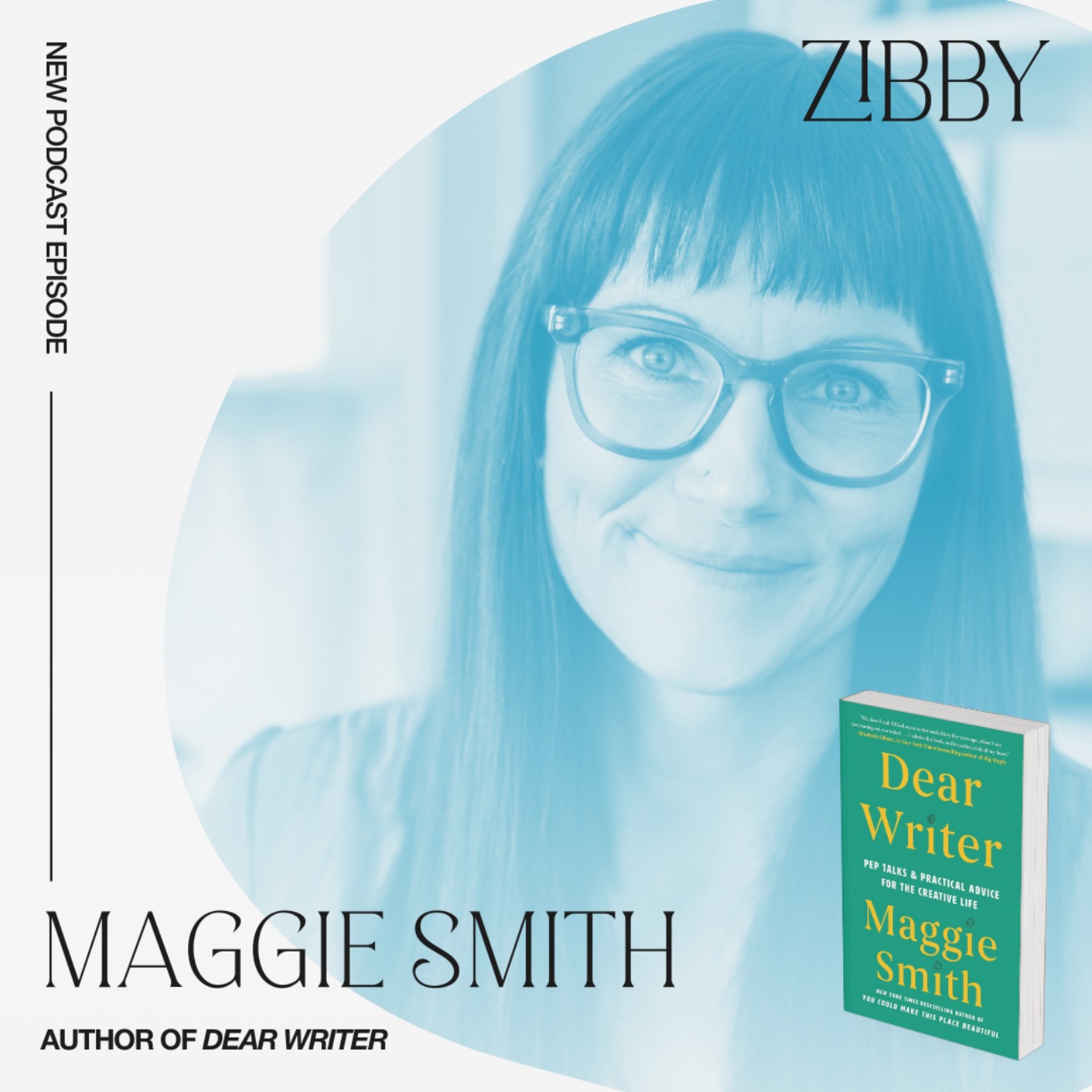
Totally Booked with Zibby
Maggie Smith, DEAR WRITER: Pep Talks & Practical Advice for the Creative Life
00:30:40
Loading summary
Transcript51 lines
- [00:01]
Zibby Owens
Hi, this is Zibby Owens and you're listening to Totally Booked with Zibby, formerly Moms don't have Time to Read Books. In my daily show, I interview today's latest best selling, buzziest or underrated authors and story creators whose work I think.
- [00:17]
Maggie Smith
Is worth your time.
- [00:19]
Zibby Owens
As a bookstore owner, publisher, author, and obviously podcaster, I get a comprehensive look at everything that's coming out and spend my time curating the best books so you don't have to stay in the know, get insider insights and connect with guests like I do every single day. For more information, go to zibbymedia.com and follow me on Instagram ibbeowens.
- [00:45]
Maggie Smith
Maggie Smith is the author of Dear Pep Talks and Practical Advice for the Creative Life. By the way, this was recorded during our Scottsdale retreat. Maggie was supposed to be with us in person, but sadly couldn't be there. Instead we did a zoom and I made this into a live podcast. So we recorded this a while back, but I hope you enjoy it and it is still relevant today. Maggie Smith is the award winning New York Times best selling author of eight books of poetry and prose, including you could make this Place Beautiful. Good Bones, Goldenrod. Keep Moving and My Thoughts have wings. A 2011 recipient of a Creative Writing Fellowship from the National Endowment for the Arts, Maggie has also received a Pushcart Prize and numerous grants and awards from the Academy of American Poets, the Sustainable Arts foundation, the Ohio Arts Council, the Greater Columbus Arts Council, and the Virginia center for the Creative Arts. She has been widely published, appearing in the New Yorker, the Paris Review, the Nation, the New York Times, the Atlantic, the Best American Poetry, and more. You can follow her on social Aggie.
- [01:47]
Smithpoet Thank you so much for coming back on Moms don't have Time to Read Books to discuss your new book, which is so good. Dear Writer, Pep Talks and practical Advice for the Creative Life. Congratulations.
- [01:58]
Oh, thanks. Thank you. I'm excited about it.
- [02:02]
You should be. It's so good. It's like you have so many recommendations for what we should read, how we should write, what different parts of the books and poems and write and words and stanzas and everything. It's comprehensive and yet of course so specific, which is what makes your writing so wonderful.
- [02:20]
Oh, that's kind.
- [02:22]
Tell everybody why write a writing book? I know it came from your substack, but talk about that and how you got into writing, advice and teaching and the whole thing.
- [02:33]
Yeah, I actually, I mean I feel like this book is like 20 years in the making. I think I'VE been writing this book in my head since I went to graduate school for poetry 24 years ago. I don't know how that's possible because I'm so. I feel like I'm still 24 in my mind, but I'm not. I went to grad school 24 years ago for poetry. Poetry. And so I've always wanted to write a craft book because I love them so much. I read craft books. I have an entire bookcase in this room devoted to craft books. I teach from them. I recommend them to other people. It's just been something I've wanted to do. And also just. I'm interested in demystifying the process. And that means. For writers, definitely, but also just for readers. Like, even if you're not a writer, I think knowing a little bit about how things are made helps you read them differently. It, like, sort of opens a door and kind of pulls the curtain aside a little bit. So when you enter a poem or a play or a story or an essay or a memoir, you can kind of see the machinations a little bit differently if you. If you know a little bit about how that thing was. Was built and conceived. And so I actually started writing this book before I started writing. You could make this place beautiful. So this book is coming out post memoir, but I started it pre memoir and then shelved it for a while while I wrote that book, which kind of consumed my life for the better part of a year. And then I was able to hop back into it and then completely rewrote it. So I think it's interesting that I started writing a writing book, and then when I went back to the writing book after kind of two years away from it, I was like, no, no, no. This is not exactly how I want to do this. And so I basically started completely over and told my editor, don't even look at the draft I sent you. I'm rewriting this book. And that's what I've been doing for the past year, plus was reconceiving the entire thing.
- [04:42]
Wow. As. As one does.
- [04:44]
As one does.
- [04:46]
You start out. The way you write about writing is, of course, in your poetic, beautiful prose. And one of the things you said in the beginning is, may the poems keep coming to meet me in the clearing, and may I not scare them back into the woods.
- [05:02]
Yeah. I mean. Right. I think that's the thing about an idea. Regardless of whether it's an idea for a novel or an essay or a poem or a substack post or whatever. The thing is A collage. You want to make a film, you know, a photograph. Whenever an idea comes to you, I feel like we have to keep such soft hands and not get grabby or controlling or weird or egotistical or nervous. Like, there are so many things I think we can do as human beings because we're all fallible that can scare ideas away in those early stages that can kind of spook them. And I mean, I really do think of, like, deer. This is the Ohio in me as I. Where I am now. You know, like you imagine deer kind of leaving a stand of trees and coming out into a clearing to kind of graze. And one little sound, you'll see their ear go up and they bolt right back into the COVID of the trees. And I feel like ideas, creative ideas can be like that. And the best thing we can do is sort of stay. Stay sort of soft and quiet and open and inviting and not try to control those things too early in the process. That sounds so woo woo. I realize, but that's really how I approach it.
- [06:21]
No, it's amazing. And you have a whole section of this book that encourages all of us to be poets, that we are all, as children, full of wonder and awe, and we are born poets. And the trick is not to lose the inner poet. Talk about that a little bit. It was beautiful.
- [06:37]
Yeah, I went. I was invited through, like, an artist in the schools thing years ago, I think. My daughter was in second grade, and I was invited to work with all of the third graders in her school district. So I didn't get to work with her. Now she's 16, so you can. This has been a while now, but I went in and worked with all of the third grade classes in our school district. And these kids came up with metaphors you would not believe. And part of their textbook that they gave me a sneak peek of was predicated on this idea that poets have special eyes. They kept saying, you know, put on your poet's eyes. And the textbook actually encouraged teachers to make like, you know, those sort of giant clown glasses that you can buy. They encourage students, as part of the lesson plan, to get a giant pair of glasses and decorate it with, like, silk flowers or whatever. And then during the lesson to put on their poet's glasses for showing kids how to see things in a marvelous way. And so I don't know if they loved it or not, but the first day I was there, I was like, there's no such thing as poets eyes. Like, let me just. Everyone put away the clown glasses. You have Them like the poet's eyes that your teacher has been talking about. You were born with those eyes. You have them, I have them. Every child has them. We all see the world with such awe and wonder. And then at a certain point, it sure seems like 12, 13, 14, 15. And then again, as we get older, we become a little calloused. Like, we grow a little bit of a thicker skin over that kind of wonder sense of ours, and we lose some of that magic that we were born with. And so I. I think so much of writing, regardless of what your sort of genre of choice is, is like unlearning as much as it is learning and being able to kind of, in a way regress back to an earlier state of consciousness where when you walked outside, you saw things in a new way. Like a child who was not cynical, who was not seen that tree go through its changes 30 years in a row. Who has not heard that bird 30 years running. Right. And so being able to kind of get back to a state where we appreciate things for what they are and can without that kind of layer of like, yeah, yeah, yeah, seen it. Seen it before. Seen it before. I mean, cynicism is such a killer for any creative endeavor. Like, if you think you've seen it before, you've felt it before, you've done it before. It's like, why bother making things if that's your outlook? Right? Very true.
- [09:29]
When you talk about craft in the book, you talk about how the idea is what has to stand alone, and the form is something that comes later. But what you have is what you've seen in nature, whatever that glimmer is that you talk about. And you even. Have you said that when your editor told you how many words your memoir was, you were like, how many sonnets is that? So talk a little bit about, like, for the word count, about not being beholden to form and instead leading from ideas.
- [10:01]
Yeah. I mean, I think it's funny, actually. I did. I think she told me, like, 65,000 words. And I thought, okay, a sonnet is 14 lines long. How many times do I have to do that in prose to get to that word count? It was really daunting, but it's true. Like, I think counting this book, the last five books that I've published have been in different genres, meaning they would be in totally different parts of a library or a bookstore. And I think it's a wonderful thing to swerve out of your lane, because probably if you think you have a lane, it's because you put yourself in that lane, or someone else put you in that lane, and so you're driving in that, and you think like, well, if I get an idea, it has to be a poem, because that's what I'd make, right? Or if I. If I get an idea, it has to be a short story, because that's what I make. And my experience tells me that usually ideas just want to see the light of day, and they actually don't have any idea about the sort of the body or incarnation they want to wear when they come to earth. They don't care. And so I really do try to sort of let the idea come out. And oftentimes that just means free writing on a legal pad and not thinking too much about the shape of the thing while I'm sort of letting it come out. And then I look at it and I think, okay, now what does this want to be? Can it be condensed and compressed down into something tight and imagistic like a poem? If the answer is no, then it's okay. Does it want to be an essay? If the answer is it still needs more leg room, does it want to be a memoir? If I don't really feel like being myself, this or the idea doesn't feel like it's coming directly from my personal experience, maybe it's fiction, maybe it's play. I don't. I don't know. But I do think sometimes we can. It's almost like you're walking into a big room, and the minute the idea shows up, if you tell it what shape it's going to be, you've slammed like 70 doors along a corridor in the room, and you can probably shoehorn it into the container you want it to be in. And it will work, but it might not work well. And if you leave all of those doors open and sort of let the idea roam a little bit, probably you'll be better off, is sort of my thinking about that.
- [12:30]
I love this whole notion of doors and transitions in hallways. And you use this in another part of the book when you're talking about craft elements. And when you do transitions in a poem or chapter to chapter or whatever, you have to imagine yourself walking from one room into another. And what does that feel like and smell like and taste, you know, all of that.
- [12:51]
Talk a little bit about that.
- [12:52]
Cause I just loved the imagery of that.
- [12:54]
Yeah. So stanza, you know, a little grouping of lines in a poem. So if you look at a poem and it's got two line stanzas, it's coupled. If it's Four line stanzas. It's quatrains. So stanza in Italian means room. And I don't know exactly when I learned that, but it absolutely changed the way I built poems. Because suddenly I was like, well, I can't really justify just doing the math. Like, I've written a 20 line poem. Should I make that 10 couplets? That's doing the math. Or should I look at what each grouping is doing? And if I get to a new idea, kind of like you do in, say, paragraphs in an essay or an article, when you have a new idea, that's when you start a new space. And so a reader can leave one paragraph, kind of be done with that idea, and then there's a transition and we enter that new space. And I started kind of thinking about poems in that way, knowing the group, the grouping of lines is a room that we travel through. And really not any different in memoir, right? I mean, I use so much white space in. You could make this place beautiful. In part because I feel like I invited the reader into a room. It might have only been one paragraph long, that room, but I handed them something very heavy in that room, and I wanted to give them time to sit with the heavy thing and then either set it down before moving to the next room or, like, have enough time and space to, like, lug that thing I just handed them along without moving too quickly. So, you know, I'm always advising people to think about time on the page. Like, how much time are you taking with something? How much. How much room and space are you giving the reader to kind of process something? And it may be that they need some white space, a paragraph break, a stanza break, a new page, a new chapter, in order to get from point A to point B comfortably without feeling like they're being herded along in like a TSA line. We don't want readers to feel that way.
- [15:14]
We don't want anyone to feel that way.
- [15:16]
No, we don't. We don't want to take our shoes off either. We do not.
- [15:21]
You have another scene later in the book where you're talking to a group of students and one girl says something to you. Like, has anybody ever tried to stop you talk about that?
- [15:34]
Yeah, I did. That was last school year. I did a presentation like a PowerPoint on word choice and wordplay for all of the fifth graders in our school district. And my son was in the room. So I worked. I think I worked more on that PowerPoint presentation than I have on anything I've ever done in my life. Because I was like, I can't embarrass my 11 year old son. Parents in the room, you know what I mean? The stakes are high. And so I walked them through all these different writing activities and we talked about word choice and wordplay and sound and all of these things. And they were engaged and terrific in this auditorium. And at the end, I did a little Q and A, and a girl up front shot her hand up and she said, did anybody ever try to stop you? And if you've read my memoir, you know, like, I have an answer for that, but it's not an answer for a room full of fifth graders, one of whom is my son. So my answer in the room was, I think if anyone has tried to stop me, like multiple times, it's been the little inner critic. It's been the voice inside my own head that says, you're not good enough. You can't do this. You don't know what you're doing. You haven't written a book like this before. You don't have training in this. Nobody cares about your ideas. You're a mom in Ohio. You know all of the things that, that your inner voice tells you, that tries to get you to stop doing what you're doing. And it always speaks louder than the inner voice that says, you've got this. I have no idea how we can work on the volume control of these voices, but the inner critic is loud. And so I mentioned that to this, to this girl. And about, I don't know, a week later, my son came home. Actually, I have it in this room somewhere with a giant manila folder full of handmade colored cards from every fifth grader in our school district across multiple schools. And it surprised me how many of those thank you notes referenced that question and answer. Like, thank you for telling me not to listen to the voice in my head that says I can't do it. Thank you for telling me not to listen to the haters, or thank you for telling me that I can be good at writing even if I'm nervous about it. And it's like they're listening. We all need, I think, these pep talks that help us get over the hump and kind of turn that inner voice down a little bit when it's a naysayer.
- [18:07]
Absolutely. We were actually just talking about that here. Someone was saying, no, I, I'm a reluctant writer because I feel like I'm not good enough. And I'm like, oh, no. Everybody feels like that.
- [18:17]
Everybody. I mean, that's the good news. And the Bad news is that it never ends. Like, there is no amount of books or success. Like it doesn't matter how long your CV is. There is no. At least in my experience. Maybe someone has, like, hacked this and I have no idea, but it's. At least in my experience. There is no amount of success that will make you exempt from the fear of making something new and sending it out into the world and having no idea how it will be received. It's. I'm not a gambler at all, but this is how I gamble. By making things that no one needs, because that is the definition of art. It's not a tool. By making things that no one needs and sending them out into the world and knowing they're imperfect, because I am, and just hoping that they find their way into the hands of people who might enjoy them. That's my gamble.
- [19:17]
I would play those odds.
- [19:18]
Yeah, okay. Sure.
- [19:23]
You have a section in the book on finding your voice. How do you feel like you found your voice? Listening to it is one thing, but finding it is another, I think.
- [19:32]
You know what? It's not something that's just done at a certain point either. I mean, it's not like you find your voice when you're 20 and then you sound like that for the rest of your life. I don't know if you've ever gone back through books of yours from, say, college, and you find your notes, like, in the margins, and the handwriting doesn't even look like yours. I feel like voice like it's recognizably yours, but you're like, I don't do my M's like that anymore. I think voice is like that. I think for me, I started sounding like myself in college in writing. My poems to that point were kind of like Sylvia Plath cover poems. I think we are all cover artists when we begin a new art. Whether it's playing guitar and playing Beatles songs before you write your own songs, or writing poems and making Sylvia Plath and Anne Sexton cover poems before you write your own. I think we all do that. That's completely natural to learn by imitation. And then the more we do that, the closer we get in time to what is recognizably ours. I think that first happened for me in my early 20s when I realized, like, oh, no, that sounds like me. I recently turned in something to an editor, and the great. I think this is one of the greatest compliments I have ever received. She said, if I found a loose page of this book on the subway, I would know it Was yours and my name and my. It's not. It's not nonfiction, and it's not poetry. So there's nothing recognizably mine in this story. Except for the fact that I wrote it. And that, to me, is the greatest compliment. I don't even know what the ingredients are, really, that would make someone know something is recognizably mine. But I love that it's there. I think it was Mary Carr who described voice as being the sort of delivery system for the author's kind of point of view and perspective in a piece of writing. So I think if we think of it that way, it is about word choice. It is about sentence structure. Right. It is about sense of humor or gravitas. I think all of those things combined make something that sounds like you and doesn't sound like other people. And yet, probably what I'm writing now doesn't sound exactly like how I would have written it 20 years ago. Right. Like, we're not static. That's a gift.
- [22:10]
Well, I took a lot of art history in college. And that's exactly what they teach you. Right. You have to identify. Is this painting that you've never seen before. Who do you think did it?
- [22:18]
Yeah.
- [22:19]
The secret to the whole thing. I was like, why do I need to learn that? But that is what the definition of being an artist is, right?
- [22:25]
Yeah. I mean, that's sort of visual voice, right. It's like having that. That style, that thing where you're like, oh, I would know. A page of a book by Ann Patchett versus a page of a book by Don DeLillo. And you wouldn't confuse the two. Cause they're not similar.
- [22:46]
You had some good advice, which I feel like is about the ending of chapters. You have on beginning and on ending. And I loved how you have just a couple. Some of the chapters in here are very short and prescriptive. And some are more emotionally evocative and everything. But for the ending chapter, you have a few things like, you know, end earlier than you think you should, or things like that. And I feel like some of those ending tips are actually applicable to life in general. So talk a little bit about that.
- [23:14]
It's probably true. Get out before you think you need to. Yeah, yeah. I mean, one of those. I find when I. Especially if I'm looking at student work, the poem always ends before they think it ends. And I think that is definitely, probably of all of those. Like, I think there's, like, a list of ending tips. I think that is one that is Definitely applicable to life in that sometimes we overstay our welcome or overstay the utility or overstay even the pleasure of a situation. And so in writing, I think something that we can often fall into the trap of doing is we have like a great line of dialogue or a powerful image or metaphor or something really beautiful. And then we don't trust that the reader is going to get it like what we've just handed them. So we come and do there's like another paragraph or another stanza or something else at the end where it's kind of like us like sweeping the stoop, you know, like we're coming out to be like, did everybody understand this? I just want to make sure everybody understood this part. Let me make sure that you got what I was handing to you. And it sort of belies a lack of trust in the reader. And I think we do ourselves a favor if we treat the reader as at least if not more intelligent than we are. And so if we treat the reader with that kind of respect, then we know we can leave a little earlier and they're going to understand. And in life, goodness gracious, haven't we all kept going with things like long after the Red Flag and the death to Nell and the. And we're like, no, no, no, I've got this, you don't have it. Just move along, do something else, start a new chapter.
- [25:04]
I love that. I think trusting the reader is. Somebody told me that once earlier and that you don't have to over explain, you don't have to say, and then five years later and then D, that readers are so smart they can jump from thing to thing with ease. And you don't, you have to just stop underestimating them.
- [25:20]
Yes. Yeah. And that's why I think, you know, one of the lessons of poetry is oftentimes it's juxtaposition instead of transition. Meaning I'm just going to hand you two things side by side and I'm going to trust you to build the bridge between the two of them. And you're going to know why I'm giving you these two things side by side. And you have to participate as a reader and make that connection as opposed to me coming and giving you thing A and then being like. And that is like thing B in this way, which feels like a textbook. Right. But not like literally literature. And so yeah, trusting the reader to participate and do some of the think work in something rather than kind of spoon feeding them things.
- [26:04]
What did you learn about yourself writing this book?
- [26:09]
Well, I learned I have a lot to say about the creative process. That has been sort of like in the back of my mind, you know, when I first wrote the first draft of this book, it was much more about writing. It was much more specific to writing, and it still is. I mean, there's still a lot about writing in this book. And then when I went back to reconceive it, I thought, actually, I want this book to be more than about writing and more than about poetry in particular. I really think creativity is our birthright as human beings. And regardless of your age or profession or whether you write professionally or write secretly and no one else even knows you do it, I think there's so much value in it. And I knew that at my core, but not until actually putting pen to paper did I realize how passionately I feel about having sort of just a sort of democratic idea about creativity and that it just should be accessible to every single human being. That's. That is. I. I learned that that is one of my core values in life, writing this book.
- [27:20]
Amazing. Well, one of the things I love about your sub stack is when you show us the behind the scenes of your poems. And you did include one of them in here. And I don't know if the final manuscript, there will be more. And now, of course, I can't find it, but. Oh, yeah.
- [27:31]
Oh, my notebook pages.
- [27:33]
Yes.
- [27:34]
Yeah, they scan. I, like, I took a photo and I'm like, will this work? Can you guys scan this into. Into the book?
- [27:42]
So when you deconstruct your poems for the rest of us, what should we take away? What should we learn from your scratchings and how things are in progress? Like, what are. What is the main takeaway of sort of that, which I think is the encapsulation of the whole book. Right. Let me show you the inside of my thinking. And you take it away.
- [28:01]
Yeah. I mean, my hope is that it's heartening and reassuring to see what a mess things start as. I would never want someone to think that when anyone sits down to write anything, it just flows naturally. Like, I just sit down and I pick up my pen and. And the muse just fills my arm, and then something beautiful comes flowing out. And then I'm like, well, I'm done with that. I can go do something else now. That's not at all how it happens. It happens like those pages where I scrawl a bunch of things down. Maybe I lose it for six months, and then I find the notebook again, and I open to those pages and I think, Oh, I think there's something here. And I'm putting it together. And over many revisions and many months and sometimes years, something finally kind of. Kind of congeals and coalesces into something I feel is worth gambling on and sending out to other people. And I think if we. If we, A, acknowledge that everybody has an inner critic, B, acknowledge everybody has imposter syndrome, and C, acknowledge that the process is messy for every single person and there's no exemption. And no. I mean, I've been writing poems since I was 13, so. Oh, my gosh, that's like 35 years. It's not. The process hasn't changed. It's not faster, it's not better. It's not easier for me now than it was when I was, you know, my son's age. It is what it is. And I hope. I hope that's not bad news. Like, what I want that to be is good news, where it's like, oh, I'm not behind because this is hard for me, or I'm not behind because my notebook is a mess and sometimes I lose them and come back and don't even remember what I was thinking of when I wrote down those two images. No, that's what it means to do what we do. That's not a bug, it's a feature. So I hope it's reassuring in that way.
- [30:10]
Amazing. This is great. Thank you so much. This was so powerful and amazing, and we will see you later today for the writing workshop. But thank you so much.
- [30:18]
Thank you. Take care, all.
- [30:21]
Zibby Owens
Thank you for listening to Totally Booked with Zibby, formerly Moms don't have Time to Read Books. If you loved the show, tell a friend, leave a review, Follow me on Instagram ibbeowens and Spread the word. Thanks so much. Oh, and buy the books.