← Totally Booked with Zibby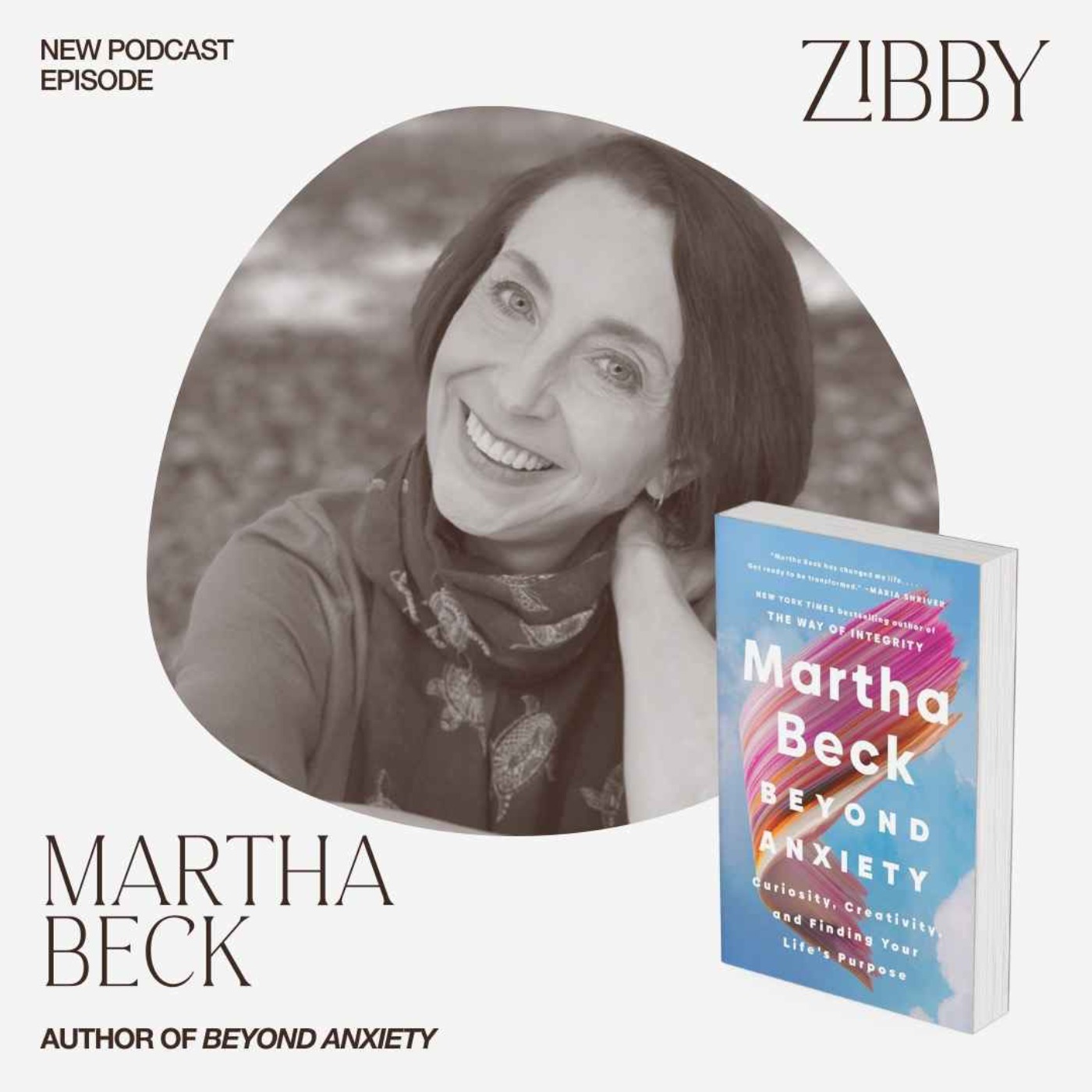
Totally Booked with Zibby
Martha Beck, BEYOND ANXIETY: Curiosity, Creativity, and Finding Your Life's Purpose
00:24:31
Loading summary
Transcript61 lines
- [00:01]
A
Hi, this is Zibby Owens, and you're listening to Totally Booked with Zibby, formerly Moms don't have time to read books. In my daily show, I interview today's latest best selling, buzziest or underrated authors and story creators whose work I think is worth your time. As a bookstore owner, publisher, author, and obviously podcaster, I get a comprehensive look at everything that's coming out and spend my time curating the best books so you don't have to stay in the know, get insider insights and connect with guests like I do every single day. For more information, go to zibbymedia.com and follow me on Instagram at Zibby Owens. Martha Beck is the author of beyond anxiety, curiosity, creativity, and finding your life's purpose. By the way, I have quoted from this book and this podcast like 20 times already since I recorded it. Martha Beck is a bestseller author, life coach and speaker who specializes in helping individuals and groups achieve greater levels of professional and personal success. She is the author of nine nonfiction books and one novel and has been a longtime contributor to O, the Oprah Magazine. She holds a PhD in Sociology from Harvard. Welcome, Martha. Thank you so much for coming on. Moms don't have to read books. So excited to have you here.
- [01:21]
B
Thanks for having me, Zibby. It's great to be here.
- [01:24]
A
Thank you. Okay, beyond anxiety, curiosity, creativity, and finding your life's purpose. I mean, what else do we need? This is like the ultimate hand.
- [01:34]
B
Yeah, I. I will write no more forever. Yeah, it's pretty topical, I think right now. You know, when I started writing it three or four years ago, I thought, you know, it was right after the pandemic. I thought, people are really, really anxious. I wonder if anything else will happen.
- [01:53]
A
Oh my gosh. Yeah. Do you mind if just a paragraph from your introduction that I thought was so funny. Okay, good. Okay. My own funny feeling. I've been studying anxiety all my life because I have it, have had it. Have had it in white hot volcanic eruptions and foul sky darkening billows. Have had it for years on end, for richer and for poorer, in sickness and in health. I remember being knotted up with anxiety on the eve of one birthday, worried sick because time was passing so fast and I had yet to accomplish anything significant. I was turning 4. Things only got worse once I started school. And you said, I'll just read this one paragraph. The first time I was assigned to write a poem, my fear of inadequacy kept me awake for five consecutive hallucinatory days and nights until my pediatrician My pediatrician put me on a short, blessed course of Valium in high school. When I joined the debate team and stood up to speak in front of a judge, I passed out cold. And then you just said all of this anxiety was one of the reasons I gravitated toward the social sciences. If I could understand the mind, my own mind, then maybe someday I could free myself from constant unease. So how. How did that go for you?
- [03:05]
B
You know, it was a long ride, but it has gone surprisingly well, I have to say. You know, I. I dug into this to researching anxiety during the pandemic because it was such the major issue. Anxiety worldwide went up by a full 25 during the. In 2022. 2020. Sorry. So I like, jumped in and. And read all this brain science that's been done and read widely. I'm a sociologist by training, so I read all the things that add anxiety to the culture, and I kind of figured out how to make my anxiety go away. And it hasn't been back. I mean, it starts. It starts to rise sometimes. And then I'm like, oh, I know how to fix this. And I stop it.
- [03:52]
A
Wow.
- [03:53]
B
And it's. I'm like, this is too good to be true. But I really have not felt anxiety since I started using the steps I describe in this book.
- [04:02]
A
Wow, that is. I mean, there's no more powerful advertisement than that.
- [04:05]
B
Oh, I'm sold.
- [04:07]
A
Yeah, sign me up. Well, you start the book by telling us, of course, the difference between fear and anxiety. And your encounter with a leopard. And now that was quickly showed you that real fear is, of course, quite different than the hauntedness of anxiety. Tell me about that and how you can identify the two.
- [04:25]
B
So we desperately need our fear. Without it, we'd all be dead. So when something dangerous is actually in our physical presence, we have this highly evolved instinct that makes us immediately go into very strong, concerted action to avoid a danger or run away from it, fight it, whatever. And then once the coast is clear, the fear goes away. Wild animals, they get afraid. I mean, they can be in the jaws of a leopard and get away and just give themselves a shake and they're sort of back at baseline within seconds. We humans are the only animals who can make stories in our minds about things that might happen in the future. Like, we got away from that leopard, but oh, my God, what was it like? Remember every detail. Tell our friends. Think about how much worse it's going to be next time. And so we spin these stories that keep triggering our fear impulse until it's just A spiral of non stop dread. And that is called anxiety. And it's not about anything clear and present in the room. It's in our own sad little heads.
- [05:34]
A
So you outline so many different really effective strategies in the book. If you could pick one and say, okay, this is the beginners. This is your first step, right. You're massively anxious. Where can you start? Which would be the, which would be.
- [05:47]
B
The step, the first step. Gosh, I'm tempted to go one further. But the first one is something I call Kissed K I S T, which sounds, it stands for kind internal self talk. Sounds so goofy. But all it is is just telling yourself the things that you would say to soothe a frightened baby or baby animal, because you are a frightened baby animal. And you just say things like, it's fine, I've got you, it's okay, going to be all right. You're okay, you're okay. These things that we instinctively would do if we found like a trembling, half dead kitten on the porch and we wanted to make it feel better. We all have the instincts to self soothe, but we don't use them. We're not trained to use them culturally. So that's the big first thing where I always have to go. And then if you want a really interesting fun trick, there's something I call scent stretching. And this is. So I'm gonna ask you to do it right now. Okay?
- [06:44]
A
Okay. Okay.
- [06:45]
B
Okay. So first think of something that makes you a little bit anxious so you can get that in your body.
- [06:50]
A
Okay.
- [06:51]
B
Let's just say the world because that's enough to make anybody anxious. Now what I want you to do is tell me one thing you love to smell.
- [07:00]
A
Okay, what is it? Warm chocolate chip cookies.
- [07:03]
B
Okay. Warm chocolate chip cookies.
- [07:05]
A
One thing you love to hear my kids talking.
- [07:09]
B
Okay. One thing you love to see.
- [07:12]
A
One thing I'd love to see the ocean.
- [07:14]
B
Okay. One thing you love to touch with your fingers or your skin.
- [07:19]
A
Just something super soft, like really fuzzy soft sweater or something. Blanket.
- [07:24]
B
Okay. And one thing besides chocolate chip cookies that you love to eat, you love to taste.
- [07:30]
A
Maybe like spaghetti with butter.
- [07:35]
B
So here's the scenario and I want you to envision this very clearly. You can close your eyes if you want to and everybody out there can play along. You are sitting with your children, listening to them laugh and talk at the beach. And it's a gorgeous day. You can hear the ocean rolling in out there. There's a tray of warm cookies that's just been pulled out of the oven. It's wafting to Your nose as you eat. Was it spaghetti?
- [07:59]
A
Yeah. Maybe not the best beach snack, but delicious spaghetti?
- [08:02]
B
No, it's fabulous. Delicious beach spaghetti. And let's see if I left anything. Oh, and you're wearing the absolute softest cashmere sweater you've ever even conceived of. And think of all these components, every sense being in that scenario. Can you do it? How's your anxiety?
- [08:23]
A
Well, now I just feel sad because that I'm not with my kids, like in this idyllic moment at the beach.
- [08:31]
B
Now, that is something you can do, something about. You can plan to get together. A lot of times these sense drenching exercises really help my clients know what to do to feel happier. But when you were holding those sensory images in your mind, how anxious were you?
- [08:48]
A
I was not.
- [08:49]
B
Yeah, you can't do it because the part of the brain that does anxiety, which is mostly on the left hemisphere, can't stay active when we really, really sink into things that the right hemisphere preferentially uses. And things like being sensing things and imagining things and putting things together in our imaginations. Those are all functions of the creative right hemisphere. And they toggle. There's tons of research showing that anxiety kills creativity. What I found is that if we can get ourselves to be creative the way you just did, in any way, it turns off anxiety. And then there are scary things happening in the world. But are you in a better position to solve those problems when you're in a panic attack or when you are creative and calm?
- [09:39]
A
Creative and calm, yes.
- [09:40]
B
There you go. We're done here. Okay, great.
- [09:44]
A
Well, that was easy. Thank you for the session. Wow. And that was just the first step. My goodness. And creativity, though, comes from a place where it's not just that you're not anxious. Right. Feeling that urge to create that you're putting something in the world that doesn't exist. That is a little bit more. It's more than the absence of anxiety, isn't it?
- [10:11]
B
Yes. And that's why this book is called Beyond Anxiety, because a third of the book is about we're all anxious. And it helps. You know, it gives lots of different tools for calming down, but that's when the really good part starts. We don't end with calm. If we're going to activate the structures on the right in the right hemisphere that are actually the. The mirror image of the anxiety structures, we have to go into creativity. We have to start connecting things. People get scared even of the word creativity, because when they're in an anxious place, they think that means, oh, my God. They're gonna make me draw something and compare it to somebody else. Oh, I can't sing, I can't dance. Peace, kind internal self talk. And just know that Zibby just did an amazing creative thing by imagining a delicious scene that has not yet taken place. So all you have to do to become creative, you could pick up a Kleenex and like wad it up and see if you can mold it into an animal. You can, you can get up and do a little dance around the room and it doesn't matter. Not have to be good. Anything you do. And there's a lot of research on this too. Anything having to do with the arts, but also things like cooking and gardening and creating social events. All of these use those creative structures. And when they are active, the anxious mind is off. The interesting thing is that the anxious mind is also the part that tracks time. So that's why you can get into something and it feels like, oh my gosh, no, time passed and it's been three hours. The anxious part of the brain will truly believe that that time didn't exist. It will say, I've always been anxious. No, I've never had any breaks in my anxiety. What are you talking about? Because it doesn't access these other sensations. Anxious brain doesn't even know about creative brain. But creative brain can use all the information in anxious brain to solve problems just by imagining anything.
- [12:19]
A
Wow, this is very powerful, right? What is this? What are some how do the how then. So this is the explanation for flow state, right? Okay, how do we then apply that for kids and make things that kids are interested in? What if they don't have? Does it apply any differently for children?
- [12:40]
B
It does in that they are way ahead of us. So in the 1960s, NASA had a study done to identify creative geniuses so they could hire them. And it turned out that 2% of adults rated as creative geniuses. And they kept using this test for a while and then someone thought to give it to 4 and 5 year olds. How many of them do you think rated as creative geniuses? All of them, pretty much 98%. And I think probably the 2% just hadn't slept well. So I think all children are born creative geniuses. And the people who did that study to explain how 98, 96% of their people were losing their genius by the time they became adults. They said, it's the school system. It teaches us not to be creative. It likes us to be formulaic, to follow instructions, to give predictable answers, to keep a track of time and all the things and read and write and do arithmetic, all of which is very left hemisphere dominated. So that makes us anxious. Even reading, which I love, forces us to tighten the focus of our eyes, which is a fight flight response. And like when an animal sees something scary, it's like really gets intense so it triggers the whole fight flight phenomenon when we just read. So what I would do if and I happen to be raising a four year old helping raise a four year old right now. I wish I'd known this when my older kids were younger. Don't require them to come out of their creative genius. Encourage them, give them time to mess around, break all the rules, give them stuff to just fool around with. And by the way, don't praise them for doing it well because that makes them anxious because now they think they're being scored. Just praise them for being amazing and creative and wow, who could even imagine what you'll do next? Just so yeah, let them be who they are and praise them for being it, but not for being good at it, which ties people in knots.
- [14:58]
A
Excellent. Today's episode has been sponsored by Wayfair. I don't know about you, but I am so excited to get rid of all the holiday clutter and make room for spring refresh in my own home and office. I trust Wayfair more than any other brand and I'm probably their most frequent shopper because I decorated all of Zibby's bookshop on Wayfair and then all of the Zibby Media offices in New York City on Wayfair, plus my own home. I am obsessed. Wayfair has stuff for everyone and everything. Think carpets. Think comfy poofs for kids. Think couches and tables and office chairs and cute knickknacks and everything you can need to make your space feel refreshed and cozy and wonderful. Plus, it comes so fast and the prices are amazing. There's something for every style and every home and office, no matter your space or your budget. Wayfair will make it easy to tackle all your New Year's home goals with endless inspiration for every space and budget, whether you need a light refresh or an organization overhaul. So give your home the refresh it needs with wayfair. Head to wayfair.com right now. That's W A Y F A I R.com Wayfair Every style, every home Today's episode is sponsored by Acorns. Acorns makes it easy to start automatically saving and investing so your money has a chance to grow for you, your kids, and your retirement. You don't need to be an expert. Acorns will recommend a diversified portfolio that fits you and your money goals. Acorns lets you invest with the spare money you've got right now. You can start with $5 or even just your spare change so you don't need to feel like financial wellness is impossible. Acorns gives you small, simple steps to get you and your money back on track. And it's the new year when we all make New Year's resolutions. Last year I made a resolution to go to the gym more often. I tried to say I would go once a week. Basically, I think I've gone to the gym like three times in the whole last year. But I am not giving up on my resolutions. And saving money and making smart financial decisions is a resolution that Acorns makes it really easy to keep. By the way, I invested with Acorns in 2023 and in my portfolio I am up 20.24%, which is really awesome. So you should do it too. It's amazing. Head to acorns.com books or download the Acorns app to start saving and investing for your future today. Paid client endorsement compensation provides incentive to positively promote Acorns tier one compensation provided investing involves risk. Acorn Advisors LLC and SEC registered investment advisor. View important disclosures@acorns.com books wow. And then how does all of this tie into the purpose of life?
- [18:05]
B
Ah, because as you follow, so there's two spirals. Anxiety sends us into a tight, nasty little corner. Like a phobia will advance. Someone's afraid of going to the store, then they're afraid of going outside. Then they're afraid of going outside the bedroom. It closes in. That's agoraphobia, of course. Weirdly, you know, when people were locked in during COVID a lot of people developed that just because we were closed in anyway. So it has this tiny tightening effect on the other side. Creativity also spirals, but it spirals outward and it connects us with more and more and more things. And it connects things. Even the two sides of the brain are a slightly different color because the right brain has more of these long neurons that are insulated with this white substance called myelin so that it can create what are called far transfers. Where to? It will link two things that seem very different that have never been linked before. And then, wow. The whole, the whole brain lights up, but it needs these long white colored nerves. So the right side of your brain is actually paler than your left hemisphere. So yeah. And as you get connected to more and more and more things, it never ends. Ultimately, you mentioned flow state. Flow state happens when you're creating something at the very edge of your skill level and you're completely invested. It doesn't mean you're just sitting on the beach drinking margaritas. It means you're actually creating. You're doing stuff that's not easy for you, but it's joyful and it's meaningful. Then you connect and connect and connect and there comes a moment when you disappear and there is just the creation and that. So the book's divided into thirds. The creature who's frightened, the creative who thinks about things the way most humans do when they're in creativity, and then the creation when you can actually just disappear into this blissful process that seems to be happening somehow through you. And that is one of the best reasons to be a human being, I have to say.
- [20:21]
A
Do you feel that's where you are.
- [20:23]
B
A lot of the time? Yeah, man. I. It's happening. I get up every morning, I turn on a big bright light and I start drawing. Not. And then I, when I finished a picture, I stick it in a closet somewhere and forget that it exists. I did that first as an experiment to see what would happen if I really pushed the right side of my brain. It made me so happy. I was going to do it for a month and it was like I discovered some kind of incredible drug or something. I was just like thrilled to be alive and completely non tracking. My calendar people had to come tell me what to do when. But it's a good feeling to live without anxiety. It is so freaking good.
- [21:08]
A
Wow. It seems so simple. Just get more engaged creatively and trick your brain to stop using the side that it's been so used to using.
- [21:16]
B
It would be really simple except for one thing. Our entire culture is built on the premises that are present in that anxiety spiral in the left hemisphere of our brains. That part of our brains believes that there is no meaning in life. There is only grabbing stuff. Can you get enough stuff? Money, power, fame, get stuff, get stuff. And productivity is everything. Why? So you can die having done the most tasks. We have all these anxiety based rules in the culture, in our workplaces, in our schools. And the second you engage with that, you're going to be socially pressured to spin into anxiety again. So the spin in the brain is mirrored by the spin in the culture. And in order to get really resilient to that, you kind of have to practice moving your brain from anxiety to Creativity, because the brain is malleable. We can change it. And what fires together wires together. So if every day you have a practice, and I obviously talk about this in the book, if you have a practice that moves you out of anxiety and into creativity, you're going to develop, like, a muscle that resists the pull and push of the culture as it tries to make us anxious.
- [22:38]
A
I like it. Yes. Now I see why, when I have 8 million things to do, I have to, like, go into Canva and start making a new visual and move things around, you know, because look at your books.
- [22:49]
B
Look at those books behind you. If that is not an act of enormous creativity, I don't know what is. The colors. I'm just like, ah, I just could stare at your bookshelves all day.
- [22:59]
A
That is what I did during COVID by the way. I took all these books right back to your Locked in theory. So, you know, and you're creating a.
- [23:07]
B
Podcast and you're just. You're actively making stuff. That's one thing I tell people is a quick trick is to say to yourself, if something bad happens, instead of saying, oh, my God, what do we do now? What do I do? Say, oh, my God, what shall we make now? What can I make now? Because making stuff, the moment you're making something, you can't stay anxious.
- [23:32]
A
You're explaining a lot of my behavior. I'm liking this very much. I appreciate it. I appreciate it. Wow.
- [23:41]
B
Thank you.
- [23:42]
A
Yeah. This is so great. Amazing. Okay, well, what is one thing, just as a last question that you feel you're able to do now, freed of anxiety, that you never, ever would have believed that you could have done before?
- [23:56]
B
Oh, my God. You would not believe how many things I had. For example, I had. I've had chronic pain for a lot of my life. During my 20s, I was pretty much bedridden. So from 18 to 30, I was really in tremendous amounts of chronic pain. And then I. I left that behind. I found ways of living that made my stress levels go down. And that really helped with my symptoms, which is part reason I developed. I became a coach with a coaching system. I was trying to find things that showed up in my body as more capability, but I always thought of my body as sort of frail. And then I broke my foot, my toe, five years ago, and it didn't heal well. I was in the African bush, so I didn't see a doctor. And then I had to have surgery on it, and I just. And it was really a massive surgery for me. Like, it was months and months and months without being able to touch that foot to the ground. And so I walked away with kind of a lot of anxiety about, I don't want to try too hard. Then I get invited to do this, this long week long walk in England with nine other people, only two of whom I'd met. And we were going to walk 10 to 15 miles every day for a week. And I. There's no way. There's just no way. For 10 years, I had barely walked, and I thought I couldn't, but everything in my body, when I looked at the email inviting me, said, absolutely, go do it. So I said, okay, I'll be there. And I started walking and realized that much of my fear was related to something called psychogenic pain, which is when you remember the brain remembers the pain even after the tissues have healed, and it reproduces the pain even when the tissues are fine. So I felt like I was having my foot sawed open. And I just kept walking and realized that had been an anxiety pattern, not tissue damage. And I went to England and walked 75 miles in six days. I skipped today because my son was sick, but I. What? I got rid of my anxiety and suddenly I can walk 10 miles a day. I'm 62.
- [26:21]
A
Like that was.
- [26:21]
B
That's not supposed to happen when you're 62. I see better. My health is better. My relationships are better. Yeah. As I say in the book, when you get to that third part, the transcendence, it feels like you're experiencing miracles on a daily basis or. Yeah, I'm going to make that claim. I know it's bold. Try it. Hear me now, understand me later.
- [26:47]
A
Wow, this is so inspiring. Thank you so much. What a way to reframe life and deal with our worries and deal with what is outside of our control. Now there is something. There is a tool you've put in my toolbox that was not there before. So thank you so much.
- [27:02]
B
Thank you. And keep arranging books. It's really working. Thank you.
- [27:06]
A
Okay, you keep writing them and I'll keep arranging them.
- [27:08]
B
Thank you so much.
- [27:10]
A
All right, thank you. Take care. Thanks so much. Bye. Bye. Thank you for listening to Totally Booked with Zibby, formerly Moms don't have Time to Read Books. If you loved the show, tell a friend, leave a review, follow me on Instagram, ibbeowens and Spread the Word. Thanks so much. Oh, and buy the books.