Loading summary
Transcript69 lines
- [00:00]
Zibby Owens
Hi.
- [00:01]
Sarah Gibson Tuttle
Who here loves when their nails are perfectly done? Me. I'm Sarah Gibson Tuttle and I started Olive in June because let's be real, we all deserve to have gorgeous nails. But who wants to spend a fortune or half their day at the salon? And that's why I created the mani system. So you can have that salon perfect manicure right at home. And guess what? The best part, each mani only costs two dollars. Yup, you heard me. Two dollars. No more 30, 40, $50 salon trips that eat up your day. Now you can paint your whenever you want, wherever you want. And trust me, you're gonna be obsessed with your nails and everyone is gonna ask you, where did you get your nails done? And here's a little something extra. Head over to oliveandjune.com and get 20% off your first mani system with code perfectmani20@oliveandjune.com perfectmanny20. That's code perfectmanny20 for 20% off at olivenjune.com perfectmanny 20. You're all set for a nail glow up. Let's get those nails looking fabulous, shall we?
- [01:00]
Kelly Clarkson
Hey y', all, it's Kelly Clarkson with Wayfair, where delivery and setup are as a few taps on your phone. Picture this. You're relaxing in an old hammock, scrolling Wayfair's app when you spot it. A brand new patio set. Next thing you know, Wayfair delivers it right to your patio and sets it up. Oh, you need a new grill too. All right, Wayfair's got you covered. With Wayfair's room of choice delivery and fast expert setup on qualifying orders, life gets a little easier. Visit Wayfair.com or the Wayfair app. Wayfair Every style, every home.
- [01:32]
Nutrafol Sponsor/Announcer
Today's episode is sponsored by Nutrafol. Do you ever worry about your hair? I was convinced that my hair had gotten a little bit thinner once I reached a certain age, which had me in a complete panic. So I started taking Nutrafol and it helped. Nutrafol is the number one dermatologist recommended hair growth supplement and the number one hair growth supplement brand personally used by dermatologists. Nutrafol offers multiple formulas for men and women tailored to different life stages like postpartum or menopause and lifestyle factors. For all of you who abide by a plant based diet, I do not. Adding Nutrafol to your daily routine is easy. You just order online, no prescription needed. You get automated deliveries and free shipping to keep you on track. Plus, with a Nutrafol subscription, you can save 20% and get added perks to support your hair health journey. You just take four supplements a day and you'll be on your way. Let your hair be one less thing to worry about. See visibly thicker, stronger, faster Growing hair in three to six months with Nutrafol and for a limited time, Nutrafol is offering our listeners $10 off your first month subscription and free shipping. When you visit nutrafol.com and enter promo code Zibby that's nutrafol.com spelled N u T R a F o L dot com promo code Zibby Go do it.
- [02:57]
Zibby Owens
Hi, this is Zibby Owens and you're
- [02:59]
listening to Totally Booked with Zibby, formerly
- [03:02]
Moms don't have Time to Read Books in my daily show, I interview today's latest best selling buzziest or underrated authors and story creators whose work I think
- [03:12]
is worth your time.
- [03:14]
As a bookstore owner, publisher, author and obviously podcaster, I get a comprehensive look at everything that's coming out and spend my time curating the best books so you don't have to stay in the know. Get insider insights and connect with guests like I do every single day. For more information, go to zibbymedia.com and follow me on Instagram Ibeowens Madi Friedman
- [03:41]
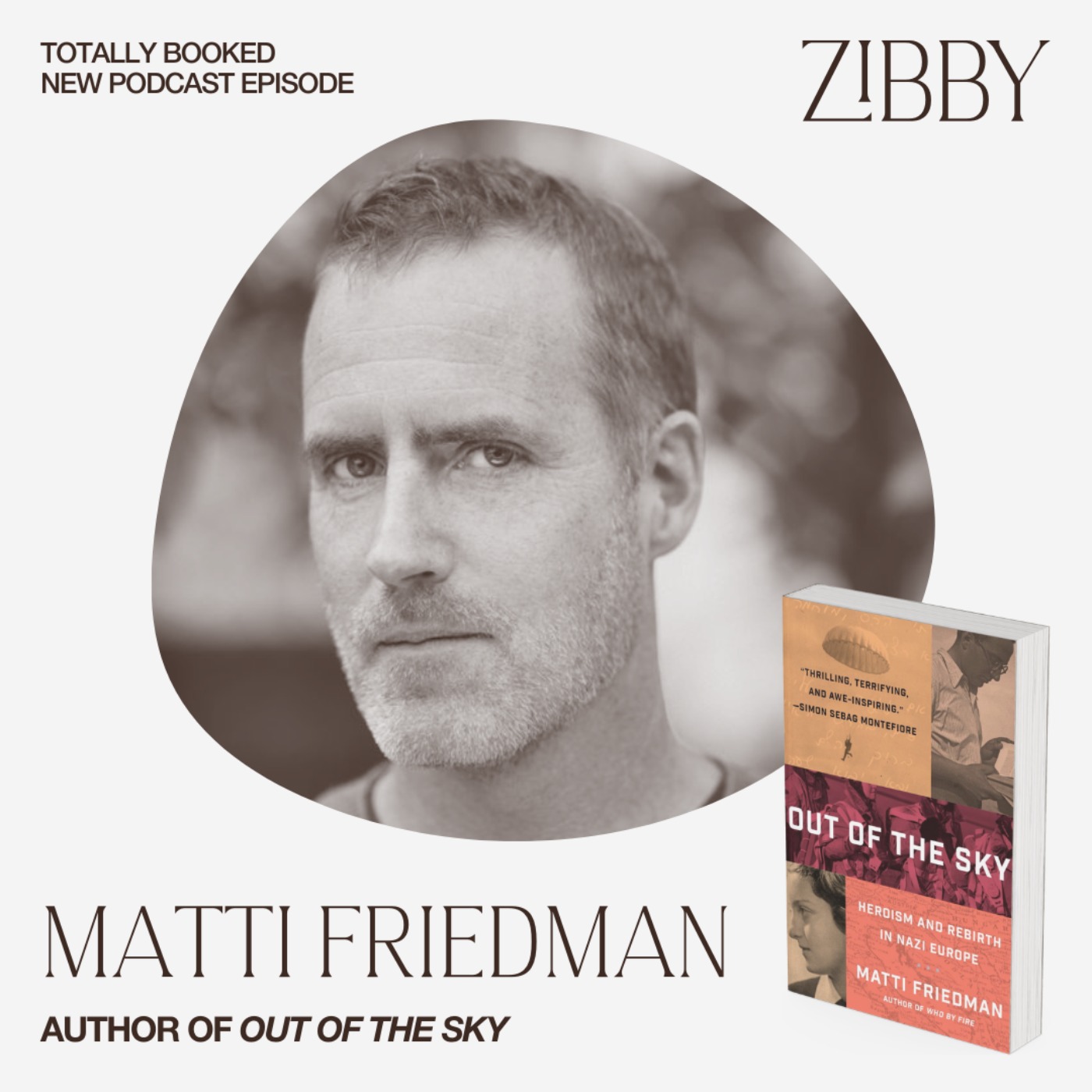
is the author of out of the Heroism and Rebirth in Nazi Europe. Matty is an award winning journalist and the author of four nonfiction books. His work has appeared in the New York Times, the Atlantic, Tablet, Smithsonian, and elsewhere and he is currently a columnist
- [03:55]
Nutrafol Sponsor/Announcer
for the Free Press.
- [03:56]
Zibby Owens
He is also the author of who by the Fire? Leonard Cohen in the Sinai, which was selected by Vanity Fair as one of
- [04:03]
the year's best books.
- [04:04]
Also Spies of no Country, Secret Lives at the Birth of Israel, which won the 2019 Natan Prize and the Canadian Jewish Book Award winning Pumpkin Flowers, A Soldier's Story of a Forgotten War, which was chosen in 2016 as a New
- [04:18]
Nutrafol Sponsor/Announcer
York Times Notable Book and one of
- [04:20]
Zibby Owens
Amazon's 10 Best Books of the Year, and the Aleppo Codex, which won the 2014 Sammy Rohr Prize and the ALA's Sophie Brody Medal. His books have been translated into more than a dozen languages. Matty was born in Toronto and lives in Jerusalem.
- [04:33]
Nutrafol Sponsor/Announcer
By the way, when we were speaking
- [04:35]
Zibby Owens
on the podcast, he expressed concerned about how, given the current climate, it was impossible to plan anything. And then I think two days after we spoke was when the US attacked Iran. So as I'm recording this bio, even Israelis continue to go back and forth into bomb shelters, Matti included, and we are thinking of him as he goes through this. And here is his episode. Welcome, Maddie. Thank you so much for coming back on Totally Booked to talk about out of the heroism and rebirth in Nazi Europe. Congratulations.
- [05:09]
Matti Friedman
Thank you so much for having me again.
- [05:10]
Zibby Owens
You're welcome. Can you tell listeners about your book? Why did you decide to tackle this topic? What exactly is covered? Although I know because I read it, but, you know, tell everybody else.
- [05:20]
Matti Friedman
Sure. This. This is a book about a very strange episode which is at once very well known in Israel and at the same time almost completely unknown. It's a strange mission in 1944. A British operation that takes a group of young Jews who've escaped the Holocaust and who've made it to what was then British mandate Palestine and gets them to volunteer to parachute back into the Holocaust. And it's a story that becomes part of the mythology of Israel in its early years. There's one character in particular who becomes a national heroine whose name is still known pretty ubiquitously to this day. That's Hannah Senesh. And I never quite understood what the story was and I knew the name Hannesanish, but it was kind of like Davy Crockett or George Washington or something where you have some very vague idea of who this person was, but you don't really know. And a few years ago I decided that I would investigate and see what the story really was. It was also an attempt to kind of ask what Zionism is, what the state of Israel is trying to achieve. Kind of peel away eight decades of very complicated and controversial history and get at the core of what this country was in the eyes of the people who founded it. And the people who embarked on this mission were really kind of some of the earliest heroes of Israel. And understanding who they were seemed to me would help me understand something deep about the place where I've lived and reported for the past 30 years. Another aspect of it is the nature of heroism. It just struck me as an interesting moment to investigate what heroes are. We live in a kind of anti heroic moment where our tendency is to tear down heroes. And I wanted to look at a moment where people did not have that instinct and to ask what heroes are and what the connection is between heroism and literature.
- [07:10]
Zibby Owens
So not a big goal or anything, just like a little fun project on this.
- [07:14]
Matti Friedman
Yeah, basically a tweet.
- [07:15]
Zibby Owens
Yeah, exactly. Basically a tweet. What do you think that's about? Why is there an era of anti heroism now?
- [07:22]
Matti Friedman
It's interesting to think about it. I mean, the moment that really stands out for me is when President Trump kind of belittled the heroism of John McCain. There was that moment when you have John McCain, who's this incredible war hero who survives years in Vietnamese captivity and is tortured and kind of comes out of it in this very noble way. And you have an American, a very senior American politician, who says, I think this is more or less an exact quote, who says, I like the kind of heroes who weren't caught, or something like that. So you kind of, instead of admiring someone like John McCain, felt the need to kind of bring him down a few notches. And I think that's a pretty common response. And I. I encounter it in different ways when people look at whether even if it's just like a sports hero or. Or a celebrity, that the urge is to kind of tear people down and bring them down to our level. So when looking at a hero, your response could be, wow, that person is amazing. I want to be like that person. Or you can kind of reconcile the very disturbing gap between you and this heroic figure by belittling the hero and saying, no, this person isn't a real hero. They're doing it for the money. They're mentally unstable. There are many explanations for why people aren't as great as they seem. And if we look back at this story, which happens in 1944, the world is very different. And people are willing to accept that there are heroes in the world. And people understand that a national movement is going to require heroes. And of course, there are many examples of. In those same years of World War II heroes, people could look up to bomber pilots and heroic women working in the armament factories and a Marine who stormed the beaches and on some Pacific island. This was pretty accepted in those years. And I think the cultural change has been very interesting. And it's not something that I discuss at length in the book, but it's definitely in the subtext.
- [09:17]
Zibby Owens
Yeah, I feel like without the hope of heroes, you lose something as a society. Right. We have to collectively want to uplift or it becomes sort of dark.
- [09:28]
Matti Friedman
I couldn't agree more. That there's something about the cultural vibe, which is very much about downlift. I don't think that's actually a word.
- [09:36]
Zibby Owens
Let's make it a word.
- [09:38]
Matti Friedman
But the idea of kind of looking up to someone who sets an example, that idea has. It's very, very much battered and in many cases, I think non existent, and it's certainly very partisan. So the heroes to one group of people are villains to another group of people, even in the same society. And the idea of agreed upon heroes, someone like George Washington or Lincoln, someone who basically the entire society can look up to and say, wow, that person is amazing. I want to be like that person. Even that idea is really under fire in an age of extreme sectarianism and division. So this story happens in a very different world. And it's one that is. It's a world that in many ways is much darker than our world, but it's also a world that's more innocent and makes more room for people's idealism and for their best instincts.
- [10:29]
Zibby Owens
Well, what you do so beautifully in the book is take us really closely, sort of zoom in on a couple different characters who we don't know that much about. And we track they're coming from the sky, which is what one person says in a camp, basically about how this person sort of just fell from the sky and helped them. But we see what their lives were like before, in many cases, what they were like during. You have examples of people who were just going about their lives sort of a la Anne Frank, like, wanting to be a writer, wanting to do this, like looking up to their parents or wanting to, you know, and then they end up in these military situations and becoming, you know, heroes, if you will, or their trajector. Now you've uncovered some of which you point out weren't even written in English, or you found obscure texts and translated. And you've really, like, highlighted these characters in a way that it's like watching a movie and finding out all about people whose stories were somewhat lost and now really refined in clear detail. And you have scenes in here which are so compelling that make the reader feel like we are trying to get through the almost impossible to understand and put ourselves in moments like clawing out from being buried under snow and, you know, trying to charge. I mean, I'm all over the place here, but you put us in these moments that feel practically impossible to survive and somehow are survivable. And, I don't know, tell me a little bit about how you did it. And you also, in the book talk about how you go back to all these places and you're now you're visiting this place and now you're here and showing us what it's like today and contrasting it to how it was. Talk a little bit about sort of the scope of the project and how you focused on the characters and some of these powerful moments. That was a long, rambling thing.
- [12:21]
Matti Friedman
There were 32 parachutists who took part in this mission. I chose four so the book really revolves around four characters. And I don't think it's ruining anything to say that not all of them survive to the end of the book. And so, I mean. And even the characters who do survive the mission are not available in 2026 for Inter. So I had to reconstruct it in a different way. Mostly that involved archival research. There are thousands and thousands of documents in mostly in Tel Aviv that recount the mission day to day. It was very well documented. So it really comes to life in these very old files that are kept in a few different places here in Israel. And there were some obscure memoirs written about it. And there has been writing about this mission over the years. So I tried to bring the characters to life through that way. The amazing thing about them, and this kind of relates to what we were talking about at the beginning, is that they were incredibly literary people. So they wrote Hannesenish, who's really the dominant character here, a very young woman at the time of the operation. She's 22 when she jumps into occupied Yugoslavia. She was a superb writer. I mean, she left a great diary and she wrote poetry and she wrote a song that today is probably the most famous song in modern. In modern Hebrew. So. And this is true of the other characters as well. So I actually had quite a bit to work with because they were so verbal. And when I was trying to think about how these people who are very non military characters, as you know, you know, like today, if they showed up at a recruiting center, they probably would have been turned away. They were like bookworms, you know. Hana Senesh is basically a theater kid. She's the daughter of a playwright. And they weren't military figures. And what they were was literary characters who had a very concrete idea of what heroism was, what a heroic narrative is, and how to exist as a hero in the world, which is an idea that they drew from books. So there's a really deep connection here between books and their heroism. And it also means that they left us a lot of really excellent writing, even though unfortunately, most of them could not write about it in retrospect because they did not survive the mission in 1944. But that's how I put it together and what I was really missing after spending many, many months in the archives looking at documents, what I was missing was the feel of the landscape, because I'm writing this from Israel. So part of the story happens in Israel, but most of it happens in Central Europe, mainly in what was then Yugoslavia, Hungary and what was then Czechoslovakia. So I had to go back. And I had an incredible time retracing the steps of my characters. And I went to Hungary. I went to Budapest, which is where Khanasenish is from, and I went to the site of a mass grave in Slovakia, and I found a hotel where some of the characters had stayed during a partisan uprising in Slovakia in 1944. And perhaps the most striking trip for me was a train journey that I took in Italy, retracing the steps of one of my characters, whose name was Enzo Cereni. He was Italian, and he. I won't give it all away, but he ends up on a train going through northern Italy, over the Alps, and ends up in a concentration camp called Dachau next to Munich. So I really retrace that journey on a train. And of course, it's a beautiful journey. I mean, I think he didn't appreciate it when he did the train journey, but it's just a stupendously beautiful train journey over the Alps. And you can really feel what the characters felt, or at least see what they would have seen 80 years ago.
- [15:47]
Zibby Owens
Well, I love that because it feels like, as the reader, we then got to see. And even when you use texts of what it was, I think there was a whole book on Hungary at the time that you contrasted with, you know, the streets then and how you see it now, and even a place in Tel Aviv, I think you said. And then you compared that to the thriving metropolis that it is today. And so we all feel we got to go on this. On this journey with you, which was so interesting. And to your point, about the literary influence on everybody, you even mention that you uncovered this anthology, I think, Settlers on the Kibbutz of essays written by women, which has not been really publicized or really uncovered. And you quoted from some of the women and what it was really like at the time, which I found fascinating. As someone who loves anthologies, what did you take away from that?
- [16:36]
Matti Friedman
One of the amazing things about this story is that the strongest characters, in many ways are women. So of my four main characters, two of them are women. One of them is Hannes Senesch, and one of them is Havivah Reich. And Khaviva's favorite book was this anthology, which was published a few years before the Mission. It's an anthology of writing by women. It's called Members of the Kibbutz. In Hebrew, it's called, which means specifically female members of the kibbutz, because in Hebrew the words have gender. So it's specifically referring to the female members of the kibbutz. The kibbutz movement was a socialist, kind of radical socialist, Zionist movement. And part of the idea was not just building a Jewish state, it was freeing women from the bonds of bourgeois capitalism and the family so kids would be raised communally in children's houses in order to free the women for work. And the book is an anthology, which is really just a fascinating document, completely forgotten. I'd never heard of it until I started researching this story. And it tells this chapter about what it was like to work in a dairy barn. And there's a chapter about a woman who's a tiler. She's laying tiles in the port of Haifa. Then there's a fascinating essay about the erotic life of the kibbutz. How is a woman supposed to navigate biological realities and radical socialist ideas, which are very critical of things like monogamy? So it's a really interesting document. And Aviva absolutely loved this book, and she loved it so much that she put it in her pack and took it with her when she volunteered for this mission. And she travels from her kibbutz in British Mandate Palestine. She takes it to Cairo, where she undergoes a period of training by British intelligence. The operation is run by an arm of British intelligence called MI9, and she is given radio training. She's taught to use Morse code. And then she's flown to a recently liberated port in Italy called Bari. And from there, she's inserted into occupied Slovakia by an American airplane. And she takes this book. It's in her pack. She refuses to part with this book, and she will not part with this book until a few days before a kind of climactic battle in the forest of Slovakia, when she realizes that she has to get rid of it, and she buries it in a forest in Slovakia. And a few months later, someone retrieves the book, and it was sent back to her kibbutz. And actually, two days ago, I was on her kibbutz, and I held the book in my. In my hands, which is quite amazing to do. And it's this incredible feminist document that inspired her to undertake this. This act of heroism, perhaps in the hopes of becoming herself. A chapter in the anthology of, you know, heroic pioneer women.
- [19:17]
Zibby Owens
That's amazing.
- [19:19]
Quince Sponsor/Announcer
Today's episode has been sponsored by Quince. These days, I am all about quality over quantity, especially in my closet. If it's not well made and versatile, I am just not wearing it, and it's not worth it to me. That's why I love Quince. The fabrics feel elevated, the cuts are thoughtful, and the pricing actually makes sense. Quince makes high quality wardrobe staples using premium fabrics like 100 European linen, 100 silk and organic cotton poplin. Lightweight cotton cashmere sweater is perfect for the changing seasons and can't miss. Seasonal colors and prints for spring are amazing. They're versatile, well made pieces that make getting dressed simple. Quint clothing is consistently rated 4.5 to 5 stars by thousands of customers. I personally would rank them five stars. That's just me. Real people wearing these pieces every day are actually loving them and they work with safe ethical factories and cut out the middleman. So it's just quality clothing. As I have told you all and post on Instagram, my winter coat is Quince so I think about Quince every single day. It is my go to and has gotten me through this dreary, terrible winter that we've all had and that I can't wait to be over right now. Go to quince.com zibby for free shipping and 365 day returns. That's a full year to wear it and love it. And you will now available in Canada too. Don't keep settling for clothes that don't last. Go to q U-I-N-C-E.com zibby for free shipping and 365 day returns. Quince.com zibby.
- [20:55]
Kelly Clarkson
Hey y', all, it's Kelly Clarkson with Wayfair, where delivery and setup are as easy as a few taps on your phone. You're relaxing in an old hammock scrolling Wayfair's apple when you spot it. A brand new patio set. Next thing you know, Wayfair delivers it right to your patio and sets it up. Oh, you need a new grill too. All right, Wayfair's got you covered. With Wayfair's room of choice delivery and fast expert setup on qualifying orders, life gets a little easier. Visit Wayfair.com or the Wayfair app Wayfair Every style, every home.
- [21:25]
Gatorade Sponsor/Announcer
Does your day move faster than you
- [21:27]
Creon Sponsor/Announcer
can keep up with new Gatorade lower sugar? My family and I can stay at the top of our game.
- [21:32]
Gatorade Sponsor/Announcer
No artificial flavors, sweeteners or colors.
- [21:35]
Creon Sponsor/Announcer
75% less sugar and all the electrolytes of regular Gatorade now available nationwide.
- [21:42]
Zibby Owens
Well, it really gives me goosebumps because these characters who want to be writers and here we are almost 100 years later and they are writers now. Like we are reading them in your book. Their words are getting out there and it's just amazing. It's just, I mean, I guess just Never give up on your dream of being a writer. You never know who's going to read
- [22:04]
Matti Friedman
it when it's really true. I mean, it's a shame that they didn't live to see the writing be read by anyone else. Certainly Chana dreamed of being a novelist. We know that because she writes it in her journal. That's her dream. And if you read her writing as a very young woman who's also writing, she writes in Hungarian until she arrives in Israel at age 18, and then starts writing in Hebrew. So she's operating in a language that she's acquired just a few years before, and she's incredibly proficient in Hebrew, and she writes beautifully, and her poetry and her writing is still. It's the writing of a young person. She's not quite there yet, but she will get there. Had she been given a few more years, she would have been a great writer and we would know her name, and we don't, which is tragic, but at least we can kind of recreate who she was because of the amazing writing that she left. And the same is true of someone like Enzo Sereni, the Italian who I mentioned. He had written a book by the time the mission happened, and posthumously, another book of his was published. And he was a writer. He dreamed of writing the great Italian Jewish novel, which was supposed to tell the story of his family, a family from Rome, kind of an aristocratic Jewish family from Rome. His father had been a doctor, the physician at the court of the Italian king. And his novel was going to tell the story of. It was going to be a multi generational novel about a family of Italian Jews who are pulled in different directions by, you know, secular revolution and communism and traditional Judaism and fascism. And. And he never got to write the novel. Instead, he kind of became a hero himself. He became almost a literary figure himself. He enacted the novel, but never, never got a chance to write it.
- [23:46]
Zibby Owens
Oh, my gosh. Sometimes I think about the wall of books that would have been had all the Jews lived, and how instead now there are just a couple books here and there, as opposed to a full bookshelf, and all the stories that were lost in addition to everything else, but the loss that we all have as a society of readers and people who long to understand others.
- [24:09]
Matti Friedman
Anyway, they believed in the power of words.
- [24:12]
Zibby Owens
Yeah.
- [24:12]
Matti Friedman
And I think more than anything, they thought that they were writing a different story about the Second World War. I don't think they really expected to have a military impact. I mean, they knew they weren't going to defeat the Wehrmacht. They knew they weren't going to save the Jewish people. I mean, what could a handful of, you know, young Jews do in occupied Europe in 1944? What they knew that they could do because they believed in literature, was tell a different story about the war in which they were heroes and not victims. And this is the story that the Zionist movement wanted. And they were essentially sent to act out a story. So the mission fails in practical terms. It achieves nothing basically in real terms. But real terms were not the important terms here because the mission was essentially a literary mission. And that's why 80 years later, we're still talking about these heroes and what they accomplished and what they left us.
- [25:08]
Zibby Owens
And then contrast this to Goldie Hawn in Private Benjamin, which is what the US is contributing to this era. We have these brave warriors and here we have. Anyway, whatever. It's great to have role models in any way we can find them. There are moments in this book that feel like, I mean, I keep referencing movies, which is sort of a default to just how visual and, you know, impactful the moments are. But there's one moment that you write about in the woods where this group of sort of bedraggled refugees are wandering through and they come across a Jewish soldier who says Shabbat Shalom and they all start crying. I hope I'm getting this totally right. But another goosebump inducing moment where they couldn't even imagine that they could have a Jewish soldier savior like this from where they were bespeckled in the, in the woods and all of that. Like, tell me a little more about that moment.
- [26:08]
Matti Friedman
It's really hard to recreate from the current moment because we're all used to the existence of the State of Israel. And in fact, in the eyes of many people, the, you know, the state of Israel is too powerful. And it's almost impossible to remember a moment when Jews had absolutely no power. And in 1944, that is very much the state of affairs. You have this incredible, really industrial slaughter of Jews in Europe. Six million people are murdered. They have nowhere to go. People can't escape anywhere. The doors are closed. There is no Jewish state. There's a Zionist movement that's trying to build something in British Mandate Palestine, but it hasn't happened yet. And the British will not allow anyone to come. So there's no Jewish army, there's no Jewish air force. These parachutists have no way to get to Europe, which is why they become British agents. That's their only way to get to Europe and make contact with the Local Jews, they need the British, they need the Royal Air Force to drop them into Europe. There's no other way to get there. So the idea that there are Jewish soldiers who are preoccupied with helping Jews, this, for someone in 1944, was completely mind blowing. Certainly, if you're a Jew wandering around the forests of Yugoslavia, which was the case in the scene that you're mentioning, and there's a group of refugees among the trees in the forest. There are no young men. Something has happened to all the young men. So it's old men and there's women and children, and they've been kind of kicking around in the forest. And they encounter two of the parachutists who've come from the land of Israel. And one of them speaks to them in Hebrew. One of the parachutists addresses these people in Hebrew and they just can't believe it. I mean, they've never seen anything like it. So it's an incredible scene because the existence of these soldiers suggests a different future. There is a future where these people will not be powerless. And they've been sent from, you know, a country that these people have heard about from the Bible. Same, same country. And it. It gives them hope. But there's also a tragedy there, which is that beyond giving them hope, they can't do anything for them. There's no way to get them out of Europe. The. The, you know, the British airplanes that are flying, the parachutists, and they can't take anyone out. The planes are reserved for military personnel. So no one prioritizes saving these people to the extent that their enemies prioritize killing them. And that's just the state of affairs. And it's one reason that this Ms. Touching in a sad way, because they're sent to Europe in their understanding of the mission. They're sent to Europe to save Jews, and they can't. They have no way to do it. All they can do is tell them a story, which kind of returns us to the theme of storytelling. All they can do is say, survive until the end of this war and you'll be able to get to this country which does not exist, but will one day. So it's just a story. And it's an incredibly powerful story. It's so powerful that it ends up working. But in 1944, it all feels incredibly tenuous and unlikely.
- [28:54]
Zibby Owens
Can I read, like, the two paragraphs around what we're talking about? Is that okay?
- [28:58]
Matti Friedman
Of course, yeah.
- [28:59]
Zibby Owens
Okay. The refugees SHOUT questions in German, Serbo, Croat and Yiddish. Chaim understands that they were interned in an Italian camp, escaped when the fascist regime of Mussolini collapsed, and had been wandering for months. He finds that he too is crying and can't speak. In his next transmission to headquarters, Chaim asks his British commanders to fly the refugees to safety. But space on Allied aircraft is scarce and reserved for military personnel. M19 needs trained aircrew who can be put on new bombers, not useless civilians. Heim knows this. The position of the Western Allies is that the particular problems afflicting Jews in this war will be solved by the general defeat of Nazism, which is why no airplanes are ever sent to disable the death camps. There is not a country on earth that prioritizes saving these people to the extent that their enemies prioritize killing them. The parachutists from the land of Israel. Haim the scythe can tell the people in the forest a story. There's a place for them in the world, the same one they know from the Bible. He made it there himself, then flew back to this hell and jumped from an airplane to reach them. Maybe knowing this will give them strength to survive a while longer. Other people control the plains, the ports and the sea. He has nothing to offer but this story. So beautiful.
- [30:11]
Matti Friedman
Thank you. At the time, it must have struck them as being not very much. You know, they must have hoped for some kind of concrete assistance.
- [30:19]
Zibby Owens
They're like, thanks a lot for the story.
- [30:20]
Matti Friedman
Yeah, this is a great story. Do you have any food you could give us? Can you perhaps get us out of here? And the answer was no. I mean, they really had nothing to
- [30:31]
Zibby Owens
offer, and yet here we are still talking about it. It's amazing, really amazing.
- [30:34]
Matti Friedman
Because the story. Right, because the story, I mean, they understand this. And that's what's amazing about this mission. The story isn't nothing. It kind of seems like nothing. And the mission would seem to be a failure if you judge it according to any military measure. They don't really save any Jews. They don't kill any Germans. The whole thing doesn't really add up in military terms. So you could say it's just a story. But they understand that a story is something that's incredibly powerful. And in fact, Jewish history is held together by stories. There's no country for most of the history. So people don't share a geography, and they don't share a political system, and they don't even necessarily share a spoken language. Right. You have Jews who are living in Yemen and Jews who are living in Poland, and Jews who are living in Manhattan, and Jews who are living in Toronto, which is where I grew up. So, you know, what holds the whole thing together? Well, actually, it's held together by stories, by books that the Jews read at the same time. And, you know, and it kind of holds the whole thing together. So I think there's a deep Jewish understanding of the power of a story, and it's not. It seems very intangible. But, you know, I'm speaking to you from Israel right now, which is a country that is born of a story and it became real. So stories are powerful things. In our characters certainly understood that.
- [31:53]
Zibby Owens
You and I, here we are just keep talking about, you know, people of the book. We're just keeping this going. And then just quickly, you know, why. You, you grew up in Toronto, you moved to Israel, you've been there 30 years, you write books, you examine history, you spend your time taking trains to recreate these journeys. Like, how did this happen to you?
- [32:15]
Matti Friedman
First of all, I feel very lucky that it happened to me. I mean, it's really just. I feel really lucky to be able to. I was going to say do this as a job, but calling it a job is really a bit of a stretch. But I think that I arrived here when I was 17 in Israel without really understanding much about the country. And since then, I've been trying to explain the country mainly to myself. So before I'm writing for anyone else, I'm writing for myself. And I'm trying to figure out this really kind of wild and surprising and frustrating and depressing and exciting and electric place where I find myself living. And each book is an attempt to explain something else about that. And I've been drawn particularly to stories that are really distant from my own experience of stories about the Jews of the Arab world. I wrote a book about a crazy rock and roll tour given by Leonard Cohen, you know, at the Egyptian front of the Yom Kippur War. And this one is a return to a European story, so kind of part of the official mythology of Israel, but a part of the national mythology that isn't really properly understood and hasn't been investigated in depth for a long time. But it's clear to me that to understand this country, you need to understand who these characters are. For example, if you're walking around Manhattan and I write this in the book, if you're on Lafayette street and you go to Washington Square park, are these people. Obviously, they exist at a place that's very close to the heart of what America is, and it's worthwhile to figure out who they were. So if you drive around Israel, you'll pass a kibbutz called Yad Chana, which is named for Hannesenish. You'll pass another kibbutz called Netzer Sereni, which is named for Enzo Sereni, the Italian parachutist. You'll pass a kibotz called Lavot Haviva, named for Chaviva Reich, who we mentioned. There's a place called Alone Abba, which is named for another parachutist whose name was Abba Berdichev. So even the landscape in Israel, these characters are encoded in the landscape. The story of this operation is part of the Israeli landscape. There are 32 streets named for Hanasenish in Israel. So it seemed to me that if I could just figure out who these people were and why they were important, something would be revealed about this country. And in a broader sense, something would be revealed about human nature and why some people become heroes and why heroism is. Is important, even in an age that I think insists that it's not that important.
- [34:37]
Zibby Owens
Amazing. Well, I am grateful on behalf of everybody that you've chosen to direct your intellect at this topic and our people and all of that. So thank you. I learned a lot from the book and it's just amazing. It's just amazing what we can uncover and share. And thanks for doing the work for the rest of us.
- [34:56]
Matti Friedman
Thank you so much for having me again and thanks for this conversation.
- [34:59]
Zibby Owens
Thank you.
- [35:00]
Okay, take care.
- [35:02]
Thank you for listening to Totally Booked with Zibby, formerly Moms don't have Time to read books. If you loved the show, tell a friend, leave a review, follow me on Instagram ibbeowens and spread the word. Thanks so much. Oh, and buy the books.
- [35:24]
Kelly Clarkson
Hey, y', all, it's Kelly Clarkson with Wayfair, where delivery and setup are as easy as a few taps on your phone. Picture this, you're relaxing in an old hammock, scrolling Wayfair's app when you spot it. A brand new patio set. Next thing you know, Wayfair delivers it right to your patio and sets it up. Oh, you need a new grill too. All right, Wayfair's got you covered with Wayfair's room of choice delivery and fast expert setup on qualifying orders, life gets a little easier. Visit Wayfair.com or the Wayfair app. Wayfair. Every style, every home,
- [35:58]
Gatorade Sponsor/Announcer
You do it all. So why not get all the electrolytes hydrate better than water with new Gatorade lower sugar now with no artificial flavors, sweeteners or colors. And 75% less sugar than regular Gatorade New to the fridge all the Gatorade electrolytes you love. Gatorade lowers sugar. Is it in you? Now available nationwide.
- [36:23]
Zibby Owens
Lunch was great, but this traffic is awful. Um, can we stop at a bathroom? Are you alright? And keep having stomach issues after eating like diarrhea, gas and bloating, abdominal pain and sometimes oily stools.
- [36:35]
Creon Sponsor/Announcer
Sound familiar? Those stomach issues may actually be a pancreas issue called exocrine pancreatic insufficiency or epi. Creon pancrelipase may help manage epi. Creon is a prescription medicine used to treat people who can't digest food normally because their pancreas doesn't make enough enzymes.
- [36:52]
Creon may increase your chance of fibrosing colonopathy, a rare bowel disorder. Tell your doctor if you have a history of intestinal blockage or scarring or thickening of your bowel wall, if you are allergic to port or if you have gout, kidney problems or worsening of painful swollen jo. Call your doctor if you have any unusual or severe gastrointestinal symptoms or allergic reactions. Take Creon as directed by your doctor and always with food. Do not chew capsules as this may cause mouth irritation. Other side effects may include blood sugar changes, gas, dizziness, sore throat and cough. These are not all the side effects of Creon. Call 800-633-9110 or visit creoninfo.com to learn more. That's creoninfo.com I'm asking my doctor about
- [37:21]
Kelly Clarkson
epi and if Creon could help.