Loading summary
Transcript84 lines
- [00:01]
A
If you're an H Vac technician and a call comes in, Grainger knows that you need a partner that helps you find the right product fast and hassle free. And you know that when the first problem of the day is a clanking blower motor, there's no need to break a sweat. With Grainger's easy to use website and product details, you're confident you'll soon have everything humming right along. Call 1-800-GRAINGER Click grainger.com or just stop by Granger for the ones who get it done.
- [00:30]
B
You know you've reached peak Couple energy when your undies match Meundies Match Me has you both covered, literally in super soft ultra modal undies, socks, PJs and loungewear. Festive prints? Check. Cozy vibes? Double check. And right now it's deal season. Get up to 50% off site wide for Black Friday and Cyber Monday. Take your couple game to the next level with Meundies Match Me. To get deals up to 50% off, go to meundies.com acast enter promo code acast that's meundies.com acast code acast dog.
- [01:11]
C
Owners we love to spoil our pups and more than anything, we want them to live long, healthy, comfortable lives. But here's the thing a lot of us don't realize when our dogs are trying to tell us something's wrong. Constant paw licking, rubbing on the couch or obsessively eating grass can all be signs of allergies. Because 90% of a dog's immune system lives in the gut, supporting digestion is key. That's where Better Wild Allergy Relief Soft Chews come in. These veterinarian approved chews use an ancestral blend of wolf probiotics called Ancestral Advantage to strengthen your dog's natural defenses. BetterWild even offers chews for joint support, dental health and a digestive meal Topper all science backed solutions to help your dog feel their best. Right now, Better Wild is offering our listeners up to 40% off of your order@betterwild.com podcast that's betterwild.com podcast for up to 40% off your order. Betterwild.com podcast.
- [02:14]
A
Hi, this is Zibby Owens and you're listening to Totally Booked with Zibby, formerly Moms don't have Time to Read Books. In my daily show, I interview today's latest best selling, buzziest or underrated authors and story creators whose work I think is worth your time. As a bookstore owner, publisher, author and obviously podcaster, I get a comprehensive look at everything that's coming out and spend my time curating the best books so you don't have to stay in the know, get insider insights and connect with guests like I do every single day. For more information, go to zibbymedia.com and follow me on Instagram. Ibbe Owens.
- [02:57]
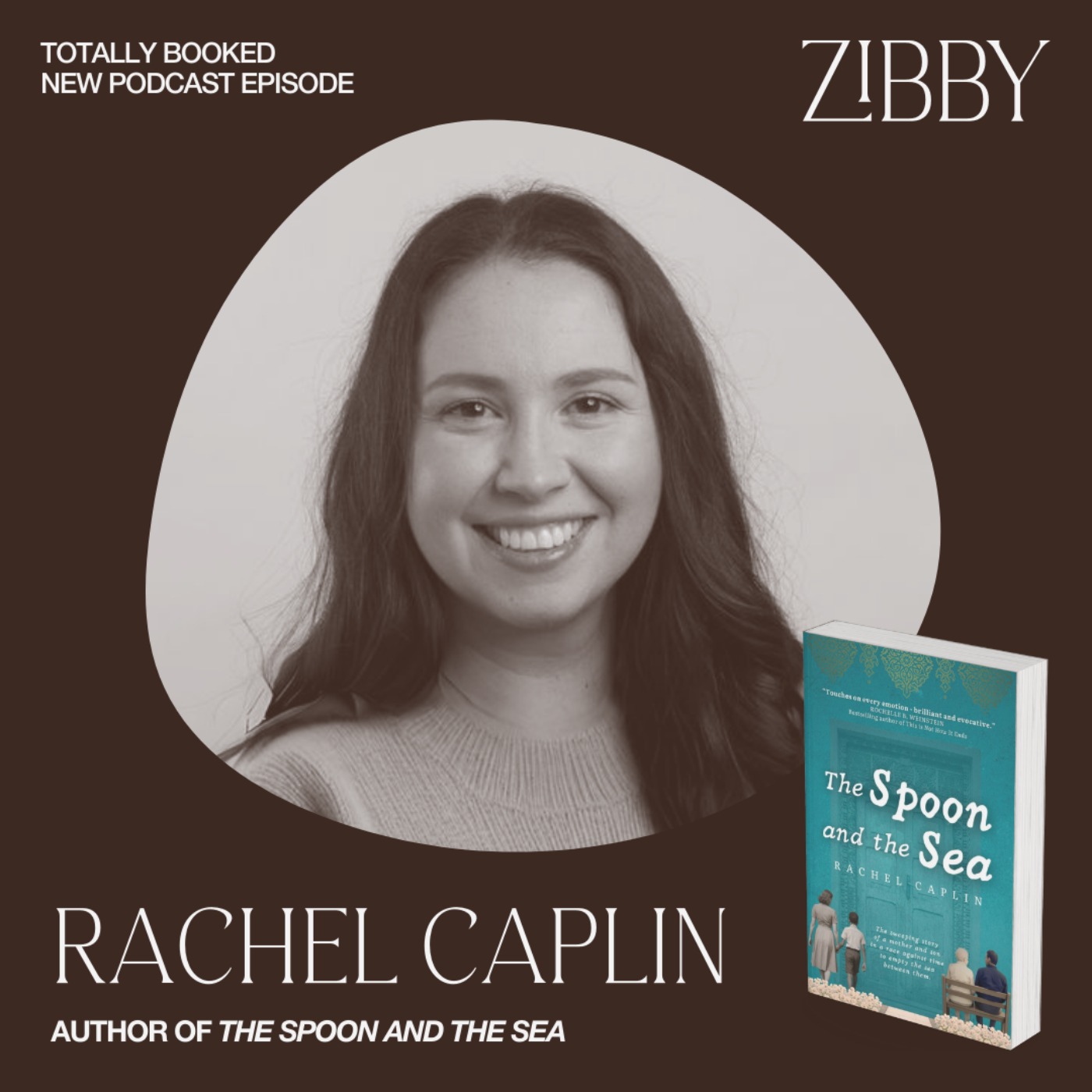
Rachel Kaplan is the author of the Spoon and the Sea, a best selling historical novel and Vogel Literary Award finalist. She is originally from Australia and moved to Israel in 2015 where she currently balances her writing with a career in the Tech center through the tech sector and a busy family life with her husband and their three young daughters. Hi Rachel, thanks so much for coming on. Totally Booked to talk about the Spoon and the Sea. Congratulations.
- [03:26]
D
Thank you so much for having me.
- [03:27]
A
Oh, it's my pleasure. And are you in Australia? Where are you today?
- [03:31]
D
In Israel.
- [03:32]
A
In Israel. Amazing.
- [03:33]
D
I've been living here for almost 10 years now.
- [03:35]
A
Oh my gosh. Amazing. Then I will cut that part out. Let me just start again. But you're originally Australian, right?
- [03:41]
D
I am. And the accent confuses everyone, so feel free to keep it in.
- [03:45]
A
Okay, fine. Okay. Rachel the Spoon and the Sea Tell listeners about your book.
- [03:51]
D
Sure. The Spoon and the Sea is a historical fiction novel that centers around Ashe. He's a grown man, but as a young child he was basically left to be raised by his Arab father on the island of Zanzibar where he was born after his Jewish mother, Rose, left him to go back to her hometown in England. And the story takes place in Jerusalem. Rose is in her final days growing old in the grips of dementia. And Rose and Ashley are trying to bridge this gap to empty that sea between them, to reconcile all of the decisions and all of the events in history that took them apart over so many years and so many places. And that's what the book's about.
- [04:31]
A
Amazing. So there's a true Inspired by thread.
- [04:34]
D
Talk about that very much. There's a story. I feel like every family has some story in their archive that everyone says someone one day needs to write that into a book. And I have one of those that very much the arc of the story from taking place in England and this sort of forbidden love between a young Jewish girl and a young Arab Muslim man takes place. And coming to British Mandate Palestine, moving to Zanzibar, having a child. All of the bare bones of the book are true. And basically in 2018, when my grandma passed away, the story isn't about her, but I was overcome with grief. She was one of the great loves of my life.
- [05:17]
A
I'm so sorry.
- [05:18]
D
And I was honestly, in an almost unhealthy way, trying to keep her alive. And my husband said, why don't you write now? I don't have any training or anything, so I don't think he meant a book, but I think he just maybe meant, like, on my phone, just like, take your thoughts and write them there. And I started thinking, what if I take my grandma and her character and every. The way she dressed, the way she spoke, and I put, like, almost layered it on top of this true story from this family archive that I have, and let's see what happens. And I was overcome by the creativity of the project. It took about a year and a half to write. No one was ever meant to see it. And here we are.
- [05:56]
A
And how did it help with your grief?
- [05:58]
D
A lot. It helped me to let her go in an interesting way because at certain points in writing the story, the character Rose came to junctions that my grandma would have never made that choice. She would have never done that. So at a point where I had to choose between the character and what I knew the arc of the story had to follow, I was either, well, either I have to change the arc of the story or I need to let go of this character, being her, and helped me to let her go and to accept that writing this character wasn't going to keep her alive in some weird way. So it helped me to create a character that has bits of her, but to accept that she's no longer here. And it was my tribute to her.
- [06:39]
A
So tell me more about your relationship with Rose the grandmother.
- [06:43]
D
So I actually didn't get to meet the real character, which I think helped because I think that to be put between my grandma, who I knew very well, and the real character that Rose is based on, who I didn't get to meet, it would have felt like I had to try stay true to both. This way. I only had one person that I had to really think about. Got it. And that was where the creative process came in. And that's where I say, always it's inspired by true events. But there's. In any work of fiction, which, at the end of the day, it is. You have to take some license and try to imagine what they were thinking, what they were feeling. And that's how it came about.
- [07:20]
A
I always thought it would be really interesting to try to do sort of. I think it's called auto fiction, where you, like, write. You fill in the dialogue and the settings and, like, write how my parents met, you know, as a short story or Something like that, when you know the, the bones, like as you're saying, but you have to fill in the rest, like so interesting.
- [07:37]
D
I tend to think that the real stories of our own lives or people around us are the most fascinating. Like, I find it quite remarkable how, how often people completely fabricate stories when there's so much content that's interesting to read and to write around us. I mean, even our everyday lives, I think a field, I mean, I know especially over the last two years, I feel like, you know, there are going to be so many books filled with our experiences.
- [08:01]
A
So you've lived in Israel for 10 years. Talk a little bit about being Australian, moving to Israel. Why did you make that choice? Like, what has the rest of your life been since you weren't an author? All the, all the time, you know, Explain that.
- [08:18]
D
Sure. So I grew up in Perth, which is, we say it's the most isolated Jewish community in the world. I've never fact checked if that's true, but it's definitely up there.
- [08:26]
A
Okay.
- [08:26]
D
It's at the end of the day.
- [08:27]
A
I'll take your word for it.
- [08:29]
D
Exactly. And I grew up there and I had never left Australia till I was 15. And then I came on a family trip to Israel and I just felt something that a lot of people feel when, when they come here. That's this completely almost irrational, indescribable feeling of belonging. And I think coming from such a small and isolated Jewish community, I was overcome by how many Jewish people were here. It was mind blowing to me. And I made the decision basically there and then that I would move here one day, which I did. So just after I turned 24, I was in the middle of my masters and made aliyah. I moved to Israel and I was in the middle of my degree in political economics. Nothing to do with anything of what I do today. Today I work very much deep in the high tech scene here, which as you probably know, is a really like thriving and exciting place to be. And I had never written anything before this book. I always love words, I love to read, but I never thought that I would be an author. But it's interesting because the experience since the book has come out, everyone in it in Israel who's known me in sort of this last 10 years, like, this chapter is like, wow, you can write. And everyone in Australia who knew me growing up says, finally you put out a book.
- [09:43]
There's this part of me that feels like I've sort of brought some part of myself that maybe in the journey here, I Didn't get to really bring to the fore until now. And it's a new part of my life that I love. I really do.
- [09:56]
A
Amazing. So we were. We were both mentioned in this article that came out recently. Why don't you tell listeners that your story?
- [10:05]
D
Sure. So basically I wrote this manuscript and I remember the day I finished it, I sat on the couch and I said to my husband, I finished the book. And he said, who are you going to show it to? And I said, no one, he said. I said, it's not a real book. It's just a Google Doc that I wrote. And he said, you really encouraged me. So I shared it with a couple of friends and the feedback was far beyond more than what I would have ever expected. And someone convinced me to submit it for an award. And this is how much I don't come from the industry. I was like, well, the Israeli market's very small. I'll try the Australian market. So I Google like Book Award Australia, and I happen to submit to the Vogel, which I didn't know was like the most prestigious award there. And then I've completely forgot about it and I was in the top three. So I basically was in the newspaper based on that. That's how my extended family found out that I wrote this book. And then from that I was approached by a number of different agencies. And from there I signed with an agency and we began all the editorial work and the process that comes with that, which I really enjoyed. And then the plan was to begin shopping the book around at the Frankfurt Book Fair, which was October 17, 2023, and to be an Israeli author on October 17, 2023, a debut author with no anything. But I'll tell you, for about a year or so, I presumed that all the strange responses we were getting were. I was like, we must improve the product. That was really the mindset I was in. Let's improve the opening chapters. Let's work on how we're pitching it. Like, I really didn't jump to any conclusion about anything. And I remember it so clearly. I got off a call with my agent and I was particularly frustrated because I could feel that something wasn't adding up. And I went onto Instagram and Noah Tishby was interviewing you.
- [11:57]
And you were talking about what was happening in the book industry. And it was a very short video, maybe a minute, and if it put into words what I was feeling was happening to me, and I really didn't jump to that conclusion for a long time. And I remember I sent it to Everyone, like, this is what's happening to me. Oh, my God. And I then spoke to my agent about it, and at first they really tried to deny it. And then I said, let me ask you point blank, if today I submitted the same manuscript to the same award, would I be published in the newspaper? And they said, absolutely not.
- [12:31]
A
Oh, my gosh.
- [12:33]
D
I said, well, there you go. I was under contract, though, so there was very little that I could do. And then in June, there was the 12 days of war with Iran, which were 12 days that I think we're still reeling from. They were really indescribable. I've got three young kids under the age of six. So it was just a complete. I mean, we can talk about that. It's a whole. Anyway, so I was in the middle of that really.
- [13:02]
Indescribable event, scary time. And the agency posted on social media something that vilified Israel in the context of this war with Iran. And I wrote and I said, I want to cancel the contract. I said, like, this is one step too far. And I said, I'm going to be Israeli about this, and just because I can't do this the easy or the traditional way, I'll find a different way. And so the book came out. I published it on Amazon in July. I have had the most amazing experience connecting with the Jewish author community in the U.S. some of the most kind and generous and helpful people who I haven't even got to meet in person. And so when the opportunity to participate in this article came out, to tell the story from the debut Israeli author perspective, and also to really say thank you to the support of these authors in the US Because I know that it puts a risk on their careers every single time you take that risk on your career every single time. So for anyone to put their name on an Israeli author, I know what that means, and it's been truly heartwarming.
- [14:08]
A
Oh, that's amazing. That gave me such goosebumps that you put on Instagram, and that clip of me downstairs with Noah was on it, and then it had an impact in your life. That's just.
- [14:19]
D
I was here on the couch, and I think I literally gasped. I was like, oh, it seems so obvious now. But, yeah, my. My first response was was not to think that. I mean, I must have to improve it somehow. And that's what I'll keep doing, and we'll keep fixing it.
- [14:37]
A
So how has your book been received in Israel?
- [14:41]
D
In Israel. So it's not in Hebrew yet. Everyone here wants to know when it's going to be available in Hebrew, which will happen at some point. The best part for me was at first, like when I first came out, most of the sales were either in Israel or in Australia, where my friends and family are. And like 82% of the sales are now in the US which to me is the best because I'm seeing reviews from people, I have no idea who they are, which is, I think once you pass that friends and family.
- [15:09]
It'S really, really exciting. So here, I mean, I actually gave my first talk at a book club on Thursday night. And, you know, I'm there with a group of women, all of whom have moved to Israel from Australia, the us, Canada, the uk, Ireland over the years. And to sit around and talk about this book and how it intersects with just how diverse and how rich the culture is here. And I'm a big believer that there need to be more books that show just how amazing this country is, how many stories are hidden in the fabric of society here. I think a lot of the times when we think about changing the public perception, we focus very much on, on advocacy, political commentary, and there's a place for that. But books can change hearts and minds over years and I think there needs to be more of it in English for non Israeli speakers. So I'm a huge advocate for anyone who's, who's working on that. And I finished writing my second book in June, which I hope to put out eventually. I think it's super important.
- [16:10]
A
Wait, tell me about your next book.
- [16:12]
D
So when I finished the first book, a few people said, are you going to write another book? And I said, well, I only wrote this one because I was so sad, so I hope to never write another book. And then October 7th happened and I had the same feeling like I needed to write to process my feelings. So it's not a book, that's a play by play of October7 events. It does connect, but it's more the story that I felt like I needed to say to everyone about the events, which is, I was very overcome by the fact that people kept referring to it as an unprecedented event. And I kept saying this is the most precedented event in history. This has happened again and again and again. And that was what I really wanted to come and say, like, we need to look at this more broadly. So it's another historical fiction, dual timeline novel. That seems to be my happy place about that.
- [17:06]
A
Wow. Okay, now let's go back to you being a mom through the terrifying 12 Year War and everything that's really happened. I mean, it's enough, you know, the fear. You know, I have four kids. I'm here in New York. I still feel fear. And people are like. But the people in Israel, they're not even afraid. You know, there was some day that I was, like, so terrified, and everyone's like, P.S. everyone in Tel Aviv is, like, out getting coffee, like, can you just stop? And I was like, oh, okay.
- [17:33]
D
I think we deal with different fears. I think that the fear of being Jewish outside of Israel is very real. It's different. Like, the fear is of something different than what we fear here. The 12 days with Iran, for example, were. I mean, we're very lucky because we have a bomb shelter in our apartment, which is our room. So a lot of the times when things happen overnight, we're able to just put the kids into bed in our bed, and they think it's a bit weird, but it's fun. And we close the door and. And that's it. So we were saved a lot of having to explain just because the ages. Like, my oldest kid, like, she isn't even five, so she's now five. Like, so we don't need to explain too much. My second daughter loves elephants. They're her favorite animal. And the sound on the app when a missile is coming sounds like an elephant. So she loves the sirens because she thinks there are elephants outside. And so for 12 days, we were in this cycle where she was saying, why are there so many elephants outside? Why can't I go see them? Children, in many ways, help to deal with it because you have to be fine for them. You can't completely collapse into a state of panic because you have to be fine for them. But then the whiplash you feel afterwards, that's what I experienced the most. Like, during the 12 days I was able. I was. I was okay because I had to be. You're a mum. You have to be okay. And then afterwards, it was sort of, what did we just live through? How are we going to work and going to meetings? And you would sit for coffee with a friend and you find you're both just sort of zoning out and be like, did that really happen? So I think Israelis are extremely resilient. I actually think that sometimes we overplay the narrative to the point that it's. It's okay to not be okay when things are crazy and terrifying. Sometimes there's a bit too much of that, I think. And I think now we're seeing a lot of the effects. You know, we're seeing the effects of mental health over the long term like this has been the longest war in our history and we're seeing now that there are effects. And I think that Israel as a country, I think we're going to learn a lot by how to how to balance this narrative of resilience with providing the support that people need when something is truly terrifying and being okay, but needing to be able to talk about it as well.
- [19:51]
A
Today's episode has been sponsored by Quints. When it comes to holiday gifting, I want to give things people really love. Beautiful, timeless pieces they will wear for years. So that's why I'm going with Quince. From Mongolian cashmere sweaters to Italian wool coats, everything is premium quality at a price that actually makes sense. Quince has something for everyone. Soft cashmere sweaters for $50 that look and feel like designer pieces. Silk tops and skirts for dressing up, perfectly cut jeans for everyday wear and outerwear that actually keeps you warm. I've been wearing my new quince coat with this fur collar on social media, so you should be able to see me wearing it on Instagram Ivyowens. I love, love it. And of course it would make a great gift. The Italian wool coats are also amazing standout pieces. Beautifully tailored, soft to the touch and crafted to last for the seasons. Every piece is made with premium materials from ethical, trusted factories and priced far below what other luxury brands charge. The craftsmanship really shows in every detail. The stitching, the fit, the drape. It's elevated, timeless and made to wear on repeat. There are just so many options. I can totally see myself giving my friends one of their beautiful options, like a sweater or one of their coats for someone really special. And as if that isn't enough, they also have stuff for home, bath, kitchen and travel. Come on, find gifts so good you'll want to keep them yourself with quince. Go to quince.com zibby for free shipping on your order and 365 day returns. Now available in Canada too. That's Q-U-I-N-C-E.com zivi to get free shipping and 365 day returns. Quinns.com zivi.
- [21:45]
Today's episode is sponsored by Aura Frames. Okay, who else is looking for easy, thoughtful, fabulous gifts to give people that you love? I mean, who is not looking for that? Well, I have the answer for you. Aura Frames is the answer to every holiday gifting moment and you'll never have to struggle again to find the perfect gift. This is so personalized because you can load this digital frame with all photos of people you love, the recipient people they love. All you have to do to get unlimited free photos and videos is download the Aura app, connect to wifi and you can preload photos before it ships. And you can keep adding photos from anywhere, anytime and add a message before it arrives so you can share your videos all year long. And yet you're giving it right for the holidays. A gift box is included. Every frame comes beautifully packaged in a premium gift box with no price tag. So don't wait. Win the holidays now with Aura Frames for a limited time. Save on the perfect gift by visiting auraframes.com to get $35 off Aura Frames bestselling carver matte frames named number one by Wirecutter by using promo code zibby at checkout. That's a U R A frames.com promo code Zibby Z I V V Y this deal is exclusive to listeners and frames sell out fast so order yours now to get it in time for the holidays. Support the show by mentioning us at checkout. Terms and conditions apply. Now goodbye while I go fill another frame for a very lucky recipient in my family.
- [23:27]
Today's episode is sponsored by Wayfair. Oh my gosh, the holidays have come up so quickly. My kids all have given me their wish lists but I have so many other gifts to give and also I need to just spruce up my home and thanks to Wayfair I have done that. I ended up just getting this adorable console table for our family room where I've put photos of my family and my late stepfather and a beautiful arrangement of flowers and it has really just changed my whole room around. It's making it perfect to celebrate the holidays all together with my home. And by the way, it came so quickly right when I needed it and was super easy to assemble. I am a huge fan of Wayfair and I've even posted a picture so you can check on Instagram to see this beautiful table that we have. And it was such a great value and has just every time I look at it I'm so excited. There's really something for every style in every home, no matter your budget and Wayfair makes it so easy to tackle your home goals and your gift list all at the same time. Same time. So get last minute hosting essentials, gifts for all your loved ones and decor to celebrate the holidays. For way less. Head to Wayfair.com right now to shop all things home. That's W-A-Y-F A I R.com Wayfair, every style, every home.
- [24:50]
Well, I feel Israel is in a tricky spot because the pr, the perception of Israel has sort of taken a nosedive here among. Not Jews. Well, some Jews, I guess, actually. But people who don't know enough, who aren't educated, don't understand what's going on. And so it's just easy to say, okay, well, these are the bad guys now. And Israel hasn't been saying, no, no, no, we're not. You know, it's been so quiet on the response. You know, there's been no response to set anybody on a different course. And so I think those of us in the States, and I didn't mean for this to become political at all, but are sort of left, you know, trying to defend Israel on our own and just like, you know, putting stakes in the ground and, you know, trying our best. And as someone who moves to Israel, as an Australian, like, how are you feeling about all of this? And we don't even have to go there.
- [25:37]
D
But no, I think I'm extremely frustrated. I'll say two things which almost contradict each other.
- [25:43]
A
Great.
- [25:44]
D
I love that.
- [25:46]
Israeli, very Jewish of us.
- [25:49]
The first thing is that I think Israel's in a really tough spot where. In. Where simultaneously, for the last two years, we have been forced to be both very fearsome to our neighbors and our enemies, and we needed to have a position of strength in order to do the things geopolitically that we've needed to do, and at the same time, trying to garner the sympathy of the world. And those are diametrically opposed to be both the strong and the weak at the same time. And I think that at the end of the day, for better, for worse, that's a different discussion. We prioritized the former. But seeing how Israel is perceived outside the world, like, you know, that's a real hit and it's going to take years to recover from that. And on that, I'll share the story of a friend. He, on October 9, called a friend and said, how can I help? Like, what can I do? And this friend said, go to the prime Minister's office, to the spokesperson's unit, and you can help there. So he said, great. So he turned up and he said, there was nothing. There was no one, no one. He was paired with someone who wasn't. You're now the official spokesperson. And he said, okay, we just booked a call with cnn. Where do I write it down? There was. There was nowhere. The infrastructure for this needs to take place over years, and it needs to also happen when we're not in war. And my. My big fear is that now that hopefully with this war ending, that again, we're going to forget how important this is. Not only to rehabilitate the damage of what's been done, but it's a constant effort that needs to happen to build the perception and the understanding of what our side of the story is. And it's not our strong point at all. There are some people, like Noah, doing incredible work, but from an infrastructure perspective, there's a lot lacking and it's not a strong point. We're good at lots of things. That's just not been something that we've invested in long term, in my humble opinion. Wow.
- [27:48]
A
Well, thank you for that. I think a lot of people wonder what people over there are thinking right now. And so I really appreciate the candor. Even though we're talking about your novel, which doesn't have anything necessarily. It's all connected. It's all connected. You know, it's funny too, because in your book, Palestine is one of the first places, but I feel like Palestine also has become word that's become charged.
- [28:09]
D
Listen, a lot of the editorial process with the agency from October 7 onwards, I was, I mean, first, the first thing was they said, can we tell people you're an Australian author? I said, well, it's going to become fairly obvious quickly that I don't live there. So anyone who doesn't want to work with me, that's not going to work.
- [28:26]
A
Right.
- [28:27]
D
And also words like using the words like British Mandate, Palestine, Zionism, you know, should we have an Arab character here and there? And a lot of changes that I felt like we're trying. And I said, like, this book is not about the Israel Palestinian conflict. It's not about that at all. I don't want to try to make it about. That's the last thing that I want to do. If anything, I feel this book is about how love can transcend everything and can build bridges. If anything, that's what the book talks about. So I think that referring to British Mandate Palestine as It was in 1947 when the stories take place, and to give a bit of a snapshot about, you know, just a glimpse, a glimpse into the remarkable things that were happening here. I didn't want to gloss over those things.
- [29:15]
A
I love that. Really, really impressive. Okay, where are you headed? You have this other book that you are also going to find a home for and get out there and use all your hustle and all of the good things. Where do you like where do you want your life to go? I know it's sort of a big question, but you're young and you've got small kids.
- [29:37]
D
You know, this book and the book coming out and like I mentioned, sort of the. Almost the return to the roots that I feel like I had so many years ago has brought me in many ways to think about, okay, how does this in any way adjust how I spend my time?
- [29:55]
Writing books, I think will now always be something that I'm. I'm doing. I mean, I'm actually curious, in your opinion. I think it's too soon for October 7th related fiction. I think now we're seeing, you know, memoir coming out and, you know, sort of from those who were hostages or survivors or families of. So that's part of why I'm sort of holding back on it for now. But I do think, in general, looking forward, writing books will always be part of it. And what I'm working on in a sort of ad hoc way now is how can I help to bridge the narratives between what. What October 7th means to Jews in Israel and what it means to Jews outside? And I think as an immigrant, I have that unique perspective, speaking every day to Jews outside Israel and understanding that October 7th in many ways can also mean October 8th and everything that happened afterwards. And when you talk about October 7th in Israel, it's very much. It's a. It's a different experience. But if we want to look at the whole of the Jewish people and what does this event mean for us, and how do stories in the many forms that they'll take. So I'm working on some interesting ways, just the ways that I can help to connect between different people and organizations and entities, from government to nonprofit publishing, to try and make sure that it's cohesive, to make sure that we don't end up with two different narratives about what October 7th means. And how do we take this storytelling that as a. As a Jewish culture we are so good at? And how do we try to use that to make an impression on hearts and minds even after this war is over, in the years to come? And equal, equally as important, Jewish people who have found themselves looking at Israel more over the last two years. How do we keep those eyes on Israel? Don't look away. There's so much here to see. Like, how do we. How do we keep that bridge very much alive? That's how I see the book and the writing and the stories part of my life. And that will somehow fit in with the, you know, the full time Tech job and the kids and the crazy life that Israel has in and of itself.
- [31:57]
A
Amazing. Awesome. My pet mission, as you try to do your two missions, is find some way to minimize infighting among Jewish people. There's so much. We can't afford it.
- [32:11]
D
One of the messages of my second book is that is so much what led to what enabled October 7th to happen. Can't afford it. Can't afford it in Israel. It was so visceral and it was violent in those days. I actually wrote an essay for the On Being Jewish now that was published a couple of weeks ago, which was a letter to myself. Yom Kippur. Just before I read that.
- [32:38]
A
Yeah, yeah, I read everything.
- [32:42]
D
And I just remember seeing on that day the violence between Jews on Yom Kippur in Israel. And I thought, like, this is the lowest of the low, is rock bottom that we've hit, and we didn't even know what was about to hit afterwards. And I so agree with you that we can't afford it. We can't afford it in Israel, we can't afford it outside, and we can't afford also to have a fragmentation between Israel and Jewish people out outside Israel. We are so outnumbered.
- [33:08]
A
I agree.
- [33:09]
D
And we need to be cohesive even when we don't agree. And I think that there's often there's a confusion between unity and uniformity.
- [33:19]
They're so not the same thing. And Israel is. Is based on that. Israel is a whole melting pot of everyone and everything.
- [33:26]
A
Well, as. As a mom, I think of it as coming from the top too.
- [33:31]
D
Right.
- [33:31]
A
Like, if I. I am the most. I mean, I like to think I am the most influential in, like, getting my kids to stop fighting with each other. Right. They love each other, but they're going to fight because kids are going to fight. But if left unchecked, who knows?
- [33:43]
D
No, I think I agree. You can't look at the leadership and seeing leadership fighting and expect that somehow that's not going to trickle down. But at the same time, I think in the last few years we've seen the power of the people. And I think from October 7, the day itself, all the institutions failed.
- [34:01]
A
Yes. We need to make some changes systemically.
- [34:04]
D
Great. I think we've got lots more to talk about and to do and any way that I can help from here and same here. Love to work on that together. Thank you so much.
- [34:12]
A
Thank you, Rachel. Thank you. And congratulations on your book.
- [34:15]
D
Okay, thanks.
- [34:16]
A
Bye. Bye. Thank you for listening to Totally Booked with Zibby, formerly Moms don't have time to read books. If you loved the show, tell a friend, leave a review, follow me on Instagram ibbeowens and spread the word. Thanks so much. Oh and buy the books.
- [34:40]
C
If you're the purchasing manager at a manufacturing plant, you know having a trusted partner makes all the difference. That's why hands down, you count on Grainger for auto reordering. With on time restocks, your team will have the cut resistant gloves they need at the start of their shift and you can end your day knowing they've got safety well in hand. Call 1-800-GRAINGER click granger.com or just stop by Grainger for the ones who get it done.
- [35:09]
B
You know you've reached peak Couple Energy when your undies match Meundies Match Me has you both covered literally in super soft ultra modal undies, socks, PJs and loungewear. Festive prints? Check. Cozy vibes? Double check. And right now, it's deal season. Get up to 50% off site wide for Black Friday and Cyber Monday. Take your couple game to the next level with Meundies Match Me. To get deals up to 50% off, go to Meundies.com acast enter promo code acast that's Meundies.com acast code acast did.
- [35:50]
A
You know that skincare can start in the laundry room?
- [35:52]
D
All freeclear is the number one laundry.
- [35:55]
A
Detergent brand recommended by dermatologists, allergists and.
- [35:58]
D
Pediatricians for sensitive skin. Allfree Clear is 100% free of dyes and perfumes. It provides an effective clean is gentle on skin while removing impurities like dirt and body oil without leaving irritating residues. Plus, all free Clear liquid is safer choice certified by the US EPA for a clean you can feel good about. All you need is all free clearance.