Loading summary
Transcript25 lines
- [00:01]
A
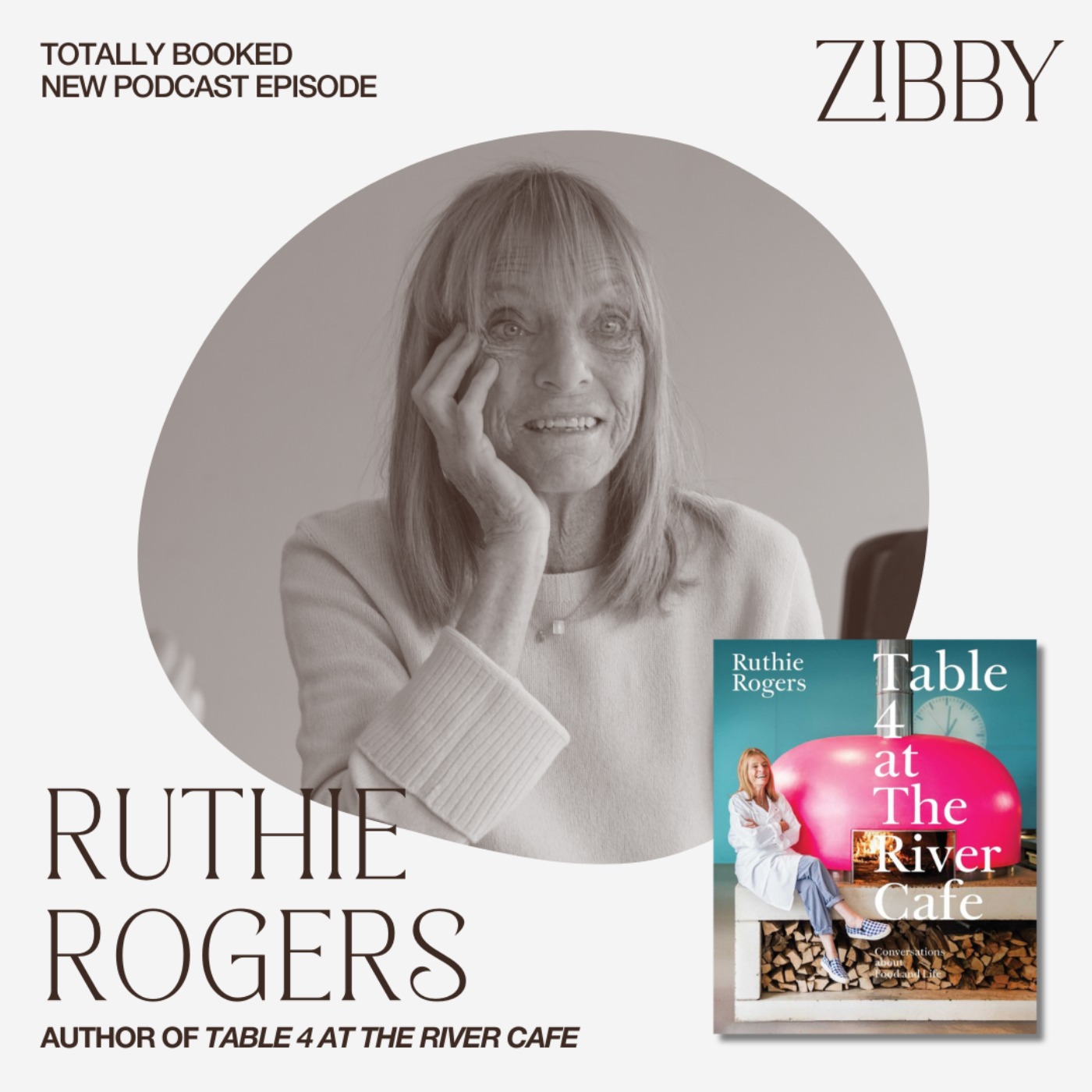
Hi, this is Zibby Owens and you're listening to Totally Booked with Zibby, formerly Moms don't have Time to Read Books. In my daily show, I interview today's latest best selling, buzziest or underrated authors and story creators whose work I think is worth your time. As a bookstore owner, publisher, author and obviously podcaster, I get a comprehensive look at everything that's coming out and spend my time curating the best books so you don't have to stay in the know, get insider insights and connect with guests like I do every single day. For more information, go to zibbymedia.com and follow me on Instagram ibbeowens. Ruthie Rogers is the Author of Table 4 at the River Conversations About Food and Life. Ruthie is the co founder of the River Cafe in London and an award winning chef. She is also the host of the podcast Ruthie Ruthie's Table 4 and the author co author of 13 cookbooks including the River Cafe Cookbook, River Cafe 30 and the River Cafe Lookbook. She was awarded an MBE in 2010 and a CBE in 2020, both very big deals in the UK. Welcome Ruth. Thank you so much for coming on Totally Booked to talk about your book Table four the River Cafe. You are podcaster, extraordinaire, restaurateur, conduit to every star imaginable, foodie, all the things
- [01:32]
B
nice way to start the day. I want to thank, I'm thanking you for having me on your fantastic podcast. So it's a mutual thank you very much.
- [01:44]
A
So why don't you tell listeners how your book came to be. It's such a creative offshoot of your podcast and your restaurant and everything. Talk a little bit about, well maybe actually back up and tell everybody about the rest restaurant and starting that and how that became a podcast with recipes and then it became a book.
- [02:05]
B
Okay, well, I have a restaurant called the River Cafe. I founded it in 1987 with Rose Gray, the late Rose Gray, who very sadly died in 2010. The two of us were partners from the very beginning. We were very good friends. And I think it really came from two things. One was why couldn't we have a restaurant that had the kind of food that we had both eaten, eaten and cooked in Italy? Rose, we were both family cooks. Rose had four children. She'd lived in Lucca. My husband was born in Florence. And so we, it was kind of home to go back there and we stayed with his family and we would, we took a house every summer and so we, we thought about this. But then my. My husband was the architect with Renzo Piano of the Pompidou center in Paris. And when we came back to London, we wanted to create an office that was a community, that we weren't just a floor and a building in the center of London. So we looked and we looked, and we found these warehouses bit outside of the center, you could say about 20 minutes from Marble Arch, half an hour, but right on the Thames with the green space in front of it. And we thought, this is the office we could have. We could share it with other architects. We had a painter. There was another design firm. So it became a community with nowhere to eat. And so I thought, having had worked as a graphic designer, and for lots of reasons, I called Rose up and I said, come and have a look. There's a little space here, and why don't we do it? And we looked at it. It was tiny. And in 1987, we opened our doors, and that's. And we. And we did. We wrote. We did it on the principles of the way we cooked at home. So everybody had a role, whether you were washing dishes or you were cleaning floors or you were waiting on the bar, that everybody worked in the preparation of food. Rose and I were only allowed to open at lunch. So I did sandwiches and she did pastas. And the next day I did pastas and she did sandwiches. So that's sort of the real basis of how we opened. We brought ingredients back from Italy in those days because it was hard to get some of the prosciuttos or parmesan cheese. You know, we just grew. We grew as, you know, as the restaurant grew. The restaurant grew slowly. So first we only open at lunch. Then we were allowed to open for lunch and dinner, but not at the weekends. Then we were allowed to open lunch and dinner at the weekends, but we had to close early. So it was just a constant growth. And we're now almost 40 years old. And the restaurant has retained all its ethos. You know, the way we opened it, with the values we had and the concerns we had, and I hope, you know, with the cooking has gotten better and better.
- [04:59]
A
That's amazing. So amazing. So how. How did the restaurant become such a celebrity hotspot? One of the things in your book is that you're hugging every famous person imaginable.
- [05:13]
B
I apologize for that.
- [05:15]
A
No, no, it's amazing. And you're getting them to share really intimate, amazing stories that you get them to open up on your podcast about their innermost feelings about, you know, dishes that are comfort foods for them and their families and stories that we haven't heard from all these notables and. But how did you. How did you start that whole thing, so to speak?
- [05:42]
B
Well, it really, really started when I'd always. I'd been to a restaurant in New York called Roberta's. I remember years ago in Brooklyn, and they had a radio station. And I thought, how cool is that to have a radio station. Station the restaurant. Because people, you know, I always think the whole idea of a restaurant is that everybody has a story. You know, everyone has a story, and there might just be stories that they might like to tell or we might like to hear. And so we thought, oh, River Cafe radio, that would be fun. But of course, that was in a long, long time ago. But then when podcasting came out, we became interested in that and. And. But still with not the idea of doing it. It really happened for us when Covid with the pandemic, because we felt like other restaurants, we wanted to reach the people we couldn't see, people couldn't come to the River Cafe, people in their houses. And I thought, well, maybe what we should do is just read a recipe every day, and we'll just get different people every day to read a recipe. And then Graydon Carter is a very good friend of mine, said, come on, Ruthie, you need to think a little bit more about this. And maybe what you do is you segue from the recipe to memories, stories, what they cook, what they eat and where they go. So we kind of developed that. The first three people I asked were just three good friends of mine who were Michael Caine, who eats in the restaurant every week. And I think it was Jake Gyllenhaal and Wes Anderson. And so three guys. And so I. I asked them each to read a recipe, and of course we recorded it, but they had. We couldn't do it face to face. And then I sent it to. I had friends who worked at iHeart. They became interested in it, and very again, quite slowly, it just started. We started doing it. You know, I'd never had any experience and felt like I'd been sort of pushed into a swimming pool but didn't know how to swim. And we learned, and I think we learned together. I'd say that we. Then one of the things about doing this podcast about food was that had I asked, you know, Paul McCartney, who did one of the early ones, if he would talk about the Beatles, had asked Nancy Pelosi to talk about, at that time, impeachment, had I talked about David Beckham to how to play football, how he, you know, those kind of things, they probably would have said, ruthie, thanks, but no thanks. But the fact that I said we're only really going to talk about food. You know, did your mom cook? Did your dad cook? Did you grow up with lots of food? Did you ever go to a restaurant? That brought out kind of memories for me. Paul McCartney talked about a recipe his mother taught her him two days before she died, you know, and he still cooks. And, you know, Austin Butler talked about having a peanut butter jelly sandwich with his mom when she was not well, and then joyous, you know. You know, Paul McCartney talking also about going to Paris with John Lennon. I only have five pounds to spend on wine. So he thought wine was disgusting. You know, so it's just been a way of getting to know people through their experience of food.
- [08:59]
A
That's amazing. Well, the way you got everybody to open up is. Is amazing. And then when did you decide you should turn this into a book project as well?
- [09:10]
B
Well, actually, I have to say it was Amy Bell of Simon and Schuster who came to see us and said, this is, this is a book. And I really, you know, I think this could be a great book. I'd like to do this book. And so we started talking, so I didn't have to persuade anyone to do. Which is a great luxury.
- [09:31]
A
That's wonderful. Well, the pictures are amazing, the food descriptions themselves. It's hard not to read this book and have your mouth, not just water for all of the food. I found it interesting because you always ask people their favorite comfort food. I always personally gravitate to the sweet when I think about comfort foods. But most of them were quite savory. They were surprising what they were, whether it was, know, a, a pasta or, you know, all these different, more, you know, meals maybe made by somebody they loved or something like that. Tell me a little bit about that and the patterns that you've seen.
- [10:11]
B
Well, I think there, there are a couple things. One is that somebody, Kirsty Young, does a program that's very popular in England called Desert Island Discs, which they ask people. It's almost like it's more important than getting a knighthood, is to be asked in desert is. And they ask. I phoned her up. I said, kirst, you've got to help me. And she said, well, one thing I would advise with you is you have one question that you ask everyone. And the question people always ask me is, what would be your last meal? And I find that a really gloomy one. To think about. So we thought, well, comfort food is kind of nice because it kind of can mean anything. So we did. Comfort food. Food gives, you know, sustains hunger. If food prevents hung. If food is a way of performing, if food is a way of sharing, if food is a way of kind of expressly celebrating, it also is a form of comfort. So what is your comfort food? And one of the things that I've noticed and stand by is that most of the people I've interviewed did not grow up entitled. And they see their success, whether it's an actor or a writer or an artist, as somehow when they could begin to eat what they wanted to eat, when they could choose off the menu what they fancied without having to be obsessed with the prices, that it was a kind of measure of their success. You know, oh, I've made it in the world because I can go to a good restaurant. I've made it in the world because I can buy a good ingredient. Michael Caine, if you ask him, he said that, you know, I said, what's your comfort food? And he says, well, it used to be potatoes and now it's caviar. That is, it does show a trajectory from moving, being able to access food you love.
- [12:12]
A
Interesting. Well, another theme, of course, is how much food bonds us to the people that we love and takes us back or makes us closer or all of that. Can you talk about some relationships that people discussed? I mean, you know, to your Paul McCartney point, he talked about, you know, deciding to become vegetarian and the effect on his family. And then you have his daughter with her own Stella, with her own thoughts on vegetarianism and all of that and just how families as systems sort of operate on the food perspective.
- [12:48]
B
So I think, again, talking to Elton John was really beautiful because at the end of it, his assistant, who said she'd sat through every Elton John interview since, you know, last 25 years, had never heard stories that he told about his grandmother and cooking with his grandmother or the fact that his grandmother brought up peas for him to shell together, or I think that families, you know, connecting through food, you know, Rick Rubin, the record producer, I don't think he ever had a meal at home. You know, his family went out to Kentucky Fried, you know, fast food, Kentucky Fried Chicken or, you know, McDonald's or, you know, just kind of. But his mother just never cooked a meal at home. And I think, you know, you suspend judgment. I do. For people who didn't cook. You know, Pete Davidson's mother never cooked. It was really interesting meeting people Whose mothers, you know, didn't cook because they had to teach school or they had to, you know, work at night, or they didn't like cooking, you know, and then sometimes the fathers stepped in or sometimes they went out, or sometimes the kids had to kind of find something. But I think families expressed themselves. A lot of the people I spoke to talked about the family meal at dinner, you know, and what that meant to them. Of, you know, sometimes it was really fun because everybody talked and had to kind of get together as a way over food and being together. But some of them felt very isolated or frightened at meal times. And I think a friend of mine, who Matthew Barzin, who was divorced, his parents were divorced, and he said how every Saturday when his father had him, he suddenly had to cook for him. He'd never cooked for him before, but somebody wanted to prove that he was taking care of him, you know. And I think. I think that these stories of families and how they merged or didn't merge or cooked or didn't cook is quite interesting.
- [15:03]
A
I agree. It's absolutely fascinating. When you are in your restaurant, paint a picture for me of the restaurant at dinner time. Are you walking from table to table? Do you pull up a chair and sit next to everybody? What does it look like in your restaurant? I've never been there.
- [15:21]
B
You have to come. Oh, yes. River Cafe, as I said, was kind of designed by my husband. It's in warehouses outside this very center of London. It's right on the Thames, so we have big floor to ceiling windows with a green space in front of it, and then the Thames. And on Sunday, the green space is full of children because everybody brings their children because it's very safe and it's protected. And then we had the River Cafe grew from, you know, being nine tables to, you know, 15 to 18 to be open, as I said, in the morning or night. And now. And then in 2008, we had a fire and we had the choice. We could have painted the whole thing white and just put the carpet down. But we closed for seven months and we made it a completely open space. And I think by having that kind of open space, it gives a connection from the chefs who are cooking to the people who are eating, from the people who are eating to the waiters who are serving, to the people who are eating, to other people eating. It's quite. I'm not saying it's the only way to run a restaurant because quite often I quite like going and not seeing a kitchen and just being in a quiet space. But we love that way of working. And my role is to cook. You know, that's what I do. And recently, because of books and because of podcasts and because of television, many other things, I've been doing more days and so perhaps less nights behind the kitchen. But I really. My love is to be in the kitchen with the chefs. If I'm not working in the kitchen and I'm eating there, I have to say, I spend a lot of my time. My husband died four years ago, and we always ate here together. But particularly now with. And I have 13 grandchildren and big family and a lot of friends. It just seems to me that if I can be anywhere, I want to be here in the restaurant. And I don't ever know. There's a line in Casablanca when Ingrid Bergman comes in and says, I want to see Rick. Whereas Rick. And he says, rick doesn't sit with customers. Well, I try not to sit with the customers, but if there's somebody I haven't seen, I'll pull up a chair or very rarely sit down. But I think goes back to the stories. Every table has a story, and you never really know what that story is. And so you have to be. I like to say hello and then keep walking.
- [18:00]
A
Or there is something about looking at all the tables and knowing that something is going on and not knowing what it is. Like, what are they talking about? Who are they? Are they on the first date? Are they breaking up? Is that the babysitter? Is that the mom? Like, who are these people?
- [18:16]
B
Yeah, I mean, I once wanted to send a bottle of champagne to friends of mine who were. Were celebrating their. I think, their anniversary. They were quite young. And I said to the waiter, said, ruthie, I just can't get near that table because she's just crying the whole time. And I thought, oh, no. You know, and the dramas that, you know, a friend of mine came in and said, you know, he did say, my. My son's in rehab. And he said, I don't know, everybody looks so happy. And I said, you know what? You could go to every table, and there'll be somebody whose cousin, you know, has an illness, whose father has been fired, whose mother's getting divorced, whose cousin is in rehab. Everybody, you know, has a story.
- [18:58]
A
It's so true. If only there was a way to get not just select people sort of on podcast sharing, but to somehow, I feel like we're also private and have to be in public. And yet if there is a way, you know, sometimes I want people to be able to wear t Shirts like, you know, currently grieving or, you know, battling mental illness or, like, you know, just got fired or just some way where. Because I feel like people would be much more compassionate towards each other.
- [19:28]
B
Exactly. I mean, if you. That's why, you know, if somebody says, oh, there's a difficult table on table 41, and then you go and talk to them. I remember that this girl, I said, are you okay? You know, something. And she said, because she complained about everything, and. And then she just started. And she's. She actually. She started crying, you know, because she ended up in Manchester. She applied for a job and she didn't get it, you know, But I have to say, there are people who are. We have a lot of celebrations in the River Cafe. It's very sweet. You see a lot of young people coming in and they're celebrating something or there's a lot of joy, I think, for being. That's what I. I used to say that, you know, how would you describe a great city? You'd say it has great libraries, it has great theaters, it has beautiful parks, it has interesting shops, it has, you know, all sorts of, you know, the grow. Or it has universities. And then I realized when Covid. When restaurants were closed, that when people came back and restaurants were open, they really miss them. You know, they miss that spontaneous seeing a friend, that kind of being in a place where you're being looked after. I think they are probably a pretty integral place in a city. I totally agree.
- [20:48]
A
Well, thank you for your contribution. All the meals, all the community that you've created, and the podcast, and now this fabulous, beautiful book that is such a delight to dive into and learn about people. And in so doing, like, we also learn about ourselves. So thank you so much.
- [21:07]
B
Thank you. I hope you'll come. You come and see me.
- [21:09]
A
I would love to. I would love to. All right. Thank you. Thank you.
- [21:15]
B
Bye.
- [21:15]
A
Bye. Thank you for listening to Totally booked with Siby, formerly Moms don't have time to read books. If you loved the show, tell a friend, leave a review. Follow me on Instagram iippyowens and spread the word. Thanks so much. Oh, and buy the books.