Loading summary
Transcript298 lines
- [00:24]
A
Welcome to season four of Trap Talk
- [00:26]
B
brought to you by Craig off the choice of champions.
- [00:29]
A
You know, Rick, the only thing looks better than these hats we're wearing right now is a bunch of gold and silver from Ron Prescott at Midstate Precious Metal. Show them the goods.
- [00:36]
B
Listen, all I got silver right now, I won't bring the gold out for
- [00:39]
A
Zach, but you know I always want to get that.
- [00:41]
B
Gold shotgun shells, 10 ounces bars. Folks, he could do anything for you. For all your shoot needs, give Ron Prescott a call. Midstate Precious metal dot com.
- [00:51]
A
He's a great guy. Support him. He supports all the shoots. He supports Trap Talk. If you're thinking gold or silver, you need to be thinking Ron Prescott at Midstate Precious Metals. Thank you, Ron. That's right.
- [01:00]
B
Thanks for all the support.
- [01:01]
A
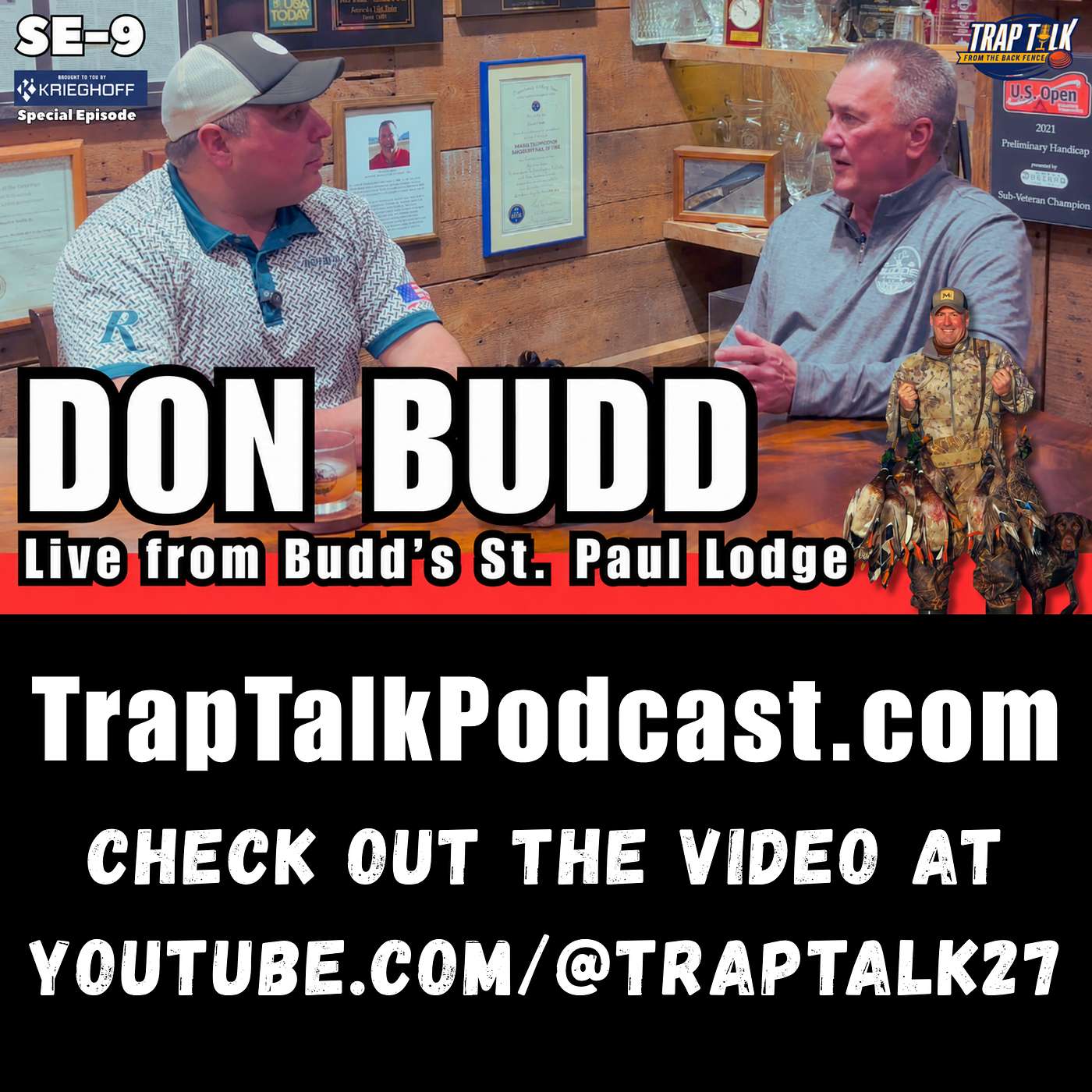
Welcome back, Trap Talk listeners. I'm your host, Zach Nini. I'm here with my very good friend and the infamous Mr. Don Bud from St. Paul, Kansas. Welcome to the show, Don.
- [01:10]
C
Thank you for having me.
- [01:12]
A
It's a pleasure. So this is a very special episode of Trap Talk. We were out in the the pits today shooting some ducks at Don's Duck club here in St. Paul, Kansas. And we'll talk a little bit more about that. But Don is one of my oldest, best friends in trap shooting and he is a, he is a Kansas State hall of fame member. You were inducted in what, 20.
- [01:34]
C
20, 2016.
- [01:36]
A
Oh, okay. So that, that seems like a long time ago, but it wasn't, it was just. Yes, it has been a long, it's been a minute. So. So you're in the Kansas State hall of Fame. You've been shooting for many, many years. And we're pleasure to have you on the show and hear your story. So. So Don, for the people that don't know you, how did you get into trap shooting? Where did it start and what brought you to here now?
- [01:57]
C
Well, when I was young, I liked hunting. My dad was a hunter and started with that and the love of the outdoors. And then in high school had some good friends of mine that were shooting a league there around Kansas City. And that's kind of where it all started as a league shooter. Then slowly but surely, as a lot of us have, we just graduated into registered shooting.
- [02:20]
A
So. So leagues and your dad and then ata. How long do you think it took to go from the leagues to the ata? Was it several years of league shooting or was it pretty quick? What was that timeline for you?
- [02:32]
C
Well, it was several years of league shooting because as we know, especially you know, in the 70s and 80s, money was driven on trap. Shooting was expensive as it is today, so you only had so much money. You could only do so much. So league shooting was relatively inexpensive. You know, even back in the day when shells were 50, 40, $30 a flat, it was still a lot of money. You know, $18 to shoot 100 targets.
- [02:56]
A
Relatively. Yeah. I mean, relatively. It was always an expensive game. But, you know, and. And I. I love talking to you because you have a lot of nostalgia in the game. You've been in the game a lot longer than I have, obviously. So, you know where it was and where it is. What was the big differences back then that you noticed versus today?
- [03:13]
C
The equipment, probably more so when I say equipment, not only your shotgun, not only your shell, but the traps, just all of the technology is so much better today and so much different. And, you know, the guys that shot these handsets and broke these big scores, you got to tip your hat to them. In comparison to us today that are shooting them off these, you know, off these automatics with the voice calls. I mean, it is. They can say what they want to say. I've shot them both for a long time. This is a more desirable target.
- [03:47]
A
It's a. It's a more consistent target. It's a cleaner target. It's more on time. You had a lot more variables with the handsets, with the wider targets, with the speed, and then, like you said, with the quality of the guns. I mean, they probably didn't have as great a stock fitting as they do now. Then they probably didn't have adjustable ribs and all that other stuff that you were dealing with. So it was, you know, most commonly, what, model twelves and. And BT99. And I mean, adjustable comb was pretty much. That was the big deal.
- [04:13]
C
Yeah, I remember I was shooting with C. Barnhart, and he walked up and we were shooting at Cedar Hill Gun Club there in Lawrence, Kansas, and he walked out and had a Ludic space gun. And of course, you know, Barney could shoot a boom handle. Yeah. But it was just amazing. That was the technology then. Now you. You know, most people have never seen a Ludic space gun, but if you walk one, buy one today, you pick it up and put it in a trash can.
- [04:39]
A
Well, yeah, I mean, it looked really weird, but at the time, it was cutting edge technology. And, you know, with. With Al Ludic being what he was an innovator. I knew Jimmy Ludic very well because I shot for the Ludic family. They were one of my first sponsors before Bobby Chambers got me Introduced to, to Craig off. It was, you know, their thing when they came out with that, that one touch rib that was at the time the only rib that you could just adjust with your fingers so quickly and so instantly. And that was, I mean, 2007, 2008. And so they were always innovating and making things happen in the game. But you know, it's interesting that you, you've been able to watch the game from now to then and be able to pick apart, you know, what's the major changes and what people are experiencing. But as you said, it's still expensive. It was expensive then, it's expensive now. Is there a lot of other changes that you've experienced or that you feel have either made the game better or worse?
- [05:37]
C
To this day, I'd say the biggest change to the game to all shooters, I don't care if it's a league shooter or it's a kta high level competitive shooter, is gun fit. Biggest thing, because once again, back in the 60s, 70s and 80s, you, you took a gun out of the box and that's what you did. You didn't adjust a rib. You know, the guys that take their Model 12 and they'd put it in the bumper or their pickup and they'd bend it a little bit and okay, it's going to shoot a little higher. You know, you, you tape a little bit of cardboard from your shell box on, on your comb and that's what you do. And now you've got, I mean, you got winning building stocks that fits you. And it's like, you know, it's like driving the McLaren. You know, it's, it's. They fit the car to you, they fit the stock to your gun. I mean, it's just, it's. It that is, I think, the biggest
- [06:30]
A
game changer in this sport, and that is huge. I think so many people overlook how important it is for the gun to fit. And me and Ricky talk about it all the time and Ricky's not here. He has some stuff that he had to be doing. But I came down to visit dawn and, and shot some ducks. And, you know, I've shot with Don all over the country and I know Ricky usually does the introductions about all the accolades, but Don is a very acclaimed shooter. I mean, the biggest things that I remember you doing in the short time that I've been shooting with you has been, you know, the 600 straight that you ran at the ground in the singles. You've won multiple state titles in Kansas. How many titles have you won?
- [07:04]
C
In Kansas, I won the singles and the all around.
- [07:07]
A
Okay, so singles and all around. And do you have an amount of trophies that you've won at the grand, or do you remember? I mean, I know it's numerous.
- [07:14]
C
Yeah, I know. I don't remember. I've been fortunate enough to. To win quite a few, that's for sure. And, you know, winning a trophy at the grand, most people will never do it. That are shooters. It's quite an accomplishment, no matter who you are. But in Kansas, winning a state title because we've got. We're known to have a few good shooters in Kansas. That's a big accomplishment in my book.
- [07:37]
A
Well, it was. And correct me if I'm wrong, but didn't you used to shoot quite a bit with Harlan?
- [07:41]
C
Yeah, a lot with Harlan. Many, many years with Harlan. So what was most? Everything, you know, I bet. Hey, I'll tell you folks.
- [07:51]
A
So let's speak on that for a moment. You know, you were obviously competitor. I've known your whole life. As long as I've known your whole life. You've been very competitive and wanting to win and want to be successful in whatever it is that you do. So here you are on the squad with Harlan Campbell, arguably the greatest trap shooter that's ever walked the face of the earth, other than Don Bud.
- [08:10]
C
And see, most people don't acknowledge it. Zach does acknowledge it.
- [08:14]
A
I get that. So. So what was that like as a being on the squad with Harlan, and how did you overcome that to win the state titles that you won, even when he was shooting in that state?
- [08:26]
C
Well, and it was just a thing that were. When you would shoot on the squad that we shot on, then everybody made everybody else better. And it started with Harlan. And that's just. That's as simplistic as it gets, I guess. And he taught me a lot of things. He taught me a lot of things. Just he, you know, Harden wasn't a guy. I was having trouble in the doubles one time in San Antonio when they had Southwestern grand down there. And he's got me out in the parking lot and I'm holding the broom handle, standing on one foot, clucking like a chicken, you know, because, you know, this.
- [09:06]
A
This is what I messed up.
- [09:07]
C
Yeah. This is what I'm supposed to do. And I told him, I said, harlan, I can't learn this way. I learned more from Harlan by just standing next to him and watching how he did it. And that's. That's just as simple as it was.
- [09:23]
A
So what were the things that you picked away from his game that you introduced into your game that you think are really relevant for our listeners today that, like the things that made him great and made you great in your time.
- [09:32]
C
What were you working on? Well, I think the biggest thing were my change came from wanting to win to actually winning was Harlan told me one time 25 years ago that you've got to go out there not wanting to win. You've got to go out there knowing you're going to win.
- [09:54]
A
And that's a big mouthful. I think there's so many people that want to win, there's so many people that want to compete at a high level, but they might not have the belief that they can win. And I really think that you have to have that belief before you start winning. It's a. It's kind of a putting one thing in front of the other in this game, if you don't believe in yourself, if you don't go out there and say, I'm going to win today, I mean, if you don't believe in it, nobody else is going to believe in it.
- [10:17]
C
And.
- [10:18]
A
And I've seen that true so many times with so many competitors. And when it comes to. We were just talking on the show the other day about bad weather and people going out in bad weather and saying, oh, well, I'm not going to shoot good today because it's raining or it's windy or it's this or that. And as soon as they say that, they're gone. I mean, they're not. They're not. They're not even in the picture that we have to worry about in our. In our field, in our level. So I can say that you've always had a very winning mindset where you've always went out there and regardless of how you were sharing yours, like, I'm going to go beat you guys today, or we were going to put five bucks on it. Or if Rich Bullard came into the building, you're going to let him know, like, hey, it's on. I'm going to come after you today. I mean, that's.
- [10:53]
C
We were doing good. Why do you mention Bullet?
- [10:56]
A
He's famous on the show, folks. We got to bring him up no matter where we are, even when we're in Kansas, we got to bring up Bullard.
- [11:02]
C
It's just one of those. You know, I've known Rich Bullard. I've shot with him, and I don't want to make this about Bullard because nothing's about Bullard, but he. We've Shot all over the country on many different squads, never really the same squad. And I just want to tell you folks, you're going to have sympathy for me on this. Last year, he goes, and we were going to shoot the. Maybe the Southwestern grand or something. It was me and Zach Bullard, Justin Debris, Wyatt Debris, and Barrett Debris, maybe, I think.
- [11:30]
A
Yeah.
- [11:30]
C
And so he goes to the Lobbies behind my back, and he. And he throws me off the squad. He calls me and says, I'm very sorry, but we had a vote. It was unanimous, and we're not going to shoot with you anymore. And I. And, you know, it hurt me deeply. And then I thought about it for a little bit, and I figured it out. He's scared. He can't take the pressure.
- [11:51]
A
Well, I mean, you did nickname him the Shadow, and I think that was where it all started.
- [11:56]
C
Right.
- [11:56]
A
He was casting that shadow in front of you where you were shooting your stellar score at the Kansas singles. I'm not going to mention the score. It's too high for most people to comprehend. But. But that's. I think that's where it all might have originated.
- [12:08]
C
Well, he shot that half rib, you know, he would point at Jupiter when he would stop, and then he'd make the Zorro move to the target. So the Shadow was really one of the only, one of the few distractions that he had, other than the 937.
- [12:24]
A
I can't disagree. We'll get on a tangent, folks, so we'll focus back on Don. So. So you shot with Harlan. I mean, would you say, 10 years?
- [12:34]
C
Longer.
- [12:35]
A
Longer. Longer. And. And, you know, what was. What was your original squad at the time? I mean, the guys that you really
- [12:40]
C
competed with the most on that squad had Rob Taylor and me, Bobby Chambers and Zerne. And then there was always a filler. Harlan. Yeah. Harley Harlan. Yeah. Harlan was your fellow. That's what I can remember.
- [12:58]
A
That. That filler material guy that he so forgot.
- [13:01]
C
The 10 years with them, with the. With the captain, that was. That was. That was. That was pretty much the squad for a number of years. Yeah.
- [13:08]
A
And. And being on with that level of competition around you, I mean, I would imagine that you guys pretty much won the event almost every day between someone on the squad or 1. 1. A trophy. Almost every day.
- [13:20]
C
Yeah. There was somebody on the squad that I didn't care if we were at the Grand American or the Kansas State shoot or wherever we may have gone to. To shoot somebody on there. Had to beat somebody on the squad, typically.
- [13:32]
A
And if you did, you're probably pretty high in the running for winning the whole show.
- [13:37]
C
That would be right? Yes.
- [13:38]
A
So getting into your technical game, Don, I, I know now you shoot a sights and you also shoot a Parazi for doubles. So two separate guns. Did you always do that setup or how long have you been shooting that network of guns?
- [13:50]
C
Well, obviously when I started, I think I started with a Winchester 101 over another 32 inch gun that obviously would rattle your teeth and then graduated and went to an 1100 and then I went to a Beretta 303 and that's what I shot for a number of years. That's what I broke my first 200 in the singles with was a Beretta automatic and I had a sights separate 303 with a sights barrel on it that I shot in handicap and shot and shot the Beretta automatic.
- [14:21]
A
So a Beretta gun with a sight sparrow.
- [14:22]
C
Right.
- [14:23]
A
And you liked the way it patterned?
- [14:24]
C
Yeah, yeah, it was good. And I just wasn't smart enough to know what technology was. And as far as you know, you're watching all these guys back in the day, they're shooting the Parazis, they're shooting all these break open guns and to tell you the truth at the time it just, it, it wasn't cost effective for me to do that. So, so I didn't. And then I got a hand injury there and so I had laid off for several years and when I came back that's when I started shooting the sights and that was a, that was a learning curve for sure.
- [15:00]
A
So, so for you, are you very similar to me and Ricky's style where you're on the house and you know, 70, 30, 80, 20 gun or what's your setup, you know, hold points and point of impact. What are you using?
- [15:11]
C
Yeah, so I'm a one eyed shooter. I right eye and I'm one of those guys, if I shoot both eyes open, I see two barrels, two targets, the whole thing. I've tried all the tape on your eyes, you know, finger, the whole thing, it just, it never worked for me. It may work for, for other people, but yeah, I, I hold on the top of the trap house. When I'm on 1 and 5, I hold off the corners and that's just on doubles. I, I hold on the front lip on singles and handicapper holding the back lip of the trap house.
- [15:42]
A
Okay, so, so from 1 to 5 your adjustments are outside on the edge just a little bit so you can see that target coming to you. Is that correct?
- [15:49]
C
Yes.
- [15:50]
A
Okay. And Then everywhere else, the front lip and just waiting for the target to emerge. You're one eye, so you're peripherally kind of looking above the gun. You're seeing it and then you're attacking it. And then in doubles you said the back of the house or the front of the house?
- [16:02]
C
Front of the house.
- [16:03]
A
So the front of the house in doubles and then you're shifting the hold point based on where that first bird is.
- [16:08]
C
Yes.
- [16:08]
A
So you know on post five, you're holding to the left of that line a little bit, I would assume.
- [16:13]
C
Yes.
- [16:13]
A
Okay, so, so, so pretty much chasing everything down. Everything you're doing, you're working from on top of the gun and you're chasing it down and you're closing distance. What would you say your feeling or thought or visual is when you say hey, it's time to, to pull the trigger or you'll release or pull release, release. So when you release the trigger, are you seeing gun come in and saying hey, that's the spot or are you feeling it or what? What would you describe to the listeners as a release shooter on the show? What gives you that? Okay, I'm in the right spot?
- [16:45]
C
Well, in doubles. Right. Is that what you're talking about or anything?
- [16:48]
A
Any cl. Any of the games you're shooting?
- [16:50]
C
Well, doubles is a lot different. I guess I'll address the singles and the handicap which are, which are, are essentially the same. I set the target on the top of the end of my gun and that's, that's when I let the figure go. In doubles, I've got to do the same thing with the first target. If I don't, I'm going to shoot, I'm going to shoot over the top of that first target every time.
- [17:15]
A
Okay, so when you say on top of the gun, you're one eyed, so your, your vision is, is pretty tight. Now you're, you're probably not looking at the beads, but you're still seeing peripherally. The gun and the target come together and you're looking at the target, but you could notice that it's right on top of the gun when you go to let go.
- [17:31]
C
There's a lot of moving parts in, in how I do it. I'm chasing the target. Obviously holding your gun still in my game is critical. If I don't hold my gun still and I make any kind of movement one way or another, there's typically going to be a bad outcome.
- [17:47]
A
So completely still, completely see the bird with your eyes and then make one clean move to it and that's the best successful method that you've used so far?
- [17:55]
C
Yes.
- [17:56]
A
So I know, you know, we've kind of talked about this over the last few years. You've had some things happen with your eyes where there's been adjustment. You know, for any shooters that are transitioning and having eye issues, what good advice would you give them? What are the things that you've been doing that have been helpful to keep your game in a high area when you're dealing with difficulties with vision?
- [18:15]
C
Well, I've had. As we all do as we get older, I've had some difficulties with cataract. So I went in and had the cataract issue addressed, and then that. That kind of fixed me for a while. But then I got Bell's palsy here several years ago, and that has kind of. It came and went since then. Eyes water a lot, and it really slowed my game. When I. When I mount the gun, it takes me sometimes thousand one thousand, five, thousand, one thousand ten, because. And I've tried everything in the world to address this with. With eye doctors and everything else, and there's just nothing you can do when. When you take your head and you mount it on your stock, it goes blurry. So you got to blink your eyes however many times to get a clear picture.
- [19:05]
A
And if you.
- [19:05]
C
If. Obviously if you shoot, you don't have a clear picture. Once again, bad outcome.
- [19:09]
A
Yeah. And. And for the people that might not have shot with Dawn, I mean, some of our friends have labeled Don a slower shooter. And I. And I understand what he's saying, though, because if you're mounting the gun and everything's blurry, why would you call pull like you have to. You have to let everything clear up before you give yourself an opportunity to shoot that target.
- [19:28]
C
Yeah. If you don't. If I do not, and I think it's probably true in everybody, if you do not get a clear look at that target initially, you're just not going to have a positive outcome.
- [19:39]
A
Hey, folks, I got to give a quick thank you to integrated companies out of Utah. They're a great company. They support trap shooting and they support trap talk. Ricky, tell them what they do.
- [19:48]
B
They do about anything you can imagine for all businesses of all size. But they do insurance, hr, payroll taxes, accounting. But we would like to thank Terry and Flynn Paulson for supporting us.
- [20:00]
A
We really appreciate it. Absolutely. If you're a business owner in the trap shooting community and you like supporting brands to support trap support integrated companies out of Utah. All right, folks, we got to talk about Johnson's furniture, appliance and mattress. Jason Johnson. He's a great guy. I just seen him in the shoot off the other day. He's helping shooters out with their mattresses all across the country. Tell him about it.
- [20:20]
B
Rick Johnson's furniture appliance and mattress in Wichita Falls, Texas. They will do a white glove separate service on Tempur Pedic mattresses right to your door or to your gun club, it don't matter. It'll help you out.
- [20:33]
A
See, I need it cuz one of those RVs, they come with them little flimsy little mattresses. My neck's all hurt. I need something good to sleep on. We got to feel good, we got to shoot good. So give them a try, folks, if you're looking for the best RV bed in the industry.
- [20:45]
B
Yep, that's right. You got to get a good mattress if you want to shoot well. We appreciate everything you do for us, Jason.
- [20:51]
A
Hey folks, we got to talk about 12 gauge leather works out of St. John George, Utah. I just got my package in the mail. I got a brand new trap talk pouch with a holder and shelves. I got all kinds of stuff. What kind of stuff you got, Ricky?
- [21:03]
B
I got the same. Got the initials on there. Nice four box holder. But the best thing is the buckle holder, folks. That is cool. We've got a stamp of initials.
- [21:14]
A
It's awesome. I love that buckle holder. We can, I'm hanging that right behind me. When we do podcasts, that's a great gift for Christmas. I mean, think about everybody hanging their buckles up. And you know these guys pretty well, right, Rick?
- [21:24]
B
Yeah, I actually did lessons at Livermore with them here at the beginning of the year with his Jared and his son Carson. There's a nice little pic of us there. And as you can see, it was a little cold in California, but great folks. They support trap shooting, they support trap talk.
- [21:39]
A
If you need some leather stuff, give them a try and we'll see him at a shoot near you soon. So. So moving on, I mean, you've, you've been very influential in the game and there's a lot of things that you've done in your life that, you know, most people don't have the opportunity or the, the privilege of being able to do, which is amazing. But if we're looking at the game now as a, as a shooter, as a spectator, as a businessman, are there things that you think we should be doing differently to grow the sport or the things that we're missing the boat on? Because I know you've run A lot of clubs, you've been on a lot of boards, you've, you know, you've kind of been an advocate of trap shooting in a lot of different ways. You know, what is it going to take to bring trap shooting back to where it needs to be?
- [22:20]
C
You know, I don't know if we ever want to take trap shooting to where it was. We want to take it to where it's going to be, I think. And that obviously is with the youth. There's no question about it, which I think the ATA has done a fairly good job with success in that. The problem is from my perspective, I don't know all the raw numbers, but I just see it, one plus one is two, that there's a lot of guys like me that are getting old and sooner or later we're going to die or we're going to quit shooting or something's going to happen. And for every one of me there's going to have to be three replacement. And the reason I say that is because if you get the 18 or 16 or 14 year old kid that's going to shoot, mom and dad's paying the bills. It's easy to shoot. Go out and shoot all you want. You know, there's no pressure, there's no nothing season. Yeah, then I'm 18. Well then I'm going to go to college. Well, you can. Mom and dad's still going to float the boat. We're still going to do what we're going to do, but then we're going to get out of college, we're going to have to maybe get a different job, we're going to get married, we're going to have a kid. Well then you're going to lose them for a while. So then you replace it with the next guy. You see what I'm saying? So you're going to maybe have a couple decades, 15, 20 years of really one trap shooter.
- [23:36]
A
There's a lag time. Yeah, there's a lag time on that for sure.
- [23:39]
C
Right.
- [23:39]
A
And I would love another cocktail, please. Thank you.
- [23:44]
C
I would do. But you got to come in front of camera to get it. Don't knock my trophy over.
- [23:58]
A
Yes. So you know, that's a mouthful right there because you know you're articulating. There's a lot of people that are a little bit older in the sport. Obviously that's the median age of the trap shooters is going higher and higher. When we get into the youth. If you don't have three, four, five people replacing because of all the early life events, there's some issue there. But I mean, I am seeing some people that are coming back. I mean, one person that I know that you know was away for a little while, it's coming back into his, Tony Fortno. I mean, he was gone and, and you know, he watches the show all the time and thanks for watching Tony. We'll have you on one of these days soon. But you know, he, you know, he had to go get some work done and get some things and now he's like, okay, I'm coming back into the game. And there's this little bit of a lag time with young people because they got to get their careers in order or they got to get their priorities straight before they do it. But I think that everyone gravitates back to the game if they love it. And you know, we, we both love the game. We have a lot of friends that love the game and, and I guess I enjoy the trap shooting aspect, but I really enjoy the people of the sport.
- [25:00]
C
That's probably the main reason that I'm still doing it, is because of the people in the sport. I have so many friends that either don't shoot anymore or still do shoot, but yet come to the shoots and it is. And Tony, I've known Tony for years to great young man, great ambassador for the sport as well. But you look at categories, you look at senior vet, look at vet, look at sub vet and then you start taking it downwards, the middle between that and let's say junior, there's a big gap in just raw number of shooters. And that's where I guess to go back to your original question, trying to fill that gap. It's going to take somebody smarter than me to do that.
- [25:46]
A
Yeah, I mean there's a lot. I mean, ideally you would want the open category to be the largest category. And what I'm seeing is, I think at least in most shoots you're seeing more category shooters overwhelm the open. I mean you have X amount of open shooters and then everybody's in a category. And you know, you would love to have, you know, 30, 40 and 50 year olds competing and paying and traveling, but life doesn't always allow that. I mean there's not many 34, 35 year olds that consistently travel the country and shoot trap everywhere you look. I mean, at least from what I'm
- [26:20]
C
seeing that is true. And you see it at the satellite grands, you see the people that are attending are going to be. I don't, once again, if I say percentages I'll be wrong, but I would if I were to venture to guess. Category shooters are probably going to be 80% of your shooter.
- [26:43]
A
And I mean, we have to run the numbers. I'm sure we can get it. Ricky's always good with the numbers, so he'll come back.
- [26:48]
C
And Lynn Gibson, can you get on that? Get back to us bodies, blah, blah, get, get us the numbers, let us
- [26:55]
A
know what's going on. But, but you know, it's, it's very important that we think about the future of the sport because if we don't think about the future of the sport, then it won't be around for us to enjoy later. And for me, you know, I, I love documenting the game of trap through this podcast and interviewing a lot of great people and that's a lot of fun. But the other thing is promoting it and encouraging it so that in 20 or 30 or 40 years there's still a game to shoot. Because I know, you know, if you have a downward trend in this, I mean, how are the gun clubs going to stay open? How are we going to have facilities to actually throw targets to shoot at? And I know I don't want.
- [27:33]
C
Right. And you know, these smaller gun clubs, we just started one in Kansas City, Kansas here a few years ago and we don't even throw registered targets simply because politics sometimes get in the way. Economics certainly get in the way of a gun club. So we do corporate events, we do a lot of leagues, we do things like that. And there's a danger of a lot of these small gun clubs going and doing the same thing.
- [28:01]
A
So what would, what would you say is the advice to, to be able to direct them towards the ata? Do you think there's any, there's any fix to keep them throwing registered targets or do you think that some of the small clubs are just going to always stray away and focus on their league business and their meat shoots and their corporate events?
- [28:16]
C
Well, you know, unfortunately there's a lot of guys that are my age and older that were used to shooting once again, $18 targets and shooting three dollar a box shells. So when, when shell prices go and escalate to what they, they are today, target prices go to what they are. Trap help goes to what it is. It's hard for a lot of people to grasp it. In my opinion, honestly, for these clubs to make money, 100 targets ought to be about $80.
- [28:49]
A
Yeah, and we, and I know that that's a shocking number, folks. And we've, you know, we've talked about it with some people. But, you know, the biggest complaints that we're getting from people that shoot the sport are, well, you know, I pay for the event, and then I win an event and I get, you know, a thimble or I get a. A duck feather or something along those lines. And it's like, you know, where is the value for the money? But when you look at the minimum wage, when you look at the cost of white flyer targets, when you look at the, you know, the cost of, you know, running a shoot and hiring shoot managers and target setters and all these other things, and there's not a lot of money left over from the cost of the targets to the profit line. I mean, there's. I mean, usually the gun clubs and I used to be on the board of the mta. You know, usually these gun clubs are making it either in the kitchen or in the camping or in other areas other than the target, like getting the target in the air. You want to bring the customer in the door and then have other areas where you can generate some revenue. Because there's not a lot of meat on the bone at, you know, even at $50 or hundred, unfortunately, there's a lot of trophies. They give, you know, lady one lady to junior gold vet. Three different vet categories. I mean, there's a lot of things that they're giving away.
- [30:02]
C
And that. That's probably. That is not probably. That is the biggest concern is just simply the bottom line. And I can speak to it from a private gun club to being on the board of the KTA for a number of years, if it wasn't for benefactors, most of these clubs wouldn't survive anyway.
- [30:30]
A
Yeah. And that's generous people that are. That decide that, hey, they want to keep this thing going, and they put in the benches and the overhangs and the hall of Fame buildings and all the things that we enjoy, but there's not a lot of profit left over to build these. These facilities.
- [30:43]
C
No, no. And, you know, we were so fortunate with Sparta, with the state of Illinois going and doing what they did. Now, I know we've had some problems with that through the years. Once again, political problems. But could you imagine going today in state Illinois saying, well, you're not going to have the grand American there anymore. Now go somewhere and have your world championship.
- [31:11]
A
Build it.
- [31:12]
C
Yeah, build it. And it. It's just I've built a lot of stuff in my life, and I can tell you, unless Elon Musk come in and wrote a big check, it'd be virtually impossible.
- [31:23]
A
Yeah, because, I mean, no matter how much money you have, if you invested 20, 30, 40, 50, $100 million in a facility, how long is it going to take for you to get that back? You can never get it back. I mean, you can never charge enough money, throw enough targets to make enough profit to actually pay that out. It has to be a complete loss leader and someone willing to donate this in and say, this is what we're doing.
- [31:45]
C
Correct.
- [31:47]
A
And, and that, that makes a lot of sense. And so, so, so Don, you know, you, you've obviously competed at a very high level. You've been all over the place. Did you, when you were at the apex of your shooting career, did you set goals? Did you train a lot? Like what, what are the things that people that are listening to you that want to have the career that you had, what did you do?
- [32:07]
C
Well, my, My first goal was to win a Kansas state championship. Championship. That was, that was my first major goal. Then I wanted to make the all American team, and then I wanted to win a grand rank. I haven't been successful, but that, that is my priorities and how I set them. I was lucky enough to, to achieve both the others.
- [32:34]
A
So setting the goals. And were you more of a mental setting or did you write them down or what was, what was the way that you visualized to achieve those things?
- [32:42]
C
No, I would, I, it was all a mental, it was mindset, bottom line, mindset. When I started the season, I knew I'd look at the season before. Okay, who won our singles championship? Who won this? Who won? Right? Yeah, it was pretty easy to look at that.
- [32:58]
A
Harlan Harlem, right?
- [32:59]
C
Yeah. But, okay, I've got this guy to be, and he wasn't hard to be. He was standing right next to me. All I had to do was shoot him in the foot. He's out.
- [33:10]
A
Came over, take him out.
- [33:16]
C
But, but that was it. I, I picked the best guy and that, that, that's my goal.
- [33:22]
A
Do you, do you even know how many second to Harlan trophies you've got in your life?
- [33:27]
C
A lot. A lot, A lot, a lot. The best thing I've got from Harlan, here's something right here. This is. He give this to us as a gift at the 2012 Grand. Says one to remember. And he's got my name on it. And thank you, Harlan Campbell. And he gives me, gives us all a set of pins, old school pins with our name on them. There were supposed to be a set of keys to a new Lamborghini, but he forgot to give me those.
- [33:57]
A
So was that the year that he went into the hall of Fame.
- [34:01]
C
Yes.
- [34:01]
A
Okay.
- [34:02]
C
Yes.
- [34:02]
A
So I think. So I think, I think that. I mean, I remember going. It was a while back ago, but. But that was a. That was an incredible ceremony.
- [34:09]
C
Right?
- [34:09]
A
I mean, I can't verbatim remember all the speeches that were given, but I do remember something to the effect of when the White flyer came out and talked about, you know, how many hundreds that Harlan's broker. Hundreds and two hundreds and singles and hundreds and doubles. They were referring to them in pallets. Yes, pallets of. Pallets of 200 straights and pallets of 100 straights and doubles. And, you know, it's just like to think of a whole pallet of White Flyers and he had two or three of them that were all with perfect scores. I mean, I'm sure you have similar numbers, but we don't need to get into that.
- [34:40]
C
Mine are a little better. We don't talk about that. So.
- [34:46]
A
So how many years in total do you think you've been shooting trap now?
- [34:50]
C
Started in the 80s and had that. And of course, in the 80s it was, you know, hit and miss time. You'd shoot a few. And then I had that lapse time when I. When I hurt my hand. So I guess I've never kept score on how long it's been, but around 40 years. Yeah, a few decades.
- [35:09]
A
Yeah, 40 years on and off, here and there.
- [35:12]
C
So.
- [35:13]
A
So let's take a step back because a lot of people know you as a trap shooter, but they don't know you from a business standpoint or the other things that you've done. And I think you're probably one of the most interesting people that we've had on the show as far as other things that you've done in your life. We just had Robert Height on the show the other day and we talked about his national championships that he's won in the funny car racing. And I, I would say he's in the top, you know, top five of interesting people outside of trap shooting that have done things successful outside of trap shooting. You've been very successful. What was your start in your businesses and kind of, what was your mindset? And then kind of walk us through where you went and how you finished through your career.
- [35:52]
C
Graduated high school in 1977. Golly, when you say that, that seems like it was a really long time ago. And in 1980, I opened my first retail sporting goods gun shop. Of course, gun shops back then were mom and pop gun shops like mine was. And you know, you didn't have the. You didn't have the National Cabela's in every town. He didn't have Bass pro. He didn't have shields, didn't have all that stuff. And I did that for a number of years. And then in 88, there was a friend of mine that was in the pawn business and he said, you should really think about this. This is something that would probably fit you. Well, I knew nothing about the pond business, so I said, I'm going to come and work for you for a week. I just want you to treat me. I'm going to take the trash out. I'm going to just. I want to see how it goes. And so I did, and it damn sure was interesting. And I looked into it and I bought an old bank building downtown Kansas City and open. Opened a pawn shop and did that for a number of years. My son now has it and runs it. I have no part of it. Rather I go in and steal money whenever I can and run as fast as I can to get out the door. But as you should. Yeah. And in the early 90s, I kind of crossed over into the real estate business, into buying and selling land. And in 97, right before we built the Kansas Speedway and the Legends there in Kansas City, Kansas, I was probably more lucky than good. I just happened to own couple thousand acres out there and it was, it went right place, right time, and we built several hundred houses and some residential stuff, multifamily stuff and commercial stuff, and had a big part in the speedway and had a big part in the Legends. And we now have the Kansas City, Kansas Chiefs, who used to be good, still argue, very, very proud to have that now. And that's just then kind of got out of all of that in the 2010, 2011 time frame and decided I was going to come to St. Paul, Kansas and just hunt ducks and hunt deer and have a good time and got bored and started building hunting lodges and doing. Doing a little bit of, you know, select client stuff. And now we have three lodges, soon a fourth. And you've obviously been here several times. And we tried, we just tried to give everybody the best experience we can. And that's kind of where we are today. So I went from graduating high school to going into business to coming a little bit full circle and thought I was going to be retired to working again.
- [39:02]
A
So. So you, you glanced over some things that I want to go into detail on. So there's a lot of steps there. You know, let's circle back to the pawn business. Because you said you got into the pawn business and you were very lightly with what you spoke on. But, and we're going to put these, these videos up. John will kind of show the images of all the different covers of magazines that Mr. Dawn has been on the COVID of. But you've been on the COVID of espn, right? And, and how many different magazines have you been accoladed as, as the, you know, basically super bowl ring king of the pawn business?
- [39:44]
C
Well, I done. A lot of people won't know who Frank Deford is. Frank Deford was a very world renowned writer for Sports Illustrated. And we did a, they did a HBO show called Real Sports with Bryant Gumball. And Frank came to my house and we did an in house interview, a 20 minute segment for the Real Sports. And I've been on the front page and, and this sounds like bragging and you know, as any of you know, I'm really not a bragger on high date. I am very humble, but I've been, I've been very lucky. I've been on the front page of the USA Today, the Kansas City Star, the Washington Post, ESPN the Magazine, The Wall Street Journal, and there's one or two more little publications. Right, right.
- [40:47]
A
Little stuff. But, but in, in your heyday, how many super bowl rings did you possess
- [40:53]
C
in the most super bowl rings or championship championships? Championship rings, yeah. A couple hundred.
- [41:02]
A
So a couple hundred championship rings from the NFL and a trophy like this one right here. Tell the folks what we're looking at
- [41:11]
C
that came out of a box of Cracker Jacks
- [41:16]
A
or give us the full story.
- [41:17]
C
Right. That is a, that is a Super bowl trophy from when the Niners beat the San Diego Chargers. And it's something that a lot of these articles address it, that, you know, the NFL hates it because there's one of these. I mean, we're sitting here right now, we're drinking cocktails, we're doing this. We've got clients in the other room and they're, they're doing their thing and they see this and it's a little bit of shock and awe, but the NFL can't stand it because there's not another one in existence outside of the NFL. Now what a lot of people don't realize is these trophies, the day of the super bowl, this trophy is engraved AFC versus nfc. It's not engraved Kansas City Chiefs beat the Kansas City Chiefs. Right? So on the field, this is what they get. Now if you'll notice, today on the field, every time you see this trophy, you'll see Two guys, pretty indiscreet guys, but they're always around this trophy because they don't want this to happen.
- [42:25]
A
So what happened? Tell me the story of how this got out of circulation and. And how they actually try to keep the trophies now. And in the past,
- [42:37]
C
the way that I ended up getting this one was through. Each team gets. Gets these trophies. One, they get three total. They get one that goes into the showcase, one that goes in the general manager's office, one that goes in the owner's office every year. Then obviously the one in the field goes back to Tiffany and they destroy it.
- [43:00]
A
So that's for the Tiffany showcase. They come out with one, and then they say at the end of that game, it's destroyed.
- [43:06]
C
Right. And they've. They've changed these trophies from day one, the Lombardi Trophy, to today just a little bit, you know, but enough. Tiffany makes. Tiffany's always made the trophy. They're all sterling silver. They're a lot of. There's been duplicates. There's been fakes made. But if you ever were touch and feel one, you had it in your head. I mean, you making the quality and making the way that is, you can't duplicate it without it being fairly obvious. And I'm really sidestepping your question on how I got it, and I'll probably continue to sidestep it.
- [43:42]
A
That's okay.
- [43:44]
C
That's okay.
- [43:46]
A
Don acquires things, and we just don't know how. But the fact of the matter is, in your knowledge, that is the only trophy.
- [43:54]
C
To my knowledge. And once again, I've been scrutinized by obviously, some of the best journalists in the world. And I wouldn't think they would keep. Every year the super bowl comes around and I get a call from somebody. I mean, I've done halftime stuff for Super Bowls. I've done a lot of that type of thing. And I just. I don't think they would continue to ask if they didn't have some sort of belief.
- [44:22]
A
I'll agree. It's his. His thing is I'm not interested. I'm not buying. And they keep coming harder. That's the Dawn Bud way. But so. So correct me if I'm wrong, and I heard this rumor, but, you know, everyone's kind of heard of the. The show Pawn Stars. Didn't they ask you to do that before they asked him? Or was that. What was that?
- [44:44]
C
I don't know if they asked me before they asked Rick and them guys to do it, but they did approach me. And I don't know, they may have approached other people besides me, but obviously in hindsight I wish I would have did it well but at the time they didn't know how it was going to work. They didn't know anything and they were just looking. I, I felt like there was a chance that they were looking at putting a negative connotation on the pawn business. So that's the reason I did not do it.
- [45:17]
A
Yeah, because you're above board kind of guy.
- [45:20]
C
Correct, Correct. How do you know?
- [45:21]
A
I always, I always warm fuzzy feelings
- [45:24]
C
when I'm around dog but, but as you should.
- [45:27]
A
And it's just, you know, it wasn't you. People say, oh, I'm in the pond business or I'm not and, and you know, your mind gravitates to, you know, garage sales, estate sales and nickel and dimes and you know, power drills that are used. But I mean you're talking about dealing with in elite collectible things. I mean one of a kind, you know, original Colts and Super bowl championship rings and Lombardi trophies and I mean you kind of elevated to the high end echelon unique items that people are very sought after.
- [45:59]
C
And I think the way that I had success doing that was, and I think this has just been my business model from day one is when you're dealing with people, especially pro athletes, you know, you're taking a kid and back in the day they didn't have any education for these kids. They're coming out of college and you're going to get then a million dollar signing bonus. They didn't have any education for them. Today they do. The NFL does it does a great job in educating, you know, some of these other sports probably need to take a page out of their playbook to do that. But I was always discreet because you don't want to embarrass someone. You know, they're at a low point in their life. And we've all seen the articles of, you know, the national articles through the years about different players. I have never, and I've been asked countless, countless times. I remember I did a show with MSNBC and it was a finance, it was a financial show obviously and they were, they were asking questions about. That's when collectibles were really starting to be the Sotheby's and Christie's and things like that, you know, and we were, you know, they were asking questions and they just kept pressing on. Well, where did. Because they asked me to bring a sample or what there was. So, you know, we bought a table full of bling and they all want to know who it is, why they did it. And I just never would divulge it because you didn't want to embarrass the guy. How, how it got started with me in that was. There was a guy that I knew that played football at Wyandotte High School, that was a competing high school with my high school. And he went on to play for the Oakland range. And Skip Thomas, they called him Dr. Death.
- [47:51]
A
You know, Rick, I just love having the peace of mind and knowing that if I'm traveling or I'm flying, something happens, I can get my winig and my craig off replaced quickly and easily without costing me a bunch of money.
- [48:01]
B
Yeah, exactly. The gun and trophy insurance, it's the best out there to ensure your guns, sure. Your trophy, animals, everything.
- [48:08]
A
Thank you to the whole Cushman family for supporting the show and everything they do for trap shooting.
- [48:12]
B
Absolutely. Get a hold of Cole Cushman and he'll get you set up.
- [48:15]
A
You know, Rick, when you're riding around, your air conditioning and your nice can am and I'm walking, I'm thinking to myself, where do I get one of these things At Big Red Motorsports, that's
- [48:23]
B
where you get one. One George or Jason Lee, they'll take care of you, Zach.
- [48:27]
A
I mean, I need one. I'm tired of riding on the back of that cooler. I want to sit inside that cab and roll around in style. I mean, my face is on the back, but help me out.
- [48:34]
B
Listen, I'm gonna move your face to the bumper is where it's gonna get moved for the new one, okay? All you need is a little quiche and we can take care of you. But listen, Big RedMotorsports.com thanks Jason and George Lee and Big Red Motorsports for all the support. They'll take care of you for folks. And it's free delivery. Hey Zach, have you been out to 73 Pointers Ranch lately?
- [48:54]
A
You know I have. Rick and Carla Burke have been great. I normally hunt pheasants and chucker down there, but now they got a brand new sporting clays facility and it is top notch. I shot it the other day, absolutely loved it. And if you guys haven't, you need to go give it a check out.
- [49:09]
B
Well, I'll have to come out and do a little hunting and we'll shoot
- [49:11]
A
some sporty clays then 45 minutes from St. Louis Airport. Come see it if you haven't. Guys, check them out. You know, Ricky, I know you used it on your barrels, but do you even know What RGS stands for?
- [49:20]
B
No, Zach, what does it stand for?
- [49:22]
A
Really good.
- [49:23]
B
Well, that is true. It is good stuff, folks. I use it to clean my barrels and it does make them shine.
- [49:29]
A
Only problem is I wear white T shirts when I clean my barrels and I get them all messy so I got to be better at that. But it gets all the plastic, all the gunk out. Give them a try, folks. They're great.
- [49:37]
B
That's right. Give RGS a try.
- [49:39]
C
We appreciate all the support and me and Skip were always fairly good friends and he played with Matusak and you know, the Snake Stabler and you know, Madden's the coach and the whole thing.
- [49:56]
A
Thank you.
- [49:56]
C
Skip is the one that I. And I can say it now because Skip's dead, but he's the one. I bought the first sue Oakland Raiders, he Super Bowl. And I still have, I don't have the ring. I. That was early, early in my career and I wish I would have, wouldn't have sold it. A lot of things I wish I wouldn't have done or would have done. But I still have a trophy. The city of Oakland give it to him one year and they only give it to the starters and he's got it signed to me. It's. Tiffany's made it. It's kind of a cool. It's not a La Mar trophy, but it's this big with a pewter bowl. It's. But it's very, very, very unique. But I've dealt with probably 500 or more athletes and I think that's why they kept coming to me and I still get calls today that because they knew that I wasn't going to embarrass them.
- [50:52]
A
Yeah. And I think in any level of life, I mean, you know, you deal in that level. I'm dealing with finances for people and people want to keep their money issues very private. I mean, money is a very private issue. And when you're having money issues or you're needing to sell things, I mean, they don't want to be made a fool of. And on top of that, these are high profile people that are doing very successful things that everyone else looking up to them would say, oh my God, they're doing so well or their life or this and that. But you know, I would tend to agree with you. The lack of education around finances in this country is, you know, abysmal. You know, we look at the rates and only 6% of people walking around in the United States are on track to retire and maintain their lifestyle above excess of Social Security. So, you know, six out of 100 people. And I think that that's purely because there's a lack of education. We went from a pensionary environment where people would work in a factory or work for a company and get a pension and maintain their income for their whole life, to now a, you know, a. A 401k defined contribution plan program where they're putting the money and they don't know what it's going to equal to. You know, they work, but they don't know, you know, how to equate what's 2% of their paycheck or 5%. Most people don't plan for that. And I think with these athletes that are making millions and millions of dollars, you know, you go from making nothing to making a lot of money. What do you want to do? You want to enjoy the finer things in life, come out to, you know, Don's in St. Paul, Kansas, shoot ducks? I mean, there's things that you spend money on that maybe you shouldn't always spend money on in that position. And I think that that is a big testament to you and your character by keeping that discreet and by servicing them and helping them the best way you can.
- [52:36]
C
Yeah. And like I said, I've always been proud of that and will continue to do it. I don't. I probably, you know, when I did it, I can remember. It's terrible. I keep aging myself in this. In this conversation. But I remember the Internet comes out and then ebay, you know, soon to follow. And of course, I'm telling my son, you know, he's about this tall man.
- [52:57]
A
I said, this is a fad.
- [52:58]
C
It's never gonna get this Internet thing. Come on.
- [53:00]
A
You know, he told me the same thing about Chad GBT the other day. This is a fad. It's going nowhere.
- [53:05]
C
I didn't know. What is this? You know, he puts the app on my phone. I don't know what the hell I'm doing. It knew you, though.
- [53:12]
A
We, We. We. We were sitting here in the lodge and we chat gbt, who's Don Bud. And it gave a good illustration of the things that you've done in your life. I mean, it kind of. It didn't miss much.
- [53:23]
C
Well, the only. Well, the only thing that it kind of glossed over a little bit initially was best looking man and trap shooter.
- [53:30]
A
You know, I think Rich Bullard has. No, no, no, no, no.
- [53:33]
C
He quite. He coined the phrase, but it's not true. We should have an independent vote. Really. You put that. You put that tall, bald Headed bastard up against me. Come on now.
- [53:47]
A
So, so in, in the, in the pawn world you were, you know, one of the top guys. And then you went into the real estate and you said the Kansas City Speedway. So you know, how much involvement do you have in erecting that whole facility?
- [54:02]
C
There was, you know, initially kck, if you were to look at KCK as a clock, you had development from KCI Airport, which is kind of a landmark to a lot of people. Then you would take it to 6 o', clock, which is Johnson County, Overland park, the next of Leawood, very affluent part of the state of Kansas. And then you had Wyandotte County. Well, that was the 6 o' clock to 9 o'. Clock. And it was a ghost town. I mean it was, I mean when I say ghost town, it didn't have the, it didn't have the median income. It didn't have the, the, the shops and the hotels and things like that. And so when this initially started, I can remember sitting in some of the first negotiations and I'm sitting at a table with the Cabela's brothers, with Warren Buffett and Bill France. I'm looking across this table and then I'm looking at our local politicians. And we all know how local politicians are and they're very good at taking the claim and the glory and the headlines. But they're typically can't balance their own checkbook. So I'm looking at this, this table of guys and I remember at the time there were, we have a financing mechanism in Kansas called star bonds which we just used to get the chiefs Kansas City and that sales tax and revenue bonds. And so this was something that was created just for the Kansas Speedway and the resident and the legends development around there. And so you're sitting at the table with these financial geniuses, right? And I'm sitting about the fourth row watching. But I felt pretty lucky just to be in a room, right? And I think exactly how are they going to screw this thing up? And I remember Bill France looks at our then mayor who we now have a unified government in Kansas City, Kansas. So they combine the city and the county government. At that time we did not. They take it to the county commission, which had seniority at the time to approve this. They do. They then send it to the city council, the mayor at that time, they vote no, we don't want, you know, we're not going to do it. So hence we get to the table and we were at the meeting. And I'll never forget Bill France looks right at this mayor. And he tells her, he says, you know, I think you're a very intelligent woman. You would make a great vice presidential candidate for Bill Clinton. Guess what? In a week, we voted yes, changed everything. She had an epiphany, but ultimately turned out good. And it, it, it was, it was, it was a good thing. It's just, it's one of those things where you get, you're concerned about failure when you have, the whole point of this thing is you've got mind levels, business, business minds and, and financial interests in here. Then you have these other people negotiating that can't, most of the time, those deals never get done. And we were, we were very lucky.
- [57:27]
A
And you've been influential and you've been helpful and you've been on a lot of boards, you've been a lot of committees. You've been, you know, a voice that's listened to in the construction, the business world and, and, and I mean, various arenas. Really. What would you dedicate that success to? Is it, is it just producing results? Is it being in the right rooms? I mean, what do you think allowed you those opportunities in your life?
- [57:51]
C
When, Whenever I, I made it a very big goal of mine to where, if I would open my mouth, number one, I wanted to be correct and I wanted to be able to deliver. So if I say that one plus one is two, and I can, I can take that and I can make it four for you, and here's how I can do it. I was always 100% successful doing that. And as that graduated from, from something small to something a little bit bigger, that's just all. And it is my mindset still today, it's no different.
- [58:29]
A
So, I mean, breaking that down, that's a very intricate thought. But breaking that down, it's basically just being a man of your word. I mean, you take, if you're saying this is what's going to happen, this is how it's going to be, you stick by that and you over deliver under promise and over deliver.
- [58:44]
C
That's correct.
- [58:45]
A
And in doing that, people have basically said, this guy's got a reputation for doing what he says he's going to do. And in this world we live in today, there's a lot of people that make a lot of promises and they never end up fulfilling those promises.
- [59:00]
C
Right. And for a lot of you that do know me, I'm pretty outspoken. If I have an opinion, I'm going to say it. I don't care if it's a room full of two people or 200,000 people. I'm going to say it, and I'm going to have enough substance to back it up. And I did that. I remember when Governor Brownback appointed me here to our Kansas Wildlife, Parks and Tourism at that time commission. I go to some of the meetings and had a lot of really good people. Then you had the ones that were kind of dragging you down. Right. We had a great lady that was running parks there in Kansas, Linda Lanterman. She ran all the state parks, did a fantastic job. You had people that were running certain departments doing fantastic jobs, but then you'd have their staff. And I go to the first meeting I listen to, which is hard for me to do, sitting, listening. Then I go to the second meeting, I listen some talk, ask a few questions. By the third meeting, I'm calling bullshit on a lot of it. And here we go. Thank you. That tends to create difficulties in the political circle, but. But I'll never forget it. I had Governor Brownback call me and says, don, if you truly believe that what you're saying is right, then you continue saying so.
- [60:33]
A
That's powerful. Yeah, I mean, that's really powerful. And so. So, you know, you went from high level pawn to real estate and political environment and influencing and being on boards and then basically retirement in 2010, 11 is really when I started to get to know you the best, because I remember we were introduced through two people, Dave Kelly and Rich Buller. I mean, that's kind of how we started to get to hang out and shoot together was, you know, Dave had great things to say about you. And I don't know why Rich had great things to say about you based on this podcast. But, but, but, you know, they said, hey, you know, Don's a great guy, he loves a duck hunt. And I always used to duck hunt with Dave Kelly in California. You know, I was a kid and I remember going out with him and Byron and I'd shoot so many ducks that I couldn't even carry him out. I've got pictures of me and I was just a skinny little shit and I had stringers of greenhead.
- [61:29]
C
What were you, six months old?
- [61:30]
A
Yeah, exactly. It was a long time ago, Don, but I mean, we go out there and we just hammer these ducks.
- [61:36]
C
Yeah.
- [61:36]
A
And, you know, we just had so much fun with it. Now, Bullard, he killed ducks when he's a kid. You couldn't get him to come out here, go hunt with us anywhere.
- [61:43]
C
You know what Muller did? What? Choked his chicken. He never killed any.
- [61:48]
A
He shot cats.
- [61:49]
C
Correct.
- [61:50]
A
He says he Shot the cats on the pails and you know, but, but, but, but for, for me, you know, you know, we kind of started talking and getting together through trap shooting and then I had no idea that you were so passionate about, about duck hunting. And I mean, how long have you had this facility? I know you haven't been running the lodge the way you're running it now that long, but how long have you have you been here?
- [62:12]
C
Over 20 years. So.
- [62:14]
A
20 years.
- [62:14]
C
But when I first came here, I bought a little house in town and I was just kind of feeling everything out. I didn't really know, I knew it was good, I just didn't know how good and I just didn't know how deep I wanted to get in. And so I kind of felt it out for three or four or five years, you know, just looking, but, but then bought the first piece of ground and have, have escalated it since obviously.
- [62:39]
A
But so for the people that aren't, aren't aware of where we are, we're in St. Paul, Kansas. And for the people that don't know what that means, you know, tell the folks what kind of, you know, influential duck hunters have come through here and you know what the island is and, and what kind of ducks you have here.
- [62:57]
C
Well, where we're sitting here, if you were to walk out my south door right here and you walk 60 steps, you're at the Neosha Wildlife Area. The Neosha Wildlife Area is now a world renowned waterfowl area. And there's a island bridge on bridge off island and we call it Bud's Big Island. I didn't name it. They did it out of, I guess, gratitude, I don't know. But, but it is without a doubt some of the best waterfowl hunting in the United States, bar none. And we've got the Neosho River. What we do is we plant corn, we have pump permits, we pump water out of the Neosha, we flood the corn, we've got, you know, permanent blinds, we've got electricity in the blinds, we've got pits, we got stand up lines, we got you come hunting with us, we're going to put you in a Polaris North Star and we're going to take you to the blind. You're going to take two steps, you're going to get in, you're going to sit down and I'm going to give you the speech about listen to what I say and be safe, load your gun and shoot that. Then you're going to come back, you're going to have cocktails. Samantha's going to feed you and you're going to stay in one of us. And that's, that's as complicated as it gets for you as a hunter. And we went.
- [64:21]
A
And for me, that works, right?
- [64:22]
C
And we went today. When did we go? 11 o'. Clock.
- [64:26]
A
Went. Yeah, it was around 11.
- [64:28]
C
And my son, and my son was down today and had, had had a couple other friends down and we killed, I think, 31 mallards.
- [64:38]
A
It was a crazy day. I mean, and it was, it was awesome because I asked Don, I said, and normally, you know, I said, hey, do we need to go out early? And he's like, no, the ducks will be flying around noon. And I said, okay. And, and, you know, most duck hunters, you know, it's get up early, get out to the blind, you know, it's uncomfortable, it's cold, it's whatever. But just the way this island is, the way the ducks fly, and they're generally flying between 10 and 2 o' clock most days that I've been out here. And so, you know, Samantha made us a big, beautiful breakfast. We had biscuits, gravy, we had potatoes, we had eggs, we. All this stuff. And we're drinking coffee and we're just relaxing and kind of waking into the day. And then, you know, right around, you know, that midday area, we go out there and boom, we're in the pit and ducks are hammering us all day long. And we're just having a great time. But, but you know what I had found. And I, I didn't know this because the first time you invited me out here, it must have been, I don't know, almost 10 years ago. I mean, it was, it was a very, very long time ago. It was before you were guiding. It was just, you just got done building the lodge that we're sitting in right now. And this, it was basically just you and your friends. And I remember the first time I came out, Dave Kelly was here. So he came out and I joined and it was me, you, and Dave Kelly, and we shot ducks for three days. And I, I couldn't. I mean, I, I was tired of carrying the damn things. And when we went into the, the, the, the grocery store in town, I seen all the pictures of the deck commanders that had been coming into town. I guess they've done a lot of hunting here also, right?
- [66:02]
C
Yeah, the Robinsons have hunted. We've had, we've had a lot of people come and still do come and hunt on the island. And it's like, I say, it's pretty, pretty world Renowned, no question about it.
- [66:18]
A
Yeah, it's, we're going to, we're going
- [66:20]
C
to see Dave Kelly in Idaho. Finally. He came here like a hundred times. Finally. He calls this year. He don't call me. He calls. Zach says, you want to come out and go hunting? Zach says, yeah. I said, do you think I can invite Don? I guess if he's got to come, we'll get him.
- [66:33]
A
Yeah.
- [66:34]
C
So we're on next week.
- [66:35]
A
We were, we were going to do other things, work related things next week, but we've decided to hop on a plane and go to Boise, Idaho and talk with Mr. Dave Kelly. And I have a feeling that I'm going to bring my podcast gear and we might set up this, this whole setup that we've got here and then see what Mr. Dave Kelly is up to in Boise and see what kind of ducks we have. Because, I mean, he's talking a lot of. I'm not going to say that he's not. I mean, he's, he's, he's chirping. I can tell you the duck hunting experience is in St. Paul, Kansas. From day to night, we've got the lodge and I'm going to, I'm going to give John some pictures of the lodge and some videos of splicing so you guys can see. What the amenities are. But there's a fireplace running all the time. We've got buffalo trace single barrel in our cup all day long. And the food's excellent, the people are excellent and the guide is, the guides are, are great and the ducks are here. I mean, we just. I've never had a bad time here. I've never, I've never experienced anything other than a really relaxing, fun, calm, happy environment. And you know, what more can you ask for in duck hunting?
- [68:59]
C
Well, and when we talk about the lodge, we've got the main lodge here in St. Paul and this lodge is 16,500 square feet. We've got the other lodge uptown that we affectionately call the strip Club. Now, St. Paul, Kansas is a very Catholic town. I went to this Catholic school most of my life. And you're a saint. I buy it. It was a restaurant and I buy it. And Father comes and says, don, congratulations, we're glad you bought this. And what do you plan on doing? I looked him right in the eye and said, father, this is probably not going to make you happy, but I'm going to open a strip club. It's like you shot it and, and you didn't open a strip club. For the folks listening we call it the strip club. Just, it's for that reason.
- [69:50]
A
It's, it's, it's a, it's got a nice bar in it that's private and it's got a, you know, several rooms and showers there and a kitchen and everything. And I remember the first year that you got it, we came down and when we, you had some, some Louisiana boys that brought you up a bunch of oysters and we cooked oysters Rockefeller and we, we ate like kings and we drank like kings and, and just enjoyed it and you had the fire pits out back. But you know, he's got gun lockers, he's got top shelf amenities, the beds are comfortable. I mean all you do is get here and once you get here, everything else is taken care of. I mean there's nothing that you have to worry about or that you have to do. I mean, just get your hunting license and come on down to St. Paul and, and basically being world class hunting, what else do you need to do?
- [70:38]
C
Yeah, is there something that you need that is not here? You let us know and you'll have it in an hour.
- [70:44]
A
That's a lot of fun. So, so how many, I mean, how many acres and how many spots do you have acquired now associated with this lodge?
- [70:52]
C
We've got four different spots and you know, the number of acres aren't as relevant, it's several hundred. But it's the location of those spots. See, you got to get under the ducks, that's the big thing. And you got to get where there's a lot of pressure in certain areas anymore. Because once again, it's not a secret. It's like Stuttgart, Arkansas. This, this is stuck guard, Arkansas, 40 years ago is what St. Paul, Kansas is. And so you're. There's much of this ground getting bought up by corporate. There's much of this ground getting bought up by people that are. Wanting to have an environment where they can have meetings, they can bring their business guys, they want to do things like that and that's what's happening. Unfortunately, we're never going to see it go back because duck hunting now and it could change, I suppose, but it's the new golf.
- [71:57]
A
You know, Rick, I know you had a lot of involvement with them since the beginning, since they started. But I really love the way that the shot tracker, you know, catches the doubles from shot to shot with the looping, you know, tell the folks what they need to know about that system.
- [72:09]
B
It's the best system out there. It's like having a coach on the End of your barrel, like we say. But going especially in doubles, from first shot to second shot. You can see it on the graph. You can see it on video.
- [72:20]
A
Yeah. I mean, if you talk about that J Hook with Sha Holly and all them, I mean, it'll literally show that loop, and I think that's really powerful if you're doing it. They've supported the show since the beginning. They love trap shooting. They're great people. Give them a shot, folks. They make a great product.
- [72:33]
B
Take Aim Technologies.
- [72:34]
A
Hey, Rick, we got to take a second. We got to thank Outlaw Engineering and the Freston family for supporting trap shooting and supporting trap talk. Podcast. Podcast. They've been here for us. They're great people, you know, you know them real well, Rick.
- [72:45]
B
Yeah, I've known Randy since 1988. R2 and the family, they're great supporter of the show. Coop just won the Autumn grand handicap championship with a 97.
- [72:55]
A
I know, I was there. I got to interview him. It was great. I was so proud of him. He's doing a great job. Hashtag, where's Coop? He's somewhere with that big buckle. He's having fun.
- [73:03]
C
So that's.
- [73:04]
A
You need anything engineering related, get a of hold Outlaw. They'll take great care of you. Great folks. Thanks for all the support. Outlaw. You know, Rick, I was at the Autumn grand and the Nevada State shoot, and I was just really impressed with how I could see where my squad was when I was up. Just the technology, the ability to be able to see what options I've played if the event's paid or not. I mean, what's your experience with. With the app?
- [73:25]
B
Listen, SOS Clay's app, it's the best thing out there, folks. You can see everything. It's great. You see your option payouts. You can see when you're up, you can see who's paid on your squad. Sometimes Zach doesn't pay on time, but it's okay.
- [73:37]
A
I get out there. But what I really think is, is for gun clubs, it's free. Call Greg, get a hold of him. He'll set you up. He'll get you running.
- [73:44]
C
Right.
- [73:45]
A
And if you pay the the premium once a year, you get free pre squatting in all the shoots. And that's the best value in trap shoot.
- [73:51]
B
Absolutely.
- [73:51]
C
SOS clays.com in the outdoor world.
- [73:54]
A
To me, it really is. And you know, and I've had more relationships come out of hunting or sporting clays than I have out of anything else. And it's one of those things where if you get to spend a day, a couple days with a person and really get to know them and do something that you love. There's a lot of opportunities in, in that, that come if you're in that type of, that type of world where relationships matter. Now I, you know, personally, I love trap shooting, but if I wanted to go and do clientele stuff, it's either on the sporting clays course or it's here. I mean there's no, there's no, there's no better place than bringing the right people here and just getting to relax and get to know who they are and spend some time together and have some fun and shoot some ducks.
- [74:38]
C
You know, it's odd you'd say something like that here. I donated five years ago, a hunt to a dream factory foundation in Kansas City. It helps kids that are sick and they have a dream like make a wish. I mean there's several different. So I donate this and a guy buys it by the name of Todd Hillman. And Todd probably won't mind me mentioning his name. And he comes, it was maybe two years ago, three years ago, and he brings a guy with him named Spiros Fellows. And they come and. Never met him before in my life. And I'm thinking when they get here, Todd's wearing, he's wearing a sport coat that's got the Grinch on it. You know, one of those. Like I'm looking at this guy, I said, this guy's gonna go out and shoot ducks. Nicest guy in the world. Love him to death, you know, and they couldn't make it last year. He comes this year and I finally figured out, I said, philos. So I called Todd, I said, that is Philos Spiros. His dad's name is George. Yeah, yeah, that's who it was. I sold his dad some apartment ground 25 years ago in Kansas City. Big George Philos, when I was, now is 92 years old. He was here two weeks ago with these guys to hunt. Never hunted, ate, drank. We talked, talked for hours. Just about what we're talking about now. The good old days. Yeah, but he, he comes from Greece is not. I mean, I sat there and listen, they got baklava. You put him on this deal, you, you'll have the, the biggest audience in the world. You know, a 90 year old Greek talking.
- [76:22]
A
Yeah, we get to talking, we get the olive, we get the drinks and the bl. We're good to go.
- [76:26]
C
Yeah, it'd be like having your dad on. Yeah, I mean people listen to it forever.
- [76:30]
A
They Just. Just couldn't enough.
- [76:32]
C
But. Oh yeah, it was just. It was a wonderful thing. And that comes out of. Of pure luck. On. Could. You couldn't happen it again?
- [76:41]
A
No. And it's weird. I mean, but. But even, you know. So we have a show sponsor, 73 Pointers Ranch, and they do chuckers and pheasants and. And, you know, quail and planted birds. About 30 minutes west of where I live in Jonesburg, Missouri, it's Rick and Carla Burke. And their. And the guide there, one of my good friends, is Mitch Peters. And, you know, and they're clients of mine. They're great people. And it's amazing because you have a guide here, Stan. And Stan comes and guides for you here at your lodge, but he goes and hunts over at this Jonesboro place. So I've been coming up here all these years and didn't know that Stan was best friends with the people that I hunt with over there.
- [77:31]
C
And.
- [77:31]
A
And then these people, Rick, Carla, Burke, Mitch and all them, they go up to Canada and they fish at his club every year. And so it was like just a small world. But I mean, I'm friends with you, I'm friends with them, I'm friends with Stan. And it's all in the exact same circle. It's like, how do you. How do you separate states and countries? I mean, Canada, Missouri, Kansas, and the same people are flowing through the same rooms.
- [77:57]
C
It's.
- [77:58]
A
It's wild. But. But I think it's just the people that gravitate like the same things, and then they hang out with the same people, and it gets very, very small in that world.
- [78:08]
C
It does. And, you know, you think about it, you're young enough, you've got. You've got a lot more days to. To form a lot more other relationships, business wise, personal wise. And you look at it, though, and you look at how many great people that you just know. You know, it's hard to call somebody a friend all the time. Right. You know, a lot of people. And, you know, I sit down and I tell Samantha and I tell my son a lot. You know, I can drive across the country and I don't think I could go very far without knowing if I had a problem, I could call somebody that's 50 or 100 miles away somewhere. I don't care where I'm at.
- [78:51]
A
Yeah. It doesn't matter the state.
- [78:53]
C
Right? Yeah. And I mean, I've got. I've got them in my phone. I don't have to look them up. I got them in my phone. And so I feel very fortunate for that.
- [79:00]
A
It's a great thing. And I think that that's been created over the 40 years of shooting trap and doing what you do. I mean, and meeting great people and great people, like other great people, they gravitate to it. We all have the same likes. We have this, you know, mostly the same political views, the same views on the world, the same views on relationships, monies, things like that. But, you know, it's just. It's really impressive what you've done with your life, Don. I mean, you've definitely been a mentor to me. You've been someone that I've looked up to and asked a lot of questions about, like, hey, what's a good way to look at this? Or what's a good way to look at that? And you've always had a lot of insight and thought. So with that, I want to ask you, for young people listening to our show, if they're passionate about shooting trap and they're wanting to build a life around being able to do what they want to do, what would be good advice that you give to young people in business that are trying to make their path? Like, how do they, you know, carve something out of their own so that they're not necessarily in the. In the wheel of life where they're not able to do what they want to do?
- [80:01]
C
Well, that's a pretty broad question, obviously, but depending on their personality, I suppose if they had the personality that they were forward thinkers and they wanted to be independent, they should go out and find something they really want to do and find a way to make money doing it. One, on their own. Two, if they're more. A little more reserved, a little more cautious, let's say, find a great mentor that can take them through it and find them a great path to do it. Because as much as everybody in the world wants to say there's one thing that's going to make you happy and be successful and do what you want to do and drive a nice car and live in a nice house and hunt ducks in a nice place. Buffalo trace money. You got to go make money to make all this happen. Everybody that tells you money can't buy happiness. How many? Four. You ever see
- [81:04]
A
poor people? We might edit out that,
- [81:09]
C
but I know that sounds very harsh to say, but what I'm saying is, if. If you want to do these kind of things, you've got to do it. Not saying that money buys happening. Not saying that, but resources. If you want to do something like this, this is something that is an indulgence. This is not something that. Is something that. Yeah. And it's not a necessity. It's not like eating food or something.
- [81:32]
A
Not food, water, shelter.
- [81:33]
C
Right. So this is something that is higher level. This is a luxury. So if you want that luxury, there's one way to get it. Money. Short of that, you're not going to get it. You're going to get a happy life, probably doing something else, but you're not going to. To answer your question, you're not going to get to do what we do.
- [81:51]
A
And I think that that's important for young people listening to the show to realize is if you want to do what you want to do, whether it's shooting, whether it's duck hunting, whether it's deer hunting, whether it's traveling the world, whether it's whatever, it requires resources and it requires effort. And what I heard from you in the beginning of this conversation was there was a period of time where you said that you were shooting a beretta.303 and you didn't have the resources to shoot. And you were focused on business. And so there was a period of time where you were traveling around and doing all these things. You were so focused on building your business, building your career, building what you needed to do so that you could do this. Now, is that correct?
- [82:31]
C
That is. That's 100% correct. And that. I found it all over the world. I found it in Africa. I've hunted in New Zealand. I've hunted in England. I've hunted in. In Italy. I've hunted all over the world. Shot all over the world. And being able to afford. Afford that luxury was the drive that I had to do better. And it wasn't necessarily my passion was hunting and shooting. Obviously, somebody else's passion may be something else. But you asked about the shooting and there's so much of a cross. And I don't know about today with the younger people because I guess I've never really sat and talked to them about that. But back in the day, the hunting and the shooting crossed over. I mean, it was a big crossover. It doesn't matter if it even is that today. But if you want to be able to afford that luxury, you've got to be able to have the drive to once again set your goal. I want to go to Africa and shoot a Cape buffalo. And it's going to cost X. Okay. It's a pretty lofty goal right now. So let me figure out a way I can do it in three years. And Set that goal and go do it.
- [83:52]
A
And I think that's fabulous advice because what you've said is visualize what you want in life and then set a goal, set a timeline and then figure out how you're going to get there. And that doesn't matter if it's business, relationships, trap, shooting, whatever it is in your life. You visualize what you want, you dream about what you want, and then you start putting a plan and approach to achieve those things. And I think so many people nowadays, they're going through life without division, without a plan, without a, a lane. And that causes chaos and that causes failure. I mean, how many people shoot aimlessly without ever putting a target on what they're trying to achieve? And all of those rounds, I think are generally wasted, right?
- [84:35]
C
And as we know, as we go through life from our teens to the end of the road, our goals change, our needs change. You have to adapt yourself to it and don't accept anything less than what you feel like. Your goal is today, not yesterday, what
- [85:01]
A
it is today, what makes you happy, what you're trying to achieve. And that's huge. And, and like I said, I, I, I've had so much fun coming up here this week. You know, it, it broke up. You know, we're at, we're in between Christmas and New Year's and you know, I've made this trip for many, many years, come down, spent time with you and you have a, a fabulous five star facility. Anybody that wants to check this place, place out, we're going to put a link up here, down here. It's, it's Bud St. Paul, right? I mean, what's your, what's your, what's your website?
- [85:34]
C
Bud St. Paul Lodge.
- [85:35]
A
Bud St. Paul Lodge. We have the Instagram page, but you know, you're going to see a bunch of green heads. You're going to see a world class lodge. You're going to have great amenities and great food and you know, you've always been very welcoming. I've never met anyone in this club that you had as a guest or as a client that wasn't top notch great people, which is a testament of who you hang around with and who you've, who you've been gravitating to in your life, Don. I mean, it's just everyone here is fun. Everyone here is cordial. Everyone here is safe. And, and you, you know, like I said, I've hunted from California to New York and a lot of places in between. And there's not, there's, there's no place that I've been to this. Like, this place.
- [86:13]
C
Well, good. I'm. I'm proud of it.
- [86:16]
A
Well, Don, you know, I know we could have you on the show many times, and we can talk about many more victories and many more stories and many more success. Is there anything else that you want to share with the listeners before we get out of here today?
- [86:29]
C
Once again, I think the biggest thing I'd like to share from the trap shooting side is I would like to see more young leadership in our ATA hierarchy. I'd like to see some directors that are younger people. I know it's challenging to do. With that being said, from the hunting
- [86:57]
B
side,
- [87:00]
C
I'd like to see more efforts for conservation across the United States on every level. Not waterfowl specific, not deer specific, not bear specific. Whatever. Whatever it may, I want to. I'd like to see that. And from the political side, which unfortunately drives most everything else, you'd like to see common sense.
- [87:26]
A
That's big words from Don Bud. And I agree with all of that. I think the only caveat I would add to that, as I would like it to go back to how it was when you were a kid, where it was shooting and hunting correlated. I think now there's shooting and there's hunting. And a lot of the times the guys that I'm talking to that are hunting don't necessarily shoot clays, and the guys that I talk to that shoot clays don't necessarily hunt. And I think that there's a big opportunity for marketing on the hunting side to say, hey, if you're hunting, why don't you try clay shooting in the summer? And, hey, if you're clay shooting, why don't you try duck hunting or, you know, chuckers or pheasants or whatever it is in the fall? I think there could be a lot of overlap there, and I think that creates a much bigger pool and a much bigger market. The only downside to that is the revenue resource requirement to have a hobby all year long. That is, you know, you're going from duck hunting to, you know, to deer hunting to trap shooting to, you know, I mean, you really have to have a pile to go to do all those things.
- [88:27]
C
I mean, that's a lofty goal, and I would agree with it 110%. But the difference is today. The major difference that there is today that we have, that we did not have when I was growing up is our phones. This is what drives everything. It's what drives the young people. I mean, their interest level in Some sort of electronic device that we never had is elevated to here. So the hunting side typically falls in when it becomes a business side. And I 100% agree that that would be a fantastic thing to happen. I just don't know how it can happen.
- [89:20]
A
And that's why we have these shows, so we can discuss these topics and think about these ideas. And if there's anybody that has ideas, please send them into the show. If there's anybody that has thoughts, please send them in. We would love to cover them. You know, me and Ricky and John do our question answer sessions. You know, we appreciate everyone listening to these shows consistently. Don, is there anyone that you would like to thank? But, you know, sponsors, people, things like that before we get out of here, People that have been influential in your game that have helped.
- [89:46]
C
Well, obviously my family. Big Samantha, Big Bobby at winning big. All my friends.
- [89:57]
A
Yeah, you've got a lot of friends, Dawn.
- [89:59]
C
I know you got a lot of friends.
- [90:01]
A
A lot of people love dawn and
- [90:02]
C
they're all lucky to have me.
- [90:04]
A
Mr. Humble himself. You heard it here first, folks. Well, you know, I, I've had so much fun. It's, it's a blessing to be able to come and spend this time with you every year. You know, it, it's, it's, it's something that I look forward to and I, I schedule and this is my relaxing place where I don't have to, you know, act any certain way. I can just kind of mold into that.
- [90:25]
C
Oh, you act a certain way?
- [90:27]
A
Oh, yeah. Not. But we, we have a lot of buffalo, right? We eat really well, we hunt ducks and we, we melt into the leather sofas, which is a lot of fun, you know. That being said, folks, if you're ever in the area or ever wanting to experience duck hunting at a high level, get in contact with, with dawn and, and book a, a trip. I guarantee you won't regret it. You're going to love it. And you know, hey, if you, if you're a trap shooter and you let me know, I might even make it up here myself because I'm always looking for excuses to drive up to St. Paul, Kansas and shoot some ducks. Thank you for listening to the show.
- [91:02]
C
One thing I'd like to add is if you notice this show, there's been no interruptions. There's been no blah, blah, blah, blah, blah, blah, blah. And we'd like to thank Ricky Marshall for that.
- [91:15]
A
He has a way with words. You know, him and Ricky are close friends. Ricky, you can't hold it against him. He's had, he's had a, he's had a few pops so that, that was a well placed joke, I will say that. But we both love Ricky. But the good news is he probably won't listen to this show anyway. He hasn't listened to a lot of the shows so it's because when you do them you don't listen to as many of them. But but for everyone tuning in, Happy Friday. Thank you for liking sharing subscribers subscribing, sending in your comments, wearing your merchandise, your Trap Talk hats. Make sure you swing by the booth at the grand next year. Building 106. We're having a great time. We got a lot of new stuff launching. We got a lot of great interviews coming up on the on the table. It's going to be a great season. We're rolling off fun and into it and we're just finishing up the year with some some greenhead ducks at at Bud St. Paul. So thanks for tuning in, folks.
- [92:05]
C
It.