Loading summary
Transcript244 lines
- [00:01]
Ben Bankus
5:00am I'm up with a crisp Celsius energy drink running 12 miles today. Grab a green juice, quick change and head to work. Meetings, workshops. One more Celsius. No slowing down. Working late, but obviously still meeting the girls for a little dancing. Celsius live fit. Go grab a cold refreshing Celsius at your local retailer or locate now@celsius.com.
- [00:24]
Host 1 (possibly British)
ugh.
- [00:25]
Ben Bankus
You said you were over him, but his hoodie is still in your rotation.
- [00:29]
Allie Jackson
It's time.
- [00:29]
Ben Bankus
Grab your phone, snap a few pics and sell it on Depop. Listed in minutes with no selling fees. And just like that, a guy 500 miles away just paid full price for your closure. And right on cue. Hey, still got my hoodie?
- [00:43]
Allie Jackson
Nope. But I've got tonight's dinner paid for.
- [00:46]
Ben Bankus
Start selling on Depop.
- [00:47]
Allie Jackson
Where taste recognizes taste list now with no selling fees, payment processing fees and boosting fees still apply.
- [00:53]
Ben Bankus
See website for details. This whole idea that you don't feel safe because somebody's making jokes is so dangerous for society. Some guy was trying to get people to call the police during the show to have me arrested for hate speech. One of my audience members told me that her union teachers union sent her an email saying not to attend my show. Imagine an email going out to a company or an organization saying, please do not attend this drag time story hour. Improving your own life will do more for the country than marching around with a sign trying to get a comedy show canceled. Be successful. Start a business.
- [01:29]
Host 1 (possibly British)
Clean your room.
- [01:29]
Ben Bankus
Clean your room. And I sound like a parent, but the right needs to parent the left.
- [01:34]
Host 2 (possibly Francis or another co-host)
Your universities are incredibly prestigious. You've got literally everything.
- [01:39]
Ben Bankus
They've all been infiltrated. All the universities are infiltrated by China. We need to make the gay people in charge of the country and then fill the country with mushrooms.
- [01:54]
Host 1 (possibly British)
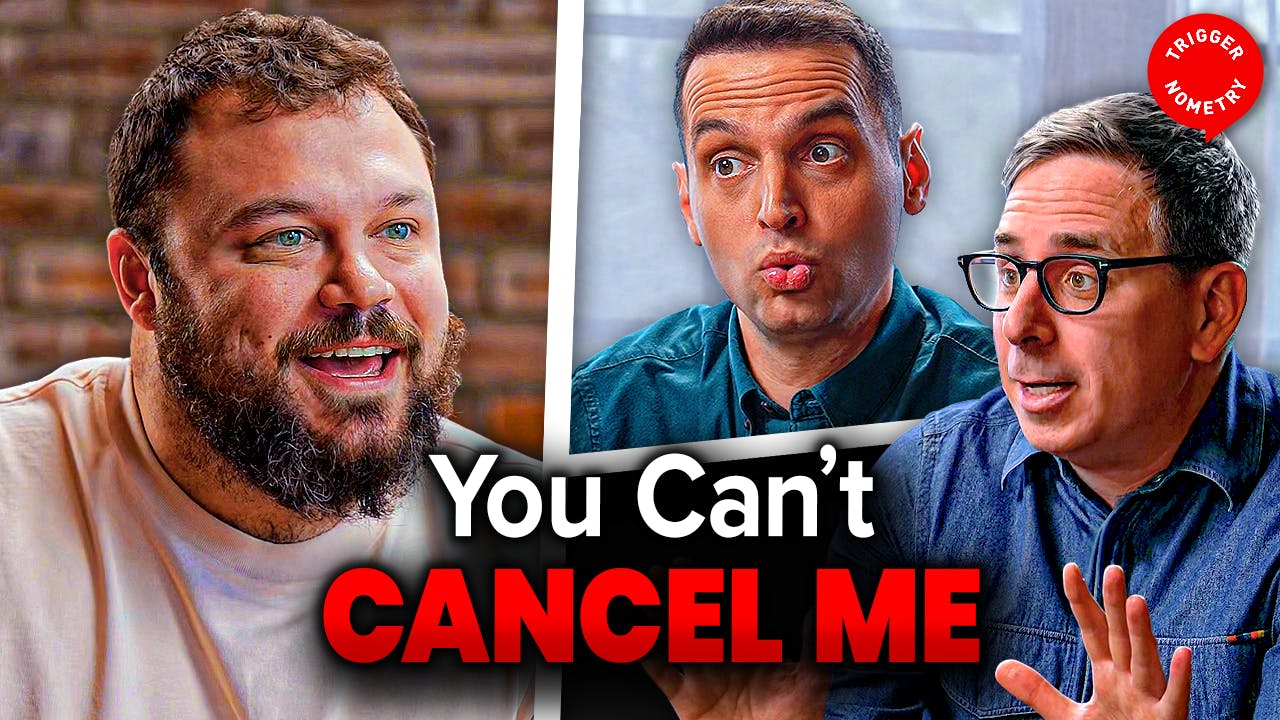
Ben Bankus, welcome to Trigonometry.
- [01:56]
Ben Bankus
Thank you so much for having me.
- [01:58]
Host 1 (possibly British)
Oh, man, it's awesome. You are absolutely blowing up. We were just talking before we started. The reason we really like your stuff a is you're very, very funny. Just very funny. But also I think you're very authentic with the voice that you represent, which is like a lot of comedians who do offensive material, they play that sort of like guilty liberal card. It's like, well, you know, you know, I'm not woke, but I'm also not that other evil thing. Whereas you embrace the evil.
- [02:22]
Ben Bankus
What are we talking, Ricky Gerbais?
- [02:24]
Host 1 (possibly British)
No, I just think he stays out of politics. But you know what I mean, right?
- [02:29]
Ben Bankus
Yeah. No, he takes good pictures of his cat. I,
- [02:34]
Host 1 (possibly British)
we're starting strong here. I like it.
- [02:36]
Ben Bankus
I mean, look, I, I say things that I think of and that's what the art form is. And there are things that I would say to probably my mom if she was still alive and she, to make her laugh, I would, you know. Growing up, my mom had a pretty dark sense of humor. She was a high school teacher, 35 years in Scarborough, Ontario, which is a, a little bit of a rough suburb of Toronto. And she always had, you know, there was always things happening at her school, you know, robberies and murders and she had a student shoot somebody in the, in a bus with a sawed off shotgun on the, you know, and it was a kid that she had just thrown out of her class like a week before. And so she, you know, she saw stuff and she had a real life and you know her like she was born 1948, so right after the war and stuff. So I always made jokes about whatever I wanted at home. There was never a line. You know, maybe if it was really bad joke, my mom would go, but that's what comedy is. Sometimes it is you're making somebody laugh and they're going, stop. That's not the right time. But when it's on a stage and the people have paid for is the right time. And I don't believe in censoring myself, especially on stage. Sometimes I make the joke with my audience. I'll make a really bad joke. I'll be like, not posting that one.
- [04:01]
Host 1 (possibly British)
And then you post it.
- [04:03]
Ben Bankus
And then I post it. Yeah. No, no, I don't. Some, some, I mean some of my, my worst stuff is not being posted yet because it's for the audience to come and pay and see. You said, I believe in free speech. I believe in speech for pay.
- [04:16]
Host 1 (possibly British)
Well, you got into trouble if you can say it that way with your stuff about ice, right? What was your take on, on the whole ICE thing?
- [04:25]
Ben Bankus
I mean, as, I mean I'm, I'm Canadian, so I'm an immigrant and I think we need to get rid of these people.
- [04:32]
Host 2 (possibly Francis or another co-host)
I don't know, I don't know what to say.
- [04:34]
Ben Bankus
It's the same thing in Canada. Canada does not have ice. I think the number is now around 400,000 people waiting for deportation who've had or more. Maybe there's millions, but officially I think there's four or five hundred thousand in Canada. There's no ice. There's no deporting those people. They, they just get a notice and they're supposed to self deport and that's not good for the country to just have a bunch of illegal. I mean, right now in Canada has IRGC members and stuff in the country. And, you know, during this, like, Canada is becoming a safe haven for, you know, IRCC members. I mean, is that a good thing? I don't think so. So I think that I believe in a safe. I want to have a safe, healthy, beautiful country, whether it's Canada, America, wherever I'm living. I want it to be beautiful and amazing and. And the people who are pro or anti ICE are also in favor of letting people out of jail for committing serious crimes and, you know, giving money to illegal immigrants. It's. It. I, I just don't know how I can be in favor of that stuff.
- [05:49]
Host 1 (possibly British)
But you didn't get in trouble for that. You got in trouble for a joke about ice, right?
- [05:52]
Ben Bankus
Yeah.
- [05:53]
Host 1 (possibly British)
Something to do with Renee Goode?
- [05:54]
Ben Bankus
Yeah, yeah, I made a joke about it right when it happened. And you know, it was, it was very funny for my audience. And the people who are upset, of course they're going to be upset. You know, they.
- [06:06]
Host 1 (possibly British)
But they cancel a bunch of your shows, right? Is that what happened?
- [06:08]
Ben Bankus
No, I think that, I mean, a lot of this is interesting. A lot of people are like, are you shows all getting canceled? No, not at all. I mean, we had shows in Minnesota got canceled because there was an active riot and I mean, I should have canceled it myself. People were like, you should maybe not go. Like, people were worried about me and the venue canceled because, I mean, they said it was for safety reasons. The real reason is they were liberal and the people who ran the business were liberal. So even though Democrats, because they believe in like communism now, they don't care about making money. So it's like, oh, six sold out shows. Six sold out shows. We'll cancel them because it's for the greater good of the greater. It ain't good. I'm just saying it's not. So. Yeah, this idea that shows are being canceled in America is not true. Canada, they canceled a few. They have these. The Canadian Anti Hate Network and all these organizations that are paid for, they just found out, are paid for by the Liberal Party in Canada, which is like the Democrat Party in Canada through back channels, apparently. And that organization's goal is to shut down people like me, I guess, that don't. Aren't censoring themselves or aren't woke. Basically, if you're not woke, you shouldn't be allowed to perform. You shouldn't be allowed to be platformed. You shouldn't be allowed to blah, blah, blah, even when the shows are sold out. And that's wrong. I mean it's obviously wrong. And a lot of it has to do with, in Canada, if you're going to be at a venue, a lot of them are city funded or, or you know, government funded venues and they're saying he shouldn't be allowed to perform there because it's government funded and they have a mandate to have DEI and you know, not what, you know, all those bullshit things that they write in those, you know, our mission statement is that we acknowledge that we are on stolen land. There's no freedom of speech allowed in this establishment. And if you say anything naughty, you'll
- [08:17]
Host 1 (possibly British)
be, you know, they have great names though, those organizations. They do the anti hate ones. We have one of them in the UK called Hope Not Hate and all they do is go around doxing anyone who's not well.
- [08:28]
Ben Bankus
Yeah, it's like, so, oh, you're anti hate, what do you do? Oh, we hate Ben Bankus. And we discriminate. We don't discriminate against broad groups. We discriminate one person at a time. And that's apparently okay. But the shows were sold out. I mean we're talking, I just had a show, Nanaimo BC, 900 people sold out. It's been sold out for like a month and a half. And then they cancel it. You know, there was a whole thing. They had, they had a city, it was a city funded venue but not affiliated with the city or something. So people went to the, they protested, they protested the city council meeting, they got into the city council meeting, they raised this concern. The mayor of Nanaimo said that, well, we don't want to be part of censorship, even though his material is disgusting and horrific and awful. But it's, we don't want to take part in censorship. So they basically said, we're not going to pressure the venue to shut it down, but we will make a statement that we, this is the new thing. Something bad happens, let's make it. We make a statement reaffirming our commitment to diversity, inclusion. What does that even mean? It means nothing. And so they sent that statement to the venue and of course there's somebody woke working at the venue who goes, finally there's a statement, this means we can cancel. And then they get some woke lawyer to look at it. And the woke lawyer goes, well, with the statement you just say that we didn't feel safe. The staff was. Didn't feel safe. This whole idea that you don't feel safe because somebody's making jokes is so dangerous for society. The idea that it's like safety has to do with words is not. It's just not true. It's a lie and it's being peddled. And that venue is getting bombarded by my fans, of course. So this is the weird thing. Venues will cancel my shows in Canada if 10 people complain. Apparently, you know, if they're loud enough or you know, okay, oh, there was 50. Okay, there's 50 that they gathered over. We had 900 just buying tickets then, plus the other thousands that wanted to buy tickets that couldn't get tickets, plus the millions online. And the venue seems to just only worry about liberal complaints because the second they cancel my show, what do they do? They turn off comments on all their posts. They turn off reviews on Facebook. Any review, any negative review on that venue that says you guys canceled the show, I'm very upset about this. They just mark as spam and get it deleted. So if they don't care about complaints coming from the right or from people who already bought tickets who legitimately were going to go to your venue, but care about complaints from people who are never going to go to your venue, might not even live in your city, but are calling in, is that a free country? Is that free speech? No. And this, the left pushes back and goes, well, it is free speech, but it's not free of consequences. It's a sold out show. It's been on sale for seven months. We sold it out. I did my part. The venue decides to cancel it because they're getting complaints. That is, that is a violation of free speech. I'm sorry, in my eyes, maybe. I don't know what. You know, British Columbia and Canada has some really crazy laws. So I'm sure, you know, they were suggesting some guy was trying to get people to call the police during the show to have me arrested for hate speech.
- [12:01]
Host 2 (possibly Francis or another co-host)
When did it become the case that nerds like these people, like, I'm just really offended. And we used to take the piss out of them back in the day. These people were losers. And we all used to laugh at them.
- [12:15]
Host 1 (possibly British)
Still are.
- [12:15]
Host 2 (possibly Francis or another co-host)
Yeah. And they still are. They'd be the people at school who would grass you up to the teachers, like, he said something nasty. But now it's like, oh, we listen to these people.
- [12:27]
Ben Bankus
Guess it's the payback we get for bullying the crap out of them in high school. Right? We bullied them and then we bullied them in university when took liberal arts degrees. And we Said, you're not going to have a job. You're not going to be anybody. You're going to be nobody. You're going to be working at McDonald's. We used to do that at my alma mater in Queens University in Kingston, Ontario. The frosh week, the first week, like freshman week. And they would, you know, the, the engineers would say to the, the arts majors that their thing was McDonald's. McDonald's. You're going to work at McDonald's because your career, your degree means nothing. So those people got upset and those people were like, maybe I'll get into politics. And then they got into politics and then all the other people who were bullied and felt, you know, done wrong by, voted for them and wanted, yes, we're going to change things. We're going to get rid of the jocks and the meanies and, you know, the toxic men, and we're going to replace it with feminized men and Woke women and LGBTQ plus A2 and, you know, bipoc and all this stuff. And they don't want to lead for everybody. That's the big difference is that people who were in power before, who weren't like ultra left did primarily, they would make speeches and say, we're, we're trying to make, we're here for everybody. Even though we won, you know, your guy lost. But we want to make sure that you know that we care about you and your problems. And for the most part, they did. Conservatives were in power in Canada. Homosexuality was not illegal.
- [14:08]
Host 1 (possibly British)
So what, you want some, you lose something.
- [14:13]
Ben Bankus
But I don't think homosexuality should be illegal. But, but I know, but, but that's the point is that they think people on the right, right are like homophobic, anti Semitic. It's like not true at all. A lot of people on the right are pro Semitic or Jews or are Jews. And like, I have a joke about, you know, people like, oh, the right, they, they don't like gay people. It's like, not true. If I meet a gay guy and he goes, I like Trump. I'm like, oh, maybe I like Dick. You know, it's, but it's the, the point is that we should all be getting along and respecting each other's differences. And if I have a difference of opinion and a difference of joke and you don't like it, don't go to the show, ignore it and move on with your life. And if you can't, well, I guess it was a good joke.
- [15:03]
Host 2 (possibly Francis or another co-host)
Has it come to the point, do you think in Canada, because I do think in the uk, a friend of the show, a magnificent comedian called Scott Caporo, he regularly tells me, calls me up, I go, scott, how's this week been? He went, well, I played a comedy club recently in London and I got reported to the European Court of Human Rights. Yeah. And then seriously, like people. And I think the problem is, it's. You're dealing with children. The more you allow this sort of behavior to continue, the more you embolden it and the more it happens. Whereas if you just turn around and go, you're being, to use British vernacular, a bit of a minge, mate. Grow up. I think we'd see this stamped out pretty quick.
- [15:47]
Ben Bankus
Is that us saying it to them or them?
- [15:49]
Host 2 (possibly Francis or another co-host)
Yeah, yeah, go to. But if everybody did it, not just us, but if literally everybody just turned around and went, you can have your tantrum, but ultimately I don't care.
- [15:59]
Ben Bankus
I think a lot of conservatives, traditionally, people who voted conservatively, weren't that involved in everything. They had their jobs, they had their good life and they go, okay. And then I vote conservative because screw all these people. I don't want to give them money. I don't care about them. Which is your right. You have a right to not care. You don't have to care about everything. What about the. What about I don't care, I'm not allowed, I'm allowed to not care. So I don't know what was the question?
- [16:30]
Host 2 (possibly Francis or another co-host)
So I guess the question is, is
- [16:32]
Ben Bankus
that if we tell them to stop,
- [16:34]
Host 2 (possibly Francis or another co-host)
well, or even just go, look, you can do it, but it's gonna make no difference. Have your tantrum, have your tweets, whatever else, it's not going to change anything. Eventually it would stop working, wouldn't it?
- [16:46]
Ben Bankus
Correct. And a big problem is again, in Canada, the medium sized venues have these mission statements that they came up with. I don't know why, but they came up with these woke mission statements. And it gives ammunition to the people who want my show canceled to say, hey, look, you're on your website, it says you support fairness and being nice and no bad words or whatever. And then this guy's doing the opposite of this. And then they go, oh, no. And then the person in charge, who's probably unsophisticated, probably doesn't understand what's going on in the world from both sides, is looking at it from one perspective, goes, good, we can get rid of them, we don't have to do it and we can just move on. And they think that they're going to be the only Backlash is going to come from the left.
- [17:37]
Host 1 (possibly British)
Most people think they're informed, in reality they're selectively informed. Modern media doesn't just tell stories, it quietly decides which ones you never hear about at all. That's why I use Ground News. It's the only app that compares how the same story is covered across the political spectrum and show you what whole audiences are not being told. The Blindspot feed is one of my favorite features. Every day it flags upwards of 20 stories that are being ignored either by the left or the right. Follow along at Ground News Trigonometry. Take this story. A major US poll found that Republican voters confidence in Trump's economic leadership has dropped sharply during his second term. That is not a minor data point. If you only read right leaning publications, you would have missed this completely. On the other hand, look at this. The UAE drops UK from scholarship list over radicalization concerns on university campuses. That's a significant story. Yet coverage from left leaning outlets was almost non existent. Ground News puts all of this in one place. Headlines, bias, breakdowns, ownership and context so you can actually understand what's going on, not just react to what you're told. Go to Ground News slash trigonometry to get 40% off their unlimited vantage plan, the same one we use, and stop being managed by the media. It seems like America's kind of got past the point that Francis is talking about though, right? Like my sense, Britain and by your telling, Canada as well hasn't. But in the US it feels like no one actually gives a shit anymore, right?
- [19:04]
Ben Bankus
Thanks to Trump. I mean he's the guy openly saying retard. And you know what, what speech has been limited by Trump according to the left? It would be. You can't say that you want to destroy America and kill all the Jews. You're not allowed to do that anymore. I mean that's not that that you were never allowed, it's just that the Democrats were bat, you know, wouldn't bat an eye at it even though they knew it was illegal. Just like the immigration, they knew the immigration was coming in illegally. But it's going to help us. So let's, let's keep doing it.
- [19:41]
Host 1 (possibly British)
So there is a lot of gaslighting going. I don't know if you saw this story yesterday as we're recording this, somebody there was a protest outside Mamdani's mansion in New York, right? And then somebody threw two improvised explosive devices and they were. And most of the mainstream media reported it like, like I just told you what they failed to say. Is the devices were thrown by two Islamists at the protesters who were outside. Like, the amount of just misrepresentation of what's going on is quite incredible.
- [20:12]
Ben Bankus
Well, if there's an incident where somebody throws a bomb at a protest, the main question is, wait, what was the protest? And that's wrong. I mean, if you're throwing a bomb at any protest, that's a big problem. But for some reason, if it was a liberal leftist protest, they would have said white supremacist attacks, peaceful lgbtq, anti abortion rally or pro abortion rally. If it was an anti abortion rally, that's the thing. Pro abortion rally. Somebody tries to blow it up. How? You know, how dare you? These people. Anti abortion rally. Well, they were causing some ruckus, you know, they were causing some problems out there. And it shouldn't be like that. Free speech is free speech. You want to say what you want to say. If you want to protest, protest. If that's being attacked violently, it should be called out. And I saw that Mamdani half called it out, but really was more calling out the protest.
- [21:16]
Host 2 (possibly Francis or another co-host)
And the thing that I always find surprising, though, Ben, is we talk about your comedy being offensive. I think back to, like, what me and my mates used to joke about 20 years ago and what goes on in people's WhatsApp groups. If our WhatsApp groups, anybody's WhatsApp groups were doxxed, it'll be over for all of us. So actually, what you're doing is a more honest version of comedy where you're going, hey, you know these fucked up thoughts that we all have, I'm going to say them in a funny way.
- [21:46]
Ben Bankus
I'm doing something different. And people can argue that people can hate on me, people can, whatever. But I know what I'm doing in my heart and I know that it's a good thing for this world and for regular people to be able to feel free to express themselves and not feel afraid. And every time I make a joke and I post it and it gets 10 million views, that broadens the free speech array or what's. What's, you know, and that's what the left really hates about my comedy. If he makes that joke, that means somebody else is going to make another joke and then somebody else is good. Yeah, because you guys are trying to stop that. You're trying to suppress free speech and then turn around. Like in Canada, they'll. They'll shut down a show and then the people shutting it down will make a statement and go, we believe in free Speech. But when it comes to this, we don't. That's. You don't believe in free speech. Why not just come out and be honest? Be like, we are against free speech. Free speech is dangerous. We don't like it because that's the reality. I'm sick of hearing. I'm all in favor of freedom of speech, except this guy really pushed. What are you talking about? That's what free speech is for.
- [22:57]
Host 2 (possibly Francis or another co-host)
But it's also just not the fact that what you're saying aren't opinions. This is what really annoys me. You're a comedian. You do comedy. The purpose of comedy, by its nature, is that you don't take it seriously. You're not a politician getting up there and going, well, she died. That's a good thing.
- [23:12]
Ben Bankus
Yeah. Might have to be, though. Might have to be a politician.
- [23:16]
Host 2 (possibly Francis or another co-host)
Don't become a politician. But doesn't that frustrate you in a way?
- [23:22]
Ben Bankus
I mean, it doesn't really frustrate. I think the more angry people get. I mean. Good, Renee, good. Let him get that mad at a joke. Okay, so I'm. If anything, I'm actually doing the people who are angry a favor because instead of being angry at their own lives and their own failures and what's going on in the world and being angry that they can't pay their bills, they get to just go online and look at my comedy and go, this is what I'm going to spend time on. This is what I'm going to be mad about. So you're welcome to the people who are angry that I've given you a break from your own problems.
- [23:56]
Host 1 (possibly British)
I do think you've hit on something very true there, which. And it's true of, like, everybody on all sides. Sides. Like, you know, you in Britain, you go. In England, you go to a football game. There's some very, very angry men about somebody who's kicked the ball the wrong way. It's probably your divorce. It's not that. You know what I mean? And it's like that with everything. I think the Internet just allows people to channel their rage. Yeah. The failings and things that we all have to deal with in life. Add some figure that they claim is right. Ruined everything because he told the joke in a comedy club.
- [24:26]
Ben Bankus
You know, they're not necessarily angry about the material or what I'm saying. They're angry that I'm doing it in a way that is successful and in a way that is. If I did it on a podcast, they'd go, that wasn't Funny. He's not funny. And they still say that on my standup, but they know it's not true because they're watching people die laughing and clapping, and that, that's what really pisses them off. And then they go, okay, well, let me do the math. If you. 23rd tickets are $35 a piece. He did 700 seats. Cancel it. We can't let them get money. We can't let them be successful. We can't let them. Because they know that once you get successful, once you have money, your words mean a lot more. And you're. That's, that's a much better form of protest than standing outside in the rain with a sign, screaming with a whistle is to get. That's, that's all good, but how about I just get rich and then say what I want? That's scary for people because when you're rich and you have some heat behind you, people are going to listen. And like you said, it's comedy. I'm trying to make people laugh. And when they laugh, that is a threat to the left, because they are anti humor right now. They're anti. Don't laugh at that. You can't laugh at that. Here's what you can laugh at. And to them, a good joke is something that only if it's not, doesn't offend anybody, it doesn't hurt anybody. That's not going to make me laugh necessarily. Maybe if I'm at my, you know, a kid's recital, I'll, you know, I, I laugh at some borderline woke stuff. And honestly, some woke comedy, it's offensive the other way. Talking about Trump. And sometimes I do laugh. I, I don't get angry. I don't watch comedy and get angry ever. I'm curious what the other side's doing. I, I watch I and do their thing. I would never say. I hope he doesn't. He shouldn't make it. He shouldn't be paid. No, do your thing, make your money.
- [26:23]
Host 1 (possibly British)
And you can appreciate a good joke even if you don't agree with the premise of it. I do that all the time, for sure.
- [26:28]
Ben Bankus
I mean, I'll laugh. And that's the thing, is that people laugh at some of the people complaining about my comedy. I bet you anything did laugh. They watched it, they laughed and they go, oh, my God, I'm so mad that I laughed. And then they say, how dare you? This wasn't funny. And it's like, you laughed. Just, just, just relax. It's. We're in a very tumultuous. World and crazy time. And the best way to get through hard times is to laugh. That's what soldiers do, that's what paramedics do, that's what doctors do. That's what everybody who has a tough job and a tough life does. And you know, the left needs to loosen up, stop with the. Stop dying on the hill of free speech and what the other side is allowed to make jokes of. What the other side is allowed to. You guys do something better then Canada. There was a video. It's absolutely hilarious. I don't know if you will show it to you later but the CBC which is like the BBC made, you know, so after my show, one of my shows was canceled in Kitchener, I think Ontario. Now they're getting another woke comedy group which is like a 65 year old woman who has like 200 followers and like some other lady who's like not just nobody. And they're gonna do a comedy show for good. And a comedy show, it's called Laugh Good or whatever and it's, it's to, to promote and it's. We have 12 local comics so complete nobodies. And this is, this is our alternative. We're giving an alternative for Ben Vegas. No, you're not. You're canceling my show and then you're saying this is what you're allowed and then nobody's going to buy tickets, nobody's going to go to that show. But that's fine. Let's, let's. That's. They almost rather have nobody show up to the show. But it's not offensive than offensive and
- [28:23]
Host 2 (possibly Francis or another co-host)
it's sold out because the way they portray you is that you're this kind of edgy dark lord who lives in the recesses of the Internet. And the ever loads of people that I know and I would include normies under this umbrella. Love your stuff, share your stuff. You are the mainstream. You are far more mainstream in that sense than somebody who's like I don't know what a woman is.
- [28:47]
Ben Bankus
They want to discredit me. Especially in the Canadian media. They want to make it like. I think in this video the woman was saying he is this new rage bait comedy. It's like. Oh yeah, you mean like Lenny Bruce, right? Rage bait comedy from 1962. I mean this new phenomenon where a goes on stage says something really funny about a recent topic that's sensitive and everybody laughs. They are. It's pure propaganda. They have a billion dollars behind them. And I'm an independent artist and I'm Canadian getting canceled in my own country by the Canadian Arts Council and all that those people, in order to put in their terrible comics that nobody knows and in their. And they're so stupid that they think that my fans who are regular people are gonna get a refund notice on their ticket for my show and go, well, I'm glad, I'm glad because that was gonna be really bad. What else is there to see? Oh, comedy. Two female queer comics doing an interpretive dance. Let's go to that instead. I mean, are they that stupid that they really think that they're going to convince my fans who are working people, jocks, ex hockey players, cop lawyers, professionals, business owners, they're going to go and watch an extremely far left performance of Nobody, no name comics. And this is what the, you know, people, it's like they just think, like they just bought tickets. They didn't know what they were buying tickets. No, they're my fans. There's right now 1.4 something million between Facebook and Instagram and they want to see me. They don't want to see your crap. And they're going to all those, all the venues that have tried or want to cancel in Canada. They're going to be begging for me to come back in a couple years when I'm, you know, and they're going to say, we're sorry, we got new management, we got. I'm going to say, I'm not coming back there, man. I'm not supporting a business that does that.
- [30:52]
Host 1 (possibly British)
I think you're overestimating possibility to change their mind.
- [30:56]
Ben Bankus
And they're not going to change their mind. They're just going to be, they're going to be kicked out because. And because they.
- [31:02]
Host 2 (possibly Francis or another co-host)
Do you really think that, Ben?
- [31:03]
Host 1 (possibly British)
Because of yourself? Since they believe in communism, they don't give a shit about the money.
- [31:08]
Ben Bankus
They don't, but it's going to. I have faith that it will change. I mean, Pierre Poliev, maybe he'll win. If not, maybe I'll have to fucking run. I'm not going to do that.
- [31:19]
Host 1 (possibly British)
We just had Pierre on the show.
- [31:20]
Ben Bankus
I know, I know. I listened to it and you know, he. I've met Pierre and I really respect Pierre, but he needs to win because he needs to go a little bit harder. And I've said this to a few MPs in Canada that I know because look at Trump, he went really hard. He went hard, okay? He won. So you either go hard and win or you pretend to be kind of in the middle and you lose. The people you're Going to, the way you're going to win an election in Canada and I mean in the states, this is what happened is you're going to activate voters that never voted. Stop trying to win over, you know, the new, the little India. We're going to go to little India and we're going to put on a turban. The white politician puts on a turban and goes, please vote for. No, no, stop it. Just say what you actually want to do. We're going to deport all these people, go into the little India and be like, hey, who's here legally? Raise your hand, who's not? Okay, get out. But I'm saying that there has to be some, some aggressive policy. Like if I was to run for prime minister in Canada, I would say we're going to get rid of all wokeness in every establishment in the country that is government funded. Anybody who's government funded, we are going to. If you want to be woke, you can be private and you can lose money, but the government's not going to lose money and sub, subsidize something that, like these venues. Why does the government have to subsidize a venue if they're going to cancel arbitrarily different performances and lose money? Why we should be, we should, Canada should be encouraging all the best comedians in America to come to all of the venues and treat them with the utmost respect and the utmost. Be super welcoming. Especially if they're selling out. Especially if the people that the government represents, who are the taxpayers, are buying tickets to the venue. That's the whole, their whole argument is it's a taxpayer venue. Yeah. You know who's a taxpayer? Me. You know who's a taxpayer? All the, all the people who are going to the show, you know who isn't or barely is a taxpayer? The people complaining. Oh yeah, they're a taxpayer, but they got a tax return. They're, they're actually getting paid by the government. They're not tax, they're not a taxpayer. They're getting 3, 4, 5, $6,000 at the end of the year because they, they made so little money.
- [33:53]
Host 2 (possibly Francis or another co-host)
A while back I pushed myself in training because I'm a bit of a legend, but ended up with a back strain that took far longer to recover from than it ever used to. Nothing dramatic, just one of those moments where you realize your body isn't snapping back the way it once did. And as you get older, those moments start adding up. Turns out there's a real reason for that. Your stem cells are the repair system your body relies on. They're the internal maintenance crew that keeps you healing, recovering and functioning. But that system slows with age. Fewer cells, weaker signals, slower bounce back. That's exactly why Qualia built their stem cell formula. It uses well researched ingredients like sea buckthorn and royal jelly to support your repair system. So your body can keep doing what it's meant to do. And it isn't something you take every day, just four days a month, to help maintain your regenerative capacity over time. So if you've ever felt like your body just doesn't bounce back like it used to, whether it's after a tough workout, getting sick, or the wear and tear of life, Qualia Stem cell is for you. Qualia Stem cell was designed to support your body's natural repair systems, helping you heal, recover and keep going strong. And right now, you can try it for up to 50% off@qualialife.com trigg and here's a bonus. Use the code Trigg for an additional 15% off your order. That's Q U A l I a life.com trig your body's built to repair itself. Qualia helps it to do that better. Big thanks to Qualia for sponsoring this episode.
- [35:31]
Host 1 (possibly British)
Would you not think. And I honestly don't know about Canada, but when I think about the UK and there seem to be some similarities, I go. I think the reason that a lot of politicians in this kind of center, right. Don't go the Trump route is that the public are very different. Like the population of the countries like,
- [35:48]
Ben Bankus
or they're bought and paid for.
- [35:50]
Host 1 (possibly British)
But you. What I'm getting at is like there's a big cultural difference between Canada and America and America and Britain. No, I mean Ari Matthias is great joke. I think he went to Canada. We had him on the show a while back and he just went. It's great to be in Canada, as I call it. Gay America, you know, like is there is very creative.
- [36:10]
Ben Bankus
Never heard that one.
- [36:12]
Host 1 (possibly British)
But you know, but like if an American made that joke in Britain, there is a kernel of truth to it in that people see the world differently. People are much more. They are on. On the balance of things. More work or at least there's more of them, you know, is that not fair?
- [36:28]
Ben Bankus
What did Pierre lose by like a percentage or something? Like 1 or 2%. It's so close. It's so 50. 50, right. And that's of the people that vote, which is only like 60% or 70% of the whole country. So that 30% they're mostly not woke because woke people vote. That's why they keep winning, because they're so organized and they've got their organizations and they're in their unions and sending out emails. Oh, that was another one in Sudbury, Ontario. One of my audience members told me that her union, her union, teachers union sent her an email saying not to attend my show. So that's where they're at. But the teachers union, teachers union sent an email to the teachers in Sudbury, Ontario saying, do not attend the Ben Bankus comedy show. It's hate filled, blah, blah, blah.
- [37:17]
Host 2 (possibly Francis or another co-host)
Do you know, at least they were right. But you know what's interesting about teachers is that the good ones, they have the darkest sense of humor.
- [37:26]
Ben Bankus
Oh, because the thing.
- [37:28]
Host 2 (possibly Francis or another co-host)
Yeah, because when I was working in schools, the stuff that you deal with on a day to day basis, here's
- [37:34]
Ben Bankus
the thing, there aren't any good ones. While the good one was the one that came to my show and ignored that. But there's no. Imagine an email going out to a company or an organization saying, please do not attend this drag time story hour. This is. That can't that. Oh, that's, that's. And even the show in Nanaimo that they canceled 900 seats. The next day they announced an all ages drag event. Literally the next day they announced it. And that was their like, we're so sorry that we even were about to maybe have him here. So let's have as many gay people on stage with their penis as that as possible. So the people who love my comedy are definitely, you know, most in Canada. I bet you most of them, if not 99% of them would become American like this or be okay with 51st State. And the reason is because of like what you said. They're trying so hard to convince the people on the right that you have no option. Your opinion is invalid. You're not allowed to have it. You'll be fired if you have it. You're a comedian. You like this guy, he's been canceled. We're not going to allow him to perform. And so it pushes people to be like, well, maybe we should just get an, you know, be part of America where free speech is allowed. Because why is, why are we being pushed and pulled by the left who is not the dominant force in Canada in terms, financially, just politically, you have a bunch of poor loser people protesting things. You know, like how on a scale of 110, how insane do you have to be to protest a comedy show? Like, how like, are you, like, do you just do that? And then after you're like, ah, that was a tough day. All right, tomorrow we gotta talk to my accountant, I gotta talk to my lawyer. No, they're nobodies. Right? So the answer is a Trump style thing would work well in Britain and in Canada. It's just a matter of stop being afraid that you're gonna lose. Stop being afraid to lose.
- [39:33]
Host 1 (possibly British)
What I find interesting is how unaware these people are that like 40 years ago was exactly the other way around. And it was the religious right that was protesting and canceling comedians. I mean, Bill Hicks final Letterman appearance that wasn't broadcast. Cause I think he came out as being pro lesbian or made a joke that sounded like he, you know, daddy's two, like Billy's two mummies or whatever. And other George Carlin. George Carlin wasn't being arrested because he wasn't woken up. Like, do you know what I mean? So it's funny how the very movement and ideology that came up on this idea of like, well, artists should be free to be creative and shouldn't be restricted by the state and they're now doing the exact same thing is incredible.
- [40:14]
Ben Bankus
They're doing it in an even more aggressive way because, you know, back then it had never been done. So it was kind of like, where's this coming from? Why are they swearing so much? Why are they talking about vulgarity and sex and all these things? Like when Lenny Bruce would be arrested and George Carlin and, and Richard Breyer and now it's like we had the 80s and 90s and the 2000s, and now all of a sudden it's, let's go back. Let's actually. No, no, no. All that stuff we've been doing for 30 years that people have been loving, that's been making billions and billions of dollars for the entertainment industry and Hollywood and made all these stars famous and made Jimmy Kimmel famous because he was doing blackface and you know, made it. Jimmy Fallon did. Like everybody doing black. But now only those people can be famous. And those people that were bad before are now the most woke and nobody can come into the industry. That's what it is. Because really, to break out in the industry, you have to be different. You have to say what you really think and be yourself. And yeah, maybe in 20, 30 years, and you know, maybe I'll be like, you know what? Some of what I said was a little too far, but that's because you already have money, right?
- [41:28]
Host 1 (possibly British)
You know, I'm saying, so you've already made it.
- [41:31]
Ben Bankus
It's.
- [41:31]
Host 1 (possibly British)
And by the way you don't want to lose it. There's other part of it which is like, they all have to act like they're super woke, even if a lot of them aren't. Because if you push back against this, well, you did blackface. Here's a fucking photo on the front page of the New York Times. What are you going to do now?
- [41:47]
Ben Bankus
They're worth enough money to speak their mind. It's pretty. I think it's now. It's just that they truly are and have been brainwashed. And I think that even millionaires who are part of the Hollywood system are being brainwashed. And, you know, they're. I mean, people are coming to their house, you know, when the FBI is coming to your house and going, maybe we'll do a little more like this. Maybe the shtick goes a little this way. I don't know if that's actually happening, but if you're a late night TV show, there is some affiliation with, like, public policy and there's a reason why they're doing it. So it's not purely money because they, if you know, how much is Jimmy Kimmel worth?
- [42:26]
Host 1 (possibly British)
I don't think it's about money enough to walk. It's about status and friendship groups and whatever. Like, you have, you have a cozy life. You have your friends, you have your, the, the golf club that you. All of that. And, and people fear, I think, losing, being ostracized by their community a lot more than they fear losing money, actually, or losing future earnings.
- [42:47]
Ben Bankus
Having friends is overrated. If you have time to have friends, you're doing something wrong. I mean, you know, I mean, you're, you're a friend, but like, it's nice to have.
- [42:56]
Host 2 (possibly Francis or another co-host)
But you can even say the word when you're a friend.
- [42:58]
Host 1 (possibly British)
No, no, you're not.
- [42:59]
Ben Bankus
But, like, you know, well, we're not sitting on the couch playing Xbox for four hours. You know what I'm saying? Like, we're adults. This is, you know, do I go? I have a family. Once you have a family and you're working all the time, who's. Who's your friend? Right? Nobody.
- [43:12]
Host 2 (possibly Francis or another co-host)
Right?
- [43:13]
Ben Bankus
Your agent.
- [43:14]
Host 1 (possibly British)
You know, you're gonna find out one day that is not true.
- [43:18]
Ben Bankus
Well, well, maybe not, but I do think it's important. I mean, look, I'd rather be friends with people I'm paying because then I can fire them. I don't want to be friends with them anytime.
- [43:29]
Host 1 (possibly British)
True friendship right there.
- [43:30]
Host 2 (possibly Francis or another co-host)
I mean that show business friendship. But I think the thing is as well is that, you know, Once you get to a certain point, you define yourself by having the Jimmy Kimmel Show. Are you really Jimmy Kimmel without the Jimmy Kimmel Show? And also, you see a lot of people work in legacy media, there's this fear because on a part of, on a, on a level, they got given something, they got given an opportunity. Now, to be fair to all of them, they made the most of that opportunity, the show became successful, whatever, but there's still a part of it that was given to you. You were given that opportunity. No one gave the opportunity to you, Ben. You built it off your own back, which means that you are far more stable and secure than even the Jimmy Kimmels of this world. Who knows that a split second it can be taken away from them.
- [44:16]
Ben Bankus
Well, when Jimmy Kimmel made the comments about Charlie Kirk and they took his show off the air and it was this whole like fake thing where it's like cancel culture is coming to the, you know, the Trump shut it down and then he was back on the air two days later. So it was never like he was shut down. It was never like he stopped getting paid. It was all fake. Now here's my question to Jimmy Kimmel. You think that there's a lack of freedom of speech for people on the left? Well, how about change your show all of a sudden and go completely right and you know, just go like Gutfeld, be on the right, See what happens. See what happens. Will your speech be taken away? Because that's the true test. You know what I'm saying? Yeah, number one, it might, they might question it until the viewership goes up. Got Felt gets more views than, than all of those other late night TV shows. Why? Because it's. Because he's, he's not lying. I don't even think some of the people like the Jimmy, Jimmy this and Jimmy that, they don't even believe the stuff they're pushing. Like you said, they're just, they're doing a job. And they're doing it well in the sense that they'll cry. They'll cry, they'll cry on command if they got to prove their point. Or maybe, maybe they do believe it. I don't know. But the point is, if they switched up and tried to become right wing, they would have their speech taken away very quickly by those networks, in my opinion.
- [45:47]
Host 2 (possibly Francis or another co-host)
But it's also, it's not about being right wing. It's just about being honest. You see, sometimes they present these stories and you go, nobody believes this. The vast majority of people don't believe this.
- [46:00]
Ben Bankus
Yeah.
- [46:00]
Host 2 (possibly Francis or another co-host)
And if you're not prepared to take risks in a creative industry as an artist, you're done. It doesn't matter. Even if you're doing observational material, you still need to take risks.
- [46:11]
Ben Bankus
I just don't understand. This whole thing is like, people, like, it's like you're not allowed to say it's right wing, but the left is allowed to say it's right wing. You know, I'm saying, so like they'll, they'll look at my comment go, it's far right. It's anti woke. It's. But if you yourself are like right wing openly, then it's like, you know, you're not allowed to do that. Why can't we, the right, if they want to continue being in power in America and if they want to be in power in Europe and stuff like that, they have to kind of unfortunately use some of the tactics of the left, at least in being loud and annoying to win, because otherwise the other side will just be louder and more annoying with less people. And, you know, it's like you're not allowed to say at a workplace, if you work for a bank and you're in the office and you go, you know what? I like ice. Let's get rid of more people. I think they shouldn't be here. That's not allowed. You could be fired. But if you come in and say we need to get rid of ice, I think we need to go around and round up the ICE agents and put them in jail and take away their rights. That's fine. So that's not right. And generally my comedy is existing for the people who are frustrated about that to have some cathartic relief and laugh about the current state of the lack of freedom of speech. And they should be allowed to do it. They should be allowed to go to the show. They should be allowed to laugh at it. And if they're not, then it's getting more serious. You know, it's, it's there. The left is making this more serious than it has to be. They, they claim some of the Nanaimo BC we're canceling the show for the safety of the community. It's a comedy show. What safety are you worried about? Well, we're worried that some of the words in there are going to raise everybody laughing at those jokes already agrees with those things. So you're just saying that they're not allowed to agree or they're not allowed to laugh. And now you're actually making it more dangerous because now you have 900 people who live in your community, you canceled their favorite thing that they were gonna go do. Now they're pissed off. Now they might go out into the community and say something crazy to who knows what at some bus stop and be like, you know, start instead of biting their tongue. If they went to my show and laughed about it, they'd look at it and just go, whatever.
- [48:27]
Host 2 (possibly Francis or another co-host)
But I would disagree with what you said. That say that they agree with your points of view. One of my favorite comedians who you probably have never heard of is a guy called Jerry Sadowitz. Jerry Sadowitz is one of the most brilliant comedians to ever grace the stage.
- [48:41]
Host 1 (possibly British)
He's brilliant.
- [48:42]
Host 2 (possibly Francis or another co-host)
And what Jerry Sadowitz does is he plays this character of the most pathetic, awful human being that you could ever see. He is the lowest of the low. And because of that, he does jokes about everyone that are really dark, really hateful, really offensive. He got canceled from the Edinburgh Festival because people got upset. You know, the standard stuff. I don't agree with what Jerry Sadowitz says. I go to watch Jerry Sadowitz.
- [49:09]
Ben Bankus
Why does everybody have to say that?
- [49:10]
Host 2 (possibly Francis or another co-host)
No, no, no, no, no. I don't agree with you.
- [49:13]
Host 1 (possibly British)
France is making a difference.
- [49:14]
Ben Bankus
I don't know what his jokes were.
- [49:15]
Host 1 (possibly British)
The point he's trying to make is Jerry Sadowitz is not expressing his fucking opinion on stage. He's telling jokes.
- [49:21]
Ben Bankus
Right.
- [49:21]
Host 1 (possibly British)
And there's a big fucking difference. Yeah, a character telling jokes and a person expressing their opinions. Now, in your case, I think they're much more closely aligned. But Francis point is, sometimes it's just a joke.
- [49:32]
Host 2 (possibly Francis or another co-host)
So, for instance, one of Jerry Sadowitz's jokes is, gary Glitter is the greatest rock star of our generation. He should be allowed to fuck who he wants, when he wants, how he wants. Gary Glitter is a pedophile who got arrested in Thailand. But the whole purpose of Jerry is that I'm gonna say the most dark, outrageous, awful stuff, which is indefensible on any level. But I'm going to express it beautifully. I'm going to write it immaculately, and I'm going to deliver it phenomenally well, so that you have to laugh despite, you know, you knowing full well that what I'm saying that might have already walked out of the shop is awful. But do you see what I mean? You know how at the beginning of every year, people say, this is a year, Things change. Then by February, everything looks the same. If you've been sitting on a business idea for months or even years, 20, 26 is your line. In the sand. The most common thing that separates people who talk about building something from the people who actually do it is taking the first step. And if you want this to be the year you finally launch, the smartest move you can make is starting your business with Shopify.
- [50:43]
Host 1 (possibly British)
2026 is the year you launch your business. The year you transform into an entrepreneur, founder or boss. One powerful move puts your future firmly in your hands. Starting a business with Shopify. Maybe you've got a product you can't stop thinking about, a skill everyone tells you to monetize, or a store you've already imagined in your head. Shopify is how you make that real. Shopify provides everything you need to sell online and in person.
- [51:09]
Host 2 (possibly Francis or another co-host)
Millions of entrepreneurs have already made this leap from household names to people launching their first ever business. Shopify gives you all the tools to build your dream store easily. You can choose from hundreds of beautiful templates and customize everything to match your brand. Setup is fast thanks to Shopify's built in AI tools. They write product descriptions and headlines for you and even help you edit your product photos. Marketing is built in too. You can create email and social campaigns that reach customers wherever they scroll down.
- [51:42]
Host 1 (possibly British)
As you grow, Shopify grows with you. Handle more orders, expand into new markets and manage everything from one simple dashboard. In 2026, stop waiting and start selling with Shopify. Sign up for your one pound a month trial and start selling today at shopify.co.uk trigger. Go to shopify.co.uk trigger that's shopify.co.uk trigger.
- [52:09]
Ben Bankus
I say things that I don't mean. Every comic does that. I mean some of the things I do mean, but like not to the extreme of like, you know, the Renee Good. Do I think it was actually good? No. And I talk about, it's like her name was good, that's why it's funny.
- [52:22]
Host 2 (possibly Francis or another co-host)
Yeah.
- [52:22]
Ben Bankus
If her name was, you know what, some other random last name and you just said, I'm glad, like it doesn't. Or good. It doesn't make sense. So yeah, of course the jokes, you know, are exaggerated over the top, but. But to laugh at them, you have to be in agreeance with something. You have to be in agreeance with me that I'm telling you a joke and that you're not going to be offended at it. You don't necessarily have to agree politically, but you have to agree to something. When you go into a comedy show, there's an unwritten contract of I'm going to tell the jokes. And if you don't like it. You don't have to laugh. If you really don't like it, you can leave. You can't yell out. You can't cause problems during the show. But if I. And. And you understand that I am joking. You know what I'm saying?
- [53:10]
Host 1 (possibly British)
Do you get a lot of people heckling you?
- [53:14]
Ben Bankus
Yeah, normal amount. I get a lot. People are really excited for my shows. They get really drunk. They get really drunk, and then I, you know, they. They end up heckling, but they love me, you know what I'm saying? And then I have. Yeah, if I go to a random place and do a show, somebody might freak out and get mad and. But, you know, I just don't understand this whole. Like, it's like, why do you have to explain that you're like that pedophile jokes? Like, why do you have to explain that you're against it? Like, it's like, obviously, you know what I'm saying? Like, I. I do Epstein jokes. It's like somebody got mad at Mothership. I made a joke because I was saying that, you know, whatever, that he was a good guy, you know, so why is that? But it's funny because it's obviously not true, right?
- [54:01]
Host 2 (possibly Francis or another co-host)
Yeah.
- [54:01]
Ben Bankus
You know what I'm saying now? Some of my jokes are funny because they are true. Or maybe, maybe, maybe Epstein was a good guy. I don't know. But, you know, like, people. He made jokes about indigenous people in Canada. Oh, so you're not allowed to. You're not allowed to talk about a group of Canadians that I'm. I'm born and raised in Canada, grew up with the. Learn the history, blah, blah, blah, and I still can't make a joke. Well, if you knew the history, you'd know it's not funny. Give me a freaking break. Let me deal with what's funny. You deal with what's serious, you know what I'm saying? Or I'll have to come over there and tell you what's serious, and then they won't like that. That won't be very funny.
- [54:37]
Host 1 (possibly British)
I can't imagine they will.
- [54:38]
Ben Bankus
No, they'll be scared shitless. If I was in power in Canada, full power. Be scared shitless of me.
- [54:45]
Host 2 (possibly Francis or another co-host)
I mean, you've got a glint in your eye when you say that.
- [54:48]
Ben Bankus
I'm gonna have to do it. I'm gonna have to. Maybe 10, 10, 15 years from now, we'll see.
- [54:53]
Host 2 (possibly Francis or another co-host)
But how did Canada get in this mess? This is a question that I've actually wanted to ask Canadians.
- [54:59]
Ben Bankus
I mean, the same thing. Look at Europe. It's in the same problem.
- [55:03]
Host 2 (possibly Francis or another co-host)
Do you think it's the same problem?
- [55:05]
Ben Bankus
Yeah, because it's the same.
- [55:07]
Host 1 (possibly British)
What's the problem?
- [55:08]
Ben Bankus
Civilization. The problem is over empathy and feeling bad for people that we shouldn't feel bad for and, you know, letting in millions and millions of immigrants into the country that have completely different views. Hate the West. Want to change the West. Want to implement Sharia law. Want to implement, you know, okay, we'll split up the west, basically. Okay, this is the Sharia part. This is the LGBTQ trans part. This is the Hindu part. And then there's a little sliver for the people who. Yeah, you remember your country. This is where you go. So. And when you do that, and you have people in power. So the LGBTQ plus people created all these woke rules that now ultra is like, Islamists are taking advantage of. Right? So their rules were originally like, we're just gay. We just want to be gay. We don't want anybody to make fun of us, and we don't want to get our feelings hurt. We want to be able to shake our dicks in front of kids and do Drag Queen story Hour and all this stuff. And then the Islamists are, like, coming in going, oh, my God, if they're falling for this, they'll fall for our stuff. You know that if. Oh, and then they can say whatever they want. And anybody who says anything to me, that's discrimination based on the laws that the gay people pass. And now. So it's. And. And another reason that all this nonsense, because normal, regular people are busy doing comedy and podcasts instead of politics because we don't want to. We thought we could just live in a country and be successful and follow our dreams. And the people who didn't think that was the case are now in power, Right?
- [56:50]
Host 1 (possibly British)
So they don't want you to live your life. They want to be in your shit. They want to be in your business.
- [56:55]
Ben Bankus
We need to make being in politics cool again for the cool people. And the cool people might need to go back into politics and start saying what they really want to say and pushing what they really want instead of just being at home shaking their head, going, oh, this is horrible. Anyway, gotta go to work.
- [57:11]
Host 2 (possibly Francis or another co-host)
Yeah, it's a good point, actually. We need to get back to the era of jfk, where you could basically be a cool president and have sex with Marilyn Monroe.
- [57:20]
Ben Bankus
Nothing wrong with it. Nothing wrong with being a cool president. Nothing wrong with being a cool prime minister. And, you know, Keir Starmer is so not that and he's so. He's so aggressively. So aggressively woke. And so, you know, I've never seen him laugh or smile. He takes everything super seriously. Everything is hello to the British people. This is one of the worst. There's no fun. Where's the fun? When's the last time a politician talked about have fun? When's the last time a politician said, we need to care about families and worry about the health and longevity and the love the left has hijacked? Love. They now like bad bunny. I am against. I am. Love is stronger than I hate. First of all, no, it's not.
- [58:14]
Host 1 (possibly British)
But second of all, yeah, historically speaking, I think you're onto something.
- [58:19]
Ben Bankus
But why does the community who aborts kids wants to have trans. Is their kids. Doesn't really or doesn't have kids or doesn't want kids. Why are they the community of love? And it's all about what's. When they. When the left says love, what they really mean is allowing illegal immigration to happen unfettered. Nobody should check it. Love is that, you know, we have to. Loving our trans community. Loving. What about. But the. The left, the right is the one who actually loves. They love their family. They love their country. They would die for their country, die for their family, protect their fam. Like, I have kids. I love my kids. You're telling me that the love that the LGBTQ community has for each other is stronger than the love that people have for their children? Like, what are we doing here? They're not the arbiter of truth. They're not the arbiter of love. And if anything, the left is the hateful, evil side of things. Now. That is disregarded God. I mean, you don't have to be religious to believe in God. You don't have to be. We're on a rock, spitting in the middle of a galaxy, in a universe we don't understand, swimming in some sort of soup that we're all in that we can't see, that we breathe in something insane is going on on Earth. And when you're thinking about these trivial. Well, he said a joke that I didn't like. And does he not know how serious it is that women historically, have been marginalized? You know, we're in a universe like you could do anything. You could become an astronaut. You could invent something. You can become the next Elon. You can.
- [59:59]
Host 1 (possibly British)
And they hate that. But this is where you're wrong, though. This is where you're wrong. They can't become the next Elon because becoming the next Elon is fucking hard. You gotta be smart. You gotta work hard. You gotta take big risks.
- [60:10]
Ben Bankus
They can. They just don't want to.
- [60:11]
Host 1 (possibly British)
I don't think they even can. They neither want to, nor do they have the talent, which is why they sit in the corner and go, I can't believe he said that.
- [60:18]
Host 2 (possibly Francis or another co-host)
That.
- [60:18]
Host 1 (possibly British)
Because it's. So be trying to give him benefit. No, but this is what I don't. I. I did a debate with this Destiny guy, and I met some of his audience, and this. It radicalized me because. Because these people, they just. They. They don't. Like you said, they don't want to do the work that it takes to achieve anything. But a lot of them also maybe just can't. And so they are stuck in Loserville. And because of that, they hate everyone who isn't.
- [60:44]
Ben Bankus
Well, that's why they side with Hamas. They side with, like, terrorist organizations because, like you said, they feel that, well, I'm not gonna. I can't become anything. So let's just burn it all down. And let's just. You know, let's. Let's not like, you know, I hate Elon because he's a billionaire and because he works. And I hate this person. I hate that person. It's like, you know, if you're. If you're not waking up every day going, how do I become more successful? Or, how do I fix something? How do I improve my life? Improving your own life will do more for the country than marching around with a sign trying to get a comedy show canceled or trying to get anything canceled. And that goes for both sides. Like, if you're on the right and you really. You're. You're out of protest. I get it. But, like, be successful. Start a business. Buy some pool cleaning equipment.
- [61:40]
Host 1 (possibly British)
Clean your room.
- [61:41]
Ben Bankus
Clean your room. But I'm saying, buy some pool cleaning equipment and create a pool business that cleans pools and do something. It's not that hard to start a business than to be successful. And my message to the left is the opposite of yours in a way that. Because I want them to snap out of it, I do think they're capable of doing great things, but they have to put down the sign, push the. Put down the phone, and focus on something. And I know I. And I sound like a parent, maybe a parent that they never had or the parent they did have that they resent. But this is. What's going on right now is the right needs to parrot the left, and they need to basically say, hey, like you said this. No you're ruining the country. You're destroying everything. You have to stop. And if they don't, what, what do we do? What is the consequence? We just have no more. You know, Canada will have no comedy shows. Cancel everything. Unless you're a government funded comedian. Like in the Soviet Union. Like my dad, he's, he's from the Soviet Union. Former Soviet Union, Lithuania. And he talks when he watches the CBC in Canada, he goes, this is Soviet, like the level of propaganda, it's, it's legit. So no, comedy's comedy. If you don't like it, don't go. And as for everything else, show me one thing where the left has improved anything. Like one thing.
- [63:12]
Host 2 (possibly Francis or another co-host)
The coffee. That's true, it's coffee. Look, I'm.
- [63:15]
Ben Bankus
Look, it's at the very end, after all the, the human trafficking and the, in the, in the Colombian forest jungle and the children picking at the tree and the bing, bing, bing. And then, and then finally. And then it's processed, but at a plant with a bunch of probably Republican people working at it and it. And the companies. And then finally in the last second, some woke person goes, do you want, do you want Americano or do you want Palmilk?
- [63:45]
Host 1 (possibly British)
Okay, yeah. But you can't deny it. Conservatives are terrible at making coffee and also they're terrible at making movies and
- [63:52]
Host 2 (possibly Francis or another co-host)
they're terrible at making breakfast. Really? Yeah. Conservative breakfasts are terrible.
- [63:56]
Host 1 (possibly British)
What's a conservative breakfast?
- [63:57]
Host 2 (possibly Francis or another co-host)
Oh, you know, it's heavy and it's stodgy and it's just.
- [64:00]
Host 1 (possibly British)
Wait, what about the English breakfast? Surely that's conservative because it's traditional, right? The English. Have you ever had an English breakfast? You look like you've had.
- [64:06]
Host 2 (possibly Francis or another co-host)
You look like you enjoy an English breakfast.
- [64:08]
Ben Bankus
What is it?
- [64:09]
Host 2 (possibly Francis or another co-host)
What do you mean?
- [64:09]
Host 1 (possibly British)
It's bad.
- [64:13]
Host 2 (possibly Francis or another co-host)
Get out, get out.
- [64:17]
Ben Bankus
No, it's a tea and crumpets, right?
- [64:19]
Host 2 (possibly Francis or another co-host)
Yeah, yeah. Well, no, it's black pudding, sausage, egg,
- [64:24]
Host 1 (possibly British)
baked beans, hash brown, all that good stuff.
- [64:26]
Ben Bankus
Yeah, I've had that.
- [64:27]
Host 1 (possibly British)
That's a conservative breakfast, surely.
- [64:29]
Host 2 (possibly Francis or another co-host)
Yeah. When you come to Basically Canada, Mark 2, which is a UK, what movies
- [64:32]
Ben Bankus
have conservatives made that are bad or.
- [64:35]
Host 2 (possibly Francis or another co-host)
Because the pushback to that is. Clint Eastwood is a conservative.
- [64:38]
Host 1 (possibly British)
He's made some great movies.
- [64:39]
Host 2 (possibly Francis or another co-host)
Yeah.
- [64:40]
Ben Bankus
The issue is that conservatives don't want to make movies. The ones that would be good at it are making money, doing something else, owning a, you know, some random company that does pool cleaning or, you know, and they never, they just made their money. They're like, I'm not going to get into movies.
- [65:00]
Host 2 (possibly Francis or another co-host)
You Know what my hope is, is that we reach the peak of this in politics. We're Justin Trudeau, who was the wokest of the woke. Of the woke. And you talk about Canada, and I think what we're doing is we're not being really honest in a way, because your population voted for Trudeau, who was the literal worst, you know, what was. What did he say once when he went our men and he said a woman. That wasn't him, though, wasn't it him?
- [65:29]
Host 1 (possibly British)
No. Some American senator.
- [65:31]
Ben Bankus
Mail in bell. I mean, I'm not a conspiracy guy fully, but I know that mail in ballots were huge in that election because it was Covid, you know, Pierre Poliev again. He didn't push hard enough. He should have. He didn't push hard enough against everything. And he made a lot of conservatives vote for this other party that is like more right. And that's why they lost, because if they had not had that other party, they would have voted for him and he would have won. So the idea that everybody supported him is not true. The people who vote, he won from the people who vote. The people who don't vote didn't vote. Why didn't they vote? Well, because the conservative guy didn't make them want to vote.
- [66:19]
Host 2 (possibly Francis or another co-host)
I mean, that's absolutely fair. Do you think that we're going to see Canada get better? Do you have hope for Canada?
- [66:27]
Ben Bankus
I have hope. I think that me doing my shows is helping. I mean, I do, because when they happen, it gives people hope. They cancel two and then we're still going to do three. Or I just did this weekend. I have six. Sold out in Niagara Falls and then sold out in Lethbridge, Alberta. Sold out in Cranbrook, BC Sold out in Campbell River, BC Sold out in Kelowna, BC and when those shows happen, people see it and they feel hope that the country is what it used to be and they think that they're going to cancel shows and it's somehow going to get rid of me. It's like, you're literally making me bigger. You're making me more. People who haven't heard of me go, who are these people complaining about? These people that I hate? Who are they complaining about? Then they see it's me and they go, oh, I love it. Oh, I can't believe I never heard of this guy. Where. When is he performing? Okay, I'm going to go get tickets. So, yeah, thank you to the haters. And keep, keep, keep e building the venues, you know, do your thing and try to. They're trying to get the shows canceled because they have nothing better to do. And really what they're doing is me a huge favor.
- [67:40]
Host 2 (possibly Francis or another co-host)
So, Mina, the wall is your nakos. Sia prende unidiola solo con libro. Te vaja quedar attascado lo que de verda marca la diferencia e cuchar como habla la gente in contecto reale. If you didn't understand that, but you want to, then listen up if you did. Apologies, I'm about to repeat myself. If you learn a language only from a book, you're going to hit a ceiling. What actually changes everything is hearing how people really speak speak in real situations. That's why I genuinely recommend lingopie. I'm fluent in Spanish and immersion is what got me there, not textbooks. Lingopie is built around that same idea you learn by watching real TV shows and movies. And while you're watching, the subtitles are interactive. You can click any word for an instant translation, save it automatically, and later review it with flashcards, quizzes and pronunciation tools. Lingo pie turns passive watching into active learning without making it feel like studying. And I'll give you an example of what I've been watching. There's a Venezuelan adaptation of Wuthering Heights on there called Cumbres Borrascosas. So yes, I'm quietly working my way through a Spanish language, Gothic romance. It's dramatic, intense, very emotional, bit like my love life. And it's brilliant for picking up the kinds of expressions and turns of phrases you never meet in a textbook. You start noticing how people actually argue, confess things, exaggerate, all in real Spanish at full speed. They've got 3,000 plus shows and movies across 14 languages. And you can use it on your phone, laptop or tv, which makes sticking with it much easier. And consistency is the whole game. If you want to learn a language the way people actually speak it, click the link in the description for 55% off an annual plan. If you want to understand the language the way it's actually spoken, this is one of the best ways to do it I've ever seen. So once again, click the link in the description or go to learn.lingopie.com trigonometry because the concern is, Ben, is that the people who are entrepreneurial, the people who are on the right, the people who want to achieve things, build things, they're going to leave Canada because quite frankly, why would you stay?
- [70:05]
Ben Bankus
They already have. A lot of them already have. I mean, I ran into, I mean, when I'm in Canada. I do get recognized on the street. I ran into two people in Yorkville just crossing the street. And the one guy was a young guy, tall guy, and he was like, love everything you're doing, you know, thank you for being brave enough to just do what you're doing. And he's like, you live in the States mostly. I'm like, yeah. He's like, man, I was just in Scottsdale. So nice. It's so good. I just, I want to get down. Everybody wants to go because they're the regular normal people who aren't woke can't handle it anymore. And that's part of the, part of the goal of the WOKE in my opinion is to make it so horrible that the people they hate leave, which is successful people who's going to pay
- [70:53]
Host 1 (possibly British)
all the taxes when that happens?
- [70:54]
Ben Bankus
They don't care. They just borrow money. It's all fake. They just keep borrowing from whoever in China. And they do that. They have some system where they, they buy the bonds back from themselves and to print the money. And I forget, I don't know, I'm not a finance, but I know that it's not good, it's not sustainable. But they want this, this world. And then they have more crime and more poverty and more starvation and all these problems and then they have, eventually they're gonna have nobody but themselves to blame. So it might, maybe it will be a 30 year thing where they go full, full communist and everybody, any dissenters are either arrested or have to leave. And then when finally the new generation of woke people go, wait a second, why is everything like this? I don't like this. Then it'll change because the people now are brainwashed to the extreme. They are the people who, like you said, there's more of them. I don't know if there's more, but they're, they're loud and they're super brainwashed and they believe it so much that they, they'll do anything, they'll do anything to shut things down, including violence.
- [72:10]
Host 2 (possibly Francis or another co-host)
Because it's so bizarre. Because Canada should be one of the most successful, richest nations on the planet. When you look at the resources that you have, have, you should be literally top five, top six richest nations. And you look at the population as well who are super educated. Your universities are incredibly prestigious. You've got literally everything.
- [72:34]
Ben Bankus
They've all been infiltrated, all the universities are infiltrated by China. And super, I mean part of ultra WOKE is China. I believe that they, they know, they knew, they studied. How do we destroy the west. And they go, let's woke and then immigration.
- [72:51]
Host 2 (possibly Francis or another co-host)
Ben, you can't do the. Without doing the action. Come on.
- [72:56]
Ben Bankus
We need to make the gay people in charge of the country and then fill the country with mushrooms, and then we can have control of the farm ranch. But that's really what they want is, is control. It's all about control. Part of the apology stuff. And not, like, for, why did they cancel all those pipelines where they could have been pumping gas to the entire world and Canada could have been a leader in natural gas and oil production or whatever, getting it out of the ground because of woke, because it's environmentally not friendly and because the indigenous people and because of this. And it's like, but although the environment and the indigenous people would be better taken care of if Canada was rich, it's the same thing. Like, it's like, it's the same. I'm gonna hold the sign up and say, I'm for this, instead of, I'm gonna forget about all that, focus on my business, get rich, and then maybe have an opinion about something once I'm a prominent individual. So Canada decided, let's not be a prominent country. Let's stand up for all these BS WOKE takes. So there's no pipeline. Now they're giving all the land back to the indigenous people that are already impoverished. And sorry to say, a lot of them are, you know, they're not in great shape. And what is the reason for that? They've been given billions of dollars. Why are they not in great shape? Oh, well, they need the land back. Okay, here's the land. Oh, they're still not in great shape. What do they need? Well, they need to make sure that there's no freedom of speech so nobody can talk badly about them, and then they'll be okay. And then they're destroying good countries. And it's coming from these people who are brainwashed, maybe by China, maybe by, you know, the tick tocks. I don't know what it is, but I'm against it. I want Canada to be a great, safe, amazing place to raise your families to. You should be able to have. The school should not be filled with political stuff and political. I mean, transgender ideology and all that stuff, which. Imagine having to learn about transgender ideology a week after there was a trans person who shot up school and there's people dead. And then the next. The first class back, they're like, well, we need to. First of all, let's acknowledge the land we're on. It's all fake. It's all meant to make you insane. It's all meant to make you angry so that you hopefully. I think their main goal is that you do something crazy and then they can really. Now we're trapped.
- [75:26]
Host 1 (possibly British)
Well, you mentioned a good place for families. How are you finding being a dad?
- [75:30]
Ben Bankus
I love being a dad. I think everybody should be a parent. I think that you grow up and a lot of these people who are out there protesting, who have no kids, no nothing, no job, no, no responsibilities. And so like you didn't grow up. Once you have a kid, that's when you have your own kid. You deal with your own, you know, traumas as from when you grew up or whatever. Like you remember, oh, that's why my dad was mad. Because this and that, everything starts to make sense. You can't, you, you. It's healing, it's a healing thing to have your own family. And these people who want to destroy that and take away, you know, first of all, the first way they destroy it. Well, women need to work too. They want women's rights, but what they really mean is they want women to work as hard as men and then also be taken care of like their women. It's like you can't have both. You can't have both. And women like staying at home and taking care of kids. I guess not all women do.
- [76:32]
Host 1 (possibly British)
Some women, not all women.
- [76:36]
Ben Bankus
Not all women. But there's. Nobody's forcing you to do that. But people are forcing other people to go to work because, because the, the economy is getting so horrible that it's like you can't. In Canada at least, you can't do it. America, you can. There's more and more state stay at home moms every day.
- [76:53]
Host 1 (possibly British)
Well, the evidence is very clear. Statistically speaking, most women would prefer the opportunity to stay at home with their kids for a lot longer than they get to.
- [77:00]
Ben Bankus
And now there's these women in their 50s and they're like my kids. I just don't know what happened to them. They were so sweet. What happened is you didn't stay home and you sent them to some school and you made a false reality of what they're working towards. And their whole goal Is to get 85 average so they can get into some university so that they can go there and have sex with a million people. And then they, and then after that they can hopefully go into the workforce and then hopefully they meet a guy by 35 and then hopefully. It's all the reason why people used to get married so young. I think and why it makes more sense is because you actually can love somebody. Then, you know, like, think about your first and second, you know, loves versus, you know, dating in your 30s or dating in your 40s or 50s. That's why those marriages lasted. They met young, they had kids young. They grew up in their 20s. They didn't grow up in their 40s. Like, now it's like, people are, I'm adulting. You're 43. Like, you should have had a kid at 25. I mean, I wish I had kids earlier and I had a kid at 30, but I would have maybe, you know, maybe it was the right time. But either way, 30's still young nowadays. But my message to people who love me and love my comedy is thank you. Love yourself. Forget about these people. Do what you need to do. Stand up. Don't forget about them in the sense that. Don't let them ruin your day. But if you're. If you need to stand up to somebody or say something in public, like, do it. Don't break the law. But, like, if somebody's clearly woke and has a mask on and is, like, causing us to see and be like, hey, tell them people don't agree with you. You should know that. People need it. People need to tell people that are pushing this ideology that they're wrong to their face, because they don't. They don't go out and see that they're so protected from getting the other opinion online. Oh, no. Block, block, block. Oh, I don't look at any of that stuff. I. You know, even some of the announcements, they'll. They'll make an announcement. You're trying to get.
- [79:10]
Host 2 (possibly Francis or another co-host)
We.
- [79:10]
Ben Bankus
We here at the Homosexual Society of whatever town are trying to get Ben bank as a show. And then the first comment is, we have muted comments to protect the members of the lg. What do we. So there's no debate. No debate. Have a debate. I'm on the verge. I was thinking, like, maybe I should, in some of these towns, like, should I just do a show where I invite people who hate me on stage and, like, debate them or something like those shows, would that make them not.
- [79:38]
Host 2 (possibly Francis or another co-host)
What?
- [79:38]
Ben Bankus
Like, maybe, like, don't cancel the show. You can come. You can come and go on stage and try to debate me in front of my crowd, See how it works.
- [79:47]
Host 1 (possibly British)
I can see why you'd want to do that.
- [79:48]
Ben Bankus
Yeah, it'll be really fun. Yeah, some good clips.
- [79:51]
Host 2 (possibly Francis or another co-host)
Yeah, for you, it'd be fun.
- [79:52]
Ben Bankus
For them, it'd be horrible. But that's the point. That's the point. Because they want attention. Okay, let's give you attention.
- [79:59]
Host 1 (possibly British)
And do you have any funny thoughts on Iran and what's happening there?
- [80:04]
Ben Bankus
I mean,
- [80:08]
Host 1 (possibly British)
only horrible thoughts. All right, next.
- [80:10]
Ben Bankus
Funny thoughts on Iran. There's, you know, people are against it. I don't know. I think that we need to blow some people up.
- [80:21]
Host 1 (possibly British)
Very MAGA point of view. Micah loves the war.
- [80:23]
Ben Bankus
Yeah, well, not all of it, but
- [80:25]
Host 1 (possibly British)
look, 85% of America, I've been saying
- [80:28]
Ben Bankus
we should blow some. Like, we should blow up everybody because they don't like us. Well, they want to blow us up. But you're not. It's the same thing. It's like woke. It's like, you. You can make fun of me, but if I make fun of you, oh, that's bad. So. And I guess it's different because people are dying, apparently.
- [80:52]
Host 2 (possibly Francis or another co-host)
So you're not pro ayatollah?
- [80:54]
Ben Bankus
I'm not pro ayatollah.
- [80:55]
Host 1 (possibly British)
He's kind of dead. So it's hard to be pro.
- [80:57]
Ben Bankus
This was something that was going to happen, whether it was now or in 20 years or in 50 years.
- [81:02]
Host 1 (possibly British)
You can't have around having nuclear weapons.
- [81:04]
Ben Bankus
But the rest of it is complicated also. I mean, this is. My intellectual people on the left supported the war in Ukraine. They support Ukraine against Russia. They want Ukraine to win. They still have the Ukrainian thing in their bio. And they go, america needs to step up and help us. And America did. I mean, I say we because I live here, not because I'm American. But, I mean, Canada helped, too. They sent some helmets. But America gave billions, right? Or trillions to the Ukraine push to fight back against Russia, and it's not enough. And the Europeans are saying, it's not enough. We need to do more. So America goes, all right, let's blow the shit out of Iran because they're
- [81:49]
Host 1 (possibly British)
giving Russia that actually helps Ukraine massively. It's huge, right? Because the Iranians can't send their drones to.
- [81:55]
Ben Bankus
The Iranians are sending military equipment to Russia. They're sending energy, gas, oil, everything to Russia. They support Russia. America goes in, blows the shit out of Iran, and everybody's like, this is an illegal war. It's like, but we're helping the guy. This is how we. You got to think outside the box. What, are we just going to go into full force into Ukraine and get all of Europe nuked? No, let's go in and attack their weakest, their weakest ally that's supplying them with stuff. So the Democrats should be happy. And secretly, some of them know this and they're going, oh, this actually does help the Ukraine poll. And, and you know, Zelensky's on board with it. And, and here's Starmer goes, he probably realized this two days too late because the first day he's like, we do not stand with them because we want to make sure the Muslims don't riot here. And then two days later he goes, oh, this is good for Ukraine. Let's join in. And he goes, we're going to join. And Trump goes, we don't need allies jumping in when we already won the war. And it's such an interesting thing to see that. So America played it so good. Trump played it so good that the Europeans. Where's America helping us with Ukraine? We need to help billions of dollars from Ukraine. And America was saying, spend your own money more. You need to up your military budget. They weren't doing it. And then finally America goes, okay, well, I'm going to help you, but in a different way. Are you going to help me? And they go, no. So the countries want help from America to fight off Russia, but they won't help America to fight off Russia in an out of the box way because they're not smart enough to realize what's going on. There's a lot of high level stuff going on and a lot of smart people are behind closed doors. And I think they have, I think they got a hold of it. I think Sec. Mr. Secretary of War Pete Hegseth is also very, very good. He's a genius in some ways. I know that people would disagree with that. And hey, don't judge a book by his cover. But he's not that he. I mean, people think he, they're like, he's not. I mean, he's clearly smart. He knows what he's doing and I have faith in those people. And if, if it goes wrong, I would say something, or if I disagreed, I would say something. But so far the only thing I disagree with in the Iran war is the amount of fake news that the left like are. They're supporting this AI, like fake news, worst footage and being like, welcome. Israel's getting pounded. It's like, that's literally AI. Like, you guys have lost your minds. You're literally posting AI and pretending like something's happening. That's not so that's bad.
- [84:39]
Host 2 (possibly Francis or another co-host)
Ben, it's been an absolute pleasure having you on the show. Finally.
- [84:44]
Ben Bankus
You can see it with a straight face. Yeah, yeah. People are like, holy shit, that's really. Ben Manus.
- [84:49]
Host 2 (possibly Francis or another co-host)
Final question is always the same. What's the one thing we're not talking about that we really should.
- [84:54]
Host 1 (possibly British)
Before Ben answers the final question at the end of the interview, make sure to go to triggerpod.co.uk, where you'll see this. Are there things you poke fun at in the relatively safe surroundings of Austin that you might be a little more circumspect of in the woke environs of Toronto?
- [85:11]
Host 2 (possibly Francis or another co-host)
Who would Muslim extremists have to kill for you to believe that their intentions are benevolent? What's the one thing we're not talking about that we really should be
- [85:22]
Ben Bankus
Jews. We didn't talk about the Jews enough.
- [85:25]
Host 1 (possibly British)
Quite a lot of people talk about Jews nowadays.
- [85:27]
Ben Bankus
Yeah.
- [85:28]
Host 1 (possibly British)
You're a Jewish background, right?
- [85:30]
Ben Bankus
No.
- [85:30]
Host 1 (possibly British)
You won't admit to in the current climate.
- [85:33]
Ben Bankus
I mean, my dad was Jew. Like, he's not religious Jewish. He's not. Yeah, he's not religious. But he was born in Lithuania right after the Second World War. So his parents used to be probably a little bit more than bored. Born.
- [85:50]
Host 1 (possibly British)
Oh, born.
- [85:50]
Ben Bankus
Yeah, he was born bored. Yeah. Look, people, my opinions, people can't handle my opinion, but my opinion is that for the most Jews created a lot of good things that we use today. And, and I, I don't, I, I don't hate them. I think that that's controversial to say. I don't hate Jews at all. I like them. People are gonna be mad about this. Are they Jews? I do, I think a lot of.
- [86:20]
Host 1 (possibly British)
No, no, I agree with you. I, I said, are there a lot of people are going to be mad about this?
- [86:24]
Ben Bankus
I don't know. I get sometimes people are like, like, I'll have like the best bit and be like, was funny. But then I researched and found out he's a Jew. So not funny. It's like, what does that even mean? And I'm not, I don't go to synagogue. I don't know how to speak Hebrew. I don't know anything.
- [86:39]
Host 1 (possibly British)
Are you good with money?
- [86:41]
Ben Bankus
I mean, I'm making money.
- [86:45]
Host 1 (possibly British)
There you go.
- [86:45]
Ben Bankus
And that's the most important thing in this world is to take care of yourself and your family and to have faith in some sort of higher power. Because you're going to need that. You're going to need that. If you're fighting off millions of people who hate you, you're going to need the power of the universe to do that. My goal is to become the biggest comic in the world.
- [87:06]
Host 1 (possibly British)
So people Prime Minister of Canada, well,
- [87:10]
Ben Bankus
that's the same thing. But if I have to be, to become Prime Minister you got to become. Canada's never had a famous pre. Already famous prime minister besides Trudeau, but he wasn't famous for something he did himself. So maybe that's, maybe that's the future. But for now, we're going to sell out everything and we're going to have my shows. People have the best time of their lives, so we'll see you there.
- [87:40]
Host 1 (possibly British)
Well, you're doing very well, man, so congratulations and thanks for coming on. Head on over to triggerpod.co.uk where we ask Ben your questions.
- [87:49]
Host 2 (possibly Francis or another co-host)
What conversations have you had with other comedians that have experienced cancellation, I. E. Shane Gillis, Tony Hinchcliffe, etc, Have they given you any advice?
- [87:59]
Ben Bankus
This is behind a paywall.
- [88:00]
Host 2 (possibly Francis or another co-host)
Yeah.
- [88:00]
Host 1 (possibly British)
Yeah.
- [88:16]
Allie Jackson
If you're a podcast host, listen up. This one's for you. My name is Allie Jackson. I'm the host of Finding Mr. Height, a dating and relationship podcast that I've been doing for four years now, sharing my positive and practical approach to dating that's built on my own life experience. And I wanted to share another experience that I've had. My secret behind monetizing my show. It's called Red Circle. And I was just telling my colleague about how much I love their platform. With Red Circle, not only am I getting a seamless hosting experience, but I also love the support I receive in ad sales. It's not just typical ad sales either. It's targeted opportunities based on my show and my life. And the platform is super simple. You just set your preferences and Red Circle matches you with sponsors that align with your show. You can vet every opportunity and their platform gives you great analytics. More recently, too, my Red Circle team has brought me opportunities outside of my podcast on social media to really augment the podcast partnerships. Bring them full circle. I just can't recommend them enough. If you want to give it a try, go to redcircle.com to get your free trial. That's redcircle.com for a free trial.