← True Crime Garage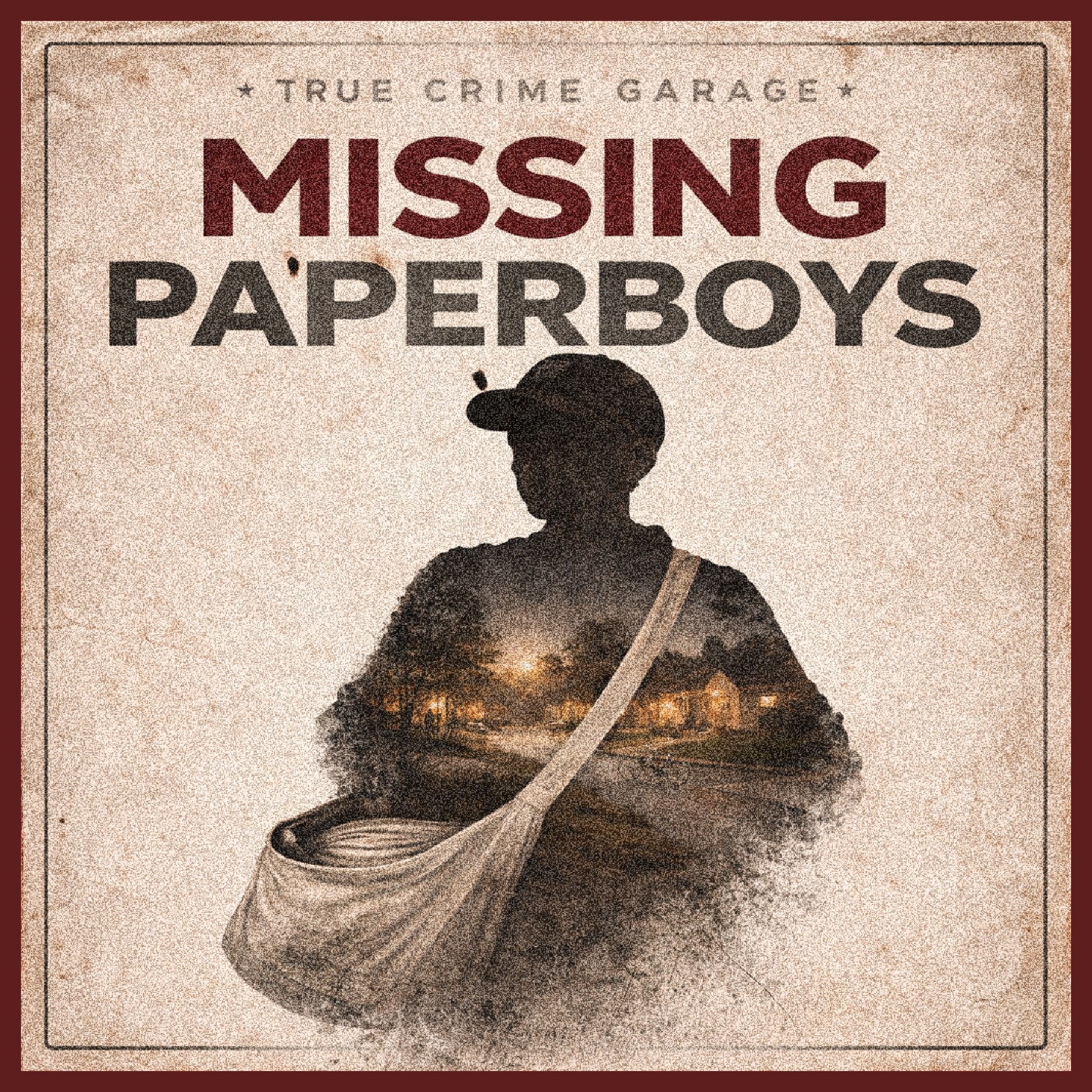
True Crime Garage
Missing Paperboys /// Chapter 1 /// Johnny Gosch
01:05:08
In the early eighties middle America experienced tragedies that no parent could imagine, until it happened for the first time. Newspaper boys were disappearing. They would step out into the dark of the early morning hours to deliver the daily news to their neighborhoods and some of them did not return. It started in Iowa and then moved to Nebraska. Kids were plucked off the street just a few steps into their routes and some have vanished forever. The first boy gone was Johnny Gosch.
Loading summary
Transcript118 lines
- [00:00]
Apple Card Announcer
This message is brought to you by Apple Card. Apple Card members can earn unlimited daily cash back on everyday purchases wherever they shop. This means you could be earning daily cash on just about anything, like a slice of pizza from your local pizza place or a latte from the corner coffee shop. Apply for Apple Card in the Wallet app to see your credit limit offer in minutes subject to credit approval. Apple Card issued by Goldman Sachs Bank USA, Salt Lake City branch terms and
- [00:26]
Host 1 (Possibly Nick)
more@applecard.com Picture this It's the end of a long week. You're unwinding in the tub, listening to your favorite true crime podcast and then Chronic Hives come back again in the middle of the episode. What a wet blanket looks like another spell of itchy, swollen, red or skin colored hives. If you have chronic spontaneous Urticaria or csu, there may be a different treatment option. Worried about your chronic hives interrupting our next episode? Learn more@treatmyhives.com Garage.
- [01:27]
Host 2 (Possibly Captain)
Sa. Sam.
- [02:31]
Narrator
In the early 80s, Middle America experienced tragedies that no parent could imagine until it happened.
- [02:37]
Host 1 (Possibly Nick)
For the first time, newspaper boys were
- [02:40]
Narrator
disappearing from the streets. They would step out into the dark of the early morning hours to deliver the daily news to their neighborhoods and some of them did not return. It started in Iowa and then it moved to Nebraska. Kids were plucked off the street just a few steps into their routes and some have vanished forever. The first boy gone was in West Des Moines, Iowa. The papers he carried read Des Moines Sunday Register. The newspaper Iowa depends upon September 5, 1982. $1 for a single copy, $0.85 by motor route and $0.80 by carrier. The top story headline read Good News of Iowa. Humanity emerged in Tragedies of Summer. The day's weather forecasted on the front page. Partly Cloudy with a 30% chance of showers and thunderstorms in the afternoon, highs
- [03:49]
Host 1 (Possibly Nick)
80 to 85 degrees.
- [03:51]
Narrator
But none of that mattered because the boy was gone before sunrise. Vanished. This is True Crime Garage and this is our look at the missing Paper Boys. Chapter one Johnny Gosh,
- [04:38]
Host 1 (Possibly Nick)
We are going back in time to the 18th of September 1983. This is Bellevue, Nebraska. Bellevue, Nebraska is just outside of and just south of Omaha, Nebraska, which is right on the state line of Nebraska and Iowa. September 18, 1983 was in fact a Sunday. Please note that all three the location, the month and the day of the week, and more importantly the fourth item here, Captain, the scenario regarding this story are all very key ingredients to the emergency response, response and law enforcement officers responding to this call for help that caused them to have great concern. And they all agree this is very, very strange. Very, very scary stuff right off the rip. So this is from Peter Klismit's book. Now we've recommended his book before in our recommended segment here in the garage. The book title is FBI Diary Profiles and Evil. And this portion of his book reads. 13 year old Danny Joe Eberly got up early, as he always did, and headed down to a nearby convenience store to pick up his supply of 70 Sunday newspapers to go out and deliver them. He rolled the papers, put the entire load in the delivery bag on his bicycle and took off on his route. But he only made it three stops on this route. When some people on the route didn't get their newspapers at the usual time, they were on the phone to Danny's parents, calling his home phone number. Puzzled by the number of phone calls, his parents headed out on the route, eventually finding Danny's bike inside the gate of a fence around a dentist's home. Folded newspapers were inside the delivery bag, but Danny Joe was nowhere to be found. There were no signs of a struggle. His parents drove around to see if they could find him but could not and immediately afterward called the Bellevue Police Department. Police began searching for the boy right away, systematically talking to people in the area. But no one had seen anything, including Danny Joe himself. The search continued for the entire day with officers checking every building in the area and searching around houses. More neighbors were interviewed, but no one had seen Danny Joe with anyone. He had simply vanished. And as Peter Klismet writes, much like Johnny Gosch did a year before. And the parallels, he says, were eerily similar. No clues were found, despite a search by over a hundred townspeople and officers. The day became evening and when darkness fell, the search was put on hold and began first thing the next morning. Yet again, the search teams fanned out with guidance and organization from law enforcement. The sheriff's department was involved and the Bellevue police chief contacted the local FBI office in Omaha, Nebraska. Agents were immediately assigned to help with the search and investigation into the boy's disappearance. There were no indications of problems at home that could have made him decide to run away. To the contrary, he was conscientious about getting up, delivering his papers and getting himself to school every morning. There were no problems at school. No one could understand how he could mysteriously disappear. So where this call goes here, Captain, we have. FBI is going to get involved very quickly in the disappearance of Danny Joe Eberly from Bellevue, Nebraska. Newspaper boy out on his route doesn't come home. It appears he made it to three of the stops, delivering three newspapers and then something must have occurred after that third delivery and now the boy is gone. The FBI, we have special Agent in charge Herb Hawkins at the local field office here. And we have assistant Special Agent in Charge John Evans from the Omaha, Nebraska field office. So they are coordinating with the Bellevue Police Department and the Sarpy County Sheriff's Office. Herb Hawkins and John Evans get a local agent, Peter Klisman Jr. Who we've already mentioned his name a couple times. I believe he is out of neighboring state Iowa at this time. They get him involved and they also make a call to Quantico to bring in one of the big guns, one of the original mindhunters, Robert Ressler. On these initial phone calls, all of the agents discussed, could this be a link? Could this be a continuation of the case that made national headlines just 130 miles to the east and almost exactly one year prior, about another missing paper boy, 12 year old Johnny Gosh.
- [10:02]
Host 2 (Possibly Captain)
When I think this hit home to a lot of people because at that time your paper boy delivering your daily paper is a part of your daily life. So this affected a lot of individuals.
- [10:16]
Host 1 (Possibly Nick)
For many, it's the start of each day, the start of that daily life.
- [10:21]
Host 2 (Possibly Captain)
Absolutely.
- [10:22]
Host 1 (Possibly Nick)
To have something go so wrong so quickly in the day is jarring. And then we know as this story stands today, very, very haunting, very mysterious. So let's circle back here and get into the details because I know we've talked about it many times here in the garage, but everybody listening today may not be fully up to speed on the Johnny Gosh portion of this story. And again, the FBI agents that get involved in this missing paperboy case, immediately they have to be thinking about Johnny Gosh again. It's just 130 miles away. It took place about one year prior to. In today's trailer we talked about the newspaper headline and details that were on the front page of the Des Moines Register newspaper, the very papers that Johnny Gosh was out delivering on the day he went missing. Right now the next day the headline was Police Hunt Missing West Des Moines Boy with an article featuring a school picture of the missing youngster, Johnny Gosh. And this true crime story breaks down as such. Before dawn on September 5, 1982, the quiet routines of a West Des Moines, Iowa neighborhood were already stirring. Johnny Gosh, a 12 year old Des Moines Register paper boy born November 12, 1969, got up early to begin his Sunday morning routine, which was delivering the Sunday morning paper, going on his paper route in the Gosh home. This was usually a familiar ritual. Johnny often would get his father up, wake him up. John Gosh is his father, so the two of them could go on the route together. But on September 5, 1982, Johnny went out alone. He wasn't entirely by himself though. That morning he took the family's dog. This is a small miniature dachshund. Dog's name is Gretchen. So Gretchen goes with him as he headed out into the pre dawn darkness of West Des Moines.
- [12:40]
Host 2 (Possibly Captain)
Well, let me just for people that are not familiar with paper boys, because in the 70s, 80s, 90s, it was commonplace. So you'd have a kid that was local to the route. The route would be normally a couple blocks a section of housing close to that individual's location or close to their house. The papers would be delivered in a stack. The newspaper boy would then wake up. Normally before school, they would get the papers, they would roll them or bag them, and then they would head out and deliver them. Now, most of the time, the paper boys were, I would say, early teenagers to high school students.
- [13:25]
Host 1 (Possibly Nick)
Well, see, that's interesting that you say that because that was our experience. We delivered newspapers in the 90s, and I think that these stories are why in the 90s that the paper boys were a little older than they were in the 80s.
- [13:42]
Host 2 (Possibly Captain)
Right.
- [13:42]
Host 1 (Possibly Nick)
And as you said, that paper route, very important for folks to know that was either very near the delivery boys home or the delivery boys home was part of that route. And Sunday is always your biggest delivery day. I recall my route damn near every house on the route received a Sunday paper. It was about half or maybe a third received the paper daily.
- [14:10]
Host 2 (Possibly Captain)
Yeah. And with the Sunday papers, they normally had ads, so there'd be heavier papers. But a typical day they'd wake up, collect the papers that were delivered to them. They'd have to roll them or bag them and then they deliver them. Now, they might deliver them by themselves or they might have a parent that helps them. And sometimes that would depend on the weather.
- [14:31]
Host 1 (Possibly Nick)
Exactly. And note that in both of these cases that we've mentioned here with these two paper boys, this is both occurring on a Sunday. So the busy day for these delivery boys and the day that the paper boys would be out the longest amount of time on their route as well.
- [14:51]
Host 2 (Possibly Captain)
Right. And so if they're delivering the papers by themselves, they become very vulnerable.
- [14:55]
Host 1 (Possibly Nick)
This next part, I want to be clear here. Some descriptions say white sweatshirt. The majority of them say white T shirt. This is a description of what Johnny Gosh was wearing when he set out that day to deliver the papers. Now, Johnny Gosh is on foot where Danny Jo Eberly was on his bicycle.
- [15:19]
Host 2 (Possibly Captain)
Right.
- [15:19]
Host 1 (Possibly Nick)
Johnny wore clothes described in later summaries as a white T shirt or white sweatshirt with Kim's Academy on the back. He was also wearing warm up pants and blue rubber flip flops. And he carried the standard yellow newspaper delivery bag used by the local carriers. And if you go back on message boards or go through comments, people that lived in the area that have continued to follow the Johnny Gosh case, they say that there's a picture of a delivery bag and everybody's comments are the same. All of the kids, all the delivery boys wore those same delivery bags. They were used to seeing that color, that delivery bag. His route began near the area later associated with what would be suspected as the abduction site or near the abduction site. So this is around 42nd street in Marcourt Lane in West Des Moines. Like other carriers, Johnny first needed to collect his newspapers. So there's a drop off spot. Other Des Moines registered paper carriers would later say that they saw him at the paper drop off picking up his papers.
- [16:30]
Host 2 (Possibly Captain)
Right.
- [16:31]
Host 1 (Possibly Nick)
Those sightings are corroborated by multiple witnesses. These became the last widely verified moments of Johnny Gosh's mourning. Not long after, something happened that several people would remember in fragments and uneasy impressions. Another paper boy, he's much later identified by the single name of Mike. I don't know if that's his real name or if that's how they chose to identify him early on in this case, Captain, the. A lot of the paper boys that had comments or said that they may have seen something were not identified to the public by name.
- [17:11]
Host 2 (Possibly Captain)
Yeah, because law enforcement was afraid that they would be targeted.
- [17:14]
Host 1 (Possibly Nick)
Exactly. This paper boy named Mike later reported that he saw Johnny talking with a stocky man who was near a blue two tone car. Now, a second witness, his name, John Rossi, also saw a man in a blue car speaking with Johnny and felt that something about it didn't sit right. Rossi recalled that Johnny told him the man was asking for directions, and Johnny asked Rossi to help. Rossi tried to do what he could in the moment. He looked at the license plate, but when the situation passed, he found that he could not recall the plate number. Later, he would describe the frustration of that gap, how he kept hoping the numbers would suddenly return to him. He says, quote, as distinctly as night and day, end quote. But they never did.
- [18:09]
Host 2 (Possibly Captain)
Right.
- [18:09]
Host 1 (Possibly Nick)
Rossi eventually underwent hypnosis and reported some plate details to police, including that the plate he believed was to be an Iowa license plate from Warren County. So as Johnny moved on, walking roughly one block north toward where his route began, another paperboy noticed something else. Johnny appeared to be followed by another man. Around that same time, a neighbor later described hearing a door slam, seeing a silver Ford Fairmont speed away northward from the area where Johnny's wagon would later be found. So that wagon is what he used to carry the papers. And as said, this would be his big day. He's got his. He's got his bag over his shoulders and he's got his wagon that he's pulling behind him. That wagon, Johnny Gosh's wagon would become one of the most haunting physical anchors in, in this case.
- [19:12]
Host 2 (Possibly Captain)
And we know because we were both paperboys, but I didn't remember, or I don't remember seeing other paper boys out when I was delivering. Sometimes one of the people on your routes might open up the door as you're going to deliver the paper on their porch. But you also didn't really see cars on the road because you're delivering the papers before work and before school.
- [19:38]
Host 1 (Possibly Nick)
Yeah, you would often during the week would. It would be a little more typical that you might see somebody out or somebody in their front yard or going out to their vehicle. But you're absolutely right 95% of the time. First off, circle back to something else. You said, I never saw another delivery boy. And we did this, you know, we had a route for years. I do recall almost every day seeing the drop off the person that would drop off the bundles of newspapers because you would wait for them to arrive so you could start. You couldn't start until you received that bundle. So that person, that vehicle you would typically see. I would anyway. Every single day.
- [20:22]
Host 2 (Possibly Captain)
Yeah.
- [20:23]
Host 1 (Possibly Nick)
And at most during the week, most days, the only thing I would encounter would be a, A dog that would decide to chase you temporarily or, or, or again, maybe somebody walking out to get in their vehicle to go into work early. So it's usually kind of the, the dead of the morning, for lack of a better term here. His route is interesting, and I'm guessing it's a much heavily. More heavily populated area. You have paper carriers meeting in a central location that morning to receive their paper bundles. And they're, they're all kind of in the same space before they part ways and go to start their routes. That would seemingly be helpful in the Johnny Gosh case, that we have some of these eyewitnesses and then potential ear witness. But I will say this, Captain, that, yeah, the timeline of events and witness reports of that morning, they seem a little scattered. Some of them overlap, and some of them are not quite clear on the order of what took place that morning.
- [21:41]
Host 2 (Possibly Captain)
Well, eyewitnesses normally have the best intentions, but if you ask me what I ate for breakfast yesterday, I couldn't tell you. One of the things that I think helps law enforcement in these cases is we should have an idea of when the papers were dropped off to the paper boy for him to then either wrap the papers or roll the papers up. And so at least we have a starting point in these timelines.
- [22:08]
Host 1 (Possibly Nick)
Yes, we have a generalization of some of these times. And then the car information is helpful. It doesn't seem to produce any leads, But I think it helps when talking about theories and speculation in the Johnny Gosh case. So just like in the Danny Joe Eberly case that we referenced earlier, as the morning continues, Johnny's parents, the Goshes, they begin receiving phone calls from customers along Johnny's route. People are complaining that their newspapers had not been delivered. And this is what's going to kick things into action. Johnny's father went out for a quick search of the surrounding neighborhood. So the route is nearby. The streets are familiar to the father, obviously, and yet within minutes, he found something that made the situation unmistakably wrong. Two blocks from their home, John Gosch found Johnny's little red wagon sitting abandoned. It's was not empty. It's still full of newspapers.
- [23:12]
Host 2 (Possibly Captain)
Not a good sign.
- [23:13]
Host 1 (Possibly Nick)
The Des Moines Sunday register that had never made it to the porches that Johnny was to deliver them to. So this finding here, captain, tells a simple story with terrible implications that Johnny had made it out there, started his route, and something caused him to quit mid route after finishing just a couple of deliveries. He had been interrupted by something, but almost, I want to point out, almost immediately once he starts his route. I think that could be key here in this disappearance case.
- [23:51]
Host 2 (Possibly Captain)
Yeah, I think it shortens the time frame. And then obviously that'd be my luck. Go out to get the paper. It's not there. I call to complain, make an ass of myself, Just to find out that my paper boy has gone missing.
- [24:07]
Host 1 (Possibly Nick)
Johnny's parents, John and Noreen Gosh, they contacted the west Des Moines police department and reported their son missing. In later public statements, his mother, Noreen, would be sharply critical of what she saw as a slow initial response time by police. She described a policy at the time that a child could not be classified as a missing person until 72 hours had passed. And by her account, police did not arrive to take their report for 45 minutes, a stretch of time that in the. A case like this is going to feel like a lifetime to those involved. Now, early on, we have, we have like, police assumptions that seem very shifty in the Johnny Gosh case. You review some articles and it, it sounds like he was initially viewed as a possible runaway. Other articles where police or law enforcement members are saying that, oh, no, we, we don't believe that he's a runaway. He, it's simply a missing persons case.
- [25:20]
Host 2 (Possibly Captain)
Right.
- [25:20]
Host 1 (Possibly Nick)
Others saying we have to wonder if he's been abducted or it could be a kidnapping, but it's just a missing person's case. So it's really all over the map as to what they thought took place right out the gate.
- [25:33]
Host 2 (Possibly Captain)
Well, my problem with this is, to me, this is stupidity. Because if we have a missing child that didn't collect the papers, like I said, to roll them or bag them, no effort to deliver the papers, then I think you could say, hey, maybe he ran away. But when you have a wagon full of papers and no sign of this paper boy, it makes zero sense. Oh, I, I delivered three papers and then I decided I'm going to run away. It's stupidity, in my opinion.
- [26:04]
Host 1 (Possibly Nick)
Well, and given his age, you know, boys will be boys. And I think that there was some thought by some, not many, that this could just simply be a prank that Johnny was pulling on people. But very quickly, I believe this is the next day or within 48 hours, the district circulation manager, his name is Lou Cook, he said, and this is something that Johnny's friends had said as well, like, we don't think he would have pulled a prank because if he did, it wouldn't involve the newspaper or his paper route. And okay, so that's kids saying that. But Lou Cook, the circulation manager, had this to say. He says this disappearance didn't fit the image of Johnny Gosh. Of the kid that he knew. He said Johnny didn't seem to him to be the type of kid that would just wander off. He says Johnny had, quote, never before not delivered his route, end quote. And Cook goes on to say he was responsible with a strong service record. And this is something that the carriers pointed out as well as the manager, that if carriers missed a delivery, if there was a paper that was not delivered on a Sunday, the carriers themselves were charged 75 cents per paper that was not delivered. Meaning Johnny, gosh, if he were to pull a prank, it would have cost him $27.75.
- [27:36]
Narrator
Right.
- [27:37]
Host 1 (Possibly Nick)
And as logic went, no one thought a prank would be worth that to a boy 12 years old who is known to be responsible and hardworking.
- [28:01]
Host 2 (Possibly Captain)
Foreign.
- [28:06]
Host 1 (Possibly Nick)
This is the time when kids benefit from reviewing key concepts and strengthening skills before assessments. IXL helps reinforce what they're learning right now so they feel ready and capable. IXL is an award winning online learning platform for Pre K through 12th grade with personalized interactive lessons in math, reading, writing and science that adapt to each child's level and pace. Proven in all 50 states to improve grades, students who use IXL score higher on test. IXL is used in 96 of the top 100 school districts in the U.S. i have friends, I have family who use and love ixl. Why? Because they see the positive impact that it is making on their children's learning experience, their education. It's about catching up for some kids. It's about getting ahead for other kids. I get it. It's difficult as parents to strengthen the areas that challenge our children and that's what IXL can do for you. It gets you organized and it gets you progress for your children and their learning experience. Make an impact on your child's learning. Get IXL now and True Crime Garage listeners can get an exclusive 20% off IXL membership when they sign up today at ixl.com garage. Visit ixl.com garage to get the most effective learning program out there at the best price.
- [29:49]
Greenlight Sponsor Announcer
This message is sponsored by Greenlight. Every true crime story has money somewhere in the mix. Financial stress pushes people to desperate decisions and a lack of financial literacy is what makes people easy targets. Teaching our kids about money isn't just smart parenting, it's protection. Green Light helps keep your family's financial and personal safety from becoming another cautionary tale. Greenlight is a debit card and app for families, but it's more than a money tool. It's a safety net for teaching kids about money while also helping protect them before bad habits, bad actors or real
- [30:28]
Host 2 (Possibly Captain)
world risk take hold.
- [30:29]
Greenlight Sponsor Announcer
I wish Greenlight was around. When I was a kid I had a paper route. I get paid every month, but I just give the money to my father and he'd have to make all the deposits. I bet my father would have loved if we had this app because I was probably asking him all the time, what's my balance? With the Greenlight app I could have checked my balance.
- [30:49]
Host 2 (Possibly Captain)
This is also a great tool.
- [30:50]
Greenlight Sponsor Announcer
If you have nieces and nephews or friends and family that just come over, they do some chores, you can pay them directly. My nieces and nephews love this because when they do the work they see in their account the payoff. It's teaching them how to save and be smart with their financial decisions. Every day they're handling money without guidance is a missed opportunity. Start your risk free Greenlight trial today@greenlight.com garage. Don't wait to teach your kids real world money skills. That's greenlight.comgarage to get started greenlight.comgarage Spring
- [31:26]
Host 1 (Possibly Nick)
is the season for closet cleanouts. In fact, I just cleaned out mine. It's the perfect time to narrow down your wardrobe to pieces that are well made and easy to wear all the time. That's where Quince comes in. With Quint you get fabrics that feel elevated, fits that are well thought out and pricing that actually makes sense. Quince works directly with ethical factories and cuts out the middlemen so you're paying for quality not brand markup. Everything is designed to last and make getting dressed easy. I love Quince. My Quince items stay in my closet. They don't get cleaned out because I love them and they are made to last. I've purchased shirts, long sleeve, short sleeve tees, pants, jeans. I love their socks and oh I am up to my third pair of sunglasses from Quints. I got a regular rotation of sunglasses going on and their shipping is fantastic. It arrives as said when said and I get regular updates on where my pieces are and when they are going to get to me. When it comes to clothing, Quince hits it out of the park. Comfort check, fit check, quality check. They nail it all the time. Refresh your wardrobe with Quince. Go to Quince.com Garage for free shipping and 365 day returns. Now available in Canada too. Go to Quinc.com Garage for free shipping and 360 five day returns. Quint.com Garage Mint Mobile Baby Are you tired of spending hundreds on crazy high wireless bills, bogus fees and free perks that cost you more in the long run then a premium wireless plan from mint mobile for 15 bucks a month might be right for you. Bring your own phone and number, activate with ESIM in minutes and start saving immediately. No long term contracts. No hassle. I love Mint Mobile. I've been using it saving money. My family have been saving money as well because everybody I talked to they were paying more than 15 bucks a month for their wireless service. And guess what? Make the switch, you get the same great service that you currently have. I would argue in cases it has been even better. If you like your money, Mint Mobile is for you. Shop plans@mintmobile.com TCG that's mintmobile.com TCG Upfront payment of $45 or 3 month 5 gigabyte plan required equivalent to $15 per month. New customer offer for first 3 months only. Then full price plan options available, taxes and fees extra. See Mint Mobile for details.
- [34:58]
Host 2 (Possibly Captain)
All right, we are back. Cheers, mates. Tall cans in the air. Make sure you tip your newspaper boy.
- [35:05]
Host 1 (Possibly Nick)
That's right. Don't know that they exist anymore.
- [35:09]
Host 2 (Possibly Captain)
Simpler times, my friends. Friend?
- [35:11]
Host 1 (Possibly Nick)
Yeah, we. You want to watch something interesting, talk to the young person working the customer service desk and ask them, do you sell newspapers? And then just see how that plays out. So let's get into this timeline the best we can. So the Des Moines Register, the same paper that our missing boy was delivering, would later document the first frantic hours and type that captured both urgency and uncertainty regarding the missing boy. The paper described how another carrier reported seeing Johnny talking with a man along the route and how authorities were reluctant to call it a kidnapping right away, publicly labeling it, at least initially, as a missing person incident, while not ruling out abduction. A police artist created a drawing of a, quote, mystery man. But authorities declined to release it at the time, citing uncertainty about whether it would was even an accurate likeness of the mystery man. The description in early reporting centered around a man wearing a baseball cap and driving a dark blue car who had asked for directions to 86th street and Hickman Road. That same man had reportedly asked two boys separately for directions to that same location in the same reporting. The timeline tightened around the moment that Johnny Gosh's family finally realized that Johnny was missing. One of Johnny's 37 customers called the Gosh home at 7:45am to ask why the Sunday paper hadn't arrived. Again, this was a customer who was saying that he received his paper daily, on time, every day. So this was out of the ordinary. And this person is on record saying that Johnny was. This was unusual for Johnny, who was reliable and prompt with his paper delivery. So, dad, John Gosh checked Johnny's room first, finding the bed empty. Then this is crazy, too. The dog by this point had returned home. Remember, the dog went out with Johnny that morning.
- [37:38]
Host 2 (Possibly Captain)
And just so I'm clear, we have eyewitnesses that have this guy wearing a baseball cap and a car asking for directions, asking directions from. From multiple paper boys. And then there's another individual. But do we think that there's two individuals or is it possible that that's
- [37:57]
Host 1 (Possibly Nick)
what gets so confusing about this? The details around the. When I look at this case, I think we're talking about a window of approximately 30 minutes or so between the time that Johnny arrives to the paper drop off, rolls up the papers, he's got his wagon ready to go, he's, he's got his bag ready to go and he sets off on his route. And we know that he only makes it two blocks from his home where the wagon is eventually found. But through throughout all of these witness statements and some of these, let's keep in mind, will be secondhand. They'll be told secondhand to Gosh's family. And this is information that they will then put into the public atmosphere.
- [38:46]
Host 2 (Possibly Captain)
Right.
- [38:46]
Host 1 (Possibly Nick)
This is also information that comes from other sources that say they were told by paper carriers that morning that they saw this or they saw that or a neighbor saw this or heard that. What you ultimately end up with here, Captain, is potentially three individuals that are of question and two vehicles. What, so you have a driver in one vehicle, a driver in another vehicle and then an individual that's on foot, making it that more difficult to understand and explain the situation.
- [39:17]
Host 2 (Possibly Captain)
Right. And again, law enforcement doesn't know which individual these eyewitnesses are talking about. So I think it would be difficult to come up with a composite sketch that you feel confident in.
- [39:29]
Host 1 (Possibly Nick)
Yes. And they will eventually release a sketch to the public and we will go through that information as well. Now, we should note here that if this timeline is accurate to the minute mark, I think it's a very accurate timeline. I just wouldn't nail it down to a specific minute here, but roughly the family saying 7:45 is when they're notified that papers weren't delivered. John Gosh, Johnny's father, finds the wagon. And during the time while police were contacted to come out to the area, John Gosh delivered the undelivered newspapers himself. So if the timeline is correct, this would put the police there taking the report by 8:30am that morning. Now keep in mind, it's reported that Johnny Gosh would have left his home just prior to 6:00am that morning. So we have a good deal of time and if it was about a 30 minute window, we have, as I suspect, roughly two hours before the police are there and on the scene.
- [40:36]
Host 2 (Possibly Captain)
Well, I think what makes this more complicated is like I said, there's not a lot of individuals out. So did these eyewitnesses see somebody that's involved in this kidnapping or did they see somebody out for a morning walk or a jog? And then if you're pleased, you go, well, we have eyewitnesses saying that there's an individual asking for directions. Is he a part of it or is there somebody on his route? Because you might only have, let's say, 32, 100 and some customers, but you might have a route that consists of 200 houses.
- [41:16]
Host 1 (Possibly Nick)
Yeah. And throughout this day, this Sunday in September, there the search will widen. So eventually we will have involved here the West Des Moines police Department, the Polk County Sheriff's Department, the Iowa Highway Patrol, and it will go so far as to include off duty and reserve officers as well. And of course, we have family, friends and neighbors that will get involved in actively searching the neighborhood and beyond. On the Saturday, the day search ran into rain in the afternoon, Complicating the situation. We have volunteers that are soaked. You know, you're out there in the rain, you're looking for a missing boy. And it's the. As the minutes turn into hours and the hours go by, you're just building up with a deepening sense of dread. We thought we would find this kid. Maybe we're not going to. And this search continues with a lot of folks involved until dark that Sunday night.
- [42:18]
Host 2 (Possibly Captain)
Yeah, I think the thing that's scary for law enforcement and for the community is if there's more than one individual involved, then what are we dealing with by Monday?
- [42:31]
Host 1 (Possibly Nick)
So now, day two of the search for 12 year old Johnny. Gosh, we get thousands of volunteers, but zero answers. So this is Labor Day. Monday, September 6, 1982. When the search intensified, more than 1,000 volunteers combed woods, parks, fields and ditches around West Des Moines. Search lines formed with people spaced out about five feet apart, moving through wet grass and brush looking for anything, a newspaper bag, the shoes or flip flops, clothing, any trace that could say where Johnny Gosch had gone. Others drove slowly along rural roads in Polk county and Dallas counties, scanning ditches and roadside edges. Still more volunteers cruised nearby highways. At South woods park, searchers moved through gnats and mosquitoes, having to deal with that. And at one point there were some items that prompted calls to authorities. One was a Kleenex and the other was a set of footprints. But these findings, while they, you know, increase the level of uncertainty, they. These seem to not produce any leads. And neither of these have ever been described as evidence, just possible, just things that were found during the search. So.
- [44:01]
Host 2 (Possibly Captain)
Right.
- [44:01]
Host 1 (Possibly Nick)
Unfortunately, we're left with authorities having found no clues. And then once again, on day two, the search is called off at dark. This circles back to some of the statements by witnesses or potential witnesses, as well as what law enforcement Is describing the case. So officials publicly, you know, on the record, they describe the case in careful terms. Let's. Let's say that careful terms I think is accurate. They said that there's no clear indications of a kidnapping. So no evidence. No, no actual evidence that there was a kidnapping. They're also saying there's no evidence or great reason to suspect that Johnny had run away. Right now, they did what they were clear on here, captain, is they are looking for the vehicles and the people seen near the time Johnny vanished. All right, so the dark blue car connected to the man asking for directions and also a silver late model Ford Fairmont described as having a wide black stripe on it. Police said they wanted to speak to the drivers because they might have witnessed something, Even stating publicly that they were not necessarily treating them as suspect vehicles, simply witness vehicles. As the official investigation continued, anxiety spread through the community's families. Parents of other paper carriers talked about their children no longer going out alone on their routes. District circulation managers called carriers and their parents calling the carrier's parents with warnings saying, you know, you got to be cautious. Do not get into any cars. If something feels strange, go to a customer's door and knock on the door and tell the customer to notify the authorities. So this disappearance very quickly changed the emotional map of a place that had assumed that those early morning hours were safe.
- [46:14]
Host 2 (Possibly Captain)
Well, we have evidence of that. We have a driver asking kids for directions and multiple kids trying to give that individual directions.
- [46:23]
Host 1 (Possibly Nick)
Yeah, well, let's get. Let's get into that description there. And I think after all this time, we got to say suspect description here, Right?
- [46:33]
Host 2 (Possibly Captain)
Well, I was going to say it's laughable when they.
- [46:36]
Greenlight Sponsor Announcer
It's like the deli case.
- [46:37]
Host 2 (Possibly Captain)
Well, we're not saying the guy on the bridge is a suspect, but we'd love to talk to him. And that's what we hear in all these cases.
- [46:44]
Host 1 (Possibly Nick)
Like, that's true. But within the first 48, 72, and even, I would say even, you know, the first 48 to 72 hours, even the first week, there is some strategy involved in that statement because what you're hoping. And it wouldn't be the first time. It's rare, but it wouldn't be the first time that you publicly announce, hey, a person that looks like this or a vehicle that looks like that was seen in the area at the time in question, we want to know what that person may have seen or heard, if they have further information that might help us find this person or find the offender. And in some cases, the actual offender will come forward with the belief that they can get in front of it.
- [47:30]
Host 2 (Possibly Captain)
Right.
- [47:31]
Host 1 (Possibly Nick)
And give you some kind of story. And, and, and, and also it may, it may put a little paranoia on that individual thinking, oh, I was seen there. It's only a matter of time before they figure out it was me. I better get there and tell them why I was there and what, you know, make up some, something that I saw or I was there, but I didn't see anything. And in fact, we know that in the Delphi case, Richard Allen, who would later be convicted of those murders, did come forward and talk to somebody saying that he was there that day but didn't see really anything going on.
- [48:10]
Host 2 (Possibly Captain)
Right.
- [48:11]
Host 1 (Possibly Nick)
This portion though, also. Don't let it be lost on you, garage friends. Read between the lines. There's, there's a bit of a theory of coordination here in this abduction. Right. So over time, the case developed additional public details, including a composite sketch that we've discussed briefly, a suspect description later released to the public. The suspect was described as a man around 5 foot 9 inches tall, approximately 175 pounds, with dark eyes, black eyebrows, black hair combed back, a black mustache, appearing to be in his mid-40s, with a heavy beard or unshaven appearance. Okay, now keep in mind it's still not light out when this witness sees this and is giving this description later and is giving this description of saying I saw this person at a distance, right? So where the heavy beard to unshaven appearance sounds strange to me. I don't think they were able to fully articulate 100% what they remember seeing as far as when, when they. Was it a beard or was he just looked like he didn't shave for a couple days. Many of the descriptions also include this saying that it possibly of Latin appearance. The vehicle often associated with this individual is described as a two tone blue mid sized car, potentially a 1979-81 model that is described as clean on the outside, possibly clean interior, and an Iowa license plate. Here's where things get a little twisted. And it might be twisted for a good reason and in the right direction. It's hard to say when we sit here all these years later with so many questions. Hard to say. Noreen Gosh, Johnny's mother, later would publicly describe what she said. Witnesses tell her that they saw the paper drop off.
- [50:19]
Host 2 (Possibly Captain)
Right.
- [50:19]
Host 1 (Possibly Nick)
She says that a driver pulls up, shuts off his engine. So keep in mind there would be multiple paper carriers here. From all the descriptions I've read, it sounds like there Were about three boys here, maybe two at this spot. But as she tells it, the driver pulls up, shuts off the engine to the vehicle, opens up the passenger door and started having a conversation, asking for directions. And her retelling, she says that Johnny turned to one of the other carriers, another boy, and said that he was afraid. He said that he was done loading his papers and he was going to get out of there and he might even head back home. So Johnny leaves, as Noreen said. She says that about the same time the driver pulled out, too, but not before a detail that she says stuck in her mind as extremely significant. She says that the driver, before pulling off, before driving off, he flicked the dome light three times before driving away. So you can usually typically reach up and you could. There's a switch where you could set the dome light to be on, off, or when the car door opens, right. Trigger it to turn on. And she is saying that one of the witnesses has told her that the man reached up and using the switch, flicked the dome light to the vehicle on and off three times.
- [51:52]
Host 2 (Possibly Captain)
But what does that mean?
- [51:54]
Host 1 (Possibly Nick)
It's hard to say. And again, if. If you want to look at this and read between the lines of a possible coordinated abduction, this obviously would be some kind of signal or trigger to somebody, right?
- [52:08]
Host 2 (Possibly Captain)
Or is it possible that, like you said, there's multiple settings, and if they turned on their light for some reason, and then they scroll back, or not scroll back, but they flip back to make it only open when the door, does it flicker in between?
- [52:26]
Host 1 (Possibly Nick)
Well, and yeah, the other thing, too, is oftentimes, leave it to me to
- [52:32]
Host 2 (Possibly Captain)
get hung up on something that might not be much of a big deal at all.
- [52:36]
Host 1 (Possibly Nick)
No, no, no, I think it's fair. I think where someone could point to that and say, well, this man clearly was signaling somebody. And when given Noreen's description, it absolutely sounds that way. And she could be absolutely right. I want to be clear about that. But I cannot tell you how many times I've reached up to turn that dome light on and I turn it off, you know, or I go to. I go to turn it on and I turn it to the open setting where the car door would trigger it. Or I go to turn it off and I turn it the. To open and the back on. You know, you can't. The thing is, when that light is not on and the. You don't really know the switch is little. Especially in those old cars that. That age of vehicle, 79 to 81 model, it would be common for somebody to turn the switch multiple times before getting it to the actual setting that they want.
- [53:30]
Host 2 (Possibly Captain)
But also, sometimes the switch isn't not on the light.
- [53:33]
Host 1 (Possibly Nick)
It's near the wheel somewhere. The. Yeah, the other thing. Let's throw another wrench. In this whole portion of the story, some of the witness descriptions of this man. Remember, he's asking for directions, and he asked more than one individual for directions. So some of these descriptions, not all say that the man was. His speech was slurred. So there are some police officers that believe that this guy was just a drunk driver that was probably actually lost in looking for some direction to get where he needed to go.
- [54:11]
Host 2 (Possibly Captain)
Yeah, that makes sense.
- [54:13]
Host 1 (Possibly Nick)
It does make some sense. But then when you want to, the flip side of that coin is the officers. The officers that are suspicious of this vehicle because, well, we gave out the description of the vehicle and the man, and he never came forward to talk to us, to tell us if he saw anything. So it's. This is a very difficult case, obviously.
- [54:33]
Host 2 (Possibly Captain)
Yeah. But hold on a second. If he was drunk driving, he might not come forward for that reason.
- [54:38]
Host 1 (Possibly Nick)
True. But I would hope that in a situation this severe that you would be like, you'd be willing to go, we appreciate you coming forward.
- [54:47]
Host 2 (Possibly Captain)
Right.
- [54:47]
Host 1 (Possibly Nick)
Do not drink and drive anymore. It would be. I think it would be a little despicable if they're like, all right, well, you just confess to. He also doesn't have to confess to drinking and driving to come forward. Right. I was out driving that night. Oh, that kid said I slurred my speech. Was that kid now? Yeah, he didn't have to include that part if it was part of it. Okay. So like we said, this detail with many others in the Johnny Gosh case can be argued and theorized a number of different ways. And of course, Noreen has said publicly for a long time she believes her view of this is that this was some kind of signal. The dome light action was a signal to someone watching nearby, Someone who then later grabbed Johnny because we know he walked away from this location unharmed, alive and well. Now, she also described that one paper boy reportedly saw a tall man step out from between two houses and then follow behind Johnny. Now, police at the time described in one account, this is by West Des Moines police Lieutenant Miller. So he. He's actually a rookie at this time, but later he's. He's on record regurgitating this portion of the story once he reaches lieutenant years later.
- [56:16]
Host 2 (Possibly Captain)
Right.
- [56:17]
Host 1 (Possibly Nick)
He's saying, you know, we called in for additional help. We did canvassing. We Went door to door. We went searching for witnesses, and he said, we just kept running into dead ends. For all the manpower and urgency, no one found Johnny Gosh. And along those years, sightings, investigators and public pressure were mounting. In the months and years that follow, the story did not end. Noreen Gosh stated that a few months after the disappearance that Johnny was allegedly seen in Tulsa, Oklahoma. And she describes this disturbing incident in which a boy repeatedly yelled to a woman for help before being dragged away by two men. The case also drew the attention of private investigators who worked with the Gosh family. Among those who assisted Johnny's parents were Jim Rothstein, who is described as a retired New York City police detective, and Ted Gunderson, described as a retired chief of of the FBI's Los Angeles Field office. Now this mother's grief would turn to advocacy and omission. Just one month after Johnny's disappearance, Noreen Gosh founded the Johnny Gosh foundation and developed a program called In Defense of Children. The work grew into a national campaign. She toured widely, making nearly 1,000 personal appearances, often alongside law enforcement, missing persons organizations, and groups concerned with human trafficking. She pressed a message that came from the most personal source possible. Children could vanish quickly, even in, quote, safe places and systems needed. And systems were needed to respond immediately. And this circles back to the problem with, hey, you know, at this time period, a person isn't missing, a kid isn't missing until it's been 72 hours. So then in October of 1982, President Ronald Reagan signed the Missing Children's act, described as an effort to address the tragedy of missing children and reassure parents that every effort would be made to find them. In this story and in others, the environment of the early 1980s was simple. I mean, in many cases, there's no national headlines. In many cases, there's no national hotlines, tip lines to call, no amber alerts, no rapid deployment infrastructure, no DNA databases. The resources that we have today and the things that have been put in place since kids like Johnny went missing have grown over the years only to the betterment of locating the child or locating the reason why they didn't come home. As the years went on, the public visibility of Johnny's case grew. In 1984, Johnny Gosh's photograph appeared on milk cartons produced by the Des Moines based Anderson Erickson Dairy Company. His picture was placed alongside the photo of another Des Moines Register paper boy who we will discuss in this series. His name is Eugene Martin, who went missing in 1984. Johnny was among the first Missing children to have a disappearance publicized in that manner. The image traveling into kitchens and grocery stores, an everyday reminder that the boy had not been located.
- [60:04]
Host 2 (Possibly Captain)
People often wonder why a case resonates with the nation and why other cases don't. But it's simple. In this case, most people had a paperboy. So most people can relate something to this case. And if you can relate something to the case in your own life, it becomes more important to.
- [60:26]
Host 1 (Possibly Nick)
Well, and we've reviewed a lot of these cases and what we typically see is there's, there's many different avenues that a grieving parent can go down when they are dealing with this situation, this very unfortunate scenario.
- [60:44]
Host 2 (Possibly Captain)
Right.
- [60:45]
Host 1 (Possibly Nick)
And some of them go heavy into mission oriented or advocacy. And in that regard, Noreen Gosh is one hell of a force. And that's also a reason why Johnny Gosh's case is so publicized and so remembered and still being discussed in places like the garage here today. In fact, I mean, this is just another part of her actions. In July of 1984, she authored a bill. The Johnny Gosh Bill was passed into Ohio, into Iowa law. It mandated immediate police involvement whenever a child went missing. And according to the report, the approach was subsequently adopted by eight additional states. That same year, 1984, Noreen Gosh traveled to Washington, D.C. and testified before Congress. She later stated that her testimony led to her receiving death threats.
- [61:47]
Host 2 (Possibly Captain)
How does that make any sense?
- [61:48]
Host 1 (Possibly Nick)
Well, she was, she was on the forefront of people talking about human trafficking and something that is difficult to understand today and nearly impossible to understand in the early 80s. So she's saying that that led to death threats. I, I don't think that that's people, you know, typical mom and dad in the public calling her up or sending a death threat, saying, hey, you better shut your mouth. I think she's. What she's saying without saying it is people that are involved in this, criminals that are involved in things like this were the types that were threatening her. And, and that's her way of pointing out there's more people potentially involved in these sort of activities than anybody in the public. Even people in law enforcement may be aware of and keep in mind her actions and her loud mouth. And I want to be clear, I don't mean that as a criticism. I mean that as if everybody could have a bullhorn that have had to face supreme difficulty like this or unimaginable tragedy if everybody had a bullhorn and everybody. And people opened up their earballs. Open up your ear holes. Everyone. Yeah, it's her actions that, you know, we talk about the Walshes and so many other people, but it wasn't. The Walsh is just alone. It was people like Noreen Gosh that helped to eventually establish the national center for Missing and Exploited Children. Nick Mech, as we often say here in the garage. And a big part of that too, was President Reagan opening up his ear holes and listening to these parents that were saying, look, in my area, we have a problem. My kid's not the only one. Look at, look at what's happened in Florida, what happened here in Iowa, what happened in California, Texas. And suddenly you realize these are not all just one offs. These are unfortunately not unique situations. In the 70s, in the early 80s, the child abduction rates especially what is, is stranger on stranger crimes, the rates were much higher back then.
- [64:01]
Host 2 (Possibly Captain)
Yeah. What I was going to say is these aren't one of one, These crimes aren't one of one, but these criminals are not one of one. I think you could take it a step further. It's like, yeah, Dahmer is a unique serial killer, but there's thousands of them. When you think of these kidnappers or human traffickers, they're not one of one. It's not a rare situation. If this is happening in this state, this is happening in every state. So how many of these sick individuals are out there and how many of them are working together?
- [64:36]
Host 1 (Possibly Nick)
Yes. And if it happened, if it can happen in Los Angeles, California, it can happen in Des Moines, Iowa. And look, a lot of this will, you will see how these actions in these communities and these parents coming together with community leaders will change future cases that are similar. So In October of 1982, President Ronald Reagan signed the Missing Children Act. This is an effort to address the tragedy of missing children and reassure parents that every effort would be made to find them. Okay, so we've already mentioned that. But what it, what it directly means is that the FBI would expand to becoming more involved in local homicide cases, local abduction cases, missing persons cases. It wouldn't just be when they are called in because a ransom demand or state lines were crossed.
- [65:36]
Host 2 (Possibly Captain)
Right.
- [65:37]
Host 1 (Possibly Nick)
The case file details here before we were at Captain at the time of his disappearance. Now, of course, this is over 40 years ago, but Johnny was described as a Caucasian male with brown hair and blue eyes, approximately 67 inches tall, which would be 5 foot 7 inches tall and about 140 pounds at the time that he disappeared. I want to point out something here that is noteworthy and I think it adds to the credibility of the possible suspect composite and description that we discussed earlier, one of the witnesses that provided details about that composite that helped put that composite together and the description of that person together simply stated that even from a distance, I, I'm, I'm basing the height and weight of the individual off of Johnny's because Johnny was standing near this person. And he said that the guy was slightly bigger than Johnny was, slightly taller, slightly heavier than Johnny was. So that, that's very helpful for the description there.
- [66:49]
Host 2 (Possibly Captain)
Yeah, but this makes it difficult too, because if we don't have a solid age range, then you could go, well, this guy could have been in his late teens.
- [67:00]
Host 1 (Possibly Nick)
Correct. But this witness is saying that he believed the individual to be in his 40s. Now, regarding Johnny Marks, noted for identification purposes include a birthmark on his left cheek and a horseshoe shaped scar on his tongue. The last confirmed date he was seen, of course, was September 5, 1982. The investigation began with the West Des Moines Police Department and later involved the FBI. Dental records were made available and entered into databases. The familial DNA samples were submitted and are available for possible future identification. In later commentary, John Walsh, the longtime host of America's Most Wanted and father of Adam Walsh, is quoted reflecting on the Johnny Gosh case and the lack of resolution, saying, no body, no suspects, no clear answers. Very sad. He stated his belief that a serial pedophile kidnapper may have been active in the area at that time. And he also emphasized the cruelty of uncertainty, saying, quote, not knowing is the worst part. For families, the disappearance did not only remove a child from a household, it reshaped the household that remained. The long strain on the Gosh family resulted in Noreen and John eventually divorcing. They have both expressed differing feelings, opinions and theories about the case publicly since their boy was lost. The story of missing paper boy Johnny Gosh does not end, but this is what the terrifying story leaves us with online. As IowaColdcase.org describes it, the Gosh missing persons case. It's a story that shocked communities and catapulted Iowa into the national spotlight. It changed state law and and forever change why parents monitored their children's activities and how they did so. Where the story leaves off, Johnny Gosh went missing September of 1982. Delivering newspapers, a good timeline, the best we could put together. About 5:45am Johnny leaves his home in West Des Moines with his dog Gretchen and a red wagon to deliver the Des Moines Register Sunday edition. 6am he meets another paperboy at a drop off point near the Valley United Methodist Church. This is at 42nd in Ashworth to sort bundles of papers. The final sighting witnesses report seeing Johnny talking to a man in a blue two tone car and a silver car is also noted by another witness. And this would be shortly after just prior to leaving the meetup spot and shortly after leaving the meetup spot. And as we said after 7am it's when calls start going to the Gosh home about undelivered newspapers. How the story stands today. Way back in 1982, Johnny Gosh's Red wagon was found abandoned with newspapers still in it untouched. Witnesses described a man in a blue car asking for directions. A possible second follower in a vehicle speeding away. Massive searches and multiple agencies produced no definitive break in the case. The case has become a catalyst for policy changes and child safety advocacy, but did not deliver the one thing the family and the community needed the most. Proof of what happened to Johnny Gosh and where he went after those last confirmed moments at that paper drop off near the start of his route. Despite all of the ex extensive physical searches and interviews, the investigation produced little physical evidence and no suspects were arrested in connection with Johnny's disappearance. The case quickly became not only a family tragedy, but a community tragedy. And for many, a 12 year old paperboy frozen in time. Then as years passed, the Johnny Gosh disappearance became a national reference point. And now today, it's a cold case. One that is of the most haunting kind.
- [71:42]
Host 2 (Possibly Captain)
Foreign. Thank everybody for joining us here in the garage each and every week. So much more to get to in this series. Stick around and until then, be good,
- [72:00]
Host 1 (Possibly Nick)
be kind and don't.
- [72:08]
Host 2 (Possibly Captain)
Sa.
- [72:38]
Redfin Sponsor Announcer
There's a difference between liking a house and actually getting it. Redfin is built to close that gap. Redfin agents close twice as many deals as other agents. So when you find a home you love, you're not a step behind when it's time to make an offer. That means less watching great homes disappear and more zeroing in on the one you'll actually end up calling home. Redfin helps turn saved listings into real addresses. Get started@redfin.com. own the dream.
- [73:10]
Liberty Mutual Sponsor Announcer
And Doug, there's nowhere I wouldn't go to help someone customize and save on car insurance with Liberty Mutual. Even if it means sitting front row at a comedy show.
- [73:19]
Host 1 (Possibly Nick)
Hey everyone. Check out this guy and his bird. What is this, your first date?
- [73:23]
Liberty Mutual Sponsor Announcer
Oh, no. We help people customize and save on car insurance with Liberty Mutual together. We're married. Me to a human, him to a bird.
- [73:30]
Host 1 (Possibly Nick)
Yeah, the bird looks out of your league anyways.
- [73:32]
Liberty Mutual Sponsor Announcer
Only pay for what you need. @libertymutual.com Liberty, liberty, liberty, liberty.