Loading summary
Transcript54 lines
- [00:01]
Renita Hora
Life is a workout and Smoothie King.
- [00:03]
Dr. John Bukowski
Is here to help you power through.
- [00:04]
Renita Hora
Whether you're crushing morning miles or sprinting.
- [00:07]
Dr. John Bukowski
Through back to back meetings. Give your body the energy, protein and.
- [00:11]
Renita Hora
Power it needs to help you conquer your goals.
- [00:13]
Dr. John Bukowski
Only at Smoothie King, short fiction is much easier to get published.
- [00:18]
Renita Hora
Okay?
- [00:18]
Dr. John Bukowski
Even though there's not the many, many venues there were 50 years ago for short stories, there are many more than there are people who were willing to take on new authors in a novel. So I think it does help you because it gives you some bona fides. It basically says, oh, this person's pitching me this novel. Can they write? Oh, look, they've already published eight short stories or ten short stories. Okay, that gives them a little more credibility. Maybe I'll take it. Maybe I'll read it rather than just put it in the circular file. Welcome to the True Fiction Project, a podcast series that explores the origins of fiction. Every week we begin with an interview, nonfiction followed by a creative piece, fiction inspired by something from the interview.
- [01:09]
Renita Hora
The idea is to demonstrate, of course.
- [01:11]
Dr. John Bukowski
That fiction is born out of our life experiences. Now here's your host, storyteller, author, public speaker, health and wellness expert, Renita Hora.
- [01:26]
Renita Hora
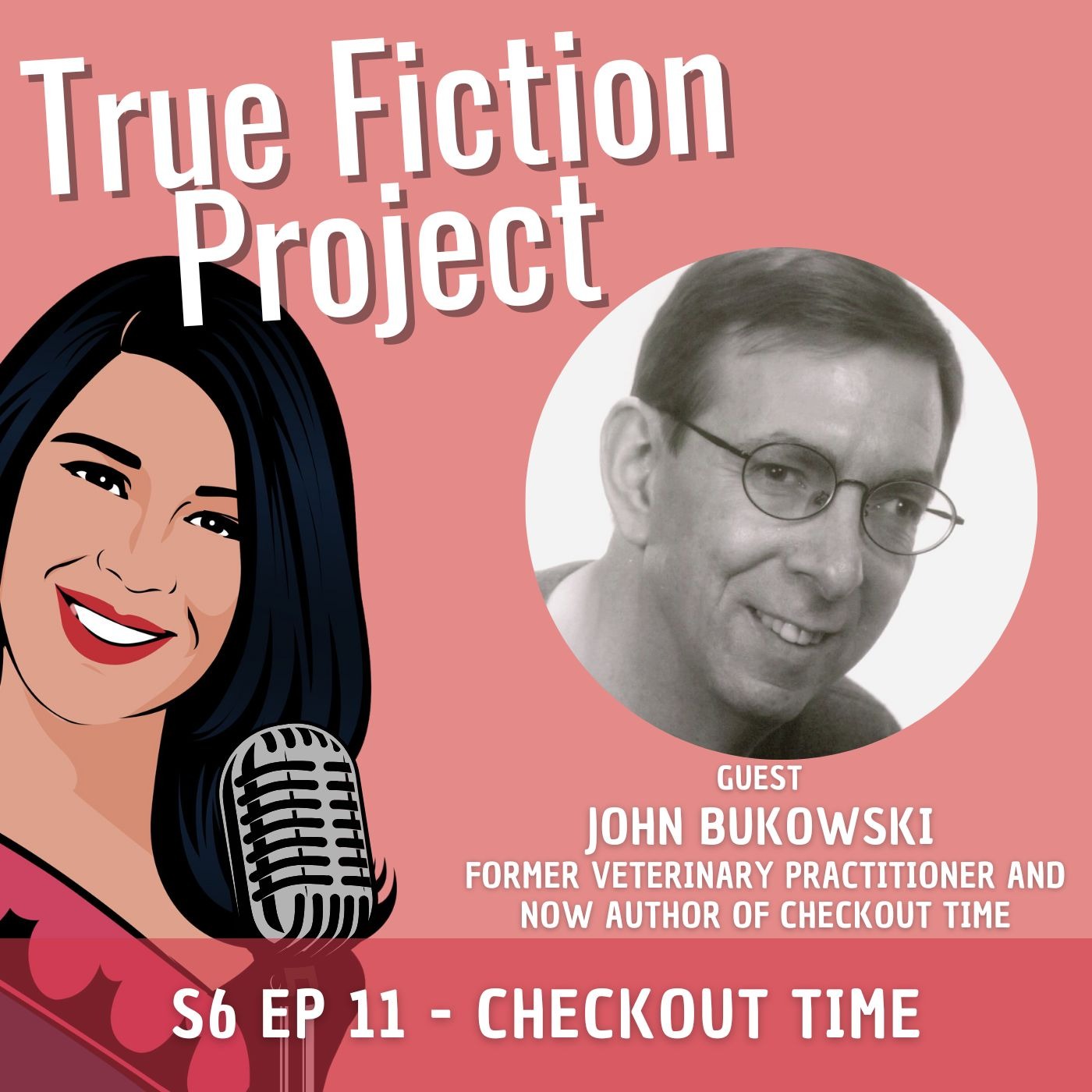
Welcome to the True Fiction Project. I am your host, Renita Hora and I have with me today Dr. John Bukowski. He is a former vet, as in veterinary practitioner. He's a health researcher, a medical writer, but he now writes short fiction and fast paced novels including Project Suicide and the recently published Checkout Time. I'm definitely going to ask him more about those. Let him explain those himself. He's done a whole bunch of writing, consumer materials, websites, radio, scripts. So without further ado, here is Dr. John Bukowski. Hi, John. Welcome to the True Fiction Project.
- [02:09]
Dr. John Bukowski
Hi, Renita. My pleasure. Thanks for having me.
- [02:11]
Renita Hora
Thank you for being on the show. So how do you go from being a vet and a health researcher and just a medical guy in general to writing? Are you writing about health and medical stuff? Are those what your stories are about?
- [02:25]
Dr. John Bukowski
Well, yeah, you know, in a way I'll, I'll go back to my secondary school training and into college. And I'm a person who has been blessed or perhaps cursed with being fascinated by a lot of topics. And in school, my big three were history. I still love history to this day, English reading and writing. I've been an avid reader all my life of fiction and nonfiction and science. Well, when you want to do a career though, you got to make a decision. You can't do all of those. So I Chose science. And so I went off and worked for my veterinary degree and I practiced for, oh, about seven years or so in the Michigan area. And then after maybe my 500th youth in Asia, I decided I wanted to do something that didn't require so much of a stress filled playing God as it were, life and death decisions. So I went back to school and got a master's and then a PhD in epidemiology, the study of disease patterns. During COVID you heard a lot of people who said they were epidemiologists as a, you know as well as a lot of real epidemiologists. So I did that. And as I was doing that and working for government and industry, I found that I was researching less and less and writing more and more. And partly that was because I enjoyed it and number two, my bosses appreciated it. That just got right. So whenever there was anything important to be written, I was usually kept. So I did that epidemiology career for about 20, 25 years. And then I wanted to move back to the midwestern United States. I'd been living in New Jersey, so my wife started her own company, she's a medical editor. So I joined that as a medical writer, a freelance medical writer. And I did that for quite successfully, for quite a few years. And then the Great recession hit in 2008 and no one was hiring people to do what I was doing. So part of our income dried up. But I had time. And any writer who writes anything, advertising copy, medical writer, whatever, wants to be the great American novelist, whether they say they do or not, we all do. So I said, hey, I have some time. I got a six, eight month period here with not a lot of medical writing to do. So I started writing fiction and I actually produced a novel, a thriller novel, that is still on my computer gathering dust and what Stephen King would call a trunk novel. He just sits there. But it got me hooked. And so even as business picked up, I kept writing short fiction. I plugged away at a couple other novels and about 2015, I guess it was about nine years ago, I retired from medical writing completely and I started writing fiction.
- [05:21]
Renita Hora
So the novel you were talking about was that Project Suicide?
- [05:26]
Dr. John Bukowski
No. And that's, that's the thing that you have to. When you ask a writer, how many books have you written, they always say written or gotten published.
- [05:35]
Renita Hora
I see.
- [05:36]
Dr. John Bukowski
Because they're not. Suicide is my first published novel. In 2022, I had several novels that didn't go anywhere. I'm working on a bunch of ones right now that are in various levels of completion. But Project Suicide, those followed by checkout time the next year.
- [05:55]
Renita Hora
Got it. I see. So two published novels, others written hidden trunk novels and many, many short stories as well.
- [06:04]
Dr. John Bukowski
Right. Right now I have about 15 short stories that have been published in either anthologies or in magazines.
- [06:12]
Renita Hora
I see. Now Project Suicide, of course, is a medical thriller. Is that the same for checkout time, your second published novel?
- [06:21]
Dr. John Bukowski
No, Checkout time is a little different. Project Suicide, I'll give you the thumbnail on it. It is the story of how a cure for Alzheimer's disease is perverted into an assassination drug. Now high profile politicians are killing themselves and only a drunken genius can save the country. So that was very much a. What they call a medical techno thrower. It has overtones of things about genetics and things like that. And I tried not to put too much of that in because you don't want people's eyes to gloss over. I see Michael Crichton also did that. And in some respects, I would say Michael Crichton was one of my influences for writing this type of novel.
- [07:04]
Renita Hora
Got it. Now I have to ask because there are so many writers out there who experiment both with short fiction as well as long form and such as yourself. And, you know, we're told all these things. I don't know how much of it we're told these things, but, you know, honestly, we can do what we like. Oh, you should publish some of the short fiction because that'll help you get the novels published. And some people are very sort of gung ho about that strategy, if you call it a strategy. And others like, you know, there's. That doesn't make any sense. Where in that spectrum do you like?
- [07:42]
Dr. John Bukowski
I would say I believe the short fiction helps you for a couple reasons. First of all, short fiction is much easier to get published.
- [07:49]
Renita Hora
Okay.
- [07:50]
Dr. John Bukowski
Even though there's not the many, many venues there were 50 years ago for short stories, there are many more than there are people who are willing to take on new authors in a novel. So I think it does help you because it gives you some bonafides. It basically says, oh, this person's pitching me this novel. Can they write, oh, look, they've already published eight short stories or ten short stories. Okay. That gives them a little more credibility. Maybe I'll take it. Maybe I'll read it rather than just put it in the circular file.
- [08:23]
Renita Hora
Right. So your point being that short stories might be a good idea for debut novelists. So those who don't have a novel out, Is that right?
- [08:30]
Dr. John Bukowski
Right. And that's true. But they're also fun to write. They don't require the long commitment of a novel. And I found novel writing was very similar to working in my PhD. You do a little bit every day for months or years at a time. And that's what it is with novel writing. A lot of people have the idea that a novelist goes off to a cabin in the woods for a month, writes a best selling novel, comes back and sends it in. It gets published. What actually happens is it takes you 6, 8, 10, 12 months to write the first draft. And there'll probably be more like three to four to five more drafts correct before you even show it to an editor. Before that, you probably showed it to some beta readers, you know, somebody, friends who are writers and you say, what do you think? Is this good? Does it make sense? Is there a plot hole? Does it flow well enough and they give you some feedback and then you keep plugging away and after about five or six revisions, rounds of revision, each of which take two to three weeks apiece, then it's ready to go to an editor. And that's far from being published at that point. So it takes a few, it takes a few years.
- [09:45]
Renita Hora
It does take a few years. And with the short stories though, even though you say, and I believe you, it's not like I'm contesting it, you know, that you can do it faster and it doesn't require that kind of commitment. I mean, it does require commitment. Is it not more difficult to do a full on, well fleshed out developed story, beginning, middle and plot points, whatever, in what is it, 10,000 words? 5,000? 15,000?
- [10:13]
Dr. John Bukowski
Well, anywhere from 1500 to 10,000.
- [10:17]
Renita Hora
Okay, so that's really short. Okay, I mean, could be really short. 1500 to 10,000. So. So with the little space, is it not more difficult to get the story in?
- [10:29]
Dr. John Bukowski
Well, it's different. You start out. It's like if you're watching a half an hour TV show versus a two and a half hour movie. There's a complete story in a half an hour TV show, but it's accelerated. There's fewer characters, there's fewer plot lines, there's fewer all these things. I grew up being a student of things like the Twilight Zone, which were very half an hour anthology stories. And it's still basically the same structure, but really abbreviated. Maybe instead of being multiple plot lines, they'll be one, for example, in the short story.
- [11:10]
Renita Hora
I see. So today you are going to read us what for the creative portion of this episode.
- [11:17]
Dr. John Bukowski
I'm Going to read the first chapter, which is a relatively short chapter. It's only about a five or six minute read of Checkout Time. My second novel, and I'll set that up with Checkout Time, is a story about a arsonist bopper known mysteriously as Conrad Hilton. That's his suitable okay. And he's trying to extort money from hotel owners. Pay me or I'll bomb your hotels. He's pursued by a beautiful government FBI agent and a handsome government researcher who I modeled after myself. They pursue him until Conrad turns the tables and the hunters that come to hunt it.
- [11:54]
Renita Hora
I see. Now, aside from the fact that you modeled the researcher after yourself, a handsome, good looking researcher after yourself, what is the true life inspiration for this story for Checkout Time?
- [12:08]
Dr. John Bukowski
It actually goes back to when I was working in industry and I had to travel on business and I went to a hotel and went to many hotels, but I went to this one hotel. I sat on the bed and looked up at the ceiling and there was a trapdoor and you could tell it was meant to access air hand blue doctor or something. It had lot of those little just buttons that you just pushed and turned that would pop open. And I thought, and this is a great for writers, they always talk about the what if scenario. That's how most stories start. And I said, you could put something there. Yeah, what could you put there?
- [12:41]
Renita Hora
What could you put there? And it's almost like a writing prompt, right? It's like go about your daily life.
- [12:46]
Dr. John Bukowski
Exactly.
- [12:47]
Renita Hora
Come across a situation and that's a writing prompt and you're thinking, okay, let me start there. And what if, right?
- [12:53]
Dr. John Bukowski
And so my first what if was what would you put up there?
- [12:56]
Renita Hora
What would you put up there?
- [12:58]
Dr. John Bukowski
If you put like stolen jewels or cash, you could have the drug dealers chasing you because you found their money. You know, it plops down on the floor. That's one type of thrower. You could have stolen microfilm or I guess it would be microfilm disc now discs. That would be a spy thriller. My inclination is to have a bomb up there. And the reason for that is I grew up at kind of a pyro. So I said, okay, why, why are you going to put a bomb up there? And it could be for revenge. It should just be a crazy man. Or I thought, wait a minute. There was a wonderful movie that I liked in the 1970s which not a lot of people have heard of, called Roller Coaster. And it's the story of a man trying to extort money from amusement parks. Pay me money or I'm going to blow up your rides when people arrive. So I said, perfect, I will make it similar. I mean, not obviously not copying story, but a similar premise, a similar MacGuffin, if you want to call it, as Hitchcock would say, to have this be an extortionist trying to make some money.
- [14:05]
Renita Hora
Okay, well, I cannot wait to hear the piece. But before you get into it, do share with our audiences where we can find your work, your books, social media, just where we can find you online, whatever you want to give us.
- [14:20]
Dr. John Bukowski
Okay, well, you can find most stuff through my website, which is thriller. John B.net T-H R I L L E R John B J o h n b.net also, you can get directly to each one of my novels right on Amazon by doing projectsuicidenovel.com or check out timenovel.com both those will take you directly to my books.
- [14:45]
Renita Hora
Fantastic. So dedicated websites for each of your books and of course we're going to have all of that information in the show, notes linked and everything. It's been such a pleasure to have you on the True Fiction project. And you are going to give our subscription audience a little bit more, is that right?
- [15:05]
Dr. John Bukowski
Yeah. I've had several short stories published in the last six months or so. One of them is called the Wheel of Fortune is the name of the short story. It's in the Larceny and Last Chances anthology which people can find on Amazon or whatever.
- [15:19]
Renita Hora
Okay, that is wonderful. So if you would like to listen to that short story by our guest today, John, please make sure that you subscribe if you haven't already. And for the rest of you, it's been a pleasure to have you on the Trufiction project. John, thank you so much for joining us today.
- [15:39]
Dr. John Bukowski
My pleasure. Thank you.
- [15:40]
Renita Hora
Let's hear your story. Your opening to checkout time.
- [15:45]
C
You just realized your business needed to hire someone yesterday. How can you find amazing candidates fast? Easy. Just use Indeed. Stop struggling to get your job post seen on other job sites with Indeed sponsored jobs. Your post jumps to the top of the page for your relevant candidates so you can reach the people you want faster. According to Indeed data, sponsored jobs posted directly on indeed have 45% more applications than non sponsored jobs. Don't wait any longer. Speed up your hiring right now with Indeed. And listeners of this show will get a $75 sponsored job credit. To get your jobs more visibility@ Indeed.com Arts, just go to Indeed.com Arts right now and support our show by saying you heard about Indeed on this podcast terms and conditions apply. Hiring indeed is all you need.
- [16:43]
Renita Hora
And now to the premise of the True Fiction Project, which, of course, is to create fiction out of nonfiction.
- [17:00]
Dr. John Bukowski
Thomas Tomaszinski had experienced a bumpy flight before, but never in a hotel room, nor had a roar like a freight train ever awakened him from a dream about Suki. Red hair dragged over a trim athletic frame before his eyes open. His ears popped as if the room suddenly lost cap and perhaps pressure. Then turbulence that would make Chuck Yeager lose his lunch launched the king size bed a foot to the right. The air filled with debris. Bits of plaster and insulation snowing down from a foot wide rent in the ceiling. Then he smelled an accurate mix of electrical wiring and building materials that had surpassed the activation energy needed to turn them into fuel. The roof over his head cracked amid a shower of sparks. Tom hit the worn carpet, eyes stinging and lungs hacking as a section of burning ceiling took his place on the bed. The air was cleaner near the floor, yet the dust still made it difficult to see. Fighting claustrophobia, Tom forced himself to think about the floor plan. The door should be to the left somewhere. He winced as his outstretched fingers bent back against the chairload. Keep moving, he thought, shouldering past the chair, knees and palms scraping against the worn carpet. Another piece of ceiling fell behind him, showering his bare legs with hot needles. It was as if fire was racing into the door. He prayed he'd win. Tom scurried faster, head low, skin scraped by the cheap current. Without warning, his scalp thwacked a wooden surface. Stars flared in the world grave. Then more cinders hit his leg and full consciousness returned. The hotel door was flat, smooth, and not yet hot, but the smoke was thicker here, forcing him to snatch a breath in between coughs. He flailed at the metal door handle, which turned but wouldn't unlast. He jammed up and down a dozen times. Nothing. He rose against the door to get more leverage, but the smoke forced him back down. Down. His throat burned as he fought a coughing jag. I'm going to dial up his, he thought, coughing in my underwear against the hotel door. Then a thought burst into his brain. The deadbolt. Tom thanked whatever God was watching over him and reached for the lock. A spark sent another hot needle into his hand. Cursing, he shook off the insult, then attacked the deadbolt. He heard a click as a light lock turn. The door unlatched with the next foot. He banged his head again, opening the door but barely felt it, relieved to be in a hallway bathed in emergency lighting. The pale glow changed to a strobe. As a klaxon sounded, an automated voice announced, there is a fire. Please evacuate the building. Ducking his head below the smoke, Tom paused. No shit, Sherlock. The automated voice again ignored him, continuing his cold mechanical drone. Do not use the elevators. Tom didn't need to think about the floor plan this time. Stairs would be on either end of the hall. His room was nearest the left exit, but that seemed to be the source of the smoke. Tom shuffled on all fours, body low. Right knee and right hand moved together, followed by left hand and left knee. The smoke got thicker, required an even lower crouch. Right, then left, right and left. He hung up to the cadence like a prayer. The air ahead was brighter, the flashing strobe bouncing off the beam of Elevator Village. A few more feet, he'd be at the exit. As he crawled forward, he grabbed something soft and alive. Ow, said the person who belonged to the foot Hat kept moving as the foot began to shape the calf. The calf of five escaped. The disrobed get the hell off my ass. Said the holder of the panty covered pot. Move it. Tom shouted. The exit door opened and a hook tumbled onto cold concrete. The glow was more constant here, battery powered lights replacing the strobes, panting skivvies barely providing scant insulation against the floor. Tom looked at his fellow escape. Me. He recognized the red hair on the face, which looked older without makeup. She was wearing nylon hipsters under a cheek and read Fuck the Whales. Every mammal for himself. Hey Tom, Tom, she said. Hey, Agent Sally, he replied. Would you like that drink now? She smiled at the pale light. I'm buying. Let's go find an open bar. Tom heard bare feet flopping down the stairs, then a grunted shit as those feet found a pedal, grinning. He's had his feet after hers.
- [21:49]
Renita Hora
Here at the True Fiction Project, we're always looking for great stories that make for compelling fiction. So if you have a great story or know someone who does, or if you're a writer who'd like to be featured on the show, then please do get in touch with with us@rinita.com contact and if you haven't signed up for our newsletter, then you can do so by visiting substack.comitahora all spelled out one word. That's substack.com I T A H O R A I'll be offering paid subscribers something a little extra special each time, including a video version of this podcast.
- [22:41]
C
You just realized your business needed to hire someone yesterday? How can you find amazing candidates fast? Easy. Just use indeed Stop struggling to get your job post seen on other job sites with Indeed sponsored jobs. Your post jumps to the top of the page for your relevant candidates so you can reach the people you want faster. According to Indeed data, sponsored jobs posted directly on indeed have 45% more applications than non sponsored jobs. Don't wait any longer. Speed up your hiring right now with Indeed and listeners of this show will get a $75 sponsored job credit. To get your jobs more visibility at Indeed.com Arts, just go to Indeed.com Arts right now and support our show by saying you heard about Indeed on this podcast. Terms and conditions apply. Hiring Indeed is all you need.