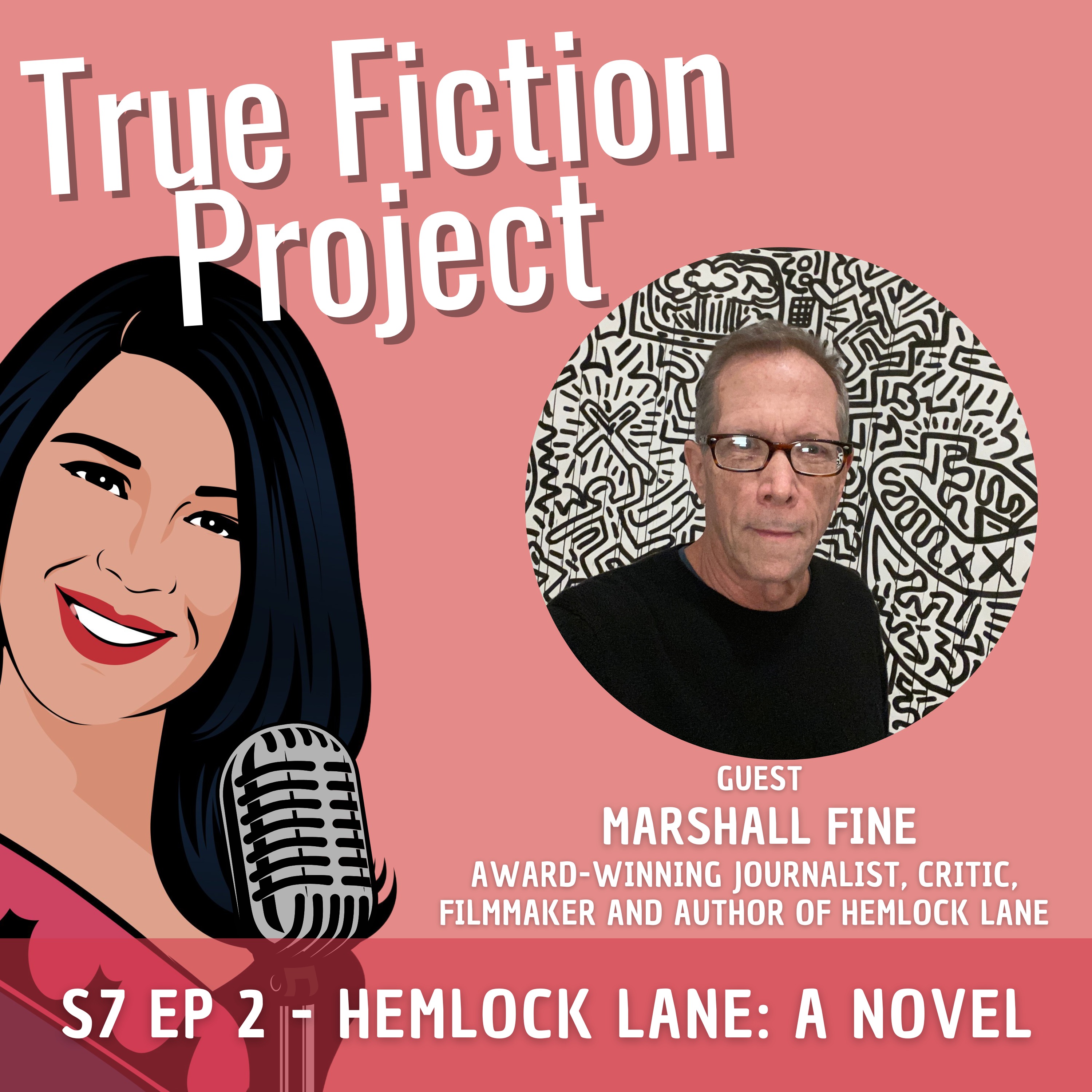
Loading summary
Transcript74 lines
- [00:00]
Shopify Announcer
Shopify is a global commerce platform that helps you sell at every stage of your business and sell more with less effort. Thanks to the Shopify Magic, your AI powered all star. Sign up for a $1 per month trial period at shopify.comredcircle all lowercase go to shopify.comredcircle now to grow your business no matter what stage you're in. Shopify.com/red circle I challenged myself with the.
- [00:30]
Marshall Fine
Structure of writing a story that takes place over the course of four days, with each day told from the perspective of a different character. I like novels that reveal themselves slowly. I like the idea that each character saw things from a different perspective. And so as you saw that person's perspective, you got a new insight into what had come before.
- [00:55]
Renita Hora (Intro/Outro)
Welcome to the True Fiction Project, a podcast series that explores the origins of fiction. Every week we begin with an interview. Nonfiction followed by a creative piece, fiction inspired by something from the interview. The idea is to demonstrate, of course, that fiction is born out of our life experiences. Now, here's your host, storyteller, author, public speaker, health and wellness expert, Renita Hora.
- [01:25]
Renita Hora (Host)
Welcome to the True Fiction Project. I'm your host, Renita Hora, and on today's show, we have a guest who is an award winning journalist, a critic, a filmmaker, a novelist. Marshall Fine is definitely the kind of person I want to be when I grow up. Hi, Marshall. Welcome to the True Fiction Project.
- [01:49]
Marshall Fine
Hi, how are you? Thank you for having me.
- [01:52]
Renita Hora (Host)
Thank you for being here. And just, you know, by way of introduction, I know we're gonna talk about your novel today, Hemlock Lane, but you have done so much, I mean, bring our audiences into your world because you've done film biographies and documentaries. A Playboy interview with Howard Stern. Show us your life.
- [02:16]
Marshall Fine
I guess I always operated under the philosophy that what productive use can I be making of this particular moment? I always had a full time job up until I retired about four years ago. But even then I was always working on something else. And I was very productive as a critic and reporter, but I was always working on something else. I have a hard drive full of plays and screenplays that nobody's seen. Hopefully, you know, now someone will go, oh, what else do you have? That was sort of why I kept writing them. But I guess you could say I have a restless creativity, that I'll see something and go, I think I could do that. And so I try.
- [02:56]
Renita Hora (Host)
A restless creativity is the only way to go for creative people. Because if you're not restless, you're not creative. If you're not creative. You're not going to do anything. So tell us about some of the biographies of filmmakers that you've written.
- [03:12]
Marshall Fine
I've written three. I wrote two directors, Sam Beckinpah and John Castavetes, and then a biography, an unauthorized biography of the actor Harvey Keitel in each case. And I would say this is true of the documentaries I've made as well. My interest is in people who start their own path, who are in the system, but see another way, even if it's not the accepted way, and that if they run into a resistance, you know, it makes them rebels in some way. That was certainly true of Peckinpah and Cassavetes, who both went about filmmaking in a new way that influenced a lot of other people. And Harvey Keitel, in a lot of ways, was the same thing. He was really an actor's actor who, when I, at the point where I wrote the book in the mid-90s, he was sort of this icon of independent film who had championed and helped a number of young directors get their first films made. So I'm always looking for that person who's sort of basically beating their own new trail.
- [04:13]
Renita Hora (Host)
Beating their own new trail. So does this include the documentaries you've done as well?
- [04:18]
Marshall Fine
I would say that's true. I mean, both Rex Reed, who was a film critic, sort of groundbreaking film critic and interviewer, part of the new journalism in the 60s and 70s, and Robert Klein, a comedian who I did a documentary about, who, along with Richard Pryor and George Carlin, created kind of a new paradigm for comedy in the late 60s and early 70s that took it from the Borsch Belt days to sort of the baby boom audience, and again, you know, created something new that, you know, lasted for a long time.
- [04:51]
Renita Hora (Host)
Amazing, because these are some of the historic names in comedian history, you know, that we all really look up to. So it's wonderful to hear that you've interviewed them at such close contact. And not just that. Also, was it Howard Hughes?
- [05:06]
Marshall Fine
Howard Stern?
- [05:07]
Renita Hora (Host)
Howard Stern, okay. But you also interviewed Howard Stern for a Playboy interview, is that right? How did that go?
- [05:15]
Marshall Fine
That was great. I mean, that was the reason that I became a reporter, is that it gives you license to ask people nosy questions, which, you know, a lot of fun. And certainly to be able to ask Howard Stern those kind of direct questions. And the Playboy interview, you were required to have six hours of time with the subject. So cover a lot of ground with Howard Stern in that time. And I was a big fan. I had read his book. I that was sort of the reason that I ended up getting the interview is because I had written favorably about his show and the book itself. I'd reviewed the book and so I was offered the assignment and took it. Absolutely. It was a lot of fun. It was certainly a journalistic high point for me.
- [05:55]
Renita Hora (Host)
So these interviews don't. Documentaries, biographies. Can we look at them or read them? Are they online? Are they available to us?
- [06:06]
Marshall Fine
HOWARD STRU. I think you have to probably have a subscription to the Playboy to get into their archive of interviews. My biographies are available as actual physical books. They were written long enough ago that they were never made into ebook. But you can find them on Amazon. Certainly you can find them through my website, which is marshallfine.com well, we're going.
- [06:29]
Renita Hora (Host)
To have links to all of these goodies in our show notes, so fear not. But obviously this leads me to ask about your role as chair of the New York Critics Circle. Film Critics Circle. You've held that chair four times, if I understand correctly.
- [06:47]
Marshall Fine
I did. I joined the group in 1988, shortly after I started as a critic at a paper in New York and was with the group for the next 35 years. I chaired it on four separate occasions. It's a voluntary thing. I was also unofficially for a long time the group's treasurer and then eventually transitioned to become the group's general manager and sort of put into place a number of systems to keep the group kind of going forward. It was an unusual group in the sense that it only existed to give awards. So they only met once, you know, basically twice a year, once for a meeting to vote on new members and wants to vote on the awards themselves. And then they gave an awards dinner. And so the chairman basically organized those meetings and put together and hosted the dinner itself. As general manager I had. And as treasurer I had sort of institutional memory. And so I sort of figured out how to kind of put that in writing and pass it along to the next person that I found to take over the general manager position. So I'm a big believer in the group. I'm a big believer in the power and the necessity of critics and feel like it's an important group going forward. So I wanted to ensure that it had a future.
- [07:58]
Renita Hora (Host)
And I'm guessing that the requirement was that you needed to be a New York based film journalist or film critic or something of the sort. Is that right?
- [08:08]
Marshall Fine
You had to be where. Yes, you had to be a working critic at one of the daily newspapers or weekly magazines. It's in the last few years has expanded to include online critics and freelancers. The group has grown quite a bit. Also gotten much younger than when I was there. I mean, again, I'm a baby boomer. You know, we're now to, you know, Gen Z, basically, as critics. So, you know, things change like that. You know, generational change is an inevitable thing.
- [08:37]
Renita Hora (Host)
Absolutely, absolutely. All right, so let's get to Hemlock Lane. This is a new novel. Is it published yet?
- [08:46]
Marshall Fine
It comes out November 25th.
- [08:48]
Renita Hora (Host)
Amazing. Well, congratulations.
- [08:50]
Marshall Fine
Thank you very much. I appreciate it.
- [08:52]
Renita Hora (Host)
Yeah, tell us about it. I know it's not your debut novel, so you are a well seasoned novelist here.
- [09:01]
Marshall Fine
Well, it's my second novel and the first novel was basically a character study of one person from her point of view. This one is. I challenged myself with the structure of writing a story that takes place over the course of four days, with each day told from the perspective of a different character. I like novels that reveal themselves slowly. I like the idea that each character saw things from a different perspective. And so as you saw that person's perspective, you got a new insight into what had come before.
- [09:32]
Renita Hora (Host)
So this is very interesting, and it sounds almost like an episodic TV show, you know, bringing to audiences the same incident from four different perspectives. Am I guessing correctly or less?
- [09:50]
Marshall Fine
The. The repetition of the same incident from different perspectives as opposed to additional incidents that give you new insight into the characters and what's come before.
- [10:00]
Renita Hora (Host)
I see. So what is the genre of Hemlock Lane?
- [10:05]
Marshall Fine
I guess it's classified as book club.
- [10:07]
Renita Hora (Host)
Book club, which is what you must define it because when it comes to genres like book club and upmarket, we never know what we're talking about.
- [10:16]
Marshall Fine
My books seem to find their way into the women's fiction category.
- [10:20]
Renita Hora (Host)
Okay, okay, excellent.
- [10:21]
Marshall Fine
Contemporary women. Mother, daughter, that sort of thing, I guess.
- [10:25]
Renita Hora (Host)
That sort of thing.
- [10:26]
Marshall Fine
You know, I wasn't aiming for a genre. I was just trying to tell my story. I'm always sort of surprised. I mean, it's also been classified as a historical novel because the present tense of the story is 1967. You know, I was alive in 1967. I remember 1967 very clearly. So to me, that doesn't seem historical. But I understand that there are people for whom that is the path that is the distant past. I guess it does qualify.
- [10:53]
Renita Hora (Host)
I tell you, I was at a writer's conference recently and I was told that everything about the 80s is historical fiction. So go figure.
- [11:02]
Marshall Fine
I suppose, if you were. If you were born after 9, 11, and, you know, everything from the 20th century is like, I was born in the middle of the 20th century, and everything from the 19th century seemed like, you know, the Wild west and Wild Bill Hickam, that kind of thing.
- [11:16]
Renita Hora (Host)
Absolutely.
- [11:17]
Marshall Fine
Cowboys and Indians.
- [11:18]
Renita Hora (Host)
Yeah. So what happens on that single day on Hemlock Lane? What is the fulcrum, if you will, of the story, you know, that single event or what is it that happens on that single day in Hemlock Lane?
- [11:34]
Marshall Fine
It's about a daughter who's just finishing graduate school who has been summoned by her father. They live in Tarrytown, New York, just north of the Tappan Zee Bridge in the suburbs, north of the city. She's been in college and grad school at Syracuse. She has secrets of her own. She has a very domineering mother from whom she's about to try and make a break, but she's coming home, and that's a secret that she doesn't want to get out. And her father has a secret that he needs to tell her, both of which they're keeping from the mother who is this, again, dominating figure that everybody sort of treads lightly around. And it's a question of what will and won't come out this weekend and what will be the fallout when it does.
- [12:18]
Renita Hora (Host)
So would it be fair to say it sounds like it's very character driven rather than plot driven? Is that a fair accent?
- [12:25]
Marshall Fine
I'd say that is very accurate.
- [12:26]
Renita Hora (Host)
Okay.
- [12:27]
Marshall Fine
Each character gets their backstory told, gets, you know, a certain amount of flashback. And so, you know, it takes place in the past, in the present, but the present is 1967.
- [12:37]
Renita Hora (Host)
And why did you choose to sort of treat it this way? Meaning pick one single day and have this be the lens that you bring the story to audiences from, albeit through these different characters.
- [12:51]
Marshall Fine
One of the inspirations was the Thornton Wilder novel the Bridge at San Luis Rey, which is essentially a series of stories about unconnected people. But each of the stories ends with the person arriving at that bridge and walking across it just before it collapses and they all die. I wasn't going that far, but I liked the idea of bringing together characters in ways that are unexpected. It was basically, there's a single event that I had in mind which is, you know, her having to tell her parents that she is take a job in another city and move away against their wishes, but that there's a lot of tension in doing it over the course of one weekend and slowly having things reveal themselves in ways that people aren't expecting.
- [13:38]
Renita Hora (Host)
So I have to ask you this, Marshall, because given that this is historical fiction and Given that you have a contemporary reader today who's going to be reading this book, some of the themes which might have been dire or shocking or tense or difficult in 1967, would they cause that kind of tension today? So, for example, if she is trying to move away from home and, you know, this is something that she needs to bring to her parents and there is stress around this, how would today's reader sort of view that, if you will?
- [14:14]
Marshall Fine
I think that there is no sort of time period, time limit on domineering parents and that we all have people in our lives around whom we have to be careful because we don't want the emotional fallout of rubbing them the wrong way. And this is, you know, a whole family that is, you know, it's being a book of matches and living around dynamite.
- [14:40]
Renita Hora (Host)
I see. I like that. So it's not necessarily about what the situation is, but how this domineering mother in this case is treating that situation and what that means in terms of the other characters always treading on eggshells around her. Is that correct?
- [14:57]
Marshall Fine
Yeah, I think that is, Zach.
- [14:58]
Renita Hora (Host)
Yeah, that is definitely a universal theme. I think that transgresses cultures and time and, you know, other situations. Various situations. Okay, so I know you're going to be reading us something from the novel. Can you tee that up for us, give us some context?
- [15:16]
Marshall Fine
Sure, I would. It's basically the first two pages of the book introducing this central character. Her name is Nora. And I get into it a little bit. Just basically one of the themes in the book is that she is sort of an early feminist in second wave feminism is 1967. It's a couple of years after Betty Friedan's Feminine mystique came out. But, you know, at that point in time, this was still not a widely accepted or even widely known point of view that it was, it was considered shocking. You know, Betty, what Betty Friedan was saying about the role of women in society to the average middle class suburbanite, this was, you know, what was she talking about? They didn't know. And that today the idea of female equality is sort of a given in life that, you know, among, you know, as this is what you teach your kids, that boys and girls, you, you know, you have equal opportunity, you're both the same. But it wasn't always the same. And I think that that's one of the things that hopefully younger readers will take away is that things have changed a lot in the 60 years since the setting of this book. Anyway, so the first two pages is just her heading home and sort of giving intimation of a little of what stick out.
- [16:31]
Renita Hora (Host)
And so this is the point of view of the daughter, is that right?
- [16:35]
Marshall Fine
Of the daughter.
- [16:35]
Renita Hora (Host)
And her name is Nora Levitsky. Nora Levitsky. Okay, before you actually give us the reading, let us know, Marshall, where we can find you online. I know you gave us your website a little bit earlier, perhaps repeat that. And are there any social media handles or anything else you can point us to?
- [16:55]
Marshall Fine
I'm on Instagram, but you can find that through my website. But really I don't do much else on social media, so it's really my website.
- [17:02]
Shopify Announcer
Marshallfine.com Shopify is a global commerce platform that helps you sell at every stage of your business and sell more with less effort. Thanks to the Shopify Magic, your AI powered all star sign up for a $1 per month trial period at shopify.com redcircle all lowercase go to shopify.com redcircle now to grow your business no matter what stage you're in. Shopify.com RedCircle Excellent.
- [17:32]
Renita Hora (Host)
All right, thank you, Marshall. In your hands. Cannot wait to listen. And now to the premise of the True Fiction Project, which of course is to create fiction out of the nonfiction.
- [17:59]
Marshall Fine
Nora Levitsky pulled off New York State Highway 17 into the parking lot of a diner in Roscoe, New York. From here it was only about 100 miles south to the Tappan Zee Bridge in Tarrytown, less than two hours to her parents house in the hills north of its eastern end. No point in arriving any earlier than necessary. She thought. I'd like to be able to breathe easy for a while longer. Plus, it was lunchtime and she'd skipped breakfast to get an early start from Syracuse. She parked her 1959 Port country square station wagon, formerly her father's work car, in the diner's half full parking lot and went inside where the hostess seated her in a booth. The elderly waitress shuffled over with a menu. Nora said, that's okay. Can I just have a grilled cheese sandwich and a large Coke with ice? Thanks. The waitress, whose name tag said Sal, blinked a couple of times behind oversized bifocals and said, want French fries? Absolutely. And some ketchup plates. When she'd gone, Nora reached for her purse and dug out the note from Stephen. She'd found it in there at the gas station a few miles back when she fished for her wallet to pay for gasoline. The note provoked the same giddiness in her now that it did the first time she read it at the gas pump. Steven's hand scrawled message was playful and affectionate, talking about their future and joking about finishing law school so I can become a public defender and start representing people who have no hope of paying me. That first time she read it, Nora felt tears on her cheeks and after noticing the woman at the next gas pump looking at her, brushed them away with a chagrined smile. Their future together right there. At that moment in June 1967, Nora Levitsky, who had once vowed that she would never, ever get married, realized she was thinking about sharing a future with Osmond.
- [19:56]
Renita Hora (Host)
There we go. It seems that ultimate decision. You know, thinking about sharing a future with a husband and someone who doesn't want to necessarily get married.
- [20:06]
Marshall Fine
Exactly, exactly. It's a big leap for her.
- [20:09]
Renita Hora (Host)
Absolutely. And again, as I said, a universal theme that definitely resonates, transgresses, ages and, you know, decades and generations. Marshall, thank you.
- [20:21]
Marshall Fine
Absolutely. Thank you. I appreciate you having me. I appreciate you taking the interest.
- [20:25]
Renita Hora (Host)
Thank you. Marshall. It was wonderful to have you on the True Fiction Project, and of course we will be linking to your book on Amazon, so hopefully our listeners and viewers can go beyond this episode and dive right into it.
- [20:42]
Marshall Fine
I hope they enjoy it.
- [20:43]
Renita Hora (Host)
Thank you. That was Marshall Fine. He is a journalist, a film critic, a film filmmaker, and he joined us today to talk about his upcoming novel, Hemlock Lane. This is the True Fiction Project and I am your host, Rinita Hora. Here at the True Fiction Project, we are always looking for great stories that make for compelling fiction. So if you have a great story or know somebody who does, or if you are a writer who would like to contribute, then please do get in touch with us@renita.com contact.
- [21:27]
Renita Hora (Intro/Outro)
Thank you for listening to the True Fiction Project with Renita Hora. Be sure to subscribe to the newsletter to receive more inspiring stories showing how fiction is born from our everyday experiences. For more information visit www.TrueFictionProject.com.
- [21:51]
Marshall Fine
Extra value meals are back.
- [21:53]
Renita Hora (Host)
That means 10 tender juicy McNuggets and.
- [21:55]
Marshall Fine
Medium fries and a drink are just $8 only at McDonald's for limited time only.
- [22:01]
Renita Hora (Intro/Outro)
Prices and participation may vary. Prices may be higher in Hawaii, Alaska and California and for delivery.