Loading summary
Transcript425 lines
- [00:00]
Wix Advertiser 1
How many times have you wished you could be in two places at once? With wix, you practically can. Wix's website builder is packed with powerful AI tools to make running your business online easier. Build a full site just by talking with AI, get an AI agent to manage your sales and marketing, or work like a 10 person team, even if it's just you. So you don't need superpowers to get everything done, you just need Wix. Try it now for free@wix.com the money.
- [00:28]
Saurabh Bajaj
That you're spending is not just growing you, it's growing the entire category, right? So when Celebration grows, so does Ferrero Rocha grows. Real Juice Gift Pack grows. Everybody grows.
- [00:40]
And I realized that there are two tasks. There is either grow the category or.
- [00:46]
There is steel share.
- [00:47]
And you have to do only one of the two.
- [00:50]
And that choice makes all the difference.
- [00:56]
Renita Hora
Welcome to the True Fiction Project a a podcast series that explores the origins of fiction. Every week we begin with an interview nonfiction followed by a creative piece, fiction inspired by something from the interview. The idea is to demonstrate, of course, that fiction is born out of our life experiences. Now here's your host, storyteller, author, public speaker, health and wellness expert, Renita Hora.
- [01:26]
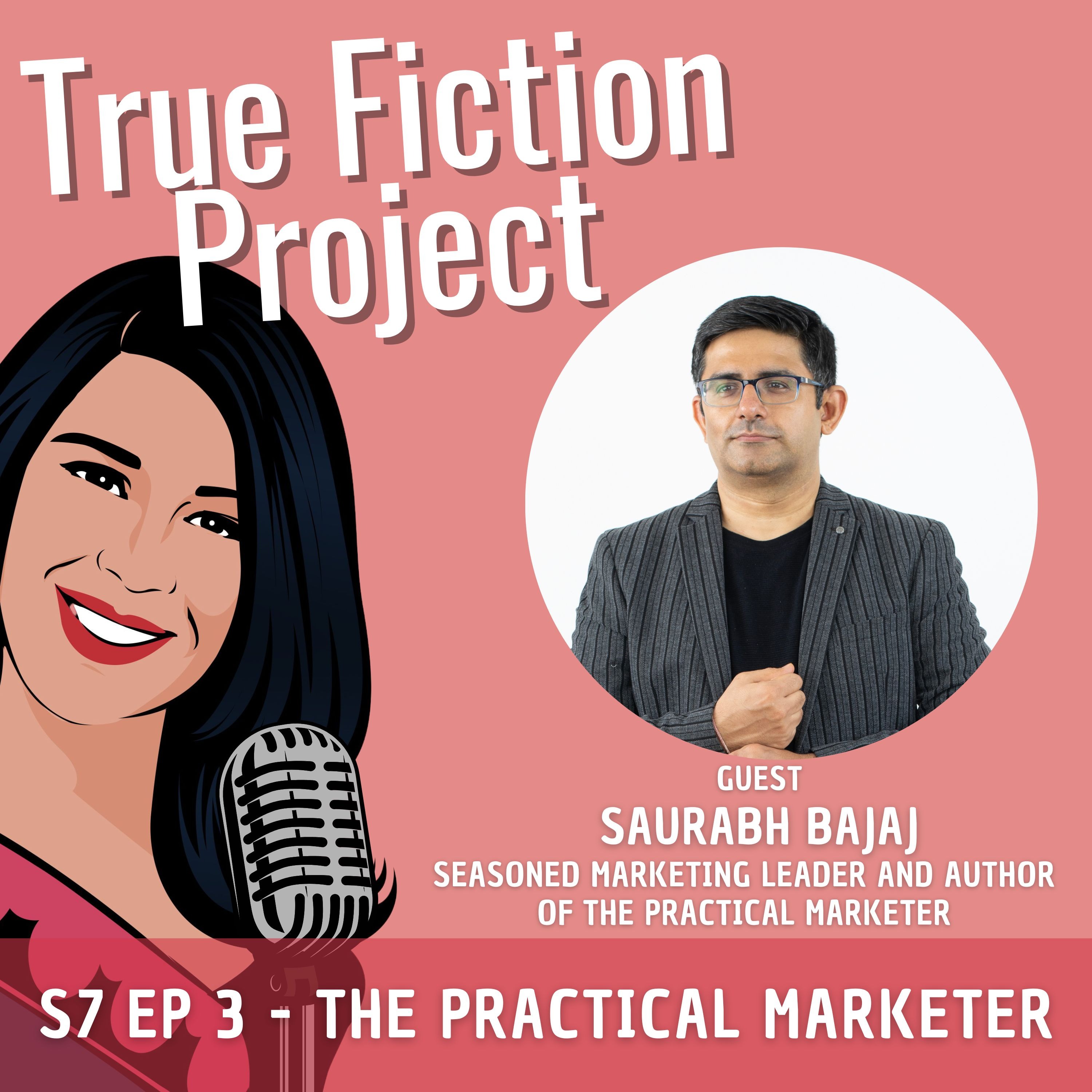
Welcome back to the True Fiction Project. I am your host, Rinita Ahora. And as you know, this is your go to podcast for all things that relate to the journey of a story, from its nonfiction roots to its fictional outcome. Today we are doing something a little bit different. We have a nonfiction author. This is a very special author, Saurabh Bajaj, who I actually met through Jeko. We have a common publisher. So without further ado, I'm going to introduce Sourabh. He is the executive vice president, prepaid marketing head for Vodafone Idea and he has written a fascinating book called the Practical Marketer. Hi Saurabh. Welcome to the True Fiction Project.
- [02:12]
Saurabh Bajaj
Thanks Ranita. Absolutely great to be here.
- [02:14]
Renita Hora
It is so great to have you on the show. And I know we've been talking about this for a while, ever since we first met. So it's taken many months, but we finally brought it to fruition.
- [02:25]
Saurabh Bajaj
Absolutely. I'm so glad we could finally bash the calendars and get this conversation going.
- [02:31]
Renita Hora
Absolutely. So, Sourabh, as I was mentioning to our audiences, you and I met through Jekyll, which is a publisher. It's a common publisher for both of us. But more specifically, their sweet spot really is nonfiction books. Right.
- [02:49]
Saurabh Bajaj
The.
- [02:50]
Thanks.
- [02:51]
Renita Hora
So I would love to know, given your very strong marketing background and you've had a very interesting career. Did you go to Jekyll? Did Jekyll find you? How did that even happen?
- [03:03]
Saurabh Bajaj
Great.
- [03:04]
So, you know, I think I always felt that I will write a book someday. And I think my book was a gift of the Pandemic. Well, the Pandemic gave a lot of unfortunate stuff to a lot of people. But I think the moment I got into the pandemic, literally on the first weekend of the lockdown, is when I put out my first LinkedIn post.
- [03:22]
And that's where the journey started. Once my draft was ready, however, I.
- [03:26]
Actually shot it out to 30 odd publishers and I had a couple of.
- [03:31]
Them, which is quite interesting.
- [03:32]
I went to the documents page of.
- [03:34]
The couple, but then when I finally found Jeko, I felt it was a.
- [03:38]
Match made in heaven because they have just the right catalog of books, which I would like my book to belong to. Did a lot of diligence in the editing. I mean, it took me two years to write the book and two years to edit it. So I actually, given that it was the first book, I wanted somebody who would probably as much effort in editing and pulling it together as I've spent in probably writing it. So hence I think I was quite happy with Jekyll being my choice of the publisher.
- [04:02]
Renita Hora
Amazing. So what is it about this book that requires that kind of detail in editing? I mean, this is the practical marketer.
- [04:13]
Saurabh Bajaj
That's right.
- [04:14]
Renita Hora
And you say that there's a disconnect between the theoretical and the practical aspects of marketing. So tell us about that. And did that compound the editing process?
- [04:24]
Saurabh Bajaj
So, you know, the fun part was as I went through the pandemic, I said, like I told you, I wrote a post every week.
- [04:30]
Yeah.
- [04:31]
And the first post that I wrote, it happened to be on the first.
- [04:34]
Weekend of the lockdown. It got 35,000 views.
- [04:37]
And I was like, okay, wow, I think I'm onto something. Yeah. The second post got another 15,000. The third one got 25,000.
- [04:44]
And I was like, okay, I think I have something to share. But I couldn't put a finger on.
- [04:48]
It that what is it that I'm.
- [04:49]
Going to actually write about?
- [04:51]
And I had a number of thoughts.
- [04:52]
Fiction, nonfiction, marketing, non marketing, and so on and so forth.
- [04:56]
But then whenever I would have this.
- [04:59]
Intriguing conversation in office and I would be like, you know, I'm working with such senior people, but why don't they all just get this? Like, why isn't it so easy for.
- [05:10]
Just about everybody, including senior management, to.
- [05:13]
Figure out the simple rules of how.
- [05:15]
Is the celebrity hired? Or why are consumer promotions done? Or how is packaging design actually evaluated?
- [05:22]
You know, I mean this is very ABC basic stuff.
- [05:25]
But not only is it not taught in business school, the rules are not codified and the way we all operate, everybody sort of starts by reinventing the.
- [05:35]
Wheel wherever anything needs to be done.
- [05:37]
So I thought that why can't I just create this playbook?
- [05:40]
Because clearly this playbook doesn't exist.
- [05:43]
And once I put the book down.
- [05:45]
I actually have a bunch of startups.
- [05:47]
Who actually tell me that, you know what Sourabh, your book is our bible. We come to work in the morning, we turn the page and say, hey, what do I have to do today?
- [05:54]
Renita Hora
So because it's a day by day.
- [05:57]
Saurabh Bajaj
Guide or something like that, it's actually.
- [06:00]
Every decision that you'll ever have to take when you start your own startup. From building your strategy towards, you know, building the right product to figuring out what kind of research is required.
- [06:11]
Everything is just broken down as a workshop.
- [06:14]
Like, hey, pick up this book, just follow it. This is how it is done. Don't need to think too much. There is no Theoretical Gyan in there.
- [06:21]
There is no gas, there is no general theory. Everything is a step by step simplistic.
- [06:27]
Guide that Maybe even a 1012 year old can just pick it up and.
- [06:30]
Say, hey, I think I could do.
- [06:31]
Renita Hora
This Theoretical gyan for a 1012 year old. Okay, can the need for an MBA program. Let's just go straight to your book, right? MBA in marketing not required. But I have to ask Saurabh, is marketing not the kind of thing that just changes its face every few years? I mean, isn't that why it's difficult to write a rule book for marketing?
- [06:53]
Saurabh Bajaj
So you know what I found funny.
- [06:55]
Is the fact that I always say.
- [06:57]
In an ideal world I would be a researcher in physics.
- [07:01]
Oh, okay.
- [07:01]
And the reason why I say that is because I read the Brief History.
- [07:06]
Of Time by Stephen Hawking in my high school. I read the Brief History of Time and I was fascinated by physics because.
- [07:13]
That'S what Stephen Hawking does, right? He makes it so simple that exotic concepts like quarks, big bang, black holes.
- [07:21]
Are so simply said that a young kid can get them. But how come I never found the book for marketing? And I've had a passionate love affair with marketing for the last 21 years.
- [07:31]
But it took me all the way till the third year of my grad.
- [07:35]
School to discover marketing.
- [07:38]
Because that book, which simplifies and makes.
- [07:40]
It accessible was just not written so.
- [07:43]
That is what I believe the practical marketeer is for everybody. Because a lot of us build our.
- [07:49]
Careers in marketing but we don't really discover what marketing is still very, very way down the line.
- [07:56]
Mostly into our postgraduate degree, not even.
- [07:58]
In our grad schools.
- [07:59]
Renita Hora
Right.
- [08:00]
Saurabh Bajaj
And hence I felt that this book just had to be written.
- [08:03]
Renita Hora
Now Saurabh, I have to ask you, what aspects of marketing do you go into? In your book you talked about packaging design and a few other things. And A, I'd love to know what kinds of marketing you talk about. B, I am most definitely going to ask you about social media marketing because that seems to be the rage for any product, any service, anything, anyone. Correct me if I'm wrong.
- [08:31]
Saurabh Bajaj
Yeah.
- [08:32]
So the first concept that I talk about in my book is the fact that before you start purchasing, putting your marketing brains at work, you need to first figure out what your company's strategy is. What's your brand task? Yeah, now this sounds very simplistic, but.
- [08:48]
What I was very surprised by that.
- [08:50]
Is this simple concept on what's the brand task is not really covered in.
- [08:54]
Any literature of marketing which at least.
- [08:56]
I have come across and I've read a lot of it.
- [08:59]
And I realized this when I was running this brand called Cadbury Celebrations.
- [09:04]
I was growing really fast. I was growing at around 25% CAGR.
- [09:09]
For about three to four years.
- [09:11]
Renita Hora
What is CAGR?
- [09:12]
Saurabh Bajaj
Compounded Annual Growth Rate.
- [09:14]
Renita Hora
Okay.
- [09:15]
Saurabh Bajaj
So I took on 150 crore brand and in four years I made it.
- [09:18]
A 300 crore brand.
- [09:20]
So when I was on that ride, by my third year in the brand.
- [09:24]
We started running out of factories lines.
- [09:27]
Which was growing so fast the lines are not available. So my director, marketing, Chandramoli Venkatesan, God.
- [09:33]
Bless his soul, he was the author.
- [09:36]
Of the Catalyst and he passed away.
- [09:37]
A few years back. He told me, saurabh, the money that you're spending is not just growing, you is growing the entire category. Right? So when Celebration grows, so does Ferrero Rocha grows. Real juice gift pack grows. Everybody grows, right? How do you ensure that only you.
- [09:55]
Grow and other guys don't grow?
- [09:56]
Renita Hora
Oh my goodness.
- [09:57]
Saurabh Bajaj
Okay.
- [09:58]
And I realized that there are two tasks. There is either grow the category or.
- [10:03]
There is Steel share and you have.
- [10:05]
To do only one of the two.
- [10:07]
And that choice makes all the difference, right? Because see, the consumers don't really care about our brands.
- [10:14]
So if you tell a consumer, please buy only Colgate, they don't know what you're talking about. Like they're not even thought so deeply. So if you're Colgate, you just say.
- [10:21]
Brush twice, let's grow the category.
- [10:23]
Or if you have pep student, you'll say, you know what, I think Colgate is not giving you something which I.
- [10:27]
Can give you that steel share.
- [10:29]
So you can either tell people use.
- [10:31]
More or use me instead of the other guy.
- [10:33]
Renita Hora
Right.
- [10:34]
Saurabh Bajaj
And that choice is really one of.
- [10:35]
The most fundamental questions which you must answer before you start your marketing journey.
- [10:40]
Renita Hora
And is that different for different brands or different products or categories or should it change?
- [10:48]
Saurabh Bajaj
So, for example, one of the things.
- [10:49]
Which I found very interesting is the.
- [10:51]
Fact that Cadbury's in India has been.
- [10:53]
Keeping this one line, kuch mita Hojai as something sweet for the last 30 years. Right? And why, why is that? See, the average Indian still has only half a kilo of chocolate in the full year, while an average European has 15 kilos of chocolate. Now does that mean Indians are extremely healthy? Not really, because we also eat 15 kilos of traditional sweets of Mithai of jalebi.
- [11:22]
So all Cadbury has done for the.
- [11:24]
Last 30 years is to convince Indians that chocolates is nothing but a modern version of the age old mithai. I see by chipping away at all of those rituals when you would in your mind have actually considered a regular mithai, including occasions which are very auspicious.
- [11:44]
Like when you go in the morning.
- [11:45]
To give an exam, you're supposed to have some curd and sugar as a.
- [11:49]
Mark of good luck. So we had a campaign of Cadbury Dairy Milk saying that when you're starting.
- [11:54]
Something new, started with chocolates. So all of those neat states where Mitha is considered chocolate edges in and.
- [12:01]
That'S called grow the category where you.
- [12:03]
Get users from outside of the chocolates category. While if you enjoy looking at Cannes winning case studies, Cannes is the Oscars of advertising. You will always find Burger King out there. And Burger King does these fantastic campaigns where they're happy to take on McDonald's directly. Like one of the campaigns where they.
- [12:24]
Said that when McDonald's was giving away.
- [12:26]
Money to charity, they were actually helping.
- [12:29]
A cause where they were giving money to children afflicted with cancer.
- [12:33]
At that time, Burger King said that.
- [12:35]
Full day, I will not serve a single whopper. You come to my store, I will tell you to go and buy a McDonald's burger.
- [12:42]
So audacious campaigns like that Burger King has done. Now the question is why?
- [12:47]
Why would you ever directly promote your competition?
- [12:51]
The reason why they do that is because Burger King knows no child on the planet will ever have their first burger as a Burger King. Oh.
- [13:00]
First burger will always be at McDonald's because of how affordable it is, because.
- [13:04]
Of the toys, because of the kid's Happy Meal. But moment you become a burger consumer and you have had your first McDonald's, a Burger King can come in and.
- [13:13]
Say, stop having that sorry excuse for.
- [13:15]
A burger and move on to the real thing, which is Burger King. And that steals share.
- [13:21]
Renita Hora
That is great. Okay. I never thought about it from that point of view that you actually need to use your competitors to. To introduce your audiences to the product in the first place before you steal this.
- [13:35]
Saurabh Bajaj
Wow.
- [13:35]
Renita Hora
Okay. So I'm trying to think from the point of view of a storyteller or an author of books. You need to get people to read books first or read romance books first or read suspense books first before you ask them to read your own. Something like that.
- [13:50]
Saurabh Bajaj
You can probably say that, you know, your first book is going to be an Ennis Blyton. And I can tell you I can now move you up from Ened Plaitis.
- [13:57]
Into some real romance.
- [13:59]
Renita Hora
I see. I get it. I get it. Okay. So speaking of books and authors and storytellers, I would love to ask you whether we. Storytellers and storytellers are very wide category of people, right? You've got authors of books, you've got screenwriters, you've got narrative fiction writers for podcasts and audio, and then you've got game writers. So many. Can we benefit from your guiding principles in the Practical Marketer to market what we do and our stories?
- [14:34]
Saurabh Bajaj
Absolutely. Game on.
- [14:35]
Because that's what marketing is, right? Marketing is always considered an art or a science. And you know the question that I.
- [14:42]
Once asked myself when I was a child? What does it mean to be educated?
- [14:48]
And the thought which I had was, what if I was to land up at some point in time into this island where I don't even know the language? You know, maybe it's a village and.
- [14:57]
There are people there and they are.
- [14:59]
Living their own life, and I just land up there. I don't know the language.
- [15:03]
Could I survive?
- [15:04]
Could I thrive? Could I pick up an occupation?
- [15:08]
Could I sell stuff?
- [15:09]
Could I just make a living?
- [15:11]
And I felt that is the meaning of being educated.
- [15:14]
And that is exactly what marketing does.
- [15:17]
So the Practical Marketeer equips you, whether you are a startup founder, an author.
- [15:22]
Or anybody wanting to even build a.
- [15:24]
Social media profile, to say, I want.
- [15:25]
To reach out to people, I want.
- [15:26]
To market my thoughts. Those are the kind of things that.
- [15:30]
My book essentially covers in the Simplest.
- [15:32]
Language possible, peppered with anecdotes from my.
- [15:35]
Life and in the corporate world, which.
- [15:37]
Makes it more like a story rather.
- [15:39]
Than a dry book.
- [15:41]
Renita Hora
Can you give us one or two examples of tips that we could apply we storytellers?
- [15:46]
Saurabh Bajaj
Sure. So one of the things which I've.
- [15:48]
Realized as I've had my personal branding journey and I built a LinkedIn following.
- [15:53]
Of almost 50,000 followers, right?
- [15:56]
Is the fact that there is a communication audience and then there is a consumption audience. The communication audience is really who we want to reach out to. For example, on LinkedIn, I would want.
- [16:06]
To probably impress, you know, corporate leaders.
- [16:09]
I would like to impress people, recruiters, somebody might even hire me. I might want to impress bookshop owners, right?
- [16:17]
But I cannot get to that audience directly. I need to reach out to my consumption audience. I need to reach out to people.
- [16:24]
Who just want to consume my content.
- [16:26]
Which are probably likely to be students.
- [16:28]
So if I'm going to be reaching.
- [16:29]
Out to students, I need to talk to the students.
- [16:32]
And as I appeal to them and.
- [16:33]
As I understand them, the viral ability which will build will actually help me.
- [16:38]
Reach out to my communication audience.
- [16:40]
So understanding that there is an end goal and that there's a way to get there, right?
- [16:45]
And how do you reach out to your communication audience?
- [16:47]
You understand them and you add value to their lives.
- [16:50]
So I have so many anecdotes about.
- [16:53]
You know, how I build my career.
- [16:54]
Maybe that is what is more interesting to them than the theoretical concepts in my book. Maybe they will read the book later, but they first want to understand me and my career stories first. So how do you build availability? And how do you first talk to the people who definitely want to engage.
- [17:10]
With you before you reach out to people that you want to engage with?
- [17:14]
Renita Hora
Because you do a lot of, correct me if I'm wrong, classes and master classes and speaking engagements and live sessions where we can interact with you and derive practical value from what you are teaching us. Is that correct?
- [17:28]
Saurabh Bajaj
So, in fact, I have given this.
- [17:31]
Talk on the practical market here in.
- [17:32]
Across 60 to 70 colleges. In fact, I'm traveling to IAM Ranchi on the 11th and 12th and probably to Iam Calcutta by the start of November. But what I really enjoyed is when I got invited by two biscuit companies.
- [17:49]
Bispham and Dreambake, to Calcutta about a couple of weeks back. And the session which I usually take for about an hour, actually lasted four hours because all of these people were.
- [18:00]
Actually discussing saying that, you know, we love your concepts in a book, but how do we apply to our day job. So as people pick up the book and trying to say that, hey, what.
- [18:08]
Do I do with this?
- [18:09]
How do I grow my profile with this?
- [18:11]
Right.
- [18:11]
I think the whole conversation just becomes very engaging and entertaining for everybody.
- [18:16]
Renita Hora
So social media, we have to come back to that or come forward to that. I don't know. I mean this is the one thing that everybody says is non negotiable. This is the only way to market anything, product, service, person in today's day and age is through social media. And that in and of itself just incorporates so many things. Is it you, your own social media? Is it other influencers? Is it like, what is it? How do you do it? Is this something you cover?
- [18:48]
Saurabh Bajaj
Sure it does.
- [18:49]
And you know what is very interesting is the fact that, you know, I think one of the biggest strengths of.
- [18:54]
A marketeer is their curiosity.
- [18:56]
You know, the curiosity to just play with a new toy, do something new.
- [19:00]
So way back in 2009, I literally.
- [19:03]
Wrote the playbook for how social media.
- [19:05]
Marketing is done at Cadbury's.
- [19:08]
So this was a brand that I was running called Cadbury Celebrations. And we were the first guys to.
- [19:14]
Put up a Facebook fan page and.
- [19:16]
We were the top five brands in.
- [19:17]
The country to do that.
- [19:18]
Right? And I grew my, my fan page of Cadbury Celebrations from zero to a.
- [19:24]
Million fans in six months time with almost zero spent.
- [19:29]
Renita Hora
Hmm. Could that have been because, you know, in 2009, social media marketing was fairly nascent an exercise. I mean, today it seems extremely complicated with several multiple platforms to choose from. You know, Instagram has taken the world by storm, as has TikTok in the US and outside of India. And it's hard even for anyone, regardless of what they are marketing, to even pick which platform works. What do I focus on? Is it Instagram, is it LinkedIn, is it TikTok, etc. What are your thoughts?
- [20:07]
Saurabh Bajaj
Sure.
- [20:07]
See, first is why social media, right? And the reason why social media is because it is just so difficult to reach out to consumers today.
- [20:16]
See, first of all, none of us.
- [20:17]
Watch regular tv, so regular TV advertising is dead, right? Next you could probably catch us on ott, but then we all pay the.
- [20:25]
Premium and we have ad free ott.
- [20:29]
So if you're not going to see ads on OTT and we don't watch.
- [20:31]
Tv, how do you grab the audience? Right?
- [20:34]
The only way to grab the audience.
- [20:36]
Is to turn up when they are searching for you. So the whole power equation from, from.
- [20:41]
The brands has moved to the consumer.
- [20:43]
Where in the past the Consumer was just watching the dumb tube, which is.
- [20:47]
Tv brands had paid for their content so they had no option but to watch the ads.
- [20:51]
Renita Hora
I see.
- [20:52]
Saurabh Bajaj
So now, because I cannot send message to the consumer directly, I have to.
- [20:57]
Turn up when a consumer is searching for me.
- [20:59]
And hence, over the past decade, 50% of marketing dollars have moved to the digital medium. And of the 50% half, which is about 25 percentage of total sum, has.
- [21:09]
Moved on to just search.
- [21:11]
And now search is further evolving because what happened is it was enough to do SEO, which is to just buy.
- [21:19]
The right tag words and you could turn up.
- [21:21]
But now nobody is searching links anymore. We are all just looking at the AI generated summary. Now SEO has morphed into Geo aeo. There are new forms of turning out.
- [21:33]
And reaching out when the consumer is.
- [21:34]
Reaching out to you.
- [21:36]
Renita Hora
So what kind of social media presence does one need to have for a brand to even be interested in supporting me?
- [21:44]
Saurabh Bajaj
So you're saying what kind of social media presence you need to have for brands to be interested in supporting you?
- [21:49]
Correct.
- [21:50]
Renita Hora
Whoever I am, whatever I do, sure.
- [21:52]
Saurabh Bajaj
So I would say that what this whole piece of AI generated summaries is doing is that they are putting queries in a context. So these are no longer dumb queries, they're no longer queries of, hey, I.
- [22:07]
Want to look at soaps and you.
- [22:08]
Have five soaps, right? These queries are becoming more and more nuanced.
- [22:13]
These queries could be that I have.
- [22:14]
A skin infection, I'm having such and.
- [22:17]
Such rash, what am I supposed to do now? Or I want to cook this particular.
- [22:21]
Dish which is going to be as authentic. And now what do I require? Right? As context becomes more and more important in search, the more you take authority on your domain, the stronger you are likely to be. Yeah.
- [22:36]
If, for example, I have tried to.
- [22:38]
Build my authority around marketing, so now I have a website called the Practical.
- [22:42]
Marketeer which has got a series of.
- [22:44]
Podcasts which discuss the backstories of say.
- [22:47]
The top 20, 30 brands in the country.
- [22:49]
I also have all the ads which are featured in my book on my website.
- [22:55]
Now I've created a lot of teaching.
- [22:56]
Material for each of the chapters. Now I uploaded all of that on my website as well. So now if you notice, my website becomes a one stop shop.
- [23:03]
Whether you are a student, you're an educator, you're just somebody interested in marketing.
- [23:07]
So the more you establish a domain authority, the more you have covered all the bases, the more you are able to put your queries in context, the.
- [23:18]
More valuable you are Likely to be.
- [23:20]
Renita Hora
So this is a very interesting point you talk about because it makes perfect sense to me. If you are a nonfiction storyteller, right? Your subject is nonfiction. That particular subject is marketing. That is the domain for which you have become or need to become, or in your case, you definitely are an authority, right? So you build your messaging, be it on your website or social media, you know, what have you around that. What does a fiction author do? A fiction author is writing fiction, right? A fictional story, a love story, a thriller, mystery, whatever it might be, which is a finite story. How did, how did they become a domain authority? How do they market?
- [24:04]
Saurabh Bajaj
What do they do?
- [24:06]
Good question. Good question.
- [24:07]
For sure.
- [24:08]
See, some of the influencers that I've worked with, right, Are also very, very clear on what their brand Persona, personality is. And the second thing that brands look for is like a culture match, right?
- [24:20]
Either I'm going to look for a domain authority match, or I'm going to.
- [24:24]
Look for a tonality match, right? Now, am I a clearly a humorous slapstick guy?
- [24:29]
Am I somebody who's purely humor led? Am I somebody who's deeply emotional? Am I somebody who's extremely caring, right?
- [24:36]
It's about the brand archetype wheel, the.
- [24:39]
12 archetypes which brands sort of try to own.
- [24:42]
So what part of the archetype wheel do you sit on? Are you a magician? Are you a jester? Are you a king?
- [24:48]
And hence, what are the brand which.
- [24:50]
Are likely to be interested in that tone of voice?
- [24:53]
Whom do you think that you distinctly.
- [24:55]
Talk in the tone and nature of. That could be another way of finally architecturing yourself.
- [25:02]
Because, you know, for example, one of the things is I do so much, I do many things. But at the end of the day.
- [25:08]
At the core, I'm just a marketeer.
- [25:10]
And my. The book of the name of my book says it all.
- [25:13]
I am a practical marketeer. That's my claim to fame. That's my singular meaning, right? So it's very clear on what my brand, Persona or my personality is now. It will evolve.
- [25:22]
I mean, I'll write my second book.
- [25:24]
This is likely to be called the Growing Marketeer.
- [25:26]
But the core is sort of singular.
- [25:28]
So the more you are clear of who you are, the more you are able to introspect and say, hey, who do my friends see me as?
- [25:35]
What is the emotion that I evoke.
- [25:38]
When I interact with people? And can I, once I'm aware of it, can I own it?
- [25:44]
Can it be my brand?
- [25:46]
Renita Hora
Now, you mentioned these 12 archetypes. Can you be more than one or is that a bad idea? Everybody needs to pick one and go with that.
- [25:56]
Saurabh Bajaj
So you can be obviously more than one.
- [25:59]
It's also often a degree of evolution.
- [26:01]
Right.
- [26:02]
It's also a thing of, you know what?
- [26:04]
Hey, currently, I guess I'm this.
- [26:06]
Right. But as I mature like fine wine, I think I'm probably gonna head there.
- [26:11]
Renita Hora
Right, but does that confuse your audiences? You know, I ask very specifically because again, from the point of view of storytellers, many of us and writing fiction, we're writing cross genre, we write romance and historical fiction and comedy, let's say. Right?
- [26:28]
Saurabh Bajaj
Yeah.
- [26:29]
Renita Hora
But to your point, the comedy audience might be quite different from the historical fiction audience, even though there is overlap. So how do you address that?
- [26:39]
Saurabh Bajaj
So one thing which I've always found.
- [26:41]
Very interesting is that my best performing posts on LinkedIn are always the ones in which I have felt a little.
- [26:49]
Uncomfortable putting them out.
- [26:51]
Renita Hora
Uncomfortable how?
- [26:52]
Saurabh Bajaj
Those posts where I actually reveal a.
- [26:54]
Part of my soul, where I actually make myself vulnerable, where I'm deeply authentic. Right. Where I say something that I feel.
- [27:02]
Am I sure I want to let.
- [27:04]
Be aware of this part of my life.
- [27:06]
I think that's the part that really connects.
- [27:08]
Right. And I think that's, I mean, the well abused word of authenticity comes in.
- [27:13]
Renita Hora
Can you give us an example? Any example?
- [27:16]
Saurabh Bajaj
Sure.
- [27:17]
So when I wrote about the first post that I told you about, which got the 35,000 views, right?
- [27:22]
Renita Hora
Yes.
- [27:23]
Saurabh Bajaj
Now, in that particular post, I had this moment of introspection when I was.
- [27:28]
With Diageo, I was selling alcohol.
- [27:31]
I had the best job in the world. In my workshops, you could have 35 different types of whiskeys in the first half of the day and obviously take the first second half off. So when I was having this dream.
- [27:41]
Job and I was doing very well.
- [27:42]
Like people loved me at Diho, my equity was gold dust. And they literally were along the lines of, you tell us what you want. I mean, you want shares of the global company, we'll give them to you. So that was the kind of a.
- [27:53]
Space that I had.
- [27:54]
I was really flying high. I was doing very well. And I had this moment of crisis where I was like, you know what?
- [28:00]
I think I'm moving very fast in the wrong direction.
- [28:04]
I'm going where I don't want to head.
- [28:06]
I'm just doing so well. I'm going so fast, but I don't want to go there.
- [28:10]
Renita Hora
But why not?
- [28:11]
Saurabh Bajaj
Because it just at some level just felt so meaningless that at 50, I.
- [28:16]
Would probably be making the global strategy for Rum.
- [28:18]
Who cares if people have a couple.
- [28:20]
Of extra pegs of rum?
- [28:21]
It just felt a little meaningless at some stage.
- [28:25]
Renita Hora
Okay, this is where we layer in the philosophy. Oh my gosh, Saurabh, we're going to have to talk offline.
- [28:35]
Saurabh Bajaj
So when I shared that concept, right? So that is something that went viral in recent times. I wrote this post saying that the.
- [28:43]
Retirement age of employees in corporate India today is between 42 and 45 years.
- [28:50]
And that post shook people up. And I got 100,000 views. And you can see the sheer amount.
- [28:58]
Of impact that would have had a.
- [28:59]
Lot of people because everybody just took a step back saying that, you know what, hey, I can see a lot.
- [29:04]
Of my friends going through difficult times and maybe this is something that I've.
- [29:08]
Never even thought about. So sometimes there are thoughts which might be buried in your subconscious, which you.
- [29:14]
Would have probably felt and seen by people. Experiences of other people around you.
- [29:19]
And sometimes when you just share them.
- [29:20]
In a brutally honest manner, they just.
- [29:23]
Go off like wildfire because it just.
- [29:25]
Resonates with so many people. And believe you me, it's a little uncomfortable because I'm comfortable at my job, I'm doing well, I'm having a great career. So why should I write about something like this? But what I am writing about is helping a lot of people because I have some 14, 15 friends on the bench and if somebody can learn from their experience, it'll be good for them because I wrote in there what my introspections are and what I think I.
- [29:46]
Am doing right now on a subtle note and what they should be doing.
- [29:50]
Renita Hora
Very interesting. I could just go on forever. I could just sit with you and go on forever. But unfortunately we don't have that kind of time today. So, Saurabh, I know that you are going to read us or tell us a little story from your book, an anecdote. So before you get into that, tell us, can you set it up for us? What is it about? Give us some context.
- [30:14]
Saurabh Bajaj
Great.
- [30:15]
I did about three, four years in.
- [30:17]
Sales, then I moved into the marketing team. I managed Gems for seven, eight months.
- [30:21]
And then Cadbury Celebrations as a brand.
- [30:24]
Was going through a crisis and my.
- [30:26]
Super boss Nikhil Rao felt that this.
- [30:28]
Boy has got spunk.
- [30:29]
Let me just bet on him because probably nobody else will take on the brand at that moment. So he called me, he said, why.
- [30:34]
Don'T you take up this challenge?
- [30:35]
And I said, why not? And I was like, maybe I'm honored because the two guys handling this before.
- [30:41]
Me were senior guys and I'm fairly far more junior. But I also knew it's a very.
- [30:45]
Operationally tough brand, you know, to make these gift packs. And I actually sat with my director.
- [30:49]
Saying that, you know what, I think.
- [30:51]
You pulled one fast one over me because you know, you're giving me this tough brand where I have to do all these boxes. And I remember Sanjay Puruhit then saying that swarab see it is of operationally.
- [31:00]
Challenging but it is still a brand.
- [31:02]
And I was like, you know what, all my friends will be doing all the fun stuff and I'm doing this difficult brand making gift packs.
- [31:07]
This is not going to be fun. Right.
- [31:09]
So that was when I took on this brand. And to make matters worse, the moment.
- [31:15]
I took on the brand, the managing director in the open house said, why.
- [31:20]
Shouldn'T we shut down this brand? Because this brand had been profit negative for the last 15 years and in the last three, four years that stopped growing. So it was plum to say that.
- [31:31]
Should we absolutely stop investing?
- [31:33]
So that's where I found myself. And then what I learned about consumers made it into probably one of the best joyrides of my life.
- [31:41]
Renita Hora
Amazing. Okay, so before we get into the story, let our audiences know where we can find you on your website, social media, LinkedIn, anything you'd like to share.
- [31:53]
Saurabh Bajaj
So on LinkedIn you can just search.
- [31:55]
Me up as Sourabh Bajaj. Yeah.
- [31:57]
And I would be fairly there. You should be able to find me on LinkedIn. I also have a website called www.thepracticalmarketeer.in yeah, that's. You get a lot of content. With regards to my book, I think.
- [32:11]
They'Re the top two areas.
- [32:12]
These are the best places to find me.
- [32:14]
I'm also there on Instagram on the Practical Marketeer.
- [32:17]
But I think LinkedIn and my website are really the go tos and I.
- [32:22]
Renita Hora
Can certainly vouch for that. I know just how much content you put out. So thank you on behalf of everyone. I know I dive there on a very regular basis and I think everybody else should too. Don't. Should. Should is a bad word, but you should. Okay. Sourabh, thank you so much for joining us today on the True Fiction project. I cannot wait to hear your anecdote.
- [32:43]
Saurabh Bajaj
Great.
- [32:45]
Wix Advertiser 2
I don't know about you, but when I'm using AI for my business, I. I don't need it to tell me what to do. I know what I want. I just need help making it happen. With Wix, I finally have an AI tool that gets things done the way I want. I Just have to describe the type of website I need and it's ready. I can even ask it to manage my inventory, plan my next marking campaign or help out my customers. Wix gives me AI wherever I need it. Try it out@wix.com.
- [33:25]
Saurabh Bajaj
So this brand that I was running called Cadbury Celebration had stopped growing and not much growth was happening.
- [33:32]
So I would go to consumers and.
- [33:34]
Ask them, hey, don't you like this box of Cadbury Celebrations? It's perfect for your Diwali gifting or Rakhi.
- [33:40]
Why aren't you buying any more?
- [33:42]
I like, don't you?
- [33:43]
You don't think it's nice? It's not popular.
- [33:45]
They're like, no, no, we like it.
- [33:46]
So why didn't you buy it the last time? And the simple answer was, I just.
- [33:51]
Didn'T think about it. I was like, hey, how do I solve for that? I mean, as a marketeer, how do I solve for. I didn't think about it.
- [33:58]
So I went back to my boss.
- [33:59]
And I said, what do we do? He said, sort of let me set a vision. Can we own the spirit of Diwali.
- [34:06]
Much like Coke owns the spirit of Christmas in the US and in fact.
- [34:11]
In 1903, Coca Cola actually invented the character of the Santa Claus. So how do we do something that iconic?
- [34:19]
Like, great.
- [34:19]
That's a great way. But to find that answer, I'll have to go out there and meet consumers. So I met consumers in Bombay and Delhi, the key metros. And these guys were like the life of the society. They would collect money from everybody, bring in a lot of crackers, you have a great time. And I said, it's great. You know all the people, people that come over, do you really know them?
- [34:39]
And they're like, hey, I mean, we.
- [34:41]
Don'T really know them. We are very busy in our life. But yeah, the Diwali party should be great.
- [34:45]
So I was like, you don't really.
- [34:46]
Know these people, right?
- [34:48]
They're like, no.
- [34:48]
I mean, I don't really care. I mean, we're all busy, but yeah, it's good to meet up at Diwali.
- [34:53]
They're like, okay.
- [34:54]
So then I went down to a small town, we went to Bareilly, and we went to the small town of.
- [34:58]
Diwali and we spent the full day with them.
- [35:00]
And we did something called intergenerational consumer group, which is we met three generations together, like children, the owners as well as their parents. And we spent the full day celebrating, you know, how Diwali is for them. And Then there's this one moment in.
- [35:14]
Which the penny dropped, right?
- [35:16]
That moment was when the tenant, right, whom I was spending time with, says, my landlord lives in the house below.
- [35:23]
And both our children have been going to the same school for the last seven years ever. Everybody in school thinks they are brothers now.
- [35:33]
That joy of relationships is what Diwali is about. Diwali is about real connection. And India in its growth of progress has forgotten those connections, right? We are no longer connecting with people. We are just very transactional. We just go about our day job. That whole glue of society was not there anymore.
- [35:55]
So we said, can celebrations own this?
- [35:59]
Can we tell people just during Diwali, let go of everything?
- [36:04]
Can you just take that happiness vacation?
- [36:07]
Can you just go out there and.
- [36:08]
Find somebody, that little somebody and truly make them happy?
- [36:12]
And is that all you should do? And hence this campaign of Tois Diwali, AAP Kisek, Kush Karogoi was born and ODA next four years. I have won every award that the industry had to offer. Every single award is what we won. The 150 crores of Cadbury celebrations won more awards than the 2000 crores of Dermil of Cadbury's. Right. Cadbury as an organization won the client of the year with FES and mvs. That is media and creative. On the back of the laurels we brought home, that campaign was born in 2008.
- [36:45]
To this day, day the same campaign.
- [36:47]
Is alive and kicking. It is still equally resilient and relevant because we hit upon a genuine consumer insight. A genuine reason for gifting, right? A reason for why. Why the brand exists.
- [36:59]
Right?
- [36:59]
And that for me was the campaign and the story that I wanted to share.
- [37:09]
Renita Hora
Amazing. It's just incredible and so inspirational. Saurabh, thank you so much for joining us today on the True Fiction project. It has been such a pleasure.
- [37:19]
Saurabh Bajaj
Thank you so much.
- [37:19]
It was absolutely great being here, Renita. And for everybody who's logged in, please do pick up your copy of the Practical Marketeer.
- [37:26]
Trust me, you'll love the read.
- [37:27]
I mean, whether you're a marketeer or not, I think the stories are just going to completely fascinate you.
- [37:32]
Renita Hora
Saurabh, I have to ask you a question. Would you be willing to give away a signed copy of your book to one of our viewers or listeners today?
- [37:43]
Saurabh Bajaj
Hundred percent.
- [37:44]
I would love to hear that.
- [37:45]
Renita Hora
All right. Okay. If that's a go then why don't you give our audiences a challenge question so that you can pick the best answer and you can decide who to send it to.
- [37:57]
Saurabh Bajaj
Sure.
- [37:57]
Great. So what I would ask the readers, the people logged on to say, you know, you may or may not be a marketeer, could be an author, you could be somebody else. But how do you think my book is going to benefit you? How are you going to pick up the Practical Marketeer and what are you seeking out of it? How would it help you? I think that is something that I.
- [38:17]
Would love to hear.
- [38:18]
Renita Hora
Okay, True Fiction Project viewers, listeners, whether audio is your jam or you're watching this, that is your challenge question. You know, how is the practical marketer going to benefit you? Make the answer good so that Saurabh sends you the book. Saurabh, thank you so much. That is Saurabh Bajaj. He is the author of the Practical Marketer and an EVP at Vodafone. And this is the True Fiction Project. I am your host, Rinita Hora. Here at the True Fiction Project we are always looking for great stories that make for compelling fiction. So if you have a great story or know somebody who does, or if you are a writer who would like to contribute, then please do get in touch with us@renita.com contact.
- [39:14]
Thank you for listening to the True Fiction Project with Renita Hora. Be sure to subscribe to the newsletter to receive more inspiring stories showing how fiction is born from our everyday experiences. For more information, visit www.TrueFictionProject.com.
- [39:37]
Wix Advertiser 2
Your business is one of a kind, so your website should be too. With wix, it's easy, almost too easy to create a website that's perfectly yours. Just tell AI what kind of site you want to build or choose from thousands of templates, change whatever you want whenever you want and get everything you need to start running your business your way. No matter what you sell or what you aspire to be, you can do it all yourself on wix.